Electricity cannot be stored in an economic way (in large quantities)  Therefore, at each moment the electrical power consumed should equal the electrical power generated.  Companies that sell electricity estimate the amount of energy their clients will consume. They buy this “Scheduled Power” from generation companies, who put it on the transmission grid.  Balancing the net
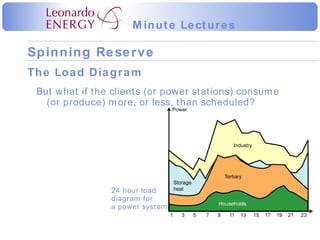
But what if the clients (or power stations) consume (or produce) more, or less, than scheduled? The Load Diagram 24 hour load diagram for  a power system
The difference between the scheduled consumption and the real load is counteracted by the transmission system operator, who is responsible for keeping the network balanced The difference between the scheduled production and the actual production should be also taken into account An imbalance results in a frequency that is lower or higher than the target frequency (generally 50Hz) The system operator maintains the balance by making use of the “spinning reserve” The Transmission System Operator
Spinning reserve = the unused capacity which can be activated on decision of the system operator Spinning reserve is provided by devices that are synchronized to the network and able to affect its active power  Negative spinning reserve = capacity that can be switched off quickly to compensate a dip in energy demand. Definition
Who provides it? (1/2) The system operator pays a generation company to provide spinning reserve This makes the system operator a client of generation companies Though less common, a consumer can provide spinning reserve as well, if he agrees to reduce its load upon request of the system operator
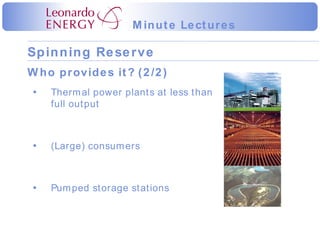
Who provides it? (2/2) Thermal power plants at less than full output (Large) consumers Pumped storage stations
Secondary frequency control A centralized automatic control that delivers reserve power on short notice in order to bring the frequency back to the target value.
Tertiary frequency control A manual change in the dispatching in order to restore the secondary reserve and provide a more permanent solution if the imbalance between consumed power and scheduled power persists react if the secondary reserve does not suffice manage congestions (which the secondary control does not do)
The complete picture (1/2) Schematically, frequency regulation can be represented as follows: A  tie-line  is a circuit (e.g. a transmission line) connecting two or more control areas or systems of an electric system A  transmission system operator (TSO)  is a company that is responsible for operating, maintaining and developing the transmission system for a control area and its interconnections [UCTE Handbook]
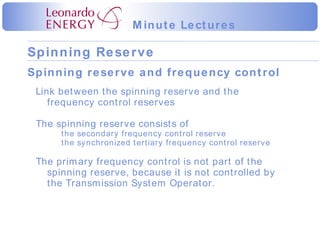
Spinning reserve and frequency control Link between the spinning reserve and the frequency control reserves The spinning reserve consists of  the secondary frequency control reserve the synchronized tertiary frequency control reserve The primary frequency control is not part of the spinning reserve, because it is not controlled by the Transmission System Operator.
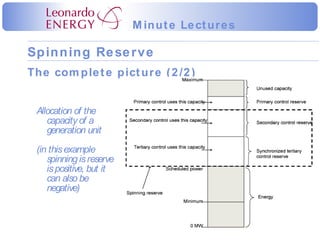
The complete picture (2/2) Allocation of the capacity of a generation unit (in this example spinning is reserve is positive, but it can also be negative)
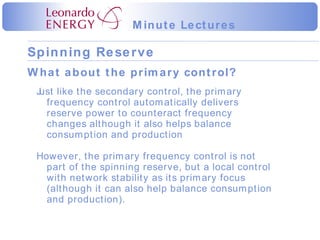
What about the primary control? Just like the secondary control, the primary frequency control automatically delivers reserve power to counteract frequency changes although it also helps balance consumption and production However, the primary frequency control is not part of the spinning reserve, but a local control with network stability as its primary focus (although it can also help balance consumption and production).
Round-up The spinning reserve is a synchronised unused capacity that can be activated quickly by the TSO to offset the differences between the scheduled load/production and the real load/production. It controls the frequency on the net. The spinning reserve is the responsibility of the transmission system operator, who will “rent” the required capacity from generation companies.
Further information Y Rebours & D Kirschen (University of Manchester) What is Spinning Reserve? A survey of Definitions and Specifications of Reserve Services UCTE Operations Handbook view

Spinning reserve

  • 1.
    Electricity cannot bestored in an economic way (in large quantities) Therefore, at each moment the electrical power consumed should equal the electrical power generated. Companies that sell electricity estimate the amount of energy their clients will consume. They buy this “Scheduled Power” from generation companies, who put it on the transmission grid. Balancing the net
  • 2.
    But what ifthe clients (or power stations) consume (or produce) more, or less, than scheduled? The Load Diagram 24 hour load diagram for a power system
  • 3.
    The difference betweenthe scheduled consumption and the real load is counteracted by the transmission system operator, who is responsible for keeping the network balanced The difference between the scheduled production and the actual production should be also taken into account An imbalance results in a frequency that is lower or higher than the target frequency (generally 50Hz) The system operator maintains the balance by making use of the “spinning reserve” The Transmission System Operator
  • 4.
    Spinning reserve =the unused capacity which can be activated on decision of the system operator Spinning reserve is provided by devices that are synchronized to the network and able to affect its active power Negative spinning reserve = capacity that can be switched off quickly to compensate a dip in energy demand. Definition
  • 5.
    Who provides it?(1/2) The system operator pays a generation company to provide spinning reserve This makes the system operator a client of generation companies Though less common, a consumer can provide spinning reserve as well, if he agrees to reduce its load upon request of the system operator
  • 6.
    Who provides it?(2/2) Thermal power plants at less than full output (Large) consumers Pumped storage stations
  • 7.
    Secondary frequency controlA centralized automatic control that delivers reserve power on short notice in order to bring the frequency back to the target value.
  • 8.
    Tertiary frequency controlA manual change in the dispatching in order to restore the secondary reserve and provide a more permanent solution if the imbalance between consumed power and scheduled power persists react if the secondary reserve does not suffice manage congestions (which the secondary control does not do)
  • 9.
    The complete picture(1/2) Schematically, frequency regulation can be represented as follows: A tie-line is a circuit (e.g. a transmission line) connecting two or more control areas or systems of an electric system A transmission system operator (TSO) is a company that is responsible for operating, maintaining and developing the transmission system for a control area and its interconnections [UCTE Handbook]
  • 10.
    Spinning reserve andfrequency control Link between the spinning reserve and the frequency control reserves The spinning reserve consists of the secondary frequency control reserve the synchronized tertiary frequency control reserve The primary frequency control is not part of the spinning reserve, because it is not controlled by the Transmission System Operator.
  • 11.
    The complete picture(2/2) Allocation of the capacity of a generation unit (in this example spinning is reserve is positive, but it can also be negative)
  • 12.
    What about theprimary control? Just like the secondary control, the primary frequency control automatically delivers reserve power to counteract frequency changes although it also helps balance consumption and production However, the primary frequency control is not part of the spinning reserve, but a local control with network stability as its primary focus (although it can also help balance consumption and production).
  • 13.
    Round-up The spinningreserve is a synchronised unused capacity that can be activated quickly by the TSO to offset the differences between the scheduled load/production and the real load/production. It controls the frequency on the net. The spinning reserve is the responsibility of the transmission system operator, who will “rent” the required capacity from generation companies.
  • 14.
    Further information YRebours & D Kirschen (University of Manchester) What is Spinning Reserve? A survey of Definitions and Specifications of Reserve Services UCTE Operations Handbook view