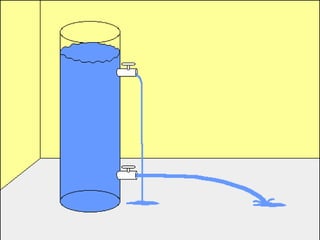
FLUID STATICS
Fluid Statics
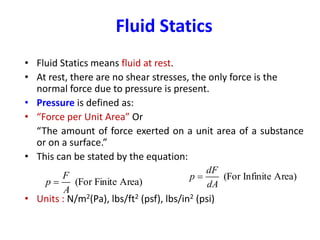
• Fluid Statics means fluid at rest.
• At rest, there are no shear stresses, the only force is the
normal force due to pressure is present.
• Pressure is defined as:
• “Force per Unit Area” Or
“The amount of force exerted on a unit area of a substance
or on a surface.”
• This can be stated by the equation:
• Units : N/m2(Pa), lbs/ft2 (psf), lbs/in2 (psi)
Area)
Finite
(For
A
F
p 
Area)
Infinite
(For
dA
dF
p 
Example
A load of 200 pounds (lb) is exerted on a piston confining oil
in a circular cylinder with an inside diameter of 2.50 inches
(in). Compute the pressure in the oil at the piston.
Solution:
Principles about Pressure
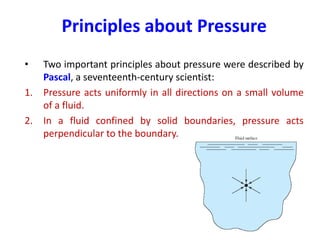
• Two important principles about pressure were described by
Pascal, a seventeenth-century scientist:
1. Pressure acts uniformly in all directions on a small volume
of a fluid.
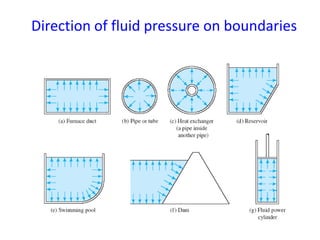
2. In a fluid confined by solid boundaries, pressure acts
perpendicular to the boundary.
Direction of fluid pressure on boundaries
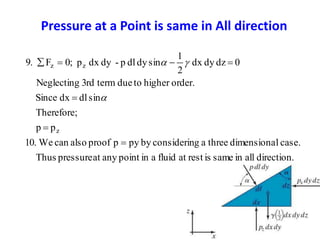
Pressure at a Point is same in All direction
(Pascal’s Law)
x
x
x
z
x
p
p
Therefore;
cos
dl
dz
Since
0
dz
dy
p
-
dy
dl
cos
p
;
0
F
8.
Zero.
to
equal
be
must
direction
any
in
element
on
components
force
the
of
Sum
:
Condition
m
Equilibriu
7.
rest.
at
is
fluid
the
since
involved,
is
force
l
tangentia
No
6.
cancel.
they
because
considered
be
not
need
direction
y
in
Forces
5.
direction.
vertical
and
horizontal
in
pressure
avg.
are
p
and
p
4.
direction.
any
in
pressure
Avg.
p
Let
3.
paper).
of
plane
ular to
(perpendic
dy
Thickness
2.
rest.
at
fluid
of
element
shaped
wedge
a
Consider
1.









Pressure at a Point is same in All direction
direction.
all
in
same
is
rest
at
fluid
a
in
point
any
at
pressure
Thus
case.
l
dimensiona
three
a
g
considerin
by
py
p
proof
also
can
We
10.
p
p
Therefore;
sin
dl
dx
Since
order.
higher
to
due
term
3rd
Neglecting
0
dz
dy
dx
2
1
sin
dy
dl
p
-
dy
dx
p
;
0
F
9.
z
z
z










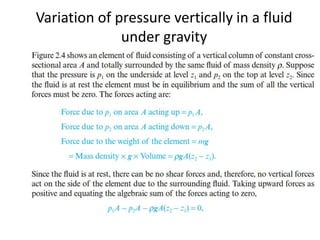
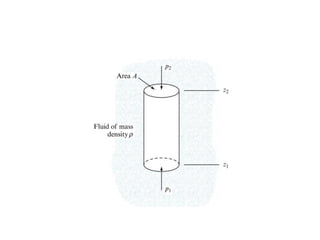
Variation of pressure vertically in a fluid
under gravity
Example
Pressure expressed in Height of Fluid
• The term elevation means the vertical distance from
some reference level to a point of interest and is
called z.
• A change in elevation between two points is called
h. Elevation will always be measured positively in
the upward direction.
• In other words, a higher point has a larger elevation
than a lower point.
• Fig shows the illustration of reference level for
elevation.
Relationship between Pressure and Elevation:
Pressure Head
• It is the pressure expressed in terms of height of fluid.
• h=p/ represents the energy per unit wt. stored in the fluid
by virtue of pressure under which the fluid exists. This is also
called the elevation head or potential head.

p
h 
Example
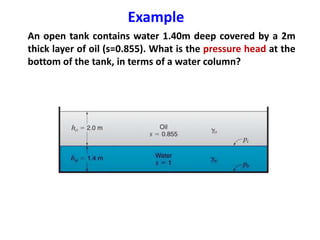
An open tank contains water 1.40m deep covered by a 2m
thick layer of oil (s=0.855). What is the pressure head at the
bottom of the tank, in terms of a water column?
m
p
h
h
h
p
SOLUTION
m
h
m
p
m
kN
x
h
m
kN
x
m
kN
w
b
we
w
w
o
o
b
w
w
i
o
o
o
w
11
.
3
81
.
9
51
.
30
30.51kN/m
9.81(1.4)
(8.39)2
2
11
.
3
710
.
1
40
.
1
h
h
So
710
.
1
81
.
9
78
.
16
h
:
oil
of
equivalent
for water
/
78
.
16
2
39
.
8
p
:
interface
For
/
39
.
8
81
.
9
855
.
0
/
81
.
9
2
oe
we
oe
2
i
3
3






























Solution:

Fluid Statics 1.pptx

  • 1.
  • 2.
    Fluid Statics • FluidStatics means fluid at rest. • At rest, there are no shear stresses, the only force is the normal force due to pressure is present. • Pressure is defined as: • “Force per Unit Area” Or “The amount of force exerted on a unit area of a substance or on a surface.” • This can be stated by the equation: • Units : N/m2(Pa), lbs/ft2 (psf), lbs/in2 (psi) Area) Finite (For A F p  Area) Infinite (For dA dF p 
  • 3.
    Example A load of200 pounds (lb) is exerted on a piston confining oil in a circular cylinder with an inside diameter of 2.50 inches (in). Compute the pressure in the oil at the piston. Solution:
  • 4.
    Principles about Pressure •Two important principles about pressure were described by Pascal, a seventeenth-century scientist: 1. Pressure acts uniformly in all directions on a small volume of a fluid. 2. In a fluid confined by solid boundaries, pressure acts perpendicular to the boundary.
  • 5.
    Direction of fluidpressure on boundaries
  • 6.
    Pressure at aPoint is same in All direction (Pascal’s Law) x x x z x p p Therefore; cos dl dz Since 0 dz dy p - dy dl cos p ; 0 F 8. Zero. to equal be must direction any in element on components force the of Sum : Condition m Equilibriu 7. rest. at is fluid the since involved, is force l tangentia No 6. cancel. they because considered be not need direction y in Forces 5. direction. vertical and horizontal in pressure avg. are p and p 4. direction. any in pressure Avg. p Let 3. paper). of plane ular to (perpendic dy Thickness 2. rest. at fluid of element shaped wedge a Consider 1.         
  • 7.
    Pressure at aPoint is same in All direction direction. all in same is rest at fluid a in point any at pressure Thus case. l dimensiona three a g considerin by py p proof also can We 10. p p Therefore; sin dl dx Since order. higher to due term 3rd Neglecting 0 dz dy dx 2 1 sin dy dl p - dy dx p ; 0 F 9. z z z          
  • 8.
    Variation of pressurevertically in a fluid under gravity
  • 11.
  • 12.
    Pressure expressed inHeight of Fluid • The term elevation means the vertical distance from some reference level to a point of interest and is called z. • A change in elevation between two points is called h. Elevation will always be measured positively in the upward direction. • In other words, a higher point has a larger elevation than a lower point. • Fig shows the illustration of reference level for elevation.
  • 13.
  • 14.
    Pressure Head • Itis the pressure expressed in terms of height of fluid. • h=p/ represents the energy per unit wt. stored in the fluid by virtue of pressure under which the fluid exists. This is also called the elevation head or potential head.  p h 
  • 16.
    Example An open tankcontains water 1.40m deep covered by a 2m thick layer of oil (s=0.855). What is the pressure head at the bottom of the tank, in terms of a water column?
  • 17.