International Trauma Life Support
for Emergency Care Providers
CHAPTER
eighth edition
International Trauma Life Support for Emergency Care Providers, Eighth Edition
John Campbell • Alabama Chapter, American College of Emergency Physicians
Trauma in
Pregnancy
19
Copyright © 2016 by Pearson Education, Inc.
All Rights Reserved
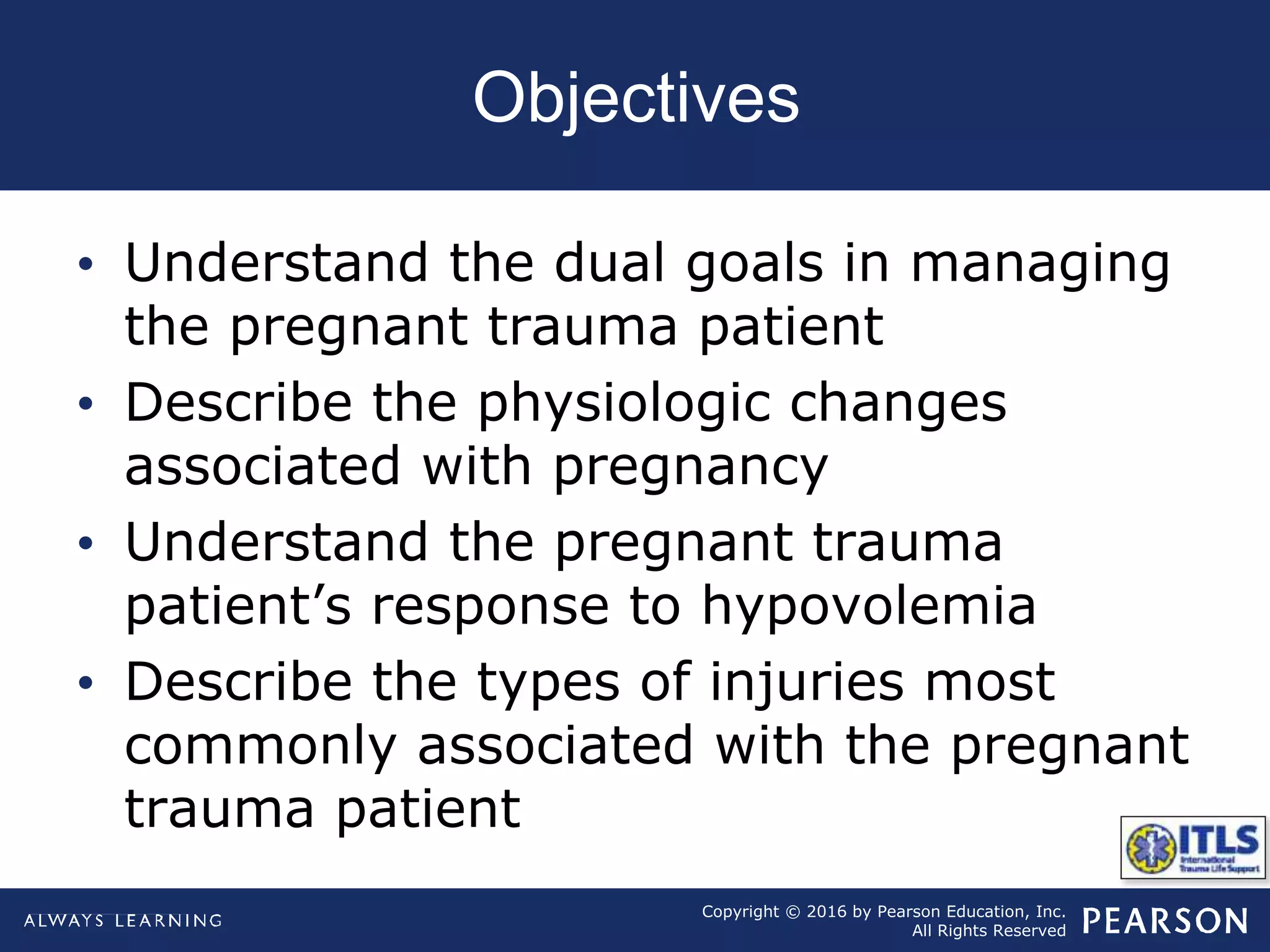
Trauma in Pregnancy
Copyright © 2016 by Pearson Education, Inc.
All Rights Reserved
Objectives
• Understand the dual goals in managing
the pregnant trauma patient
• Describe the physiologic changes
associated with pregnancy
• Understand the pregnant trauma
patient’s response to hypovolemia
• Describe the types of injuries most
commonly associated with the pregnant
trauma patient
Copyright © 2016 by Pearson Education, Inc.
All Rights Reserved
Objectives
• Describe the initial assessment and
management of the pregnant trauma
patient
• Discuss trauma prevention in
pregnancy
Copyright © 2016 by Pearson Education, Inc.
All Rights Reserved
Trauma in Pregnancy
• Unique challenges
– Vulnerability of pregnant trauma patient
– Potential injuries to unborn child
• Dual roles
– Provide care to mother
– Provide care to fetus
Copyright © 2016 by Pearson Education, Inc.
All Rights Reserved
Trauma in Pregnancy
• Leading cause of morbidity and
mortality
– 6–20% of pregnancies experience some
trauma
 1 in 12 injured experience significant trauma
– Major causes
 Motor-vehicle collisions
 Falls
 Abuse and domestic
violence
 Penetrating injuries
 Burns
 Suicide
 Homicide
Copyright © 2016 by Pearson Education, Inc.
All Rights Reserved
Factors Affecting
Fetal Mortality and Morbidity
• Hypoxia
• Infection
• Drug effects
• Pre-term delivery
Copyright © 2016 by Pearson Education, Inc.
All Rights Reserved
Pregnant Patient
• Increased risk for trauma
– Fainting spells, hyperventilation, excess
fatigue commonly associated with early
pregnancy
– Balance and coordination affected by
changes throughout pregnancy
Copyright © 2016 by Pearson Education, Inc.
All Rights Reserved
Fetal Development
Copyright © 2016 by Pearson Education, Inc.
All Rights Reserved
Viability Assessment
Copyright © 2016 by Pearson Education, Inc.
All Rights Reserved
Physiologic Changes
Copyright © 2016 by Pearson Education, Inc.
All Rights Reserved
Physiologic Changes
• Respiratory system
– Diaphragm elevated due to uterine size
– Decreased thoracic volume
– Relative alkalosis
– Predisposed to hyperventilation
Copyright © 2016 by Pearson Education, Inc.
All Rights Reserved
Physiologic Changes
• Anemia in pregnancy
• Absolute anemia
• Decreased gastric mobility
Copyright © 2016 by Pearson Education, Inc.
All Rights Reserved
Vital Signs in Pregnancy
• Do not mistake normal vital signs of
pregnancy for signs of shock
– Normal pulse: 10–15 beats faster
– Blood pressure: 10–15 mmHg lower
– 30–35% blood loss (1500 cc)
before significant blood pressure change
• Be alert to all signs of shock
– Frequent ITLS Ongoing Exams
Copyright © 2016 by Pearson Education, Inc.
All Rights Reserved
Response to Hypovolemia
• Vasoconstriction and tachycardia
– Reduction of uterine blood flow by 20–
30%
– Fetal heart rate and blood flow decrease
– Fetus becomes hypoxemic
• High-flow oxygen is essential
– Maternal shock has 80% fetal mortality
rate
Copyright © 2016 by Pearson Education, Inc.
All Rights Reserved
Trauma in Pregnancy
• ITLS Primary and Secondary Surveys
• Optimize maternal and fetal outcome
– High-flow oxygen rapidly administered
 Fetal hypoxia occurs before maternal hypoxia
– Fluid administration must be prompt
 Fluid volume needed is greater
– Frequent Ongoing Exams
 Mortality of fetus related to maternal treatment
 Optimal care of the fetus is appropriate
treatment of the mother
Copyright © 2016 by Pearson Education, Inc.
All Rights Reserved
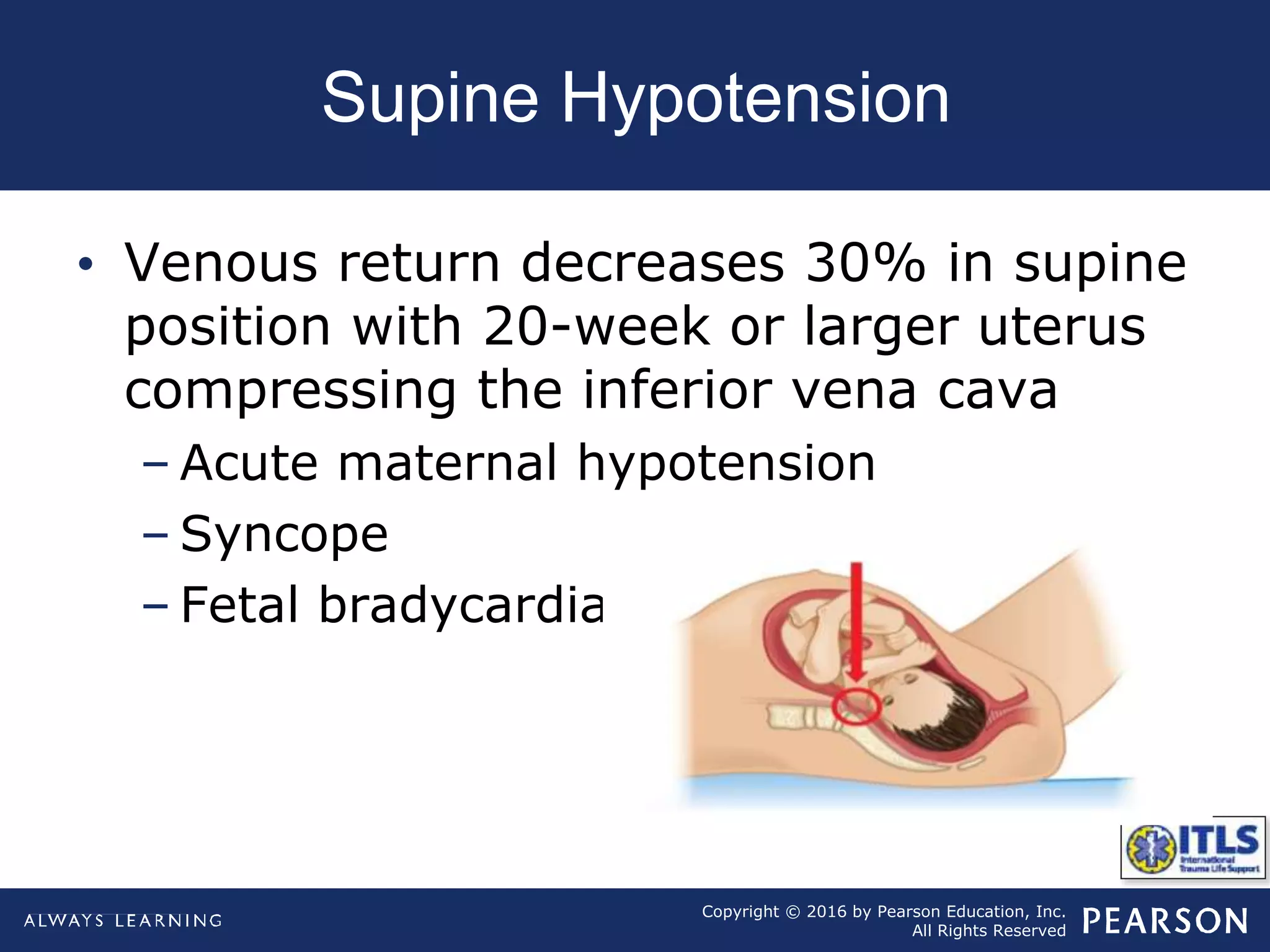
Supine Hypotension
• Venous return decreases 30% in supine
position with 20-week or larger uterus
compressing the inferior vena cava
– Acute maternal hypotension
– Syncope
– Fetal bradycardia
Copyright © 2016 by Pearson Education, Inc.
All Rights Reserved
Supine Hypotension
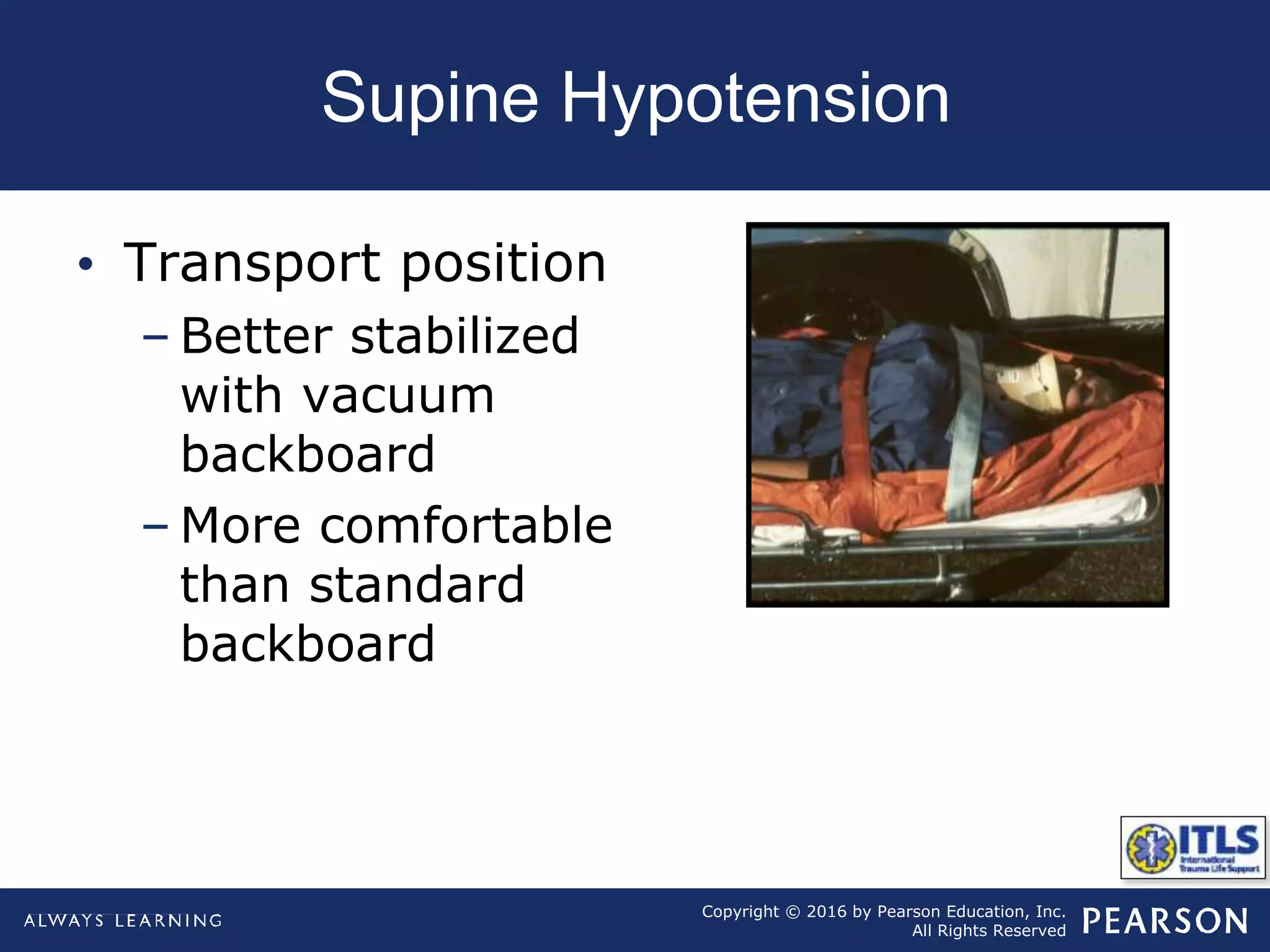
• Transport position
– Elevate right hip 4–6 inches (10–15 cm)
with towel
– If SMR and backboard needed, tilt or
rotate backboard 15–30° to patient’s
left
– Manually displace
uterus to left
Copyright © 2016 by Pearson Education, Inc.
All Rights Reserved
Supine Hypotension
• Transport position
– Better stabilized
with vacuum
backboard
– More comfortable
than standard
backboard
Copyright © 2016 by Pearson Education, Inc.
All Rights Reserved
Relatively minor abdominal
trauma can cause fetal death
Maternal death is most
common cause of fetal death
Copyright © 2016 by Pearson Education, Inc.
All Rights Reserved
Types of Trauma
• Motor-vehicle collisions
• Penetrating injuries
• Domestic violence
• Falls
• Burns
Copyright © 2016 by Pearson Education, Inc.
All Rights Reserved
Motor-Vehicle Collisions
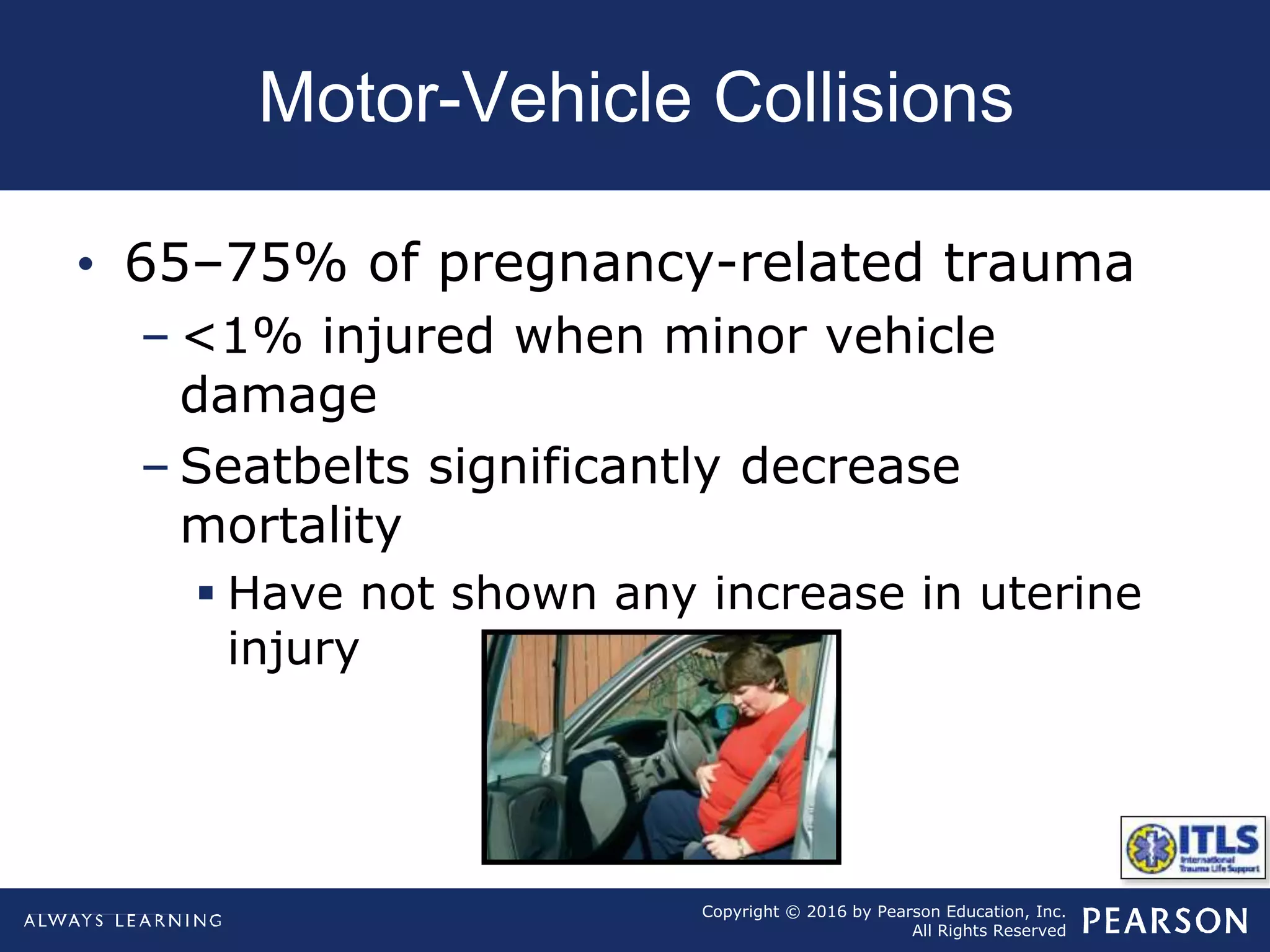
• 65–75% of pregnancy-related trauma
– <1% injured when minor vehicle
damage
– Seatbelts significantly decrease
mortality
 Have not shown any increase in uterine
injury
Copyright © 2016 by Pearson Education, Inc.
All Rights Reserved
Motor-Vehicle Collisions
• Maternal death
– Head injury
 Most common
– Uncontrolled
hemorrhage
 Second most
common
 Assess pelvis
• Fetal injury
– Fetal distress
– Fetal death
– Placental abruption
– Uterine rupture
– Pre-term labor
Copyright © 2016 by Pearson Education, Inc.
All Rights Reserved
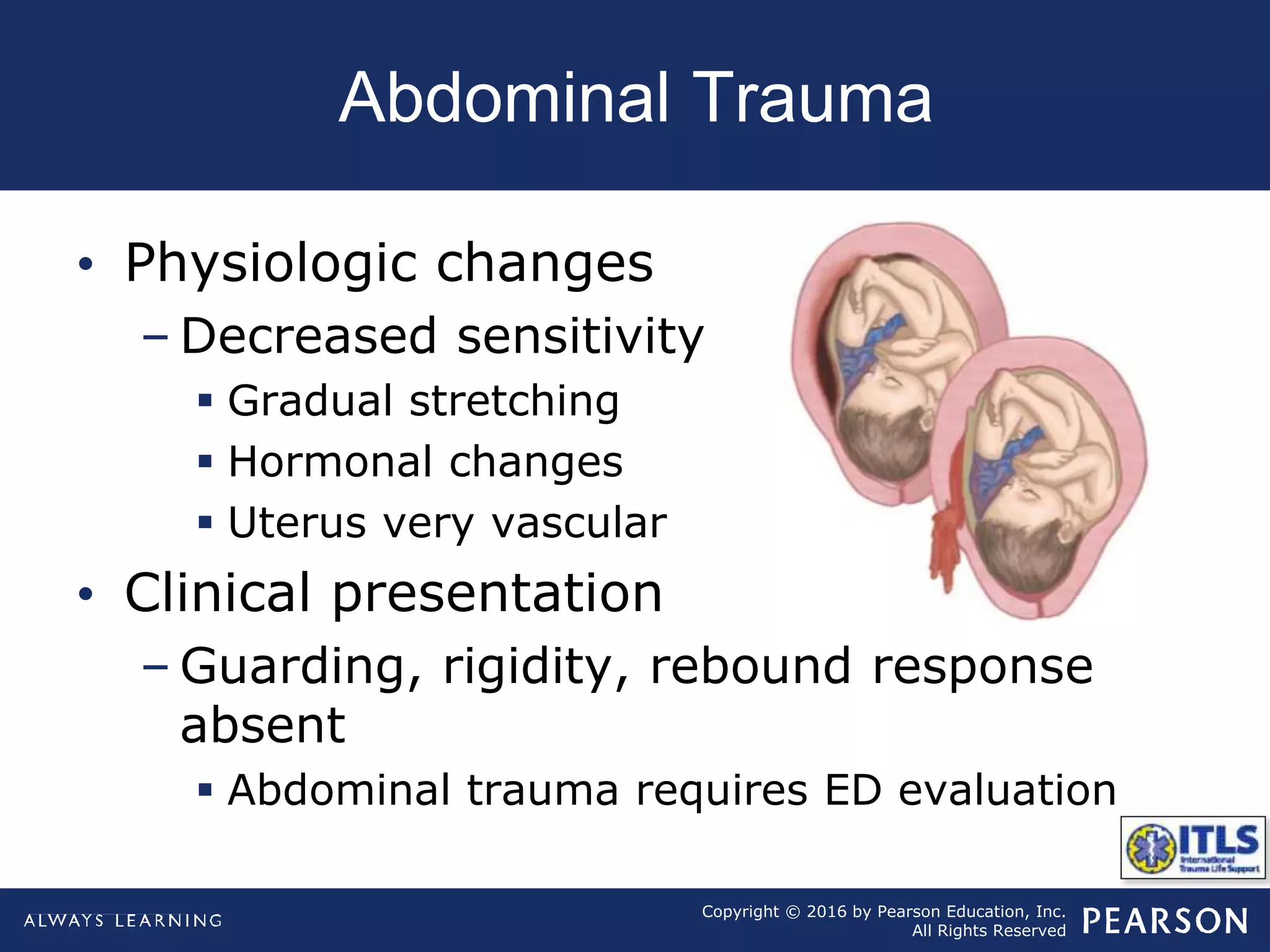
Abdominal Trauma
• Physiologic changes
– Decreased sensitivity
 Gradual stretching
 Hormonal changes
 Uterus very vascular
• Clinical presentation
– Guarding, rigidity, rebound response
absent
 Abdominal trauma requires ED evaluation
Copyright © 2016 by Pearson Education, Inc.
All Rights Reserved
Penetrating Injuries
• Gunshot wounds and stabbings
– Entry below fundus
 Uterus absorbs force, protects maternal
organs
 High fetal mortality rate: 40–70%
 Lower maternal mortality rate: 4–10%
– Entry above fundus
 Bowel injury due to displacement
Copyright © 2016 by Pearson Education, Inc.
All Rights Reserved
Domestic Violence
• 10% experience abuse during
pregnancy
• Occurrence increases in 2nd and 3rd
trimester
– Proximal and midline injuries
 Face and neck most common
– Low birth weight
– Abused by spouse or boyfriend:
70–85% (U.S.)
Copyright © 2016 by Pearson Education, Inc.
All Rights Reserved
Falls
• Injury from falls
– Increase with progression of pregnancy
 Center of gravity altered
– Proportionate to force and body part
impacted
– Pelvic injuries
 Placental separation
 Fetal fractures
Copyright © 2016 by Pearson Education, Inc.
All Rights Reserved
Burns
• Fluid volume needed increases
– Mortality and morbidity
 Maternal mortality same as non-pregnant
 Fetal mortality increases with >20% BSA
 CO exposure increases risk to fetus
– Pregnant women with CO poisoning should be
transported to hyperbaric center if available
Copyright © 2016 by Pearson Education, Inc.
All Rights Reserved
FAST Exam
• No exposure to radiation
• Rapid assessment
• Assess both mother and fetus
Copyright © 2016 by Pearson Education, Inc.
All Rights Reserved
Trauma Prevention
• Proper seatbelt use
• Report domestic violence
• Counseling for domestic violence
• Patient education
– Multiple changes associated with
pregnancy
 Physiological, anatomical, emotional
Copyright © 2016 by Pearson Education, Inc.
All Rights Reserved
Summary
• Trauma in pregnancy
– Knowledge of physiological changes
 Hypotension and hemorrhage easily
overlooked
– Rapid evaluation and interventions to
stabilize
 Aggressive oxygen administration
 Aggressive fluid resuscitation
– Prevent supine hypotension
• Fetal care depends on maternal care

Chapter19 trauma in pregnancy

  • 1.
    International Trauma LifeSupport for Emergency Care Providers CHAPTER eighth edition International Trauma Life Support for Emergency Care Providers, Eighth Edition John Campbell • Alabama Chapter, American College of Emergency Physicians Trauma in Pregnancy 19
  • 2.
    Copyright © 2016by Pearson Education, Inc. All Rights Reserved Trauma in Pregnancy
  • 3.
    Copyright © 2016by Pearson Education, Inc. All Rights Reserved Objectives • Understand the dual goals in managing the pregnant trauma patient • Describe the physiologic changes associated with pregnancy • Understand the pregnant trauma patient’s response to hypovolemia • Describe the types of injuries most commonly associated with the pregnant trauma patient
  • 4.
    Copyright © 2016by Pearson Education, Inc. All Rights Reserved Objectives • Describe the initial assessment and management of the pregnant trauma patient • Discuss trauma prevention in pregnancy
  • 5.
    Copyright © 2016by Pearson Education, Inc. All Rights Reserved Trauma in Pregnancy • Unique challenges – Vulnerability of pregnant trauma patient – Potential injuries to unborn child • Dual roles – Provide care to mother – Provide care to fetus
  • 6.
    Copyright © 2016by Pearson Education, Inc. All Rights Reserved Trauma in Pregnancy • Leading cause of morbidity and mortality – 6–20% of pregnancies experience some trauma  1 in 12 injured experience significant trauma – Major causes  Motor-vehicle collisions  Falls  Abuse and domestic violence  Penetrating injuries  Burns  Suicide  Homicide
  • 7.
    Copyright © 2016by Pearson Education, Inc. All Rights Reserved Factors Affecting Fetal Mortality and Morbidity • Hypoxia • Infection • Drug effects • Pre-term delivery
  • 8.
    Copyright © 2016by Pearson Education, Inc. All Rights Reserved Pregnant Patient • Increased risk for trauma – Fainting spells, hyperventilation, excess fatigue commonly associated with early pregnancy – Balance and coordination affected by changes throughout pregnancy
  • 9.
    Copyright © 2016by Pearson Education, Inc. All Rights Reserved Fetal Development
  • 10.
    Copyright © 2016by Pearson Education, Inc. All Rights Reserved Viability Assessment
  • 11.
    Copyright © 2016by Pearson Education, Inc. All Rights Reserved Physiologic Changes
  • 12.
    Copyright © 2016by Pearson Education, Inc. All Rights Reserved Physiologic Changes • Respiratory system – Diaphragm elevated due to uterine size – Decreased thoracic volume – Relative alkalosis – Predisposed to hyperventilation
  • 13.
    Copyright © 2016by Pearson Education, Inc. All Rights Reserved Physiologic Changes • Anemia in pregnancy • Absolute anemia • Decreased gastric mobility
  • 14.
    Copyright © 2016by Pearson Education, Inc. All Rights Reserved Vital Signs in Pregnancy • Do not mistake normal vital signs of pregnancy for signs of shock – Normal pulse: 10–15 beats faster – Blood pressure: 10–15 mmHg lower – 30–35% blood loss (1500 cc) before significant blood pressure change • Be alert to all signs of shock – Frequent ITLS Ongoing Exams
  • 15.
    Copyright © 2016by Pearson Education, Inc. All Rights Reserved Response to Hypovolemia • Vasoconstriction and tachycardia – Reduction of uterine blood flow by 20– 30% – Fetal heart rate and blood flow decrease – Fetus becomes hypoxemic • High-flow oxygen is essential – Maternal shock has 80% fetal mortality rate
  • 16.
    Copyright © 2016by Pearson Education, Inc. All Rights Reserved Trauma in Pregnancy • ITLS Primary and Secondary Surveys • Optimize maternal and fetal outcome – High-flow oxygen rapidly administered  Fetal hypoxia occurs before maternal hypoxia – Fluid administration must be prompt  Fluid volume needed is greater – Frequent Ongoing Exams  Mortality of fetus related to maternal treatment  Optimal care of the fetus is appropriate treatment of the mother
  • 17.
    Copyright © 2016by Pearson Education, Inc. All Rights Reserved Supine Hypotension • Venous return decreases 30% in supine position with 20-week or larger uterus compressing the inferior vena cava – Acute maternal hypotension – Syncope – Fetal bradycardia
  • 18.
    Copyright © 2016by Pearson Education, Inc. All Rights Reserved Supine Hypotension • Transport position – Elevate right hip 4–6 inches (10–15 cm) with towel – If SMR and backboard needed, tilt or rotate backboard 15–30° to patient’s left – Manually displace uterus to left
  • 19.
    Copyright © 2016by Pearson Education, Inc. All Rights Reserved Supine Hypotension • Transport position – Better stabilized with vacuum backboard – More comfortable than standard backboard
  • 20.
    Copyright © 2016by Pearson Education, Inc. All Rights Reserved Relatively minor abdominal trauma can cause fetal death Maternal death is most common cause of fetal death
  • 21.
    Copyright © 2016by Pearson Education, Inc. All Rights Reserved Types of Trauma • Motor-vehicle collisions • Penetrating injuries • Domestic violence • Falls • Burns
  • 22.
    Copyright © 2016by Pearson Education, Inc. All Rights Reserved Motor-Vehicle Collisions • 65–75% of pregnancy-related trauma – <1% injured when minor vehicle damage – Seatbelts significantly decrease mortality  Have not shown any increase in uterine injury
  • 23.
    Copyright © 2016by Pearson Education, Inc. All Rights Reserved Motor-Vehicle Collisions • Maternal death – Head injury  Most common – Uncontrolled hemorrhage  Second most common  Assess pelvis • Fetal injury – Fetal distress – Fetal death – Placental abruption – Uterine rupture – Pre-term labor
  • 24.
    Copyright © 2016by Pearson Education, Inc. All Rights Reserved Abdominal Trauma • Physiologic changes – Decreased sensitivity  Gradual stretching  Hormonal changes  Uterus very vascular • Clinical presentation – Guarding, rigidity, rebound response absent  Abdominal trauma requires ED evaluation
  • 25.
    Copyright © 2016by Pearson Education, Inc. All Rights Reserved Penetrating Injuries • Gunshot wounds and stabbings – Entry below fundus  Uterus absorbs force, protects maternal organs  High fetal mortality rate: 40–70%  Lower maternal mortality rate: 4–10% – Entry above fundus  Bowel injury due to displacement
  • 26.
    Copyright © 2016by Pearson Education, Inc. All Rights Reserved Domestic Violence • 10% experience abuse during pregnancy • Occurrence increases in 2nd and 3rd trimester – Proximal and midline injuries  Face and neck most common – Low birth weight – Abused by spouse or boyfriend: 70–85% (U.S.)
  • 27.
    Copyright © 2016by Pearson Education, Inc. All Rights Reserved Falls • Injury from falls – Increase with progression of pregnancy  Center of gravity altered – Proportionate to force and body part impacted – Pelvic injuries  Placental separation  Fetal fractures
  • 28.
    Copyright © 2016by Pearson Education, Inc. All Rights Reserved Burns • Fluid volume needed increases – Mortality and morbidity  Maternal mortality same as non-pregnant  Fetal mortality increases with >20% BSA  CO exposure increases risk to fetus – Pregnant women with CO poisoning should be transported to hyperbaric center if available
  • 29.
    Copyright © 2016by Pearson Education, Inc. All Rights Reserved FAST Exam • No exposure to radiation • Rapid assessment • Assess both mother and fetus
  • 30.
    Copyright © 2016by Pearson Education, Inc. All Rights Reserved Trauma Prevention • Proper seatbelt use • Report domestic violence • Counseling for domestic violence • Patient education – Multiple changes associated with pregnancy  Physiological, anatomical, emotional
  • 31.
    Copyright © 2016by Pearson Education, Inc. All Rights Reserved Summary • Trauma in pregnancy – Knowledge of physiological changes  Hypotension and hemorrhage easily overlooked – Rapid evaluation and interventions to stabilize  Aggressive oxygen administration  Aggressive fluid resuscitation – Prevent supine hypotension • Fetal care depends on maternal care

Editor's Notes

  • #2 Key Lecture Points Cover the general information included in the lecture slides, including the information associated with the various trimesters. Note should be made that the status of the fetus generally depends on the well-being of the mother. Therefore, if the mother has adequate blood volume, blood pressure, and circulation, then the fetus will do well. Use the quote: “Death of the fetus in the trauma situation is most often associated with the death of the mother.” Mention that the treatment of shock is the same for pregnant patients as for other patients. Emphasize that the physiologic changes of pregnancy may cause delay in the diagnosis of the shock state in the mother. Stress that uterine obstruction of venous blood flow may cause hypotension in the supine patient (“supine hypotension syndrome”), and thus must be prevented by rolling the patient or backboard to the left. Note that there is an increased rate of fetal demise 2 or 3 days following major trauma to the mother. Mention that short backboard-type device may be ineffective as an SMR device in the pregnant patient because of the difficulty with adequately securing the straps. This concern also applies to the very obese patient.
  • #6 Major goals in caring for pregnant trauma are evaluation and stabilization. All prehospital interventions directed toward optimizing both fetal and maternal outcome. Optimal care for fetus is appropriate treatment of mother.
  • #7 Because minor injuries rarely present problems for EMS providers, ITLS focuses on more severe traumatic injuries to pregnant patient. Leading cause of morbidity and mortality 6–20% of pregnancies are complicated by accidental trauma. Approximately 8% (1 in 12) of those are significant. MVCs are most common cause (65–70%).
  • #9 The pregnant patient is often at risk for a higher incidence of accidental trauma. Increase in fainting spells, hyperventilation, and excess fatigue are commonly associated with early pregnancy. Physiological changes that affect balance and coordination
  • #10 IMAGE: Figure 19-1: Anatomy of pregnancy. Fetus is formed during first 3 months of pregnancy. The uterus does not enlarge enough to rise out of pelvis until 12th week (3 months), but then fully formed fetus and uterus grow rapidly. Fundal height reaches umbilicus by fifth month and epigastrium by seventh month. Fundus is term for top of uterus. Fundal height is term that describes location of top of uterus.
  • #11 NOTE: Table 19-1: Assessment of a pregnancy. Fetus is considered viable at 24 weeks. Viability increases significantly at 25 weeks gestation. However, pre-term infants have survived with less gestation. True gestational age cannot be determined on-scene.
  • #12 IMAGE: Table 19-2: Physiologic Changes During Pregnancy.
  • #13 Respirations are more shallow with less chest expansion. Pregnant patient presents with rapid shallow respirations.
  • #14 During pregnancy, dramatic physiological changes occur. The changes that are unique to the pregnant state affect and alter physiological response by both mother and fetus. More fluid is needed to resuscitate if patient develops shock. Increase in both red blood cells and plasma with increase of plasma greater than red blood cells. Appears to be anemic (physiological anemia of pregnancy) Many women with poor nutrition also have an absolute anemia and are less able to compensate for hemorrhagic shock. Always assume stomach of a pregnant patient is full. Always guard against vomiting and aspiration.
  • #15 Normal pregnancy vital signs make early diagnosis of shock more difficult.
  • #16 Fetus is in distress before maternal blood pressure decreases. When mother compensates for early shock with vasoconstriction and tachycardia, impact on fetus begins. Quick review of shock response Acute blood loss results in decrease in circulating blood volume. Cardiac output decreases as venous return falls. This hypovolemia causes arterial blood pressure to fall, resulting in an inhibition of vagal tone and release of catecholamines. Effect to produce vasoconstriction and tachycardia. Vasoconstriction profoundly affects uterus. Reduction in uterine blood flow by 20–30% Mother can lose 1,500 cc without detectable blood pressure change. Drop in fetal arterial blood pressure and decrease in fetal heart rate Reduced fetal circulation results in fetal hypoxemia. Administer 100% oxygen to mother, and administer oxygen to fetus.
  • #17 Remember: Normal physiologic changes of pregnancy make assessment more difficult. Changes in appearance and vital signs can be delayed and more subtle. Therefore, Ongoing Exams need to be performed more frequently.
  • #18 IMAGE: Figure 19-3: Compression of vena cava. The enlarging uterus can compress inferior vena cava when mother is in supine position, creating a form of mechanical/obstructive shock. Reduces venous return and cardiac output by up to 30%
  • #19 Remember: SMR needs to be in an anatomically neutral position specific for each patient to be neutral for spinal cord and airway. Although texts often recommend age ranges (including ITLS), SMR is principle-driven. Appropriate padding should be used for all age groups and situations (elderly, American football shoulder pads, infants, obesity, etc.). If uterus is up to umbilicus, you should tilt backboard using one of these methods. Carefully secure backboard when tilting so patient does not flip over onto floor of ambulance.
  • #21 Have high suspicion with any abdominal trauma. May not seem significant injury to mother, but can be significant to fetus Management of maternal injuries is best management of fetus.
  • #23 Seatbelts need to be worn properly—lap section positioned below the abdomen and over the hips
  • #24 Head injury is the most common cause of death in pregnant patients involved in MVCs. This is closely followed by uncontrolled hemorrhage. Maternal pelvic fracture can hold 4 or more liters of blood (uncontrolled hemorrhage) with few clinical signs. Unless there is high index of suspicion and clear understanding of physiologic changes of pregnancy, seriousness of a pelvic fracture can be overlooked.
  • #25 IMAGE: Figure 19-5: Picture of placental abruption and uterine rupture. Can have significant occult intrauterine or abdominal bleeding May not have abdominal tenderness early, even with significant bleeding Emergency Department evaluation and monitoring is recommended for even minor abdominal trauma during pregnancy.
  • #26 Gunshot wounds and stabbings are most common injuries encountered. Definitive care will depend on several factors, involving degree of shock, associated organ injury, and time of gestation.
  • #27 Large percentage of pregnant women experience domestic violence. Frequency appears to worsen as pregnancy progresses. Through second and third trimesters, estimated that 1 in 10 pregnant women experience abuse during pregnancy.
  • #28 Emergency Department evaluation and monitoring is recommended for even minor abdominal trauma.
  • #29 Of 2.2 million patients who suffer burn injuries in United States annually, less than 4% are pregnant. Fluid requirement for pregnant patient is greater than that of nonpregnant. BSA: Burn Surface Area CO has a higher affinity for fetal hemoglobin. Maternal levels may actually be lower as the fetus absorbs CO.
  • #31 Some patients get very little, if any, prenatal care, and even less prenatal education. If situation is not critical, you should not hesitate to educate your pregnant patients.
  • #32 Due to difficulty in early diagnosis, you should have a low threshold for load-and-go. Pregnant trauma with serious injuries should be directly transported to facility (trauma center) capable of managing these complex patients.