Trauma & pregnancy
Cody Starnes, M.D.
Epidemiology
●6-7% of pregnancies are complicated by trauma.
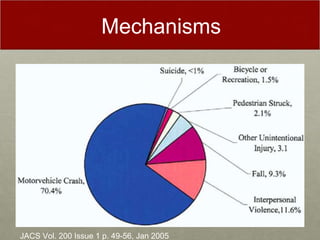
●Mechanism: MVC > Falls ~ Assaults
●Most common fetal injury is skull fractures
●Most common cause of fetal demise is abruptio
placentae. >50% placental detachment is often
incompatible with life.
●Uterine rupture is seen most often with ejection, and has
been seen at our institution. More common in women
with previous C-section.
●Penetrating trauma is rarely injurious to the first trimester
fetus as it is protected by the pelvis.
Mechanisms
JACS Vol. 200 Issue 1 p. 49-56, Jan 2005
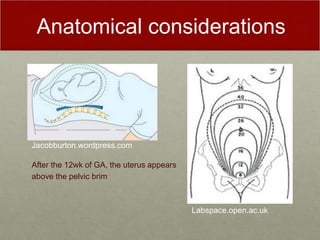
Anatomical considerations
Labspace.open.ac.uk
Jacobburton.wordpress.com
After the 12wk of GA, the uterus appears
above the pelvic brim
Anatomical considerations
●The diaphragm is elevated by up to 4cm in the
pregnant patient. However, this should not affect the
location of tube thoracostomies.
Physiologic changes
●There is a 10 fold increase in blood supply to the
uterus during pregnancy.
●The hormonal flux of pregnancy causes laxity of the
pelvic ligaments predisposing to more severe pelvic
injuries.
●Hydronephrosis and hydroureter develop, which is
something to keep in mind when working in or near
the retroperitoneum.
●The LES looses tone and predisposes the gravid
patient more to GERD and, thus, aspiration.
physiology
●Blood volume and cardiac output increase. On average,
blood volume increases by 48%.
●However, plasma increases to a greater extent than
RBC mass leading to a lower than normal hematocrit
(32-36%)
●Of note, the mother can loose about 1/3 of her total
blood volume before her vital signs begin to deviate (i.e.
~2L)
●Hypercoagulability – increased production of facors 1, 7-
10, as well as decreased production of plasmin. This
should be kept in mind when interpreting a TEG.
physiology
●Baseline chronic respiratory alkalosis is expected.
●GFR is increased, which may lead to more rapid
clearance of certain medications.
●Delayed gastric emptying and prolonged intestinal
transit has been debunked by several studies out of
Britain.
●Hypertension and headaches may confuse the
workup, but can be attributed to pre-eclampsia.
Supine hypotension
syndrome
●a.k.a. Aortocaval Syndrome
●Affects ~10% of all
pregnancies.
●Most patients develop
paravertebral collaterals to
compensate.
●Symptoms are vague and
include dizziness,
hypotension, pallor,
bradycardia, nausea,
sweating
●Mechanical ventilation can
further exacerbate by
decreasing preload.
www.csaol.cn/
treatment
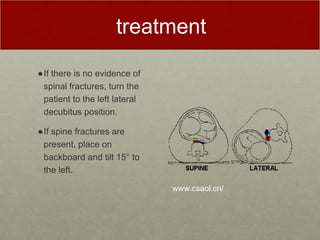
●If there is no evidence of
spinal fractures, turn the
patient to the left lateral
decubitus position.
●If spine fractures are
present, place on
backboard and tilt 15° to
the left.
www.csaol.cn/
Radiation
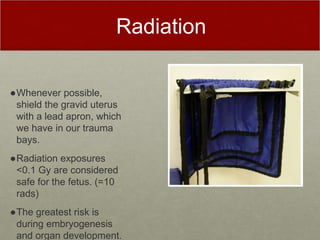
●Whenever possible,
shield the gravid uterus
with a lead apron, which
we have in our trauma
bays.
●Radiation exposures
<0.1 Gy are considered
safe for the fetus. (=10
rads)
●The greatest risk is
during embryogenesis
and organ development.
radiation
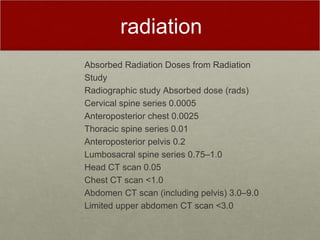
Absorbed Radiation Doses from Radiation
Study
Radiographic study Absorbed dose (rads)
Cervical spine series 0.0005
Anteroposterior chest 0.0025
Thoracic spine series 0.01
Anteroposterior pelvis 0.2
Lumbosacral spine series 0.75–1.0
Head CT scan 0.05
Chest CT scan <1.0
Abdomen CT scan (including pelvis) 3.0–9.0
Limited upper abdomen CT scan <3.0
Other tests
●FAST is still the initial test of choice for evaluation of
the pregnant trauma patient.
●A DPL can also be safely used keeping in mind that
the incision will have to be supraumbilical to avoid
the uterus.
Sheehan’s syndrome
●Keep in mind that hypovolemic shock in the
pregnant patient can result in ischemia and even
necrosis of the pituitary.
●The most common deficit is in prolactin inability to
lactate.
●However, patients with refractory hypotension and
signs of shock in the postpartum period should
instigate a search for panhypopatuitarism.
●Treat with mineralcorticoids.
Emergent OB Consult
●Whenever there is blood loss approaching 1-1.5L,
OB should be called to perform cardiotocography to
assess fetal viability
●Fetal U/S and other tests of viability are best left to
the obstetrician.
●Vaginal fluid can be tested for amniotic fluid via the
nitrazine paper test, which will turn from green to
blue in the presence of amniotic fluid.
OB observation
●In a female with a fetus 20-24wks GA or more with
minor injuries can be discharged after 4hrs of
normal cardiotocographic monitoring.
●If there are any concerning findings, the patient
should be placed on an OB floor for 24-48hrs of
continuous monitoring.
Maternal demise
●If the mother arrests with a viable fetus (>24-
26wks.), CPR should be continued while a c-section
is performed within 15mins.
●If arrest lasts longer than 20mins, then the
probability of saving the fetus is dismal.
●Be mindful that with a c-section, an additional liter of
blood loss can be anticipated.
Fetal demise
●If the fetus dies in a surviving mother, spontaneous
delivery will usually occur within 48hrs.
Amniotic fluid embolus
●Unknown pathophysiology.
●However, fetal squamous cells and fetal debris have been
found in the lungs of postmortem autopsies.
●Seen with placental abruption
●However, now thought to be an anaphylactic reaction to fetal
debris.
●DIC is also seen.
●Extremely rare at 1 in 20,000 pregnancies. Though, I’ve seen
such a patient in our STICU.
●Mortality approaches 80% regardless of therapy.
miscellaneous
●Try to avoid pressors if at all possible, as they shunt
blood away from the uterus.
●Kleihauer-Betke test is no longer performed to
evaluate for fetomaternal transfusion in the trauma
patient.
 If the mother is Rh negative, she gets Rhogam.
Sensitization seen with as little as 1μL of fetal blood.
●Splenic and retroperitoneal injuries occur more
often in the gravid patient.
Safe medications
●UFH and LMWH are the anticoagulants of choice in
pregnancy.
●Dilantin is teratogenic (cleft palates)
●Lamotrigine (Lamictal) and carbamazepine
(Tegretol) are considered the safest of the
antiepileptics
●Sucralfate is the safest agent for gastric ulcer
prophylaxis.
ATLS MOTO
references
●The Trauma Manual: Trauma and Acute Care Surgery.
3rd Ed. Editors: AB Peitzman, M. Rhodes, CW Schwab,
DM Yealy, TC Fabian. Pittsburg, Pennsylvania. 2008
●Parkland Trauma Handbook. 3rd Ed. AL. Eastman, DH
Rosenbaum, ER Thal. Dallas, TX. 2009.
●“Profile of mothers at risk: an analysis of injury and
pregnancy loss in 1,195 trauma patients.” DG Ikossi, AA
Lazar, D. Morabito, J Fildes, MM Knudson. JACS Vol
200. Issue 1. p. 49-56. Jan 2005.
●“Assessment of the pregnant trauma patient.” Betty J.
Tsuei. Injury, Int. J. Care Injured (2006) 37, 367-373.

Trauma and Pregnancy

  • 1.
  • 2.
    Epidemiology ●6-7% of pregnanciesare complicated by trauma. ●Mechanism: MVC > Falls ~ Assaults ●Most common fetal injury is skull fractures ●Most common cause of fetal demise is abruptio placentae. >50% placental detachment is often incompatible with life. ●Uterine rupture is seen most often with ejection, and has been seen at our institution. More common in women with previous C-section. ●Penetrating trauma is rarely injurious to the first trimester fetus as it is protected by the pelvis.
  • 3.
    Mechanisms JACS Vol. 200Issue 1 p. 49-56, Jan 2005
  • 4.
  • 5.
    Anatomical considerations ●The diaphragmis elevated by up to 4cm in the pregnant patient. However, this should not affect the location of tube thoracostomies.
  • 6.
    Physiologic changes ●There isa 10 fold increase in blood supply to the uterus during pregnancy. ●The hormonal flux of pregnancy causes laxity of the pelvic ligaments predisposing to more severe pelvic injuries. ●Hydronephrosis and hydroureter develop, which is something to keep in mind when working in or near the retroperitoneum. ●The LES looses tone and predisposes the gravid patient more to GERD and, thus, aspiration.
  • 7.
    physiology ●Blood volume andcardiac output increase. On average, blood volume increases by 48%. ●However, plasma increases to a greater extent than RBC mass leading to a lower than normal hematocrit (32-36%) ●Of note, the mother can loose about 1/3 of her total blood volume before her vital signs begin to deviate (i.e. ~2L) ●Hypercoagulability – increased production of facors 1, 7- 10, as well as decreased production of plasmin. This should be kept in mind when interpreting a TEG.
  • 8.
    physiology ●Baseline chronic respiratoryalkalosis is expected. ●GFR is increased, which may lead to more rapid clearance of certain medications. ●Delayed gastric emptying and prolonged intestinal transit has been debunked by several studies out of Britain. ●Hypertension and headaches may confuse the workup, but can be attributed to pre-eclampsia.
  • 9.
    Supine hypotension syndrome ●a.k.a. AortocavalSyndrome ●Affects ~10% of all pregnancies. ●Most patients develop paravertebral collaterals to compensate. ●Symptoms are vague and include dizziness, hypotension, pallor, bradycardia, nausea, sweating ●Mechanical ventilation can further exacerbate by decreasing preload. www.csaol.cn/
  • 10.
    treatment ●If there isno evidence of spinal fractures, turn the patient to the left lateral decubitus position. ●If spine fractures are present, place on backboard and tilt 15° to the left. www.csaol.cn/
  • 11.
    Radiation ●Whenever possible, shield thegravid uterus with a lead apron, which we have in our trauma bays. ●Radiation exposures <0.1 Gy are considered safe for the fetus. (=10 rads) ●The greatest risk is during embryogenesis and organ development.
  • 12.
    radiation Absorbed Radiation Dosesfrom Radiation Study Radiographic study Absorbed dose (rads) Cervical spine series 0.0005 Anteroposterior chest 0.0025 Thoracic spine series 0.01 Anteroposterior pelvis 0.2 Lumbosacral spine series 0.75–1.0 Head CT scan 0.05 Chest CT scan <1.0 Abdomen CT scan (including pelvis) 3.0–9.0 Limited upper abdomen CT scan <3.0
  • 13.
    Other tests ●FAST isstill the initial test of choice for evaluation of the pregnant trauma patient. ●A DPL can also be safely used keeping in mind that the incision will have to be supraumbilical to avoid the uterus.
  • 14.
    Sheehan’s syndrome ●Keep inmind that hypovolemic shock in the pregnant patient can result in ischemia and even necrosis of the pituitary. ●The most common deficit is in prolactin inability to lactate. ●However, patients with refractory hypotension and signs of shock in the postpartum period should instigate a search for panhypopatuitarism. ●Treat with mineralcorticoids.
  • 15.
    Emergent OB Consult ●Wheneverthere is blood loss approaching 1-1.5L, OB should be called to perform cardiotocography to assess fetal viability ●Fetal U/S and other tests of viability are best left to the obstetrician. ●Vaginal fluid can be tested for amniotic fluid via the nitrazine paper test, which will turn from green to blue in the presence of amniotic fluid.
  • 16.
    OB observation ●In afemale with a fetus 20-24wks GA or more with minor injuries can be discharged after 4hrs of normal cardiotocographic monitoring. ●If there are any concerning findings, the patient should be placed on an OB floor for 24-48hrs of continuous monitoring.
  • 17.
    Maternal demise ●If themother arrests with a viable fetus (>24- 26wks.), CPR should be continued while a c-section is performed within 15mins. ●If arrest lasts longer than 20mins, then the probability of saving the fetus is dismal. ●Be mindful that with a c-section, an additional liter of blood loss can be anticipated.
  • 18.
    Fetal demise ●If thefetus dies in a surviving mother, spontaneous delivery will usually occur within 48hrs.
  • 19.
    Amniotic fluid embolus ●Unknownpathophysiology. ●However, fetal squamous cells and fetal debris have been found in the lungs of postmortem autopsies. ●Seen with placental abruption ●However, now thought to be an anaphylactic reaction to fetal debris. ●DIC is also seen. ●Extremely rare at 1 in 20,000 pregnancies. Though, I’ve seen such a patient in our STICU. ●Mortality approaches 80% regardless of therapy.
  • 20.
    miscellaneous ●Try to avoidpressors if at all possible, as they shunt blood away from the uterus. ●Kleihauer-Betke test is no longer performed to evaluate for fetomaternal transfusion in the trauma patient.  If the mother is Rh negative, she gets Rhogam. Sensitization seen with as little as 1μL of fetal blood. ●Splenic and retroperitoneal injuries occur more often in the gravid patient.
  • 21.
    Safe medications ●UFH andLMWH are the anticoagulants of choice in pregnancy. ●Dilantin is teratogenic (cleft palates) ●Lamotrigine (Lamictal) and carbamazepine (Tegretol) are considered the safest of the antiepileptics ●Sucralfate is the safest agent for gastric ulcer prophylaxis.
  • 22.
  • 23.
    references ●The Trauma Manual:Trauma and Acute Care Surgery. 3rd Ed. Editors: AB Peitzman, M. Rhodes, CW Schwab, DM Yealy, TC Fabian. Pittsburg, Pennsylvania. 2008 ●Parkland Trauma Handbook. 3rd Ed. AL. Eastman, DH Rosenbaum, ER Thal. Dallas, TX. 2009. ●“Profile of mothers at risk: an analysis of injury and pregnancy loss in 1,195 trauma patients.” DG Ikossi, AA Lazar, D. Morabito, J Fildes, MM Knudson. JACS Vol 200. Issue 1. p. 49-56. Jan 2005. ●“Assessment of the pregnant trauma patient.” Betty J. Tsuei. Injury, Int. J. Care Injured (2006) 37, 367-373.