Paediatric Trauma
   Dr. Ashok Jaisingani
Introduction
► Trauma  is leading cause of death in children
  and adolescence in western countries.
► Many of these death are avoidable if proper
  care and effective treatment is given.
Primary Survey
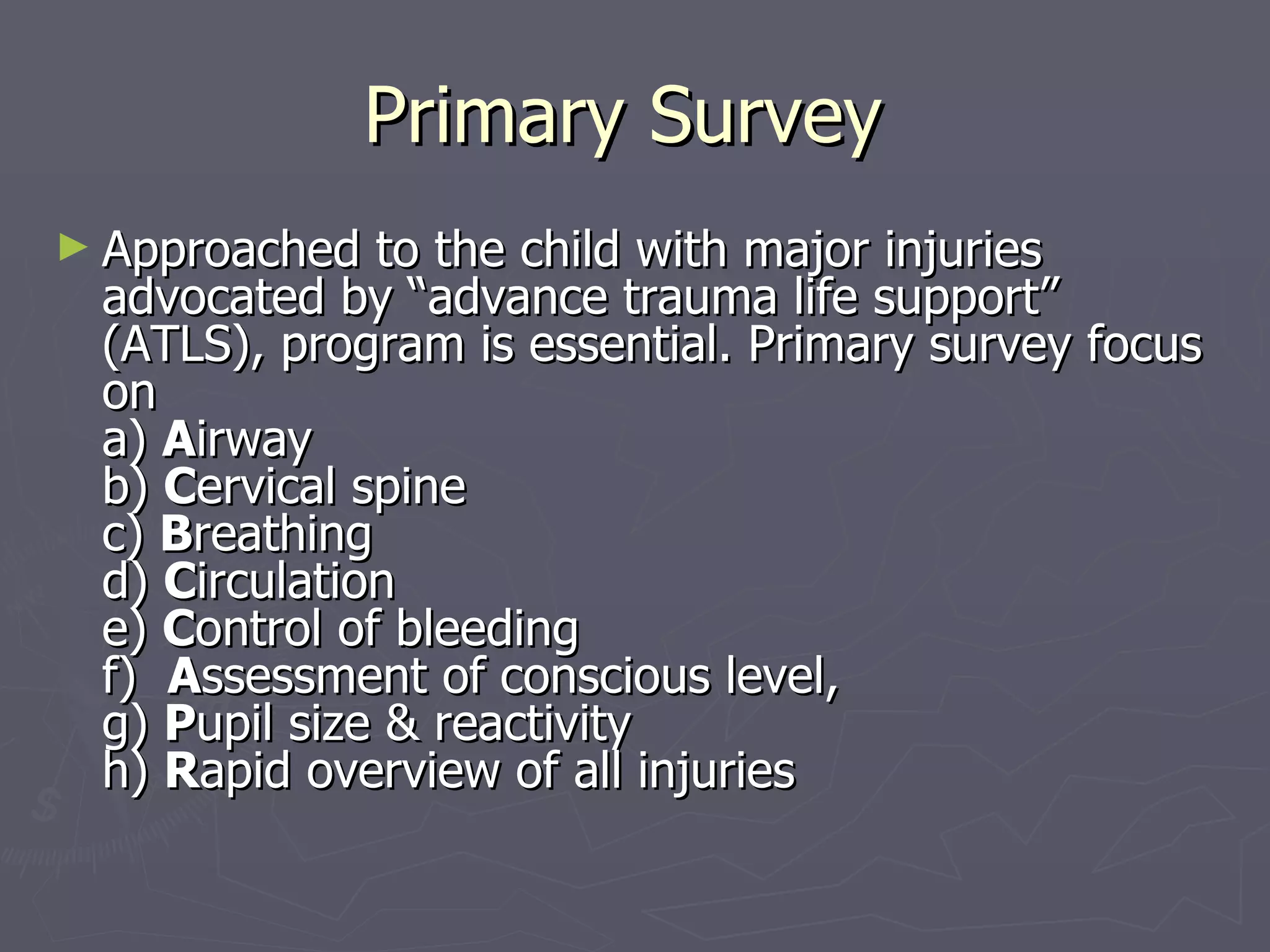
► Approached  to the child with major injuries
 advocated by “advance trauma life support”
 (ATLS), program is essential. Primary survey focus
 on
 a) Airway
 b) Cervical spine
 c) Breathing
 d) Circulation
 e) Control of bleeding
 f) Assessment of conscious level,
 g) Pupil size & reactivity
 h) Rapid overview of all injuries
Resuscitation
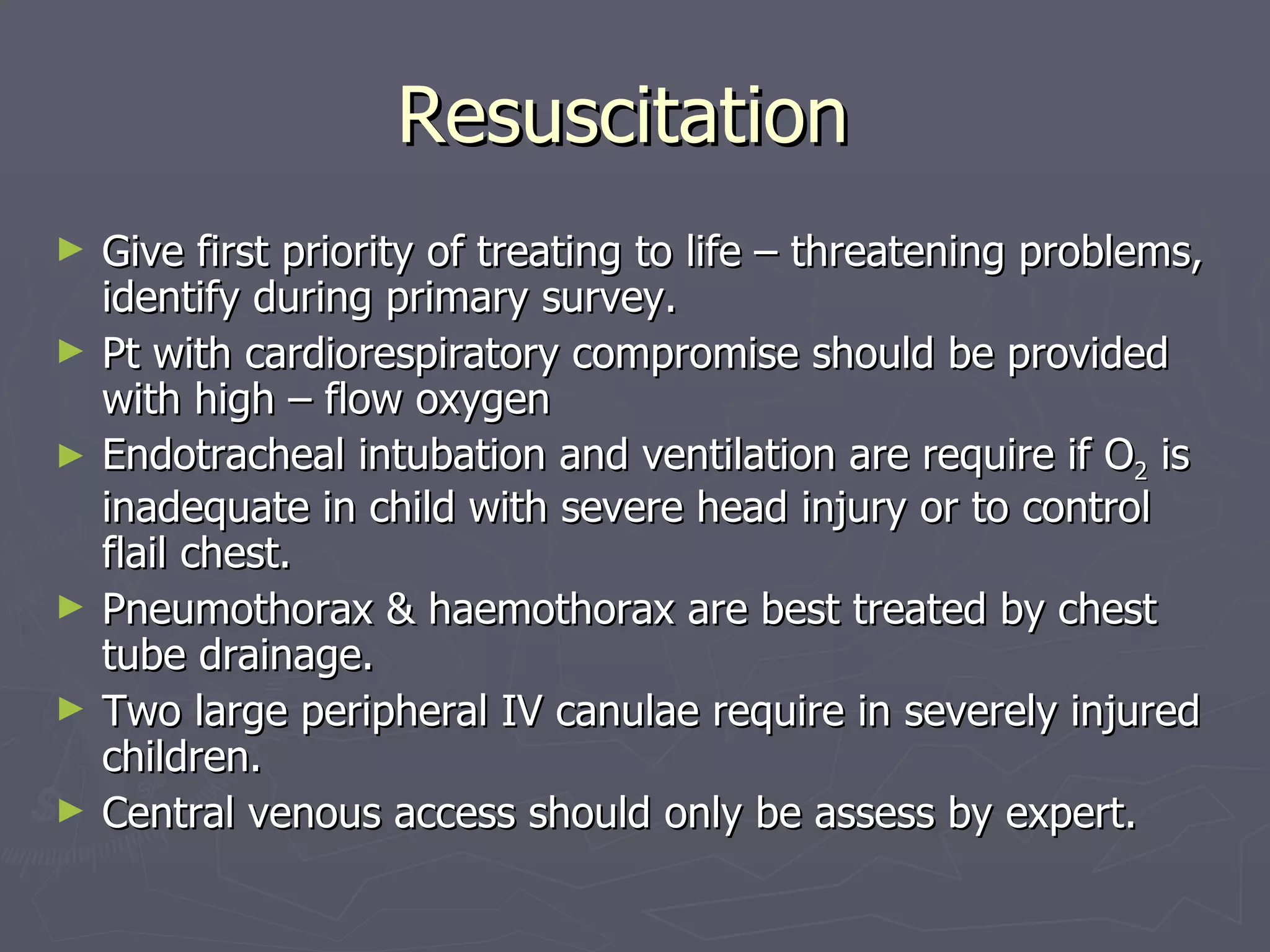
►   Give first priority of treating to life – threatening problems,
    identify during primary survey.
►   Pt with cardiorespiratory compromise should be provided
    with high – flow oxygen
►   Endotracheal intubation and ventilation are require if O2 is
    inadequate in child with severe head injury or to control
    flail chest.
►   Pneumothorax & haemothorax are best treated by chest
    tube drainage.
►   Two large peripheral IV canulae require in severely injured
    children.
►   Central venous access should only be assess by expert.
Resuscitation
►   Overextension of the neck during the maintenance of
    airway result in respiratory compromisation (short neck
    and relatively larger tongue)
►   Circulation is evaluated from vital signs, capillary refill time,
    skin color, temperature and mental status.
►   Systolic BP is normal until 25% of circulatory volume has
    been lost.
►   Intraosseous vascular assess is helpful in children
►   Cervical spine injury can be present without radiological
    signs, after major trauma cervical spine injury should be
    assumed until it can be excluded by full neurological
    assessment, the neck must be immobilized.
Secondary Survey & Emergency
           Management
► When  pt become stable, the secondary
  survey attempt to identify all injuries in a
  systemic way by detailed clinical
  examination and appropriate investigation.
► Emergency treatment involve
  1- Treatment of chest injuries
  2- Treatment of abdominal injuries.
Emergency Treatment Of Chest
                Injuries
►   Children have relatively elastic ribs, that fracture rarely,
    despite that lungs contusion is common without ribs
    fracture.
►   Major thoracic injuries may coexist despite normal
    radiographic findings are
    1) Tension pneumothorax
    2) Massive Haemothorax
    3) Cardiac Temponade
►   In all cases airway should be secured, O2 is given and
    hypovolemia is corrected with IV – fluid
►   Diaphragmatic rupture after blunt abdominal trauma can
    be detected by chest x-ray or CT-scan, surgical repair is
    undertaken once the pt become stable
Emergency Treatment Of Tension
         Pneumothorax
► Tension   pneumothorax require prompt
  clinical diagnosis and immediate needle
  thoracocentesis.
► The needle should be inserted via “second
  inercostal space”, “midclavicular line”.
► Thoracocentesis is followed by chest tube
  drainage.
Massive Haemothorax
► Massive haemothorax is treated by chest
 tube drainage via “fifth intercostals space
 midaxillary line”.
Cardiac Temponade
► Cardiac  temponade may follow blunt or
  penetrating chest injury.
► It require emergency needle
  “pericardiocentesis”.
Emergency Management Of
          Abdominal Trauma
► Blunt abdominal trauma is generally more
  common than penetrating injury.
► In children more vulnerable organs are liver and
  spleen because less protected by pliable rib cage.
► Intra-abdominal or intra-thoracic bleeding is likely
  in shock child with no obvious source of
  hemorrhage.
► The abdomen must be carefully inspected for sign
  of patterned bruising which indicate forceful
  compression against rigid skeleton.
Investigations used In Abdominal
               Trauma
► The  definitive radiological investigation of major
  abdominal trauma in haemodynamically stable
  child is CT – scan with IV – contrast.
► Expert ultrasound scanning is readily available it
  can demonstrate free abdominal fluid and solid
  organ injuries but it is not valuable as CT
► Diagnostic peritoneal lavage is obsolete in children
  because modern imaging is superior
► Laprotomy is indicated for bowl perforation and
  penetrating trauma.
Isolated Splenic Or Liver Injury
► Isolated splenic or liver injury can be safely
  managed non-operatively in majority of the
  child with blunt abdominal trauma.
► Hemorrhage is frequently self limiting, so
  that unnecessary surgery and long term risk
  of splenectomy can be avoided.
Non-operative Management Of
  Isolated Splenic or Liver Injuries
► Haemodynamic      stability after resuscitation
  with fluid not more than 40 – 60 ml/kg.
► Good quality of CT-scan.
► No evidences of hollow visceral injury.
► Frequent careful monitoring and immediate
  availability of necessary surgical expertise.
Children With Intra-abdominal
              Bleeding
► Child  with ongoing intra-abdominal bleeding
  require laprotomy.
► Preliminary angiography and arterial
  embolization can be useful in some cases of
  hepatic trauma.
► Bile leak is uncommon and managed with
  radiological techniques
Accidental Pattern Of Injury
► Pattern of injury often reflect the mechanism as
► Lap belt trauma from motor vehicle crush may
  cause injury to duodenum or jejunum and lumbar
  spine.
► Bicycle handlebar injuries associated with liver or
  pancreatic trauma.
► Straddle injuries may damage urethra and pelvis
► Runover injuries may cause severe crushing of
  chest or abdomen.
Non-accidental Pattern Of Injury
►   Non-accidental injury must considered in following cases
►   Multiple injuries at different stage of healing
►   Different types of injuries such as
    a) Soft Tissues
    b) Fracture
    c) Burn & Scald
    d) Cut and bruise
►   Significant delay between injury and seeking medical
    advice
►   Inconsistent vague history or inappropriate parental
    behavior.

Paediatric trauma

  • 1.
    Paediatric Trauma Dr. Ashok Jaisingani
  • 2.
    Introduction ► Trauma is leading cause of death in children and adolescence in western countries. ► Many of these death are avoidable if proper care and effective treatment is given.
  • 3.
    Primary Survey ► Approached to the child with major injuries advocated by “advance trauma life support” (ATLS), program is essential. Primary survey focus on a) Airway b) Cervical spine c) Breathing d) Circulation e) Control of bleeding f) Assessment of conscious level, g) Pupil size & reactivity h) Rapid overview of all injuries
  • 4.
    Resuscitation ► Give first priority of treating to life – threatening problems, identify during primary survey. ► Pt with cardiorespiratory compromise should be provided with high – flow oxygen ► Endotracheal intubation and ventilation are require if O2 is inadequate in child with severe head injury or to control flail chest. ► Pneumothorax & haemothorax are best treated by chest tube drainage. ► Two large peripheral IV canulae require in severely injured children. ► Central venous access should only be assess by expert.
  • 5.
    Resuscitation ► Overextension of the neck during the maintenance of airway result in respiratory compromisation (short neck and relatively larger tongue) ► Circulation is evaluated from vital signs, capillary refill time, skin color, temperature and mental status. ► Systolic BP is normal until 25% of circulatory volume has been lost. ► Intraosseous vascular assess is helpful in children ► Cervical spine injury can be present without radiological signs, after major trauma cervical spine injury should be assumed until it can be excluded by full neurological assessment, the neck must be immobilized.
  • 6.
    Secondary Survey &Emergency Management ► When pt become stable, the secondary survey attempt to identify all injuries in a systemic way by detailed clinical examination and appropriate investigation. ► Emergency treatment involve 1- Treatment of chest injuries 2- Treatment of abdominal injuries.
  • 7.
    Emergency Treatment OfChest Injuries ► Children have relatively elastic ribs, that fracture rarely, despite that lungs contusion is common without ribs fracture. ► Major thoracic injuries may coexist despite normal radiographic findings are 1) Tension pneumothorax 2) Massive Haemothorax 3) Cardiac Temponade ► In all cases airway should be secured, O2 is given and hypovolemia is corrected with IV – fluid ► Diaphragmatic rupture after blunt abdominal trauma can be detected by chest x-ray or CT-scan, surgical repair is undertaken once the pt become stable
  • 8.
    Emergency Treatment OfTension Pneumothorax ► Tension pneumothorax require prompt clinical diagnosis and immediate needle thoracocentesis. ► The needle should be inserted via “second inercostal space”, “midclavicular line”. ► Thoracocentesis is followed by chest tube drainage.
  • 9.
    Massive Haemothorax ► Massivehaemothorax is treated by chest tube drainage via “fifth intercostals space midaxillary line”.
  • 10.
    Cardiac Temponade ► Cardiac temponade may follow blunt or penetrating chest injury. ► It require emergency needle “pericardiocentesis”.
  • 11.
    Emergency Management Of Abdominal Trauma ► Blunt abdominal trauma is generally more common than penetrating injury. ► In children more vulnerable organs are liver and spleen because less protected by pliable rib cage. ► Intra-abdominal or intra-thoracic bleeding is likely in shock child with no obvious source of hemorrhage. ► The abdomen must be carefully inspected for sign of patterned bruising which indicate forceful compression against rigid skeleton.
  • 12.
    Investigations used InAbdominal Trauma ► The definitive radiological investigation of major abdominal trauma in haemodynamically stable child is CT – scan with IV – contrast. ► Expert ultrasound scanning is readily available it can demonstrate free abdominal fluid and solid organ injuries but it is not valuable as CT ► Diagnostic peritoneal lavage is obsolete in children because modern imaging is superior ► Laprotomy is indicated for bowl perforation and penetrating trauma.
  • 13.
    Isolated Splenic OrLiver Injury ► Isolated splenic or liver injury can be safely managed non-operatively in majority of the child with blunt abdominal trauma. ► Hemorrhage is frequently self limiting, so that unnecessary surgery and long term risk of splenectomy can be avoided.
  • 14.
    Non-operative Management Of Isolated Splenic or Liver Injuries ► Haemodynamic stability after resuscitation with fluid not more than 40 – 60 ml/kg. ► Good quality of CT-scan. ► No evidences of hollow visceral injury. ► Frequent careful monitoring and immediate availability of necessary surgical expertise.
  • 15.
    Children With Intra-abdominal Bleeding ► Child with ongoing intra-abdominal bleeding require laprotomy. ► Preliminary angiography and arterial embolization can be useful in some cases of hepatic trauma. ► Bile leak is uncommon and managed with radiological techniques
  • 16.
    Accidental Pattern OfInjury ► Pattern of injury often reflect the mechanism as ► Lap belt trauma from motor vehicle crush may cause injury to duodenum or jejunum and lumbar spine. ► Bicycle handlebar injuries associated with liver or pancreatic trauma. ► Straddle injuries may damage urethra and pelvis ► Runover injuries may cause severe crushing of chest or abdomen.
  • 17.
    Non-accidental Pattern OfInjury ► Non-accidental injury must considered in following cases ► Multiple injuries at different stage of healing ► Different types of injuries such as a) Soft Tissues b) Fracture c) Burn & Scald d) Cut and bruise ► Significant delay between injury and seeking medical advice ► Inconsistent vague history or inappropriate parental behavior.