
















Chapter 13: Health Communication   Putting the Patient Back into Physician-Patient Interactions
Health Communication   The process by which one person stimulates meaning in the mind(s) of another person (or persons) through verbal, nonverbal, and mediated messages specifically related to the physical and psychological wellbeing of another person (or persons).
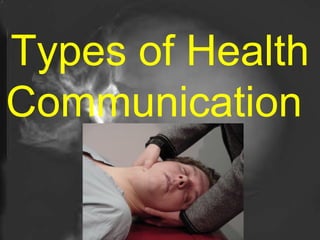
Types of Health Communication
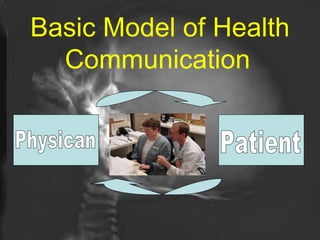
Basic Model of Health Communication   Physican Patient
The Receiver in Health Communication
Types of Patient Communication Verbal Nonverbal Mediated
Verbal Communication   What a patient actually tells her or his physician.
Directly – When a patient shows a health practitioner what is wrong.  Indirectly – Testing that allows a health practitioner to learn information about the patient. Nonverbal Communication
Interacting with physicians in online support groups. E-mailing a physician during internet office hours. Asking questions on health websites like WebMD. Mediated Communication
Health Locus of Control  Page 402 in the Book
Interpreting Your Score Scores should be between 16 and 80. Participants who score above 48 have an internal locus of control.  Participants below 48 have an external locus of control.
Internal LOC   People who have an internal health locus of control believe that the state of their health is largely impacted by their own behaviors.
External LOC   People who have an external health locus of control believe that fate, not personal choices, causes them to be unhealthy.
BIG IDEA   For effective health communication to occur, patients must take responsibility and control of the medical interview.
Utilizing the Patient Information Sheet (p. 289)
Information Your Physician Needs
Actual Reason for Coming (ARC)   Why have you decided to come see a physician?
Physical Symptoms   Physical symptoms refer to any symptoms that can either be felt by the patient or easily seen by both the patient and physician.
Psychological Symptoms   Any change in mood, emotional stability, or thought process that is not explained by normal daily living.
List of Current Medication   Any medication that you are taking (both prescription and over the counter).
Alternative Forms of Medication and Therapy  For example:  osteopathy, chiropracty, Chinese medicine, acupuncture, magnet therapy, cranial therapy, vitamins, muscle enhancers, yoga, etc…
Information to Take Away from Your Physician
Tests & Procedures Conducted Let’s you keep track of what was done to you and when it happened. Gives you a way to cross reference your bill when it comes.
Diagnosis & Prognosis   Diagnosis –  What is Wrong with you. Prognosis –  What your physician thinks will happen next.
Medication &/or Treatment Prescribed What does your physician want you to take (and how)?  What does your physician want you to do?
Side Effects What kinds of things should you look out for as warning signs that the medication/treatment is causing damage?
How Long Should I Wait? Different medications and treatments take different amounts of time to work.  You need to know how long to wait.
Date and Time of Next Appointment
Five Key Points for Patients in the Medical Interview
If you don’t understand your physician, ASK!!!
Don’t hide any details from your Physician.
Own your appointment, you’ve paid for it.
Always get a copy of test results and procedure notes for your own records.
Take Control of Your Health!!!  
Physician Credibility
Growth in Medical Research In 2002 alone, there were 522,943 articles published in some 4,600 medical journals catalogued by PubMed. There is an abundance of medical research being conducted!
The Bad
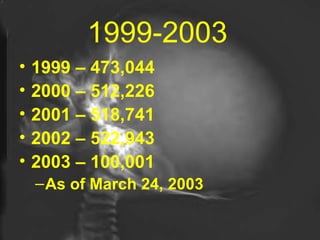
1999-2003 1999 – 473,044 2000 – 512,226 2001 – 518,741 2002 – 522,943  2003 – 100,001 As of March 24, 2003
That’s a total of 2,126,955 Articles in just 5 years
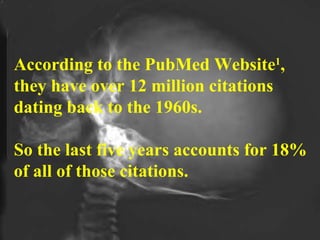
According to the PubMed Website 1 , they have over 12 million citations dating back to the 1960s. So the last five years accounts for 18% of all of those citations.
To stay up-to-date with the current medical literature, you would have to read about 6,000 research articles a day.
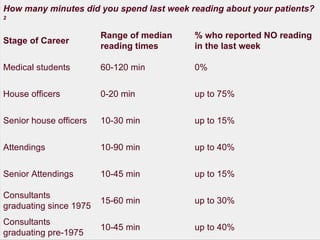
How many minutes did you spend last week reading about your patients? 2 Stage of Career Range of median reading times % who reported NO reading in the last week Medical students 60-120 min 0% House officers 0-20 min up to 75% Senior house officers 10-30 min up to 15% Attendings 10-90 min up to 40% Senior Attendings 10-45 min up to 15% Consultants graduating since 1975 15-60 min up to 30% Consultants graduating pre-1975 10-45 min up to 40%
Medical Knowledge with Years Since Graduation 3
Patient Satisfaction & Perceived Quality of Medical Care Pages 399 & 400 in the Textbook
Fear of Physician (p. 401) Richmond, Smith, Heisel, and McCroskey (2002) found a positive relationship between communication apprehension and Fear of Physician. Richmond, Smith, Heisel, and McCroskey (1998) also found that people who had high levels of anxiety while communicating with their physicians tended to have lower levels of satisfaction and reported lower levels of quality of medical care.
Gender & Health Comm In a study by Hall and Roter (2002), the researchers  found that both male and female patients tend to talk more with female physicians than with male physicians.  Female patients engage in more verbal communication with their physicians when compared to male patients (Wallen, Waitzkin, & Stoeckle, 1979; Waitzkin, 1984, 1985).
Hall, Roter, and Katz (1988) found that physicians also communicate more nonverbally with female patients than they are with male patients.  One suggested reason for this disparity is that females in the U.S. culture are more likely to take on the role of a sick patient because it is socially acceptable for a woman to show sickness in our culture, but not for men (Hohmann, 1989).
Physician Communication
Medical Interview   The process a physician uses where he or she asks a patient questions and the patient responds with answers related.
Physician Communication: SOAP and SOAP-ER Subjective Objective  Assessment  Plan Education (for Patient) Return to Clinic
In two different articles found in the  Journal of the American Medical Association (JAMA)  it was found that physicians with good communication skills had fewer patient complaints and lawsuits (Hickson, Federspiel, Pichert, Miller Gauld-Jaeger, & Bost, 2002; Levinson, Roter, Mullooly, Dull, & Frankel, 1997).
Some Research Findings on Physician Communication
Wrench and Booth-Butterfield (2004) noted that a patient’s perception of a physician’s credibility impacts a patient’s likelihood of complying with her or his physician’s prescribed treatment/medication.
Richmond, Smith, Heisel, and McCroskey (2002) found that physicians who are both highly assertive or highly responsive are seen as credible physicians.
Richmond et al. (2002) found that a physician’s level of responsiveness positively related to a patient’s level of satisfaction and perception of the quality of medical care, but assertiveness did not.
Levinson, Roter, Mullooly, Dull, and Frankel (1997) found that physicians who use humor during the medical interview were less likely to face malpractice lawsuits and had more satisfied patients.
Wrench and Booth-Butterfield (2004) found that patients who perceived their physicians as humorous also perceived their physicians as being more credible on all three levels of credibility (competence, trustworthiness, and caring/goodwill).
Gaberson (1991) found that patients who were exposed to humorous messages before an operation had lower levels of anxiety before the operation and higher post operation recovery rates.
Richmond, Smith, Heisel, and McCroskey (2001) found that that a physician’s level of nonverbal immediacy positively impacted patient satisfaction and perceptions of the quality of medical care while decreasing an individual’s fear of communication with a physician.
Richmond et al. (2001) study found that patients who perceived their physicians as more nonverbally immediate also were more satisfied and reported higher perceptions of the quality of medical care they received.

Chapter13

  • 1.
    Chapter 13: HealthCommunication Putting the Patient Back into Physician-Patient Interactions
  • 2.
    Health Communication The process by which one person stimulates meaning in the mind(s) of another person (or persons) through verbal, nonverbal, and mediated messages specifically related to the physical and psychological wellbeing of another person (or persons).
  • 3.
    Types of HealthCommunication
  • 4.
    Basic Model ofHealth Communication Physican Patient
  • 5.
    The Receiver inHealth Communication
  • 6.
    Types of PatientCommunication Verbal Nonverbal Mediated
  • 7.
    Verbal Communication What a patient actually tells her or his physician.
  • 8.
    Directly – Whena patient shows a health practitioner what is wrong. Indirectly – Testing that allows a health practitioner to learn information about the patient. Nonverbal Communication
  • 9.
    Interacting with physiciansin online support groups. E-mailing a physician during internet office hours. Asking questions on health websites like WebMD. Mediated Communication
  • 10.
    Health Locus ofControl Page 402 in the Book
  • 11.
    Interpreting Your ScoreScores should be between 16 and 80. Participants who score above 48 have an internal locus of control. Participants below 48 have an external locus of control.
  • 12.
    Internal LOC People who have an internal health locus of control believe that the state of their health is largely impacted by their own behaviors.
  • 13.
    External LOC People who have an external health locus of control believe that fate, not personal choices, causes them to be unhealthy.
  • 14.
    BIG IDEA For effective health communication to occur, patients must take responsibility and control of the medical interview.
  • 15.
    Utilizing the PatientInformation Sheet (p. 289)
  • 16.
  • 17.
    Actual Reason forComing (ARC) Why have you decided to come see a physician?
  • 18.
    Physical Symptoms Physical symptoms refer to any symptoms that can either be felt by the patient or easily seen by both the patient and physician.
  • 19.
    Psychological Symptoms Any change in mood, emotional stability, or thought process that is not explained by normal daily living.
  • 20.
    List of CurrentMedication Any medication that you are taking (both prescription and over the counter).
  • 21.
    Alternative Forms ofMedication and Therapy For example: osteopathy, chiropracty, Chinese medicine, acupuncture, magnet therapy, cranial therapy, vitamins, muscle enhancers, yoga, etc…
  • 22.
    Information to TakeAway from Your Physician
  • 23.
    Tests & ProceduresConducted Let’s you keep track of what was done to you and when it happened. Gives you a way to cross reference your bill when it comes.
  • 24.
    Diagnosis & Prognosis Diagnosis – What is Wrong with you. Prognosis – What your physician thinks will happen next.
  • 25.
    Medication &/or TreatmentPrescribed What does your physician want you to take (and how)? What does your physician want you to do?
  • 26.
    Side Effects Whatkinds of things should you look out for as warning signs that the medication/treatment is causing damage?
  • 27.
    How Long ShouldI Wait? Different medications and treatments take different amounts of time to work. You need to know how long to wait.
  • 28.
    Date and Timeof Next Appointment
  • 29.
    Five Key Pointsfor Patients in the Medical Interview
  • 30.
    If you don’tunderstand your physician, ASK!!!
  • 31.
    Don’t hide anydetails from your Physician.
  • 32.
    Own your appointment,you’ve paid for it.
  • 33.
    Always get acopy of test results and procedure notes for your own records.
  • 34.
    Take Control ofYour Health!!! 
  • 35.
  • 36.
    Growth in MedicalResearch In 2002 alone, there were 522,943 articles published in some 4,600 medical journals catalogued by PubMed. There is an abundance of medical research being conducted!
  • 37.
  • 38.
    1999-2003 1999 –473,044 2000 – 512,226 2001 – 518,741 2002 – 522,943 2003 – 100,001 As of March 24, 2003
  • 39.
    That’s a totalof 2,126,955 Articles in just 5 years
  • 40.
    According to thePubMed Website 1 , they have over 12 million citations dating back to the 1960s. So the last five years accounts for 18% of all of those citations.
  • 41.
    To stay up-to-datewith the current medical literature, you would have to read about 6,000 research articles a day.
  • 42.
    How many minutesdid you spend last week reading about your patients? 2 Stage of Career Range of median reading times % who reported NO reading in the last week Medical students 60-120 min 0% House officers 0-20 min up to 75% Senior house officers 10-30 min up to 15% Attendings 10-90 min up to 40% Senior Attendings 10-45 min up to 15% Consultants graduating since 1975 15-60 min up to 30% Consultants graduating pre-1975 10-45 min up to 40%
  • 43.
    Medical Knowledge withYears Since Graduation 3
  • 44.
    Patient Satisfaction &Perceived Quality of Medical Care Pages 399 & 400 in the Textbook
  • 45.
    Fear of Physician(p. 401) Richmond, Smith, Heisel, and McCroskey (2002) found a positive relationship between communication apprehension and Fear of Physician. Richmond, Smith, Heisel, and McCroskey (1998) also found that people who had high levels of anxiety while communicating with their physicians tended to have lower levels of satisfaction and reported lower levels of quality of medical care.
  • 46.
    Gender & HealthComm In a study by Hall and Roter (2002), the researchers found that both male and female patients tend to talk more with female physicians than with male physicians. Female patients engage in more verbal communication with their physicians when compared to male patients (Wallen, Waitzkin, & Stoeckle, 1979; Waitzkin, 1984, 1985).
  • 47.
    Hall, Roter, andKatz (1988) found that physicians also communicate more nonverbally with female patients than they are with male patients. One suggested reason for this disparity is that females in the U.S. culture are more likely to take on the role of a sick patient because it is socially acceptable for a woman to show sickness in our culture, but not for men (Hohmann, 1989).
  • 48.
  • 49.
    Medical Interview The process a physician uses where he or she asks a patient questions and the patient responds with answers related.
  • 50.
    Physician Communication: SOAPand SOAP-ER Subjective Objective Assessment Plan Education (for Patient) Return to Clinic
  • 51.
    In two differentarticles found in the Journal of the American Medical Association (JAMA) it was found that physicians with good communication skills had fewer patient complaints and lawsuits (Hickson, Federspiel, Pichert, Miller Gauld-Jaeger, & Bost, 2002; Levinson, Roter, Mullooly, Dull, & Frankel, 1997).
  • 52.
    Some Research Findingson Physician Communication
  • 53.
    Wrench and Booth-Butterfield(2004) noted that a patient’s perception of a physician’s credibility impacts a patient’s likelihood of complying with her or his physician’s prescribed treatment/medication.
  • 54.
    Richmond, Smith, Heisel,and McCroskey (2002) found that physicians who are both highly assertive or highly responsive are seen as credible physicians.
  • 55.
    Richmond et al.(2002) found that a physician’s level of responsiveness positively related to a patient’s level of satisfaction and perception of the quality of medical care, but assertiveness did not.
  • 56.
    Levinson, Roter, Mullooly,Dull, and Frankel (1997) found that physicians who use humor during the medical interview were less likely to face malpractice lawsuits and had more satisfied patients.
  • 57.
    Wrench and Booth-Butterfield(2004) found that patients who perceived their physicians as humorous also perceived their physicians as being more credible on all three levels of credibility (competence, trustworthiness, and caring/goodwill).
  • 58.
    Gaberson (1991) foundthat patients who were exposed to humorous messages before an operation had lower levels of anxiety before the operation and higher post operation recovery rates.
  • 59.
    Richmond, Smith, Heisel,and McCroskey (2001) found that that a physician’s level of nonverbal immediacy positively impacted patient satisfaction and perceptions of the quality of medical care while decreasing an individual’s fear of communication with a physician.
  • 60.
    Richmond et al.(2001) study found that patients who perceived their physicians as more nonverbally immediate also were more satisfied and reported higher perceptions of the quality of medical care they received.