FAMILY SYSTEMS THEORY By Jason S. Wrench
What is a System? Ludwig Von Bertalanffy (1968) “ Set[s] of elements standing in interrelation among themselves and with the environment”
Systems Theory Development  Miller 1978 Called for a living systems theory Broderick & Smith (1979) Published the first article applying systems theory to family scholarship
Common Components of Family Systems Theory
Non-Summativity The whole is Greater than the sum of its parts.
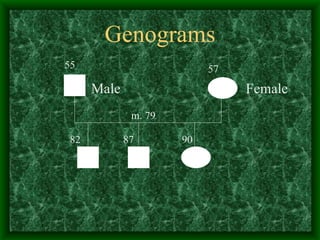
Genograms Male Female 55  57 m. 79 82  90 87
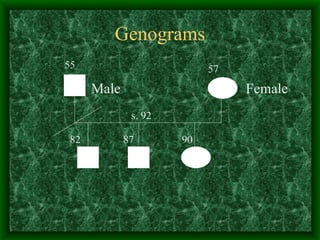
Genograms Male Female 55  57 s. 92 82  90 87
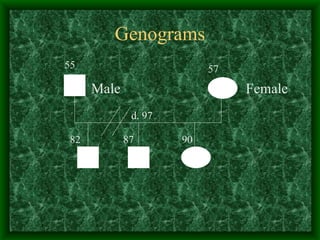
Genograms Male Female 55  57 d. 97 82  90 87
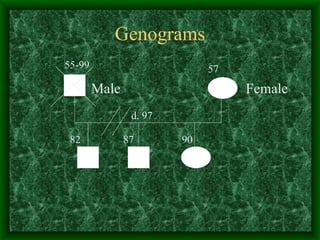
Genograms Male Female 55-99  57 d. 97 82  90 87
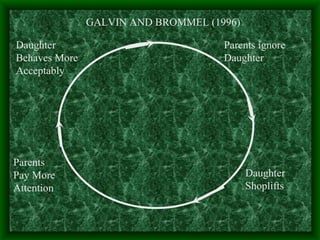
Circular Causality Family members are interrelated  Not linear (A affects B)  A & B affect each other
GALVIN AND BROMMEL (1996) Parents ignore Daughter Daughter Shoplifts Parents Pay More Attention Daughter Behaves More Acceptably
Equifinality Families may react similarly to the same experience or achieve outcomes by very different processes.
System types Sub system Supra system Boundaries Open Closed
Family Homeostasis Bradshaw (1988) Family Homeostasis (1957) Families try to cooperate within the family in order to keep the family at homeostasis.
Morphogenisis Ability to adapt and be flexible to stressors Morphostasis Tendency for a system to stay at equilibrium
Applying Family Systems Theory to Family Stressors
Family Crisis Roberts (1991) 3 Types of Crises  Hazardous event 2. Threat to Life Goals 3. Inability to respond with adequate coping mechanisms
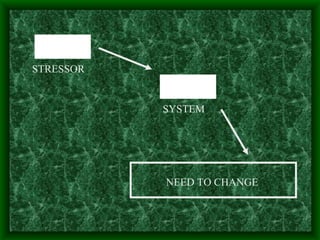
STRESSOR SYSTEM NEED TO CHANGE
Pittman’s (1987) Four Types of Stressors Bolt from the Blue Developmental Structural Caretaker
3 Approaches to Family System Theory Research
Interactional View How families interact through message transactions Structural View Focuses on dyadic social organization and role structure within the family system. How do families regulate boundaries.
Constructivist View How does the family construct its particular social reality Narratives and stores that families construct from their own experience Most pupular method currently in use
LIMITATIONS
1. Family Systems Theory has not resulted in a body of specific theoretical assertions or hypothesis which can be tested. (Broderick & Smith, 1979; Fitzpatrick and Noller, 1993). 2. Family Systems Theory may best be viewed as a metaphor for thinking about the family (Fitzpatrick and Noller, 1993).
Turner & West (1998) Limitations Too much focus on homeostasis at expense of change Too much focus on patterns at the expense of unpredictability Too much focus on the system at at the expense of the individuals A positivistic intellectual tradition that puts the researcher outside the system in search of the truth.
CASE STUDY
 
This Presentation was Created by Jason Wrench OAD SPEAKERS, Inc. Copyright 1999

Family Systems Theory

  • 1.
    FAMILY SYSTEMS THEORYBy Jason S. Wrench
  • 2.
    What is aSystem? Ludwig Von Bertalanffy (1968) “ Set[s] of elements standing in interrelation among themselves and with the environment”
  • 3.
    Systems Theory Development Miller 1978 Called for a living systems theory Broderick & Smith (1979) Published the first article applying systems theory to family scholarship
  • 4.
    Common Components ofFamily Systems Theory
  • 5.
    Non-Summativity The wholeis Greater than the sum of its parts.
  • 6.
    Genograms Male Female55 57 m. 79 82 90 87
  • 7.
    Genograms Male Female55 57 s. 92 82 90 87
  • 8.
    Genograms Male Female55 57 d. 97 82 90 87
  • 9.
    Genograms Male Female55-99 57 d. 97 82 90 87
  • 10.
    Circular Causality Familymembers are interrelated Not linear (A affects B) A & B affect each other
  • 11.
    GALVIN AND BROMMEL(1996) Parents ignore Daughter Daughter Shoplifts Parents Pay More Attention Daughter Behaves More Acceptably
  • 12.
    Equifinality Families mayreact similarly to the same experience or achieve outcomes by very different processes.
  • 13.
    System types Subsystem Supra system Boundaries Open Closed
  • 14.
    Family Homeostasis Bradshaw(1988) Family Homeostasis (1957) Families try to cooperate within the family in order to keep the family at homeostasis.
  • 15.
    Morphogenisis Ability toadapt and be flexible to stressors Morphostasis Tendency for a system to stay at equilibrium
  • 16.
    Applying Family SystemsTheory to Family Stressors
  • 17.
    Family Crisis Roberts(1991) 3 Types of Crises Hazardous event 2. Threat to Life Goals 3. Inability to respond with adequate coping mechanisms
  • 18.
  • 19.
    Pittman’s (1987) FourTypes of Stressors Bolt from the Blue Developmental Structural Caretaker
  • 20.
    3 Approaches toFamily System Theory Research
  • 21.
    Interactional View Howfamilies interact through message transactions Structural View Focuses on dyadic social organization and role structure within the family system. How do families regulate boundaries.
  • 22.
    Constructivist View Howdoes the family construct its particular social reality Narratives and stores that families construct from their own experience Most pupular method currently in use
  • 23.
  • 24.
    1. Family SystemsTheory has not resulted in a body of specific theoretical assertions or hypothesis which can be tested. (Broderick & Smith, 1979; Fitzpatrick and Noller, 1993). 2. Family Systems Theory may best be viewed as a metaphor for thinking about the family (Fitzpatrick and Noller, 1993).
  • 25.
    Turner & West(1998) Limitations Too much focus on homeostasis at expense of change Too much focus on patterns at the expense of unpredictability Too much focus on the system at at the expense of the individuals A positivistic intellectual tradition that puts the researcher outside the system in search of the truth.
  • 26.
  • 27.
  • 28.
    This Presentation wasCreated by Jason Wrench OAD SPEAKERS, Inc. Copyright 1999