THE PATIENT-PHYSICIAN ENCOUNTER DATO’ AHMAD TAJUDIN JAAFAR VICE PRESIDENT 1 (ACADEMIC) MEDICAL & ALLIED HEALTH SCIENCE ALLIANZE COLLEGE OF MEDICAL SCIENCES
WHAT DO PATIENTS WANT? Able to trust the competence and efficacy of the physician Able to negotiate through the health care system effectively Treated with dignity and respect Understand how the sickness and treatment affect their lives
WHAT DO PATIENTS WANT? Allay the fears by telling them everything that they want to know Discuss the effect of their illness on their family, friends and finances Able to plan for the future How to care for themselves away from the clinical setting Patients want the doctor to focus on their pain, physical discomfort and functional disabilities
THE RELATIONSHIP BETWEEN PATIENT AND PHYSICIAN Analyzed since 1900 When cure is impossible and treatment is limited, bedside manner was emphasized Now with the importance of psychosocial model in medicine, renewed interest is seen with medicine as a social process Harm can be done by use of the knife or slip of a word
DIMENSIONS OF PATIENT-PHYSICIAN ENCOUNTER Instrumental Component - Competence of the physicians performing the  technical aspects of care such as: * Performing Diagnostic tests * Physical Examination * Prescribing Treatment
DIMENSIONS OF PATIENT-PHYSICIAN ENCOUNTER 2. Expressive Component - Reflects the art of medicine including the effective  portion of the interaction such as: - Warmth - Empathy - How the physician approach the patient
3 COMMON MODELS OF THE PATIENT-PHYSICIAN RELATIONSHIP The Activity-Passivity Model - Power differential between patient and  physician is necessary for a steady course  of medical care. - Patient seeks information and treatment and  physician formulate decision.
3 COMMON MODELS OF THE PATIENT-PHYSICIAN RELATIONSHIP - Patient must accept it - Physician an active partner, whilst patient is  passive and no control
3 COMMON MODELS OF THE PATIENT-PHYSICIAN RELATIONSHIP 2. The Guidance - Cooperative Model - Most prevalent - Physician recommends treatment and  patient cooperates - “Doctor knows best” theory
3 COMMON MODELS OF THE PATIENT-PHYSICIAN RELATIONSHIP - Doctor is supportive and non-authoritarian, responsible for choosing appropriate treatment - Patient are expected to follow
3 COMMON MODELS OF THE PATIENT-PHYSICIAN RELATIONSHIP 3. The Mutual Participation Model – (Shared Responsibility) - Doctor and patient share responsibilities for decision  making and planning course of treatment - Patient and doctor respectful of each other expectation and values
WHAT IS THE OPTIMAL MODEL? In between guidance-cooperation and mutual participation In reality, the relationship changes over time Early on, relationship is guidance in nature
WHAT IS THE OPTIMAL MODEL? As patient becomes more confident and knowledgeable, mutual relationship set in as they: - Monitor their symptoms - Report difficulties - Work as a team to modify plan
EFFICACY OF TREATMENT Dependent on patient carrying out directives of physician Non adherent suggest a complete failure to follow a prescribed treatment
EFFICACY OF TREATMENT The assumption here is that: - The treatment is appropriate and effective - Association between adherence and improved  health - Patient is able to carry out the treatment plan
EFFECT OF AN EFFECTIVE PATIENT-PHYSICIAN RELATIONSHIP - Where the Patient-Physician relationship includes: * Competence * Communication * Effective style -These factors provide for PATIENT SATISFACTION WITH CARE - Leads to BETTER ADHERENCE TO TREATMENT
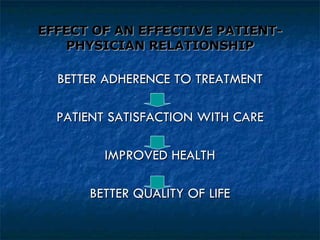
EFFECT OF AN EFFECTIVE PATIENT-PHYSICIAN RELATIONSHIP BETTER ADHERENCE TO TREATMENT PATIENT SATISFACTION WITH CARE IMPROVED HEALTH BETTER QUALITY OF LIFE

The Patient Physician Encounter

  • 1.
    THE PATIENT-PHYSICIAN ENCOUNTERDATO’ AHMAD TAJUDIN JAAFAR VICE PRESIDENT 1 (ACADEMIC) MEDICAL & ALLIED HEALTH SCIENCE ALLIANZE COLLEGE OF MEDICAL SCIENCES
  • 2.
    WHAT DO PATIENTSWANT? Able to trust the competence and efficacy of the physician Able to negotiate through the health care system effectively Treated with dignity and respect Understand how the sickness and treatment affect their lives
  • 3.
    WHAT DO PATIENTSWANT? Allay the fears by telling them everything that they want to know Discuss the effect of their illness on their family, friends and finances Able to plan for the future How to care for themselves away from the clinical setting Patients want the doctor to focus on their pain, physical discomfort and functional disabilities
  • 4.
    THE RELATIONSHIP BETWEENPATIENT AND PHYSICIAN Analyzed since 1900 When cure is impossible and treatment is limited, bedside manner was emphasized Now with the importance of psychosocial model in medicine, renewed interest is seen with medicine as a social process Harm can be done by use of the knife or slip of a word
  • 5.
    DIMENSIONS OF PATIENT-PHYSICIANENCOUNTER Instrumental Component - Competence of the physicians performing the technical aspects of care such as: * Performing Diagnostic tests * Physical Examination * Prescribing Treatment
  • 6.
    DIMENSIONS OF PATIENT-PHYSICIANENCOUNTER 2. Expressive Component - Reflects the art of medicine including the effective portion of the interaction such as: - Warmth - Empathy - How the physician approach the patient
  • 7.
    3 COMMON MODELSOF THE PATIENT-PHYSICIAN RELATIONSHIP The Activity-Passivity Model - Power differential between patient and physician is necessary for a steady course of medical care. - Patient seeks information and treatment and physician formulate decision.
  • 8.
    3 COMMON MODELSOF THE PATIENT-PHYSICIAN RELATIONSHIP - Patient must accept it - Physician an active partner, whilst patient is passive and no control
  • 9.
    3 COMMON MODELSOF THE PATIENT-PHYSICIAN RELATIONSHIP 2. The Guidance - Cooperative Model - Most prevalent - Physician recommends treatment and patient cooperates - “Doctor knows best” theory
  • 10.
    3 COMMON MODELSOF THE PATIENT-PHYSICIAN RELATIONSHIP - Doctor is supportive and non-authoritarian, responsible for choosing appropriate treatment - Patient are expected to follow
  • 11.
    3 COMMON MODELSOF THE PATIENT-PHYSICIAN RELATIONSHIP 3. The Mutual Participation Model – (Shared Responsibility) - Doctor and patient share responsibilities for decision making and planning course of treatment - Patient and doctor respectful of each other expectation and values
  • 12.
    WHAT IS THEOPTIMAL MODEL? In between guidance-cooperation and mutual participation In reality, the relationship changes over time Early on, relationship is guidance in nature
  • 13.
    WHAT IS THEOPTIMAL MODEL? As patient becomes more confident and knowledgeable, mutual relationship set in as they: - Monitor their symptoms - Report difficulties - Work as a team to modify plan
  • 14.
    EFFICACY OF TREATMENTDependent on patient carrying out directives of physician Non adherent suggest a complete failure to follow a prescribed treatment
  • 15.
    EFFICACY OF TREATMENTThe assumption here is that: - The treatment is appropriate and effective - Association between adherence and improved health - Patient is able to carry out the treatment plan
  • 16.
    EFFECT OF ANEFFECTIVE PATIENT-PHYSICIAN RELATIONSHIP - Where the Patient-Physician relationship includes: * Competence * Communication * Effective style -These factors provide for PATIENT SATISFACTION WITH CARE - Leads to BETTER ADHERENCE TO TREATMENT
  • 17.
    EFFECT OF ANEFFECTIVE PATIENT-PHYSICIAN RELATIONSHIP BETTER ADHERENCE TO TREATMENT PATIENT SATISFACTION WITH CARE IMPROVED HEALTH BETTER QUALITY OF LIFE