The Doctor-Patient Relationship
Presenters : Dr. Priyadarshani
Dr. Chibi Rushitha V
Moderator : Dr. Shantibala K
Associate Professor
Date : 20/11/2015
OUTLINE
 Introduction
 Parsons’ Model Of the Sick Role And Doctor’s Role
 Types Of Doctor-patient Relationship
 Influences On The Doctor–patient Relationship
 Partnerships In Treatment Decision Making
 Communication Skills
 Barriers In Communication
 Doctor-patient Relationship In The Past
 Doctor-patient Relationship In The Present
 Improving Doctor Patient Relationship
 Consumer Protection Act ,1986
 Conclusion
Introduction
 This is a unique social relationship where bonding is
planned with the ultimate objective of assisting the patient
to achieve treatment goals.
 This approach requires the doctor (care provider) to take
on the responsibility of directing , effecting and
maintaining the therapeutic relationship, exhibiting a
professional and ethical approach.
Why does it matter ?
 The patient-physician relationship is fundamental for
providing
1. excellent care
2. to the healing process
3. to improved outcomes
Therefore, it is important to understand what
elements comprise the relationship and identify those
that make it "good."
Parsons’ model (1951)
 Parsons’ “Ideal Patient” (Sick Role)
Rights (Permitted) to:
Give up some activities and responsibilities.
Regarded as being in need of care .
Obligations (In Return) :
Must want to get better quickly .
Seek help and cooperate with a doctor.
 Parsons’ “Doctor” (Doctors’ Role)
 Apply a high degree of skill & knowledge to the
problems of illness.
 Act for welfare of patient and community rather
then for own self interest, desire for money,
advancement etc.
 Be objective and emotionally detached.
 Be guided by rules of professional practice.
 Doctor’s Right
 Granted right to examine patients physically & to
enquire into intimate areas of physical & personal
life.
 Granted considerable autonomy in professional
practice.
 Occupies position of authority in relation to the
patient.
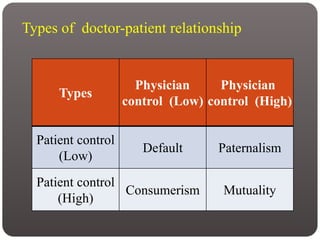
Types of doctor-patient relationship
Types
Physician
control (Low)
Physician
control (High)
Patient control
(Low)
Default Paternalism
Patient control
(High)
Consumerism Mutuality
Pateranalism
 Is widely regarded as the traditional form of
doctor-patient relationship.
 A passive patient and a dominant doctor.
Advantages
 The supportive nature of paternalism appears to be
more important when patient are very sick .
 Relief from the burden of worry is curative in
itself, and the trust and confidence implied by this
model allow doctor to perform “medical magic”
→placebo effect
Disadvantages
 Manipulation and exploitation of the
vulnerable and ill .
Mutuality
 The optimal doctor-patient relationship model.
 This model views neither the patient nor the
physician as standing aside.
 Each of participants brings strengths and resources
to the relationship.
 Based on the communication between doctors and
patients.
Patient’s role
 Patients need to define their problems in an open and
full manner.
 The patient’s right to seek care elsewhere when
demands are not satisfactorily met.
Doctor’s role
 Physicians need to work with the patient to
articulate the problem and refine the request.
 The physician’s right to withdraw services formally
from a patient if he or she feels it is impossible to
satisfy the patient’s demand.
Advantages
 Patients can fully understand what problem they
are coping with through physicians’ help.
 Physicians can entirely know patient’s value.
 Decisions can easily be made from a mutual and
collaborative relationship.
Disadvantages
 If the communication is fake, both physicians and
patients do not have mutual understanding,
making decision is overwhelming to a patient.
Consumerism
 Reverse of the very basic nature of the power
relationship.
 Patient taking active role and doctor adopting a
fairly passive role.
Patient’s role
 Health shoppers
Indications of consumer behavior:
 Cost-consciousness
 Information seeking
 Exercising independent judgement
Doctor’s role
 Health care providers
 Technical consultant
 To convince the necessity of medical services
Advantages
 Patients can have their own choices.
Disadvantages
 When things seem to go wrong, when satisfaction is
low, or when a patient suspect less than optimal care
or outcome, patients are more likely to question
physician authority.
Default
• When patient and physician expectation are at
odds, or when the need for change in the
relationship can not be negotiated, the
relationship may come to a dysfunction
standstill.
Consultation styles
1. Doctor centered
 Paternalistic - doctor is the expert and patient
expected to cooperate
 Tightly controlled interviewing style aimed at
reaching an organic diagnosis.
 Closed questions
 ‘Voice of medicine’- focus on biomedical diagnosis
and treatment as quickly as possible
2. Patient centered
 Mutuality
 Less authoritarian - encourages patient to their own
feelings and concerns
 Open questions
 ‘Voice of the patient’ - communication of patients
beliefs, feelings & psychosocial context
(bio psychosocial)
Key aspects of a of patient-centred consultation
 Biopsychosocial perspective
 Patient-as-a-person
 Sharing power and responsibility
 Therapeutic alliance
 Doctor-as-a-person
Influences On The Doctor–patient Relationship
1. Influence of time –
 Average 6 minutes (avg 2-20 min)
 Pressures of time- doctor centered consultation
 However, doctors own style & approach influences than
the time available.
 Patient centric approach needs more time but overall
reduces the number of return visits & thus the total
consultation time .
2. Patient characteristics and behaviours
The patient’s ability to exercise and control
depends on a number of factors:
 Age
 Social and educational level
 Sex
 Different languages
3. Influence of structural context
 Hospital situation/ Ward
 Fee-for service
Health literacy
 Definition-- the ability to obtain, process, and understand
basic information and services needed to make appropriate
health decisions.
 Low health literacy reduces the success of treatment and
increases the risk of medical error.
 Health literacy is of continued and increasing concern for
health professionals, as it is a primary factor behind health
disparities.
Tests to identify health literacy--
 Medical Term Recognition Test (METER)
 Rapid Estimate of Adult Literacy in Medicine (REALM)
test
 The Short Assessment of Health Literacy in Spanish and
English populations (SAHL-S&E)
 The Critical Health Competence Test (CHC-Test)
Intervention---
 Teach back method.
 Ask Me 3" is designed to bring public and physician
attention to this issue, by letting patients know that they
should ask three questions each time they talk to a doctor,
nurse, or pharmacist:
1) What is my main problem?
2) What do I need to do?
3) Why is it important for me to do this?
PARTNERSHIPS IN TREATMENT DECISION MAKING
 Models of decision making
3 models - paternalist
- shared
- informed
 Paternalist model
- the doctor, as medical expert, as solely responsible for
treatment decisions with the patient expected merely to
cooperate with advice and treatment.
Shared decision-making
1. Both doctor and patient are involved in the decision-
making process
2. Both parties share information
3. Both parties take steps to build a consensus about the
preferred treatment
4. An agreement (consensus) is reached on the
treatment to implement
Informed model
1. partnership between doctor and patient - division of
labour
2. doctor - information on all relevant options
3. decision-making- patient
 Shared decision making -impetus
1. Increased medical knowledge among patients
2. Prevailing social values- individual autonomy and
responsibility
3. Chronic illness
4. To make choices between the treatment options and to
balance risks & benefits –medical uncertainity
5. Doctors make inaccurate guesses about patients concerns
& their preferences and treatment choices differ
 Patients’ preferences for participation
 Patient’s state of health
Patients in crisis situations
Patients feel weak or distressed
Differences in the desire for involvement
Consent
Definition-- When two or more persons agree upon
the same thing in the same sense they are said to
consent
( section 13 of Indian Contract Act, 1872)
Who can given consent?
1. any person who is conscious,
2. mentally sound and
3. ≥ twelve years of age
When a consent is not valid ?
1. under fear
2. fraud
3. misrepresentation of facts
4. by a person who is ignorant of the implications of
the consent
5. who is under 12 years of age is invalid
Depending upon the circumstances in each case
consent may be
a) implied
b) express – verbal / written
c) informed
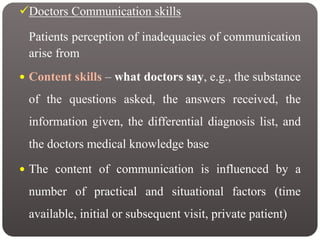
Doctors Communication skills
Patients perception of inadequacies of communication
arise from
 Content skills – what doctors say, e.g., the substance
of the questions asked, the answers received, the
information given, the differential diagnosis list, and
the doctors medical knowledge base
 The content of communication is influenced by a
number of practical and situational factors (time
available, initial or subsequent visit, private patient)
 Process skills – how doctors say it, e.g., how the
doctor asks questions, how well he listens, how he
sets up explanation and planning with the patient,
how he structures his interaction and makes that
structure visible to the patient through signposting
or transitions &how he build relationships with
patients
 Communication skills and steps to be achieved
in consultation
1. Initiating the session (establishing the initial rapport
and identifying the reason(s) for theconsultation).
2. Gathering information (exploring the problem,
understanding the patients’ perspective,providing
structure to the consultation).
3. Building the relationship (developing rapport and
involving the patient).
4. Explanation and planning (providing the appropriate
amount and type of information, aiding accurate
recall and understanding, achieving a shared
understanding and planning)
5. Closing the session.
BARRIERS IN COMMUNICATION
A) Doctor’s barrier to effective communication
 Lack of specific knowledge
 Lack of counseling skills
 Lack of time
 Lack of appropriate resources
B) Patient’s barrier to effective communication
 Sex
 Social and educational level
 Different languages
 Membership of an ethnic minority
DOCTOR-PATIENT RELATIONSHIP IN THE PAST
Paternalism
Because physicians in the past were people who
have higher social status
“doctor” is seen as a sacred occupation which
saves people’s lives
The advices given by doctors are seen as
paramount mandate
DOCTOR-PATIENT RELATIONSHIPAT PRESENT
Consumerism and mutuality
Patients nowadays have higher education and
better economic status
The concept of patient’s autonomy
The ability to question doctors
IMPROVING DOCTOR PATIENT RELATIONSHIP
 Active Listening
 Nonverbal Communication
 Agendas
 Empathize
 Educating Patients
Reassurance
Agreeing on a treatment plan
Taking responsibility
Avoid overreacting
Establishing boundaries
Consumer Protection Act, 1986
 In 1995 ,Medical profession was included under this act.
 Empowers the consumer with the Right to :
 Safety
 Information
 Choose
 Heard
 Redressal
 Consumer education
 Relationship between patients and medical professionals as
contractual and not a master-servant relationship .
 A complaint filed in the Consumer Forum/Commission shall
be decided within a period of 90 days from the date of notice
by opposite party and within 150 days if it requires analysis or
testing of commodities.
 There are no court fees to be paid to file a complaint in a
Consumer Forum / Commission.
Lodging A Complaint
FORMAT: Written
PERSON : Complainant / Representative
PLACE : Consumer Dispute Redressal Forum
FEE : Nominal
TIME LIMIT : ≤ 2 yrs
FATE : Accepted
Dismissed
Sec 12 CPA 1986
The structure of the consumer forums/ commission:
It depends upon the amount of compensation
and decided by the government from time to time
1. 1. District consumer redressal forum (Upto Rs. 20
lakhs)
2. 2. State consumer redressal forum (20 lakhs Up to
1Crore )
3. 3. National consumer redressal forum (> Rs. 1 Crore)
4. 4. Supreme court: final appeal (unlimited)
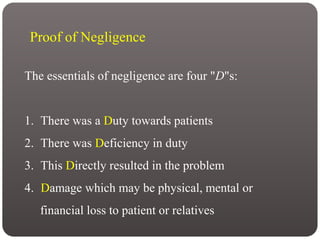
Proof of Negligence
The essentials of negligence are four "D"s:
1. There was a Duty towards patients
2. There was Deficiency in duty
3. This Directly resulted in the problem
4. Damage which may be physical, mental or
financial loss to patient or relatives
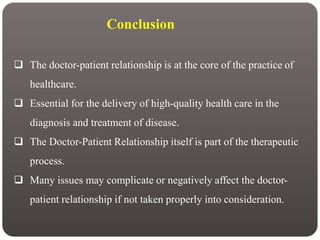
Conclusion
 The doctor-patient relationship is at the core of the practice of
healthcare.
 Essential for the delivery of high-quality health care in the
diagnosis and treatment of disease.
 The Doctor-Patient Relationship itself is part of the therapeutic
process.
 Many issues may complicate or negatively affect the doctor-
patient relationship if not taken properly into consideration.
THANK YOU

drptrelationship-160202062401.pdf

  • 1.
    The Doctor-Patient Relationship Presenters: Dr. Priyadarshani Dr. Chibi Rushitha V Moderator : Dr. Shantibala K Associate Professor Date : 20/11/2015
  • 2.
    OUTLINE  Introduction  Parsons’Model Of the Sick Role And Doctor’s Role  Types Of Doctor-patient Relationship  Influences On The Doctor–patient Relationship  Partnerships In Treatment Decision Making  Communication Skills  Barriers In Communication  Doctor-patient Relationship In The Past  Doctor-patient Relationship In The Present  Improving Doctor Patient Relationship  Consumer Protection Act ,1986  Conclusion
  • 3.
    Introduction  This isa unique social relationship where bonding is planned with the ultimate objective of assisting the patient to achieve treatment goals.  This approach requires the doctor (care provider) to take on the responsibility of directing , effecting and maintaining the therapeutic relationship, exhibiting a professional and ethical approach.
  • 4.
    Why does itmatter ?  The patient-physician relationship is fundamental for providing 1. excellent care 2. to the healing process 3. to improved outcomes Therefore, it is important to understand what elements comprise the relationship and identify those that make it "good."
  • 5.
    Parsons’ model (1951) Parsons’ “Ideal Patient” (Sick Role) Rights (Permitted) to: Give up some activities and responsibilities. Regarded as being in need of care . Obligations (In Return) : Must want to get better quickly . Seek help and cooperate with a doctor.
  • 6.
     Parsons’ “Doctor”(Doctors’ Role)  Apply a high degree of skill & knowledge to the problems of illness.  Act for welfare of patient and community rather then for own self interest, desire for money, advancement etc.  Be objective and emotionally detached.  Be guided by rules of professional practice.
  • 7.
     Doctor’s Right Granted right to examine patients physically & to enquire into intimate areas of physical & personal life.  Granted considerable autonomy in professional practice.  Occupies position of authority in relation to the patient.
  • 8.
    Types of doctor-patientrelationship Types Physician control (Low) Physician control (High) Patient control (Low) Default Paternalism Patient control (High) Consumerism Mutuality
  • 9.
    Pateranalism  Is widelyregarded as the traditional form of doctor-patient relationship.  A passive patient and a dominant doctor.
  • 10.
    Advantages  The supportivenature of paternalism appears to be more important when patient are very sick .  Relief from the burden of worry is curative in itself, and the trust and confidence implied by this model allow doctor to perform “medical magic” →placebo effect
  • 11.
    Disadvantages  Manipulation andexploitation of the vulnerable and ill .
  • 12.
    Mutuality  The optimaldoctor-patient relationship model.  This model views neither the patient nor the physician as standing aside.  Each of participants brings strengths and resources to the relationship.  Based on the communication between doctors and patients.
  • 13.
    Patient’s role  Patientsneed to define their problems in an open and full manner.  The patient’s right to seek care elsewhere when demands are not satisfactorily met.
  • 14.
    Doctor’s role  Physiciansneed to work with the patient to articulate the problem and refine the request.  The physician’s right to withdraw services formally from a patient if he or she feels it is impossible to satisfy the patient’s demand.
  • 15.
    Advantages  Patients canfully understand what problem they are coping with through physicians’ help.  Physicians can entirely know patient’s value.  Decisions can easily be made from a mutual and collaborative relationship.
  • 16.
    Disadvantages  If thecommunication is fake, both physicians and patients do not have mutual understanding, making decision is overwhelming to a patient.
  • 17.
    Consumerism  Reverse ofthe very basic nature of the power relationship.  Patient taking active role and doctor adopting a fairly passive role.
  • 18.
    Patient’s role  Healthshoppers Indications of consumer behavior:  Cost-consciousness  Information seeking  Exercising independent judgement
  • 19.
    Doctor’s role  Healthcare providers  Technical consultant  To convince the necessity of medical services
  • 20.
    Advantages  Patients canhave their own choices. Disadvantages  When things seem to go wrong, when satisfaction is low, or when a patient suspect less than optimal care or outcome, patients are more likely to question physician authority.
  • 21.
    Default • When patientand physician expectation are at odds, or when the need for change in the relationship can not be negotiated, the relationship may come to a dysfunction standstill.
  • 22.
    Consultation styles 1. Doctorcentered  Paternalistic - doctor is the expert and patient expected to cooperate  Tightly controlled interviewing style aimed at reaching an organic diagnosis.  Closed questions  ‘Voice of medicine’- focus on biomedical diagnosis and treatment as quickly as possible
  • 23.
    2. Patient centered Mutuality  Less authoritarian - encourages patient to their own feelings and concerns  Open questions  ‘Voice of the patient’ - communication of patients beliefs, feelings & psychosocial context (bio psychosocial)
  • 24.
    Key aspects ofa of patient-centred consultation  Biopsychosocial perspective  Patient-as-a-person  Sharing power and responsibility  Therapeutic alliance  Doctor-as-a-person
  • 25.
    Influences On TheDoctor–patient Relationship 1. Influence of time –  Average 6 minutes (avg 2-20 min)  Pressures of time- doctor centered consultation  However, doctors own style & approach influences than the time available.  Patient centric approach needs more time but overall reduces the number of return visits & thus the total consultation time .
  • 26.
    2. Patient characteristicsand behaviours The patient’s ability to exercise and control depends on a number of factors:  Age  Social and educational level  Sex  Different languages
  • 27.
    3. Influence ofstructural context  Hospital situation/ Ward  Fee-for service
  • 28.
    Health literacy  Definition--the ability to obtain, process, and understand basic information and services needed to make appropriate health decisions.  Low health literacy reduces the success of treatment and increases the risk of medical error.  Health literacy is of continued and increasing concern for health professionals, as it is a primary factor behind health disparities.
  • 29.
    Tests to identifyhealth literacy--  Medical Term Recognition Test (METER)  Rapid Estimate of Adult Literacy in Medicine (REALM) test  The Short Assessment of Health Literacy in Spanish and English populations (SAHL-S&E)  The Critical Health Competence Test (CHC-Test)
  • 30.
    Intervention---  Teach backmethod.  Ask Me 3" is designed to bring public and physician attention to this issue, by letting patients know that they should ask three questions each time they talk to a doctor, nurse, or pharmacist: 1) What is my main problem? 2) What do I need to do? 3) Why is it important for me to do this?
  • 31.
    PARTNERSHIPS IN TREATMENTDECISION MAKING  Models of decision making 3 models - paternalist - shared - informed  Paternalist model - the doctor, as medical expert, as solely responsible for treatment decisions with the patient expected merely to cooperate with advice and treatment.
  • 32.
    Shared decision-making 1. Bothdoctor and patient are involved in the decision- making process 2. Both parties share information 3. Both parties take steps to build a consensus about the preferred treatment 4. An agreement (consensus) is reached on the treatment to implement
  • 33.
    Informed model 1. partnershipbetween doctor and patient - division of labour 2. doctor - information on all relevant options 3. decision-making- patient
  • 34.
     Shared decisionmaking -impetus 1. Increased medical knowledge among patients 2. Prevailing social values- individual autonomy and responsibility 3. Chronic illness 4. To make choices between the treatment options and to balance risks & benefits –medical uncertainity 5. Doctors make inaccurate guesses about patients concerns & their preferences and treatment choices differ
  • 35.
     Patients’ preferencesfor participation  Patient’s state of health Patients in crisis situations Patients feel weak or distressed Differences in the desire for involvement
  • 36.
    Consent Definition-- When twoor more persons agree upon the same thing in the same sense they are said to consent ( section 13 of Indian Contract Act, 1872) Who can given consent? 1. any person who is conscious, 2. mentally sound and 3. ≥ twelve years of age
  • 37.
    When a consentis not valid ? 1. under fear 2. fraud 3. misrepresentation of facts 4. by a person who is ignorant of the implications of the consent 5. who is under 12 years of age is invalid
  • 38.
    Depending upon thecircumstances in each case consent may be a) implied b) express – verbal / written c) informed
  • 39.
    Doctors Communication skills Patientsperception of inadequacies of communication arise from  Content skills – what doctors say, e.g., the substance of the questions asked, the answers received, the information given, the differential diagnosis list, and the doctors medical knowledge base  The content of communication is influenced by a number of practical and situational factors (time available, initial or subsequent visit, private patient)
  • 40.
     Process skills– how doctors say it, e.g., how the doctor asks questions, how well he listens, how he sets up explanation and planning with the patient, how he structures his interaction and makes that structure visible to the patient through signposting or transitions &how he build relationships with patients
  • 41.
     Communication skillsand steps to be achieved in consultation 1. Initiating the session (establishing the initial rapport and identifying the reason(s) for theconsultation). 2. Gathering information (exploring the problem, understanding the patients’ perspective,providing structure to the consultation). 3. Building the relationship (developing rapport and involving the patient).
  • 42.
    4. Explanation andplanning (providing the appropriate amount and type of information, aiding accurate recall and understanding, achieving a shared understanding and planning) 5. Closing the session.
  • 43.
    BARRIERS IN COMMUNICATION A)Doctor’s barrier to effective communication  Lack of specific knowledge  Lack of counseling skills  Lack of time  Lack of appropriate resources
  • 44.
    B) Patient’s barrierto effective communication  Sex  Social and educational level  Different languages  Membership of an ethnic minority
  • 45.
    DOCTOR-PATIENT RELATIONSHIP INTHE PAST Paternalism Because physicians in the past were people who have higher social status “doctor” is seen as a sacred occupation which saves people’s lives The advices given by doctors are seen as paramount mandate
  • 46.
    DOCTOR-PATIENT RELATIONSHIPAT PRESENT Consumerismand mutuality Patients nowadays have higher education and better economic status The concept of patient’s autonomy The ability to question doctors
  • 47.
    IMPROVING DOCTOR PATIENTRELATIONSHIP  Active Listening  Nonverbal Communication  Agendas  Empathize  Educating Patients
  • 48.
    Reassurance Agreeing on atreatment plan Taking responsibility Avoid overreacting Establishing boundaries
  • 49.
    Consumer Protection Act,1986  In 1995 ,Medical profession was included under this act.  Empowers the consumer with the Right to :  Safety  Information  Choose  Heard  Redressal  Consumer education
  • 50.
     Relationship betweenpatients and medical professionals as contractual and not a master-servant relationship .  A complaint filed in the Consumer Forum/Commission shall be decided within a period of 90 days from the date of notice by opposite party and within 150 days if it requires analysis or testing of commodities.  There are no court fees to be paid to file a complaint in a Consumer Forum / Commission.
  • 51.
    Lodging A Complaint FORMAT:Written PERSON : Complainant / Representative PLACE : Consumer Dispute Redressal Forum FEE : Nominal TIME LIMIT : ≤ 2 yrs FATE : Accepted Dismissed Sec 12 CPA 1986
  • 52.
    The structure ofthe consumer forums/ commission: It depends upon the amount of compensation and decided by the government from time to time 1. 1. District consumer redressal forum (Upto Rs. 20 lakhs) 2. 2. State consumer redressal forum (20 lakhs Up to 1Crore ) 3. 3. National consumer redressal forum (> Rs. 1 Crore) 4. 4. Supreme court: final appeal (unlimited)
  • 53.
    Proof of Negligence Theessentials of negligence are four "D"s: 1. There was a Duty towards patients 2. There was Deficiency in duty 3. This Directly resulted in the problem 4. Damage which may be physical, mental or financial loss to patient or relatives
  • 54.
    Conclusion  The doctor-patientrelationship is at the core of the practice of healthcare.  Essential for the delivery of high-quality health care in the diagnosis and treatment of disease.  The Doctor-Patient Relationship itself is part of the therapeutic process.  Many issues may complicate or negatively affect the doctor- patient relationship if not taken properly into consideration.
  • 55.