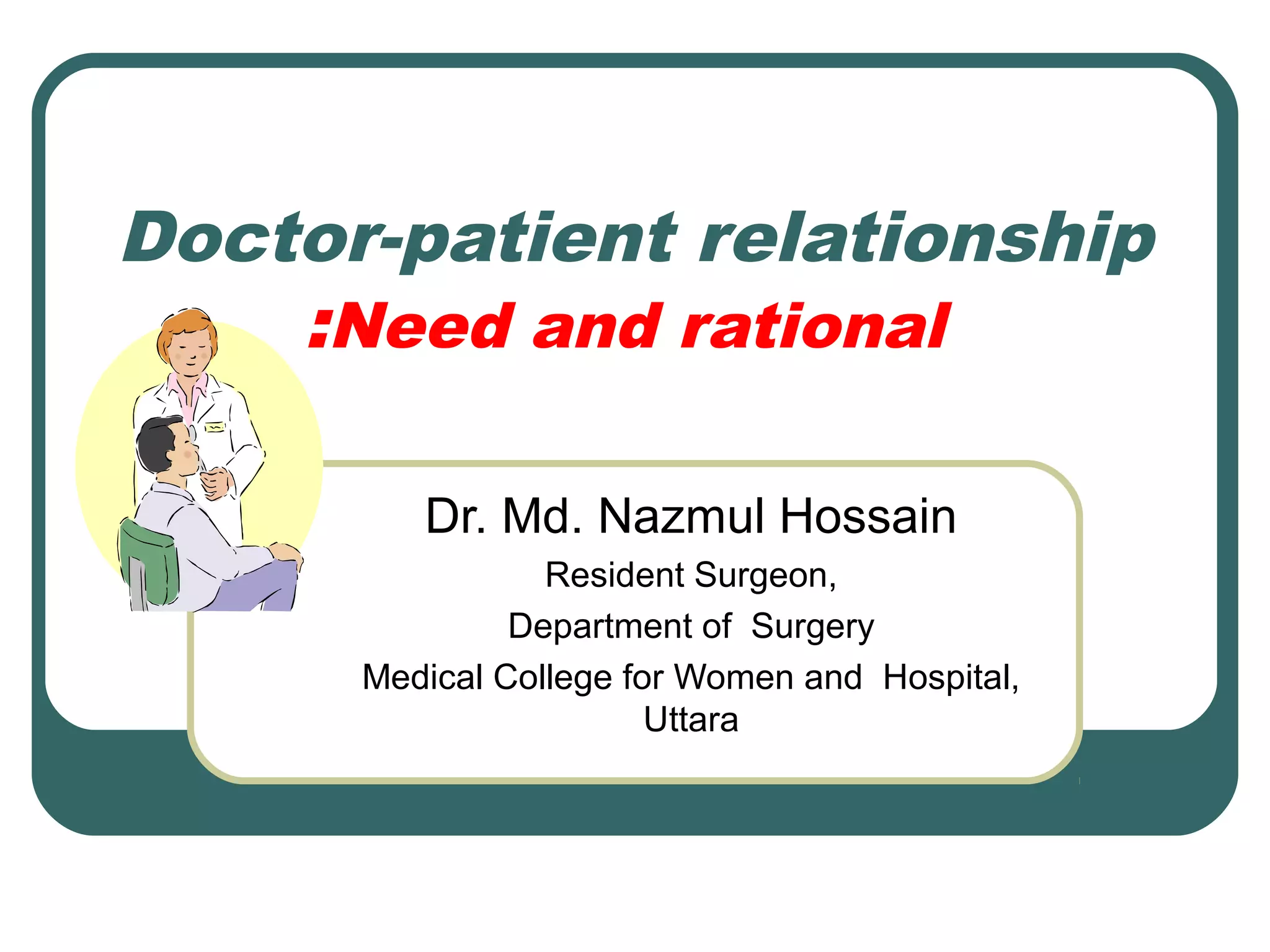

Doctor-patient relationship
:Need and rational
Dr. Md. Nazmul Hossain
Resident Surgeon,
Department of Surgery
Medical College for Women and Hospital,
Uttara
Learning objectives
By the end of this session audience should
be able to:
 Describe the different types of doctor-
patient relationships;
 Social factors influencing this consultation;
 Outline some of the sociological
perspectives on the doctor-patient
relationships.
Contents
 Introduction
 Types of D-P relationship
 Barrier of good communication
 Art of interview
 Recommendation
 Take home massage
Stop and think!
In what ways are relationships
between doctors and their
patients different from other
social relationships (e.g. between
student and librarian or between
passenger and bus driver?
Social relationships
 Perhaps patient has just met her
doctor, but within seconds s/he tells
the doctor very intimate personal
details about his/her health.
AND
 within a minutes, s/he is prepared
to remove his/her clothes and
submit to a physical examination.
Social relationships
 This is a one-way process, it would
be highly inappropriate if the doctor
started to discuss his/her own
bowel movements or if the patient
asked his/her personal questions.
 The doctor-patient interaction is
shaped by their differing social roles
and their different needs.
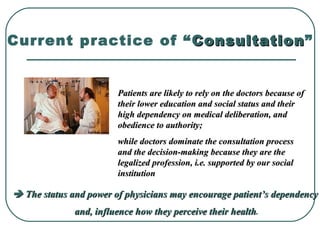
Current practice of “ ConsultationConsultation”
Patients are likely to rely on the doctors because ofPatients are likely to rely on the doctors because of
their lower education and social status and theirtheir lower education and social status and their
high dependency on medical deliberation, andhigh dependency on medical deliberation, and
obedience to authority;obedience to authority;
while doctors dominate the consultation processwhile doctors dominate the consultation process
and the decision-making because they are theand the decision-making because they are the
legalized profession, i.e. supported by our sociallegalized profession, i.e. supported by our social
institutioninstitution
 The status and power of physicians may encourage patient’s dependencyThe status and power of physicians may encourage patient’s dependency
and, influence how they perceive their healthand, influence how they perceive their health.
Disadvantages of the currentDisadvantages of the current
practicepractice
1.1. Restricts the patient’s inclination to help themselves.Restricts the patient’s inclination to help themselves.
2.2. Restricts the patients in giving their own opinion.Restricts the patients in giving their own opinion.
3.3. Reinforces the patient’s sick role.Reinforces the patient’s sick role.
4.4. Reinforces the hierarchical relationship betweenReinforces the hierarchical relationship between
doctor and patient.doctor and patient.
5.5. Assumes the doctor knows everything about the patientsAssumes the doctor knows everything about the patients
rather than the patient knowing his or her own conditionrather than the patient knowing his or her own condition
better (e.g. pain)better (e.g. pain)
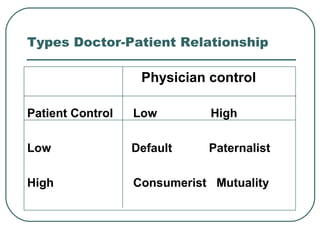
Types Doctor-Patient Relationship
Physician control
Patient Control Low High
Low Default Paternalist
High Consumerist Mutuality
Paternalism
The traditional D-P relationship
Doctor Takes on role of “parent”
Patient submissive
But currently shift towards Mutuality
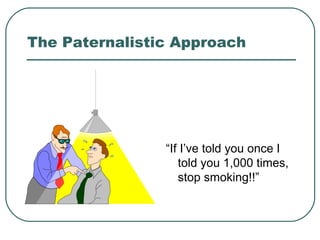
The Paternalistic Approach
“If I’ve told you once I
told you 1,000 times,
stop smoking!!”
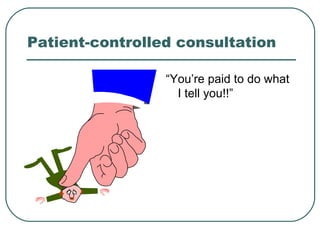
Patient-controlled consultation
“You’re paid to do what
I tell you!!”
Doctors’ barriers to effective
communication
• lack of specific knowledge;
• lack of counselling skills;
• lack of time;
• lack of appropriate resources.
Patient barriers to effective
communication
 Educational level
 Sex
 Social
 Different languages
 Membership of an ethnic minority
Developing a REAL relationship
 Have an „open” attitude: whatever is going on
between us in interaction is important and intimate,
no matter what is being discussed.
 Develop in the interviewee a feeling that he/she is
being treated
 Concentrate all your attention on the interviewee
 Help the interviewee to express those contents which
are important for the diagnosis
• Create a calm and unhurried atmosphere
• Listen kindly with empathy
• Do not express surprise
First minutes…
 Try not to be late…
 Concentrate fully and only at the patient
 Take care of the patients comfort
 Organize the environment
 Pay attention to the physical distance
 Introduce yourself…
The Art of asking questions
 The first question: general, open, refer to
the interviewee’s general life situation or
the presenting problem
• What brings you here?
• What can I do for you?
• What is your problem?
• Why are you here? (in the hospital)
• Could you tell me a bit more about …
The Art of asking questions
 Narrowing down the questions (general to
specific)
 Progression (relatively benign to personal)
 Direct questions
 Leading questions (indirect)
 Postponed questions (change of context,
better moment)
 Projective questions („some people…”,
description of interpersonal situation)
Language…
 The language must be matched to:
• interviewee’s intelectual level
• verbal skills
• personal experience
 Avoid the proffesional language and
shortenings
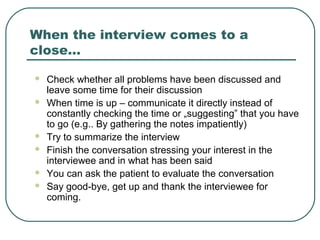
When the interview comes to a
close…
 Check whether all problems have been discussed and
leave some time for their discussion
 When time is up – communicate it directly instead of
constantly checking the time or „suggesting” that you have
to go (e.g.. By gathering the notes impatiently)
 Try to summarize the interview
 Finish the conversation stressing your interest in the
interviewee and in what has been said
 You can ask the patient to evaluate the conversation
 Say good-bye, get up and thank the interviewee for
coming.
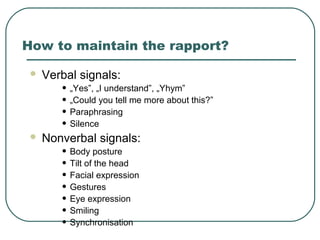
How to maintain the rapport?
 Verbal signals:
• „Yes”, „I understand”, „Yhym”
• „Could you tell me more about this?”
• Paraphrasing
• Silence
 Nonverbal signals:
• Body posture
• Tilt of the head
• Facial expression
• Gestures
• Eye expression
• Smiling
• Synchronisation
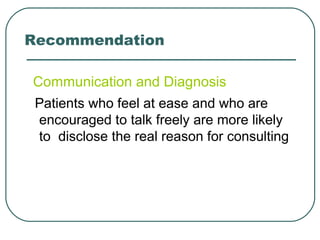
Recommendation
Communication and Diagnosis
Patients who feel at ease and who are
encouraged to talk freely are more likely
to disclose the real reason for consulting
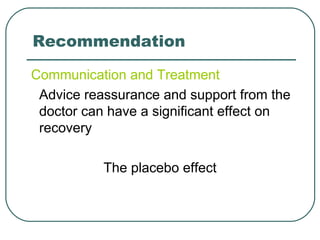
Communication and Treatment
Advice reassurance and support from the
doctor can have a significant effect on
recovery
The placebo effect
Recommendation
1.1. Both patient and doctor could participate inBoth patient and doctor could participate in
discussion and planning for treatments.discussion and planning for treatments.
2. Increase health knowledge and understanding2. Increase health knowledge and understanding
among patients.among patients.
3. Treat patients in a humanistic and adult manner3. Treat patients in a humanistic and adult manner
 Empowerment of the ptsEmpowerment of the pts
Take home message
Thank you

D

  • 1.
    Doctor-patient relationship :Need andrational Dr. Md. Nazmul Hossain Resident Surgeon, Department of Surgery Medical College for Women and Hospital, Uttara
  • 2.
    Learning objectives By theend of this session audience should be able to:  Describe the different types of doctor- patient relationships;  Social factors influencing this consultation;  Outline some of the sociological perspectives on the doctor-patient relationships.
  • 3.
    Contents  Introduction  Typesof D-P relationship  Barrier of good communication  Art of interview  Recommendation  Take home massage
  • 4.
    Stop and think! Inwhat ways are relationships between doctors and their patients different from other social relationships (e.g. between student and librarian or between passenger and bus driver?
  • 5.
    Social relationships  Perhapspatient has just met her doctor, but within seconds s/he tells the doctor very intimate personal details about his/her health. AND  within a minutes, s/he is prepared to remove his/her clothes and submit to a physical examination.
  • 6.
    Social relationships  Thisis a one-way process, it would be highly inappropriate if the doctor started to discuss his/her own bowel movements or if the patient asked his/her personal questions.  The doctor-patient interaction is shaped by their differing social roles and their different needs.
  • 7.
    Current practice of“ ConsultationConsultation” Patients are likely to rely on the doctors because ofPatients are likely to rely on the doctors because of their lower education and social status and theirtheir lower education and social status and their high dependency on medical deliberation, andhigh dependency on medical deliberation, and obedience to authority;obedience to authority; while doctors dominate the consultation processwhile doctors dominate the consultation process and the decision-making because they are theand the decision-making because they are the legalized profession, i.e. supported by our sociallegalized profession, i.e. supported by our social institutioninstitution  The status and power of physicians may encourage patient’s dependencyThe status and power of physicians may encourage patient’s dependency and, influence how they perceive their healthand, influence how they perceive their health.
  • 8.
    Disadvantages of thecurrentDisadvantages of the current practicepractice 1.1. Restricts the patient’s inclination to help themselves.Restricts the patient’s inclination to help themselves. 2.2. Restricts the patients in giving their own opinion.Restricts the patients in giving their own opinion. 3.3. Reinforces the patient’s sick role.Reinforces the patient’s sick role. 4.4. Reinforces the hierarchical relationship betweenReinforces the hierarchical relationship between doctor and patient.doctor and patient. 5.5. Assumes the doctor knows everything about the patientsAssumes the doctor knows everything about the patients rather than the patient knowing his or her own conditionrather than the patient knowing his or her own condition better (e.g. pain)better (e.g. pain)
  • 9.
    Types Doctor-Patient Relationship Physiciancontrol Patient Control Low High Low Default Paternalist High Consumerist Mutuality
  • 10.
    Paternalism The traditional D-Prelationship Doctor Takes on role of “parent” Patient submissive But currently shift towards Mutuality
  • 11.
    The Paternalistic Approach “IfI’ve told you once I told you 1,000 times, stop smoking!!”
  • 12.
  • 13.
    Doctors’ barriers toeffective communication • lack of specific knowledge; • lack of counselling skills; • lack of time; • lack of appropriate resources.
  • 14.
    Patient barriers toeffective communication  Educational level  Sex  Social  Different languages  Membership of an ethnic minority
  • 15.
    Developing a REALrelationship  Have an „open” attitude: whatever is going on between us in interaction is important and intimate, no matter what is being discussed.  Develop in the interviewee a feeling that he/she is being treated  Concentrate all your attention on the interviewee  Help the interviewee to express those contents which are important for the diagnosis • Create a calm and unhurried atmosphere • Listen kindly with empathy • Do not express surprise
  • 16.
    First minutes…  Trynot to be late…  Concentrate fully and only at the patient  Take care of the patients comfort  Organize the environment  Pay attention to the physical distance  Introduce yourself…
  • 17.
    The Art ofasking questions  The first question: general, open, refer to the interviewee’s general life situation or the presenting problem • What brings you here? • What can I do for you? • What is your problem? • Why are you here? (in the hospital) • Could you tell me a bit more about …
  • 18.
    The Art ofasking questions  Narrowing down the questions (general to specific)  Progression (relatively benign to personal)  Direct questions  Leading questions (indirect)  Postponed questions (change of context, better moment)  Projective questions („some people…”, description of interpersonal situation)
  • 19.
    Language…  The languagemust be matched to: • interviewee’s intelectual level • verbal skills • personal experience  Avoid the proffesional language and shortenings
  • 20.
    When the interviewcomes to a close…  Check whether all problems have been discussed and leave some time for their discussion  When time is up – communicate it directly instead of constantly checking the time or „suggesting” that you have to go (e.g.. By gathering the notes impatiently)  Try to summarize the interview  Finish the conversation stressing your interest in the interviewee and in what has been said  You can ask the patient to evaluate the conversation  Say good-bye, get up and thank the interviewee for coming.
  • 21.
    How to maintainthe rapport?  Verbal signals: • „Yes”, „I understand”, „Yhym” • „Could you tell me more about this?” • Paraphrasing • Silence  Nonverbal signals: • Body posture • Tilt of the head • Facial expression • Gestures • Eye expression • Smiling • Synchronisation
  • 22.
    Recommendation Communication and Diagnosis Patientswho feel at ease and who are encouraged to talk freely are more likely to disclose the real reason for consulting
  • 23.
    Communication and Treatment Advicereassurance and support from the doctor can have a significant effect on recovery The placebo effect Recommendation
  • 24.
    1.1. Both patientand doctor could participate inBoth patient and doctor could participate in discussion and planning for treatments.discussion and planning for treatments. 2. Increase health knowledge and understanding2. Increase health knowledge and understanding among patients.among patients. 3. Treat patients in a humanistic and adult manner3. Treat patients in a humanistic and adult manner  Empowerment of the ptsEmpowerment of the pts Take home message
  • 25.