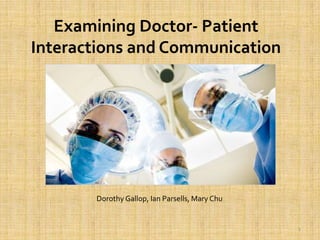
Examining Doctor- Patient Interactions and CommunicationDorothy Gallop, Ian Parsells, Mary Chu1
2Some of the Most Cited Authors:DiMatteo, R.	Hall, J.A.	Kaplan, S.H., Greenfield, S.	Levinson, W.Ong, L.M.L.Roter, D.L.		The Roter Interaction Analysis System (RIAS)	Stewart, M.	Stiles, W.B., Putnam, S.M., Wolf M.H., James, S.A.Waitzkin, H.
3The Roter Interaction Analysis System (RIAS) is a method of coding doctor-patient interaction during the medical visit. The system is broadly derived from the seminal work of Robert Bales for assessing patterns of small group interaction during problem-solving and decision-making (Interaction Process Analysis, Cambridge, Mass.: Addison-Wesley, 1950). The RIAS differs substantially from the original Bale's Process Analysis in four ways: • The coding approach is tailored to dyadic exchange specific to the medical encounter. All patient and physician dialogue is coded into categories that may be applied to each speaker, although some categories may be more common to a particular speaker. • Categories are tailored to directly reflect the content and context of the routine dialogue between patients and doctors during medical exchanges. • Identification and classification of verbal events are coded directly from videotapes or audiotapes and not transcripts. • Since coding is done directly from video or audiotapes, rather than transcripts, assessment of the tonal qualities of interaction is possible. These tonal qualities transmit the emotional context of the visit beyond the significance of the words spoken. Based on a general affective impression, coders rate both the patient and physician on global affective dimensions such as anger, anxiety, dominance, friendliness and interest.  55 page paper explaining the Roter methodhttp://www.rias.org/manual.pdf
4Some of the most cited journals	Annals of Family Medicine	British Medical Journal	Information Research	Journal of the American Board of Family Practice		Journal of the American Medical Association	Journal of Health Communication	Journal of Health Economics	Journal of the Medical Library Association	Patient Education and Counseling	Social Science & Medicine	Sociology of Health & Illness
5So Many Choices, So Little Time…
6			  Lay Information MediariesParents		         Spouse		      Other Family Members
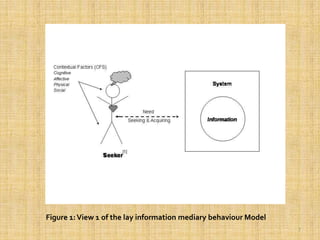
7Figure 1: View 1 of the lay information mediarybehaviour Model
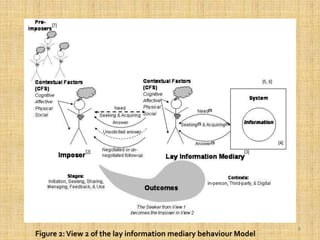
8Figure 2: View 2 of the lay information mediarybehaviour Model
9The rise of the e-patientSusannah Fox from the Pew Internet and American Life Project discusses the latest research on e-patients, including now many people are engaging in social media for health. Fox also gives advice for how patients can avoid information overload when going online.http://www.icyou.com/topics/politics-policy/health-2-0-meets-ix-susannah-fox
10RCS-ORelational Communication Scale for Observational Measurement
11Immediacy/affectionThe physician was intensely involved in the conversation with the patientThe physician did not want a deeper relationship with the patientThe physician was not attracted to the patientThe physician found the conversation stimulatingThe physician communicated coldness rather than warmthThe physician created a sense of distance between he/she and the patientThe physician acted as if he/she was boredThe physician was interested in talking to the patientThe physician showed enthusiasm while talking with the patientSimilarity/depthThe physician made the patient feel that they were similar to he/sheThe physician tried to move the conversation to a deeper levelThe physician acted like he/she and the patient were good friendsThe physician seemed to desire further communication with the patientThe physician seemed to care if the patient liked him/her or notReceptivity/trustThe physician was sincereThe physician was interested in talking with the patientThe physician wanted the patient to trust him/herThe physician was willing to listen to the patientThe physician was open to the patient’s ideasThe physician was honest in communicating with the patient
12ComposureThe physician felt very tense talking with the patientThe physician was calm and posed with the patientThe physician felt very relaxed talking with the patientThe physician seemed nervousThe physician was comfortable interacting with the patientFormalityThe physician made the interaction very formalThe physician wanted the discussion to be casualThe physician wanted the discussion to be informalDominanceThe physician attempted to persuade the patientThe physician did not attempt to influence the patientThe physician tried to control the interactionThe physician tried to gain the approval of the patientThe physician did not try to win the patient’s favorThe physician had the upper hand in the conversation
13Domains of communication in the provider-patient relationship
14House demonstrates how to not engender trust…http://www.youtube.com/watch?v=pZsICYJ1tW4first minute and 8 seconds
15
16Why they thought the doctor had a negative feeling about the information,'The doctor brushed me off "because that is not what's wrong with you"'.
'Because I was going against his advice he was difficult, but finally agreed'.
'The doctor obviously felt that it was not the correct method of treating the problem'.
'The doctor thought I was trying to self diagnose'.
'He said he was the doctor... what did I know?'17What other communication behaviors transpire and what are patients looking for in their relationship with their doctors?
18What are some of the methods used to study these communications?
19“Towards a theoretical framework”L.M.L. Ong, et al(1995)
Nonverbal Behavior and CommunicationWhat do we say when we’re not talking? What’s hidden underneath when we are? Are words the only means of information transfer?20
Nonverbal Behavior and CommunicationWhen did we start discussing Nonverbal Behavior?What we recognize as Nonverbal Behavior began with Charles Darwin back in 1872. According to Darwin, earlier in our evolutionary history, Nonverbal Behaviors had specific functions that now have lost their initial meanings. 	Over time, these behaviors have gained a communicative value as they provide others with external evidence of someone’s internal state.	(Krauss et al., 1996)21
Nonverbal Behavior and Communication	What constitutes as Nonverbal Behavior and why is it important? 	According to D.L. Roter, J.A. Hall, et al. (2005), nonverbal behavior includes communicative behaviors that do not carry content of a linguistic nature such as:  Facial Expressivity
  Smiling/Frowning
  Eye Contact
  Head Nodding
  Hand Gestures
  Posture and Body Leaning
  Position
  Appearance
  Speech Rate
  Loudness
  Pitch
  Pauses
  Interruptions
  Tone“An estimated 60-65% of the meaning in a social encounter is communicated nonverbally,” (Griffith et al., 2003). 22
Nonverbal Behavior and CommunicationConfused?Then let’s begin with some visual examples!http://www.youtube.com/watch?v=cEkT5uspE3c23
Nonverbal Behavior and CommunicationHow does this apply to Physician-Patient interaction?Nonverbal communication often anticipates, alters, substitutes for, emphasizes, or even contradicts verbal communication and it’s the primary way people express emotions. (Griffith et al., 2003)
Emotion-related communication skills, mostly nonverbal, are critical for high-quality care and influence patient satisfaction, adherence, and outcomes. (Roter et al., 2005)24
Nonverbal Behavior and Communication	How does this apply to Physician-Patient interaction? (cont.)Nonverbal behaviors contribute to the development of trust and rapport, as well as the establishment and maintenance of relationships with patients. (Ambady et al., 2002)Nonverbal behavior is the most essential way to convey empathy with patients. (Bensing et al., 1995)25
Nonverbal Behavior and Communication	Specific Examples:Head nods, open arm positions, and forward leans are thought to convey encouragement and interest.Body position has been related to patients’ perception of warmth and empathy.Smiles convey approval or agreement, frowns disapproval. Blank expressions may convey boredom, aloofness, or dismissal.26

Doctor Patient Communication

  • 1.
    Examining Doctor- PatientInteractions and CommunicationDorothy Gallop, Ian Parsells, Mary Chu1
  • 2.
    2Some of theMost Cited Authors:DiMatteo, R. Hall, J.A. Kaplan, S.H., Greenfield, S. Levinson, W.Ong, L.M.L.Roter, D.L. The Roter Interaction Analysis System (RIAS) Stewart, M. Stiles, W.B., Putnam, S.M., Wolf M.H., James, S.A.Waitzkin, H.
  • 3.
    3The Roter InteractionAnalysis System (RIAS) is a method of coding doctor-patient interaction during the medical visit. The system is broadly derived from the seminal work of Robert Bales for assessing patterns of small group interaction during problem-solving and decision-making (Interaction Process Analysis, Cambridge, Mass.: Addison-Wesley, 1950). The RIAS differs substantially from the original Bale's Process Analysis in four ways: • The coding approach is tailored to dyadic exchange specific to the medical encounter. All patient and physician dialogue is coded into categories that may be applied to each speaker, although some categories may be more common to a particular speaker. • Categories are tailored to directly reflect the content and context of the routine dialogue between patients and doctors during medical exchanges. • Identification and classification of verbal events are coded directly from videotapes or audiotapes and not transcripts. • Since coding is done directly from video or audiotapes, rather than transcripts, assessment of the tonal qualities of interaction is possible. These tonal qualities transmit the emotional context of the visit beyond the significance of the words spoken. Based on a general affective impression, coders rate both the patient and physician on global affective dimensions such as anger, anxiety, dominance, friendliness and interest.  55 page paper explaining the Roter methodhttp://www.rias.org/manual.pdf
  • 4.
    4Some of themost cited journals Annals of Family Medicine British Medical Journal Information Research Journal of the American Board of Family Practice Journal of the American Medical Association Journal of Health Communication Journal of Health Economics Journal of the Medical Library Association Patient Education and Counseling Social Science & Medicine Sociology of Health & Illness
  • 5.
    5So Many Choices,So Little Time…
  • 6.
    6 LayInformation MediariesParents Spouse Other Family Members
  • 7.
    7Figure 1: View1 of the lay information mediarybehaviour Model
  • 8.
    8Figure 2: View2 of the lay information mediarybehaviour Model
  • 9.
    9The rise ofthe e-patientSusannah Fox from the Pew Internet and American Life Project discusses the latest research on e-patients, including now many people are engaging in social media for health. Fox also gives advice for how patients can avoid information overload when going online.http://www.icyou.com/topics/politics-policy/health-2-0-meets-ix-susannah-fox
  • 10.
    10RCS-ORelational Communication Scalefor Observational Measurement
  • 11.
    11Immediacy/affectionThe physician wasintensely involved in the conversation with the patientThe physician did not want a deeper relationship with the patientThe physician was not attracted to the patientThe physician found the conversation stimulatingThe physician communicated coldness rather than warmthThe physician created a sense of distance between he/she and the patientThe physician acted as if he/she was boredThe physician was interested in talking to the patientThe physician showed enthusiasm while talking with the patientSimilarity/depthThe physician made the patient feel that they were similar to he/sheThe physician tried to move the conversation to a deeper levelThe physician acted like he/she and the patient were good friendsThe physician seemed to desire further communication with the patientThe physician seemed to care if the patient liked him/her or notReceptivity/trustThe physician was sincereThe physician was interested in talking with the patientThe physician wanted the patient to trust him/herThe physician was willing to listen to the patientThe physician was open to the patient’s ideasThe physician was honest in communicating with the patient
  • 12.
    12ComposureThe physician feltvery tense talking with the patientThe physician was calm and posed with the patientThe physician felt very relaxed talking with the patientThe physician seemed nervousThe physician was comfortable interacting with the patientFormalityThe physician made the interaction very formalThe physician wanted the discussion to be casualThe physician wanted the discussion to be informalDominanceThe physician attempted to persuade the patientThe physician did not attempt to influence the patientThe physician tried to control the interactionThe physician tried to gain the approval of the patientThe physician did not try to win the patient’s favorThe physician had the upper hand in the conversation
  • 13.
    13Domains of communicationin the provider-patient relationship
  • 14.
    14House demonstrates howto not engender trust…http://www.youtube.com/watch?v=pZsICYJ1tW4first minute and 8 seconds
  • 15.
  • 16.
    16Why they thoughtthe doctor had a negative feeling about the information,'The doctor brushed me off "because that is not what's wrong with you"'.
  • 17.
    'Because I wasgoing against his advice he was difficult, but finally agreed'.
  • 18.
    'The doctor obviouslyfelt that it was not the correct method of treating the problem'.
  • 19.
    'The doctor thoughtI was trying to self diagnose'.
  • 20.
    'He said hewas the doctor... what did I know?'17What other communication behaviors transpire and what are patients looking for in their relationship with their doctors?
  • 21.
    18What are someof the methods used to study these communications?
  • 22.
    19“Towards a theoreticalframework”L.M.L. Ong, et al(1995)
  • 23.
    Nonverbal Behavior andCommunicationWhat do we say when we’re not talking? What’s hidden underneath when we are? Are words the only means of information transfer?20
  • 24.
    Nonverbal Behavior andCommunicationWhen did we start discussing Nonverbal Behavior?What we recognize as Nonverbal Behavior began with Charles Darwin back in 1872. According to Darwin, earlier in our evolutionary history, Nonverbal Behaviors had specific functions that now have lost their initial meanings. Over time, these behaviors have gained a communicative value as they provide others with external evidence of someone’s internal state. (Krauss et al., 1996)21
  • 25.
    Nonverbal Behavior andCommunication What constitutes as Nonverbal Behavior and why is it important? According to D.L. Roter, J.A. Hall, et al. (2005), nonverbal behavior includes communicative behaviors that do not carry content of a linguistic nature such as: Facial Expressivity
  • 26.
  • 27.
    EyeContact
  • 28.
    HeadNodding
  • 29.
    HandGestures
  • 30.
    Postureand Body Leaning
  • 31.
  • 32.
  • 33.
  • 34.
  • 35.
  • 36.
  • 37.
  • 38.
    Tone“Anestimated 60-65% of the meaning in a social encounter is communicated nonverbally,” (Griffith et al., 2003). 22
  • 39.
    Nonverbal Behavior andCommunicationConfused?Then let’s begin with some visual examples!http://www.youtube.com/watch?v=cEkT5uspE3c23
  • 40.
    Nonverbal Behavior andCommunicationHow does this apply to Physician-Patient interaction?Nonverbal communication often anticipates, alters, substitutes for, emphasizes, or even contradicts verbal communication and it’s the primary way people express emotions. (Griffith et al., 2003)
  • 41.
    Emotion-related communication skills,mostly nonverbal, are critical for high-quality care and influence patient satisfaction, adherence, and outcomes. (Roter et al., 2005)24
  • 42.
    Nonverbal Behavior andCommunication How does this apply to Physician-Patient interaction? (cont.)Nonverbal behaviors contribute to the development of trust and rapport, as well as the establishment and maintenance of relationships with patients. (Ambady et al., 2002)Nonverbal behavior is the most essential way to convey empathy with patients. (Bensing et al., 1995)25
  • 43.
    Nonverbal Behavior andCommunication Specific Examples:Head nods, open arm positions, and forward leans are thought to convey encouragement and interest.Body position has been related to patients’ perception of warmth and empathy.Smiles convey approval or agreement, frowns disapproval. Blank expressions may convey boredom, aloofness, or dismissal.26

Editor's Notes

  • #10 first 3 minutes 25 seconds.
  • #34 -- Evidence that men and women are treated differently in everyday conversation
  • #35 Deborah Roter (John Hopkins University) & Judith Hall (Northeastern University)Individually, they have published extensively on different communicative roles of gender, and also collaborated on research together. Studies on gynecology and OBGYNs- 1 reported study higher but non significant levels of psychosocial behavior from male doctors to female patients.
  • #36 Scrubs– miscommunication between doctor and patient.Racist doctor? http://www.youtube.com/watch?v=K_ydNGDR-SM-- STAR TREK
  • #37 Previous research indicates that physicians expect themselves to not be affected by race or demographicsThe doctors in this study 84% were white, 11% Asian, 1% African American, and 3% HispanicPoint 1: Also perceived African-Americans and members of low/middle class groups more negatively than whites and higher SES. Point 2: Physicians attitudes towards patients is important because of their impact on the patient’s satisfaction and behavior. If a patient feels that the doctor cares about them and is interested in them as a person, they’re more likely to
  • #40 Information PovertyGordon– study on cancer patients, specifically looking at the racial issues and lung cancerDeclined elective surgery because they believed that when cancer was exposed to air, it would cause the cancer to spread.- Patients more cautious due to less favorable attitudes from doctors- less likely to engage, ask questions, SensemakingChilean study, patients claimed that being touched was a reason why the care they received was good. (Ong, L.M.L 1995)Not so in the U.S.
  • #41 School of Information and Library Science faculty @ UNC Chapel Hill ClaudiaGollop’s study looked at a very specific slice of a population in Pittsburgh– They considered their medical doctor to be the best and most reliable source
  • #42 But… they also held the library in high regard,
  • #43 #4: “Top down information transmission has ignored the realities of lay person’s lives […] it blames the victims and is received as irrelevant at best and prejudicial and oppressive at worse.#5 The information environment marked by decreasing trust in expert and institutional sources