SURGICAL
DEONTOLOGY
SHUBHAM(A.R)
MEDICAL DEONTOLOGY
Medical Deontology (Greek deon „duty‟ or „obligation‟;
is a system of moral principles that apply values
and judgments to the practice of medicine.
“set of ethical standardsand principles of behaviour of medical
practitioners while executing their professional
duties,professional ethics of medical workers and principlesof
behavior of medical personnel,directed toward maximum
benefit of treatment.”
Code of medical ethics by the World
Medical Association in Geneva(1949)
In relation to the patient, the medical worker must pay
maximum attention and apply all his knowledge in order to
restore the patient to health or bring relief to him in his
sufferings;
He must convey to the patient only information about
hishealth that will be beneficial to him and establish contact
between the patient and the physician.
He must avoid in the presence of the patient, conversations
and discussions with colleagues, personnel, and with the
patient himself concerning his illness, which sometimes
produce the development of iatrogenic diseases( diseases
produced by medical personal)
THEOBJECTSOF STUDY IN MEDICAL ETHICS
The medical ethics studies and defines the solution of
various problems of inter-personal mutual relations in
three basicdirections:
medical worker – patient,
medical worker – relatives of the patient,
medical worker – medical worker
Communication in medicine as base of
the doctor-patient relationship
Adoctor–patient relationship is very important in
healthcare, because the success of diagnosis and
treatment of disease depends from the quality of this
relationship.
Communication is the main tool that doctor can use in
order to build a strong and successful relationship with
a patient.
There are rules that doctor need to follow during
communication with a patient, in order to build a
successful relationship.
Patient‐Clinician Communication:
Basic Principles
1.Mutual respect
2. Harmonized goals
3. Asupportive environment
4. The rightinformation
5. Transparency
6. Continuous learning
Communication in medicine as base of the
doctor-patient relationship
Rules:
Sitting down duringconsultation
Apply to the patient as an individul
Showing interest and respect
Listening attentively
Listening to concerns and calming fears
Answering questions honestly
Informing and educating patients about treatment options
Involving patients in making decisions about their
treatment
Demonstrating sensitivity to patients’ cultural and ethnic
diversity
When patient enters the office, doctor needs to leave
all other work and pay all the attention to the patient;
the first meeting is very important, so, doctor needs
to welcome the patient and to represent himself;
The atmosphere at the office needs to be comfortable,
no noise, extra light, no other people at the office (the
best dialog can be built if in the room be only doctor
and the patient, because this will give opportunity to
the patient to be honest,);
While talking to the patient doctor needs to show his
interest in the discussion, he needs to pay attention
to all the information;
Doctor needs to guide the dialog; he needs to ask
questions very clear, using words that patient will be
able to understand;
It is very important to give opportunity to the
patient to ask questions; doctor need to make sure that
patient understands everything about his disease,
about the efficacy of the treatment, about his chances
for recovery; doctor needs to be honest with the
patient;
- While talking to a patient doctor needs to place
himself “on the same level” with the patient. This will
help to build a better relationship. It is not appropriate
to say phrases as “I know better”, or “just do as I said”,
doctor needs to talk with the patient using simple
words, a very small amount of special medical
terminology, and if so, to explain to the patient the
meaning of everyword;
- Patient is the one who makes decisions; doctor
needs to explain the health status of the patient, he
needs to explain to the patient preferred ways of
treatment, but the patient is the one who decides in
which way he wants to be treated (surgery,
pharmacotherapy, etc.).
Effective communication
techniques
Patient feels unconfortable during medical examination:
Doctor needs to describe what he is going to do next, and
what patient needs to do, for example: “I am going to listen to
your heart beat, would you, please take off your short?”
The purpose of every step during medical examination needs to
be explained, so, that patient feels more comfortable.
If patient refuses to follow doctor’s instructions, then, doctor
needs to ask the patient what are the causes, doctor needs to
explain why this is so important to make physical
examination; he needs to be very polite, very attentive.
Types ofcommunication
 There are 2 types of communication: verbal and non-
verbal communication.
 They both play very significant role in the realtions of
doctor and patient.
 While talking to a patient, doctor needs to pay
attention on the words he is using.
 He needs to use simple phrases, do not use only
medical terminology, so, that patient will be able to
understand everything.
Verbal communication:rules
• Acceptance: accepts legitimacy of patient's views and
feelings; is not judgmental
• Empathy: uses empathy to communicate
understanding and appreciation of the
patient's feelings or predicament;
• Support patient; offer partnership
• Sensitivity: be careful with embarrassing and
disturbing topics, including when associated with
physical examination
NON-VERBALCOMMUNICATION
• Posture: sitting, standing, relaxed
• Proximity: use of space, physical distance between and positioning
of communicators
•Touch: handshake, pat, physical contact during physical
examination
• Body movements: hand and arm gestures, foot and leg movements
• Facial expression: raised eyebrows, smile, crying
• Eye behavior: eye contact,staring
•Vocal cues: rate, volume, rhythm, silence, pause, intonation, speech
errors
• Use of time: early, late, on time, over time, rushed, slow to respond
• Physical presence: race, gender, body shape, clothing
•Environment: location, furniture placement,lighting, temperature,
color.
COMMON MISTAKES
- Asking too many questions
- Not allowing the patient to tell their story in their
own words
- Unnecessary interruptions
- Failing to pick up important verbal and non-verbal
skills
Rules of good practice in patient
information
While telling to a patient any type of information
about his health, doctor needs to be very careful,
especially if he has bad news for the patient.
First, doctor need to remember about the rule of
confidentiality, so, the patient needs to be the first one
to know any information about his health.
Before telling a bad news to the patient, doctor needs
to prepare the patient.
The process of giving badnews
 Give information
 Check the patients understanding of the information
 Identify the patient's main concerns
 give realistic hope
Consultation skills:
While talking to a patient doctor needs to:
To get the most out of the consultation for the patient
foremost and for the doctor.
To plan the consultation using a framework
To adapt style of consulting to meet the needs of the
patient
To handle difficultsituations
To have “rescue” plans when things go wrong
To use time efficiently in the consultation
To be able to improve the consultation
Consultation skills:
While talking to a patient doctor needs to:
Develop fluent dialogue with patient
Use silence effectively, allowing patient enough time to
express thoughtsor feelings
Actively encouraged patient through use of supportive
words or comments
Effectively use non-verbal behavior,
Use open, exploratory questions – inviting patient to
become activelyinvolved
Adjust language as appropriate, to meet particular needs of
the situation
Consultation:
Doctor needs to pay attention not only to physical
problems of the patient, he needs also to estimate
patient’s
- Social behavior, socialskills,
- Psychological health
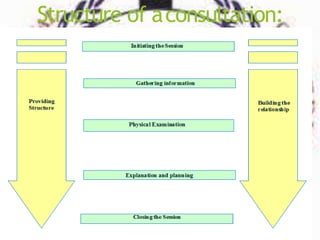
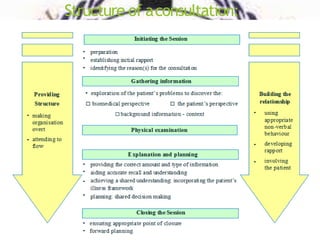
Structure of aconsultation:
Deontology

Deontology

  • 1.
  • 2.
    MEDICAL DEONTOLOGY Medical Deontology(Greek deon „duty‟ or „obligation‟; is a system of moral principles that apply values and judgments to the practice of medicine. “set of ethical standardsand principles of behaviour of medical practitioners while executing their professional duties,professional ethics of medical workers and principlesof behavior of medical personnel,directed toward maximum benefit of treatment.”
  • 3.
    Code of medicalethics by the World Medical Association in Geneva(1949) In relation to the patient, the medical worker must pay maximum attention and apply all his knowledge in order to restore the patient to health or bring relief to him in his sufferings; He must convey to the patient only information about hishealth that will be beneficial to him and establish contact between the patient and the physician. He must avoid in the presence of the patient, conversations and discussions with colleagues, personnel, and with the patient himself concerning his illness, which sometimes produce the development of iatrogenic diseases( diseases produced by medical personal)
  • 4.
    THEOBJECTSOF STUDY INMEDICAL ETHICS The medical ethics studies and defines the solution of various problems of inter-personal mutual relations in three basicdirections: medical worker – patient, medical worker – relatives of the patient, medical worker – medical worker
  • 5.
    Communication in medicineas base of the doctor-patient relationship Adoctor–patient relationship is very important in healthcare, because the success of diagnosis and treatment of disease depends from the quality of this relationship. Communication is the main tool that doctor can use in order to build a strong and successful relationship with a patient. There are rules that doctor need to follow during communication with a patient, in order to build a successful relationship.
  • 6.
    Patient‐Clinician Communication: Basic Principles 1.Mutualrespect 2. Harmonized goals 3. Asupportive environment 4. The rightinformation 5. Transparency 6. Continuous learning
  • 7.
    Communication in medicineas base of the doctor-patient relationship Rules: Sitting down duringconsultation Apply to the patient as an individul Showing interest and respect Listening attentively Listening to concerns and calming fears Answering questions honestly Informing and educating patients about treatment options Involving patients in making decisions about their treatment Demonstrating sensitivity to patients’ cultural and ethnic diversity
  • 8.
    When patient entersthe office, doctor needs to leave all other work and pay all the attention to the patient; the first meeting is very important, so, doctor needs to welcome the patient and to represent himself; The atmosphere at the office needs to be comfortable, no noise, extra light, no other people at the office (the best dialog can be built if in the room be only doctor and the patient, because this will give opportunity to the patient to be honest,);
  • 9.
    While talking tothe patient doctor needs to show his interest in the discussion, he needs to pay attention to all the information; Doctor needs to guide the dialog; he needs to ask questions very clear, using words that patient will be able to understand; It is very important to give opportunity to the patient to ask questions; doctor need to make sure that patient understands everything about his disease, about the efficacy of the treatment, about his chances for recovery; doctor needs to be honest with the patient;
  • 10.
    - While talkingto a patient doctor needs to place himself “on the same level” with the patient. This will help to build a better relationship. It is not appropriate to say phrases as “I know better”, or “just do as I said”, doctor needs to talk with the patient using simple words, a very small amount of special medical terminology, and if so, to explain to the patient the meaning of everyword; - Patient is the one who makes decisions; doctor needs to explain the health status of the patient, he needs to explain to the patient preferred ways of treatment, but the patient is the one who decides in which way he wants to be treated (surgery, pharmacotherapy, etc.).
  • 11.
    Effective communication techniques Patient feelsunconfortable during medical examination: Doctor needs to describe what he is going to do next, and what patient needs to do, for example: “I am going to listen to your heart beat, would you, please take off your short?” The purpose of every step during medical examination needs to be explained, so, that patient feels more comfortable. If patient refuses to follow doctor’s instructions, then, doctor needs to ask the patient what are the causes, doctor needs to explain why this is so important to make physical examination; he needs to be very polite, very attentive.
  • 12.
    Types ofcommunication  Thereare 2 types of communication: verbal and non- verbal communication.  They both play very significant role in the realtions of doctor and patient.  While talking to a patient, doctor needs to pay attention on the words he is using.  He needs to use simple phrases, do not use only medical terminology, so, that patient will be able to understand everything.
  • 13.
    Verbal communication:rules • Acceptance:accepts legitimacy of patient's views and feelings; is not judgmental • Empathy: uses empathy to communicate understanding and appreciation of the patient's feelings or predicament; • Support patient; offer partnership • Sensitivity: be careful with embarrassing and disturbing topics, including when associated with physical examination
  • 14.
    NON-VERBALCOMMUNICATION • Posture: sitting,standing, relaxed • Proximity: use of space, physical distance between and positioning of communicators •Touch: handshake, pat, physical contact during physical examination • Body movements: hand and arm gestures, foot and leg movements • Facial expression: raised eyebrows, smile, crying • Eye behavior: eye contact,staring •Vocal cues: rate, volume, rhythm, silence, pause, intonation, speech errors • Use of time: early, late, on time, over time, rushed, slow to respond • Physical presence: race, gender, body shape, clothing •Environment: location, furniture placement,lighting, temperature, color.
  • 15.
    COMMON MISTAKES - Askingtoo many questions - Not allowing the patient to tell their story in their own words - Unnecessary interruptions - Failing to pick up important verbal and non-verbal skills
  • 16.
    Rules of goodpractice in patient information While telling to a patient any type of information about his health, doctor needs to be very careful, especially if he has bad news for the patient. First, doctor need to remember about the rule of confidentiality, so, the patient needs to be the first one to know any information about his health. Before telling a bad news to the patient, doctor needs to prepare the patient.
  • 17.
    The process ofgiving badnews  Give information  Check the patients understanding of the information  Identify the patient's main concerns  give realistic hope
  • 18.
    Consultation skills: While talkingto a patient doctor needs to: To get the most out of the consultation for the patient foremost and for the doctor. To plan the consultation using a framework To adapt style of consulting to meet the needs of the patient To handle difficultsituations To have “rescue” plans when things go wrong To use time efficiently in the consultation To be able to improve the consultation
  • 19.
    Consultation skills: While talkingto a patient doctor needs to: Develop fluent dialogue with patient Use silence effectively, allowing patient enough time to express thoughtsor feelings Actively encouraged patient through use of supportive words or comments Effectively use non-verbal behavior, Use open, exploratory questions – inviting patient to become activelyinvolved Adjust language as appropriate, to meet particular needs of the situation
  • 20.
    Consultation: Doctor needs topay attention not only to physical problems of the patient, he needs also to estimate patient’s - Social behavior, socialskills, - Psychological health
  • 21.
  • 22.