Unit 2-4 Organizations & Movements
Myths About Affirmative Action  (Wise, 1995)
1) Affirmative action violates color-blind meritocracy.  This myth relies on two assumptions:   AA Gives preference to Lesser Qualified Minorities.  Without AA we would always judge people based on their qualifications.
Only 1 in 10 Whites claim to be victims of “reverse discrimination.”  16% of Whites claim they know someone who was a victim. 70% of Whites are convinced that this problem is rampant. 2) Whites are the victims of massive reverse discrimination.
In 1994, over 90,000 complaints of employment discrimination were filed with the EEOC; less than 3% were claims of reverse discrimination and this number hasn’t changed in the last decade.
3) Affirmative action damages black self-esteem.  This is the idea that by having “preferential treatment” we are creating permanent victims.
How does the greater likelihood of getting a good job hurt self-esteem?   The concern of damage to self-esteem arising from presumably “unearned privilege” is quite selective – shouldn’t Whites have lower self-esteem since they receive things all the time simply because they are White?
Since 1973 the number of African Americans who believe that hard work is the key to success has risen 15%. Apparently affirmative action isn’t hurting drive, it’s helping it.
4) Affirmative action is the cause of increased racial tension. Frankly – this isn’t happening.  In fact, support for affirmative action pieces of legislation around the nation is actually quite high – even among white males.
5) Affirmative action helps the wrong blacks and hurts the wrong whites. Affirmative action has been shown to help minorities in every social class – not just the more wealthy, less needing ones. The Number One Group to be helped by Affirmative Action to date has been White Women.
61% of all White-owned business have no minority workers, while less than 5% of minority-owned business (with employees), fail to have minority workers.  And most do not just have minority employees.
The Creation of Ghettos   “ I’m not responsible for what happened during slavery”  Just because we didn’t start the fire does not mean that we should not do what is necessary to help put out the fire and rebuild.
Affirmative action actually helps Whites   So long as minorities are held back and paid lower wages, the overall wage base is bid downward, so that working-class Whites are kept in a worse position than they would be were wages more equal and the labor market not so divided.
Discrimination costs all of society in terms of lost productivity.  The Commerce Department estimates that $100 billion annually is lost because of discrimination in the work place because discrimination prevents its victims from fully contributing to society.
Organizations as Cultural Groups The rites and rituals, communication rules/norms, metaphors, organizational texts, stories, images, and myths that build an organization’s unique sense of place and purpose.
Hofstede (1984) Revisited
Power Distance   Distance you are from the Top of the hierarchy to the Bottom
Individualism vs. Collectivism   1) Individual   2) Group (our personal group is what is important)   3) Collective (our people are important)
Uncertainty Avoidance   Degree to which people feel apprehensive about unknown situations & the extent they will go to avoid them.   Weak:  reduce rules, accept dissent, & take risks Strong:  extensive rules & seek consensus
Masculinity/Femininity Masculine  (Assertiveness): Achievement, ambition, acquisition of material goods   Feminine  (Responsiveness): Quality of life, servitude, nurturing, support for less fortunate
Diversity Training in Organizations
What is Diversity Training?   Diversity training is training in diversity understanding and tolerance.
Why is Diversity Training needed?   One of the cultural imperatives is economical.  We need to train employees how to effectively work and interact with people from other cultures to make money.
How to go about conducting an organizational culture profile   Basically, do an ethnography on a culture.  You look at a culture and see how it functions and what problems exist on the cultural level.
Implications of diversity training   Offer a better return on investment in human capital. Increase the pool of talent for recruitment. Increase creativity  Provide resources for attracting a diverse market. Increase productivity
Implications of diversity training   Increase an organization's ability to compete in the world market. Solve complex community challenges. Deliver services more effectively. Offer insights into socially responsible practices. Balance social, moral, and economic concerns in a single effort.
Social Movements
Characteristics of Social Movements ( Stewart, Denton, & Smith, 1994 )
Organized Collectivity   Group of people who come together with the goal to change the status quo.
Uninstitutionalized Collectivity   If it’s part of the institution it’s not really a social movement.
Large in Scope   A social movement is not people against one corporation (the anti-McDonalds groups). Instead, they are looking for larger social changes.
Proposed or Opposes Change in Societal Norms and Values   Movements always call for a change of some kind.
Moral in Tone   A social movement group will always attempt to demonstrate how the group is more moral than those in the institution.
Encounters Opposition   If a social movement doesn’t encounter opposition, then it’s truly part of status quo.
Persuasion is Pervasive   Persuasion is the basis of EVERY social movement.
Life Cycle of a Social Movement
Genesis  People see that there is a problem.
Triggering/Catalytic Event An event of some kind spurs the movement into Rapid Development.
Social Unrest Group members feel the need to do something proactive.
Enthusiastic Mobilization Members start recruiting more people as they start to take on the status quo.
Maintenance Period from Mobilization to Termination where the social movement progresses.
Termination Movement either becomes part of the status quo or disbands.
Three Characteristics of Movement Leadership
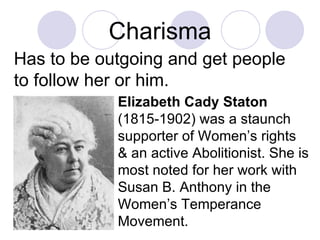
Charisma Has to be outgoing and get people to follow her or him. Elizabeth Cady Staton  (1815-1902) was a staunch supporter of Women’s rights & an active Abolitionist. She is most noted for her work with Susan B. Anthony in the Women’s Temperance Movement.
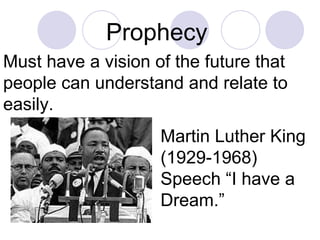
Prophecy  Must have a vision of the future that people can understand and relate to easily.  Martin Luther King (1929-1968) Speech “I have a Dream.”
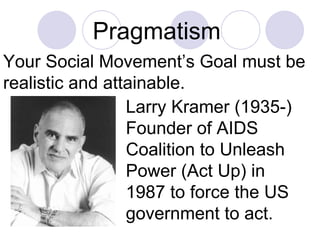
Pragmatism  Your Social Movement’s Goal must be realistic and attainable.  Larry Kramer (1935-) Founder of AIDS Coalition to Unleash Power (Act Up) in 1987 to force the US government to act.
Legitimizing the Social Movement
1) Social Movements will link themselves with traditional rights and values of equality, justice, and dignity.
2) Social Movements will establish their actions as those of legitimate organizations.
3) Social Movements may identify themselves with what is large, good, important, and of the highest order in society.
Institution’s Response to a Social Movement
Evasion   The institution will simply ignore the social movement as an entity.
Counter-Persuasion The institution will release persuasive messages that take on the movement. Retroactive to the movement’s arguments.
Coercive Persuasion The institution will use persuasion to coerce people to go against the movement.  Proactive against the movement – threats to general harassment.
Coercion   The institution will rely on surrogates to suppress social movements (using the KKK to handle the Black Panthers during the 1960s).
Adjustment Making some concessions to a social movement while not accepting the movement’s demands or goals – very superficial.
Capitulation Total acceptance of a social movements ideology: beliefs, goals, objectives, and solutions.

Unit 2 4

  • 1.
  • 2.
    Myths About AffirmativeAction (Wise, 1995)
  • 3.
    1) Affirmative actionviolates color-blind meritocracy. This myth relies on two assumptions: AA Gives preference to Lesser Qualified Minorities. Without AA we would always judge people based on their qualifications.
  • 4.
    Only 1 in10 Whites claim to be victims of “reverse discrimination.” 16% of Whites claim they know someone who was a victim. 70% of Whites are convinced that this problem is rampant. 2) Whites are the victims of massive reverse discrimination.
  • 5.
    In 1994, over90,000 complaints of employment discrimination were filed with the EEOC; less than 3% were claims of reverse discrimination and this number hasn’t changed in the last decade.
  • 6.
    3) Affirmative actiondamages black self-esteem. This is the idea that by having “preferential treatment” we are creating permanent victims.
  • 7.
    How does thegreater likelihood of getting a good job hurt self-esteem? The concern of damage to self-esteem arising from presumably “unearned privilege” is quite selective – shouldn’t Whites have lower self-esteem since they receive things all the time simply because they are White?
  • 8.
    Since 1973 thenumber of African Americans who believe that hard work is the key to success has risen 15%. Apparently affirmative action isn’t hurting drive, it’s helping it.
  • 9.
    4) Affirmative actionis the cause of increased racial tension. Frankly – this isn’t happening. In fact, support for affirmative action pieces of legislation around the nation is actually quite high – even among white males.
  • 10.
    5) Affirmative actionhelps the wrong blacks and hurts the wrong whites. Affirmative action has been shown to help minorities in every social class – not just the more wealthy, less needing ones. The Number One Group to be helped by Affirmative Action to date has been White Women.
  • 11.
    61% of allWhite-owned business have no minority workers, while less than 5% of minority-owned business (with employees), fail to have minority workers. And most do not just have minority employees.
  • 12.
    The Creation ofGhettos “ I’m not responsible for what happened during slavery” Just because we didn’t start the fire does not mean that we should not do what is necessary to help put out the fire and rebuild.
  • 13.
    Affirmative action actuallyhelps Whites So long as minorities are held back and paid lower wages, the overall wage base is bid downward, so that working-class Whites are kept in a worse position than they would be were wages more equal and the labor market not so divided.
  • 14.
    Discrimination costs allof society in terms of lost productivity. The Commerce Department estimates that $100 billion annually is lost because of discrimination in the work place because discrimination prevents its victims from fully contributing to society.
  • 15.
    Organizations as CulturalGroups The rites and rituals, communication rules/norms, metaphors, organizational texts, stories, images, and myths that build an organization’s unique sense of place and purpose.
  • 16.
  • 17.
    Power Distance Distance you are from the Top of the hierarchy to the Bottom
  • 18.
    Individualism vs. Collectivism 1) Individual 2) Group (our personal group is what is important) 3) Collective (our people are important)
  • 19.
    Uncertainty Avoidance Degree to which people feel apprehensive about unknown situations & the extent they will go to avoid them. Weak: reduce rules, accept dissent, & take risks Strong: extensive rules & seek consensus
  • 20.
    Masculinity/Femininity Masculine (Assertiveness): Achievement, ambition, acquisition of material goods Feminine (Responsiveness): Quality of life, servitude, nurturing, support for less fortunate
  • 21.
    Diversity Training inOrganizations
  • 22.
    What is DiversityTraining? Diversity training is training in diversity understanding and tolerance.
  • 23.
    Why is DiversityTraining needed? One of the cultural imperatives is economical. We need to train employees how to effectively work and interact with people from other cultures to make money.
  • 24.
    How to goabout conducting an organizational culture profile Basically, do an ethnography on a culture. You look at a culture and see how it functions and what problems exist on the cultural level.
  • 25.
    Implications of diversitytraining Offer a better return on investment in human capital. Increase the pool of talent for recruitment. Increase creativity Provide resources for attracting a diverse market. Increase productivity
  • 26.
    Implications of diversitytraining Increase an organization's ability to compete in the world market. Solve complex community challenges. Deliver services more effectively. Offer insights into socially responsible practices. Balance social, moral, and economic concerns in a single effort.
  • 27.
  • 28.
    Characteristics of SocialMovements ( Stewart, Denton, & Smith, 1994 )
  • 29.
    Organized Collectivity Group of people who come together with the goal to change the status quo.
  • 30.
    Uninstitutionalized Collectivity If it’s part of the institution it’s not really a social movement.
  • 31.
    Large in Scope A social movement is not people against one corporation (the anti-McDonalds groups). Instead, they are looking for larger social changes.
  • 32.
    Proposed or OpposesChange in Societal Norms and Values Movements always call for a change of some kind.
  • 33.
    Moral in Tone A social movement group will always attempt to demonstrate how the group is more moral than those in the institution.
  • 34.
    Encounters Opposition If a social movement doesn’t encounter opposition, then it’s truly part of status quo.
  • 35.
    Persuasion is Pervasive Persuasion is the basis of EVERY social movement.
  • 36.
    Life Cycle ofa Social Movement
  • 37.
    Genesis Peoplesee that there is a problem.
  • 38.
    Triggering/Catalytic Event Anevent of some kind spurs the movement into Rapid Development.
  • 39.
    Social Unrest Groupmembers feel the need to do something proactive.
  • 40.
    Enthusiastic Mobilization Membersstart recruiting more people as they start to take on the status quo.
  • 41.
    Maintenance Period fromMobilization to Termination where the social movement progresses.
  • 42.
    Termination Movement eitherbecomes part of the status quo or disbands.
  • 43.
    Three Characteristics ofMovement Leadership
  • 44.
    Charisma Has tobe outgoing and get people to follow her or him. Elizabeth Cady Staton (1815-1902) was a staunch supporter of Women’s rights & an active Abolitionist. She is most noted for her work with Susan B. Anthony in the Women’s Temperance Movement.
  • 45.
    Prophecy Musthave a vision of the future that people can understand and relate to easily. Martin Luther King (1929-1968) Speech “I have a Dream.”
  • 46.
    Pragmatism YourSocial Movement’s Goal must be realistic and attainable. Larry Kramer (1935-) Founder of AIDS Coalition to Unleash Power (Act Up) in 1987 to force the US government to act.
  • 47.
  • 48.
    1) Social Movementswill link themselves with traditional rights and values of equality, justice, and dignity.
  • 49.
    2) Social Movementswill establish their actions as those of legitimate organizations.
  • 50.
    3) Social Movementsmay identify themselves with what is large, good, important, and of the highest order in society.
  • 51.
    Institution’s Response toa Social Movement
  • 52.
    Evasion The institution will simply ignore the social movement as an entity.
  • 53.
    Counter-Persuasion The institutionwill release persuasive messages that take on the movement. Retroactive to the movement’s arguments.
  • 54.
    Coercive Persuasion Theinstitution will use persuasion to coerce people to go against the movement. Proactive against the movement – threats to general harassment.
  • 55.
    Coercion The institution will rely on surrogates to suppress social movements (using the KKK to handle the Black Panthers during the 1960s).
  • 56.
    Adjustment Making someconcessions to a social movement while not accepting the movement’s demands or goals – very superficial.
  • 57.
    Capitulation Total acceptanceof a social movements ideology: beliefs, goals, objectives, and solutions.