Communication & Health Promotion  Communication Science 2008 – 2009 Reint Jan Renes
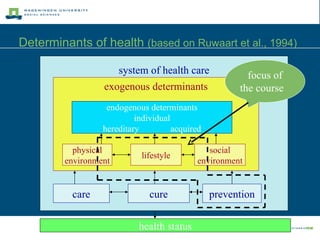
system of health care health status exogenous determinants care cure prevention endogenous determinants individual hereditary  acquired physical environment lifestyle social environment focus of the course Determinants of health  (based on Ruwaart et al., 1994)
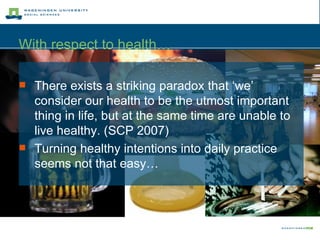
There exists a striking paradox that ‘we’ consider our health to be the utmost important thing in life, but at the same time are unable to live healthy. (SCP 2007)   Turning healthy intentions into daily practice seems not that easy… With respect to health…
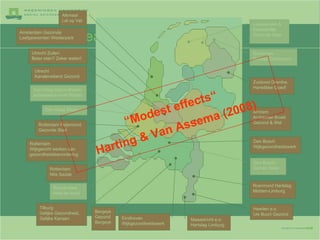
Effective health communication? Zuidoost Drenthe, Hartstikke Goed! Arnhem Arnhemse Broek Gezond & Wel Roermond Hartslag Midden-Limburg Heerlen e.o. Uw Buurt Gezond Maaastricht e.o. Hartslag Limburg Eindhoven Wijkgezondheidswerk Bergeyk Gezond Bergeyk Tilburg Gelijke Gezondheid, Gelijke Kansen Rotterdam Nôs Saúde Rotterdam Wijkgericht werken aan gezondheidsbevordering Rotterdam Feijenoord Gezonde Stad Den Bosch Wijkgezondheidswerk Alkmaar Let op Vet Utrecht Zuilen Beter eten? Zeker weten! Utrecht Kanaleneiland Gezond Amsterdam Gezonde Leefgewoonten Westerpark Den Haag Gezondheids-achterstand moet Wijken Den Haag Stiom Roosendaal Heel de buurt Den Bosch Samen Beter Groningen Broodje Oosterpark Leeuwarden & Kootstertille Gezonde Start “ Modest effects“ Harting & Van Assema (2008)
“ Modest or no effects“ Kooiker & Van der Velden (2007)
However Meta analysis of U.S. Health mass media campaigns showed that the average campaign changed the behavior of about 8% of the population in expected, positive direction (Snyder & Hamilton, 2002, in Noar, 2006). Seatbelt, oral health , and alcohol campaigns being most successful More success with focus on new behaviors than with prevention or cessation of problem behaviors. Greater effects for campaigns with greater reach/exposure. Strongest effects for campaigns with law enforcement aspects (seatbelts).
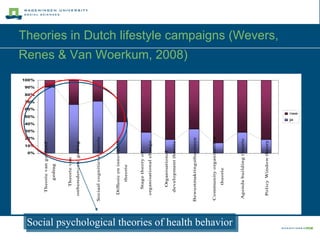
Theories in Dutch lifestyle campaigns (Wevers, Renes & Van Woerkum, 2008) Social psychological theories of health behavior
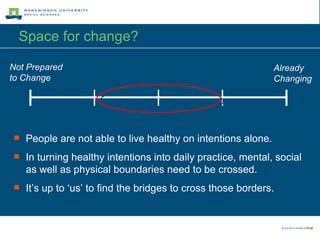
Space for change? Not Prepared to Change Already  Changing People are not able to live healthy on intentions alone. In turning healthy intentions into daily practice, mental, social as well as physical boundaries need to be crossed. It’s up to ‘us’ to find the bridges to cross those borders.
What to do?  Making intentions effective Golwitzer’s concept of ‘implementation intentions’ (1993) Deci and Ryan’s theory of Self-Determination (2000) Rothman & Salovey’s ideas about framing (1997) Get around intentions Singhal & Rogers’ concept of ‘entertainment & education strategy’ (1999) Cialdini’s ideas about influence (2003)
Focus on the individual With respect to health promotion the individual is the weakest link.  Even if the individual intention is positive all is needed to really bridge the ‘gap’ between healthy intention and ‘proper’ behavior.  “ De zwakste schakel in de tandheelkunde is niet de tandenborstel of de tandpasta, maar de tandenpoetser. Zelfs als hij dat trouw doet, doet hij het meestal verkeerd” (Schnabel, 2007)
Group assignment  List the participants in your group and decide for a group name . Decide about and shortly describe the campaign on which you like to work throughout the course. Introduce and discuss the  main issue  in ‘your’ campaign and what  specific outcomes , for which  audience  the campaign intends to generate. Sub-a ssignment 1:  Selection and 1 st  description and analysis of selected campaign
Group assignment (cont.)  A persuasive health message is a message designed to prevent health-risk behavior and to encourage healthy behavior.  Identify and discuss the most prevalent type of  theory-based persuasive health message  in ‘your’ campaign. See pp. 30/31 in the syllabus (the article of Cohen, et.al.) for a description of the different types (i.e. attitudes, social norms, and self-efficacy) of health messages.
Group assignment (cont.)  Persuasive messages may include affective dimensions that influence risk perceptions. Identify and discuss the most prevalent  affective appeal(s)  in ‘your’ campaign. See pp. 32 in the syllabus for a description of the affective appeals. Hand in  ‘hard-copy’   Mond ay  03 - 11
Anti-smoking campaigns Type of message and affect appeal Keep it nice. Smoke-free. Nicomarket Positive aspects unhooked Australian campaign Rolex Pam strategy
Take care of scientific writing!  “ Write with precision, clarity and economy. Every sentence should convey the exact truth as simply as possible” (Instructions to authors  Ecology,  1964) Scientific analysis demands precision. Scientific writing should reflect this precision in the form of clarity. Express your findings, thoughts, statements, hypotheses and conclusions clearly, logically and simply. Much effort should be given to the organization of your paper(s) and please employ crisp sentences not cluttered with excess verbiage.
National Lifestyle campaigns The focus in the Netherlands (ZonMw): Prevention of passive smoking Encouraging adults to stop smoking Preventing young people from taking up smoking Prevention of obesity Prevention of sexually transmitted diseases Moderation of the use of alcohol and the prevention of alcohol abuse Child safety and safety among the elderly Encouraging people to adopt an active lifestyle Prevention of sporting injuries
Questions? Let’s make groups!

Introduction health communication

  • 1.
    Communication & HealthPromotion Communication Science 2008 – 2009 Reint Jan Renes
  • 2.
    system of healthcare health status exogenous determinants care cure prevention endogenous determinants individual hereditary acquired physical environment lifestyle social environment focus of the course Determinants of health (based on Ruwaart et al., 1994)
  • 3.
    There exists astriking paradox that ‘we’ consider our health to be the utmost important thing in life, but at the same time are unable to live healthy. (SCP 2007) Turning healthy intentions into daily practice seems not that easy… With respect to health…
  • 4.
    Effective health communication?Zuidoost Drenthe, Hartstikke Goed! Arnhem Arnhemse Broek Gezond & Wel Roermond Hartslag Midden-Limburg Heerlen e.o. Uw Buurt Gezond Maaastricht e.o. Hartslag Limburg Eindhoven Wijkgezondheidswerk Bergeyk Gezond Bergeyk Tilburg Gelijke Gezondheid, Gelijke Kansen Rotterdam Nôs Saúde Rotterdam Wijkgericht werken aan gezondheidsbevordering Rotterdam Feijenoord Gezonde Stad Den Bosch Wijkgezondheidswerk Alkmaar Let op Vet Utrecht Zuilen Beter eten? Zeker weten! Utrecht Kanaleneiland Gezond Amsterdam Gezonde Leefgewoonten Westerpark Den Haag Gezondheids-achterstand moet Wijken Den Haag Stiom Roosendaal Heel de buurt Den Bosch Samen Beter Groningen Broodje Oosterpark Leeuwarden & Kootstertille Gezonde Start “ Modest effects“ Harting & Van Assema (2008)
  • 5.
    “ Modest orno effects“ Kooiker & Van der Velden (2007)
  • 6.
    However Meta analysisof U.S. Health mass media campaigns showed that the average campaign changed the behavior of about 8% of the population in expected, positive direction (Snyder & Hamilton, 2002, in Noar, 2006). Seatbelt, oral health , and alcohol campaigns being most successful More success with focus on new behaviors than with prevention or cessation of problem behaviors. Greater effects for campaigns with greater reach/exposure. Strongest effects for campaigns with law enforcement aspects (seatbelts).
  • 7.
    Theories in Dutchlifestyle campaigns (Wevers, Renes & Van Woerkum, 2008) Social psychological theories of health behavior
  • 8.
    Space for change?Not Prepared to Change Already Changing People are not able to live healthy on intentions alone. In turning healthy intentions into daily practice, mental, social as well as physical boundaries need to be crossed. It’s up to ‘us’ to find the bridges to cross those borders.
  • 9.
    What to do? Making intentions effective Golwitzer’s concept of ‘implementation intentions’ (1993) Deci and Ryan’s theory of Self-Determination (2000) Rothman & Salovey’s ideas about framing (1997) Get around intentions Singhal & Rogers’ concept of ‘entertainment & education strategy’ (1999) Cialdini’s ideas about influence (2003)
  • 10.
    Focus on theindividual With respect to health promotion the individual is the weakest link. Even if the individual intention is positive all is needed to really bridge the ‘gap’ between healthy intention and ‘proper’ behavior. “ De zwakste schakel in de tandheelkunde is niet de tandenborstel of de tandpasta, maar de tandenpoetser. Zelfs als hij dat trouw doet, doet hij het meestal verkeerd” (Schnabel, 2007)
  • 11.
    Group assignment List the participants in your group and decide for a group name . Decide about and shortly describe the campaign on which you like to work throughout the course. Introduce and discuss the main issue in ‘your’ campaign and what specific outcomes , for which audience the campaign intends to generate. Sub-a ssignment 1: Selection and 1 st description and analysis of selected campaign
  • 12.
    Group assignment (cont.) A persuasive health message is a message designed to prevent health-risk behavior and to encourage healthy behavior. Identify and discuss the most prevalent type of theory-based persuasive health message in ‘your’ campaign. See pp. 30/31 in the syllabus (the article of Cohen, et.al.) for a description of the different types (i.e. attitudes, social norms, and self-efficacy) of health messages.
  • 13.
    Group assignment (cont.) Persuasive messages may include affective dimensions that influence risk perceptions. Identify and discuss the most prevalent affective appeal(s) in ‘your’ campaign. See pp. 32 in the syllabus for a description of the affective appeals. Hand in ‘hard-copy’ Mond ay 03 - 11
  • 14.
    Anti-smoking campaigns Typeof message and affect appeal Keep it nice. Smoke-free. Nicomarket Positive aspects unhooked Australian campaign Rolex Pam strategy
  • 15.
    Take care ofscientific writing! “ Write with precision, clarity and economy. Every sentence should convey the exact truth as simply as possible” (Instructions to authors Ecology, 1964) Scientific analysis demands precision. Scientific writing should reflect this precision in the form of clarity. Express your findings, thoughts, statements, hypotheses and conclusions clearly, logically and simply. Much effort should be given to the organization of your paper(s) and please employ crisp sentences not cluttered with excess verbiage.
  • 16.
    National Lifestyle campaignsThe focus in the Netherlands (ZonMw): Prevention of passive smoking Encouraging adults to stop smoking Preventing young people from taking up smoking Prevention of obesity Prevention of sexually transmitted diseases Moderation of the use of alcohol and the prevention of alcohol abuse Child safety and safety among the elderly Encouraging people to adopt an active lifestyle Prevention of sporting injuries
  • 17.

Editor's Notes

  • #2 Start explaining about syllabus List with names (ask people where they are from)