Serediuc Georgeta Emilia AMB I
Medical Interview
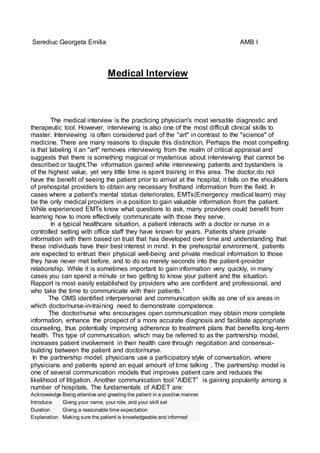
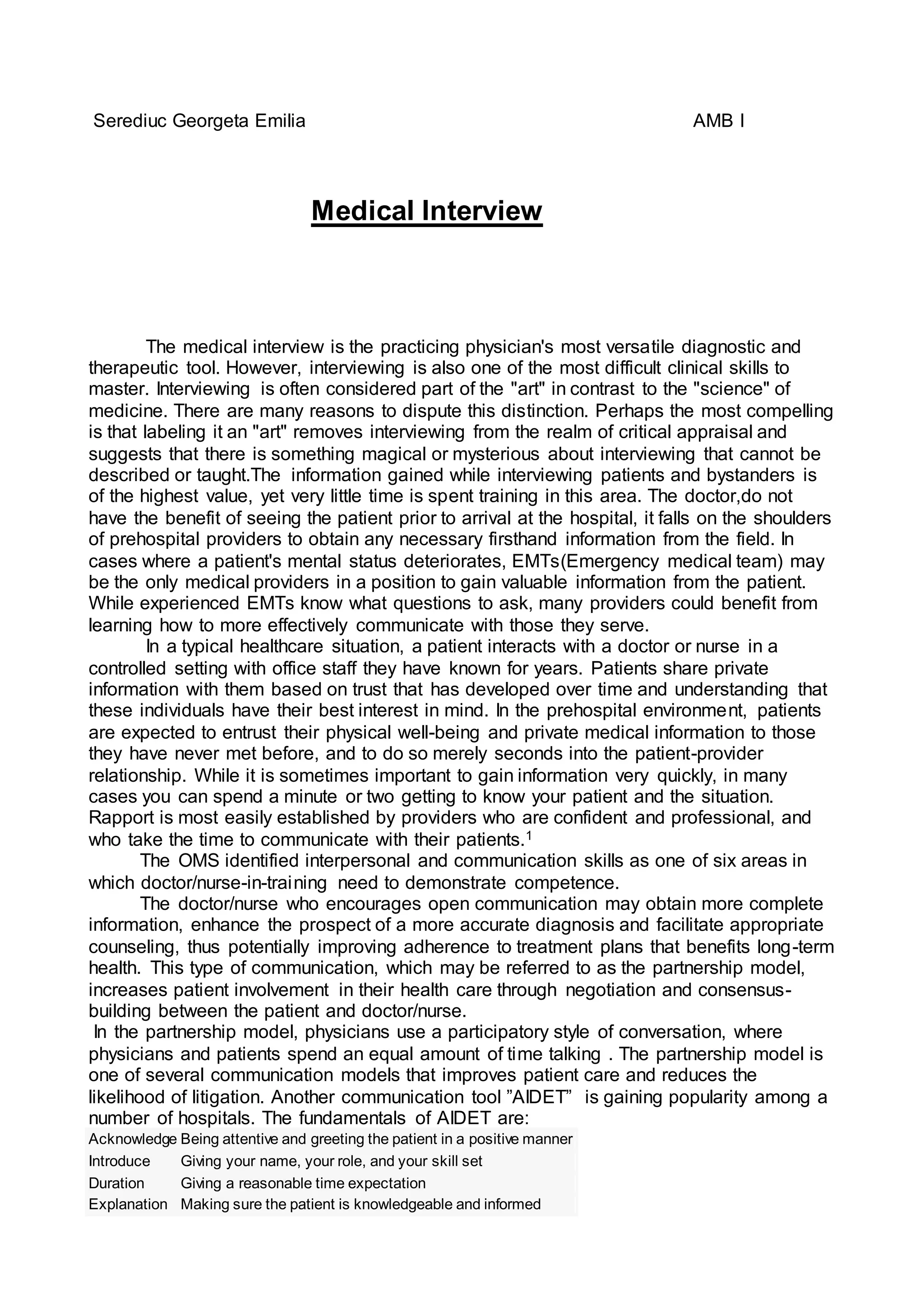
The medical interview is the practicing physician's most versatile diagnostic and
therapeutic tool. However, interviewing is also one of the most difficult clinical skills to
master. Interviewing is often considered part of the "art" in contrast to the "science" of
medicine. There are many reasons to dispute this distinction. Perhaps the most compelling
is that labeling it an "art" removes interviewing from the realm of critical appraisal and
suggests that there is something magical or mysterious about interviewing that cannot be
described or taught.The information gained while interviewing patients and bystanders is
of the highest value, yet very little time is spent training in this area. The doctor,do not
have the benefit of seeing the patient prior to arrival at the hospital, it falls on the shoulders
of prehospital providers to obtain any necessary firsthand information from the field. In
cases where a patient's mental status deteriorates, EMTs(Emergency medical team) may
be the only medical providers in a position to gain valuable information from the patient.
While experienced EMTs know what questions to ask, many providers could benefit from
learning how to more effectively communicate with those they serve.
In a typical healthcare situation, a patient interacts with a doctor or nurse in a
controlled setting with office staff they have known for years. Patients share private
information with them based on trust that has developed over time and understanding that
these individuals have their best interest in mind. In the prehospital environment, patients
are expected to entrust their physical well-being and private medical information to those
they have never met before, and to do so merely seconds into the patient-provider
relationship. While it is sometimes important to gain information very quickly, in many
cases you can spend a minute or two getting to know your patient and the situation.
Rapport is most easily established by providers who are confident and professional, and
who take the time to communicate with their patients.1
The OMS identified interpersonal and communication skills as one of six areas in
which doctor/nurse-in-training need to demonstrate competence.
The doctor/nurse who encourages open communication may obtain more complete
information, enhance the prospect of a more accurate diagnosis and facilitate appropriate
counseling, thus potentially improving adherence to treatment plans that benefits long-term
health. This type of communication, which may be referred to as the partnership model,
increases patient involvement in their health care through negotiation and consensus-
building between the patient and doctor/nurse.
In the partnership model, physicians use a participatory style of conversation, where
physicians and patients spend an equal amount of time talking . The partnership model is
one of several communication models that improves patient care and reduces the
likelihood of litigation. Another communication tool ”AIDET” is gaining popularity among a
number of hospitals. The fundamentals of AIDET are:
Acknowledge Being attentive and greeting the patient in a positive manner
Introduce Giving your name, your role, and your skill set
Duration Giving a reasonable time expectation
Explanation Making sure the patient is knowledgeable and informed
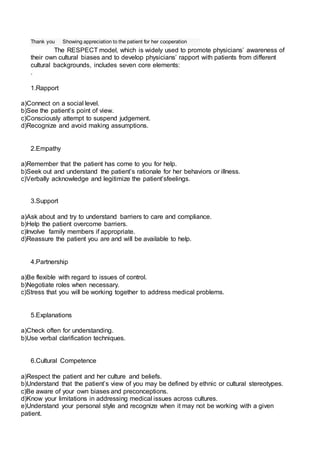
Thank you Showing appreciation to the patient for her cooperation
The RESPECT model, which is widely used to promote physicians’ awareness of
their own cultural biases and to develop physicians’ rapport with patients from different
cultural backgrounds, includes seven core elements:
.
1.Rapport
a)Connect on a social level.
b)See the patient’s point of view.
c)Consciously attempt to suspend judgement.
d)Recognize and avoid making assumptions.
2.Empathy
a)Remember that the patient has come to you for help.
b)Seek out and understand the patient’s rationale for her behaviors or illness.
c)Verbally acknowledge and legitimize the patient’sfeelings.
3.Support
a)Ask about and try to understand barriers to care and compliance.
b)Help the patient overcome barriers.
c)Involve family members if appropriate.
d)Reassure the patient you are and will be available to help.
4.Partnership
a)Be flexible with regard to issues of control.
b)Negotiate roles when necessary.
c)Stress that you will be working together to address medical problems.
5.Explanations
a)Check often for understanding.
b)Use verbal clarification techniques.
6.Cultural Competence
a)Respect the patient and her culture and beliefs.
b)Understand that the patient’s view of you may be defined by ethnic or cultural stereotypes.
c)Be aware of your own biases and preconceptions.
d)Know your limitations in addressing medical issues across cultures.
e)Understand your personal style and recognize when it may not be working with a given
patient.
7.Trust
a)Self-disclosure may be an issue for some patients who are not accustomed to Western
medical approaches.
b)Take the necessary time and consciously work to establish trust.
Differences between doctor/nurse and patients, including culture, gender, race, and
religion, can introduce bias into patient–doctor/nurse communication. Two seminal studies have
documented differences in how race and gender can affect care. Doctor/nurse may consider
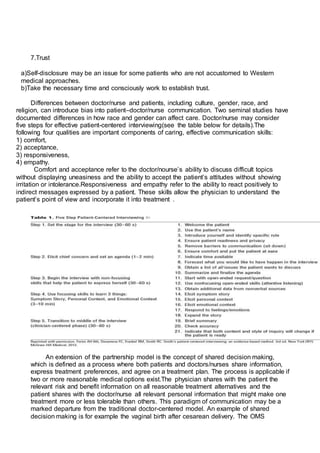
five steps for effective patient-centered interviewing(see the table below for details).The
following four qualities are important components of caring, effective communication skills:
1) comfort,
2) acceptance,
3) responsiveness,
4) empathy.
Comfort and acceptance refer to the doctor/nourse’s ability to discuss difficult topics
without displaying uneasiness and the ability to accept the patient’s attitudes without showing
irritation or intolerance.Responsiveness and empathy refer to the ability to react positively to
indirect messages expressed by a patient. These skills allow the physician to understand the
patient’s point of view and incorporate it into treatment .
An extension of the partnership model is the concept of shared decision making,
which is defined as a process where both patients and doctors/nurses share information,
express treatment preferences, and agree on a treatment plan. The process is applicable if
two or more reasonable medical options exist.The physician shares with the patient the
relevant risk and benefit information on all reasonable treatment alternatives and the
patient shares with the doctor/nurse all relevant personal information that might make one
treatment more or less tolerable than others. This paradigm of communication may be a
marked departure from the traditional doctor-centered model. An example of shared
decision making is for example the vaginal birth after cesarean delivery. The OMS
recommended that the decision for vaginal birth after cesarean delivery or repeat cesarean
delivery should occur only after a conversation between the patient and her doctor
incorporating the risks and benefits and the patient’s preferences. Shared decision making
can increase patient engagement and reduce risk with resultant improved outcomes,
satisfaction, and treatment adherence.
The use of information technology has been identified by the OMS as one of the
critical forces necessary to improve the quality of health care in the world. An increasing
number of doctors are using electronic health records and web messaging to communicate
with their patients. Health information technology systems should be compatible with the
requirements of the Health Insurance Portability and flexible enough to accommodate
state privacy laws.
It is important to use appropriate safeguards when communicating electronically with
patients.While the Privacy Rule does not prohibit the use of unencrypted e-mail for
treatment-related communication between health care providers and patients, other
safeguards should be applied to reasonably protect privacy, such as limiting the amount or
type of information disclosed through unencrypted e-mail.The doctors time spent
answering and managing e-mail should be acknowledged, and efforts should be made to
advocate for compensation for additional time spent by physicians and staff to provide this
service. When the patient has a complicated question or issues or has questions regarding
symptoms, face-to-face contact between the doctor and the patient may be preferable.
Developing effective patient–doctor communication requires a substantial
commitment in an increasingly challenging environment with declining clinical
reimbursements and increasing expenses. It may well be that, in the long term, effective
communication skills save time by increasing patient adherence to treatment, thereby
reducing the need for follow-up calls and visits. The doctor can take the following steps to
improve communication:
 Use patient-centered interviewing and caring communication skills in daily practice.
 Encourage patients to write down their questions in preparation for appointments. A
form for writing down questions can be given to patients on their arrival at the office. An
organized list of questions can facilitate conversation on topics important to the patient.
 Consider arranging for a communications consultant to conduct a workshop on cultural
and gender sensitivity for doctors and office staff based on the needs of an individual
practice.Consider hiring health care providers, such as advanced practice nurses or
doctor assistants, with patient-centered interviewing skills to assist with established
patients.
 Advocate for sustainable practice models that increase the duration of visits to provide
the opportunity to address multiple patient concerns. Increased time for visits is crucial
in efforts to improve patient-centered interviewing, shared decision making, and
improved patient–doctor communication.
The student should remember, however, that doctors learn to conduct interviews by
actually interviewing patients, and supervision can be a critical element in the educational
process.A review of audio or video recordings can help the student observe and
understand the interviewing process. Nowhere in the practice of medicine is self
awareness more important. The learning process extends over many years. The finest
doctors find new reasons for excitement and humility with each new patient encounter,with
the challenge of each new interview. It is always good to hear a patient say, "I"ve finally
found a doctor who really listens to my problems." Despite the technologic wizardry of the
modern hospital, the most difficult diagnostic puzzles are often unraveled by a carefully
conducted, patient-centered interview.

The medical interview

  • 1.
    Serediuc Georgeta EmiliaAMB I Medical Interview The medical interview is the practicing physician's most versatile diagnostic and therapeutic tool. However, interviewing is also one of the most difficult clinical skills to master. Interviewing is often considered part of the "art" in contrast to the "science" of medicine. There are many reasons to dispute this distinction. Perhaps the most compelling is that labeling it an "art" removes interviewing from the realm of critical appraisal and suggests that there is something magical or mysterious about interviewing that cannot be described or taught.The information gained while interviewing patients and bystanders is of the highest value, yet very little time is spent training in this area. The doctor,do not have the benefit of seeing the patient prior to arrival at the hospital, it falls on the shoulders of prehospital providers to obtain any necessary firsthand information from the field. In cases where a patient's mental status deteriorates, EMTs(Emergency medical team) may be the only medical providers in a position to gain valuable information from the patient. While experienced EMTs know what questions to ask, many providers could benefit from learning how to more effectively communicate with those they serve. In a typical healthcare situation, a patient interacts with a doctor or nurse in a controlled setting with office staff they have known for years. Patients share private information with them based on trust that has developed over time and understanding that these individuals have their best interest in mind. In the prehospital environment, patients are expected to entrust their physical well-being and private medical information to those they have never met before, and to do so merely seconds into the patient-provider relationship. While it is sometimes important to gain information very quickly, in many cases you can spend a minute or two getting to know your patient and the situation. Rapport is most easily established by providers who are confident and professional, and who take the time to communicate with their patients.1 The OMS identified interpersonal and communication skills as one of six areas in which doctor/nurse-in-training need to demonstrate competence. The doctor/nurse who encourages open communication may obtain more complete information, enhance the prospect of a more accurate diagnosis and facilitate appropriate counseling, thus potentially improving adherence to treatment plans that benefits long-term health. This type of communication, which may be referred to as the partnership model, increases patient involvement in their health care through negotiation and consensus- building between the patient and doctor/nurse. In the partnership model, physicians use a participatory style of conversation, where physicians and patients spend an equal amount of time talking . The partnership model is one of several communication models that improves patient care and reduces the likelihood of litigation. Another communication tool ”AIDET” is gaining popularity among a number of hospitals. The fundamentals of AIDET are: Acknowledge Being attentive and greeting the patient in a positive manner Introduce Giving your name, your role, and your skill set Duration Giving a reasonable time expectation Explanation Making sure the patient is knowledgeable and informed
  • 2.
    Thank you Showingappreciation to the patient for her cooperation The RESPECT model, which is widely used to promote physicians’ awareness of their own cultural biases and to develop physicians’ rapport with patients from different cultural backgrounds, includes seven core elements: . 1.Rapport a)Connect on a social level. b)See the patient’s point of view. c)Consciously attempt to suspend judgement. d)Recognize and avoid making assumptions. 2.Empathy a)Remember that the patient has come to you for help. b)Seek out and understand the patient’s rationale for her behaviors or illness. c)Verbally acknowledge and legitimize the patient’sfeelings. 3.Support a)Ask about and try to understand barriers to care and compliance. b)Help the patient overcome barriers. c)Involve family members if appropriate. d)Reassure the patient you are and will be available to help. 4.Partnership a)Be flexible with regard to issues of control. b)Negotiate roles when necessary. c)Stress that you will be working together to address medical problems. 5.Explanations a)Check often for understanding. b)Use verbal clarification techniques. 6.Cultural Competence a)Respect the patient and her culture and beliefs. b)Understand that the patient’s view of you may be defined by ethnic or cultural stereotypes. c)Be aware of your own biases and preconceptions. d)Know your limitations in addressing medical issues across cultures. e)Understand your personal style and recognize when it may not be working with a given patient.
  • 3.
    7.Trust a)Self-disclosure may bean issue for some patients who are not accustomed to Western medical approaches. b)Take the necessary time and consciously work to establish trust. Differences between doctor/nurse and patients, including culture, gender, race, and religion, can introduce bias into patient–doctor/nurse communication. Two seminal studies have documented differences in how race and gender can affect care. Doctor/nurse may consider five steps for effective patient-centered interviewing(see the table below for details).The following four qualities are important components of caring, effective communication skills: 1) comfort, 2) acceptance, 3) responsiveness, 4) empathy. Comfort and acceptance refer to the doctor/nourse’s ability to discuss difficult topics without displaying uneasiness and the ability to accept the patient’s attitudes without showing irritation or intolerance.Responsiveness and empathy refer to the ability to react positively to indirect messages expressed by a patient. These skills allow the physician to understand the patient’s point of view and incorporate it into treatment . An extension of the partnership model is the concept of shared decision making, which is defined as a process where both patients and doctors/nurses share information, express treatment preferences, and agree on a treatment plan. The process is applicable if two or more reasonable medical options exist.The physician shares with the patient the relevant risk and benefit information on all reasonable treatment alternatives and the patient shares with the doctor/nurse all relevant personal information that might make one treatment more or less tolerable than others. This paradigm of communication may be a marked departure from the traditional doctor-centered model. An example of shared decision making is for example the vaginal birth after cesarean delivery. The OMS
  • 4.
    recommended that thedecision for vaginal birth after cesarean delivery or repeat cesarean delivery should occur only after a conversation between the patient and her doctor incorporating the risks and benefits and the patient’s preferences. Shared decision making can increase patient engagement and reduce risk with resultant improved outcomes, satisfaction, and treatment adherence. The use of information technology has been identified by the OMS as one of the critical forces necessary to improve the quality of health care in the world. An increasing number of doctors are using electronic health records and web messaging to communicate with their patients. Health information technology systems should be compatible with the requirements of the Health Insurance Portability and flexible enough to accommodate state privacy laws. It is important to use appropriate safeguards when communicating electronically with patients.While the Privacy Rule does not prohibit the use of unencrypted e-mail for treatment-related communication between health care providers and patients, other safeguards should be applied to reasonably protect privacy, such as limiting the amount or type of information disclosed through unencrypted e-mail.The doctors time spent answering and managing e-mail should be acknowledged, and efforts should be made to advocate for compensation for additional time spent by physicians and staff to provide this service. When the patient has a complicated question or issues or has questions regarding symptoms, face-to-face contact between the doctor and the patient may be preferable. Developing effective patient–doctor communication requires a substantial commitment in an increasingly challenging environment with declining clinical reimbursements and increasing expenses. It may well be that, in the long term, effective communication skills save time by increasing patient adherence to treatment, thereby reducing the need for follow-up calls and visits. The doctor can take the following steps to improve communication:  Use patient-centered interviewing and caring communication skills in daily practice.  Encourage patients to write down their questions in preparation for appointments. A form for writing down questions can be given to patients on their arrival at the office. An organized list of questions can facilitate conversation on topics important to the patient.  Consider arranging for a communications consultant to conduct a workshop on cultural and gender sensitivity for doctors and office staff based on the needs of an individual practice.Consider hiring health care providers, such as advanced practice nurses or doctor assistants, with patient-centered interviewing skills to assist with established patients.  Advocate for sustainable practice models that increase the duration of visits to provide the opportunity to address multiple patient concerns. Increased time for visits is crucial in efforts to improve patient-centered interviewing, shared decision making, and improved patient–doctor communication. The student should remember, however, that doctors learn to conduct interviews by actually interviewing patients, and supervision can be a critical element in the educational process.A review of audio or video recordings can help the student observe and understand the interviewing process. Nowhere in the practice of medicine is self awareness more important. The learning process extends over many years. The finest
  • 5.
    doctors find newreasons for excitement and humility with each new patient encounter,with the challenge of each new interview. It is always good to hear a patient say, "I"ve finally found a doctor who really listens to my problems." Despite the technologic wizardry of the modern hospital, the most difficult diagnostic puzzles are often unraveled by a carefully conducted, patient-centered interview.