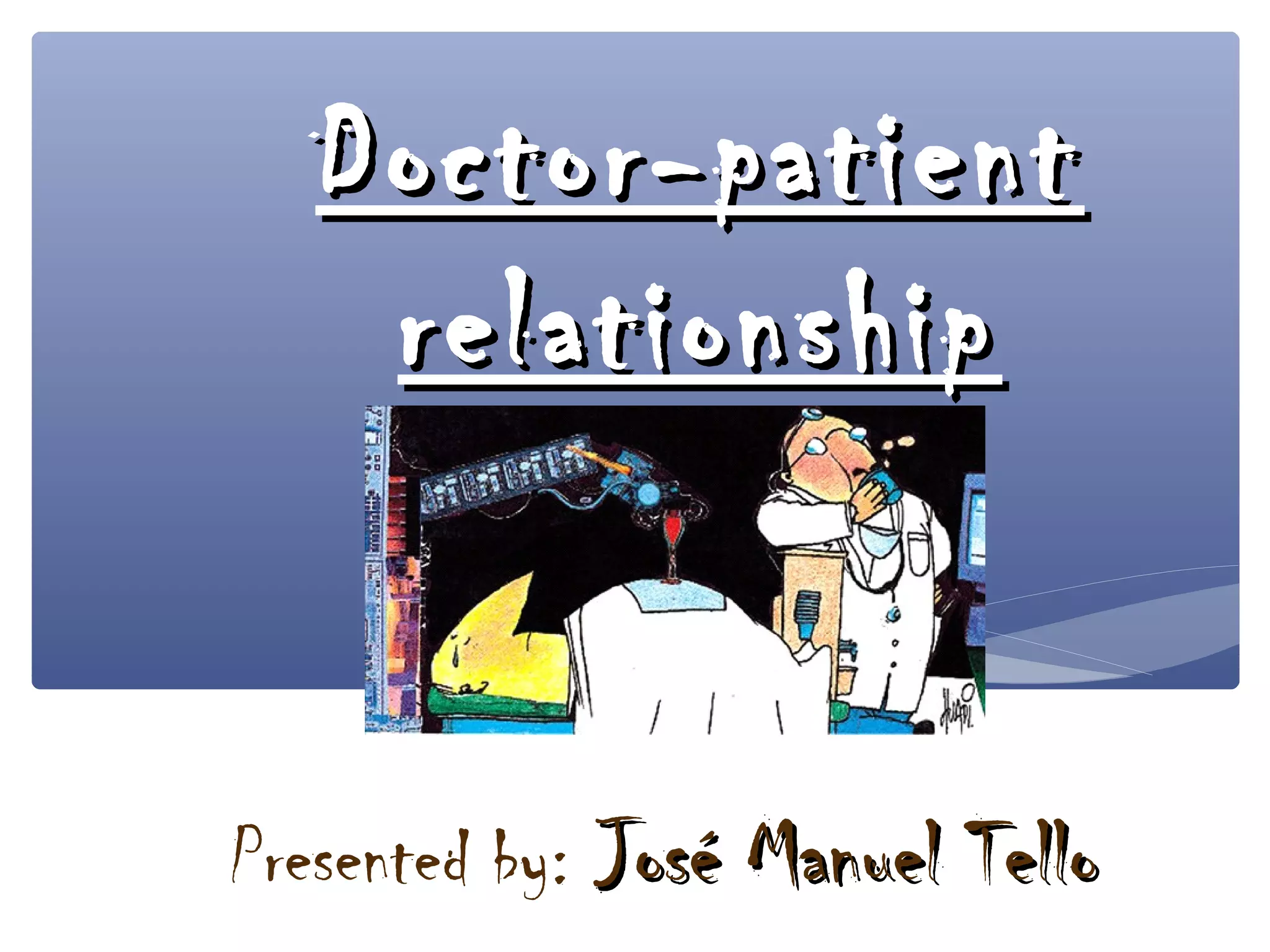
Doctor-patient
    relationship


Presented by: José Manuel Tello
The deepest foundation of medicine is love ... If our
  love is big, the bigger the fruit that it gets the
  medicine, and if diminished, our fruits are also
 dwindling. For love is what makes us learn the art
   and beyond, no doctor will not be born "the
  medicine, and if diminished, our fruits are also
                      dwindling.


                         "The patient is a person ......
                         not a medical problem to be solved "
Doctor-patient
                           relationship


   DEFINITION                       CHARACTERISTICS


                                   Hippocrates      summed
    Tha interaction                over 2000 years ago
established between
                                    1. - Knowledge.
the physician and                   2. - Wisdom.
the patient to return               3. - Humanity.
to it health, alleviate
their suffering and
prevent illness
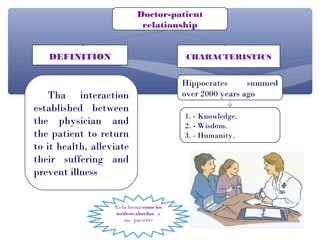
The doctor-patient
                                     relationship
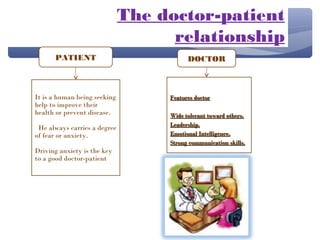
       PATIENT                            DOCTOR


It is a human being seeking         Features doctor
help to improve their
health or prevent disease.          Wide tolerant toward others.
                                    Leadership.
  He always carries a degree
of fear or anxiety.                 Emotional Intelligence.
                                    Strong communication skills.
Driving anxiety is the key
to a good doctor-patient
∗ Conduct patient
∗ Get help to improve your health
∗ Fear or anxiety
∗ Medical Conduct
∗ Affable and respectful greeting
∗ friendly service
∗ attention
∗ Setting the communication from the
  physician to the patient level
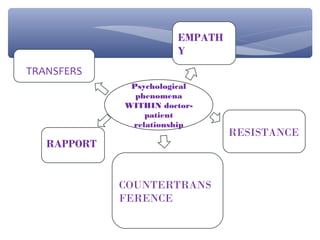
EMPATH
                       Y
TRANSFERS
              Psychological
               phenomena
             WITHIN doctor-
                 patient
              relationship
                                RESISTANCE
   RAPPORT


             COUNTERTRANS
             FERENCE
RMP: Communication
∗ Communicate with patients should be for us as important as
  medicine.

∗ In the Faculties hardly any communication related subjects.

∗ Communication skills in the best case is acquired intuitively and
  through our experience.

∗ The scientific-technical language that is mastered in the doctor-
  patient communication problem.

∗ The issuer must try to adapt to the conditions of each
  particular communicative act.
RMP: As set out in practice?

∗ Provide warmth (be humorous)

∗ Discover the reasons for the visit

∗ Examine the patient

∗ Discuss your findings

∗ Establish a treatment plan

∗ Let established a communication channel
RMP: Evidence of the utility of the communication


 ∗ Asking questions is one of the best ways of knowing.

 ∗ 60-80% of diagnoses were established with the
   interrogation.

 ∗ Improved understanding of the symptom (illness and
   meaning)

 ∗ Improving treatment compliance by the patient.
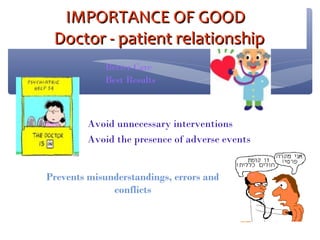
IMPORTANCE OF GOOD
 Doctor - patient relationship
            Better Care
            Best Results


         Avoid unnecessary interventions
         Avoid the presence of adverse events


Prevents misunderstandings, errors and
              conflicts
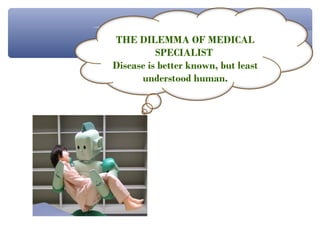
THE DILEMMA OF MEDICAL
          SPECIALIST
Disease is better known, but least
      understood human.
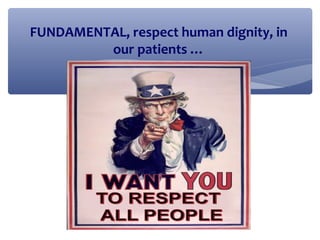
FUNDAMENTAL, respect human dignity, in
         our patients …
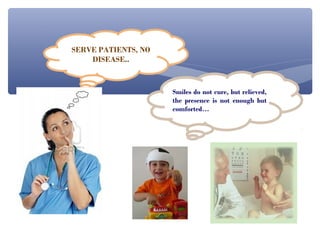
SERVE PATIENTS, NO
    DISEASE..


                     Smiles do not cure, but relieved,
                     the presence is not enough but
                     comforted…
Doctor-Patient Relationship

Doctor-Patient Relationship

  • 1.
    Doctor-patient relationship Presented by: José Manuel Tello
  • 2.
    The deepest foundationof medicine is love ... If our love is big, the bigger the fruit that it gets the medicine, and if diminished, our fruits are also dwindling. For love is what makes us learn the art and beyond, no doctor will not be born "the medicine, and if diminished, our fruits are also dwindling. "The patient is a person ...... not a medical problem to be solved "
  • 3.
    Doctor-patient relationship DEFINITION CHARACTERISTICS Hippocrates summed Tha interaction over 2000 years ago established between 1. - Knowledge. the physician and 2. - Wisdom. the patient to return 3. - Humanity. to it health, alleviate their suffering and prevent illness
  • 4.
    The doctor-patient relationship PATIENT DOCTOR It is a human being seeking Features doctor help to improve their health or prevent disease. Wide tolerant toward others. Leadership.   He always carries a degree of fear or anxiety. Emotional Intelligence. Strong communication skills. Driving anxiety is the key to a good doctor-patient
  • 5.
    ∗ Conduct patient ∗Get help to improve your health ∗ Fear or anxiety ∗ Medical Conduct ∗ Affable and respectful greeting ∗ friendly service ∗ attention ∗ Setting the communication from the physician to the patient level
  • 6.
    EMPATH Y TRANSFERS Psychological phenomena WITHIN doctor- patient relationship RESISTANCE RAPPORT COUNTERTRANS FERENCE
  • 7.
    RMP: Communication ∗ Communicatewith patients should be for us as important as medicine. ∗ In the Faculties hardly any communication related subjects. ∗ Communication skills in the best case is acquired intuitively and through our experience. ∗ The scientific-technical language that is mastered in the doctor- patient communication problem. ∗ The issuer must try to adapt to the conditions of each particular communicative act.
  • 8.
    RMP: As setout in practice? ∗ Provide warmth (be humorous) ∗ Discover the reasons for the visit ∗ Examine the patient ∗ Discuss your findings ∗ Establish a treatment plan ∗ Let established a communication channel
  • 9.
    RMP: Evidence ofthe utility of the communication ∗ Asking questions is one of the best ways of knowing. ∗ 60-80% of diagnoses were established with the interrogation. ∗ Improved understanding of the symptom (illness and meaning) ∗ Improving treatment compliance by the patient.
  • 10.
    IMPORTANCE OF GOOD Doctor - patient relationship Better Care Best Results Avoid unnecessary interventions Avoid the presence of adverse events Prevents misunderstandings, errors and conflicts
  • 11.
    THE DILEMMA OFMEDICAL SPECIALIST Disease is better known, but least understood human.
  • 12.
    FUNDAMENTAL, respect humandignity, in our patients …
  • 13.
    SERVE PATIENTS, NO DISEASE.. Smiles do not cure, but relieved, the presence is not enough but comforted…

Editor's Notes

  • #6 El paciente es un ser humano que busca ayuda para mejorar su salud, y que en la medida de lo posible siempre lleva un grado de temor o ansiedad. Aprender a manejar la ansiedad del paciente es lo más importante para una buena relación médico-paciente. La conducta médica debe ser orientada a obtener la confianza del paciente y esto se puede lograr con: El saludo afable y respetuoso (preferiblemente ponerse de pie y estrechar su mano) Con el trato amable La atención solícita El ajuste de la comunicación del médico al nivel del paciente y su familia. Actualmente el hombre cuenta con una amplia red de información y medios de comunicación sofisticados, y nos olvidamos de la comunicación y el lenguaje, sin tener en cuenta que si la comunicación en la relación médico-paciente es deficiente, la posibilidad de conflictos es muy elevada.
  • #8 Aprender a comunicarnos con los pacientes debería ser para nosotros tan importante como saber medicina, se ha demostrado que en los "juicios por negligencia", en la mayoría de ellos ha habido problemas de comunicación más que un error médico. El aumento de las demandas por errores médicos ha dado lugar por parte de los médicos a la denominada “Medicina defensiva” lo que ha llevado a un deterioro en la relación médico-paciente. Si existe alguna deficiencia en la formación de todos los profesionales en nuestro medio es la relacionada con el deficiente dominio de habilidades comunicativas. De todos es conocido que ni en las facultades de derecho, facultades de educación, ni filología, ni en las de ciencias políticas, por citar facultades, en las que se forman profesionales en la que la palabra es un instrumento fundamental apenas existen por no decir ausentes materias relacionadas con la comunicación. Si esto es así en estudios en los que la lengua es un instrumento fundamental ya todos podrán imaginarse cual es la situación en una titulación cuyo objetivo fundamental es formar a sus profesionales para investigar, diagnosticar y tratar las distintas enfermedades humanas. Como todos podrán suponer en el mejor de los casos hemos ido adquiriendo estas habilidades fuera de la formación reglada, de forma intuitiva y a lo largo de nuestra experiencia profesional en la que se incluye las observaciones de nuestros maestros más experimentados. No existe una formación específica acerca de la relación médico-paciente en el pregrado ni en el postgrado, y estas carencias generan dificultades en la comunicación y como consecuencia un escaso cumplimiento en los tratamientos por parte de los pacientes. A fuerza de experimentar procesos de comunicación frustrados hemos ido aprendiendo y dándonos cuenta de que el uso del lenguaje científico-técnico que dominamos, que hemos utilizado en nuestras relaciones profesionales con buenos resultados, en nuestra relación con el paciente puede constituir una verdadera desventaja o problema. Es un principio generalmente aceptado en cuestiones relacionadas con la comunicación el hecho de que el emisor ha de procurar adecuarse en el sentido más amplio de la palabra a las condiciones cada acto comunicativo en concreto. Del mismo modo que nuestra indumentaria, nuestros modales, nuestros gestos y nuestro registro lingüístico son diferentes en una situación comunicativa formal (conferencia, clase) que en una situación comunicativa informal (entre amigos, tertulia) , del mismo modo no pueden servir o valer los mismos factores o elementos entre una relación médico-médico que la relación médico-paciente.