Lecture 7 Tailoring and framing
Effective communication Question we need to ask: How can we create and deliver messages to the public that are relevant, interesting, informative and ultimately have the greatest change of being persuasive?
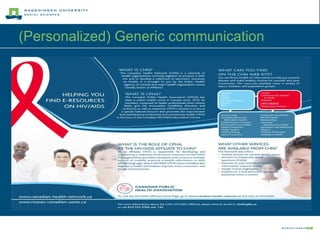
(Personalized) Generic communication
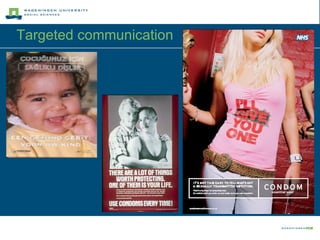
Targeted communication
Tailored communication “ Any combination of strategies and information intended to reach one specific person based on characteristics that are unique to that person, related to the outcome of interest and derived from individual assessment” (Kreuter, et al., 2000 in Noar et al., 2007) Increase of personal involvement and relevancy
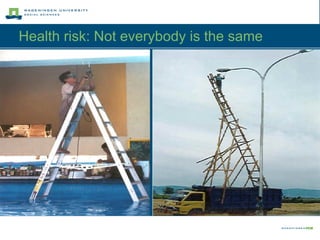
Health risk? Not everybody is the same
Health risk: Not everybody is the same
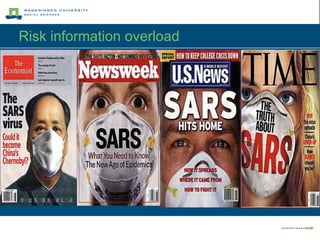
Risk information overload
"we are simple people living in a complex world.” “ What information consumes is rather obvious: it consumes the attention of its recipients. Hence a wealth of information creates a poverty of attention, and a need to allocate that attention efficiently among the overabundance of information sources that might consume it.” Herbert Simon,
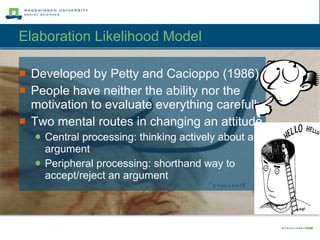
Elaboration Likelihood Model  Developed by Petty and Cacioppo (1986) People have neither the ability nor the motivation to evaluate everything carefully Two mental routes in changing an attitude Central processing: thinking actively about an argument Peripheral processing: shorthand way to accept/reject an argument
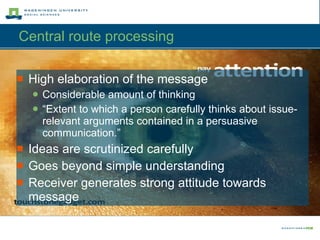
Central route processing  High elaboration of the message Considerable amount of thinking “ Extent to which a person carefully thinks about issue-relevant arguments contained in a persuasive communication.” Ideas are scrutinized carefully Goes beyond simple understanding Receiver generates strong attitude towards message
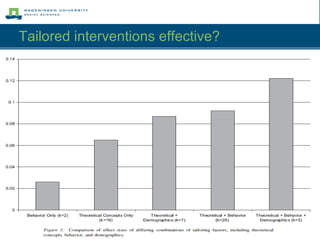
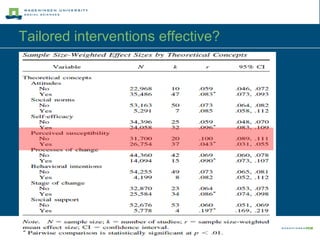
Motivation for high elaboration  Personal relevance, Involvement Tailored communication seems to enhance elaboration As such seems to be more effective in influencing health behavior change as compared to non-tailored communication Are they indeed more effective?
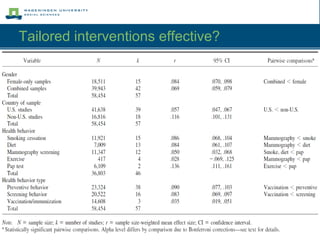
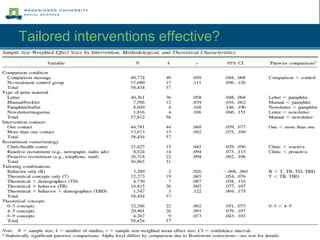
Tailored interventions effective?
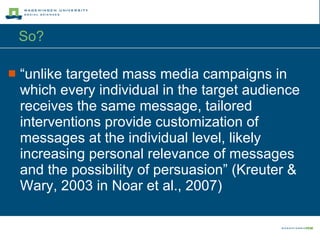
So?  “ unlike targeted mass media campaigns in which every individual in the target audience receives the same message, tailored interventions provide customization of messages at the individual level, likely increasing personal relevance of messages and the possibility of persuasion” (Kreuter & Wary, 2003 in Noar et al., 2007)
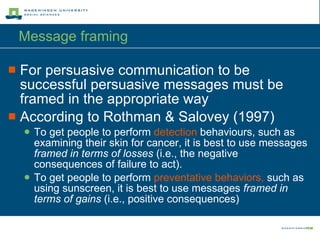
Message framing  For persuasive communication to be successful persuasive messages must be framed in the appropriate way According to Rothman & Salovey (1997) To get people to perform  detection  behaviours, such as examining their skin for cancer, it is best to use messages  framed in terms of losses  (i.e., the negative consequences of failure to act). To get people to perform  preventative behaviors,  such as using sunscreen, it is best to use messages  framed in terms of gains  (i.e., positive consequences)
Stressing gains versus lossess  Why does the way in which the message is framed make a difference? Rothman and Salovey (1997) suggest that it changes the way in which people think about their health. A loss frame focuses people’s attention on the possibility that they might have a problem that can be dealt with by performing  detection  behavior (eg, performing self-breast exams), A gain frame focuses people’s attention on the fact that they are in a good state of health and that to stay that way it is best to perform  preventative  behaviour (eg, using condoms when having sex).
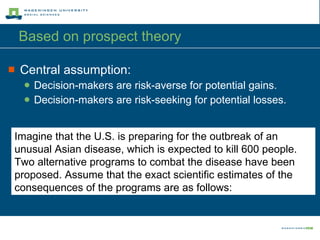
Based on prospect theory  Central assumption: Decision-makers are risk-averse for potential gains. Decision-makers are risk-seeking for potential losses. Imagine that the U.S. is preparing for the outbreak of an unusual Asian disease, which is expected to kill 600 people. Two alternative programs to combat the disease have been proposed. Assume that the exact scientific estimates of the consequences of the programs are as follows:
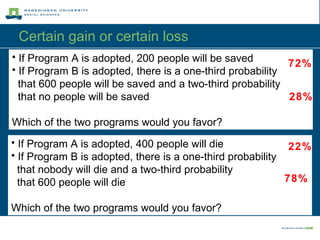
Certain gain or certain loss If Program A is adopted, 200 people will be saved If Program B is adopted, there is a one-third probability that 600 people will be saved and a two-third probability that no people will be saved Which of the two programs would you favor? If Program A is adopted, 400 people will die If Program B is adopted, there is a one-third probability that nobody will die and a two-third probability that 600 people will die Which of the two programs would you favor? 72% 28% 22% 78%
Two forms of a gain-framed message  Consequence 1: Attaining a desirable goal Loose weight ( = desirable ‘kernel’ state) through exercise Consequence 2: Not attaining an undesirable goal Not gaining weight ( = undesirable ‘kernel’ state) through exercise
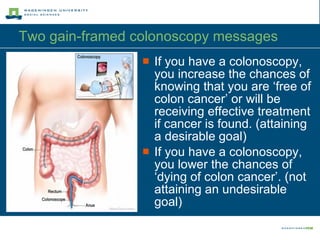
Two gain-framed colonoscopy messages If you have a colonoscopy, you increase the chances of knowing that you are ‘free of colon cancer’ or will be receiving effective treatment if cancer is found. (attaining a desirable goal) If you have a colonoscopy, you lower the chances of ‘dying of colon cancer’. (not attaining an undesirable goal)
Two forms of a loss-framed message  Consequence 1: Not attaining a desirable goal You will not loose weight (= desirable ‘kernel’ state) if you don’t exercise Consequence 2: Attaining an undesirable goal You will gain weight (= undesirable ‘kernel’ state) if you don’t exercise
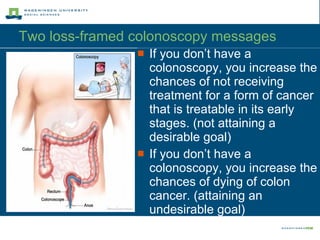
Two loss-framed colonoscopy messages If you don’t have a colonoscopy, you increase the chances of not receiving treatment for a form of cancer that is treatable in its early stages. (not attaining a desirable goal) If you don’t have a colonoscopy, you increase the chances of dying of colon cancer. (attaining an undesirable goal)
Drug abuse prevention “This is your brain” (view of egg held in hand) “This is drugs” (view of sizzling frying pan) “This is your brain on drugs” (view of egg frying in pan.) “Any questions?”
Drug abuse prevention Botvin – Life Skills Training (1995) If you maintain a drug-free lifestyle through this program, you will feel empowered and be able to deal with the stresses that life brings without the negative consequences of drug use.
So far Most research have suggested that gain-framed appeals will enjoy a significant persuasive advantage in the health prevention domain Why? Potential losses are more motivating when risky actions are contemplated (e.g. health detection behaviors such as cancer screening), but gains are more motivating than losses for low-risk behaviors (prevention behaviors such as dental flossing) So, for low-risk actions such as preventive health behaviors, gain framed messages should be more persuasive than loss-framed messages
Results O’keefe & Jensen (2007) Only in the case of dental hygiene behaviors there is a significant persuasive advantage of gain-framed appeal. Floss one’s teeth will result in ‘strong teeth’/’no cavaties’  better than  Not flossing one’s teeth will not result in strong teeth/will result in cavaties. For other cases (e.g. exercise, diet, vaccination) the overall advantage of gain-framed appeals is exceptionally small and decidedly not general.
Why dental hygiene? Maybe, for dental hygiene behaviors, but not for other preventive health behaviors (e.g. diet or exercise), performing the action is seen to have more certain outcomes than is not performing the action (see O’keefe & Jensen, 2007). According to Latimer et al. (2007) the framing effect is dependent on their congruency with people’s motivational orientation i.e. several studies showed that people sensitive to the presence of gains were persuaded to floss after reading a gain framed message, whereas people sensitive to the absence of negative outcomes were persuaded to floss after reading loss-framed arguments…
Final message As new evidence emerges, the practical guidelines for developing effective messages should be updated to disseminate details about the improved message framing strategies and to create realistic expectations for change…

Tailored health communication(7)

  • 1.
  • 2.
    Effective communication Questionwe need to ask: How can we create and deliver messages to the public that are relevant, interesting, informative and ultimately have the greatest change of being persuasive?
  • 3.
  • 4.
  • 5.
    Tailored communication “Any combination of strategies and information intended to reach one specific person based on characteristics that are unique to that person, related to the outcome of interest and derived from individual assessment” (Kreuter, et al., 2000 in Noar et al., 2007) Increase of personal involvement and relevancy
  • 6.
    Health risk? Noteverybody is the same
  • 7.
    Health risk: Noteverybody is the same
  • 8.
  • 9.
    "we are simplepeople living in a complex world.” “ What information consumes is rather obvious: it consumes the attention of its recipients. Hence a wealth of information creates a poverty of attention, and a need to allocate that attention efficiently among the overabundance of information sources that might consume it.” Herbert Simon,
  • 10.
    Elaboration Likelihood Model Developed by Petty and Cacioppo (1986) People have neither the ability nor the motivation to evaluate everything carefully Two mental routes in changing an attitude Central processing: thinking actively about an argument Peripheral processing: shorthand way to accept/reject an argument
  • 11.
    Central route processing High elaboration of the message Considerable amount of thinking “ Extent to which a person carefully thinks about issue-relevant arguments contained in a persuasive communication.” Ideas are scrutinized carefully Goes beyond simple understanding Receiver generates strong attitude towards message
  • 12.
    Motivation for highelaboration Personal relevance, Involvement Tailored communication seems to enhance elaboration As such seems to be more effective in influencing health behavior change as compared to non-tailored communication Are they indeed more effective?
  • 13.
  • 14.
  • 15.
  • 16.
  • 17.
    So? “unlike targeted mass media campaigns in which every individual in the target audience receives the same message, tailored interventions provide customization of messages at the individual level, likely increasing personal relevance of messages and the possibility of persuasion” (Kreuter & Wary, 2003 in Noar et al., 2007)
  • 18.
    Message framing For persuasive communication to be successful persuasive messages must be framed in the appropriate way According to Rothman & Salovey (1997) To get people to perform detection behaviours, such as examining their skin for cancer, it is best to use messages framed in terms of losses (i.e., the negative consequences of failure to act). To get people to perform preventative behaviors, such as using sunscreen, it is best to use messages framed in terms of gains (i.e., positive consequences)
  • 19.
    Stressing gains versuslossess Why does the way in which the message is framed make a difference? Rothman and Salovey (1997) suggest that it changes the way in which people think about their health. A loss frame focuses people’s attention on the possibility that they might have a problem that can be dealt with by performing detection behavior (eg, performing self-breast exams), A gain frame focuses people’s attention on the fact that they are in a good state of health and that to stay that way it is best to perform preventative behaviour (eg, using condoms when having sex).
  • 20.
    Based on prospecttheory Central assumption: Decision-makers are risk-averse for potential gains. Decision-makers are risk-seeking for potential losses. Imagine that the U.S. is preparing for the outbreak of an unusual Asian disease, which is expected to kill 600 people. Two alternative programs to combat the disease have been proposed. Assume that the exact scientific estimates of the consequences of the programs are as follows:
  • 21.
    Certain gain orcertain loss If Program A is adopted, 200 people will be saved If Program B is adopted, there is a one-third probability that 600 people will be saved and a two-third probability that no people will be saved Which of the two programs would you favor? If Program A is adopted, 400 people will die If Program B is adopted, there is a one-third probability that nobody will die and a two-third probability that 600 people will die Which of the two programs would you favor? 72% 28% 22% 78%
  • 22.
    Two forms ofa gain-framed message Consequence 1: Attaining a desirable goal Loose weight ( = desirable ‘kernel’ state) through exercise Consequence 2: Not attaining an undesirable goal Not gaining weight ( = undesirable ‘kernel’ state) through exercise
  • 23.
    Two gain-framed colonoscopymessages If you have a colonoscopy, you increase the chances of knowing that you are ‘free of colon cancer’ or will be receiving effective treatment if cancer is found. (attaining a desirable goal) If you have a colonoscopy, you lower the chances of ‘dying of colon cancer’. (not attaining an undesirable goal)
  • 24.
    Two forms ofa loss-framed message Consequence 1: Not attaining a desirable goal You will not loose weight (= desirable ‘kernel’ state) if you don’t exercise Consequence 2: Attaining an undesirable goal You will gain weight (= undesirable ‘kernel’ state) if you don’t exercise
  • 25.
    Two loss-framed colonoscopymessages If you don’t have a colonoscopy, you increase the chances of not receiving treatment for a form of cancer that is treatable in its early stages. (not attaining a desirable goal) If you don’t have a colonoscopy, you increase the chances of dying of colon cancer. (attaining an undesirable goal)
  • 26.
    Drug abuse prevention“This is your brain” (view of egg held in hand) “This is drugs” (view of sizzling frying pan) “This is your brain on drugs” (view of egg frying in pan.) “Any questions?”
  • 27.
    Drug abuse preventionBotvin – Life Skills Training (1995) If you maintain a drug-free lifestyle through this program, you will feel empowered and be able to deal with the stresses that life brings without the negative consequences of drug use.
  • 28.
    So far Mostresearch have suggested that gain-framed appeals will enjoy a significant persuasive advantage in the health prevention domain Why? Potential losses are more motivating when risky actions are contemplated (e.g. health detection behaviors such as cancer screening), but gains are more motivating than losses for low-risk behaviors (prevention behaviors such as dental flossing) So, for low-risk actions such as preventive health behaviors, gain framed messages should be more persuasive than loss-framed messages
  • 29.
    Results O’keefe &Jensen (2007) Only in the case of dental hygiene behaviors there is a significant persuasive advantage of gain-framed appeal. Floss one’s teeth will result in ‘strong teeth’/’no cavaties’ better than Not flossing one’s teeth will not result in strong teeth/will result in cavaties. For other cases (e.g. exercise, diet, vaccination) the overall advantage of gain-framed appeals is exceptionally small and decidedly not general.
  • 30.
    Why dental hygiene?Maybe, for dental hygiene behaviors, but not for other preventive health behaviors (e.g. diet or exercise), performing the action is seen to have more certain outcomes than is not performing the action (see O’keefe & Jensen, 2007). According to Latimer et al. (2007) the framing effect is dependent on their congruency with people’s motivational orientation i.e. several studies showed that people sensitive to the presence of gains were persuaded to floss after reading a gain framed message, whereas people sensitive to the absence of negative outcomes were persuaded to floss after reading loss-framed arguments…
  • 31.
    Final message Asnew evidence emerges, the practical guidelines for developing effective messages should be updated to disseminate details about the improved message framing strategies and to create realistic expectations for change…

Editor's Notes

  • #2 We want to know who you are so that we can deliver messages that are relevant and of interest to you!