Chapter Ten: Mixed
Methods Procedures
Chapter Outline
• Components of Mixed Methods Procedures
• The Nature of Mixed Methods Research
• Types of Mixed Methods Strategies and Visual Models
• Planning Mixed Methods Procedures
• Alternative Strategies and Visual Models
• Choosing a Mixed Methods Strategy
• Data Collection Procedures
• Data Analysis and Validation Procedures
• Report Presentation Structure
• Examples of Mixed Methods Procedures
Mixed Methods Procedures
• Describe this approach in your proposal
• Trace its history
• Provide a definition
• Mixed methods research is an approach to inquiry that combines or
associates both qualitative and quantitative forms. It involves
philosophical assumptions, the use of qualitative and quantitative
approaches, and the mixing of both approaches in a study. Thus, it is more
than simply collecting and analyzing both kinds of data; it also involves
the use of both approaches in tandem so that the overall strength of a
study is greater than either qualitative or quantitative research (Creswell
& Plano Clark, 2007).
• Discuss the reasons for choosing the procedure, and the value it will
lend to a study
• Decide on a mixed methods design to use
• Discuss the challenges with this approach
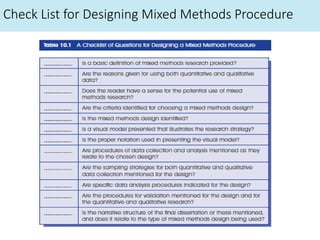
Check List for Designing Mixed Methods Procedure
Describe Mixed Methods Research
• Begin by defining mixed methods:
oInvolves the collection of both qualitative and quantitative data
in response to research questions or hypotheses
oIncludes analysis of both forms of data
oRigorous data collection and analysis
oThe two forms of data are integrated in the design analysis
oProcedures are incorporated into a distinct mixed methods
design
oProcedures can also be informed by a philosophical world-
view or a theory
Describe Mixed Methods Research
• Many different terms are used for this approach,
recent writings tend to use the term mixed methods
• The background of mixed methods by reviewing the
history of this approach
• The type of mixed methods design that will be used
and the rationale for choosing it
• The challenges this form of research poses for the
inquirer
Describe Mixed Methods Research
• Value and rationale for the choice of mixed methods
as an approach for the project:
o Perspectives drawn from quantitative and qualitative data
o Quantitative results with a qualitative follow-up data collection and analysis
o First collect and analyze qualitative data and then administer the
instruments to a sample
o Experimental results by incorporating the perspectives of individuals
o More complete understanding of changes needed for a marginalized group
through the combination of qualitative and quantitative data
o Better understanding the need for and impact of an intervention program
over time
Types of Mixed Methods Design
Convergent Parallel Mixed Methods Design (Figure
10.1)
• Description of the design: Collects both quantitative and
qualitative data, analyzes them separately, and then compares the
results to see if the findings confirm or disconfirm each other
• Data collection: Collect both forms of data using the same or
parallel variables, constructs, or concepts
• Data analysis: Challenge is to converge or to merge the data, the
two databases are analyzed separately and then brought together.
Side-by-side comparison. Start with the qualitative findings and then
compare them to the quantitative, present one set of findings first
and then the other
Types of Mixed Methods Design
Convergent Parallel Mixed Methods Design (Figure
10.1)
• Interpretation: Written into a discussion section of
the study. When there are differences in concepts,
themes, or scales there is divergence
• Validity: Using the convergent approach should be
based on both quantitative validity (e.g., construct)
and qualitative validity (e.g., triangulation) for each
database
Types of Mixed Methods Design
Explanatory Sequential Mixed Methods Design (Figure
10.1)
• Description of the design: Appeals to strong quantitative
background and involves a two-phase project with the
collection of quantitative data in the first phase, and
qualitative data to help explain initial quantitative results
• Data collection: Proceeds in two distinct phases with
rigorous quantitative sampling in the first phase and
purposeful sampling in the second, qualitative phase,
qualitative data collection builds directly on the quantitative
results
Types of Mixed Methods Design
Explanatory Sequential Mixed Methods Design (Figure 10.1)
• Data analysis: The quantitative and qualitative databases are
analyzed separately and the quantitative results are then used
to plan the qualitative follow-up
• Interpretation: First-phase quantitative results, second phase
qualitative results and a third form of interpretation: how the
qualitative findings help to explain the quantitative results
• Validity: Researcher establishes the validity of the scores from
the quantitative measures and to discuss the validity of the
qualitative findings
Types of Mixed Methods Design
Exploratory Sequential Mixed Methods Design (Figure
10.1)
• Description of the design: Start with a qualitative phase
first followed by a quantitative phase, for example the
explanatory sequential approach, the second database builds
on the results of the initial database
• Data collection: Data collection occurs in two phases. The
initial qualitative data followed by the second quantitative data
collection. The challenge is how to use the information from
the initial phase in the second phase
Types of Mixed Methods Design
Exploratory Sequential Mixed Methods Design (Figure
10.1)
• Data analysis: Analyzes quantitative and qualitative
databases separately and uses the findings from the initial
exploratory database to build into quantitative measures.
Requires careful attention to the qualitative data analysis steps
• Interpretation: First report the qualitative finding and
results, and then the quantitative results of the final phase of
the study
• Validity: Need to check for the validity of the qualitative data
and the quantitative scores
Advanced Mixed Methods Designs
There are three advanced mixed methods designs that
incorporate elements convergent, explanatory
sequential, and exploratory sequential approaches:
1. Embedded mixed methods design rests on one or
more forms of data
2. Transformative mixed methods focus on social
justice frameworks to help a marginalized group
3. Multiphase mixed methods occurs when
researchers conduct several mixed methods
projects, in a longitudinal study
Mixed Methods Notation
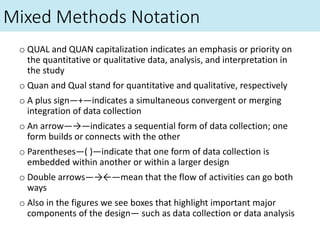
o QUAL and QUAN capitalization indicates an emphasis or priority on
the quantitative or qualitative data, analysis, and interpretation in
the study
o Quan and Qual stand for quantitative and qualitative, respectively
o A plus sign—+—indicates a simultaneous convergent or merging
integration of data collection
o An arrow—→—indicates a sequential form of data collection; one
form builds or connects with the other
o Parentheses—( )—indicate that one form of data collection is
embedded within another or within a larger design
o Double arrows—→←—mean that the flow of activities can go both
ways
o Also in the figures we see boxes that highlight important major
components of the design— such as data collection or data analysis
Mixed Methods Notation
Choosing a Mixed Methods Design
• Choice Based on Outcomes Expected: The researcher
determines the outcome(s) anticipated at the end of the mixed
methods study and then to link it to the types
• Choice Based on Data Integrated: This mixed methods
integration merges two data bases through side-by-side
comparison, data transformation, or a joint display
• Choice Based on the Timing of the Data Collection:
Either concurrent data collection – convergent strategy.
Sequential data collection - explanatory, exploratory and
sequential strategies
Choosing a Mixed Methods Design
• Choice Based on the Emphasis Placed on Each Database: A
convergent approach is best. If a stronger emphasis is on the
quantitative approach = explanatory sequential strategy is used. If
a qualitative approach is emphasized = exploratory sequential
strategy
• Choice Based on Type of Design Most Suited for a Field : Relies on
the inclination of a field toward a certain design
• Choice Based on a Single Researcher or Team: Single researcher =
sequential strategies of an explanatory sequential or exploratory
sequential approach. Research team = Multiple forms of data
collection simultaneously over a long period of time possible,
hence, embedded or a multiphase design
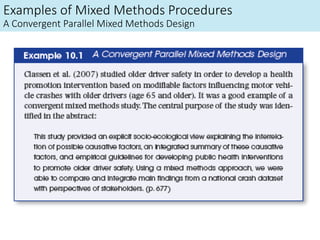
Examples of Mixed Methods Procedures
A Convergent Parallel Mixed Methods Design
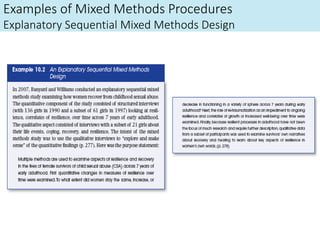
Examples of Mixed Methods Procedures
Explanatory Sequential Mixed Methods Design
Examples of Mixed Methods Procedures
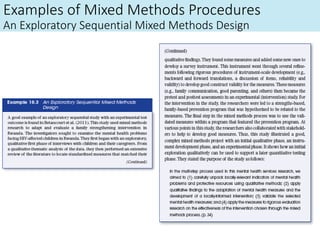
An Exploratory Sequential Mixed Methods Design
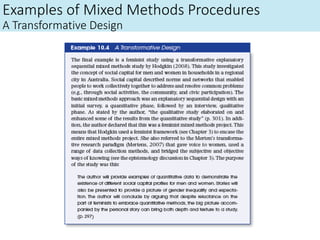
Examples of Mixed Methods Procedures
A Transformative Design

Chapter Ten Mixed Methods Procedures

  • 1.
  • 2.
    Chapter Outline • Componentsof Mixed Methods Procedures • The Nature of Mixed Methods Research • Types of Mixed Methods Strategies and Visual Models • Planning Mixed Methods Procedures • Alternative Strategies and Visual Models • Choosing a Mixed Methods Strategy • Data Collection Procedures • Data Analysis and Validation Procedures • Report Presentation Structure • Examples of Mixed Methods Procedures
  • 3.
    Mixed Methods Procedures •Describe this approach in your proposal • Trace its history • Provide a definition • Mixed methods research is an approach to inquiry that combines or associates both qualitative and quantitative forms. It involves philosophical assumptions, the use of qualitative and quantitative approaches, and the mixing of both approaches in a study. Thus, it is more than simply collecting and analyzing both kinds of data; it also involves the use of both approaches in tandem so that the overall strength of a study is greater than either qualitative or quantitative research (Creswell & Plano Clark, 2007). • Discuss the reasons for choosing the procedure, and the value it will lend to a study • Decide on a mixed methods design to use • Discuss the challenges with this approach
  • 4.
    Check List forDesigning Mixed Methods Procedure
  • 5.
    Describe Mixed MethodsResearch • Begin by defining mixed methods: oInvolves the collection of both qualitative and quantitative data in response to research questions or hypotheses oIncludes analysis of both forms of data oRigorous data collection and analysis oThe two forms of data are integrated in the design analysis oProcedures are incorporated into a distinct mixed methods design oProcedures can also be informed by a philosophical world- view or a theory
  • 6.
    Describe Mixed MethodsResearch • Many different terms are used for this approach, recent writings tend to use the term mixed methods • The background of mixed methods by reviewing the history of this approach • The type of mixed methods design that will be used and the rationale for choosing it • The challenges this form of research poses for the inquirer
  • 7.
    Describe Mixed MethodsResearch • Value and rationale for the choice of mixed methods as an approach for the project: o Perspectives drawn from quantitative and qualitative data o Quantitative results with a qualitative follow-up data collection and analysis o First collect and analyze qualitative data and then administer the instruments to a sample o Experimental results by incorporating the perspectives of individuals o More complete understanding of changes needed for a marginalized group through the combination of qualitative and quantitative data o Better understanding the need for and impact of an intervention program over time
  • 8.
    Types of MixedMethods Design Convergent Parallel Mixed Methods Design (Figure 10.1) • Description of the design: Collects both quantitative and qualitative data, analyzes them separately, and then compares the results to see if the findings confirm or disconfirm each other • Data collection: Collect both forms of data using the same or parallel variables, constructs, or concepts • Data analysis: Challenge is to converge or to merge the data, the two databases are analyzed separately and then brought together. Side-by-side comparison. Start with the qualitative findings and then compare them to the quantitative, present one set of findings first and then the other
  • 9.
    Types of MixedMethods Design Convergent Parallel Mixed Methods Design (Figure 10.1) • Interpretation: Written into a discussion section of the study. When there are differences in concepts, themes, or scales there is divergence • Validity: Using the convergent approach should be based on both quantitative validity (e.g., construct) and qualitative validity (e.g., triangulation) for each database
  • 10.
    Types of MixedMethods Design Explanatory Sequential Mixed Methods Design (Figure 10.1) • Description of the design: Appeals to strong quantitative background and involves a two-phase project with the collection of quantitative data in the first phase, and qualitative data to help explain initial quantitative results • Data collection: Proceeds in two distinct phases with rigorous quantitative sampling in the first phase and purposeful sampling in the second, qualitative phase, qualitative data collection builds directly on the quantitative results
  • 11.
    Types of MixedMethods Design Explanatory Sequential Mixed Methods Design (Figure 10.1) • Data analysis: The quantitative and qualitative databases are analyzed separately and the quantitative results are then used to plan the qualitative follow-up • Interpretation: First-phase quantitative results, second phase qualitative results and a third form of interpretation: how the qualitative findings help to explain the quantitative results • Validity: Researcher establishes the validity of the scores from the quantitative measures and to discuss the validity of the qualitative findings
  • 12.
    Types of MixedMethods Design Exploratory Sequential Mixed Methods Design (Figure 10.1) • Description of the design: Start with a qualitative phase first followed by a quantitative phase, for example the explanatory sequential approach, the second database builds on the results of the initial database • Data collection: Data collection occurs in two phases. The initial qualitative data followed by the second quantitative data collection. The challenge is how to use the information from the initial phase in the second phase
  • 13.
    Types of MixedMethods Design Exploratory Sequential Mixed Methods Design (Figure 10.1) • Data analysis: Analyzes quantitative and qualitative databases separately and uses the findings from the initial exploratory database to build into quantitative measures. Requires careful attention to the qualitative data analysis steps • Interpretation: First report the qualitative finding and results, and then the quantitative results of the final phase of the study • Validity: Need to check for the validity of the qualitative data and the quantitative scores
  • 14.
    Advanced Mixed MethodsDesigns There are three advanced mixed methods designs that incorporate elements convergent, explanatory sequential, and exploratory sequential approaches: 1. Embedded mixed methods design rests on one or more forms of data 2. Transformative mixed methods focus on social justice frameworks to help a marginalized group 3. Multiphase mixed methods occurs when researchers conduct several mixed methods projects, in a longitudinal study
  • 15.
    Mixed Methods Notation oQUAL and QUAN capitalization indicates an emphasis or priority on the quantitative or qualitative data, analysis, and interpretation in the study o Quan and Qual stand for quantitative and qualitative, respectively o A plus sign—+—indicates a simultaneous convergent or merging integration of data collection o An arrow—→—indicates a sequential form of data collection; one form builds or connects with the other o Parentheses—( )—indicate that one form of data collection is embedded within another or within a larger design o Double arrows—→←—mean that the flow of activities can go both ways o Also in the figures we see boxes that highlight important major components of the design— such as data collection or data analysis
  • 16.
  • 17.
    Choosing a MixedMethods Design • Choice Based on Outcomes Expected: The researcher determines the outcome(s) anticipated at the end of the mixed methods study and then to link it to the types • Choice Based on Data Integrated: This mixed methods integration merges two data bases through side-by-side comparison, data transformation, or a joint display • Choice Based on the Timing of the Data Collection: Either concurrent data collection – convergent strategy. Sequential data collection - explanatory, exploratory and sequential strategies
  • 18.
    Choosing a MixedMethods Design • Choice Based on the Emphasis Placed on Each Database: A convergent approach is best. If a stronger emphasis is on the quantitative approach = explanatory sequential strategy is used. If a qualitative approach is emphasized = exploratory sequential strategy • Choice Based on Type of Design Most Suited for a Field : Relies on the inclination of a field toward a certain design • Choice Based on a Single Researcher or Team: Single researcher = sequential strategies of an explanatory sequential or exploratory sequential approach. Research team = Multiple forms of data collection simultaneously over a long period of time possible, hence, embedded or a multiphase design
  • 19.
    Examples of MixedMethods Procedures A Convergent Parallel Mixed Methods Design
  • 20.
    Examples of MixedMethods Procedures Explanatory Sequential Mixed Methods Design
  • 21.
    Examples of MixedMethods Procedures An Exploratory Sequential Mixed Methods Design
  • 22.
    Examples of MixedMethods Procedures A Transformative Design