Overview
 Mixed Methods Research, Defined
 Quantitative Research
 Qualitative Research
 When to use Mixed Methods Research
 Types of Mixed Methods Research Designs
 Key Characteristics
 Steps in Conducting a Mixed Methods study
 Evaluating a Mixed Methods study
Mixed Methods Research, Defined
 A mixed methods research design is a procedure for
collecting, analyzing, and “mixing” both quantitative
and qualitative research and methods in a single study
to understand a research problem.
 To utilize this design effectively, you must understand
both quantitative and qualitative research.
 Philosophical Approaches
Creswell , J. (2012). Educational research: Planning, conducting, and evaluating quantitative and qualitative research
(4thed.). Upper Saddle River, NJ: Pearson Education.
Quantitative Research
 A type of educational research in which the research
decides what to study; asks specific, narrow questions,
collects quantifiable data from participants (a large
number of participants); analyzes these numbers
using statistics; and conducts the inquiry in an
unbiased, objective manner.
 Postpositivism – singular reality; objective; deductive
Quantitative Research (cont’d)
 Generally attempts to quantify variables of interest;
questions must be measureable.
 Example:
 What is the relationship between graduate students’
level of interaction, measured by the number of ‘hits’ in
the course, and students’ grades in an online research
methods course?
Quantitative Methodology
 Generally involves collecting numerical data that can
be subjected to statistical analysis
 Examples of data collection methodologies
 Performance Tests
 Personality Measures
 Questionnaires (with closed-ended questions or open-
ended but transferred to quan data)
 Content Analysis
 The data is generally referred to as “hard” data
Qualitative Research
 A type of educational research in which the researcher
relies on the views of participants; asks broad, general
questions; collects data consisting largely of words (or
text) from participants; describes and analyzes these
words for themes; and conducts the inquiry in a
subjective, biased manner.
 Constructivism – multiple realities; biased; inductive
Qualitative Research (cont’d)
 “There are times we wish to know not how many or
how well, but simply how” (Shulman, 1988, p. 7).
 Example:
 “What are the factors that influence a graduate students’
experience in an online research methods course?”
Qualitative Methodology
Generally involves listening to the participants’ voice
and subjecting the data to analytic induction (e.g.,
finding common themes)
More Exploratory in nature
Examples of data collection methods
 Interviews
 Open-ended questionnaires
 Observations
 Content analysis
 Focus Groups
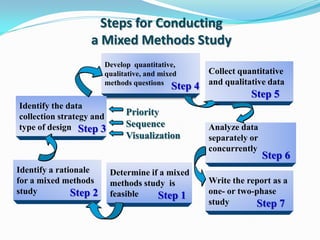
Steps for Conducting
a Mixed Methods Study
Determine if a mixed
methods study is
feasible
Develop quantitative,
qualitative, and mixed
methods questions
Collect quantitative
and qualitative data
Analyze data
separately or
concurrently
Write the report as a
one- or two-phase
study
Identify the data
collection strategy and
type of design
Identify a rationale
for a mixed methods
study
Step 1
Step 2
Step 4
Step 3
Step 5
Step 6
Step 7
Priority
Sequence
Visualization
When to Use Mixed Methods
Designs
 When both quantitative and qualitative data, together,
provide a better understanding of your research
problem than either type by itself.
 When one type of research (qualitative or
quantitative) is not enough to address the research
problem or answer the research questions.
 Pragmatism – practicality; multiple view points;
biased and unbiased; subjective and objective
Creswell , J. (2008). Educational research: Planning, conducting, and evaluating quantitative and qualitative research
(3rd ed.). Upper Saddle River, NJ: Pearson Education.
When to Use Mixed Methods
(cont’d)
 To incorporate a qualitative component into an
otherwise quantitative study
 To build from one phase of a study to another
 Explore qualitatively then develop an instrument
 Follow-up a quantitative study qualitatively to obtain
more detailed information
Creswell , J. (2012). Educational research: Planning, conducting, and evaluating quantitative and qualitative research
(4thed.). Upper Saddle River, NJ: Pearson Education.
Mixed Methods Research
Methodology
 Utilizes both quantitative and qualitative data
collection methodologies.
 Examples
 Interviews and Questionnaires
 Performance Tests and Observation
 Questionnaires and follow up Focus groups
 Document analysis, Performance Tests, Questionnaire,
and Interviews
What Is Mixed Methods Research?
A mixed methods research design is a
procedure for collecting, analyzing, and
“mixing” both quantitative and
qualitative research and methods in a
single study to understand a research
problem.
Key Characteristics of
Mixed Methods Designs: Rationale
 Rationale
 Test findings of first phase
 Explain results of first phase in more detail
 Provide a more complete understanding than either
quantitative or qualitative alone
 Collecting both quantitative and qualitative data
 Numeric data
 Text data
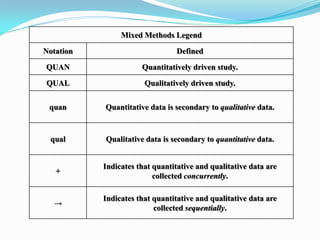
Mixed Methods Legend
Notation Defined
QUAN Quantitatively driven study.
QUAL Qualitatively driven study.
quan Quantitative data is secondary to qualitative data.
qual Qualitative data is secondary to quantitative data.
+
Indicates that quantitative and qualitative data are
collected concurrently.
→
Indicates that quantitative and qualitative data are
collected sequentially.
Key Characteristics of Mixed Methods
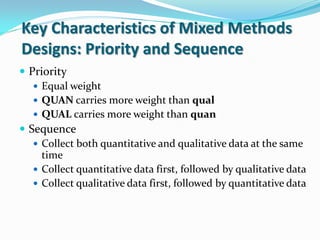
Designs: Priority and Sequence
 Priority
 Equal weight
 QUAN carries more weight than qual
 QUAL carries more weight than quan
 Sequence
 Collect both quantitative and qualitative data at the same
time
 Collect quantitative data first, followed by qualitative data
 Collect qualitative data first, followed by quantitative data
18
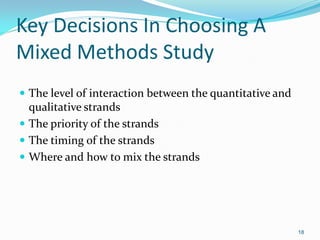
Key Decisions In Choosing A
Mixed Methods Study
 The level of interaction between the quantitative and
qualitative strands
 The priority of the strands
 The timing of the strands
 Where and how to mix the strands
20
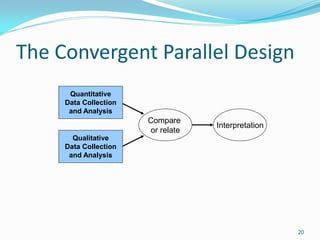
The Convergent Parallel Design
Compare
or relate
Interpretation
Quantitative
Data Collection
and Analysis
Qualitative
Data Collection
and Analysis
21
The Convergent Design
 The researcher:
 Collects quantitative and qualitative data concurrently
 Analyzes the two data sets separately
 Mixes the two databases by merging the results during
interpretation (and sometimes during data analysis)
22
Purposes for the Convergent
Design
 Obtain a more complete understanding from two
databases
 Corroborate results from different methods
 Compare multiple levels within a system
23
When to Use the Convergent
Design
 Choose this design if:
 Need to collect both types of data in one visit to the field
 Both types of data have equal value for understanding
the research problem
 Have quantitative and qualitative research skills
 Can manage extensive data collection activities
individually or with a team
24
Convergent Design
 Philosophical assumptions:
 Best suited to an "umbrella" paradigm such as
pragmatism
 Common variants:
 Parallel-databases variant
 Data-transformation variant
 Data-validation variant
25
Strengths: Convergent Design
 Intuitive
 Efficient
 Lends itself to teams
26
Challenges: Convergent Design
 Requires substantial effort and expertise
 Issues related to the samples and sample sizes
 Difficult to converge two sets of different data
 How to resolve discrepant results
27
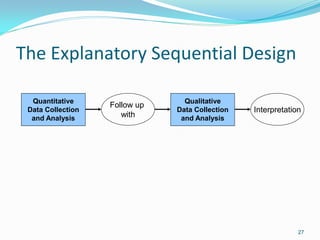
Quantitative
Data Collection
and Analysis
Qualitative
Data Collection
and Analysis
Follow up
with
Interpretation
The Explanatory Sequential Design
28
The Explanatory Design
 The researcher:
 Starts by collecting and analyzing quantitative data
 Collects and analyzes qualitative data in a second phase
as a follow-up to the quantitative results
 Connects the phases by using the quantitative results to
shape the qualitative research questions, sampling, and
data collection
29
Purposes for the Explanatory
Design
 To use qualitative data to help explain quantitative
results that need further exploration
 To use quantitative results to purposefully select best
participants for qualitative study
30
When to Use the Explanatory
Design
 Choose this design if:
 Researcher and research problem are quantitatively
oriented
 Know important variables and instruments are available
 Participants available for second data collection
 Have time to conduct two phases
 Have limited resources and need to collect and analyze
one data type at a time
 New questions emerge from quantitative results
31
Explanatory Design
 Philosophical assumptions:
 Begin from postpositivism for the quantitative phase
 Shift to constructivism for the qualitative phase
 Common variants:
 Follow-up explanations variant
 Participant-selection variant
32
Strengths: Explanatory Design
 Appealing to quantitative researchers
 Straightforward to implement two phases
 Final report can be written in two phases
 Lends itself to emergent approaches
33
Challenges: Explanatory Design
 Two phases require lengthy time to implement
 Difficult to secure IRB approval when second phase cannot
be specified before first phase complete
 Need to decide what results to follow up
 Must decide criteria for selecting participants
 Need to contact participants for a second round of data
collection
34
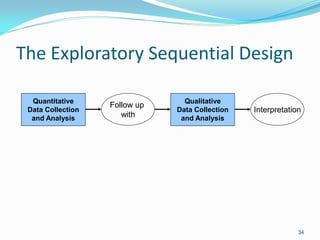
Quantitative
Data Collection
and Analysis
Qualitative
Data Collection
and Analysis
Follow up
with
Interpretation
The Exploratory Sequential Design
35
The Exploratory Design
 The researcher:
 Collects and analyzes qualitative data first followed by
quantitative data
 Analyzes the qualitative data and uses results to build to
the subsequent quantitative phase
 Connects the phases by using the qualitative results to
shape the quantitative phase by specifying research
questions and variables, developing an instrument,
and/or generating a typology
36
Purposes for the Exploratory
Design
 To first explore because variables, theories, hypotheses
not known
 To develop an instrument or typology that is not
available
 To assess whether qualitative themes generalize to a
population
37
When to Use the Exploratory
Design
 Choose this design if:
 Researcher and research problem are qualitatively
oriented
 Important variables not known and instruments not
available
 Have time to conduct two phases
 Have limited resources and need to collect and analyze
one data type at a time
 New questions have emerged from qualitative results
38
Exploratory Design
 Philosophical assumptions:
 Begin from constructivism for the qualitative phase
 Shift to postpositivism for the quantitative phase
 Common variants:
 Theory-development variant
 Instrument-development variant
39
Strengths: Exploratory Design
 Straightforward to design, implement, and report
 Quantitative component can make the qualitative
approach more acceptable to quantitative-biased
audiences
 Researcher produces a product, such as an instrument
 Lends itself to emergent approaches
40
Challenges: Exploratory Design
 Two phases require lengthy time to implement
 Difficult to specify quantitative procedures when
applying for initial IRB approval; may have to apply
twice
 Deciding the qualitative findings to use for
quantitative phase
 Procedures for developing a valid and reliable
instrument
41
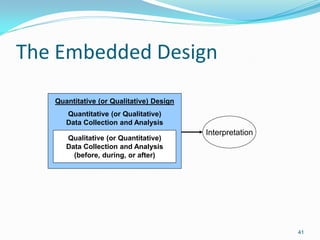
The Embedded Design
Interpretation
Quantitative (or Qualitative) Design
Quantitative (or Qualitative)
Data Collection and Analysis
Qualitative (or Quantitative)
Data Collection and Analysis
(before, during, or after)
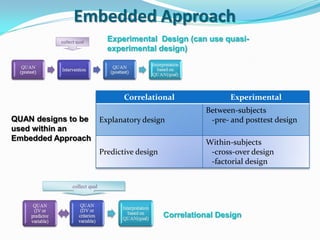
Embedded Approach
QUAN designs to be
used within an
Embedded Approach
Experimental Design (can use quasi-
experimental design)
Correlational Design
collect qual
collect qual
Correlational Experimental
Explanatory design
Between-subjects
-pre- and posttest design
Predictive design
Within-subjects
-cross-over design
-factorial design
43
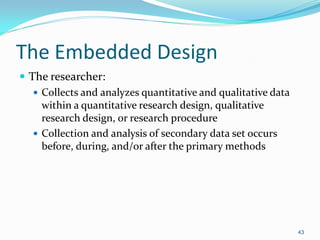
The Embedded Design
 The researcher:
 Collects and analyzes quantitative and qualitative data
within a quantitative research design, qualitative
research design, or research procedure
 Collection and analysis of secondary data set occurs
before, during, and/or after the primary methods
44
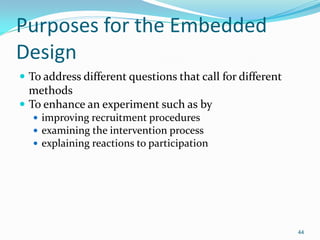
Purposes for the Embedded
Design
 To address different questions that call for different
methods
 To enhance an experiment such as by
 improving recruitment procedures
 examining the intervention process
 explaining reactions to participation
45
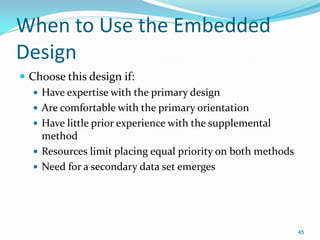
When to Use the Embedded
Design
 Choose this design if:
 Have expertise with the primary design
 Are comfortable with the primary orientation
 Have little prior experience with the supplemental
method
 Resources limit placing equal priority on both methods
 Need for a secondary data set emerges
46
Embedded Design
 Philosophical assumptions:
 Worldview may reflect the primary approach, use
pragmatism for a concurrent approach, or shift in a
sequential approach
 Common variants:
 Embedded experiment
 Embedded correlational
 Embedded instrument development and validation
 Mixed methods case study
 Mixed methods narrative research
 Mixed methods ethnography
47
Strengths: Embedded Design
 May require less time and fewer resources
 Improve the larger design with supplemental data
 Fits team approach well
 May be able to publish results separately
 Appealing to those accustomed to traditional designs
48
Challenges: Embedded Design
 Need expertise in primary design and mixed methods
 Must specify purpose for collecting the supplemental data
 Must decide when to collect supplemental data
 Results are difficult to integrate
 Must consider treatment bias if qualitative data collected
during experiment
Light, G. et al. (2009). Assessing the impact of a year-long
faculty development program on faculty approaches to
teaching. International Journal of Teaching and
Learning in Higher Education, 20(2), 168-181.
 Objective: Determine if the Faculty Development
Program (FDP) impacts teaching style of pre-tenure
faculty.
 Research Questions
 Quantitative – What effect did the FDP have on
teachers’ approaches to teaching?
 Qualitative – (Central) – How did the teachers’
teaching strategies change in response to the FDP?
 Sub - What steps did the teachers take to implement the
change?
 Mixed Method – How do the qualitative (qual) findings
explain (expand on) the quantitative (QUAN) results?
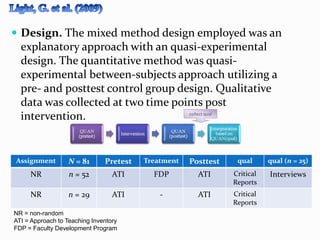
 Design. The mixed method design employed was an
explanatory approach with an quasi-experimental
design. The quantitative method was quasi-
experimental between-subjects approach utilizing a
pre- and posttest control group design. Qualitative
data was collected at two time points post
intervention. collect qual
Assignment N = 81 Pretest Treatment Posttest qual qual (n = 25)
NR n = 52 ATI FDP ATI Critical
Reports
Interviews
NR n = 29 ATI - ATI Critical
Reports
NR = non-random
ATI = Approach to Teaching Inventory
FDP = Faculty Development Program
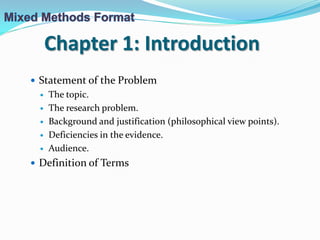
Chapter 1: Introduction
 Statement of the Problem
 The topic.
 The research problem.
 Background and justification (philosophical view points).
 Deficiencies in the evidence.
 Audience.
 Definition of Terms
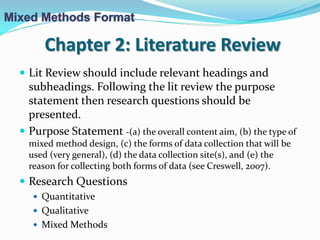
Chapter 2: Literature Review
 Lit Review should include relevant headings and
subheadings. Following the lit review the purpose
statement then research questions should be
presented.
 Purpose Statement -(a) the overall content aim, (b) the type of
mixed method design, (c) the forms of data collection that will be
used (very general), (d) the data collection site(s), and (e) the
reason for collecting both forms of data (see Creswell, 2007).
 Research Questions
 Quantitative
 Qualitative
 Mixed Methods
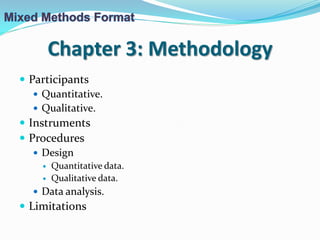
Chapter 3: Methodology
 Participants
 Quantitative.
 Qualitative.
 Instruments
 Procedures
 Design
 Quantitative data.
 Qualitative data.
 Data analysis.
 Limitations
Mixed Methods Template
 Go to the ARC website for the Mixed Methods specific
template:
http://www.fischlerschool.nova.edu/applied-
research/procedures_and_resources
Thank you for your Attention!

mixed_methods.pdf

  • 2.
    Overview  Mixed MethodsResearch, Defined  Quantitative Research  Qualitative Research  When to use Mixed Methods Research  Types of Mixed Methods Research Designs  Key Characteristics  Steps in Conducting a Mixed Methods study  Evaluating a Mixed Methods study
  • 3.
    Mixed Methods Research,Defined  A mixed methods research design is a procedure for collecting, analyzing, and “mixing” both quantitative and qualitative research and methods in a single study to understand a research problem.  To utilize this design effectively, you must understand both quantitative and qualitative research.  Philosophical Approaches Creswell , J. (2012). Educational research: Planning, conducting, and evaluating quantitative and qualitative research (4thed.). Upper Saddle River, NJ: Pearson Education.
  • 4.
    Quantitative Research  Atype of educational research in which the research decides what to study; asks specific, narrow questions, collects quantifiable data from participants (a large number of participants); analyzes these numbers using statistics; and conducts the inquiry in an unbiased, objective manner.  Postpositivism – singular reality; objective; deductive
  • 5.
    Quantitative Research (cont’d) Generally attempts to quantify variables of interest; questions must be measureable.  Example:  What is the relationship between graduate students’ level of interaction, measured by the number of ‘hits’ in the course, and students’ grades in an online research methods course?
  • 6.
    Quantitative Methodology  Generallyinvolves collecting numerical data that can be subjected to statistical analysis  Examples of data collection methodologies  Performance Tests  Personality Measures  Questionnaires (with closed-ended questions or open- ended but transferred to quan data)  Content Analysis  The data is generally referred to as “hard” data
  • 7.
    Qualitative Research  Atype of educational research in which the researcher relies on the views of participants; asks broad, general questions; collects data consisting largely of words (or text) from participants; describes and analyzes these words for themes; and conducts the inquiry in a subjective, biased manner.  Constructivism – multiple realities; biased; inductive
  • 8.
    Qualitative Research (cont’d) “There are times we wish to know not how many or how well, but simply how” (Shulman, 1988, p. 7).  Example:  “What are the factors that influence a graduate students’ experience in an online research methods course?”
  • 9.
    Qualitative Methodology Generally involveslistening to the participants’ voice and subjecting the data to analytic induction (e.g., finding common themes) More Exploratory in nature Examples of data collection methods  Interviews  Open-ended questionnaires  Observations  Content analysis  Focus Groups
  • 10.
    Steps for Conducting aMixed Methods Study Determine if a mixed methods study is feasible Develop quantitative, qualitative, and mixed methods questions Collect quantitative and qualitative data Analyze data separately or concurrently Write the report as a one- or two-phase study Identify the data collection strategy and type of design Identify a rationale for a mixed methods study Step 1 Step 2 Step 4 Step 3 Step 5 Step 6 Step 7 Priority Sequence Visualization
  • 11.
    When to UseMixed Methods Designs  When both quantitative and qualitative data, together, provide a better understanding of your research problem than either type by itself.  When one type of research (qualitative or quantitative) is not enough to address the research problem or answer the research questions.  Pragmatism – practicality; multiple view points; biased and unbiased; subjective and objective Creswell , J. (2008). Educational research: Planning, conducting, and evaluating quantitative and qualitative research (3rd ed.). Upper Saddle River, NJ: Pearson Education.
  • 12.
    When to UseMixed Methods (cont’d)  To incorporate a qualitative component into an otherwise quantitative study  To build from one phase of a study to another  Explore qualitatively then develop an instrument  Follow-up a quantitative study qualitatively to obtain more detailed information Creswell , J. (2012). Educational research: Planning, conducting, and evaluating quantitative and qualitative research (4thed.). Upper Saddle River, NJ: Pearson Education.
  • 13.
    Mixed Methods Research Methodology Utilizes both quantitative and qualitative data collection methodologies.  Examples  Interviews and Questionnaires  Performance Tests and Observation  Questionnaires and follow up Focus groups  Document analysis, Performance Tests, Questionnaire, and Interviews
  • 14.
    What Is MixedMethods Research? A mixed methods research design is a procedure for collecting, analyzing, and “mixing” both quantitative and qualitative research and methods in a single study to understand a research problem.
  • 15.
    Key Characteristics of MixedMethods Designs: Rationale  Rationale  Test findings of first phase  Explain results of first phase in more detail  Provide a more complete understanding than either quantitative or qualitative alone  Collecting both quantitative and qualitative data  Numeric data  Text data
  • 16.
    Mixed Methods Legend NotationDefined QUAN Quantitatively driven study. QUAL Qualitatively driven study. quan Quantitative data is secondary to qualitative data. qual Qualitative data is secondary to quantitative data. + Indicates that quantitative and qualitative data are collected concurrently. → Indicates that quantitative and qualitative data are collected sequentially.
  • 17.
    Key Characteristics ofMixed Methods Designs: Priority and Sequence  Priority  Equal weight  QUAN carries more weight than qual  QUAL carries more weight than quan  Sequence  Collect both quantitative and qualitative data at the same time  Collect quantitative data first, followed by qualitative data  Collect qualitative data first, followed by quantitative data
  • 18.
    18 Key Decisions InChoosing A Mixed Methods Study  The level of interaction between the quantitative and qualitative strands  The priority of the strands  The timing of the strands  Where and how to mix the strands
  • 20.
    20 The Convergent ParallelDesign Compare or relate Interpretation Quantitative Data Collection and Analysis Qualitative Data Collection and Analysis
  • 21.
    21 The Convergent Design The researcher:  Collects quantitative and qualitative data concurrently  Analyzes the two data sets separately  Mixes the two databases by merging the results during interpretation (and sometimes during data analysis)
  • 22.
    22 Purposes for theConvergent Design  Obtain a more complete understanding from two databases  Corroborate results from different methods  Compare multiple levels within a system
  • 23.
    23 When to Usethe Convergent Design  Choose this design if:  Need to collect both types of data in one visit to the field  Both types of data have equal value for understanding the research problem  Have quantitative and qualitative research skills  Can manage extensive data collection activities individually or with a team
  • 24.
    24 Convergent Design  Philosophicalassumptions:  Best suited to an "umbrella" paradigm such as pragmatism  Common variants:  Parallel-databases variant  Data-transformation variant  Data-validation variant
  • 25.
    25 Strengths: Convergent Design Intuitive  Efficient  Lends itself to teams
  • 26.
    26 Challenges: Convergent Design Requires substantial effort and expertise  Issues related to the samples and sample sizes  Difficult to converge two sets of different data  How to resolve discrepant results
  • 27.
    27 Quantitative Data Collection and Analysis Qualitative DataCollection and Analysis Follow up with Interpretation The Explanatory Sequential Design
  • 28.
    28 The Explanatory Design The researcher:  Starts by collecting and analyzing quantitative data  Collects and analyzes qualitative data in a second phase as a follow-up to the quantitative results  Connects the phases by using the quantitative results to shape the qualitative research questions, sampling, and data collection
  • 29.
    29 Purposes for theExplanatory Design  To use qualitative data to help explain quantitative results that need further exploration  To use quantitative results to purposefully select best participants for qualitative study
  • 30.
    30 When to Usethe Explanatory Design  Choose this design if:  Researcher and research problem are quantitatively oriented  Know important variables and instruments are available  Participants available for second data collection  Have time to conduct two phases  Have limited resources and need to collect and analyze one data type at a time  New questions emerge from quantitative results
  • 31.
    31 Explanatory Design  Philosophicalassumptions:  Begin from postpositivism for the quantitative phase  Shift to constructivism for the qualitative phase  Common variants:  Follow-up explanations variant  Participant-selection variant
  • 32.
    32 Strengths: Explanatory Design Appealing to quantitative researchers  Straightforward to implement two phases  Final report can be written in two phases  Lends itself to emergent approaches
  • 33.
    33 Challenges: Explanatory Design Two phases require lengthy time to implement  Difficult to secure IRB approval when second phase cannot be specified before first phase complete  Need to decide what results to follow up  Must decide criteria for selecting participants  Need to contact participants for a second round of data collection
  • 34.
    34 Quantitative Data Collection and Analysis Qualitative DataCollection and Analysis Follow up with Interpretation The Exploratory Sequential Design
  • 35.
    35 The Exploratory Design The researcher:  Collects and analyzes qualitative data first followed by quantitative data  Analyzes the qualitative data and uses results to build to the subsequent quantitative phase  Connects the phases by using the qualitative results to shape the quantitative phase by specifying research questions and variables, developing an instrument, and/or generating a typology
  • 36.
    36 Purposes for theExploratory Design  To first explore because variables, theories, hypotheses not known  To develop an instrument or typology that is not available  To assess whether qualitative themes generalize to a population
  • 37.
    37 When to Usethe Exploratory Design  Choose this design if:  Researcher and research problem are qualitatively oriented  Important variables not known and instruments not available  Have time to conduct two phases  Have limited resources and need to collect and analyze one data type at a time  New questions have emerged from qualitative results
  • 38.
    38 Exploratory Design  Philosophicalassumptions:  Begin from constructivism for the qualitative phase  Shift to postpositivism for the quantitative phase  Common variants:  Theory-development variant  Instrument-development variant
  • 39.
    39 Strengths: Exploratory Design Straightforward to design, implement, and report  Quantitative component can make the qualitative approach more acceptable to quantitative-biased audiences  Researcher produces a product, such as an instrument  Lends itself to emergent approaches
  • 40.
    40 Challenges: Exploratory Design Two phases require lengthy time to implement  Difficult to specify quantitative procedures when applying for initial IRB approval; may have to apply twice  Deciding the qualitative findings to use for quantitative phase  Procedures for developing a valid and reliable instrument
  • 41.
    41 The Embedded Design Interpretation Quantitative(or Qualitative) Design Quantitative (or Qualitative) Data Collection and Analysis Qualitative (or Quantitative) Data Collection and Analysis (before, during, or after)
  • 42.
    Embedded Approach QUAN designsto be used within an Embedded Approach Experimental Design (can use quasi- experimental design) Correlational Design collect qual collect qual Correlational Experimental Explanatory design Between-subjects -pre- and posttest design Predictive design Within-subjects -cross-over design -factorial design
  • 43.
    43 The Embedded Design The researcher:  Collects and analyzes quantitative and qualitative data within a quantitative research design, qualitative research design, or research procedure  Collection and analysis of secondary data set occurs before, during, and/or after the primary methods
  • 44.
    44 Purposes for theEmbedded Design  To address different questions that call for different methods  To enhance an experiment such as by  improving recruitment procedures  examining the intervention process  explaining reactions to participation
  • 45.
    45 When to Usethe Embedded Design  Choose this design if:  Have expertise with the primary design  Are comfortable with the primary orientation  Have little prior experience with the supplemental method  Resources limit placing equal priority on both methods  Need for a secondary data set emerges
  • 46.
    46 Embedded Design  Philosophicalassumptions:  Worldview may reflect the primary approach, use pragmatism for a concurrent approach, or shift in a sequential approach  Common variants:  Embedded experiment  Embedded correlational  Embedded instrument development and validation  Mixed methods case study  Mixed methods narrative research  Mixed methods ethnography
  • 47.
    47 Strengths: Embedded Design May require less time and fewer resources  Improve the larger design with supplemental data  Fits team approach well  May be able to publish results separately  Appealing to those accustomed to traditional designs
  • 48.
    48 Challenges: Embedded Design Need expertise in primary design and mixed methods  Must specify purpose for collecting the supplemental data  Must decide when to collect supplemental data  Results are difficult to integrate  Must consider treatment bias if qualitative data collected during experiment
  • 49.
    Light, G. etal. (2009). Assessing the impact of a year-long faculty development program on faculty approaches to teaching. International Journal of Teaching and Learning in Higher Education, 20(2), 168-181.  Objective: Determine if the Faculty Development Program (FDP) impacts teaching style of pre-tenure faculty.  Research Questions  Quantitative – What effect did the FDP have on teachers’ approaches to teaching?  Qualitative – (Central) – How did the teachers’ teaching strategies change in response to the FDP?  Sub - What steps did the teachers take to implement the change?  Mixed Method – How do the qualitative (qual) findings explain (expand on) the quantitative (QUAN) results?
  • 50.
     Design. Themixed method design employed was an explanatory approach with an quasi-experimental design. The quantitative method was quasi- experimental between-subjects approach utilizing a pre- and posttest control group design. Qualitative data was collected at two time points post intervention. collect qual Assignment N = 81 Pretest Treatment Posttest qual qual (n = 25) NR n = 52 ATI FDP ATI Critical Reports Interviews NR n = 29 ATI - ATI Critical Reports NR = non-random ATI = Approach to Teaching Inventory FDP = Faculty Development Program
  • 51.
    Chapter 1: Introduction Statement of the Problem  The topic.  The research problem.  Background and justification (philosophical view points).  Deficiencies in the evidence.  Audience.  Definition of Terms
  • 52.
    Chapter 2: LiteratureReview  Lit Review should include relevant headings and subheadings. Following the lit review the purpose statement then research questions should be presented.  Purpose Statement -(a) the overall content aim, (b) the type of mixed method design, (c) the forms of data collection that will be used (very general), (d) the data collection site(s), and (e) the reason for collecting both forms of data (see Creswell, 2007).  Research Questions  Quantitative  Qualitative  Mixed Methods
  • 53.
    Chapter 3: Methodology Participants  Quantitative.  Qualitative.  Instruments  Procedures  Design  Quantitative data.  Qualitative data.  Data analysis.  Limitations
  • 54.
    Mixed Methods Template Go to the ARC website for the Mixed Methods specific template: http://www.fischlerschool.nova.edu/applied- research/procedures_and_resources Thank you for your Attention!