MIXED METHOD
RESEARCH
WHAT IS MIXED METHOD RESEARCH?
 Mixed methods research is a procedure for collecting,
analyzing and “mixing” both quantitative and qualitative
methods in a single study or a series of studies to
understand a research problem. – Creswell & Plano Clark
(2011)
 The purpose of this form of research is that both
qualitative and quantitative research, in combination,
provide a better understanding of a research problem or
issue than either research approach alone.
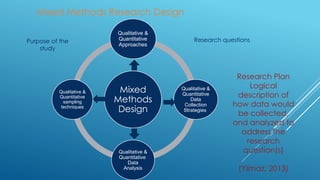
Mixed
Methods
Design
Qualitative &
Quantitative
Approaches
Qualitative &
Quantitative
Data
Collection
Strategies
Qualitative &
Quantitative
Data
Analysis
Qualitative &
Quantitative
sampling
techniques
Mixed Methods Research Design
Purpose of the
study
Research questions
Research Plan
Logical
description of
how data would
be collected,
and analyzed to
address the
research
question(s)
(Yilmaz, 2013)
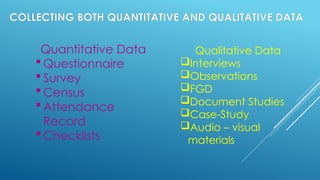
COLLECTING BOTH QUANTITATIVE AND QUALITATIVE DATA
Quantitative Data
 Questionnaire
 Survey
 Census
 Attendance
Record
 Checklists
Qualitative Data
Interviews
Observations
FGD
Document Studies
Case-Study
Audio – visual
materials
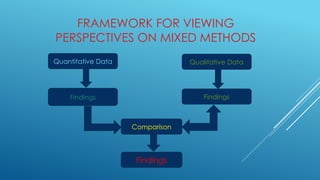
FRAMEWORK FOR VIEWING
PERSPECTIVES ON MIXED METHODS
Quantitative Data
Findings
Qualitative Data
Findings
Comparison
Findings
A MIXED METHODS RESEARCHER….
 Collects both quantitative and qualitative data
 “Mixes” them
 “Mixes” them at the same time (concurrently) or one
after the other (sequentially)
 Describes the kinds of mixed methods being used
Morse’s Notation System
Designated by upper case and lower case letters
QUAL/quan designate a mixed methods study in which
the dominant approach is qualitative, while QUAN/qual
designates the reverse.
If neither approach is dominant (i.e., both are equal), the
notation stipulates QUAL/QUAN.
Sequencing in this system is indicated by the symbols + or
.The arrow designates a sequential approach.
BASIC CHARACTERISTICS
 Collect and analyze both quantitative and qualitative
data
 Mix two forms of data in different ways
 Give priority to one or both forms of data
 Can be in a single study or in multiple phases of a study
 Design can be based on either or both perspectives
WHEN DO YOU CONDUCT A MIXED
METHODS STUDY?
When you have both quantitative and qualitative
data.
When one type of research is not enough to explain or
to answer the question.
When you want qualitative research to help explain
quantitative findings.
When you want to generalize findings to a large
population.
When you want to provide alternative perspectives in
a study.
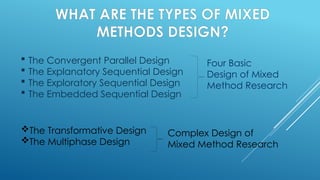
WHAT ARE THE TYPES OF MIXED
METHODS DESIGN?
 The Convergent Parallel Design
 The Explanatory Sequential Design
 The Exploratory Sequential Design
 The Embedded Sequential Design
Four Basic
Design of Mixed
Method Research
The Transformative Design
The Multiphase Design
Complex Design of
Mixed Method Research
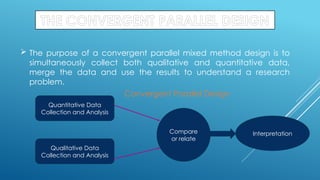
THE CONVERGENT PARALLEL DESIGN
 The purpose of a convergent parallel mixed method design is to
simultaneously collect both qualitative and quantitative data,
merge the data and use the results to understand a research
problem.
Convergent Parallel Design
Quantitative Data
Collection and Analysis
Qualitative Data
Collection and Analysis
Compare
or relate
Interpretation
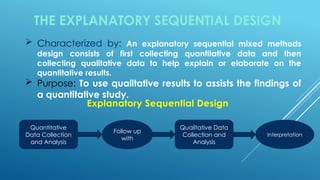
THE EXPLANATORY SEQUENTIAL DESIGN
 Characterized by: An explanatory sequential mixed methods
design consists of first collecting quantitative data and then
collecting qualitative data to help explain or elaborate on the
quantitative results.
 Purpose: To use qualitative results to assists the findings of
a quantitative study.
Explanatory Sequential Design
Quantitative
Data Collection
and Analysis
Qualitative Data
Collection and
Analysis
Follow up
with
Interpretation
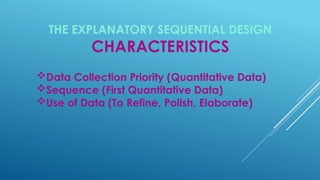
THE EXPLANATORY SEQUENTIAL DESIGN
CHARACTERISTICS
Data Collection Priority (Quantitative Data)
Sequence (First Quantitative Data)
Use of Data (To Refine, Polish, Elaborate)
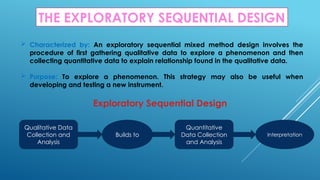
THE EXPLORATORY SEQUENTIAL DESIGN
 Characterized by: An exploratory sequential mixed method design involves the
procedure of first gathering qualitative data to explore a phenomenon and then
collecting quantitative data to explain relationship found in the qualitative data.
 Purpose: To explore a phenomenon. This strategy may also be useful when
developing and testing a new instrument.
Exploratory Sequential Design
Qualitative Data
Collection and
Analysis
Builds to
Quantitative
Data Collection
and Analysis
Interpretation
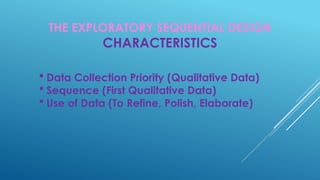
THE EXPLORATORY SEQUENTIAL DESIGN
CHARACTERISTICS
 Data Collection Priority (Qualitative Data)
 Sequence (First Qualitative Data)
 Use of Data (To Refine, Polish, Elaborate)
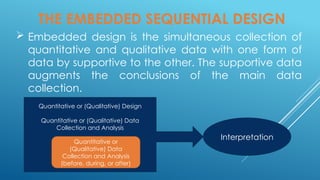
THE EMBEDDED SEQUENTIAL DESIGN
 Embedded design is the simultaneous collection of
quantitative and qualitative data with one form of
data by supportive to the other. The supportive data
augments the conclusions of the main data
collection.
Quantitative or (Qualitative) Design
Quantitative or (Qualitative) Data
Collection and Analysis
Quantitative or
(Qualitative) Data
Collection and Analysis
(before, during, or after)
Interpretation
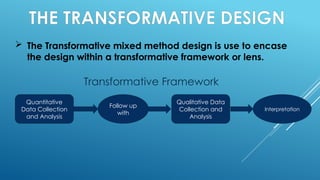
THE TRANSFORMATIVE DESIGN
 The Transformative mixed method design is use to encase
the design within a transformative framework or lens.
Quantitative
Data Collection
and Analysis
Follow up
with
Qualitative Data
Collection and
Analysis
Interpretation
Transformative Framework
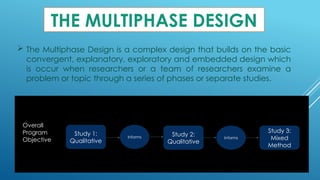
THE MULTIPHASE DESIGN
 The Multiphase Design is a complex design that builds on the basic
convergent, explanatory, exploratory and embedded design which
is occur when researchers or a team of researchers examine a
problem or topic through a series of phases or separate studies.
Study 1:
Qualitative
Study 2:
Qualitative
Informs Informs
Study 3:
Mixed
Method
Overall
Program
Objective
STEPS IN THE PROCESS OF
CONDUCTING A MIXED
METHOD STUDIES
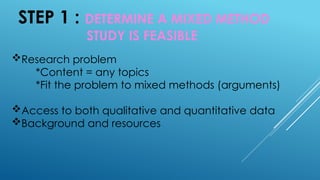
STEP 1 : DETERMINE A MIXED METHOD
STUDY IS FEASIBLE
Research problem
*Content = any topics
*Fit the problem to mixed methods (arguments)
Access to both qualitative and quantitative data
Background and resources
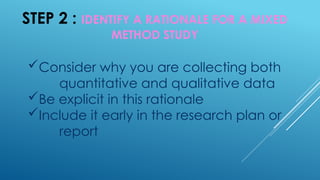
STEP 2 : IDENTIFY A RATIONALE FOR A MIXED
METHOD STUDY
Consider why you are collecting both
quantitative and qualitative data
Be explicit in this rationale
Include it early in the research plan or
report
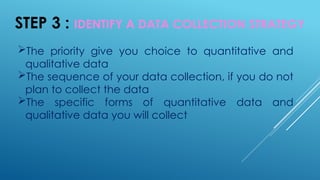
STEP 3 : IDENTIFY A DATA COLLECTION STRATEGY
The priority give you choice to quantitative and
qualitative data
The sequence of your data collection, if you do not
plan to collect the data
The specific forms of quantitative data and
qualitative data you will collect
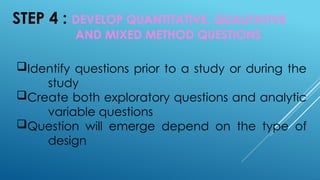
STEP 4 : DEVELOP QUANTITATIVE, QUALITATIVE
AND MIXED METHOD QUESTIONS
Identify questions prior to a study or during the
study
Create both exploratory questions and analytic
variable questions
Question will emerge depend on the type of
design
STEP 5 : COLLECT QUANTITATIVE
AND
QUALITATIVE DATA
The sequence of data collection will
depend on the type of design
In all design the presentation of data or
information will be organized
STEP 6 : ANALYZE DATA SEPARATELY OR
CONCURRENTLY
Data analyze mainly related to the specific
type of design being used
Analyze data (qualitative and quantitative)
separately, concurrently or both
STEP 7 : WRITE A REPORT AS ONE OR
TWO PHASE STUDY
The report is written in two phase
The report integrates the quantitative
and qualitative phases or the study in
each section
WHAT ARE SOME STRENGHTS?
Can be easy to describe and to report
Can be useful when unexpected results
arise from a prior study
Can help to generalize qualitative data
Helpful in designing and validating an
instrument
Can position research in a transformative
WHAT ARE SOME WEAKNESSES?
Time required
Discrepancies between different types of data
Can be difficult to decide when to proceed in
sequential designs
Little guidance on transformative methods
ACTIVITY TIME!
L2 - ACTIVITY 1:
In a long bond paper, create a
fishbone analysis on your previous
paper in ‘practical research’.
Deadline: April 1, 2024
L1 - ACTIVITY 1:
In a long bond paper, create a research article
analysis based on the link in the comment
section. Follow the PROPER format I gave
you. On april 1, you will present it individually
at the faculty office and I will ask questions.
Deadline: April 1, 2024
THANK YOU FOR
LISTENING!

3I's Midtaaaaaaaaaaaaaaaaaaerm - L2.pptx

  • 1.
  • 2.
    WHAT IS MIXEDMETHOD RESEARCH?  Mixed methods research is a procedure for collecting, analyzing and “mixing” both quantitative and qualitative methods in a single study or a series of studies to understand a research problem. – Creswell & Plano Clark (2011)  The purpose of this form of research is that both qualitative and quantitative research, in combination, provide a better understanding of a research problem or issue than either research approach alone.
  • 3.
    Mixed Methods Design Qualitative & Quantitative Approaches Qualitative & Quantitative Data Collection Strategies Qualitative& Quantitative Data Analysis Qualitative & Quantitative sampling techniques Mixed Methods Research Design Purpose of the study Research questions Research Plan Logical description of how data would be collected, and analyzed to address the research question(s) (Yilmaz, 2013)
  • 4.
    COLLECTING BOTH QUANTITATIVEAND QUALITATIVE DATA Quantitative Data  Questionnaire  Survey  Census  Attendance Record  Checklists Qualitative Data Interviews Observations FGD Document Studies Case-Study Audio – visual materials
  • 5.
    FRAMEWORK FOR VIEWING PERSPECTIVESON MIXED METHODS Quantitative Data Findings Qualitative Data Findings Comparison Findings
  • 6.
    A MIXED METHODSRESEARCHER….  Collects both quantitative and qualitative data  “Mixes” them  “Mixes” them at the same time (concurrently) or one after the other (sequentially)  Describes the kinds of mixed methods being used
  • 7.
    Morse’s Notation System Designatedby upper case and lower case letters QUAL/quan designate a mixed methods study in which the dominant approach is qualitative, while QUAN/qual designates the reverse. If neither approach is dominant (i.e., both are equal), the notation stipulates QUAL/QUAN. Sequencing in this system is indicated by the symbols + or .The arrow designates a sequential approach.
  • 8.
    BASIC CHARACTERISTICS  Collectand analyze both quantitative and qualitative data  Mix two forms of data in different ways  Give priority to one or both forms of data  Can be in a single study or in multiple phases of a study  Design can be based on either or both perspectives
  • 9.
    WHEN DO YOUCONDUCT A MIXED METHODS STUDY? When you have both quantitative and qualitative data. When one type of research is not enough to explain or to answer the question. When you want qualitative research to help explain quantitative findings. When you want to generalize findings to a large population. When you want to provide alternative perspectives in a study.
  • 10.
    WHAT ARE THETYPES OF MIXED METHODS DESIGN?  The Convergent Parallel Design  The Explanatory Sequential Design  The Exploratory Sequential Design  The Embedded Sequential Design Four Basic Design of Mixed Method Research The Transformative Design The Multiphase Design Complex Design of Mixed Method Research
  • 11.
    THE CONVERGENT PARALLELDESIGN  The purpose of a convergent parallel mixed method design is to simultaneously collect both qualitative and quantitative data, merge the data and use the results to understand a research problem. Convergent Parallel Design Quantitative Data Collection and Analysis Qualitative Data Collection and Analysis Compare or relate Interpretation
  • 12.
    THE EXPLANATORY SEQUENTIALDESIGN  Characterized by: An explanatory sequential mixed methods design consists of first collecting quantitative data and then collecting qualitative data to help explain or elaborate on the quantitative results.  Purpose: To use qualitative results to assists the findings of a quantitative study. Explanatory Sequential Design Quantitative Data Collection and Analysis Qualitative Data Collection and Analysis Follow up with Interpretation
  • 13.
    THE EXPLANATORY SEQUENTIALDESIGN CHARACTERISTICS Data Collection Priority (Quantitative Data) Sequence (First Quantitative Data) Use of Data (To Refine, Polish, Elaborate)
  • 14.
    THE EXPLORATORY SEQUENTIALDESIGN  Characterized by: An exploratory sequential mixed method design involves the procedure of first gathering qualitative data to explore a phenomenon and then collecting quantitative data to explain relationship found in the qualitative data.  Purpose: To explore a phenomenon. This strategy may also be useful when developing and testing a new instrument. Exploratory Sequential Design Qualitative Data Collection and Analysis Builds to Quantitative Data Collection and Analysis Interpretation
  • 15.
    THE EXPLORATORY SEQUENTIALDESIGN CHARACTERISTICS  Data Collection Priority (Qualitative Data)  Sequence (First Qualitative Data)  Use of Data (To Refine, Polish, Elaborate)
  • 16.
    THE EMBEDDED SEQUENTIALDESIGN  Embedded design is the simultaneous collection of quantitative and qualitative data with one form of data by supportive to the other. The supportive data augments the conclusions of the main data collection. Quantitative or (Qualitative) Design Quantitative or (Qualitative) Data Collection and Analysis Quantitative or (Qualitative) Data Collection and Analysis (before, during, or after) Interpretation
  • 17.
    THE TRANSFORMATIVE DESIGN The Transformative mixed method design is use to encase the design within a transformative framework or lens. Quantitative Data Collection and Analysis Follow up with Qualitative Data Collection and Analysis Interpretation Transformative Framework
  • 18.
    THE MULTIPHASE DESIGN The Multiphase Design is a complex design that builds on the basic convergent, explanatory, exploratory and embedded design which is occur when researchers or a team of researchers examine a problem or topic through a series of phases or separate studies. Study 1: Qualitative Study 2: Qualitative Informs Informs Study 3: Mixed Method Overall Program Objective
  • 19.
    STEPS IN THEPROCESS OF CONDUCTING A MIXED METHOD STUDIES
  • 20.
    STEP 1 :DETERMINE A MIXED METHOD STUDY IS FEASIBLE Research problem *Content = any topics *Fit the problem to mixed methods (arguments) Access to both qualitative and quantitative data Background and resources
  • 21.
    STEP 2 :IDENTIFY A RATIONALE FOR A MIXED METHOD STUDY Consider why you are collecting both quantitative and qualitative data Be explicit in this rationale Include it early in the research plan or report
  • 22.
    STEP 3 :IDENTIFY A DATA COLLECTION STRATEGY The priority give you choice to quantitative and qualitative data The sequence of your data collection, if you do not plan to collect the data The specific forms of quantitative data and qualitative data you will collect
  • 23.
    STEP 4 :DEVELOP QUANTITATIVE, QUALITATIVE AND MIXED METHOD QUESTIONS Identify questions prior to a study or during the study Create both exploratory questions and analytic variable questions Question will emerge depend on the type of design
  • 24.
    STEP 5 :COLLECT QUANTITATIVE AND QUALITATIVE DATA The sequence of data collection will depend on the type of design In all design the presentation of data or information will be organized
  • 25.
    STEP 6 :ANALYZE DATA SEPARATELY OR CONCURRENTLY Data analyze mainly related to the specific type of design being used Analyze data (qualitative and quantitative) separately, concurrently or both
  • 26.
    STEP 7 :WRITE A REPORT AS ONE OR TWO PHASE STUDY The report is written in two phase The report integrates the quantitative and qualitative phases or the study in each section
  • 27.
    WHAT ARE SOMESTRENGHTS? Can be easy to describe and to report Can be useful when unexpected results arise from a prior study Can help to generalize qualitative data Helpful in designing and validating an instrument Can position research in a transformative
  • 28.
    WHAT ARE SOMEWEAKNESSES? Time required Discrepancies between different types of data Can be difficult to decide when to proceed in sequential designs Little guidance on transformative methods
  • 29.
  • 30.
    L2 - ACTIVITY1: In a long bond paper, create a fishbone analysis on your previous paper in ‘practical research’. Deadline: April 1, 2024
  • 31.
    L1 - ACTIVITY1: In a long bond paper, create a research article analysis based on the link in the comment section. Follow the PROPER format I gave you. On april 1, you will present it individually at the faculty office and I will ask questions. Deadline: April 1, 2024
  • 32.