Decentralization and Performance
Evaluation
1
Presentation Outline
1. The Concept of Decentralization
2. Types of Responsibility Centers
3. Evaluating Investment Centers with Return
on Investment (ROI)
4. The Balanced Scorecard
5. Transfer Prices
2
I. The Concept of Decentralization
1. Decentralization Defined
2. Advantages/Disadvantages of
Decentralization
3. Two Reasons for Evaluating Subunit
Performance
4. Responsibility Accounting
3
A. Decentralization Defined
Firms that grant substantial decision making
authority to the managers of subunits are
referred to as decentralized organizations.
Most firms are neither totally centralized
nor totally decentralized. 4
B. Advantages/Disadvantages of
Decentralization
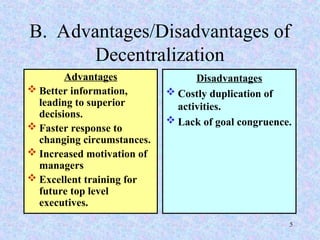
Advantages
 Better information,
leading to superior
decisions.
 Faster response to
changing circumstances.
 Increased motivation of
managers
 Excellent training for
future top level
executives.
Disadvantages
 Costly duplication of
activities.
 Lack of goal congruence.
5
C. Two Reasons for Evaluating
Subunit Performance
Identification of successful areas of
operation and areas in need of
improvement.
Influence over the behavior of managers.
Note that it is quite possible to have a good
manager and a bad subunit.
6
D. Responsibility Accounting
 Managers should only be
held responsible for costs
and revenues that they
control.
 In a decentralized
organization, costs and
revenues are traced to the
organizational level where
they can be controlled.
(See Illustration 12-3 on p.
421)
7
Types of Responsibility Centers
1. Cost Centers
2. Profit Centers
3. Investment Centers 8
Cost Centers
 A cost center is a subunit that
has responsibility for
controlling costs but not for
generating revenues.
 Most service departments
(i.e., maintenance, computer)
are classified as cost centers.
 Production departments may
be cost centers when they
simply provide components
for another department.
 Cost centers are often
controlled by comparing
actual with budgeted or
standard costs.
9
Profit Centers
 A profit center is a subunit
that has responsibility of
generating revenue and
controlling costs.
 Profit center evaluation
techniques include:
 Comparison of current year
income with a target or budget.
 Relative performance evaluation
compares the center with other
similar profit centers.
10
Investment Centers
 An investment center is a
subunit that is responsible for
generating revenue,
controlling costs, and
investing in assets.
 An investment center is
charged with earning income
consistent with the amount of
assets invested in the segment.
 Most divisions of a company
can be treated as either profit
centers or investment centers.
11
Evaluating Investment Centers
with Return on Investment (ROI)
1. The Components of ROI
2. Measuring ROI Income and Invested
Capital
3. Problems with Using ROI
4. Residual Income (RI) as an Alternative to
ROI
12
The Components of ROI
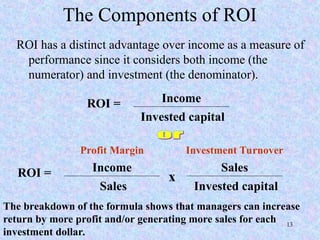
ROI has a distinct advantage over income as a measure of
performance since it considers both income (the
numerator) and investment (the denominator).
ROI = Income
Invested capital
ROI = Income
Sales
x
Sales
Invested capital
Profit Margin Investment Turnover
The breakdown of the formula shows that managers can increase
return by more profit and/or generating more sales for each
investment dollar.
13
Measuring ROI Income and Invested
Capital
ROI Income
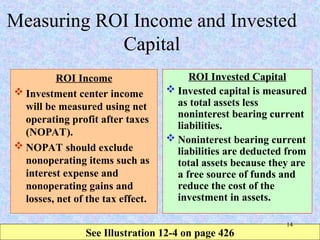
 Investment center income
will be measured using net
operating profit after taxes
(NOPAT).
 NOPAT should exclude
nonoperating items such as
interest expense and
nonoperating gains and
losses, net of the tax effect.
ROI Invested Capital
 Invested capital is measured
as total assets less
noninterest bearing current
liabilities.
 Noninterest bearing current
liabilities are deducted from
total assets because they are
a free source of funds and
reduce the cost of the
investment in assets.
See Illustration 12-4 on page 426
14
Problems with Using ROI
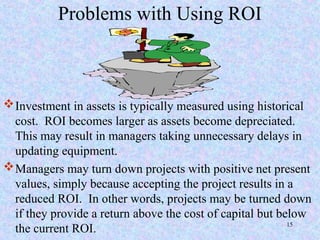
Investment in assets is typically measured using historical
cost. ROI becomes larger as assets become depreciated.
This may result in managers taking unnecessary delays in
updating equipment.
Managers may turn down projects with positive net present
values, simply because accepting the project results in a
reduced ROI. In other words, projects may be turned down
if they provide a return above the cost of capital but below
the current ROI. 15
Residual Income (RI) as an
Alternative to ROI
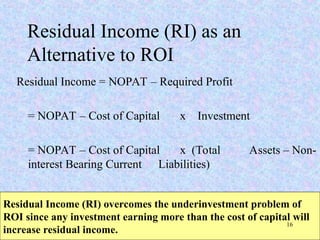
Residual Income = NOPAT – Required Profit
= NOPAT – Cost of Capital x Investment
= NOPAT – Cost of Capital x (Total Assets – Non-
interest Bearing Current Liabilities)
Residual Income (RI) overcomes the underinvestment problem of
ROI since any investment earning more than the cost of capital will
increase residual income.
16
The Balanced Scorecard
1. The Balanced Scorecard Approach
2. The Balanced Scorecard Dimensions
3. How Balance is Achieved
17
A. The Balance Scorecard
Approach
 A problem with just
assessing performance with
financial measures is that
such measures are
backward looking.
 The balanced scorecard
approach also focuses on
what managers are
currently doing to create
future shareholder value.
18
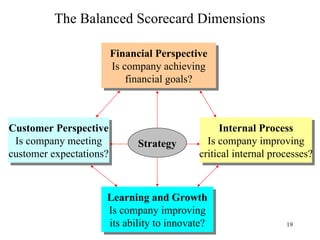
The Balanced Scorecard Dimensions
Financial Perspective
Is company achieving
financial goals?
Internal Process
Is company improving
critical internal processes?
Customer Perspective
Is company meeting
customer expectations?
Learning and Growth
Is company improving
its ability to innovate?
Strategy
19
How Balance is Achieved
Performance is assessed across a balanced set of
dimensions
Quantitative measures (e.g., number of defects)
are balanced with qualitative measures (e.g., rate
of customer satisfaction).
There is a balance of backward-looking and
forward-looking measures.
20
Transfer Prices
A. Transfer Price Defined
B. Market Prices as the Maximum
C. Variable Cost as the Minimum – Excess
Capacity Exists
D. Variable Cost Plus Lost Contribution
Margin on Outside Sales as the Minimum
– Excess Capacity Does Not Exist
E. Transfer Pricing and Income Taxes in an
International Context
21
A. Transfer Price Defined
The price that is used to
value internal transfers
of goods and services
within the same
company is known as
the transfer price.
22
Market Prices as the Maximum
The transfer price should
not exceed what the
acquiring division would
have to pay for a similar
good and given set of
conditions on the outside
market. If the outside
market is cheaper, the
good should be acquired
outside the organization.
23
Variable Cost as the Minimum –
Excess Capacity Exists
The supplying division
should not set a transfer
price that is lower than
the variable cost of
supplying the good
and/or service to the
requesting division. This
may be less than the
variable cost of serving
an outside customer.
24
Variable Cost Plus Lost Contribution
Margin on Outside Sales as the
Minimum – Excess Capacity Does
Not Exist
The minimum transfer price
will add a lost
contribution margin on
outside sales if the
supplying division must
turn away outside
customers to provide the
good and/or service to
the requesting division. 25
Transfer Pricing and Income Taxes in
an International Context
When income tax rates
between countries differ
significantly, a supplier in
a lower rate country will
want to charge the
purchasing division a
higher transfer price to
lower taxable income for
the purchaser in the
higher rate nation, and
vice versa.
26
Summary
1. Decentralization and Responsibility
Accounting
2. Cost, Profit, and Investment Centers
3. ROI
4. Residual Income
5. Balanced Scorecard
6. Transfer Pricing
27

Chapter six - Decentralization and Performance Evaluation.ppt

  • 1.
  • 2.
    Presentation Outline 1. TheConcept of Decentralization 2. Types of Responsibility Centers 3. Evaluating Investment Centers with Return on Investment (ROI) 4. The Balanced Scorecard 5. Transfer Prices 2
  • 3.
    I. The Conceptof Decentralization 1. Decentralization Defined 2. Advantages/Disadvantages of Decentralization 3. Two Reasons for Evaluating Subunit Performance 4. Responsibility Accounting 3
  • 4.
    A. Decentralization Defined Firmsthat grant substantial decision making authority to the managers of subunits are referred to as decentralized organizations. Most firms are neither totally centralized nor totally decentralized. 4
  • 5.
    B. Advantages/Disadvantages of Decentralization Advantages Better information, leading to superior decisions.  Faster response to changing circumstances.  Increased motivation of managers  Excellent training for future top level executives. Disadvantages  Costly duplication of activities.  Lack of goal congruence. 5
  • 6.
    C. Two Reasonsfor Evaluating Subunit Performance Identification of successful areas of operation and areas in need of improvement. Influence over the behavior of managers. Note that it is quite possible to have a good manager and a bad subunit. 6
  • 7.
    D. Responsibility Accounting Managers should only be held responsible for costs and revenues that they control.  In a decentralized organization, costs and revenues are traced to the organizational level where they can be controlled. (See Illustration 12-3 on p. 421) 7
  • 8.
    Types of ResponsibilityCenters 1. Cost Centers 2. Profit Centers 3. Investment Centers 8
  • 9.
    Cost Centers  Acost center is a subunit that has responsibility for controlling costs but not for generating revenues.  Most service departments (i.e., maintenance, computer) are classified as cost centers.  Production departments may be cost centers when they simply provide components for another department.  Cost centers are often controlled by comparing actual with budgeted or standard costs. 9
  • 10.
    Profit Centers  Aprofit center is a subunit that has responsibility of generating revenue and controlling costs.  Profit center evaluation techniques include:  Comparison of current year income with a target or budget.  Relative performance evaluation compares the center with other similar profit centers. 10
  • 11.
    Investment Centers  Aninvestment center is a subunit that is responsible for generating revenue, controlling costs, and investing in assets.  An investment center is charged with earning income consistent with the amount of assets invested in the segment.  Most divisions of a company can be treated as either profit centers or investment centers. 11
  • 12.
    Evaluating Investment Centers withReturn on Investment (ROI) 1. The Components of ROI 2. Measuring ROI Income and Invested Capital 3. Problems with Using ROI 4. Residual Income (RI) as an Alternative to ROI 12
  • 13.
    The Components ofROI ROI has a distinct advantage over income as a measure of performance since it considers both income (the numerator) and investment (the denominator). ROI = Income Invested capital ROI = Income Sales x Sales Invested capital Profit Margin Investment Turnover The breakdown of the formula shows that managers can increase return by more profit and/or generating more sales for each investment dollar. 13
  • 14.
    Measuring ROI Incomeand Invested Capital ROI Income  Investment center income will be measured using net operating profit after taxes (NOPAT).  NOPAT should exclude nonoperating items such as interest expense and nonoperating gains and losses, net of the tax effect. ROI Invested Capital  Invested capital is measured as total assets less noninterest bearing current liabilities.  Noninterest bearing current liabilities are deducted from total assets because they are a free source of funds and reduce the cost of the investment in assets. See Illustration 12-4 on page 426 14
  • 15.
    Problems with UsingROI Investment in assets is typically measured using historical cost. ROI becomes larger as assets become depreciated. This may result in managers taking unnecessary delays in updating equipment. Managers may turn down projects with positive net present values, simply because accepting the project results in a reduced ROI. In other words, projects may be turned down if they provide a return above the cost of capital but below the current ROI. 15
  • 16.
    Residual Income (RI)as an Alternative to ROI Residual Income = NOPAT – Required Profit = NOPAT – Cost of Capital x Investment = NOPAT – Cost of Capital x (Total Assets – Non- interest Bearing Current Liabilities) Residual Income (RI) overcomes the underinvestment problem of ROI since any investment earning more than the cost of capital will increase residual income. 16
  • 17.
    The Balanced Scorecard 1.The Balanced Scorecard Approach 2. The Balanced Scorecard Dimensions 3. How Balance is Achieved 17
  • 18.
    A. The BalanceScorecard Approach  A problem with just assessing performance with financial measures is that such measures are backward looking.  The balanced scorecard approach also focuses on what managers are currently doing to create future shareholder value. 18
  • 19.
    The Balanced ScorecardDimensions Financial Perspective Is company achieving financial goals? Internal Process Is company improving critical internal processes? Customer Perspective Is company meeting customer expectations? Learning and Growth Is company improving its ability to innovate? Strategy 19
  • 20.
    How Balance isAchieved Performance is assessed across a balanced set of dimensions Quantitative measures (e.g., number of defects) are balanced with qualitative measures (e.g., rate of customer satisfaction). There is a balance of backward-looking and forward-looking measures. 20
  • 21.
    Transfer Prices A. TransferPrice Defined B. Market Prices as the Maximum C. Variable Cost as the Minimum – Excess Capacity Exists D. Variable Cost Plus Lost Contribution Margin on Outside Sales as the Minimum – Excess Capacity Does Not Exist E. Transfer Pricing and Income Taxes in an International Context 21
  • 22.
    A. Transfer PriceDefined The price that is used to value internal transfers of goods and services within the same company is known as the transfer price. 22
  • 23.
    Market Prices asthe Maximum The transfer price should not exceed what the acquiring division would have to pay for a similar good and given set of conditions on the outside market. If the outside market is cheaper, the good should be acquired outside the organization. 23
  • 24.
    Variable Cost asthe Minimum – Excess Capacity Exists The supplying division should not set a transfer price that is lower than the variable cost of supplying the good and/or service to the requesting division. This may be less than the variable cost of serving an outside customer. 24
  • 25.
    Variable Cost PlusLost Contribution Margin on Outside Sales as the Minimum – Excess Capacity Does Not Exist The minimum transfer price will add a lost contribution margin on outside sales if the supplying division must turn away outside customers to provide the good and/or service to the requesting division. 25
  • 26.
    Transfer Pricing andIncome Taxes in an International Context When income tax rates between countries differ significantly, a supplier in a lower rate country will want to charge the purchasing division a higher transfer price to lower taxable income for the purchaser in the higher rate nation, and vice versa. 26
  • 27.
    Summary 1. Decentralization andResponsibility Accounting 2. Cost, Profit, and Investment Centers 3. ROI 4. Residual Income 5. Balanced Scorecard 6. Transfer Pricing 27