Chapter 4-The Internal
Assessment
Admas University
Outline
4.1 The nature of an internal assessment
(Internal audit )
4.2 Relationship among the functional areas of
business
4.3. Internal auditing(Internal assessment) of
Functional Areas
4.4. Internal Factor Evaluation (IFE) matrix
4.5. Case Work on Internal analysis:-Group work
2
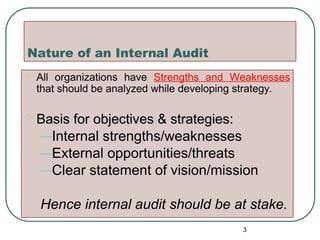
Nature of an Internal Audit
 All organizations have Strengths and Weaknesses
that should be analyzed while developing strategy.
 Basis for objectives & strategies:
Basis for objectives & strategies:
–Internal strengths/weaknesses
–External opportunities/threats
–Clear statement of vision/mission
Hence internal audit should be at stake.
3
Nature of an Internal Audit
 Internal audit is all about Identify strengths and weaknesses
in
• Management
• Marketing
• Finance and accounting
• Production and operations
• Research and development
• Management Information systems
•
4
Key Internal Forces
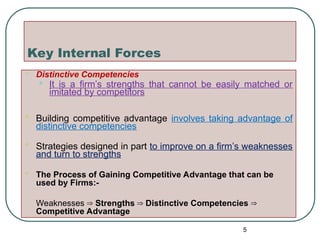
 Distinctive Competencies
• It is a firm’s strengths that cannot be easily matched or
imitated by competitors
 Building competitive advantage involves taking advantage of
distinctive competencies
 Strategies designed in part to improve on a firm’s weaknesses
and turn to strengths
 The Process of Gaining Competitive Advantage that can be
used by Firms:-
 Weaknesses Strengths Distinctive Competencies
⇒ ⇒ ⇒
Competitive Advantage
5
Internal Assessment Process
 Parallels process of external audit
 1st
) Gather & assimilate information from:-
• Management
• Marketing
• Finance/accounting
• Production/operations
• Research & development
• Management information systems
(Managers and employees from all areas should provide information)
 2nd
) A team of managers then selects 10 to 15 key
organizational strengths and weaknesses to focus on
6
Relationship among the functional
areas of business
- A key to organizational success is effective coordination
and understanding among managers from all functional
business areas.
- Through involvement in performing an internal strategic-
management audit,
- managers from different departments and divisions of the
firm come to understand the nature and effect of decisions in
other functional business areas in their firm.
- Knowledge of these relationships is critical for effectively
establishing objectives and strategies..
7
Relationship among the functional
areas of business(Cont’d)
(Cont’d)
Functional relationships:
• Number and complexity increases relative to organization size
Financial Ratio Analysis:
• Exemplifies complexity of relationships among functional
areas of the business
 A declining return on investment or profit margin ratio could
be the result of
• ineffective marketing,
• poor management policies,
• research and development errors, or
• a weak management information system.
8
Relationship among the functional
areas of business (Cont’d)
(Cont’d)
 The effectiveness of strategy formulation, implementation,
and evaluation activities hinges upon:-
• a clear understanding of how major business functions
affect one another.
 For strategies to succeed, a coordinated effort among all
the functional areas of business is needed
9
Internal auditing of Functional areas
 It is recalled that internal audit is all about gathering &
assimilating of information from:
• Management
• Marketing
• Finance/accounting
• Production/operations
• Research & development
• Management information systems
10
Management function: Management Audit
Checklist (management functions: PODSC)
 Does the firm use strategic-management concepts?
 Are company objectives and goals measurable and well
communicated?
 Do managers at all hierarchical levels plan effectively?
 Do managers delegate authority well?
 Is the organization’s structure appropriate?
 Are job descriptions and job specifications clear?
 Is employee morale high?
 Are employee turnover and absenteeism low?
 Are organizational reward and control mechanisms
effective?
11
Marketing
Process of defining, anticipating, creating,
and fulfilling customers’ needs and wants
for products and services
12
Marketing functions
1. Customer analysis- is the examination and
evaluation of consumer needs, desires, and wants
2. Selling products/services
3. Product and service planning
4. Pricing
5. Distribution
6. Marketing research
13
Marketing Audit Checklists
• Are markets segmented effectively?
• Is the organization positioned well among competitors?
• Has the firm’s market share been increasing?
• Are present channels of distribution reliable and cost effective?
• Does the firm have an effective sales force?
• Does the firm conduct market research?
• Are product quality and customer service good?
• Are the firm's products/services priced appropriately?
• Does the firm have an effective promotion, advertising, and publicity
strategy?
 Are marketing planning and budgeting effective?
 Do the firm’s marketing mangers have adequate experience and
training
14
Finance/Accounting
 Financial condition is often considered the single best measure of
a firm’s competitive position.
• Determining an organization’s financial strengths and
weaknesses is essential to effectively formulating strategies.
 The functions of finance/accounting comprise three decisions: :
 Investment decision (Capital budgeting)- is the allocation and
reallocation of capital and resources to projects, products, assets,
and divisions of an organization.
 Financing decision- determines the best capital structure for the
firm
 Dividend decision- concern issues such as the percentage of
earnings paid to stockholders, the stability of dividends paid over
time,.
15
Finance/Accounting
-N.B. Financial ratio analysis is the most widely used method for determining
an organization’s strengths and weaknesses in the investment, financing,
and dividend areas.
 Financial ratios are computed from an organization’s income statement and
balance sheet.
 Computing financial ratios is like taking a picture because the results reflect
a situation at just one point in time. Comparing ratios over time and to
industry averages is more likely to result in meaningful statistics that can be
used to identify and evaluate strengths and weaknesses.
 Key financial ratios can be classified into the following five types:
• Liquidity ratios, Leverage ratios, Activity ratios, Profitability ratios and Growth ratios
16
Finance/Accounting Ratios
 Liquidity ratios measure a firm’s ability to meet
maturing short-term obligations.
• Current ratio
• Quick (acid-test) ratio
 Leverage ratios measure the extent to which a firm has
been financed by debt.
• Debt-to-total-assets ratio - Debt-to-equity ratio
• Long-term debt-to-equity ratio
• Times-interest-earned (coverage) ratio
 Activity ratios measure how effectively a firm is using
its resources.
• Inventory turnover - Fixed assets turnover
• Total assets turnover -Accounts receivable turnover
 Profitability ratios measure management’s overall
effectiveness as shown by returns generated on sales
and investment.
• Gross profit margin - Operating profit margin - Net profit margin
• Return on total assets - Return on stockholders’ equity
• Earnings per share - Price-earnings ratio
 Growth ratios measure the firm’s ability to maintain its
economic position in the growth of the economy and
industry.
• Sales - Net income
• Earnings per share - Dividends per share
 How has each ratio
changed over time?
 2. How does each
ratio compare to
industry norms?
 3. How does each
ratio compare with key
competitors?
Finance/Accounting Audit
Checklists(Cont’d)
(Cont’d)
 Where is the firm strong and weak as indicated by financial
ratio analysis?
 Can the firm raise needed long-term capital through debt
and/or equity? e.g. debt to asset ratio
 Does the firm have sufficient working capital?
 Are capital budgeting procedures effective?
 Are dividend payout policies reasonable?
 Does the firm have good relations with its investors and
stockholders?
 Are the firm’s financial managers experienced and well
trained?
18
Production/Operations
 The production/operations function of a business consists of all those
activities that transform inputs into goods and services.
 This function comprises five functions or decision areas:
 Process- design of facility, facility layout , process flow analysis..
 Capacity- facilities planning, scheduling, capacity planning…
 Inventory- managing Raw material, work in process and Finished goods
 Workforce- managing workforce eg-job design, job enrichment,
motivation…
 Quality- decisions are aimed at ensuring that high-quality goods and
services are produced by caring for-eg quality assurance, quality
control
19
Production/Operations Audit
Checklists
 Are suppliers of raw materials, parts, and subassemblies
reliable and reasonable?
 Are facilities, equipment, machinery, and offices in good
condition?
 Are inventory-control policies and procedures effective?
 Are quality-control policies and procedures effective?
 Are facilities, resources, and markets strategically
located?
 Does the firm have technological competencies?
20
Research and Development
R&D focus:
 Development of new products
before competition
 Improving product quality
 Improving manufacturing
processes to reduce costs
21
Research and Development Audit
Checklist Questions (Cont’d)
(Cont’d)
 Does the firm have R&D facilities? Are they adequate?
 If outside R&D firms are used, are they cost effective?
 Are the organization’s R&D personnel well qualified?
 Are R&D resources allocated effectively?
 Is communication between R&D and other organizational
units effective?
 Are present products technologically competitive?
22
Management Information
Systems
 Information ties all business functions together and provides the basis for
all managerial decisions.
• Information represents a major source of competitive management
advantage or disadvantage.
 A management information system’s purpose is to improve the
performance of an enterprise by improving the quality of managerial
decisions.
 Assessing a firm’s internal strengths and weaknesses in information
systems is a critical dimension of performing an internal audit.
 Involves:-
• Information Systems
• Security
• User-friendly
• E-commerce
23
Management Information
Systems Audit Checklists
 Do the firm has MIS?
 Do all managers in the firm use the information system to make decisions?
 Is there a chief information officer or director of information systems
position in the firm?
 Are data in the information system updated regularly?
 Do managers from all functional areas of the firm contribute input to the
information system?
 Is the information system user-friendly?
 Are there effective passwords for entry into the firm’s information system?
 Do all users of the information system understand the competitive
advantages that information can provide firms?
 Are computer/IT training workshops provided for users?
 Is the firm’s system being improved?
24
The Internal Factor Evaluation
(IFE) Matrix
 A summary step in conducting an internal strategic-
management audit is to construct an Internal
Factor Evaluation (IFE) Matrix.
 This strategy-formulation tool summarizes and evaluates
the major strengths and weaknesses in the functional
areas of a business, and it also provides a basis for
identifying and evaluating relationships among those
areas.
Internal Analysis (IFE)
Five-Step Process:
Five-Step Process:
1. List key internal factors (10-20)
 Strengths & weaknesses
2. Assign weight to each (0 to 1.0) - 0.0 (not important) to 1.0 (all-
important) to each factor. The weight assigned to a given factor
indicates the relative importance of the factor to being
successful in the firm’s industry.
 Sum of all weights = 1.0
26
Internal Analysis (IFE) (Cont’d)
(Cont’d)
3. Assign a 1-to-4 rating to each factor to indicate whether that factor
represents a major weakness (rating = 1), a minor weakness
(rating = 2), a minor strength (rating = 3), or a major strength
(rating = 4).
Note that strengths must receive a 3 or 4 rating and weaknesses
must receive a 1 or 2 rating. Ratings are thus company-based,
whereas the weights in step 2 are industry-based.
4. Multiply each factor’s weight by its rating
 Produces a weighted score
27
Internal Analysis (IFE) (Cont’d)
(Cont’d)
5. Sum the weighted scores for each
 Determines the total weighted score for the organization
 Highest possible weighted score for the organization is 4.0;
the lowest, 1.0. Average = 2.5
N.B. Total weighted scores well below 2.5 characterize organizations
that are weak internally, whereas scores significantly above 2.5
indicate a strong internal position.
N.B. Be as quantitative as possible when stating factors. Use
monetary amounts, percentages, numbers, and ratios to the
extent possible.
28
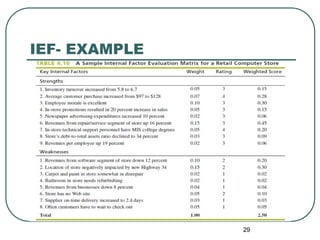
IEF- EXAMPLE
29
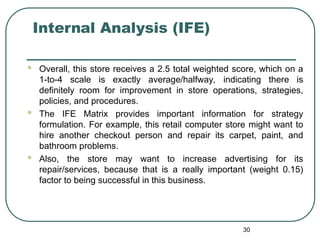
Internal Analysis (IFE)
 Overall, this store receives a 2.5 total weighted score, which on a
1-to-4 scale is exactly average/halfway, indicating there is
definitely room for improvement in store operations, strategies,
policies, and procedures.
 The IFE Matrix provides important information for strategy
formulation. For example, this retail computer store might want to
hire another checkout person and repair its carpet, paint, and
bathroom problems.
 Also, the store may want to increase advertising for its
repair/services, because that is a really important (weight 0.15)
factor to being successful in this business.
30
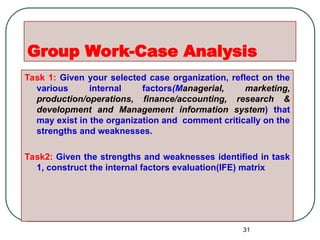
Group Work-Case Analysis
Task 1: Given your selected case organization, reflect on the
various internal factors(Managerial, marketing,
production/operations, finance/accounting, research &
development and Management information system) that
may exist in the organization and comment critically on the
strengths and weaknesses.
Task2: Given the strengths and weaknesses identified in task
1, construct the internal factors evaluation(IFE) matrix
31
Chapter four - The Internal Assessment Project

Chapter four - The Internal Assessment Project

  • 1.
  • 2.
    Outline 4.1 The natureof an internal assessment (Internal audit ) 4.2 Relationship among the functional areas of business 4.3. Internal auditing(Internal assessment) of Functional Areas 4.4. Internal Factor Evaluation (IFE) matrix 4.5. Case Work on Internal analysis:-Group work 2
  • 3.
    Nature of anInternal Audit  All organizations have Strengths and Weaknesses that should be analyzed while developing strategy.  Basis for objectives & strategies: Basis for objectives & strategies: –Internal strengths/weaknesses –External opportunities/threats –Clear statement of vision/mission Hence internal audit should be at stake. 3
  • 4.
    Nature of anInternal Audit  Internal audit is all about Identify strengths and weaknesses in • Management • Marketing • Finance and accounting • Production and operations • Research and development • Management Information systems • 4
  • 5.
    Key Internal Forces Distinctive Competencies • It is a firm’s strengths that cannot be easily matched or imitated by competitors  Building competitive advantage involves taking advantage of distinctive competencies  Strategies designed in part to improve on a firm’s weaknesses and turn to strengths  The Process of Gaining Competitive Advantage that can be used by Firms:-  Weaknesses Strengths Distinctive Competencies ⇒ ⇒ ⇒ Competitive Advantage 5
  • 6.
    Internal Assessment Process Parallels process of external audit  1st ) Gather & assimilate information from:- • Management • Marketing • Finance/accounting • Production/operations • Research & development • Management information systems (Managers and employees from all areas should provide information)  2nd ) A team of managers then selects 10 to 15 key organizational strengths and weaknesses to focus on 6
  • 7.
    Relationship among thefunctional areas of business - A key to organizational success is effective coordination and understanding among managers from all functional business areas. - Through involvement in performing an internal strategic- management audit, - managers from different departments and divisions of the firm come to understand the nature and effect of decisions in other functional business areas in their firm. - Knowledge of these relationships is critical for effectively establishing objectives and strategies.. 7
  • 8.
    Relationship among thefunctional areas of business(Cont’d) (Cont’d) Functional relationships: • Number and complexity increases relative to organization size Financial Ratio Analysis: • Exemplifies complexity of relationships among functional areas of the business  A declining return on investment or profit margin ratio could be the result of • ineffective marketing, • poor management policies, • research and development errors, or • a weak management information system. 8
  • 9.
    Relationship among thefunctional areas of business (Cont’d) (Cont’d)  The effectiveness of strategy formulation, implementation, and evaluation activities hinges upon:- • a clear understanding of how major business functions affect one another.  For strategies to succeed, a coordinated effort among all the functional areas of business is needed 9
  • 10.
    Internal auditing ofFunctional areas  It is recalled that internal audit is all about gathering & assimilating of information from: • Management • Marketing • Finance/accounting • Production/operations • Research & development • Management information systems 10
  • 11.
    Management function: ManagementAudit Checklist (management functions: PODSC)  Does the firm use strategic-management concepts?  Are company objectives and goals measurable and well communicated?  Do managers at all hierarchical levels plan effectively?  Do managers delegate authority well?  Is the organization’s structure appropriate?  Are job descriptions and job specifications clear?  Is employee morale high?  Are employee turnover and absenteeism low?  Are organizational reward and control mechanisms effective? 11
  • 12.
    Marketing Process of defining,anticipating, creating, and fulfilling customers’ needs and wants for products and services 12
  • 13.
    Marketing functions 1. Customeranalysis- is the examination and evaluation of consumer needs, desires, and wants 2. Selling products/services 3. Product and service planning 4. Pricing 5. Distribution 6. Marketing research 13
  • 14.
    Marketing Audit Checklists •Are markets segmented effectively? • Is the organization positioned well among competitors? • Has the firm’s market share been increasing? • Are present channels of distribution reliable and cost effective? • Does the firm have an effective sales force? • Does the firm conduct market research? • Are product quality and customer service good? • Are the firm's products/services priced appropriately? • Does the firm have an effective promotion, advertising, and publicity strategy?  Are marketing planning and budgeting effective?  Do the firm’s marketing mangers have adequate experience and training 14
  • 15.
    Finance/Accounting  Financial conditionis often considered the single best measure of a firm’s competitive position. • Determining an organization’s financial strengths and weaknesses is essential to effectively formulating strategies.  The functions of finance/accounting comprise three decisions: :  Investment decision (Capital budgeting)- is the allocation and reallocation of capital and resources to projects, products, assets, and divisions of an organization.  Financing decision- determines the best capital structure for the firm  Dividend decision- concern issues such as the percentage of earnings paid to stockholders, the stability of dividends paid over time,. 15
  • 16.
    Finance/Accounting -N.B. Financial ratioanalysis is the most widely used method for determining an organization’s strengths and weaknesses in the investment, financing, and dividend areas.  Financial ratios are computed from an organization’s income statement and balance sheet.  Computing financial ratios is like taking a picture because the results reflect a situation at just one point in time. Comparing ratios over time and to industry averages is more likely to result in meaningful statistics that can be used to identify and evaluate strengths and weaknesses.  Key financial ratios can be classified into the following five types: • Liquidity ratios, Leverage ratios, Activity ratios, Profitability ratios and Growth ratios 16
  • 17.
    Finance/Accounting Ratios  Liquidityratios measure a firm’s ability to meet maturing short-term obligations. • Current ratio • Quick (acid-test) ratio  Leverage ratios measure the extent to which a firm has been financed by debt. • Debt-to-total-assets ratio - Debt-to-equity ratio • Long-term debt-to-equity ratio • Times-interest-earned (coverage) ratio  Activity ratios measure how effectively a firm is using its resources. • Inventory turnover - Fixed assets turnover • Total assets turnover -Accounts receivable turnover  Profitability ratios measure management’s overall effectiveness as shown by returns generated on sales and investment. • Gross profit margin - Operating profit margin - Net profit margin • Return on total assets - Return on stockholders’ equity • Earnings per share - Price-earnings ratio  Growth ratios measure the firm’s ability to maintain its economic position in the growth of the economy and industry. • Sales - Net income • Earnings per share - Dividends per share  How has each ratio changed over time?  2. How does each ratio compare to industry norms?  3. How does each ratio compare with key competitors?
  • 18.
    Finance/Accounting Audit Checklists(Cont’d) (Cont’d)  Whereis the firm strong and weak as indicated by financial ratio analysis?  Can the firm raise needed long-term capital through debt and/or equity? e.g. debt to asset ratio  Does the firm have sufficient working capital?  Are capital budgeting procedures effective?  Are dividend payout policies reasonable?  Does the firm have good relations with its investors and stockholders?  Are the firm’s financial managers experienced and well trained? 18
  • 19.
    Production/Operations  The production/operationsfunction of a business consists of all those activities that transform inputs into goods and services.  This function comprises five functions or decision areas:  Process- design of facility, facility layout , process flow analysis..  Capacity- facilities planning, scheduling, capacity planning…  Inventory- managing Raw material, work in process and Finished goods  Workforce- managing workforce eg-job design, job enrichment, motivation…  Quality- decisions are aimed at ensuring that high-quality goods and services are produced by caring for-eg quality assurance, quality control 19
  • 20.
    Production/Operations Audit Checklists  Aresuppliers of raw materials, parts, and subassemblies reliable and reasonable?  Are facilities, equipment, machinery, and offices in good condition?  Are inventory-control policies and procedures effective?  Are quality-control policies and procedures effective?  Are facilities, resources, and markets strategically located?  Does the firm have technological competencies? 20
  • 21.
    Research and Development R&Dfocus:  Development of new products before competition  Improving product quality  Improving manufacturing processes to reduce costs 21
  • 22.
    Research and DevelopmentAudit Checklist Questions (Cont’d) (Cont’d)  Does the firm have R&D facilities? Are they adequate?  If outside R&D firms are used, are they cost effective?  Are the organization’s R&D personnel well qualified?  Are R&D resources allocated effectively?  Is communication between R&D and other organizational units effective?  Are present products technologically competitive? 22
  • 23.
    Management Information Systems  Informationties all business functions together and provides the basis for all managerial decisions. • Information represents a major source of competitive management advantage or disadvantage.  A management information system’s purpose is to improve the performance of an enterprise by improving the quality of managerial decisions.  Assessing a firm’s internal strengths and weaknesses in information systems is a critical dimension of performing an internal audit.  Involves:- • Information Systems • Security • User-friendly • E-commerce 23
  • 24.
    Management Information Systems AuditChecklists  Do the firm has MIS?  Do all managers in the firm use the information system to make decisions?  Is there a chief information officer or director of information systems position in the firm?  Are data in the information system updated regularly?  Do managers from all functional areas of the firm contribute input to the information system?  Is the information system user-friendly?  Are there effective passwords for entry into the firm’s information system?  Do all users of the information system understand the competitive advantages that information can provide firms?  Are computer/IT training workshops provided for users?  Is the firm’s system being improved? 24
  • 25.
    The Internal FactorEvaluation (IFE) Matrix  A summary step in conducting an internal strategic- management audit is to construct an Internal Factor Evaluation (IFE) Matrix.  This strategy-formulation tool summarizes and evaluates the major strengths and weaknesses in the functional areas of a business, and it also provides a basis for identifying and evaluating relationships among those areas.
  • 26.
    Internal Analysis (IFE) Five-StepProcess: Five-Step Process: 1. List key internal factors (10-20)  Strengths & weaknesses 2. Assign weight to each (0 to 1.0) - 0.0 (not important) to 1.0 (all- important) to each factor. The weight assigned to a given factor indicates the relative importance of the factor to being successful in the firm’s industry.  Sum of all weights = 1.0 26
  • 27.
    Internal Analysis (IFE)(Cont’d) (Cont’d) 3. Assign a 1-to-4 rating to each factor to indicate whether that factor represents a major weakness (rating = 1), a minor weakness (rating = 2), a minor strength (rating = 3), or a major strength (rating = 4). Note that strengths must receive a 3 or 4 rating and weaknesses must receive a 1 or 2 rating. Ratings are thus company-based, whereas the weights in step 2 are industry-based. 4. Multiply each factor’s weight by its rating  Produces a weighted score 27
  • 28.
    Internal Analysis (IFE)(Cont’d) (Cont’d) 5. Sum the weighted scores for each  Determines the total weighted score for the organization  Highest possible weighted score for the organization is 4.0; the lowest, 1.0. Average = 2.5 N.B. Total weighted scores well below 2.5 characterize organizations that are weak internally, whereas scores significantly above 2.5 indicate a strong internal position. N.B. Be as quantitative as possible when stating factors. Use monetary amounts, percentages, numbers, and ratios to the extent possible. 28
  • 29.
  • 30.
    Internal Analysis (IFE) Overall, this store receives a 2.5 total weighted score, which on a 1-to-4 scale is exactly average/halfway, indicating there is definitely room for improvement in store operations, strategies, policies, and procedures.  The IFE Matrix provides important information for strategy formulation. For example, this retail computer store might want to hire another checkout person and repair its carpet, paint, and bathroom problems.  Also, the store may want to increase advertising for its repair/services, because that is a really important (weight 0.15) factor to being successful in this business. 30
  • 31.
    Group Work-Case Analysis Task1: Given your selected case organization, reflect on the various internal factors(Managerial, marketing, production/operations, finance/accounting, research & development and Management information system) that may exist in the organization and comment critically on the strengths and weaknesses. Task2: Given the strengths and weaknesses identified in task 1, construct the internal factors evaluation(IFE) matrix 31