Chapter 1
Public Finance: An Overview
1
2
Should Governments Take Part in an Economy?
Or put otherwise…
Should Economies Consist of Households and
Firms
or Include Governments as Well?
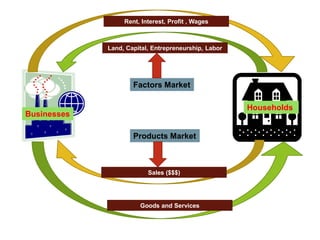
Land, Capital, Entrepreneurship, Labor
Sales ($$$)
Rent, Interest, Profit , Wages
Goods and Services
Factors Market
Products Market
Households
Businesses
4
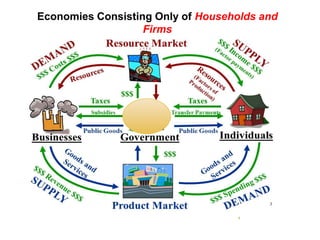
Economies Consisting Only of Households and
Firms
5
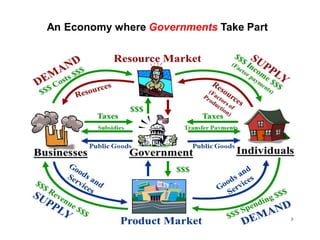
An Economy where Governments Take Part
6
Why “Complicate” matters by bringing Governments
into the picture?
This (and subsequent questions) lead to the world of
Public Finance/Public Economics
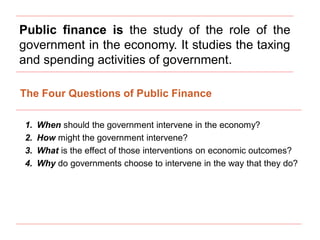
The Four Questions of Public Finance
Public finance is the study of the role of the
government in the economy. It studies the taxing
and spending activities of government.
1. When should the government intervene in the economy?
2. How might the government intervene?
3. What is the effect of those interventions on economic outcomes?
4. Why do governments choose to intervene in the way that they do?
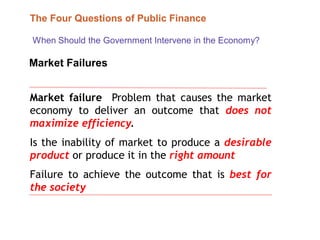
When Should the Government Intervene in the Economy?
The Four Questions of Public Finance
Market failure Problem that causes the market
economy to deliver an outcome that does not
maximize efficiency.
Is the inability of market to produce a desirable
product or produce it in the right amount
Failure to achieve the outcome that is best for
the society
Market Failures
Externalities
 Production of goods and services that involve externalities (are
benefits or costs that accrue to some third party that is
external to the market transaction (other than the immediate
buyer and seller)) are one source of market failure.
 An externality occurs when some of the costs or the benefits of
a good or a service are passed on to or spill over to some one
other than the immediate buyer or seller.
 Are benefits or costs that accrue to some third party that is
external to the market transaction.
9
Externalities
There are two types:
Negative Externalities:
Are spill over production or consumption costs imposed
on third parties without compensation to them. E.g.
Cigarette, pollution from factories, etc…
10
Negative Externalities
 The producer’s supply curve is below (to the right
of) the full cost supply curve, therefore, the
equilibrium output is > the optimal, that is over
allocation of resources
 There should be liability rules and direct control by
legislation for goods with negative externalities .
11
Externalities
Positive Externality
 Are spill over production or consumption benefits
conferred on third parties without compensation from
them.
E.g. Inventions, front yard landscaping, commercial forest
development…..
 The market demand curve is below the (to the left
of) the full benefit demand curve, therefore,
equilibrium output is less than optimal, that is under
allocation of resources.
12
Infrastructure
 Are commercially non-viable and require huge
resources beyond the capacity of the private sector.
 Contribute significantly to the productive potential of
an economy and therefore, the primary responsibility
for the provision of such facilities should be the
government.
13
When Should the Government Intervene in the Economy?
The Four Questions of Public Finance
Redistribution:
The shifting of resources from some groups in
society to others.
Redistribution
How Might the Government Intervene?
The Four Questions of Public Finance
Tax or Subsidize Private Sale or Purchase
One way that the government can try to address failures in the
private market is to use the price mechanism, whereby government
policy is used to change the price of a good in one of two ways:
1. Through taxes, which raise the price for private sales or
purchases of goods that are over-produced,
or
2. Through subsidies, which lower the price for private sales or
purchases of goods that are under-produced.
How Might the Government Intervene?
The Four Questions of Public Finance
Restrict or Mandate Private Sale or Purchase
The government can directly restrict private sale or purchase of goods
that are overproduced, or mandate private purchase of goods that are
under produced and force individuals to buy that good.
Public Provision
The government can provide the good directly, in order to potentially
attain the level of consumption that maximizes social welfare.
Public Financing of Private Provision
Governments may want to influence the level of consumption but may
not want to directly involve themselves in the provision of a good.
What Are the Effects of Alternative Interventions?
Direct Effects
direct effects The effects of government interventions that would be
predicted if individuals did not change their behavior in response to the
interventions.
Indirect Effects
indirect effects The effects of government interventions that arise
only because individuals change their behavior in response to the
interventions.
The Four Questions of Public Finance
Why Do Governments Do What They Do?
 Note the important difference between this question and the
second (How should governments intervene?).
 The second question was a normative question, one concerned
with how things should be done. This one, on the other hand, is a
positive question, one concerned with why things are the way
they are.
 Politicians must consider a wide variety of viewpoints and
pressures, only two of which are the desire to design policies
that maximize economic efficiency and redistribute resources
in a socially preferred manner.
 Political Economy: The theory of how the political process
produces decisions that affect individuals and the economy
18
The Four Questions of Public Finance
So what is PUBLIC FINANCE?
 Public Finance is the study of income and the
expenditure of the government.
 It can be defined as the science that deals with the
nature and principles of the income and
expenditure of the government.
19
Scope Of Public Finance
The subject matter of the public finance is classified
under five broad categories. They are:
1. Public revenue
2. Public expenditure
3. Public debt
4. Financial administration
5. Economic stabilization
20
PUBLIC REVENUE
 This category deals with alternative sources of public income.
 It discusses and analyses comparative advantages and
disadvantages (effects on the economy) of various sources of
revenue and the principles which should govern the choice
between them.
 Methods of public revenue and their volumes have significant
impact on production and distribution of wealth and income in
the country. It has effects on the nature and the volume of
economic activities and on employment.
21
PUBLIC EXPENDITURE
 This category deals with public expenditure and its
effect on the economy.
 Government of a country has to use its expenditure and
revenue programs to produce desirable effects on
national income, production, and employment.
22
…PUBLIC EXPENDITURE
TYPES OF EXPENDITURES
Transfer and Non-Transfer Expenditures
 Transfer expenditures are payments without
corresponding receipt of goods and services by the
state.
 In these cases, the government is simply transferring
the right or claim to use the goods and services to
certain sections of the society.
23
..PUBLIC EXPENDITURE
…TYPES OF EXPENDITURES
 Transfer expenditures have an initial effect of distribution of
income in the society in that the payment is received by an
individual without an exchange of productive resources for that
payment.
 It involves merely a transfer of tax funds between individuals in the
society.
 Examples include old-age pension, unemployment benefits, etc.
24
…PUBLIC EXPENDITURE
 Non-Transfer expenditure is that by which the state
pays for its purchases or use of goods and services
for its consumption or investment.
 Non-Transfer expenditure has an initial allocation
effect since it directly absorbs resources into
governmental production.
 Examples include expenditures on education, health
and other social overheads
25
PUBLIC DEBT
 Increasing need of government for funds cannot be
fully met by taxation alone in under developed and
developing countries due to limited scope of taxation.
 Government therefore has to resort to alternate
sources. Debt is one such source.
 This category of public finance deals with the causes,
methods and problems of public borrowings and its
management.
26
FINANCIAL ADMINISTRATION
 This category of public finance includes the
preparation of financial budget, the control
and administrations of the budget, auditing
etc.
27
ECONOMIC STABLIZATION
 This category analyses the use of public finance to
bring about and maintain economic stability in a
country.
 Generally, Fiscal and Monetary policies will
continuously be used by central banks and
governments of nations that keep the economy in a
healthy state.
28
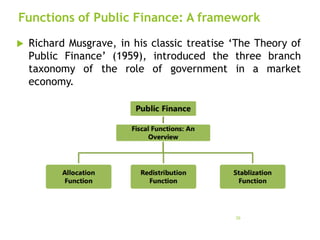
Functions of Public Finance: A framework
 Richard Musgrave, in his classic treatise ‘The Theory of
Public Finance’ (1959), introduced the three branch
taxonomy of the role of government in a market
economy.
29
A framework…
 The allocation function aims to correct the sources
of inefficiency in the economic system.
 The distribution role ensures that the distribution of
wealth and income is fair.
 Monetary and fiscal policy, the problems of
macroeconomic stability, maintenance of high
levels of employment and price stability etc… fall
under the stabilization function.
30
End of Chapter
31

Chapter one - Public Finance: An Overview

  • 1.
  • 2.
    2 Should Governments TakePart in an Economy? Or put otherwise… Should Economies Consist of Households and Firms or Include Governments as Well?
  • 3.
    Land, Capital, Entrepreneurship,Labor Sales ($$$) Rent, Interest, Profit , Wages Goods and Services Factors Market Products Market Households Businesses
  • 4.
    4 Economies Consisting Onlyof Households and Firms
  • 5.
    5 An Economy whereGovernments Take Part
  • 6.
    6 Why “Complicate” mattersby bringing Governments into the picture? This (and subsequent questions) lead to the world of Public Finance/Public Economics
  • 7.
    The Four Questionsof Public Finance Public finance is the study of the role of the government in the economy. It studies the taxing and spending activities of government. 1. When should the government intervene in the economy? 2. How might the government intervene? 3. What is the effect of those interventions on economic outcomes? 4. Why do governments choose to intervene in the way that they do?
  • 8.
    When Should theGovernment Intervene in the Economy? The Four Questions of Public Finance Market failure Problem that causes the market economy to deliver an outcome that does not maximize efficiency. Is the inability of market to produce a desirable product or produce it in the right amount Failure to achieve the outcome that is best for the society Market Failures
  • 9.
    Externalities  Production ofgoods and services that involve externalities (are benefits or costs that accrue to some third party that is external to the market transaction (other than the immediate buyer and seller)) are one source of market failure.  An externality occurs when some of the costs or the benefits of a good or a service are passed on to or spill over to some one other than the immediate buyer or seller.  Are benefits or costs that accrue to some third party that is external to the market transaction. 9
  • 10.
    Externalities There are twotypes: Negative Externalities: Are spill over production or consumption costs imposed on third parties without compensation to them. E.g. Cigarette, pollution from factories, etc… 10
  • 11.
    Negative Externalities  Theproducer’s supply curve is below (to the right of) the full cost supply curve, therefore, the equilibrium output is > the optimal, that is over allocation of resources  There should be liability rules and direct control by legislation for goods with negative externalities . 11
  • 12.
    Externalities Positive Externality  Arespill over production or consumption benefits conferred on third parties without compensation from them. E.g. Inventions, front yard landscaping, commercial forest development…..  The market demand curve is below the (to the left of) the full benefit demand curve, therefore, equilibrium output is less than optimal, that is under allocation of resources. 12
  • 13.
    Infrastructure  Are commerciallynon-viable and require huge resources beyond the capacity of the private sector.  Contribute significantly to the productive potential of an economy and therefore, the primary responsibility for the provision of such facilities should be the government. 13
  • 14.
    When Should theGovernment Intervene in the Economy? The Four Questions of Public Finance Redistribution: The shifting of resources from some groups in society to others. Redistribution
  • 15.
    How Might theGovernment Intervene? The Four Questions of Public Finance Tax or Subsidize Private Sale or Purchase One way that the government can try to address failures in the private market is to use the price mechanism, whereby government policy is used to change the price of a good in one of two ways: 1. Through taxes, which raise the price for private sales or purchases of goods that are over-produced, or 2. Through subsidies, which lower the price for private sales or purchases of goods that are under-produced.
  • 16.
    How Might theGovernment Intervene? The Four Questions of Public Finance Restrict or Mandate Private Sale or Purchase The government can directly restrict private sale or purchase of goods that are overproduced, or mandate private purchase of goods that are under produced and force individuals to buy that good. Public Provision The government can provide the good directly, in order to potentially attain the level of consumption that maximizes social welfare. Public Financing of Private Provision Governments may want to influence the level of consumption but may not want to directly involve themselves in the provision of a good.
  • 17.
    What Are theEffects of Alternative Interventions? Direct Effects direct effects The effects of government interventions that would be predicted if individuals did not change their behavior in response to the interventions. Indirect Effects indirect effects The effects of government interventions that arise only because individuals change their behavior in response to the interventions. The Four Questions of Public Finance
  • 18.
    Why Do GovernmentsDo What They Do?  Note the important difference between this question and the second (How should governments intervene?).  The second question was a normative question, one concerned with how things should be done. This one, on the other hand, is a positive question, one concerned with why things are the way they are.  Politicians must consider a wide variety of viewpoints and pressures, only two of which are the desire to design policies that maximize economic efficiency and redistribute resources in a socially preferred manner.  Political Economy: The theory of how the political process produces decisions that affect individuals and the economy 18 The Four Questions of Public Finance
  • 19.
    So what isPUBLIC FINANCE?  Public Finance is the study of income and the expenditure of the government.  It can be defined as the science that deals with the nature and principles of the income and expenditure of the government. 19
  • 20.
    Scope Of PublicFinance The subject matter of the public finance is classified under five broad categories. They are: 1. Public revenue 2. Public expenditure 3. Public debt 4. Financial administration 5. Economic stabilization 20
  • 21.
    PUBLIC REVENUE  Thiscategory deals with alternative sources of public income.  It discusses and analyses comparative advantages and disadvantages (effects on the economy) of various sources of revenue and the principles which should govern the choice between them.  Methods of public revenue and their volumes have significant impact on production and distribution of wealth and income in the country. It has effects on the nature and the volume of economic activities and on employment. 21
  • 22.
    PUBLIC EXPENDITURE  Thiscategory deals with public expenditure and its effect on the economy.  Government of a country has to use its expenditure and revenue programs to produce desirable effects on national income, production, and employment. 22
  • 23.
    …PUBLIC EXPENDITURE TYPES OFEXPENDITURES Transfer and Non-Transfer Expenditures  Transfer expenditures are payments without corresponding receipt of goods and services by the state.  In these cases, the government is simply transferring the right or claim to use the goods and services to certain sections of the society. 23
  • 24.
    ..PUBLIC EXPENDITURE …TYPES OFEXPENDITURES  Transfer expenditures have an initial effect of distribution of income in the society in that the payment is received by an individual without an exchange of productive resources for that payment.  It involves merely a transfer of tax funds between individuals in the society.  Examples include old-age pension, unemployment benefits, etc. 24
  • 25.
    …PUBLIC EXPENDITURE  Non-Transferexpenditure is that by which the state pays for its purchases or use of goods and services for its consumption or investment.  Non-Transfer expenditure has an initial allocation effect since it directly absorbs resources into governmental production.  Examples include expenditures on education, health and other social overheads 25
  • 26.
    PUBLIC DEBT  Increasingneed of government for funds cannot be fully met by taxation alone in under developed and developing countries due to limited scope of taxation.  Government therefore has to resort to alternate sources. Debt is one such source.  This category of public finance deals with the causes, methods and problems of public borrowings and its management. 26
  • 27.
    FINANCIAL ADMINISTRATION  Thiscategory of public finance includes the preparation of financial budget, the control and administrations of the budget, auditing etc. 27
  • 28.
    ECONOMIC STABLIZATION  Thiscategory analyses the use of public finance to bring about and maintain economic stability in a country.  Generally, Fiscal and Monetary policies will continuously be used by central banks and governments of nations that keep the economy in a healthy state. 28
  • 29.
    Functions of PublicFinance: A framework  Richard Musgrave, in his classic treatise ‘The Theory of Public Finance’ (1959), introduced the three branch taxonomy of the role of government in a market economy. 29
  • 30.
    A framework…  Theallocation function aims to correct the sources of inefficiency in the economic system.  The distribution role ensures that the distribution of wealth and income is fair.  Monetary and fiscal policy, the problems of macroeconomic stability, maintenance of high levels of employment and price stability etc… fall under the stabilization function. 30
  • 31.