Chapter Two: Project Life Cycle and Process Groups
2.1. Project Life Cycle
2.2. Initiation Process Group
2.3. Planning Process Group
2.4. Execution Process Group
2.5.Monitoring and Evaluation/Controlling Process Group
2.6. Closing Process Group
2.1. Project Life Cycle
Meaning Project Cycle
• Project cycle- refers to series stages that projects go through on the
path from origin to completion.
• A project life cycle is the step-by-step process by which a project is
formulated, identified, evaluated, implemented and completed.
• A Project life cycle is the series of phases that a project passes
through from its initiation (start) to its closure.
• Project phases are a collection of logically related project activities
that culminates/ends in the completion of one or more deliverables.
Project cycle models
• A clear understanding of the life cycle by dividing project life cycle into
phases of a project:
Permits managers and executives to better control resources to achieve
goals
Facilitates investment promotion and provides a basis for project
decision & implementation
Important to understand the role to be played by different actors of the
project
• However, due to the complex nature and diversity of projects, there is no
agreement about the life cycle of projects.
• But still, for life cycle of project to be understandable, the two
common project cycle referred as:
• The Baum(World Bank) Project Cycle
• The UNIDO Project Cycle
1. The Baum(World Bank) Project Cycle
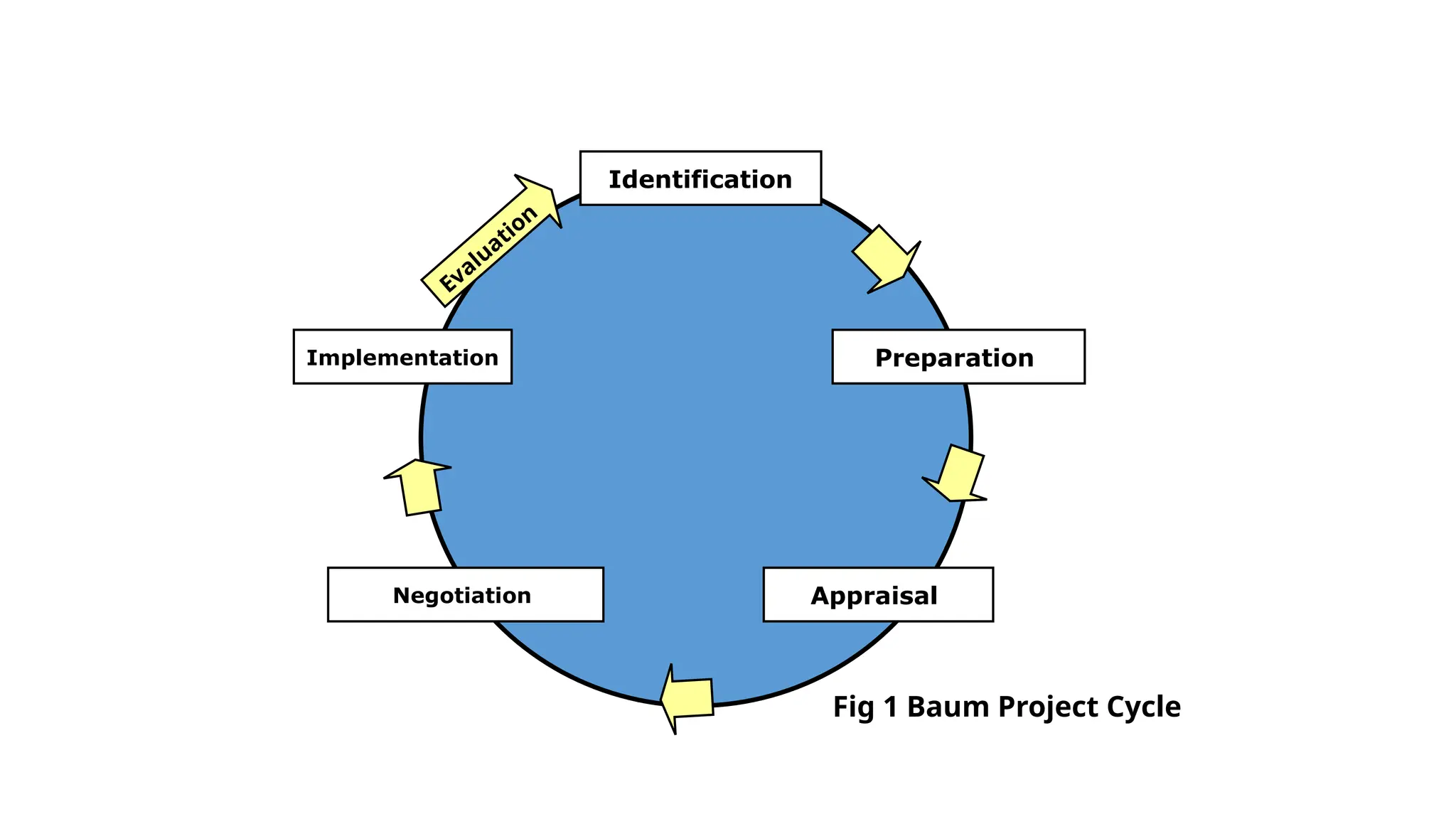
The Baum cycle- primarily reflects the series of activities and
procedures to the development of investment
projects(development projects) to be financed by the World Bank.
The Project , in the Baum Cycle, constitute six distinctive phases-
See Fig 1
Identification
Preparation
Appraisal
Negotiation
Implementation & Supervision
Evaluation
Identification
Preparation
Appraisal
Negotiation
Implementation
Evaluation
Fig 1 Baum Project Cycle
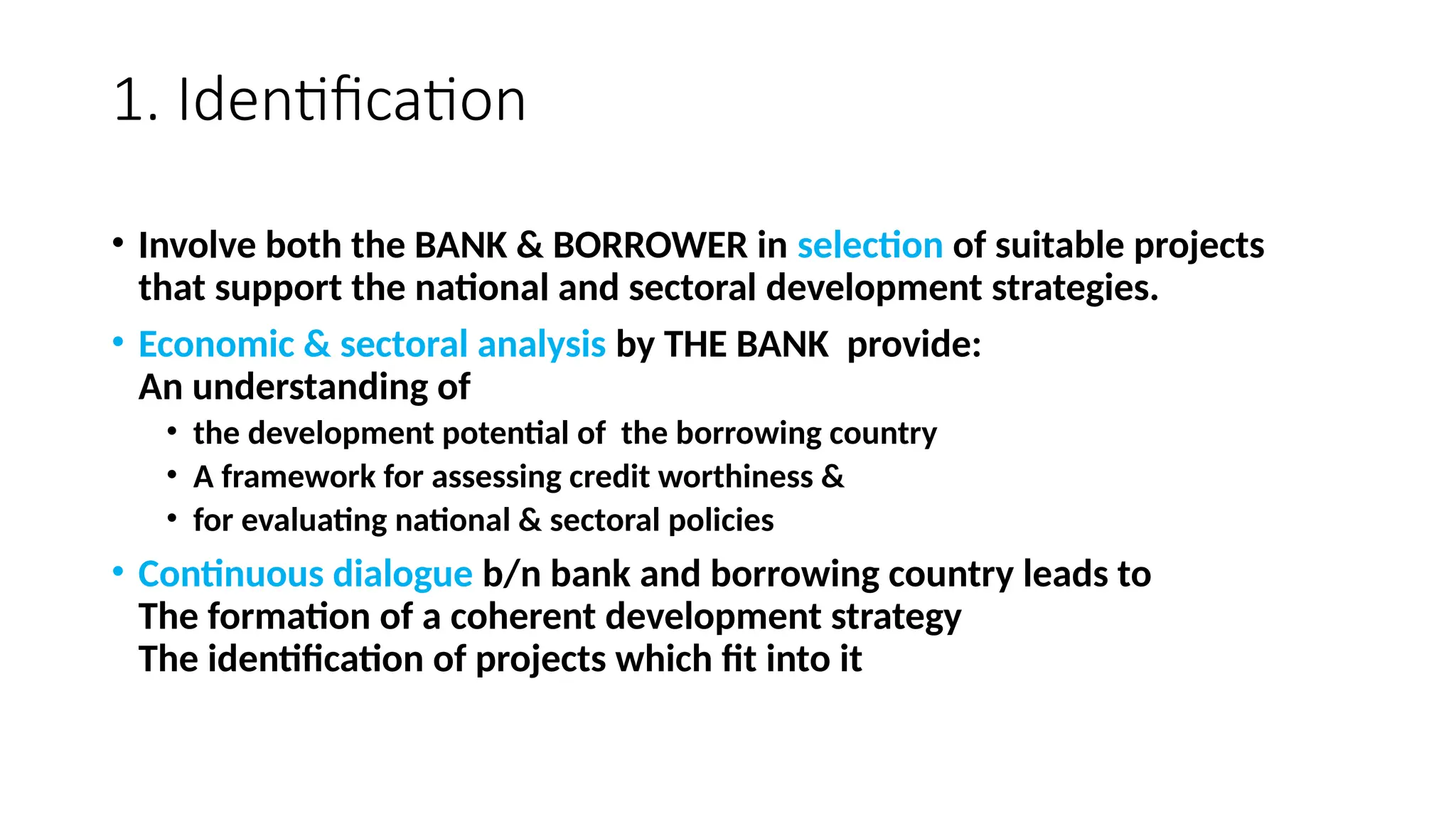
1. Identification
• Involve both the BANK & BORROWER in selection of suitable projects
that support the national and sectoral development strategies.
• Economic & sectoral analysis by THE BANK provide:
An understanding of
• the development potential of the borrowing country
• A framework for assessing credit worthiness &
• for evaluating national & sectoral policies
• Continuous dialogue b/n bank and borrowing country leads to
The formation of a coherent development strategy
The identification of projects which fit into it
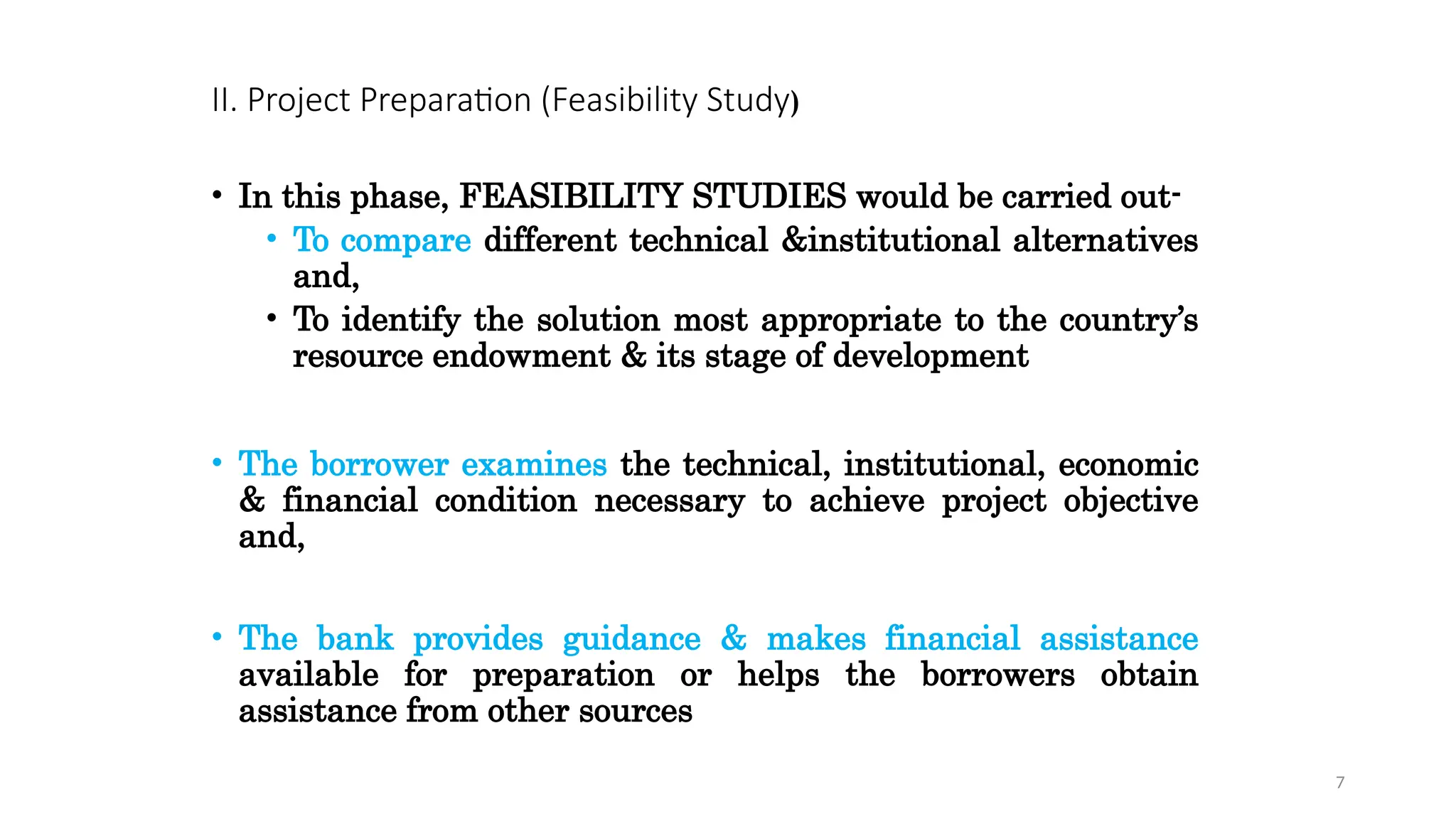
II. Project Preparation (Feasibility Study)
• In this phase, FEASIBILITY STUDIES would be carried out-
• To compare different technical &institutional alternatives
and,
• To identify the solution most appropriate to the country’s
resource endowment & its stage of development
• The borrower examines the technical, institutional, economic
& financial condition necessary to achieve project objective
and,
• The bank provides guidance & makes financial assistance
available for preparation or helps the borrowers obtain
assistance from other sources
7
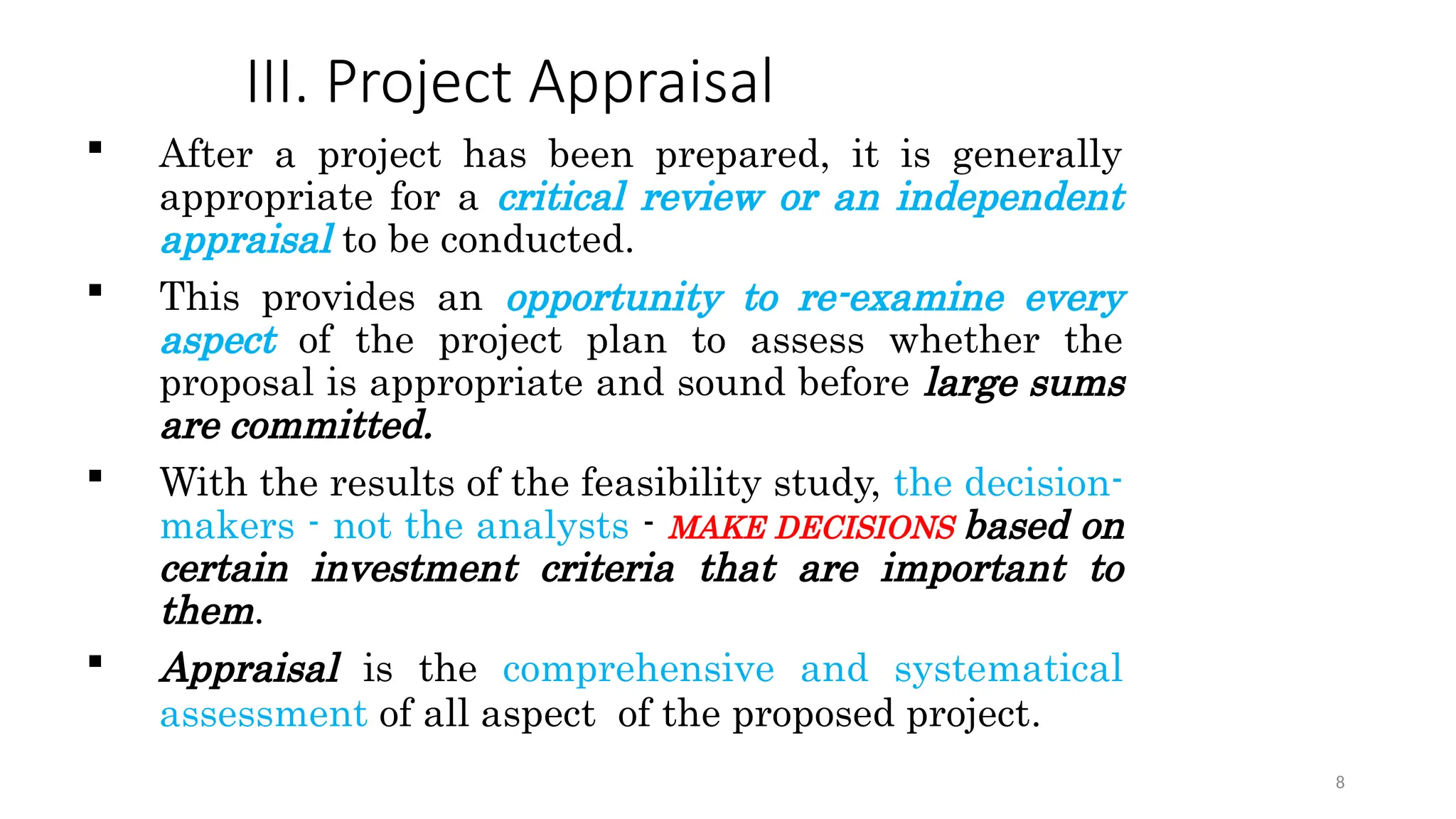
III. Project Appraisal
 After a project has been prepared, it is generally
appropriate for a critical review or an independent
appraisal to be conducted.
 This provides an opportunity to re-examine every
aspect of the project plan to assess whether the
proposal is appropriate and sound before large sums
are committed.
 With the results of the feasibility study, the decision-
makers - not the analysts - MAKE DECISIONS based on
certain investment criteria that are important to
them.
 Appraisal is the comprehensive and systematical
assessment of all aspect of the proposed project.
8
• Involves a comprehensive & systematic review of all aspects of the
project BY THE BANK
• Primarily covers four major aspects-
• Technical,
• Institutional,
• Economic,
• Financial
• Lays the foundations for project implementation & evaluation
• During this process:
• The project may be extensively modified or redesigned
• An appraisal report is drafted by the bank outlying the findings of the
appraisal and making recommendation for the terms and conditions of the loan
• An appraisal report serves as a basis for negotiations with the
borrower
Cont’d
• The project is viewed from different perspectives; technical, commercial,
financial, economic, managerial and organizational.
• Technical –
here the appraisal concentrates in verifying whether what is proposed
will work in the way suggested or not.
• Financial –
the appraisals try to see if the requirements for money needed by the
project have been calculated properly, their sources are all identified,
and reasonable plans for their repayment and other necessary
circumstances are properly identified and calculated.
10
• Commercial
the way the necessary inputs for the project
are conceived to be supplied is examined and
the arrangements for the disposal of the
products are verified.
• Economic
the appraisal here tries to see whether what
is proposed is good from the viewpoint of the
national economic development interest when
all project effects (positive and negative) are
taken into account and check if all are
correctly valued.
• Managerial
this aspect of the appraisal examines if the CAPACITY
exists for operating the project and see if those
responsible ones can operate it satisfactorily.
Moreover, it tries to see if the responsible bodies are
given sufficient power and scope to do what is required.
• Organizational
the appraisal examines the project if it is organized
internally and externally into units, contract policy
institution, etc so as to allow the proposals to be carried
out properly and to allow for change as the project
develops.
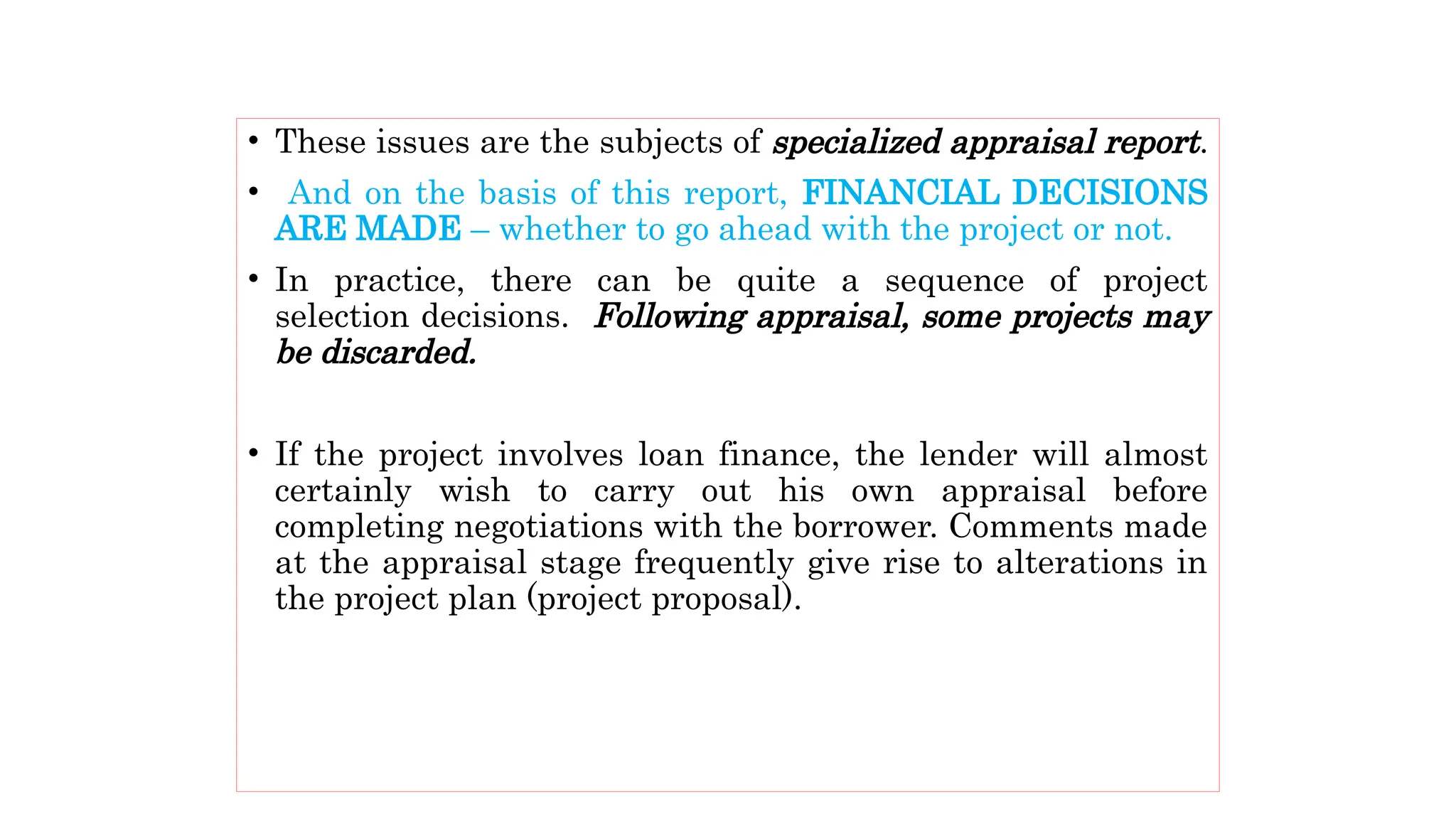
• These issues are the subjects of specialized appraisal report.
• And on the basis of this report, FINANCIAL DECISIONS
ARE MADE – whether to go ahead with the project or not.
• In practice, there can be quite a sequence of project
selection decisions. Following appraisal, some projects may
be discarded.
• If the project involves loan finance, the lender will almost
certainly wish to carry out his own appraisal before
completing negotiations with the borrower. Comments made
at the appraisal stage frequently give rise to alterations in
the project plan (project proposal).
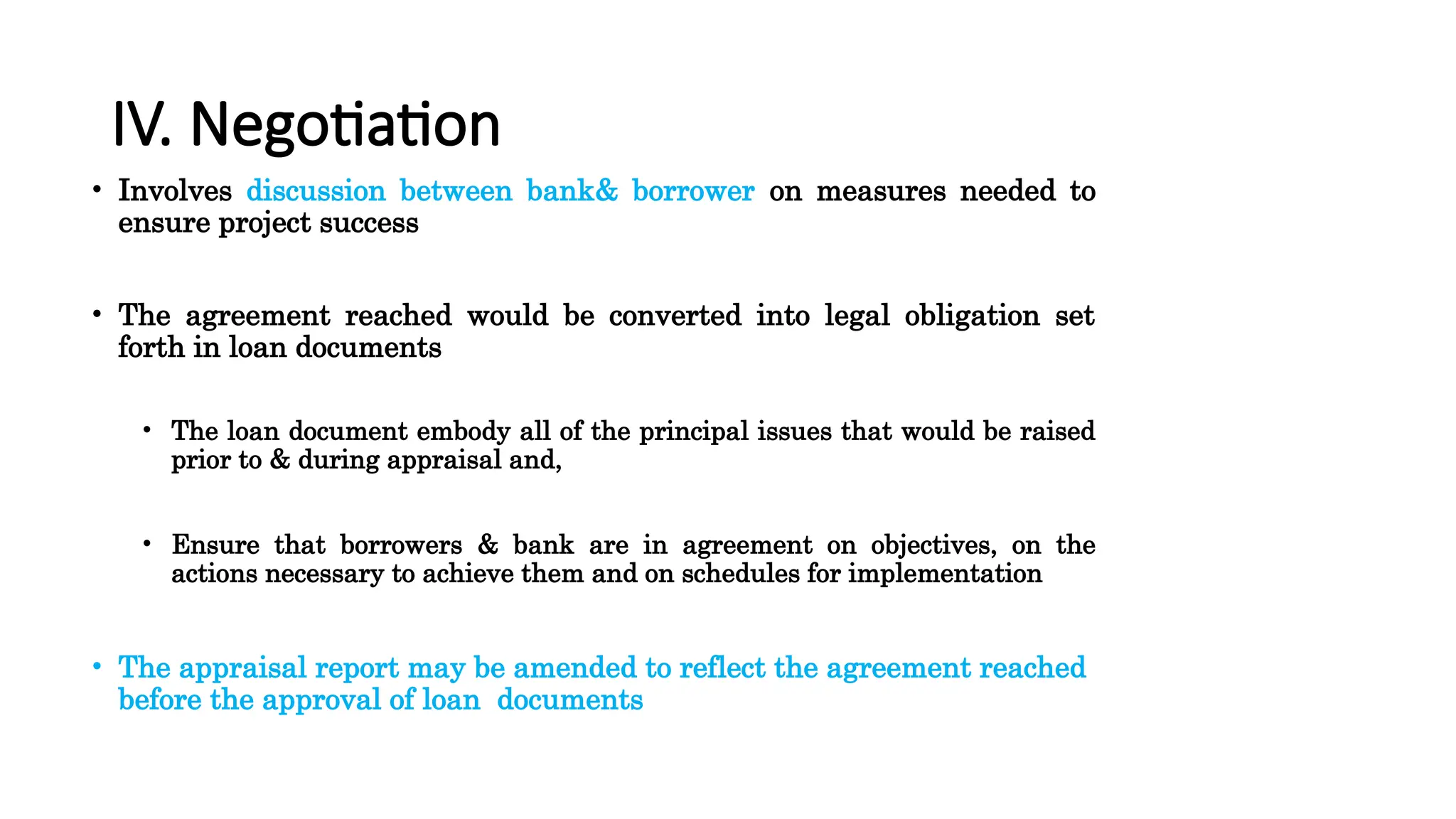
IV. Negotiation
• Involves discussion between bank& borrower on measures needed to
ensure project success
• The agreement reached would be converted into legal obligation set
forth in loan documents
• The loan document embody all of the principal issues that would be raised
prior to & during appraisal and,
• Ensure that borrowers & bank are in agreement on objectives, on the
actions necessary to achieve them and on schedules for implementation
• The appraisal report may be amended to reflect the agreement reached
before the approval of loan documents
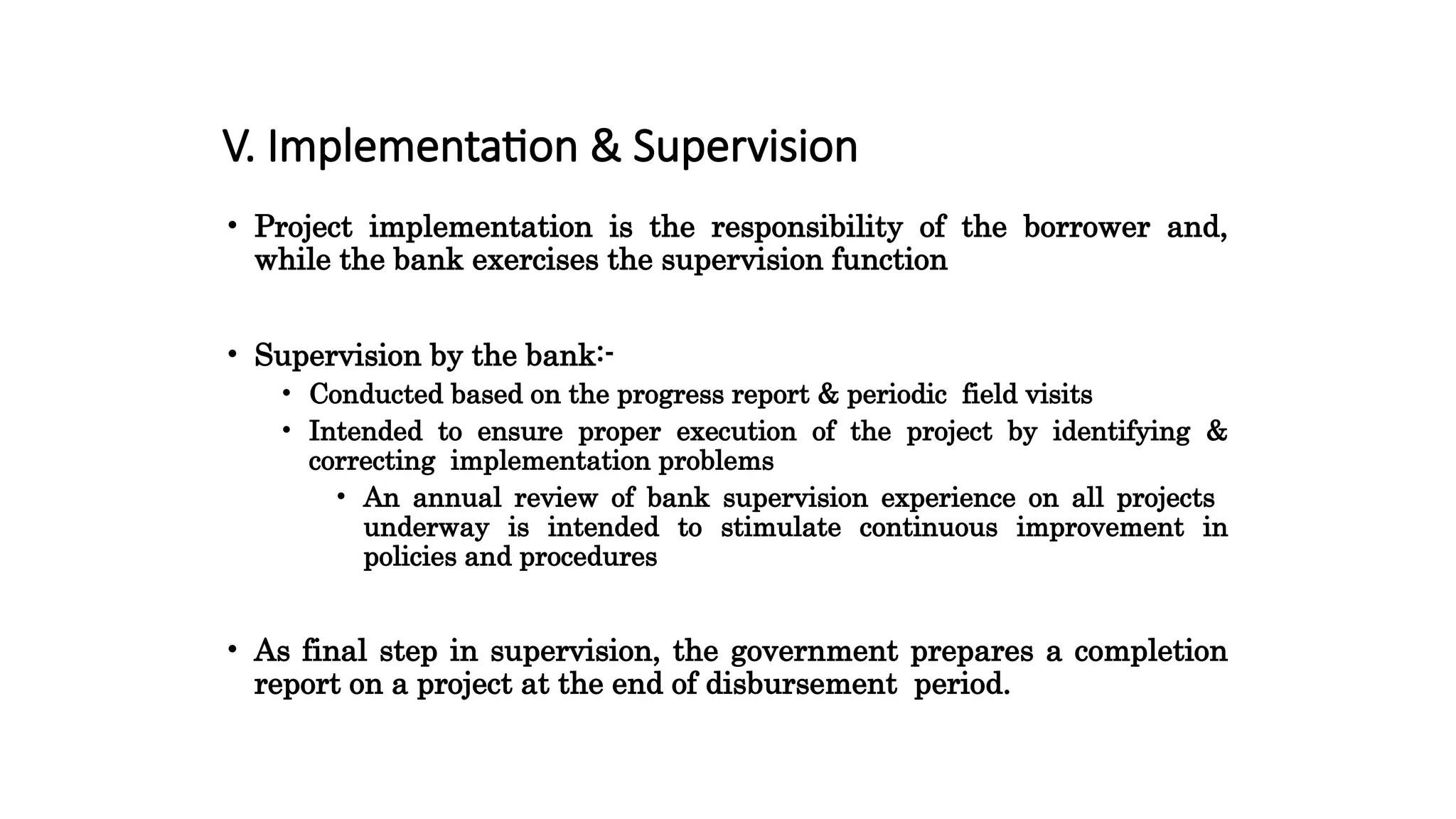
V. Implementation & Supervision
• Project implementation is the responsibility of the borrower and,
while the bank exercises the supervision function
• Supervision by the bank:-
• Conducted based on the progress report & periodic field visits
• Intended to ensure proper execution of the project by identifying &
correcting implementation problems
• An annual review of bank supervision experience on all projects
underway is intended to stimulate continuous improvement in
policies and procedures
• As final step in supervision, the government prepares a completion
report on a project at the end of disbursement period.
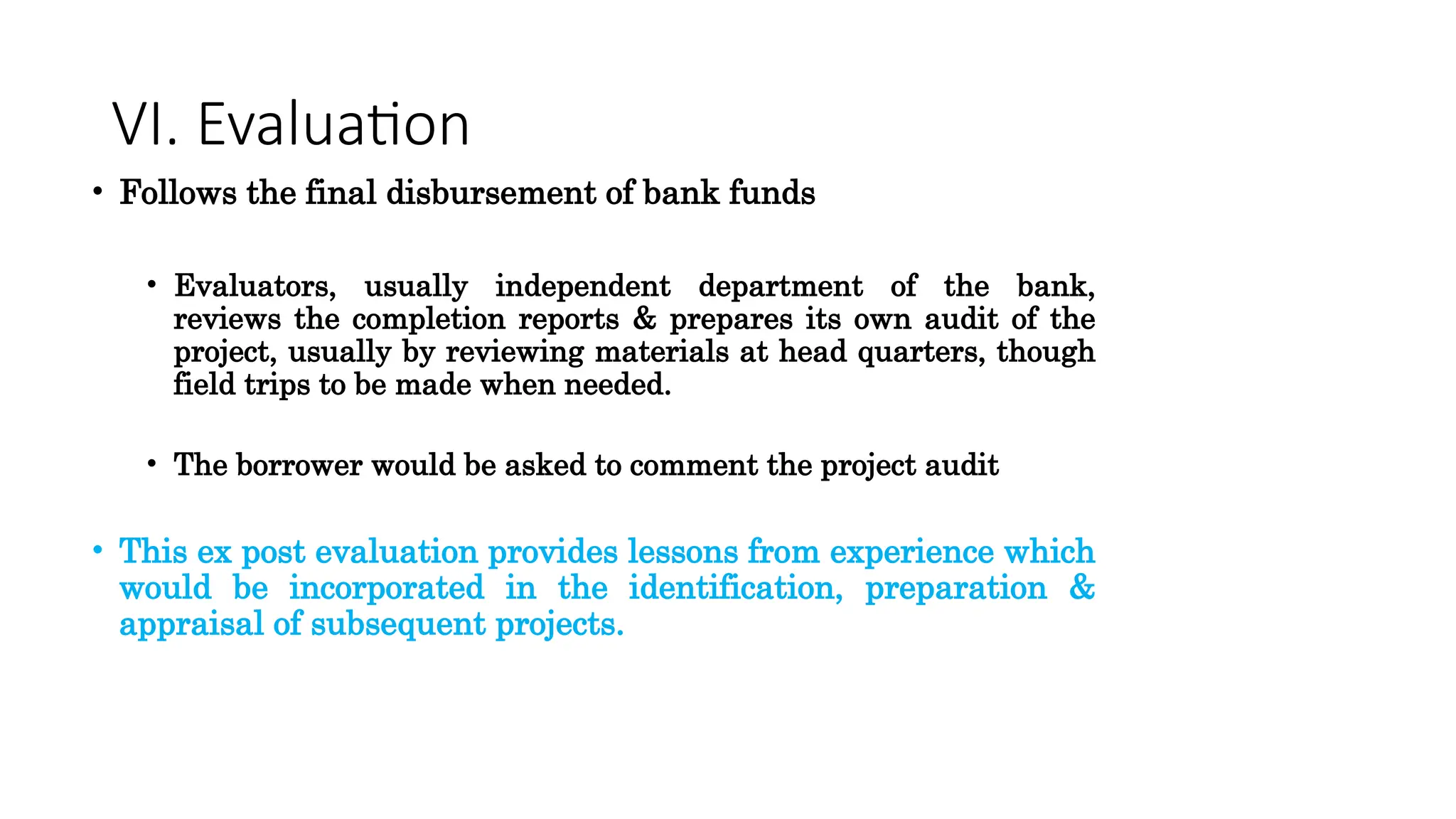
VI. Evaluation
• Follows the final disbursement of bank funds
• Evaluators, usually independent department of the bank,
reviews the completion reports & prepares its own audit of the
project, usually by reviewing materials at head quarters, though
field trips to be made when needed.
• The borrower would be asked to comment the project audit
• This ex post evaluation provides lessons from experience which
would be incorporated in the identification, preparation &
appraisal of subsequent projects.
2. The UNIDO Project Cycle
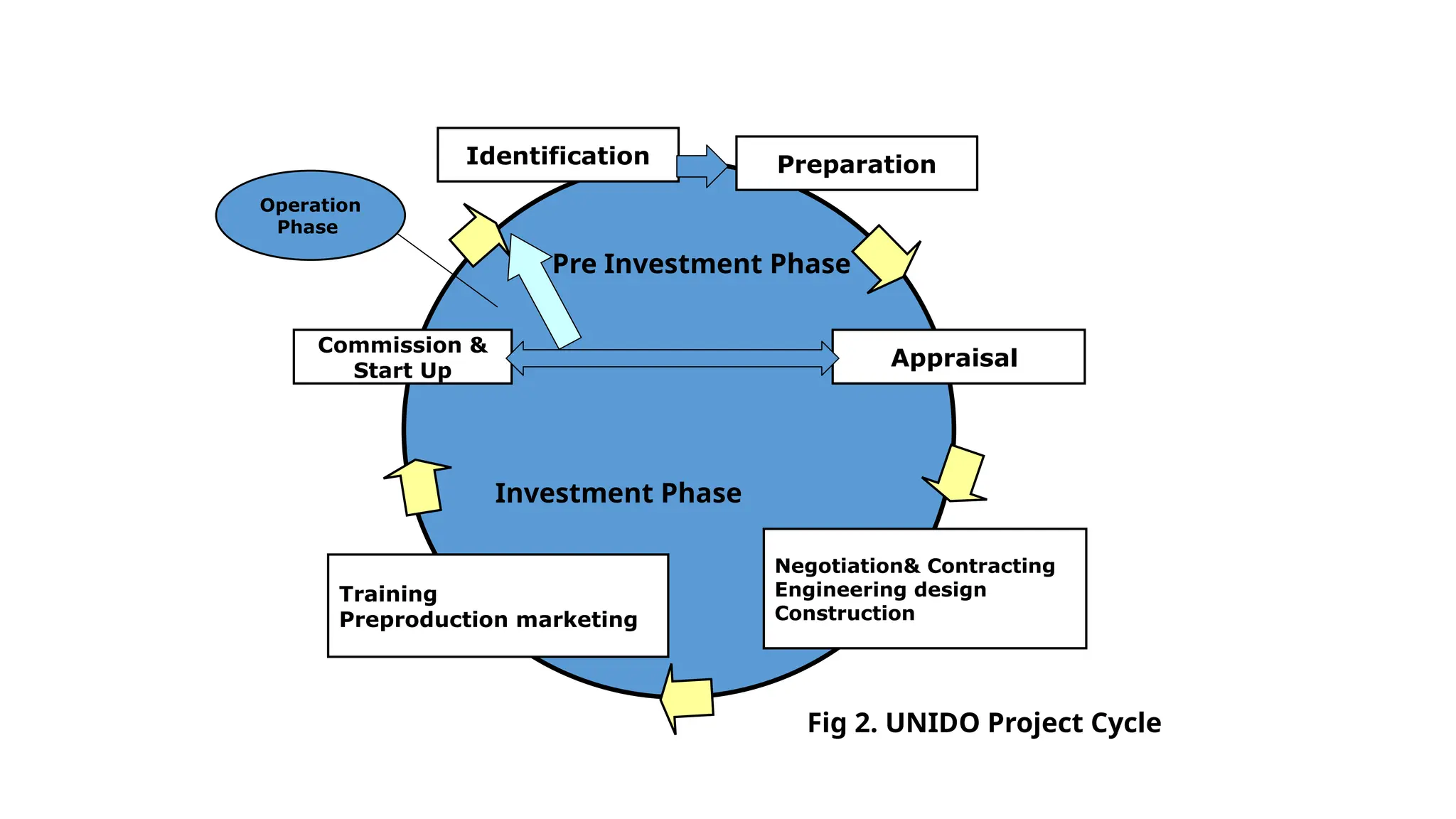
• The development of an industrial project can be shown in
UNIDO project cycle comprising three distinctive phases:--
See Fig 2.2
• UNIDO [United Nations Industrial Development Organization]
• Pre investment Phase
• Investment Phase
• Operation Phase
Pre Investment Phase
Investment Phase
Identification
Appraisal
Negotiation& Contracting
Engineering design
Construction
Training
Preproduction marketing
Commission &
Start Up
Preparation
Operation
Phase
Fig 2. UNIDO Project Cycle
I- Pre Investment Phase
• The pre investment phase consists of:-
1. Opportunity studies [Identification of investment
opportunities]
2. Pre Feasibility Study [Analysis of project alternatives,
preliminary selection]
3. Preparation [Feasibility study]
4. Appraisal and Investment Decision [Appraisal report]
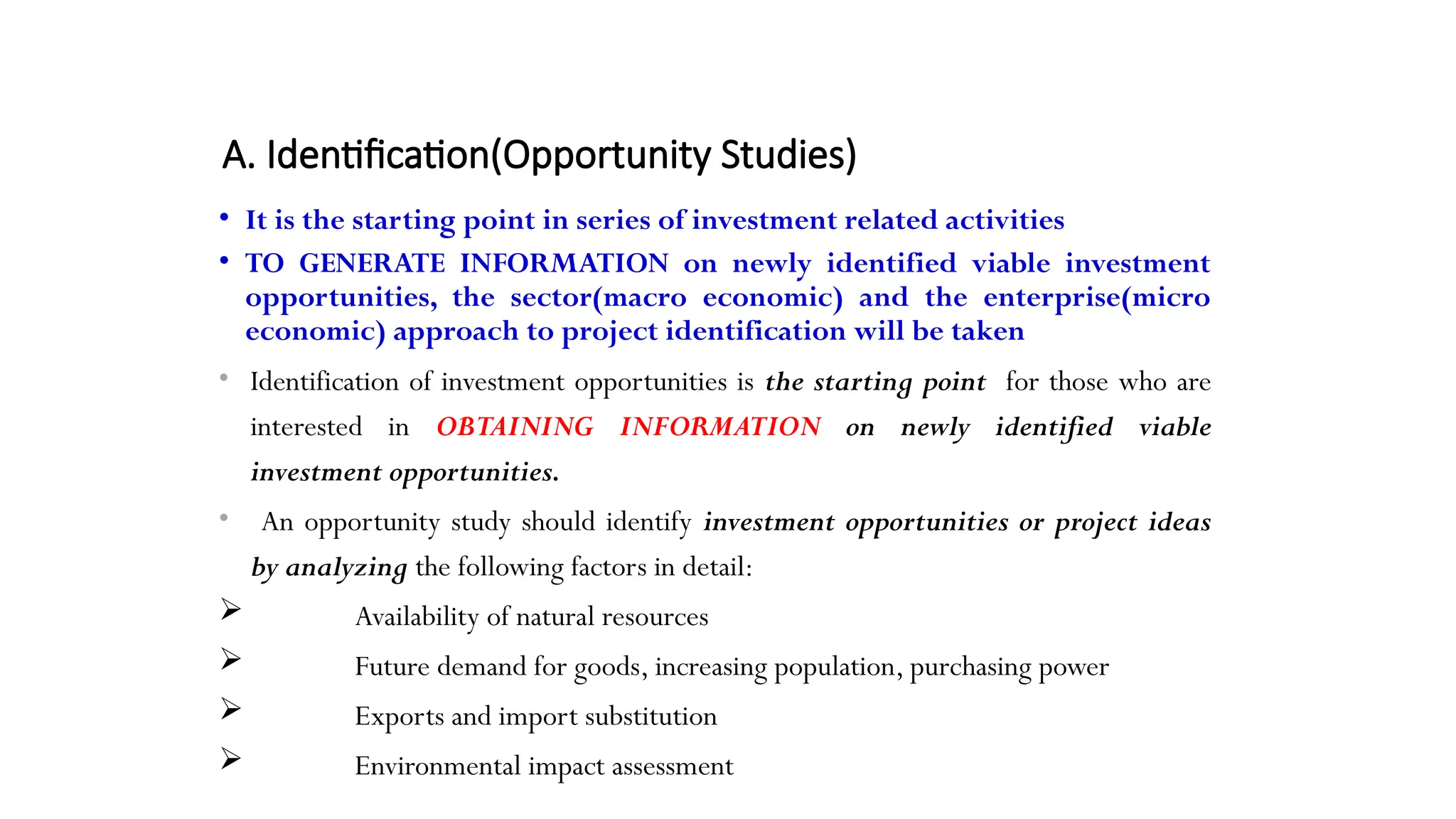
A. Identification(Opportunity Studies)
• It is the starting point in series of investment related activities
• TO GENERATE INFORMATION on newly identified viable investment
opportunities, the sector(macro economic) and the enterprise(micro
economic) approach to project identification will be taken
• Identification of investment opportunities is the starting point for those who are
interested in OBTAINING INFORMATION on newly identified viable
investment opportunities.
• An opportunity study should identify investment opportunities or project ideas
by analyzing the following factors in detail:
 Availability of natural resources
 Future demand for goods, increasing population, purchasing power
 Exports and import substitution
 Environmental impact assessment
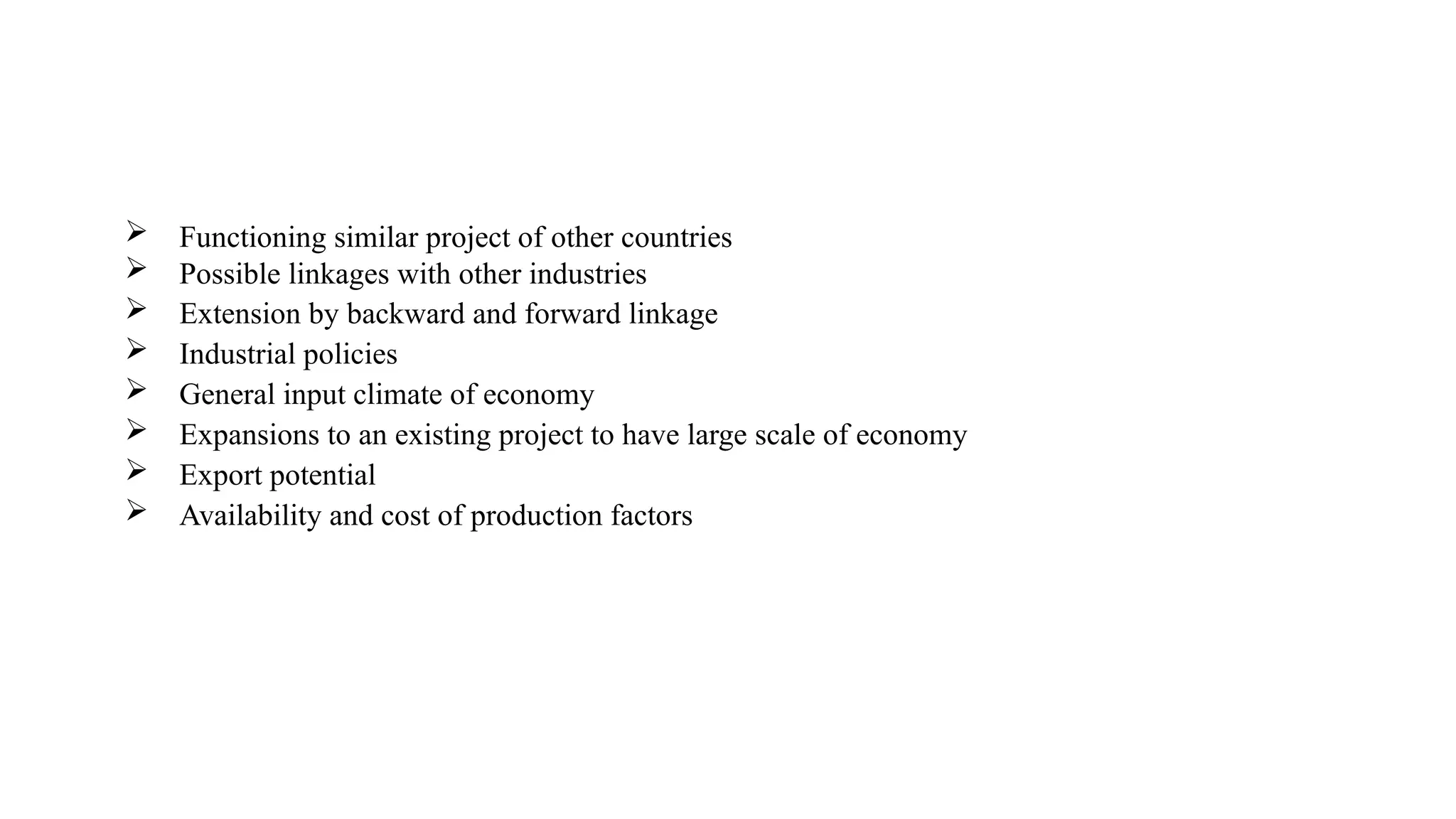
 Functioning similar project of other countries
 Possible linkages with other industries
 Extension by backward and forward linkage
 Industrial policies
 General input climate of economy
 Expansions to an existing project to have large scale of economy
 Export potential
 Availability and cost of production factors
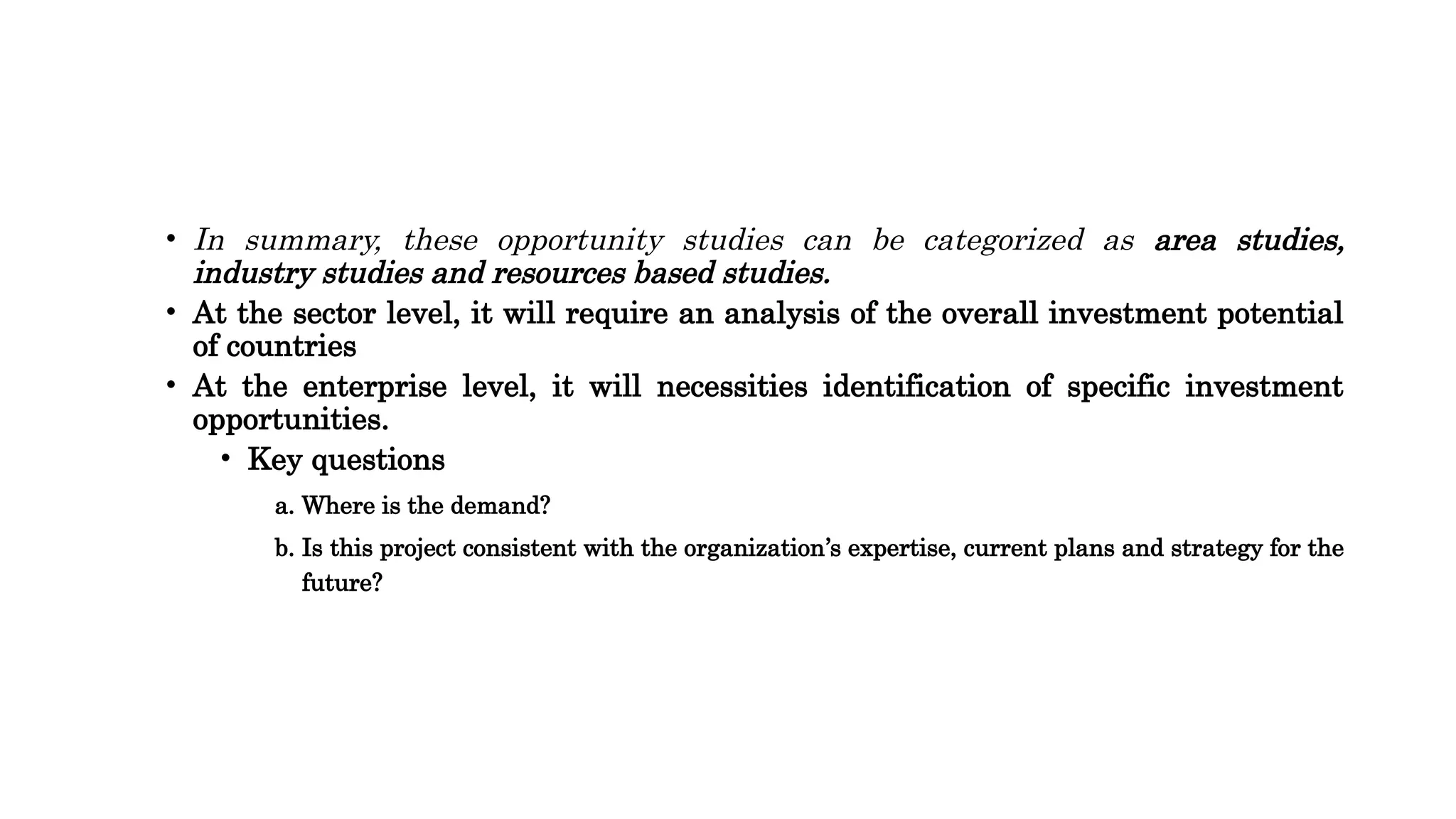
• In summary, these opportunity studies can be categorized as area studies,
industry studies and resources based studies.
• At the sector level, it will require an analysis of the overall investment potential
of countries
• At the enterprise level, it will necessities identification of specific investment
opportunities.
• Key questions
a. Where is the demand?
b. Is this project consistent with the organization’s expertise, current plans and strategy for the
future?
B. Pre-Feasibility Study/Preselection
• Objective of prefeasibility:
• To examine overall potential of project
• To determine whether
• All possible project alternatives have been
examined
• The project concept justifies a detailed analysis by
feasibility study
• The project idea ,on the basis of available
information, should be considered as either non
viable or attractive enough for a particular investor
or group
• Should maintain information across all variables to analyze that:
• Project or corporate strategies and scope of a project
• All possible alternatives should be examined
• The project concept should be justified with detailed analysis
• A critical area necessitates in-depth investigation is required
• Project idea is either attractive for investment or non-viable
• The environment situation at the site in line with national standards
• Support functional studies to convert specific areas such as:
• marketing
• Raw material and factory supplies
• laboratory and Oliphant testing
• location
• Environmental impact assessment
• Economics of scale and
• Equipment selection
• Wherever possible should use secondary information
C. Feasibility Study
• Provide all data necessary for an investment decision
• The commercial, technical, financial, economic &environmental
dimensions of a project should be defined & critically examined
on the basis of alternative solutions already reviewed in
prefeasibility study
• Focus is on improving accuracy of the key variables
• Although feasibility studies are similar in content to the
prefeasibility, it must be worked out with greatest accuracy in
an iterative optimization with feedbacks & inter linkages
• Some primary data may be needed
• All the assumptions made, data used &solution selected in
feasibility study should be described &justified.
D. Appraisal
• Once feasibility is completed, various parties involved in the project will
carry out their own appraisal of investment project
• Project appraisal as carried out by financial institutions concentrate on:
• The health of the company to be financed, The return on
investment, The protection of its creditors
• In general, the techniques applied to appraise projects center around
• Technical, commercial/market, managerial,
organizational, financial and possibly also economic
aspects
• Each project proposal is subjected to sensitivity analysis
• In order to take care of multiple adjustments of input
&output factors and risk analysis
• In order to appraise the uncertainties attached to project
data & alternatives.
• Appraisal report doesn’t deal with the project but also with the industries
in which it belongs and its implication for the economy as a whole
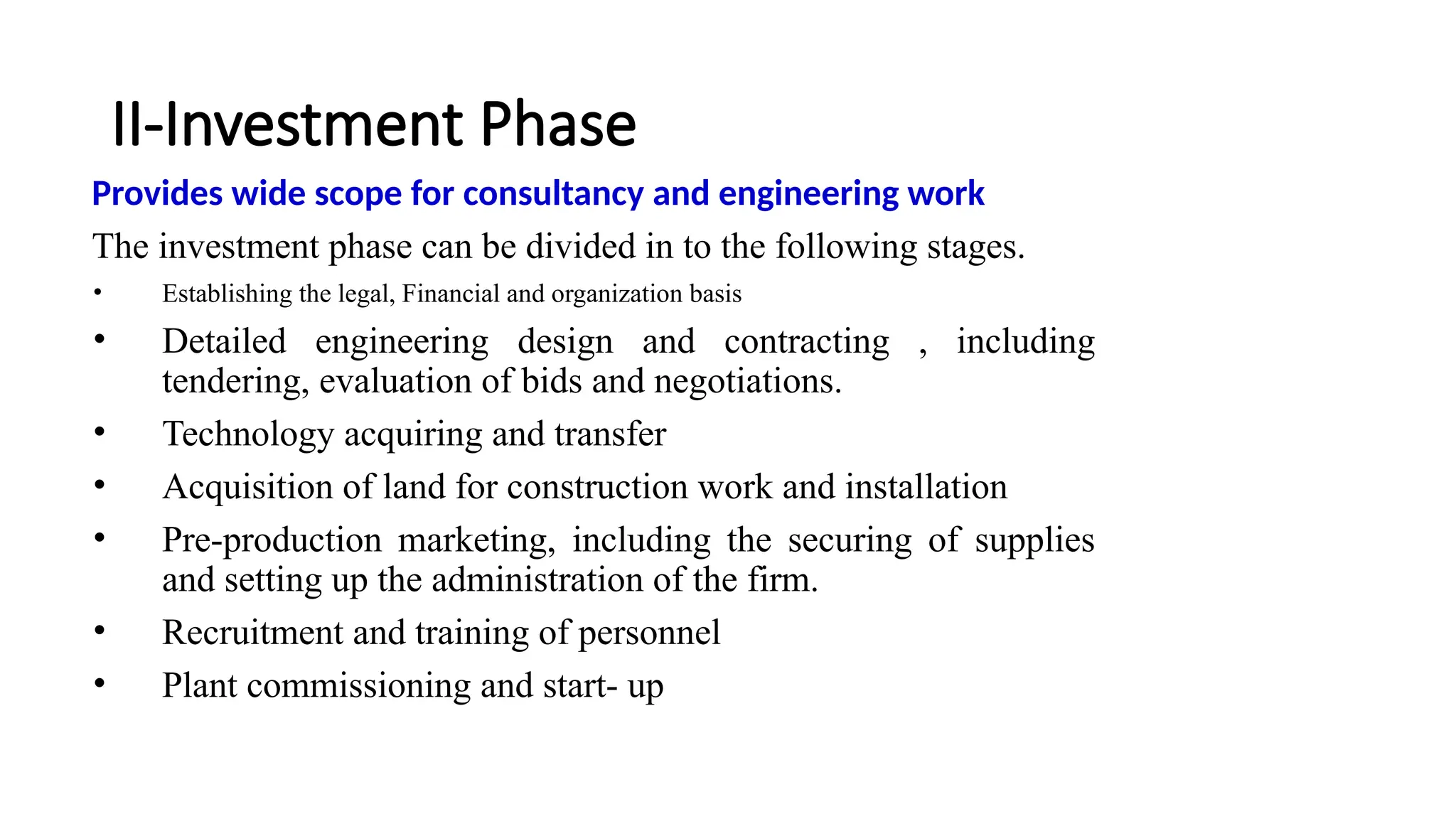
II-Investment Phase
Provides wide scope for consultancy and engineering work
The investment phase can be divided in to the following stages.
• Establishing the legal, Financial and organization basis
• Detailed engineering design and contracting , including
tendering, evaluation of bids and negotiations.
• Technology acquiring and transfer
• Acquisition of land for construction work and installation
• Pre-production marketing, including the securing of supplies
and setting up the administration of the firm.
• Recruitment and training of personnel
• Plant commissioning and start- up
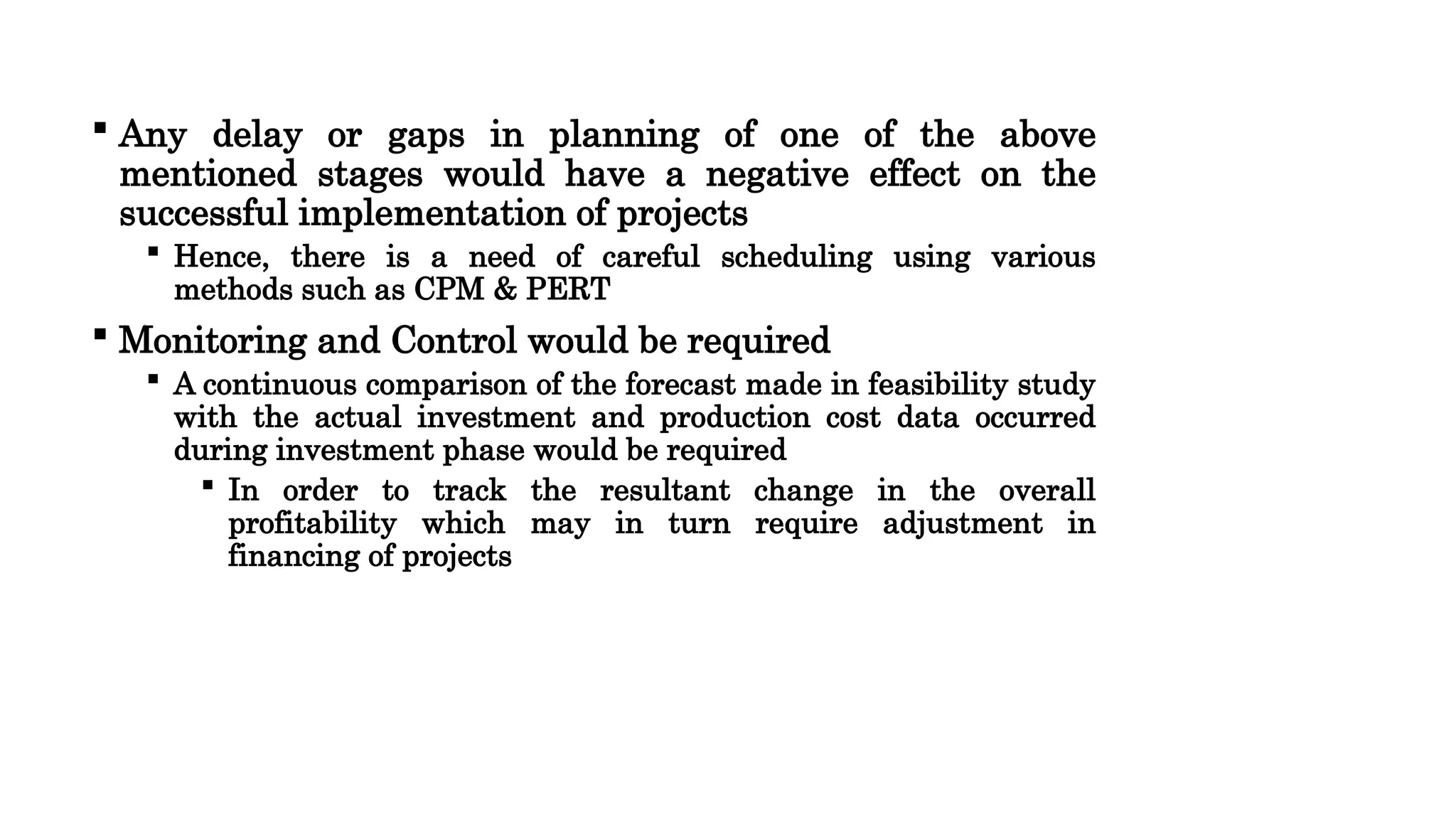
 Any delay or gaps in planning of one of the above
mentioned stages would have a negative effect on the
successful implementation of projects
 Hence, there is a need of careful scheduling using various
methods such as CPM & PERT
 Monitoring and Control would be required
 A continuous comparison of the forecast made in feasibility study
with the actual investment and production cost data occurred
during investment phase would be required
 In order to track the resultant change in the overall
profitability which may in turn require adjustment in
financing of projects
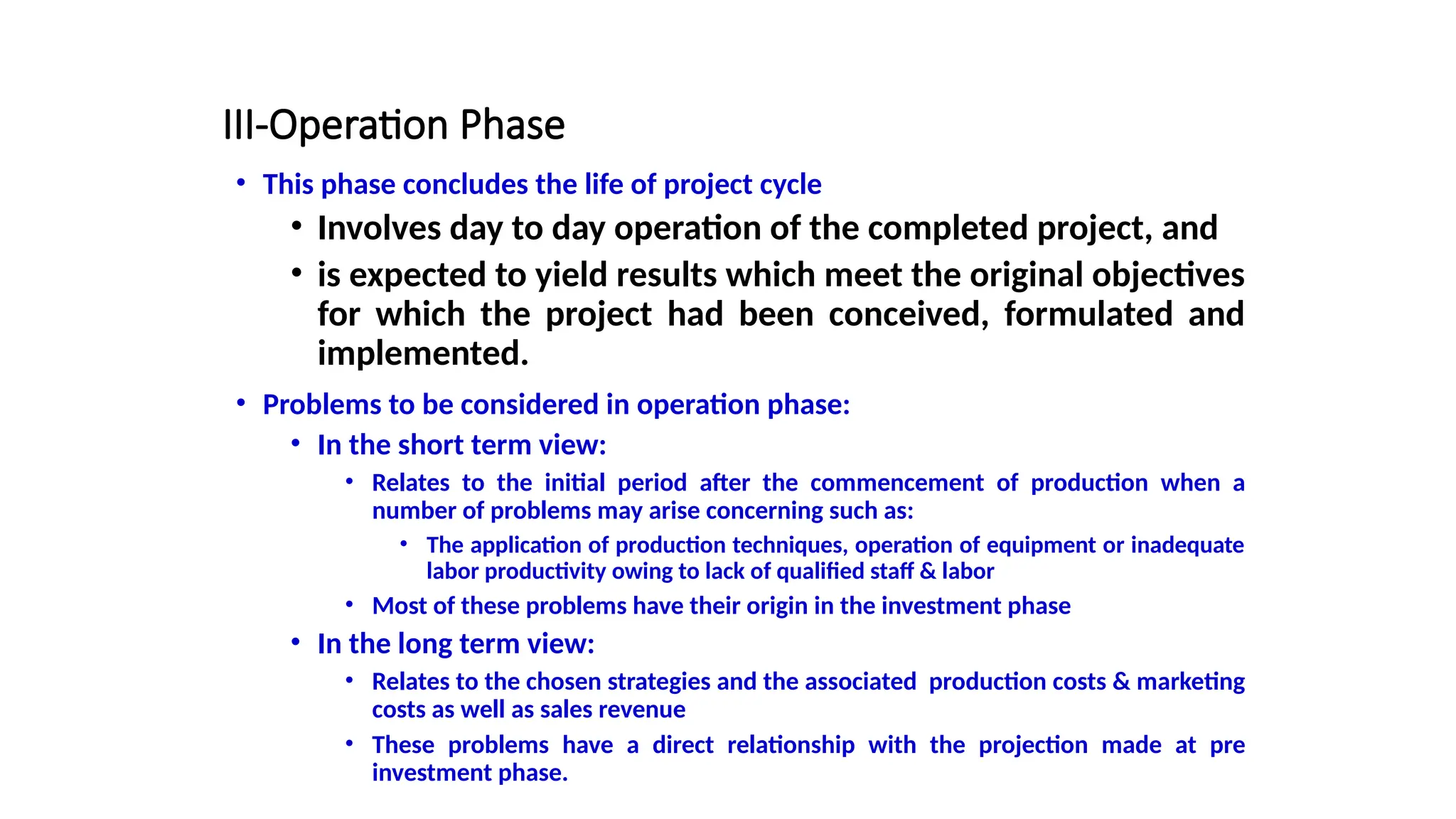
III-Operation Phase
• This phase concludes the life of project cycle
• Involves day to day operation of the completed project, and
• is expected to yield results which meet the original objectives
for which the project had been conceived, formulated and
implemented.
• Problems to be considered in operation phase:
• In the short term view:
• Relates to the initial period after the commencement of production when a
number of problems may arise concerning such as:
• The application of production techniques, operation of equipment or inadequate
labor productivity owing to lack of qualified staff & labor
• Most of these problems have their origin in the investment phase
• In the long term view:
• Relates to the chosen strategies and the associated production costs & marketing
costs as well as sales revenue
• These problems have a direct relationship with the projection made at pre
investment phase.
Further Reading
• List and discuss all the necessary steps of the following project cycle
models:
1. Integrated Project Planning and Management Cycle
(IPPMC)
2. Development Project Studies Authority (DEPSA)
Life cycle
Project Process Groups
• From initiation/authorization to completion /closure, a project goes through a
whole lifecycle that includes
1. Defining the project objectives,
2. Planning the work to achieve those objectives,
3. Performing the work,
4. Monitoring and controlling the progress, and
5. Closing the project after receiving the product acceptance.
10/18/2024 32
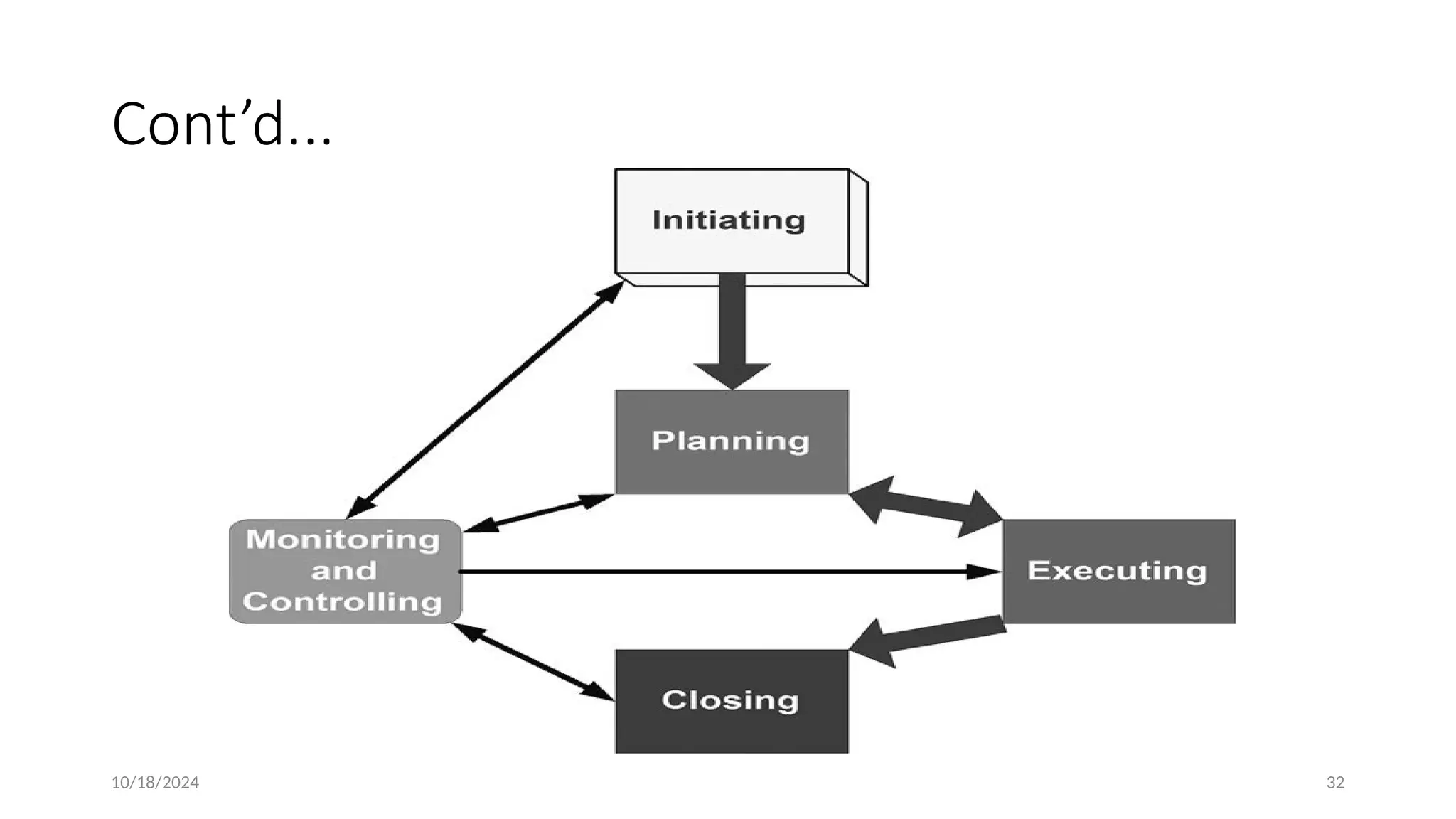
Cont’d...
10/18/2024 33
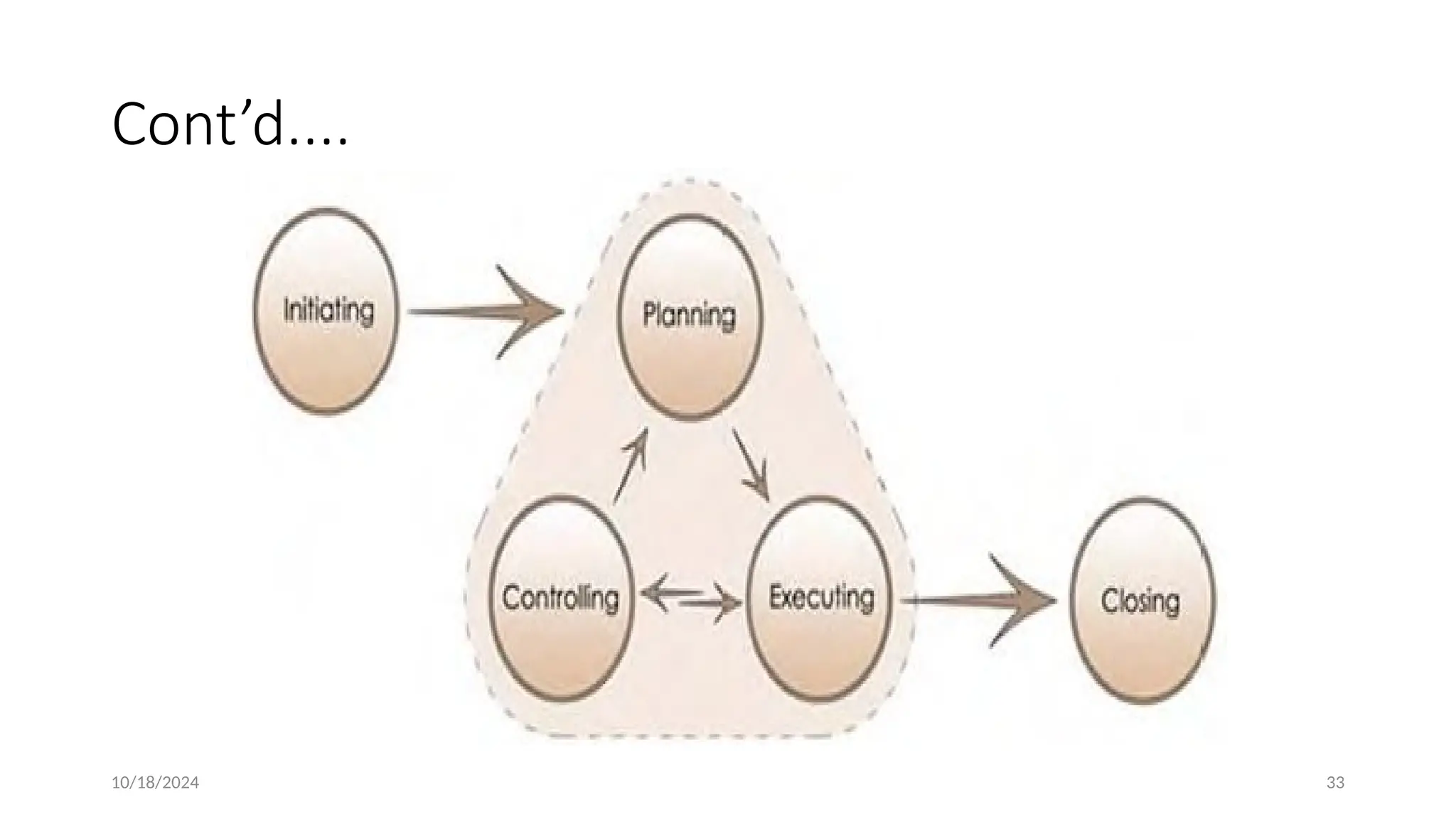
Cont’d....
10/18/2024 34
2.2. Initiation Process Group
• This stage defines and authorizes( approves) the project.
• The project manager is named, and the project is officially launched
through a signed document called the project charter[agreement] ,which
contains items such as:
• the purpose of the project,
• a high-level product description,
• a summary of the milestone schedule
• Another outcome of this stage is a document called the stakeholder
register, which identifies the project stakeholders and important information
about them.
10/18/2024 35
2.3. Planning Process Group
In this stage, the project manager, along with the project management team,
• refine the project objectives and requirements and
• develop the project management plan, which is a collection of several plans that constitute a
course of actions required to achieve the objectives and meet the requirements of
the project.
• The project scope is finalized with the project scope statement.
• The project management plan, the outcome of this stage, contains
subsidiary plans, such as:
• a project scope management plan,
• a schedule management plan, and
• a quality management plan.
10/18/2024 36
2.4. Executing Process Group
• In this stage, the project manager, implement the project management
plan, and the project team performs the work scheduled in the planning
stage.
• The project manager coordinate all the activities being performed to
achieve the project objectives and meet the project requirements.
• Of course, the main output of this project is the project deliverables.
10/18/2024 37
2.5. Monitoring and controlling Process Group
• Monitoring and controlling includes defending the project against scope creep
(unapproved changes to the project scope), monitoring the project progress and
performance to identify variance from the plan, and recommending preventive and
corrective actions to bring the project in line with the planned expectations in the
approved project management plan.
• Requests for changes, such as change to the project scope, are also
included in this stage; they can come from you or from any other project
stakeholder. The changes must go through an approval process, and only
the approved changes are implemented. The processes used in this stage
fall into a group called the monitoring and controlling process group.
10/18/2024 38
2.6. Closing Process Group
• In this stage, you manage the formal acceptance of the project product,
close any contracts involved, and bring the project to an end by disbanding
the project team.
• Closing the project includes conducting
• a project review for lessons learned and
• possibly turning over the outcome of the project to another group, such as the
maintenance or operations group.
• Celebration.
• Terminated projects (that is, projects cancelled before completion) should
also go through the closing stage.
10/18/2024 39
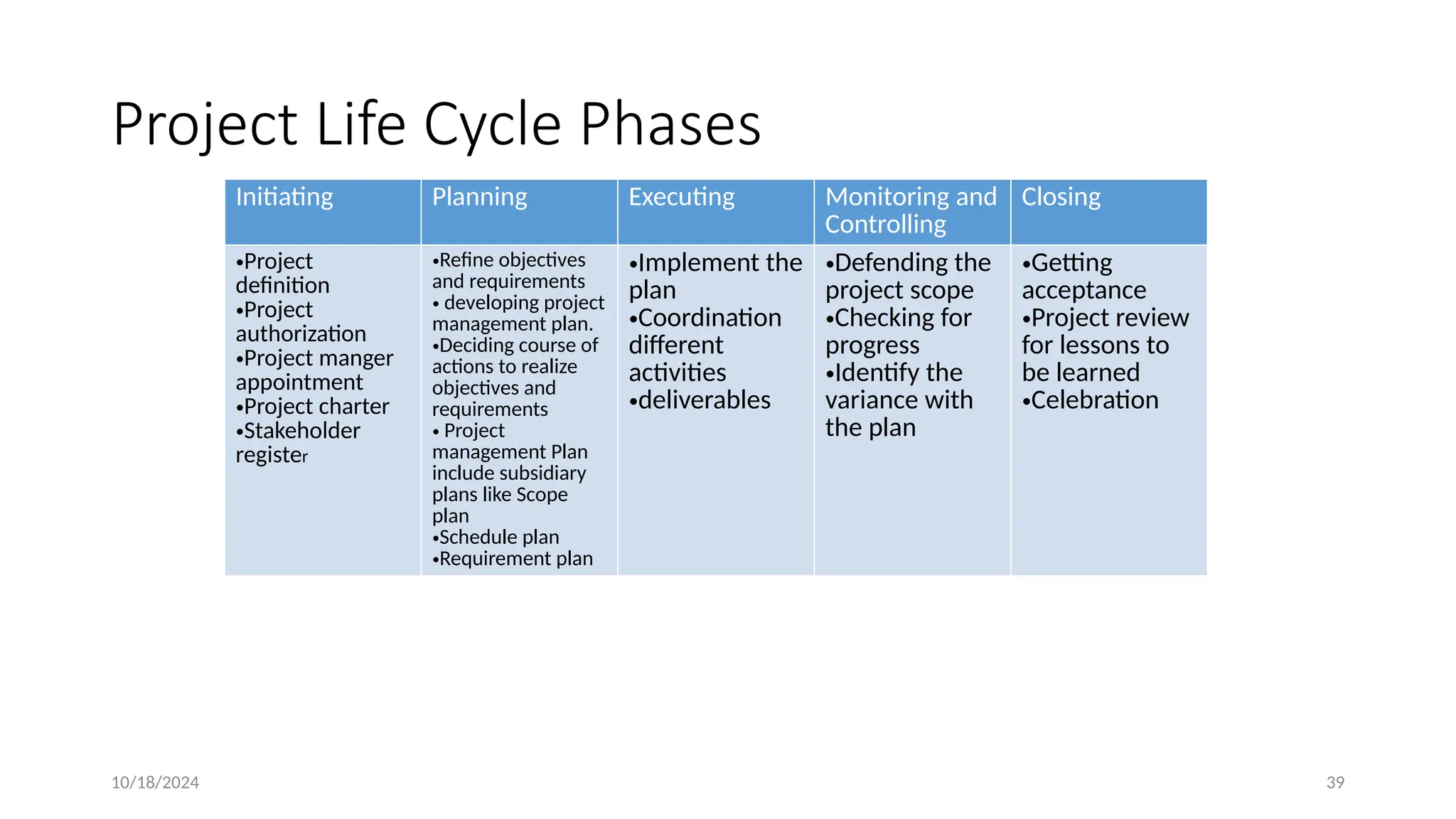
Project Life Cycle Phases
Initiating Planning Executing Monitoring and
Controlling
Closing
•Project
definition
•Project
authorization
•Project manger
appointment
•Project charter
•Stakeholder
register
•Refine objectives
and requirements
• developing project
management plan.
•Deciding course of
actions to realize
objectives and
requirements
• Project
management Plan
include subsidiary
plans like Scope
plan
•Schedule plan
•Requirement plan
•Implement the
plan
•Coordination
different
activities
•deliverables
•Defending the
project scope
•Checking for
progress
•Identify the
variance with
the plan
•Getting
acceptance
•Project review
for lessons to
be learned
•Celebration
Chapter End!

Chapter 2 - Project Life cycle for Project Management Students

  • 1.
    Chapter Two: ProjectLife Cycle and Process Groups 2.1. Project Life Cycle 2.2. Initiation Process Group 2.3. Planning Process Group 2.4. Execution Process Group 2.5.Monitoring and Evaluation/Controlling Process Group 2.6. Closing Process Group
  • 2.
    2.1. Project LifeCycle Meaning Project Cycle • Project cycle- refers to series stages that projects go through on the path from origin to completion. • A project life cycle is the step-by-step process by which a project is formulated, identified, evaluated, implemented and completed. • A Project life cycle is the series of phases that a project passes through from its initiation (start) to its closure. • Project phases are a collection of logically related project activities that culminates/ends in the completion of one or more deliverables.
  • 3.
    Project cycle models •A clear understanding of the life cycle by dividing project life cycle into phases of a project: Permits managers and executives to better control resources to achieve goals Facilitates investment promotion and provides a basis for project decision & implementation Important to understand the role to be played by different actors of the project • However, due to the complex nature and diversity of projects, there is no agreement about the life cycle of projects. • But still, for life cycle of project to be understandable, the two common project cycle referred as: • The Baum(World Bank) Project Cycle • The UNIDO Project Cycle
  • 4.
    1. The Baum(WorldBank) Project Cycle The Baum cycle- primarily reflects the series of activities and procedures to the development of investment projects(development projects) to be financed by the World Bank. The Project , in the Baum Cycle, constitute six distinctive phases- See Fig 1 Identification Preparation Appraisal Negotiation Implementation & Supervision Evaluation
  • 5.
  • 6.
    1. Identification • Involveboth the BANK & BORROWER in selection of suitable projects that support the national and sectoral development strategies. • Economic & sectoral analysis by THE BANK provide: An understanding of • the development potential of the borrowing country • A framework for assessing credit worthiness & • for evaluating national & sectoral policies • Continuous dialogue b/n bank and borrowing country leads to The formation of a coherent development strategy The identification of projects which fit into it
  • 7.
    II. Project Preparation(Feasibility Study) • In this phase, FEASIBILITY STUDIES would be carried out- • To compare different technical &institutional alternatives and, • To identify the solution most appropriate to the country’s resource endowment & its stage of development • The borrower examines the technical, institutional, economic & financial condition necessary to achieve project objective and, • The bank provides guidance & makes financial assistance available for preparation or helps the borrowers obtain assistance from other sources 7
  • 8.
    III. Project Appraisal After a project has been prepared, it is generally appropriate for a critical review or an independent appraisal to be conducted.  This provides an opportunity to re-examine every aspect of the project plan to assess whether the proposal is appropriate and sound before large sums are committed.  With the results of the feasibility study, the decision- makers - not the analysts - MAKE DECISIONS based on certain investment criteria that are important to them.  Appraisal is the comprehensive and systematical assessment of all aspect of the proposed project. 8
  • 9.
    • Involves acomprehensive & systematic review of all aspects of the project BY THE BANK • Primarily covers four major aspects- • Technical, • Institutional, • Economic, • Financial • Lays the foundations for project implementation & evaluation • During this process: • The project may be extensively modified or redesigned • An appraisal report is drafted by the bank outlying the findings of the appraisal and making recommendation for the terms and conditions of the loan • An appraisal report serves as a basis for negotiations with the borrower
  • 10.
    Cont’d • The projectis viewed from different perspectives; technical, commercial, financial, economic, managerial and organizational. • Technical – here the appraisal concentrates in verifying whether what is proposed will work in the way suggested or not. • Financial – the appraisals try to see if the requirements for money needed by the project have been calculated properly, their sources are all identified, and reasonable plans for their repayment and other necessary circumstances are properly identified and calculated. 10
  • 11.
    • Commercial the waythe necessary inputs for the project are conceived to be supplied is examined and the arrangements for the disposal of the products are verified. • Economic the appraisal here tries to see whether what is proposed is good from the viewpoint of the national economic development interest when all project effects (positive and negative) are taken into account and check if all are correctly valued.
  • 12.
    • Managerial this aspectof the appraisal examines if the CAPACITY exists for operating the project and see if those responsible ones can operate it satisfactorily. Moreover, it tries to see if the responsible bodies are given sufficient power and scope to do what is required. • Organizational the appraisal examines the project if it is organized internally and externally into units, contract policy institution, etc so as to allow the proposals to be carried out properly and to allow for change as the project develops.
  • 13.
    • These issuesare the subjects of specialized appraisal report. • And on the basis of this report, FINANCIAL DECISIONS ARE MADE – whether to go ahead with the project or not. • In practice, there can be quite a sequence of project selection decisions. Following appraisal, some projects may be discarded. • If the project involves loan finance, the lender will almost certainly wish to carry out his own appraisal before completing negotiations with the borrower. Comments made at the appraisal stage frequently give rise to alterations in the project plan (project proposal).
  • 14.
    IV. Negotiation • Involvesdiscussion between bank& borrower on measures needed to ensure project success • The agreement reached would be converted into legal obligation set forth in loan documents • The loan document embody all of the principal issues that would be raised prior to & during appraisal and, • Ensure that borrowers & bank are in agreement on objectives, on the actions necessary to achieve them and on schedules for implementation • The appraisal report may be amended to reflect the agreement reached before the approval of loan documents
  • 15.
    V. Implementation &Supervision • Project implementation is the responsibility of the borrower and, while the bank exercises the supervision function • Supervision by the bank:- • Conducted based on the progress report & periodic field visits • Intended to ensure proper execution of the project by identifying & correcting implementation problems • An annual review of bank supervision experience on all projects underway is intended to stimulate continuous improvement in policies and procedures • As final step in supervision, the government prepares a completion report on a project at the end of disbursement period.
  • 16.
    VI. Evaluation • Followsthe final disbursement of bank funds • Evaluators, usually independent department of the bank, reviews the completion reports & prepares its own audit of the project, usually by reviewing materials at head quarters, though field trips to be made when needed. • The borrower would be asked to comment the project audit • This ex post evaluation provides lessons from experience which would be incorporated in the identification, preparation & appraisal of subsequent projects.
  • 17.
    2. The UNIDOProject Cycle • The development of an industrial project can be shown in UNIDO project cycle comprising three distinctive phases:-- See Fig 2.2 • UNIDO [United Nations Industrial Development Organization] • Pre investment Phase • Investment Phase • Operation Phase
  • 18.
    Pre Investment Phase InvestmentPhase Identification Appraisal Negotiation& Contracting Engineering design Construction Training Preproduction marketing Commission & Start Up Preparation Operation Phase Fig 2. UNIDO Project Cycle
  • 19.
    I- Pre InvestmentPhase • The pre investment phase consists of:- 1. Opportunity studies [Identification of investment opportunities] 2. Pre Feasibility Study [Analysis of project alternatives, preliminary selection] 3. Preparation [Feasibility study] 4. Appraisal and Investment Decision [Appraisal report]
  • 20.
    A. Identification(Opportunity Studies) •It is the starting point in series of investment related activities • TO GENERATE INFORMATION on newly identified viable investment opportunities, the sector(macro economic) and the enterprise(micro economic) approach to project identification will be taken • Identification of investment opportunities is the starting point for those who are interested in OBTAINING INFORMATION on newly identified viable investment opportunities. • An opportunity study should identify investment opportunities or project ideas by analyzing the following factors in detail:  Availability of natural resources  Future demand for goods, increasing population, purchasing power  Exports and import substitution  Environmental impact assessment
  • 21.
     Functioning similarproject of other countries  Possible linkages with other industries  Extension by backward and forward linkage  Industrial policies  General input climate of economy  Expansions to an existing project to have large scale of economy  Export potential  Availability and cost of production factors
  • 22.
    • In summary,these opportunity studies can be categorized as area studies, industry studies and resources based studies. • At the sector level, it will require an analysis of the overall investment potential of countries • At the enterprise level, it will necessities identification of specific investment opportunities. • Key questions a. Where is the demand? b. Is this project consistent with the organization’s expertise, current plans and strategy for the future?
  • 23.
    B. Pre-Feasibility Study/Preselection •Objective of prefeasibility: • To examine overall potential of project • To determine whether • All possible project alternatives have been examined • The project concept justifies a detailed analysis by feasibility study • The project idea ,on the basis of available information, should be considered as either non viable or attractive enough for a particular investor or group
  • 24.
    • Should maintaininformation across all variables to analyze that: • Project or corporate strategies and scope of a project • All possible alternatives should be examined • The project concept should be justified with detailed analysis • A critical area necessitates in-depth investigation is required • Project idea is either attractive for investment or non-viable • The environment situation at the site in line with national standards • Support functional studies to convert specific areas such as: • marketing • Raw material and factory supplies • laboratory and Oliphant testing • location • Environmental impact assessment • Economics of scale and • Equipment selection • Wherever possible should use secondary information
  • 25.
    C. Feasibility Study •Provide all data necessary for an investment decision • The commercial, technical, financial, economic &environmental dimensions of a project should be defined & critically examined on the basis of alternative solutions already reviewed in prefeasibility study • Focus is on improving accuracy of the key variables • Although feasibility studies are similar in content to the prefeasibility, it must be worked out with greatest accuracy in an iterative optimization with feedbacks & inter linkages • Some primary data may be needed • All the assumptions made, data used &solution selected in feasibility study should be described &justified.
  • 26.
    D. Appraisal • Oncefeasibility is completed, various parties involved in the project will carry out their own appraisal of investment project • Project appraisal as carried out by financial institutions concentrate on: • The health of the company to be financed, The return on investment, The protection of its creditors • In general, the techniques applied to appraise projects center around • Technical, commercial/market, managerial, organizational, financial and possibly also economic aspects • Each project proposal is subjected to sensitivity analysis • In order to take care of multiple adjustments of input &output factors and risk analysis • In order to appraise the uncertainties attached to project data & alternatives. • Appraisal report doesn’t deal with the project but also with the industries in which it belongs and its implication for the economy as a whole
  • 27.
    II-Investment Phase Provides widescope for consultancy and engineering work The investment phase can be divided in to the following stages. • Establishing the legal, Financial and organization basis • Detailed engineering design and contracting , including tendering, evaluation of bids and negotiations. • Technology acquiring and transfer • Acquisition of land for construction work and installation • Pre-production marketing, including the securing of supplies and setting up the administration of the firm. • Recruitment and training of personnel • Plant commissioning and start- up
  • 28.
     Any delayor gaps in planning of one of the above mentioned stages would have a negative effect on the successful implementation of projects  Hence, there is a need of careful scheduling using various methods such as CPM & PERT  Monitoring and Control would be required  A continuous comparison of the forecast made in feasibility study with the actual investment and production cost data occurred during investment phase would be required  In order to track the resultant change in the overall profitability which may in turn require adjustment in financing of projects
  • 29.
    III-Operation Phase • Thisphase concludes the life of project cycle • Involves day to day operation of the completed project, and • is expected to yield results which meet the original objectives for which the project had been conceived, formulated and implemented. • Problems to be considered in operation phase: • In the short term view: • Relates to the initial period after the commencement of production when a number of problems may arise concerning such as: • The application of production techniques, operation of equipment or inadequate labor productivity owing to lack of qualified staff & labor • Most of these problems have their origin in the investment phase • In the long term view: • Relates to the chosen strategies and the associated production costs & marketing costs as well as sales revenue • These problems have a direct relationship with the projection made at pre investment phase.
  • 30.
    Further Reading • Listand discuss all the necessary steps of the following project cycle models: 1. Integrated Project Planning and Management Cycle (IPPMC) 2. Development Project Studies Authority (DEPSA) Life cycle
  • 31.
    Project Process Groups •From initiation/authorization to completion /closure, a project goes through a whole lifecycle that includes 1. Defining the project objectives, 2. Planning the work to achieve those objectives, 3. Performing the work, 4. Monitoring and controlling the progress, and 5. Closing the project after receiving the product acceptance.
  • 32.
  • 33.
  • 34.
    10/18/2024 34 2.2. InitiationProcess Group • This stage defines and authorizes( approves) the project. • The project manager is named, and the project is officially launched through a signed document called the project charter[agreement] ,which contains items such as: • the purpose of the project, • a high-level product description, • a summary of the milestone schedule • Another outcome of this stage is a document called the stakeholder register, which identifies the project stakeholders and important information about them.
  • 35.
    10/18/2024 35 2.3. PlanningProcess Group In this stage, the project manager, along with the project management team, • refine the project objectives and requirements and • develop the project management plan, which is a collection of several plans that constitute a course of actions required to achieve the objectives and meet the requirements of the project. • The project scope is finalized with the project scope statement. • The project management plan, the outcome of this stage, contains subsidiary plans, such as: • a project scope management plan, • a schedule management plan, and • a quality management plan.
  • 36.
    10/18/2024 36 2.4. ExecutingProcess Group • In this stage, the project manager, implement the project management plan, and the project team performs the work scheduled in the planning stage. • The project manager coordinate all the activities being performed to achieve the project objectives and meet the project requirements. • Of course, the main output of this project is the project deliverables.
  • 37.
    10/18/2024 37 2.5. Monitoringand controlling Process Group • Monitoring and controlling includes defending the project against scope creep (unapproved changes to the project scope), monitoring the project progress and performance to identify variance from the plan, and recommending preventive and corrective actions to bring the project in line with the planned expectations in the approved project management plan. • Requests for changes, such as change to the project scope, are also included in this stage; they can come from you or from any other project stakeholder. The changes must go through an approval process, and only the approved changes are implemented. The processes used in this stage fall into a group called the monitoring and controlling process group.
  • 38.
    10/18/2024 38 2.6. ClosingProcess Group • In this stage, you manage the formal acceptance of the project product, close any contracts involved, and bring the project to an end by disbanding the project team. • Closing the project includes conducting • a project review for lessons learned and • possibly turning over the outcome of the project to another group, such as the maintenance or operations group. • Celebration. • Terminated projects (that is, projects cancelled before completion) should also go through the closing stage.
  • 39.
    10/18/2024 39 Project LifeCycle Phases Initiating Planning Executing Monitoring and Controlling Closing •Project definition •Project authorization •Project manger appointment •Project charter •Stakeholder register •Refine objectives and requirements • developing project management plan. •Deciding course of actions to realize objectives and requirements • Project management Plan include subsidiary plans like Scope plan •Schedule plan •Requirement plan •Implement the plan •Coordination different activities •deliverables •Defending the project scope •Checking for progress •Identify the variance with the plan •Getting acceptance •Project review for lessons to be learned •Celebration
  • 40.

Editor's Notes

  • #34 A Project Charter is a document that, while describing the purpose of a project and its scope, it legally authorizes the beginning of the project. Any business nowadays, before initiating a new project requires a signed project charter. If you are an investor or a contributor in a project, you want to get a clear understanding of what this project will bring about. After all, it is important to know what resources it requires before you sign for it – and that’s exactly what a project charter provides. It clarifies general specifications, the purpose of the project, the key stakeholders, and the possible outcomes. Originally, project charters have existed for more than a thousand years in different forms. Some such examples would be colonial charters issued by kings, the Magna Carta in the 13th century etc. Nowadays, they are an integral part of the project management due to their importance as a legally binding document.
  • #35 Scope ( activities)