Management Control System Author: Manohar Prasad
  3.  BEHAVIOR IN ORGANIZATION  Learning outcomes GOALS  &  CONGRUENCE INFORMAL FACTORS THAT INFLUENCE GOAL CONGRUENCE FORMAL CONTROL SYSTEMS TYPES OF ORGANIZATIONS FUNCTIONS OF THE CONTROLLER
Organization Structure How tasks are divided, resources are deployed, and departments are coordinated Set of formal tasks  Formal reporting relationships Effective coordination of employees across departments 11/21/11 0
TYPES OF ORGANIZATIONS FUNCTIONAL ORGANIZATIONS BUSINESS UNIT ORGANIZATIONS MATRIX ORGANIZATIONS
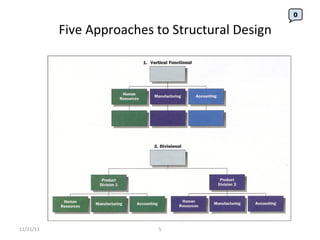
Five Approaches to Structural Design 11/21/11 0
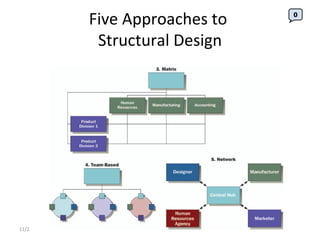
Five Approaches to  Structural Design 11/21/11 0
FUNCTIONS OF THE COTROLLER DESIGNING & OPERATING MCS FINANCIAL STATEMENTS & REPORTS TAX RETURNS PREPARATION AND ANALYSIS OF PERFORMANCE REPORTS
FUNCTIONS OF THE CONTROLLER(contd.) BUDGET PROPOSALS WITH ANALYSIS & JUSTIFICATION INTERNAL AUDITS FOR PREVENING FRAUD/THEFT DEVELOPING  PEOPLE IN CONTROL FUNCTION BUSINESS UNIT CONTROLLER & CORPORATE CONTROLLER
4.  RESPONSIBILITY CENTERS Learning outcomes TYPES OF RESPOSIBILITY CENTERS COST/EXPENSE CENTERS REVENUE/PROFIT CENTERS INVESTMENT CENTERS MEASURES  USED TO EVALUATE THEIR PERFORMANCES ROI, ROA, MVA
THE CONTROLLER BUSINESS UNIT CONTROLLER CORPORATE CONTROLLER RELATIOSHIP BETWEEN BOTH DOTTED LINE SOLID LINE
RESPONSIBILITY CENTRES RESPONSIBILITY CENTRES MANAGER RESPONSIBLE FOR  ACTIVITIES UNIT WITHIN COMPANY
RESPONSIBILITY CENTRES NATURE OF RESPONSIBILITY CENTRES OBJECTIVES INPUTS/WORK/OUTPUT RELATIONSHIP BETWEEN  INPUT & OUTPUT
RESPONSIBILITY CENTRES MEASURING INPUTS & OUTPUTS PHYSICAL MEASUREMENT LIKE HRS, KGS TRANSLATED INTO MONETARY TERMS COST –MONETARY MEASURE OF RESOURCES USED BY RESPONSIBILITY CENTRE
RESPONSIBILITY CENTRES EFFICIENCY & EFFECTIVENESS RATIO OF OUTPUT TO INPUT RATIO OF OUTPUT TO ITS OBJECTIVES EVERY RESPONSIBILITY CENTRE OUGHT TO BE BOTH EFFICIENT AND EFFECTIVE A RESONSIBILITY CENTRE IS EFFICIENT IF IT DOES THINGS RIGHT, AND IT IS EFFECTIVE IF IT DOES THE RIGHT THINGS
TYPES OF RESPONSIBILITY CENTRES COST/EXPENSE  CENRES TYPES  ENGINEERED EXPENSE CENTRES b) DISCRETIONARY EXPENSE CENTRES
TYPES OF RESPONSIBILITY CENTRES 2. REVENUE CENTRES OUTPUT IS MEASURED IN MONETARY TERMS NO FORMAL ATTEMPT TO RELATE TO INPUT
Responsibility Accounting for Profit Centres Based on detailed information about both controllable revenues and controllable costs Manager controls operating revenues earned, such as sales,  Manager controls all variable costs (and expenses) incurred by the centre because they vary with sales
Profit Centre Shows  budgeted   and   actual   controllable revenues and costs Prepared using the cost-volume-profit income statement format: Deduct controllable fixed costs from the  contribution margin Controllable margin   - excess of contribution  margin over controllable fixed costs – best  measure of manager’s performance in  controlling revenues and costs Do  not  report non-controllable fixed costs
Advantages of Profit Centre Speed of operating decisions Quality of decisions Unit level day to day decisions Corporate can concentrate on long term planning Freedom for unit managers, less dependence on head office Excellent training ground Profit consciousness among units Ready made infn on profitability of compny’s independent units Competitive  performance
Measuring Profitability Contribution margin Direct profit Controllable profit Income before taxes Net income Revenues
Investment Center An investment center is a subunit that is responsible for generating revenue, controlling costs, and investing in assets. An investment center is charged with earning income consistent with the amount of assets invested in the segment. Most divisions of a company can be treated as either profit centers or investment centers.
6.   Transfer Pricing  Learning outcomes Objectives and need of Transfer pricing Methods of Transfer Pricing Cost Based Market price based Negotiated price Administration of TRANSFER PRICES
Need For Transfer Pricing  Liberalization and Growth of multinationals  More decentralization.  Considerable autonomy Encourage them to perform well.  Business units are supposed to work under the same organization  Performance of business units.
OBJECTIVES OF TRANSFER PRICES  Proper distribution of revenue between profit centers.  Resulting profit has to be shared between the profit centers.  Providing relevant information to the profit centers Inducing goal-congruent decisions,  -improve the profits of business units and also improve the profits of the company  Measure the economic performance of profit centers  Minimizing tax liability
Goal Congruence  Some of the prerequisites for achieving goal congruency are    Competent people  Good organizational atmosphere  Details of market prices  Freedom to source  Availability of information  Scope for negotiation
Transfer Price Defined The price that is used to value  internal transfers  of goods and services  within the same  company is known as the transfer price.
Transfer Pricing  The  fundamental principle  is that the transfer price should be similar to the price that would be  charged if the  product were sold to outside customers  or  purchased from outside vendors.
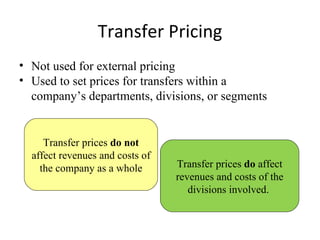
Transfer Pricing Not used for external pricing  Used to set prices for transfers within a company’s departments, divisions, or segments Transfer prices  do not  affect revenues and costs of the company as a whole Transfer prices  do  affect revenues and costs of the divisions involved.
Pricing for Internal Providers  of  Goods and Services Transfer pricing enables a business to assess both the internal and external profitability of its products or services
Methods of calculating transfer price The three methods of calculating transfer price that are used commonly are:  Cost-based pricing method  Negotiated pricing method  Market-Based Pricing Method
Cost Based Pricing How to define cost? Actual cost Standard cost Percentage of  cost Percentage of investment
Market Based Pricing Market Price Information Freedom to source Full Information Negotiation Constraints
Negotiated Transfer Price May be based on an agreement to use a cost plus a profit percentage Will be between the negotiation floor and the negotiation ceiling Negotiation floor: the selling division’s variable cost Negotiation ceiling-the market price This approach allows for cost recovery while still allowing the selling division to return a profit
Administration of TRANSFER PRICES  Implementing transfer pricing involves  Long negotiations between heads of various units Classification of products,  Arbitration conflict resolution in case conflicts arise.   
Transfer Pricing   in Multinational Settings Extremely difficult to set Tax systems Customs duties Freight and insurance costs Import/export regulations Foreign exchange controls Internal and external objectives of transfer differ May use different transfer prices for different countries; make certain of legality.
7.Measuring & Controlling Assets Prof.S.G.Patwardhan
Measuring & Controlling Assets Why long term investment is a strategic issue? Why long term investments is a control issue?
Characteristics of long-term assets Long-term assets (Building, Plant, Machinery, Information Technology) Long-term assets - an organization is committed for a long period of time. The lack of investment could cause opportunity losses or the investment could cause excess capacity. The investment amount is usually large.
Why relate profits to investments? Profits are generated ONLY if you have investments. Therefore, earning a satisfactory return on the investments employed is necessary. To compare two units, A and B, without considering the investment made in each is meaningless.
Responsibility Accounting Types of Responsibility Centers Cost center : only responsible for costs Revenue center : only responsible for revenues Profit center : responsible for both revenues and costs Investment center : responsible for revenues, costs, and investments
Measuring the Performance of Investment Centres Return on Investment (ROI) Residual Income (RI) Economic Value Added (EVA)
Accounting-Based Performance Measures Choose Performance Measures that align with top  management’s financial goals Choose the  time horizon  of each Performance Measure Choose a definition of the components in each Performance Measure Choose a  measurement alternative  for each Performance Measure Choose  a target  level of performance Choose  the timing of feedback
Effectiveness Degree to which a goal, objective, or target is met. Determined by process design Effectiveness vs Efficiency
Efficiency Degree to which inputs are used in relation to a given level of outputs. Determined by process design  and how the process operates Performance may be  effective, efficient, both, or neither. Effectiveness vs Efficiency
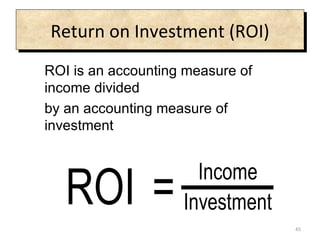
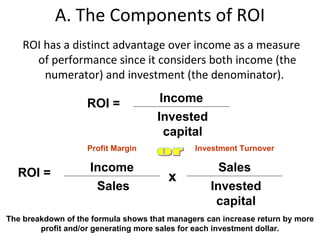
Return on Investment (ROI) ROI is an accounting measure of income divided  by an accounting measure of investment
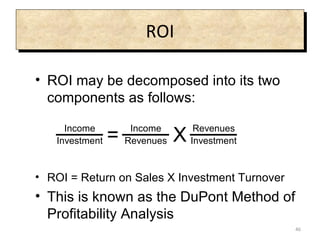
ROI ROI may be decomposed into its two components as follows: ROI = Return on Sales X Investment Turnover This is known as the DuPont Method of Profitability Analysis
A. The Components of ROI ROI has a distinct advantage over income as a measure of performance since it considers both income (the numerator) and investment (the denominator).  or The breakdown of the formula shows that managers can increase return by more profit and/or generating more sales for each investment dollar. ROI =  Income Invested capital ROI =  Income Sales x Sales Invested capital Profit Margin Investment Turnover
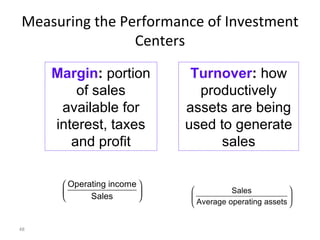
Measuring the Performance of Investment Centers Margin :   portion of sales available for interest, taxes and profit Turnover :   how productively assets are being used to generate sales
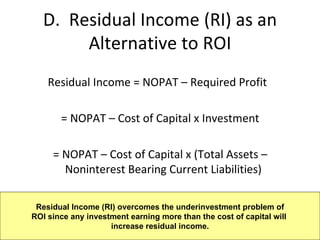
D.  Residual Income (RI) as an Alternative to ROI Residual Income = NOPAT – Required Profit = NOPAT – Cost of Capital x Investment = NOPAT – Cost of Capital x (Total Assets – Noninterest Bearing Current Liabilities) Residual Income (RI) overcomes the underinvestment problem of ROI since any investment earning more than the cost of capital will  increase residual income.
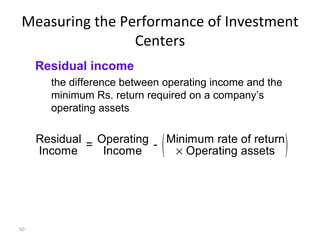
Measuring the Performance of Investment Centers Residual income the difference between operating income and the minimum Rs. return required on a company’s operating assets
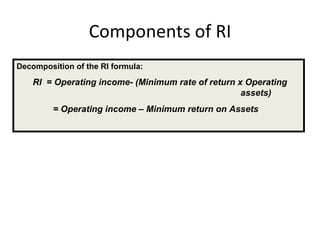
Components of RI Decomposition of the RI formula: RI  = Operating income- (Minimum rate of return x Operating  assets) = Operating income – Minimum return on Assets
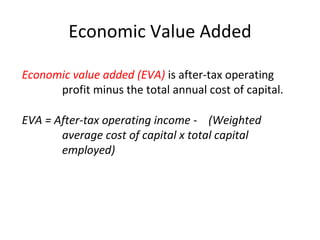
Economic Value Added Economic value added (EVA)  is after-tax operating profit minus the total annual cost of capital. EVA = After-tax operating income -  (Weighted average cost of capital x total capital employed)
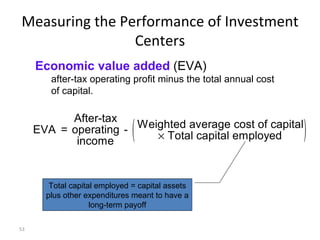
Measuring the Performance of Investment Centers Economic value added  (EVA) after-tax operating profit minus the total annual cost of capital. Total capital employed = capital assets plus other expenditures meant to have a long-term payoff
MVA Market Value Added (MVA) Difference between the market value of a corporation and capital contributed by shareholders and lenders.
Thank you !

Management Control System

  • 1.
    Management Control SystemAuthor: Manohar Prasad
  • 2.
    3. BEHAVIOR IN ORGANIZATION Learning outcomes GOALS & CONGRUENCE INFORMAL FACTORS THAT INFLUENCE GOAL CONGRUENCE FORMAL CONTROL SYSTEMS TYPES OF ORGANIZATIONS FUNCTIONS OF THE CONTROLLER
  • 3.
    Organization Structure Howtasks are divided, resources are deployed, and departments are coordinated Set of formal tasks Formal reporting relationships Effective coordination of employees across departments 11/21/11 0
  • 4.
    TYPES OF ORGANIZATIONSFUNCTIONAL ORGANIZATIONS BUSINESS UNIT ORGANIZATIONS MATRIX ORGANIZATIONS
  • 5.
    Five Approaches toStructural Design 11/21/11 0
  • 6.
    Five Approaches to Structural Design 11/21/11 0
  • 7.
    FUNCTIONS OF THECOTROLLER DESIGNING & OPERATING MCS FINANCIAL STATEMENTS & REPORTS TAX RETURNS PREPARATION AND ANALYSIS OF PERFORMANCE REPORTS
  • 8.
    FUNCTIONS OF THECONTROLLER(contd.) BUDGET PROPOSALS WITH ANALYSIS & JUSTIFICATION INTERNAL AUDITS FOR PREVENING FRAUD/THEFT DEVELOPING PEOPLE IN CONTROL FUNCTION BUSINESS UNIT CONTROLLER & CORPORATE CONTROLLER
  • 9.
    4. RESPONSIBILITYCENTERS Learning outcomes TYPES OF RESPOSIBILITY CENTERS COST/EXPENSE CENTERS REVENUE/PROFIT CENTERS INVESTMENT CENTERS MEASURES USED TO EVALUATE THEIR PERFORMANCES ROI, ROA, MVA
  • 10.
    THE CONTROLLER BUSINESSUNIT CONTROLLER CORPORATE CONTROLLER RELATIOSHIP BETWEEN BOTH DOTTED LINE SOLID LINE
  • 11.
    RESPONSIBILITY CENTRES RESPONSIBILITYCENTRES MANAGER RESPONSIBLE FOR ACTIVITIES UNIT WITHIN COMPANY
  • 12.
    RESPONSIBILITY CENTRES NATUREOF RESPONSIBILITY CENTRES OBJECTIVES INPUTS/WORK/OUTPUT RELATIONSHIP BETWEEN INPUT & OUTPUT
  • 13.
    RESPONSIBILITY CENTRES MEASURINGINPUTS & OUTPUTS PHYSICAL MEASUREMENT LIKE HRS, KGS TRANSLATED INTO MONETARY TERMS COST –MONETARY MEASURE OF RESOURCES USED BY RESPONSIBILITY CENTRE
  • 14.
    RESPONSIBILITY CENTRES EFFICIENCY& EFFECTIVENESS RATIO OF OUTPUT TO INPUT RATIO OF OUTPUT TO ITS OBJECTIVES EVERY RESPONSIBILITY CENTRE OUGHT TO BE BOTH EFFICIENT AND EFFECTIVE A RESONSIBILITY CENTRE IS EFFICIENT IF IT DOES THINGS RIGHT, AND IT IS EFFECTIVE IF IT DOES THE RIGHT THINGS
  • 15.
    TYPES OF RESPONSIBILITYCENTRES COST/EXPENSE CENRES TYPES ENGINEERED EXPENSE CENTRES b) DISCRETIONARY EXPENSE CENTRES
  • 16.
    TYPES OF RESPONSIBILITYCENTRES 2. REVENUE CENTRES OUTPUT IS MEASURED IN MONETARY TERMS NO FORMAL ATTEMPT TO RELATE TO INPUT
  • 17.
    Responsibility Accounting forProfit Centres Based on detailed information about both controllable revenues and controllable costs Manager controls operating revenues earned, such as sales, Manager controls all variable costs (and expenses) incurred by the centre because they vary with sales
  • 18.
    Profit Centre Shows budgeted and actual controllable revenues and costs Prepared using the cost-volume-profit income statement format: Deduct controllable fixed costs from the contribution margin Controllable margin - excess of contribution margin over controllable fixed costs – best measure of manager’s performance in controlling revenues and costs Do not report non-controllable fixed costs
  • 19.
    Advantages of ProfitCentre Speed of operating decisions Quality of decisions Unit level day to day decisions Corporate can concentrate on long term planning Freedom for unit managers, less dependence on head office Excellent training ground Profit consciousness among units Ready made infn on profitability of compny’s independent units Competitive performance
  • 20.
    Measuring Profitability Contributionmargin Direct profit Controllable profit Income before taxes Net income Revenues
  • 21.
    Investment Center Aninvestment center is a subunit that is responsible for generating revenue, controlling costs, and investing in assets. An investment center is charged with earning income consistent with the amount of assets invested in the segment. Most divisions of a company can be treated as either profit centers or investment centers.
  • 22.
    6. Transfer Pricing Learning outcomes Objectives and need of Transfer pricing Methods of Transfer Pricing Cost Based Market price based Negotiated price Administration of TRANSFER PRICES
  • 23.
    Need For TransferPricing Liberalization and Growth of multinationals More decentralization. Considerable autonomy Encourage them to perform well. Business units are supposed to work under the same organization Performance of business units.
  • 24.
    OBJECTIVES OF TRANSFERPRICES Proper distribution of revenue between profit centers. Resulting profit has to be shared between the profit centers. Providing relevant information to the profit centers Inducing goal-congruent decisions, -improve the profits of business units and also improve the profits of the company Measure the economic performance of profit centers Minimizing tax liability
  • 25.
    Goal Congruence Some of the prerequisites for achieving goal congruency are   Competent people Good organizational atmosphere Details of market prices Freedom to source Availability of information Scope for negotiation
  • 26.
    Transfer Price DefinedThe price that is used to value internal transfers of goods and services within the same company is known as the transfer price.
  • 27.
    Transfer Pricing The fundamental principle is that the transfer price should be similar to the price that would be charged if the product were sold to outside customers or purchased from outside vendors.
  • 28.
    Transfer Pricing Notused for external pricing Used to set prices for transfers within a company’s departments, divisions, or segments Transfer prices do not affect revenues and costs of the company as a whole Transfer prices do affect revenues and costs of the divisions involved.
  • 29.
    Pricing for InternalProviders of Goods and Services Transfer pricing enables a business to assess both the internal and external profitability of its products or services
  • 30.
    Methods of calculatingtransfer price The three methods of calculating transfer price that are used commonly are: Cost-based pricing method Negotiated pricing method Market-Based Pricing Method
  • 31.
    Cost Based PricingHow to define cost? Actual cost Standard cost Percentage of cost Percentage of investment
  • 32.
    Market Based PricingMarket Price Information Freedom to source Full Information Negotiation Constraints
  • 33.
    Negotiated Transfer PriceMay be based on an agreement to use a cost plus a profit percentage Will be between the negotiation floor and the negotiation ceiling Negotiation floor: the selling division’s variable cost Negotiation ceiling-the market price This approach allows for cost recovery while still allowing the selling division to return a profit
  • 34.
    Administration of TRANSFERPRICES Implementing transfer pricing involves Long negotiations between heads of various units Classification of products, Arbitration conflict resolution in case conflicts arise.  
  • 35.
    Transfer Pricing in Multinational Settings Extremely difficult to set Tax systems Customs duties Freight and insurance costs Import/export regulations Foreign exchange controls Internal and external objectives of transfer differ May use different transfer prices for different countries; make certain of legality.
  • 36.
    7.Measuring & ControllingAssets Prof.S.G.Patwardhan
  • 37.
    Measuring & ControllingAssets Why long term investment is a strategic issue? Why long term investments is a control issue?
  • 38.
    Characteristics of long-termassets Long-term assets (Building, Plant, Machinery, Information Technology) Long-term assets - an organization is committed for a long period of time. The lack of investment could cause opportunity losses or the investment could cause excess capacity. The investment amount is usually large.
  • 39.
    Why relate profitsto investments? Profits are generated ONLY if you have investments. Therefore, earning a satisfactory return on the investments employed is necessary. To compare two units, A and B, without considering the investment made in each is meaningless.
  • 40.
    Responsibility Accounting Typesof Responsibility Centers Cost center : only responsible for costs Revenue center : only responsible for revenues Profit center : responsible for both revenues and costs Investment center : responsible for revenues, costs, and investments
  • 41.
    Measuring the Performanceof Investment Centres Return on Investment (ROI) Residual Income (RI) Economic Value Added (EVA)
  • 42.
    Accounting-Based Performance MeasuresChoose Performance Measures that align with top management’s financial goals Choose the time horizon of each Performance Measure Choose a definition of the components in each Performance Measure Choose a measurement alternative for each Performance Measure Choose a target level of performance Choose the timing of feedback
  • 43.
    Effectiveness Degree towhich a goal, objective, or target is met. Determined by process design Effectiveness vs Efficiency
  • 44.
    Efficiency Degree towhich inputs are used in relation to a given level of outputs. Determined by process design and how the process operates Performance may be effective, efficient, both, or neither. Effectiveness vs Efficiency
  • 45.
    Return on Investment(ROI) ROI is an accounting measure of income divided by an accounting measure of investment
  • 46.
    ROI ROI maybe decomposed into its two components as follows: ROI = Return on Sales X Investment Turnover This is known as the DuPont Method of Profitability Analysis
  • 47.
    A. The Componentsof ROI ROI has a distinct advantage over income as a measure of performance since it considers both income (the numerator) and investment (the denominator). or The breakdown of the formula shows that managers can increase return by more profit and/or generating more sales for each investment dollar. ROI = Income Invested capital ROI = Income Sales x Sales Invested capital Profit Margin Investment Turnover
  • 48.
    Measuring the Performanceof Investment Centers Margin : portion of sales available for interest, taxes and profit Turnover : how productively assets are being used to generate sales
  • 49.
    D. ResidualIncome (RI) as an Alternative to ROI Residual Income = NOPAT – Required Profit = NOPAT – Cost of Capital x Investment = NOPAT – Cost of Capital x (Total Assets – Noninterest Bearing Current Liabilities) Residual Income (RI) overcomes the underinvestment problem of ROI since any investment earning more than the cost of capital will increase residual income.
  • 50.
    Measuring the Performanceof Investment Centers Residual income the difference between operating income and the minimum Rs. return required on a company’s operating assets
  • 51.
    Components of RIDecomposition of the RI formula: RI = Operating income- (Minimum rate of return x Operating assets) = Operating income – Minimum return on Assets
  • 52.
    Economic Value AddedEconomic value added (EVA) is after-tax operating profit minus the total annual cost of capital. EVA = After-tax operating income - (Weighted average cost of capital x total capital employed)
  • 53.
    Measuring the Performanceof Investment Centers Economic value added (EVA) after-tax operating profit minus the total annual cost of capital. Total capital employed = capital assets plus other expenditures meant to have a long-term payoff
  • 54.
    MVA Market ValueAdded (MVA) Difference between the market value of a corporation and capital contributed by shareholders and lenders.
  • 55.

Editor's Notes

  • #39 During the 1980s, GM embarked on an aggressive program involving the expenditure of billions of dollars to automate its assembly plants. In many cases, the modernization included the installation of advanced robotic technology. Many industry observers believed that most of the technologies that GM installed in its assembly plants were inflexible and inefficient putting it at a competitive disadvantage relative to its competitors.