CHAPTER 5
SOURCES AND METHODS OF DATA
COLLECTION
Contents
Introduction
Classifications of data
Sources of data
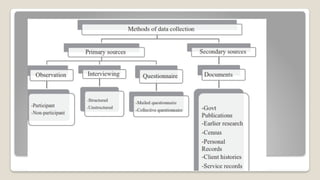
Methods of data collection
Data Vs Information
Data (singular datum)
◦ are the actual measurements or observations that result from
an investigation or survey or the values (response) of the
variable associated with an element of a population or a
sample.
◦ are data collected in an original form (not yet organized).
 Information
◦ is a set of data corresponding to a specific aspect of knowledge
combined in an organized way.
◦ It is a processed data to be used directly, and it can transfer
knowledge and meanings.
Classification of data
 Data can be classified based on different ways:
 Based on the type of variable
i) numerical (quantitative)
ii) categorical (qualitative).
 Based on Time frame
i) Cross-Sectional data- are data collected from a sample at the same or
approximately the same point in time.
ii) Time Series Data-are data collected over several time periods or at successive
points in time.
iii) Panel data(longitudinal) data: Data-are data collected over several time periods
or at successive points in time from a samples.
 Based on Source
i) Primary data
ii) Secondary data
Sources of data
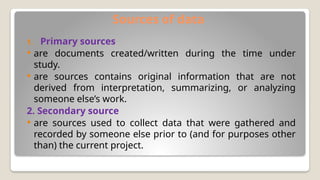
1. Primary sources
 are documents created/written during the time under
study.
 are sources contains original information that are not
derived from interpretation, summarizing, or analyzing
someone else’s work.
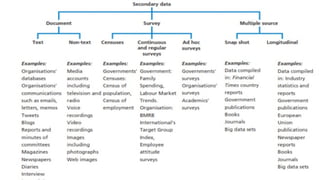
2. Secondary source
 are sources used to collect data that were gathered and
recorded by someone else prior to (and for purposes other
than) the current project.
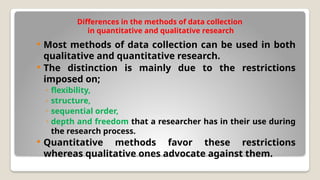
Differences in the methods of data collection
in quantitative and qualitative research
 Most methods of data collection can be used in both
qualitative and quantitative research.
 The distinction is mainly due to the restrictions
imposed on;
◦ flexibility,
◦ structure,
◦ sequential order,
◦ depth and freedom that a researcher has in their use during
the research process.
 Quantitative methods favor these restrictions
whereas qualitative ones advocate against them.
Questionnaire
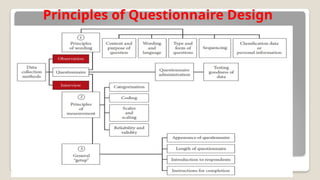
Principles of Questionnaire Design
Principles of wording
The principles of wording refer to such factors as:
1. The appropriateness of the content of the
questions.
2. How questions are worded and the level of
sophistication of the language used.
3. The type and form of questions asked.
4. The sequencing of the questions.
5. The personal data sought from the respondents.
1. Content and purpose of the questions
 The nature of the variable tapped-subjective feelings or
objective facts-will determine what kinds of questions are
asked.
 If the variables tapped are of a subjective nature (e.g.,
satisfaction, involvement), where respondents beliefs,
perceptions, and attitudes are to be measured, the questions
should tap the dimensions and elements of the concept.
 Where objective variables, such as age and educational levels of
respondents, are tapped, a single direct question- preferably
one that has an ordinal scaled set of categories-is appropriate.
 Thus, the purpose of each question should be carefully
considered so that the variables are adequately measured and
yet no superfluous questions are asked.
 The language of the questionnaire should approximate the level of
understanding of the respondents.
 The choice of words will depend on their educational level, the
usage of terms and idioms in the culture, and the frames of
reference of the respondents.
 it is essential to word the questions in a way that can be
understood by the respondent.
 If some questions are either not understood or are interpreted
differently by the respondent, the researcher will obtain the wrong
answers to the questions, and responses will thus be biased.
 Hence, the questions asked, the language used, and the wording
should be appropriate to tap respondents attitudes, perceptions,
and feelings.
2. Type and form of questions
 Open-ended versus closed questions- Open ended questions allow
respondents to answer them in any way they choose. A closed
question, in contrast, asks the respondents to make choices among
a set of alternatives given by the researcher.
 Positively and negatively worded questions- Instead of phrasing all
questions positively, it is advisable to include some negatively
worded questions as well, so the tendency in respondents to
mechanically circle the points toward one end of the scale is
minimized.
 Double-barreled questions- A question that lends itself to different
possible responses to its subparts (e.g. Do you think there is a good
market for the product and that it will sell well?).
 Ambiguous questions- questions that are ambiguously worded and
the respondent may not be sure what exactly they mean.
Contd.
 Leading questions- Questions should not be phrased in such a
way that they lead the respondents to give the responses that
the researcher would like them to give.
◦ By asking a leading question, we are signaling and pressuring respondents
to say-yes.
e.g. Don’t you think that in these days of escalating costs of living,
employees should be given good pay rises?
To what extent do you agree that employees should be given higher pay
rises? ・
 Loaded questions- Another type of bias in questions occurs
when they are phrased in an emotionally charged manner.
◦ E.g. To what extent do you think management is likely to be nasty if the
union decides to go on strike?
◦ The words strike and nasty are emotionally charged terms, polarizing
management and unions.
Contd.
 Social desirability- Questions should not be worded
such that they elicit socially desirable responses.
◦ E.g. Do you think that older people should be laid off ?
◦ This would elicit a response of no, mainly because society
would frown on a person who said that elderly people should
be fired even if they are capable of performing their jobs
satisfactorily.
 Length of questions- simple, short questions are
preferable to long ones. As a rule of thumb, a question
or a statement in the questionnaire should not exceed
20 words, or exceed one full line in print.
3. Sequencing of questions
 The sequence of questions in the questionnaire should be such
that the respondent is led from questions of a general nature
to those that are more specific, and from questions that are
relatively easy to answer to those that are progressively more
difficult.
 it is advisable not to place contiguously a positively worded
and a negatively worded question tapping the same element or
dimension of a concept. For instance, placing two questions
Such as the following, one immediately After the other, is not
only Awkward but might also seem insulting to the respondent.
◦ E.g. I have opportunities to interact with my colleagues during work
hours.
◦ I have few opportunities to interact with my colleagues during work
hours.
Contd.
 First, there is no need to ask the very same question in
both a positive and a negative way. Second, to check the
consistency of the responses), the two questions should
be placed in different parts of the questionnaire, as far
apart as possible.
4. Classification data or personal information
 Classification data, also known as personal information or
demographic questions, elicit such information as age,
educational level, marital status, and income.
 Unless absolutely necessary, it is best not to ask for the name of
the respondent. If, however, the questionnaire has to be
identified with the respondents for any reason, then the
questionnaire can be numbered and connected by the researcher
to the respondent’s name, in a separately maintained, private
document.
 This procedure should be clearly explained to the respondent.
The reason for using the numerical system in questionnaires is to
ensure the anonymity of the respondent.
 Whether questions seeking personal information should appear
at the beginning or at the end of the questionnaire is a matter of
choice for the researcher.
General appearance or “getup” of the questionnaire
 it is necessary to pay attention to how the questionnaire looks.
 An attractive and neat questionnaire with appropriate introduction,
instructions, and well-arrayed set of questions and response
alternatives will make it easier for the respondents to answer them.
 A good introduction, well-organized instructions, and neat alignment
of the questions are all important.
 A good introduction-
◦ A proper introduction that clearly discloses the identity of the researcher
and conveys the purpose of the survey is absolutely necessary. It is also
essential to establish some rapport with the respondents and motivate them to
respond to the questions in the questionnaire wholeheartedly and
enthusiastically.
◦ Assurance of confidentiality of the information provided by them will allow for
less biased answers.
◦ The introduction section should end on a courteous note, thanking the
respondent for taking the time to respond to the survey.
Contd.
 Organizing questions, giving instructions and
guidance, and good alignment
◦ Organizing the questions logically and neatly in
appropriate sections and providing instructions on how to
complete the items in each section will help the
respondents to answer them without difficulty.
◦ Questions should also be neatly aligned in a way that
allows the respondent to complete the task of reading and
answering the questionnaire by expending the least time
and effort and without straining the eyes.
Contd.
 Information on income and other sensitive personal data
◦ Although demographic information can be sought either at the
beginning or at the end of the questionnaire, information of a very
private and personal nature such as income, state of health, and so
on, if considered at all necessary for the survey, should be asked at
the end of the questionnaire, rather than the beginning.
◦ Also, such questions should be justified by explaining how this
information might contribute to knowledge and problem solving, so
that respondents do not perceive them to be of an intrusive or
prying nature.
◦ Postponing such questions to the end will help reduce respondent
bias if the individual is vexed by the personal nature of the question.
Contd.
 Open-ended question at the end
◦ The questionnaire could include an open-ended question
at the end, allowing respondents to comment on any
aspect they choose.
◦ It should end with an expression of sincere thanks to
respondents.
 Concluding the questionnaire
◦ The questionnaire should end on a courteous note,
reminding the respondent to check that all the items have
been completed,
Advantages Vs Disadvantages of questionnaires
Advantages
◦ Large amounts of information can be collected from group of people in cost effective way.
◦ Can be carried out by the researcher or by any number of people with limited affect to its validity and reliability.
◦ Quick and easy quantification of the results can be done by either a researcher or through the use of software.
◦ Scientific and objective analysis can be done effectively compared to other forms of research.
Disadvantages
◦ The response rate is very less due to low literacy rate or lack of interest in the research topic
◦ It is criticized to be inadequate to recognize some forms of information–, that is, changes of
emotions, behavior, feelings, and so on
◦ Gives only a limited amount of information without any explanation of it.
◦ Truthfulness of a respondent is difficult to measure.
Observation
What is Observation?
 concerns the planned watching, recording, analysis, and
interpretation of behavior, actions, or events.
 involves going into the field, the factory, the
supermarket, the waiting room, the office, or the trading
room watching what workers, consumers, or day traders
do, and describing, analyzing, and interpreting what one
has seen.
 Observational methods are best suited for research
requiring non-self-report descriptive data; that is, when
behavior is to be examined without directly asking the
respondents themselves.
FOUR KEY DIMENSIONS THAT CHARACTERIZE THE
TYPE OF OBSERVATION
 Controlled versus uncontrolled
observational studies
 Participant and non-participant
observational studies
 Concealment Vs Unconcealed observation
Contd.
 Controlled observation occurs when observational research is
carried out under carefully arranged conditions.
◦ The exposure of subjects (for instance, consumers, employees,
or investors) to a certain situation or condition (for instance a
specific store layout, specific labor conditions, or a certain
amount of time pressure) allows the researcher to observe
differences between individual behavioral reactions to the
situation.
◦ May be carried out in a laboratory (for instance, a simulated
store environment or trading room) or in the field (for
instance, a store).
Contd.
 Uncontrolled observation
◦ is an observational technique that makes no attempt to
control, manipulate, or influence the situation.
◦ Events are running their natural course and the researcher
observes these events without interfering in the real-life
setting.
Participant Vs Non-participant Observation
 Nonparticipant observation,
◦ the researcher is never directly involved in the actions of
the actors, but observes them from outside the actors
visual horizon, for instance via a one-way mirror or a
camera.
 Participant observation
◦ is an approach that has frequently been used in case
studies, ethnographic studies, and grounded theory
studies.
◦ the researcher gathers data by participating in the daily
life of the group or organization under study.
Concealment Vs Unconcealed observation
 Concealment of observation
◦ relates to whether the members of the social group under study
are told that they are being investigated.
◦ Advantage- the research subjects are not influenced by the
awareness that they are being observed.
◦ Indeed, reactivity or the extent to which the observer
affects the situation under observation could be a major
threat to the validity of the results of observational
studies.
 Unconcealed observation:
◦ is more obtrusive, perhaps upsetting the authenticity of the
behavior under study.
Features of observation
 It is an eye affair - In observation maximum stress is on eye.
 Definite aim - Observation without aim will be just useless,
purposeless and meaningless.
 Planning - the observer should go to the field with proper
planning.
 Direct method of study - is a method under which the
investigator is personally required to go to the field and
personally observe the situation and objects with his own eyes.
Advantage and disadvantages of Observation
 Advantages
◦ Subjective bias can be eliminated
◦ Data is unaffected by past behavior or future intentions
◦ Natural behavior of group is allowed to record
 Disadvantages
◦ Gives limited amount of information
◦ Unseen factors can affect the observation task
Interviews
WHAT IS AN INTERVIEW
 An interview is a guided, purposeful conversation between
two or more people.
 Individual or group interviews may be unstructured or
structured.
 Unstructured interviews
◦ the interviewer does not enter the interview setting with
a planned sequence of questions to be asked of the
respondent.
◦ A possible objective of an unstructured interview is to
bring some preliminary issues to the surface so that the
researcher can determine what factors need further in-
depth investigation.
Unstructured interview
 the interviewer develops a framework, called an interview
guide(which contain a list of points or topics which must be covered
during the interview), within which to conduct the interview.
 the interviewer formulates questions spontaneously during an
interview.
– Exploratory , Qualitative research
– Open-ended questions
– Ranges from an agenda of questions to an open conversation
 Features of Unstructured interview:
 does not follow strict procedure
 gives opportunity for the free flow of information between the
interviewer, and interviewee.
Structured Interviews
◦ Conducted when it is known at the outset what information is
needed.
◦ the interviewer carefully prepared questions/ schedules/ in advance
to obtain information pertinent to the research problem.
– Includes mainly closed ended questions and used for quantitative
research
◦ The content of a structured interview can be prepared in advance,
and usually consists of;
 an introduction: the interviewer introduces him- or herself, the purpose of the
interview, assures confidentiality, asks permission to record the interview;
 a set of topics (usually questions); in a logical order: first warm-up questions
(which are easy to answer and; non-threatening) and then the main questions
covering the purpose of the interview;
 suggestions for probing questions; follow-up questions that are used when the
first answer is unclear or incomplete,
Semi-structured interviews
– Qualitative or mixed research
– Open and close-ended questions
Features of structured interview
 Follows strict procedures
 Allows no adjustment of contents, wording or order of
questions.
 Usually involves a pre-arranged schedule of questions
 Includes items that are short, direct and commands
immediate responses
 Allows for easy analysis of data.
Advantage and disadvantages of Interviews
 Advantages
◦ allows the researcher to gather information from illiterate
humankind
◦ As interviewer collects data personally there are nil chances of
non-response(higher response rate)
◦ As interviewer tactfully collects the data by cross examining the
responders hence collected data is very reliable
 Disadvantages
◦ It has chances of bias
◦ The informants may avoid answering few personal questions
◦ The process is time-consuming.
◦ Requirements of money and manpower are very high.
Guidelines for interview
 Ask only one question at a time.
 Try to make sure that the respondents understand the
question.
 Listen carefully to the respondents answers. i.e., listen more,
talk less.
 Observe the respondents facial expression, gestures and tone
of voice.
 Allow the respondents sufficient time to answer the questions.
 Don’t interrupt, learn how to wait.
 Keep participants focused and ask for concrete details.
 Do not show signs of surprise, shock, anger, or other emotions
if unexpected answers are given.
Focus Group Discussion (FGD)
• is a discussion made by a panel of 6 - 12 respondents led
by a trained moderator/ facilitator.
• The moderator should ensure the discussion is “focused
“on some general area of interest and ensure that every
person has an opportunity to respond.
• It is an open ended interview conducted by one or more
interviewers with small group of individuals who are
directly or indirectly influence by the subject study.
• allow deeper examination of complex issues than other
forms of survey research, because when people hear
others talk, it often triggers responses or ideas that they
did not think about before.
• Clearly, recording proceedings is a good idea either by
- an audio recorder or
Advantages and Disadvantages of FGD
Advantages of FGD
 Speed-since a number of individuals are being interviewed at the same time data collection
is relatively quick.
 Snowballing- one person’s comment triggers a chain reaction from the other participants.
 allow people to discuss their true feelings, anxieties, and frustrations, etc., in their own
words.
limitations/ disadvantages of FGD
 Messy- the unstructured nature of the responses makes coding, analysis, and interpretation
difficult
 Not used for quantitative purposes, such as testing hypothesis and generalizations of
findings
 Shyness-In case of very sensitive topics such as sexual behavior or coping with
HIV/AIDs, group members may hesitate to air their feelings and experiences freely.
 one or two people may dominate the discussion.
…………………. // ……………………
Secondary sources
 Books Of Research Studies,
 Encyclopedias,
 Referred International Journal Articles,
 Handbooks,
 Abstracts, And ‘Grey Literature’ (Which Includes Reports,
Theses And Dissertations, Conference Proceedings, Research
In Progress, Leaflets and Posters, Media Reports, Patents,
Letters, And Diaries),
 Government Reports,
 Magazines,
 Books and Periodicals,
 Organizational Reports,
 Verbatim Transcripts,
cont’d
 These documents can be obtained from web
services like
◦ Web of Knowledge,
◦ SCOPUS,
◦ Inspire,
◦ MEDLINE,
◦ EThOS,
◦ Google Scholar,
◦ Educational Resources Information Center
(ERIC), and
◦ Microsoft Academic Research.
Thank you

Chapter five - managerial accounting .pptx

  • 1.
    CHAPTER 5 SOURCES ANDMETHODS OF DATA COLLECTION
  • 2.
  • 3.
    Data Vs Information Data(singular datum) ◦ are the actual measurements or observations that result from an investigation or survey or the values (response) of the variable associated with an element of a population or a sample. ◦ are data collected in an original form (not yet organized).  Information ◦ is a set of data corresponding to a specific aspect of knowledge combined in an organized way. ◦ It is a processed data to be used directly, and it can transfer knowledge and meanings.
  • 4.
    Classification of data Data can be classified based on different ways:  Based on the type of variable i) numerical (quantitative) ii) categorical (qualitative).  Based on Time frame i) Cross-Sectional data- are data collected from a sample at the same or approximately the same point in time. ii) Time Series Data-are data collected over several time periods or at successive points in time. iii) Panel data(longitudinal) data: Data-are data collected over several time periods or at successive points in time from a samples.  Based on Source i) Primary data ii) Secondary data
  • 5.
    Sources of data 1.Primary sources  are documents created/written during the time under study.  are sources contains original information that are not derived from interpretation, summarizing, or analyzing someone else’s work. 2. Secondary source  are sources used to collect data that were gathered and recorded by someone else prior to (and for purposes other than) the current project.
  • 7.
    Differences in themethods of data collection in quantitative and qualitative research  Most methods of data collection can be used in both qualitative and quantitative research.  The distinction is mainly due to the restrictions imposed on; ◦ flexibility, ◦ structure, ◦ sequential order, ◦ depth and freedom that a researcher has in their use during the research process.  Quantitative methods favor these restrictions whereas qualitative ones advocate against them.
  • 9.
  • 10.
  • 11.
    Principles of wording Theprinciples of wording refer to such factors as: 1. The appropriateness of the content of the questions. 2. How questions are worded and the level of sophistication of the language used. 3. The type and form of questions asked. 4. The sequencing of the questions. 5. The personal data sought from the respondents.
  • 12.
    1. Content andpurpose of the questions  The nature of the variable tapped-subjective feelings or objective facts-will determine what kinds of questions are asked.  If the variables tapped are of a subjective nature (e.g., satisfaction, involvement), where respondents beliefs, perceptions, and attitudes are to be measured, the questions should tap the dimensions and elements of the concept.  Where objective variables, such as age and educational levels of respondents, are tapped, a single direct question- preferably one that has an ordinal scaled set of categories-is appropriate.  Thus, the purpose of each question should be carefully considered so that the variables are adequately measured and yet no superfluous questions are asked.
  • 13.
     The languageof the questionnaire should approximate the level of understanding of the respondents.  The choice of words will depend on their educational level, the usage of terms and idioms in the culture, and the frames of reference of the respondents.  it is essential to word the questions in a way that can be understood by the respondent.  If some questions are either not understood or are interpreted differently by the respondent, the researcher will obtain the wrong answers to the questions, and responses will thus be biased.  Hence, the questions asked, the language used, and the wording should be appropriate to tap respondents attitudes, perceptions, and feelings.
  • 14.
    2. Type andform of questions  Open-ended versus closed questions- Open ended questions allow respondents to answer them in any way they choose. A closed question, in contrast, asks the respondents to make choices among a set of alternatives given by the researcher.  Positively and negatively worded questions- Instead of phrasing all questions positively, it is advisable to include some negatively worded questions as well, so the tendency in respondents to mechanically circle the points toward one end of the scale is minimized.  Double-barreled questions- A question that lends itself to different possible responses to its subparts (e.g. Do you think there is a good market for the product and that it will sell well?).  Ambiguous questions- questions that are ambiguously worded and the respondent may not be sure what exactly they mean.
  • 15.
    Contd.  Leading questions-Questions should not be phrased in such a way that they lead the respondents to give the responses that the researcher would like them to give. ◦ By asking a leading question, we are signaling and pressuring respondents to say-yes. e.g. Don’t you think that in these days of escalating costs of living, employees should be given good pay rises? To what extent do you agree that employees should be given higher pay rises? ・  Loaded questions- Another type of bias in questions occurs when they are phrased in an emotionally charged manner. ◦ E.g. To what extent do you think management is likely to be nasty if the union decides to go on strike? ◦ The words strike and nasty are emotionally charged terms, polarizing management and unions.
  • 16.
    Contd.  Social desirability-Questions should not be worded such that they elicit socially desirable responses. ◦ E.g. Do you think that older people should be laid off ? ◦ This would elicit a response of no, mainly because society would frown on a person who said that elderly people should be fired even if they are capable of performing their jobs satisfactorily.  Length of questions- simple, short questions are preferable to long ones. As a rule of thumb, a question or a statement in the questionnaire should not exceed 20 words, or exceed one full line in print.
  • 17.
    3. Sequencing ofquestions  The sequence of questions in the questionnaire should be such that the respondent is led from questions of a general nature to those that are more specific, and from questions that are relatively easy to answer to those that are progressively more difficult.  it is advisable not to place contiguously a positively worded and a negatively worded question tapping the same element or dimension of a concept. For instance, placing two questions Such as the following, one immediately After the other, is not only Awkward but might also seem insulting to the respondent. ◦ E.g. I have opportunities to interact with my colleagues during work hours. ◦ I have few opportunities to interact with my colleagues during work hours.
  • 18.
    Contd.  First, thereis no need to ask the very same question in both a positive and a negative way. Second, to check the consistency of the responses), the two questions should be placed in different parts of the questionnaire, as far apart as possible.
  • 19.
    4. Classification dataor personal information  Classification data, also known as personal information or demographic questions, elicit such information as age, educational level, marital status, and income.  Unless absolutely necessary, it is best not to ask for the name of the respondent. If, however, the questionnaire has to be identified with the respondents for any reason, then the questionnaire can be numbered and connected by the researcher to the respondent’s name, in a separately maintained, private document.  This procedure should be clearly explained to the respondent. The reason for using the numerical system in questionnaires is to ensure the anonymity of the respondent.  Whether questions seeking personal information should appear at the beginning or at the end of the questionnaire is a matter of choice for the researcher.
  • 20.
    General appearance or“getup” of the questionnaire  it is necessary to pay attention to how the questionnaire looks.  An attractive and neat questionnaire with appropriate introduction, instructions, and well-arrayed set of questions and response alternatives will make it easier for the respondents to answer them.  A good introduction, well-organized instructions, and neat alignment of the questions are all important.  A good introduction- ◦ A proper introduction that clearly discloses the identity of the researcher and conveys the purpose of the survey is absolutely necessary. It is also essential to establish some rapport with the respondents and motivate them to respond to the questions in the questionnaire wholeheartedly and enthusiastically. ◦ Assurance of confidentiality of the information provided by them will allow for less biased answers. ◦ The introduction section should end on a courteous note, thanking the respondent for taking the time to respond to the survey.
  • 21.
    Contd.  Organizing questions,giving instructions and guidance, and good alignment ◦ Organizing the questions logically and neatly in appropriate sections and providing instructions on how to complete the items in each section will help the respondents to answer them without difficulty. ◦ Questions should also be neatly aligned in a way that allows the respondent to complete the task of reading and answering the questionnaire by expending the least time and effort and without straining the eyes.
  • 22.
    Contd.  Information onincome and other sensitive personal data ◦ Although demographic information can be sought either at the beginning or at the end of the questionnaire, information of a very private and personal nature such as income, state of health, and so on, if considered at all necessary for the survey, should be asked at the end of the questionnaire, rather than the beginning. ◦ Also, such questions should be justified by explaining how this information might contribute to knowledge and problem solving, so that respondents do not perceive them to be of an intrusive or prying nature. ◦ Postponing such questions to the end will help reduce respondent bias if the individual is vexed by the personal nature of the question.
  • 23.
    Contd.  Open-ended questionat the end ◦ The questionnaire could include an open-ended question at the end, allowing respondents to comment on any aspect they choose. ◦ It should end with an expression of sincere thanks to respondents.  Concluding the questionnaire ◦ The questionnaire should end on a courteous note, reminding the respondent to check that all the items have been completed,
  • 24.
    Advantages Vs Disadvantagesof questionnaires Advantages ◦ Large amounts of information can be collected from group of people in cost effective way. ◦ Can be carried out by the researcher or by any number of people with limited affect to its validity and reliability. ◦ Quick and easy quantification of the results can be done by either a researcher or through the use of software. ◦ Scientific and objective analysis can be done effectively compared to other forms of research. Disadvantages ◦ The response rate is very less due to low literacy rate or lack of interest in the research topic ◦ It is criticized to be inadequate to recognize some forms of information–, that is, changes of emotions, behavior, feelings, and so on ◦ Gives only a limited amount of information without any explanation of it. ◦ Truthfulness of a respondent is difficult to measure.
  • 25.
  • 26.
    What is Observation? concerns the planned watching, recording, analysis, and interpretation of behavior, actions, or events.  involves going into the field, the factory, the supermarket, the waiting room, the office, or the trading room watching what workers, consumers, or day traders do, and describing, analyzing, and interpreting what one has seen.  Observational methods are best suited for research requiring non-self-report descriptive data; that is, when behavior is to be examined without directly asking the respondents themselves.
  • 27.
    FOUR KEY DIMENSIONSTHAT CHARACTERIZE THE TYPE OF OBSERVATION  Controlled versus uncontrolled observational studies  Participant and non-participant observational studies  Concealment Vs Unconcealed observation
  • 28.
    Contd.  Controlled observationoccurs when observational research is carried out under carefully arranged conditions. ◦ The exposure of subjects (for instance, consumers, employees, or investors) to a certain situation or condition (for instance a specific store layout, specific labor conditions, or a certain amount of time pressure) allows the researcher to observe differences between individual behavioral reactions to the situation. ◦ May be carried out in a laboratory (for instance, a simulated store environment or trading room) or in the field (for instance, a store).
  • 29.
    Contd.  Uncontrolled observation ◦is an observational technique that makes no attempt to control, manipulate, or influence the situation. ◦ Events are running their natural course and the researcher observes these events without interfering in the real-life setting.
  • 30.
    Participant Vs Non-participantObservation  Nonparticipant observation, ◦ the researcher is never directly involved in the actions of the actors, but observes them from outside the actors visual horizon, for instance via a one-way mirror or a camera.  Participant observation ◦ is an approach that has frequently been used in case studies, ethnographic studies, and grounded theory studies. ◦ the researcher gathers data by participating in the daily life of the group or organization under study.
  • 31.
    Concealment Vs Unconcealedobservation  Concealment of observation ◦ relates to whether the members of the social group under study are told that they are being investigated. ◦ Advantage- the research subjects are not influenced by the awareness that they are being observed. ◦ Indeed, reactivity or the extent to which the observer affects the situation under observation could be a major threat to the validity of the results of observational studies.  Unconcealed observation: ◦ is more obtrusive, perhaps upsetting the authenticity of the behavior under study.
  • 32.
    Features of observation It is an eye affair - In observation maximum stress is on eye.  Definite aim - Observation without aim will be just useless, purposeless and meaningless.  Planning - the observer should go to the field with proper planning.  Direct method of study - is a method under which the investigator is personally required to go to the field and personally observe the situation and objects with his own eyes.
  • 33.
    Advantage and disadvantagesof Observation  Advantages ◦ Subjective bias can be eliminated ◦ Data is unaffected by past behavior or future intentions ◦ Natural behavior of group is allowed to record  Disadvantages ◦ Gives limited amount of information ◦ Unseen factors can affect the observation task
  • 34.
  • 35.
    WHAT IS ANINTERVIEW  An interview is a guided, purposeful conversation between two or more people.  Individual or group interviews may be unstructured or structured.  Unstructured interviews ◦ the interviewer does not enter the interview setting with a planned sequence of questions to be asked of the respondent. ◦ A possible objective of an unstructured interview is to bring some preliminary issues to the surface so that the researcher can determine what factors need further in- depth investigation.
  • 36.
    Unstructured interview  theinterviewer develops a framework, called an interview guide(which contain a list of points or topics which must be covered during the interview), within which to conduct the interview.  the interviewer formulates questions spontaneously during an interview. – Exploratory , Qualitative research – Open-ended questions – Ranges from an agenda of questions to an open conversation  Features of Unstructured interview:  does not follow strict procedure  gives opportunity for the free flow of information between the interviewer, and interviewee.
  • 37.
    Structured Interviews ◦ Conductedwhen it is known at the outset what information is needed. ◦ the interviewer carefully prepared questions/ schedules/ in advance to obtain information pertinent to the research problem. – Includes mainly closed ended questions and used for quantitative research ◦ The content of a structured interview can be prepared in advance, and usually consists of;  an introduction: the interviewer introduces him- or herself, the purpose of the interview, assures confidentiality, asks permission to record the interview;  a set of topics (usually questions); in a logical order: first warm-up questions (which are easy to answer and; non-threatening) and then the main questions covering the purpose of the interview;  suggestions for probing questions; follow-up questions that are used when the first answer is unclear or incomplete,
  • 38.
    Semi-structured interviews – Qualitativeor mixed research – Open and close-ended questions
  • 39.
    Features of structuredinterview  Follows strict procedures  Allows no adjustment of contents, wording or order of questions.  Usually involves a pre-arranged schedule of questions  Includes items that are short, direct and commands immediate responses  Allows for easy analysis of data.
  • 40.
    Advantage and disadvantagesof Interviews  Advantages ◦ allows the researcher to gather information from illiterate humankind ◦ As interviewer collects data personally there are nil chances of non-response(higher response rate) ◦ As interviewer tactfully collects the data by cross examining the responders hence collected data is very reliable  Disadvantages ◦ It has chances of bias ◦ The informants may avoid answering few personal questions ◦ The process is time-consuming. ◦ Requirements of money and manpower are very high.
  • 41.
    Guidelines for interview Ask only one question at a time.  Try to make sure that the respondents understand the question.  Listen carefully to the respondents answers. i.e., listen more, talk less.  Observe the respondents facial expression, gestures and tone of voice.  Allow the respondents sufficient time to answer the questions.  Don’t interrupt, learn how to wait.  Keep participants focused and ask for concrete details.  Do not show signs of surprise, shock, anger, or other emotions if unexpected answers are given.
  • 42.
    Focus Group Discussion(FGD) • is a discussion made by a panel of 6 - 12 respondents led by a trained moderator/ facilitator. • The moderator should ensure the discussion is “focused “on some general area of interest and ensure that every person has an opportunity to respond. • It is an open ended interview conducted by one or more interviewers with small group of individuals who are directly or indirectly influence by the subject study. • allow deeper examination of complex issues than other forms of survey research, because when people hear others talk, it often triggers responses or ideas that they did not think about before. • Clearly, recording proceedings is a good idea either by - an audio recorder or
  • 43.
    Advantages and Disadvantagesof FGD Advantages of FGD  Speed-since a number of individuals are being interviewed at the same time data collection is relatively quick.  Snowballing- one person’s comment triggers a chain reaction from the other participants.  allow people to discuss their true feelings, anxieties, and frustrations, etc., in their own words. limitations/ disadvantages of FGD  Messy- the unstructured nature of the responses makes coding, analysis, and interpretation difficult  Not used for quantitative purposes, such as testing hypothesis and generalizations of findings  Shyness-In case of very sensitive topics such as sexual behavior or coping with HIV/AIDs, group members may hesitate to air their feelings and experiences freely.  one or two people may dominate the discussion. …………………. // ……………………
  • 44.
    Secondary sources  BooksOf Research Studies,  Encyclopedias,  Referred International Journal Articles,  Handbooks,  Abstracts, And ‘Grey Literature’ (Which Includes Reports, Theses And Dissertations, Conference Proceedings, Research In Progress, Leaflets and Posters, Media Reports, Patents, Letters, And Diaries),  Government Reports,  Magazines,  Books and Periodicals,  Organizational Reports,  Verbatim Transcripts,
  • 45.
    cont’d  These documentscan be obtained from web services like ◦ Web of Knowledge, ◦ SCOPUS, ◦ Inspire, ◦ MEDLINE, ◦ EThOS, ◦ Google Scholar, ◦ Educational Resources Information Center (ERIC), and ◦ Microsoft Academic Research.
  • 46.