6
 Dr. Shahzad Ahmad Khan
 Assistant Professor
 In-charge Undergraduate (FMS)
 Email: shahzad.ahmad@riphah.edu.pk
Riphah School of Leadership
Faculty of Management Sciences
Riphah International University
Islamabad
CHAPTER :6
Analyzing Consumer Markets
Chapter Questions
• How do consumer characteristics
influence buying behavior?
• What major psychological processes
influence consumer responses to the
marketing program?
• How do consumers make purchasing
decisions?
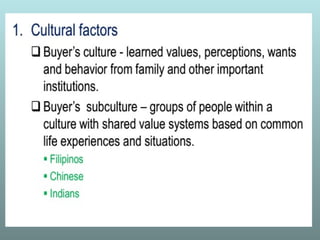
What is Culture?
Culture is the fundamental determinant
of a person’s wants and behaviors
acquired through socialization
processes with family and other key
institutions.
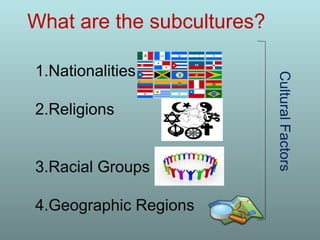
What are the subcultures?
1.Nationalities
2.Religions
3.Racial Groups
4.Geographic Regions
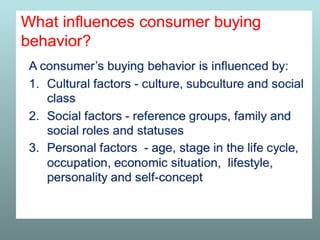
CulturalFactors
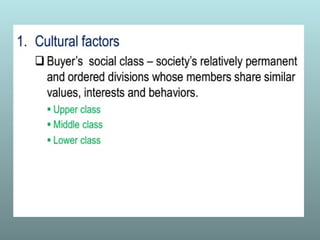
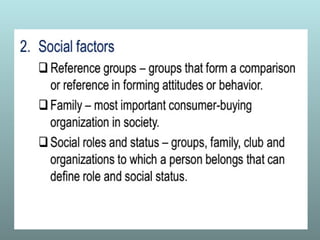
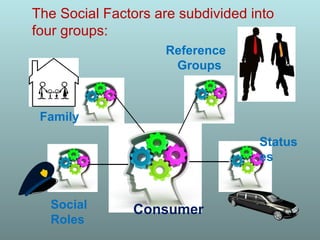
The Social Factors are subdivided into
four groups:
Consumer
Family
Status
es
Reference
Groups
Social
Roles
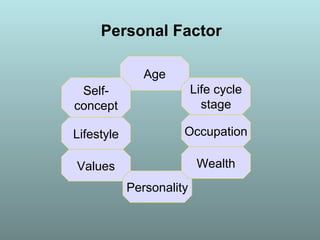
Personal Factor
Age
Values
Life cycle
stage
Occupation
Personality
Self-
concept
Wealth
Lifestyle
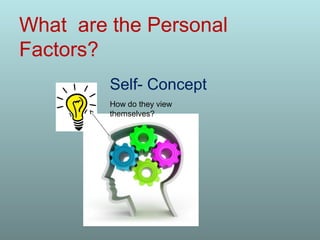
What are the Personal
Factors?
Self- Concept
How do they view
themselves?
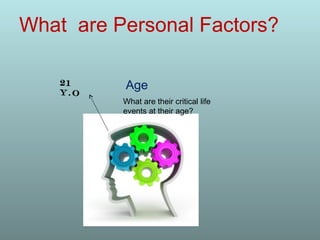
What are Personal Factors?
21
y.o
Age
What are their critical life
events at their age?
What are Personal Factors?
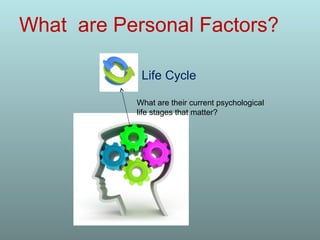
What are their current psychological
life stages that matter?
Life Cycle
What are Personal Factors?
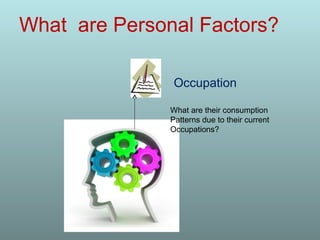
What are their consumption
Patterns due to their current
Occupations?
Occupation
What are Personal Factors?
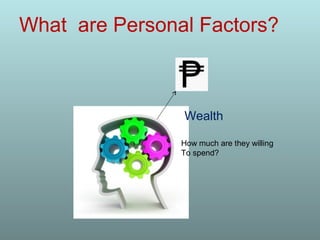
How much are they willing
To spend?
Wealth
What are Personal Factors?
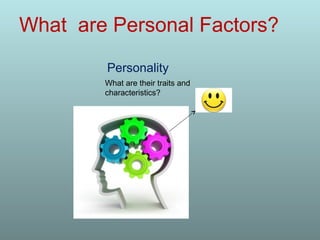
What are their traits and
characteristics?
Personality
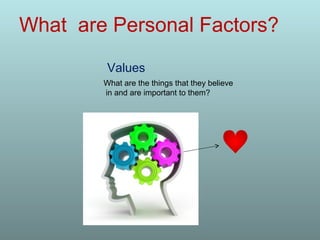
What are Personal Factors?
What are the things that they believe
in and are important to them?
Values
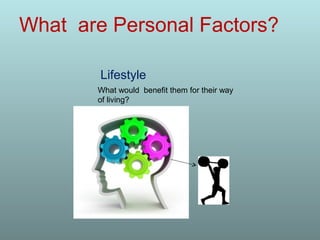
What are Personal Factors?
What would benefit them for their way
of living?
Lifestyle
21
y
.
o
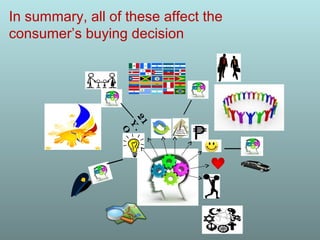
In summary, all of these affect the
consumer’s buying decision
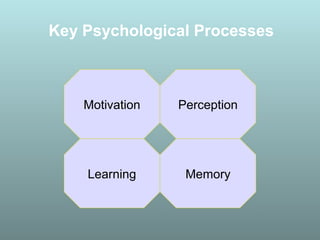
Key Psychological Processes
Motivation
MemoryLearning
Perception
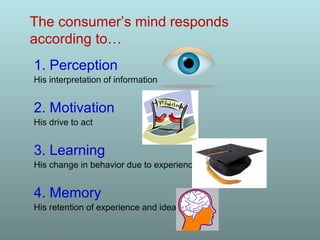
The consumer’s mind responds
according to…
1. Perception
His interpretation of information
2. Motivation
His drive to act
3. Learning
His change in behavior due to experience
4. Memory
His retention of experience and ideas
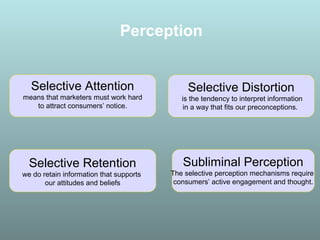
Perception
Selective Attention
means that marketers must work hard
to attract consumers’ notice.
Subliminal Perception
The selective perception mechanisms require
consumers’ active engagement and thought.
Selective Retention
we do retain information that supports
our attitudes and beliefs
Selective Distortion
is the tendency to interpret information
in a way that fits our preconceptions.
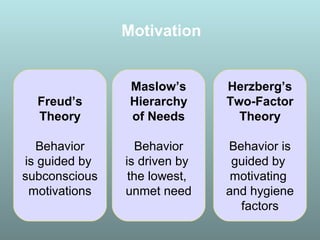
Motivation
Freud’s
Theory
Behavior
is guided by
subconscious
motivations
Maslow’s
Hierarchy
of Needs
Behavior
is driven by
the lowest,
unmet need
Herzberg’s
Two-Factor
Theory
Behavior is
guided by
motivating
and hygiene
factors
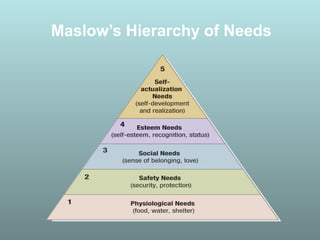
Maslow’s Hierarchy of Needs
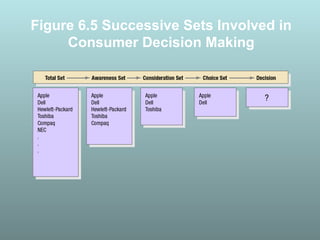
Figure 6.5 Successive Sets Involved in
Consumer Decision Making
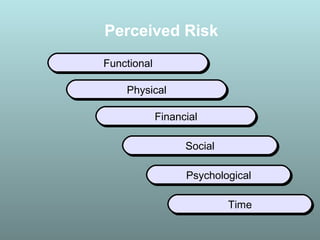
Perceived Risk
FunctionalFunctional
PhysicalPhysical
FinancialFinancial
SocialSocial
PsychologicalPsychological
TimeTime
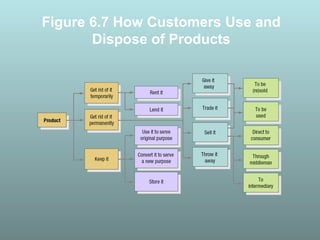
Figure 6.7 How Customers Use and
Dispose of Products
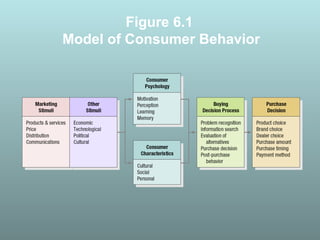
Figure 6.1
Model of Consumer Behavior
THANKS

Chapter six

Editor's Notes

  • #28 A consumer’s decision to modify, postpone, or avoid a purchase decision is heavily influencedby one or more types of perceived risk:1. Functional risk—The product does not perform to expectations.2. Physical risk—The product poses a threat to the physical well-being or health of the useror others.3. Financial risk—The product is not worth the price paid.4. Social risk—The product results in embarrassment in front of others.5. Psychological risk—The product affects the mental well-being of the user.6. Time risk—The failure of the product results in an opportunity cost of finding another satisfactory product.