




Marketing management
Topic
_____________________
Identify market segment
_____________________
Overview
• Market segmentation
• Pattern of preference segments
• Criteria for good market segment
• Basis for segmentation
• Need based segmentation process
• Benefits and limits of segmentation
Mass marketing and Micro marketing
• Mass marketing
An attempt to appeal to an entire market with one basic
marketing strategy utilizing mass distribution and mass
media. Also called undifferentiated marketing.
Read more: http://www.businessdictionary.com/definition/mass-marketing.html#ixzz3JgC14ZaY
• Micro marketing
The activity of marketing products or service directly to
particular groups of people based on information that has
been collected about them
Read more at Cambridge dictionary online
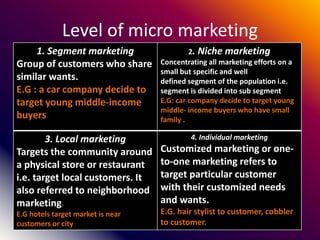
Level of micro marketing
1. Segment marketing
Group of customers who share
similar wants.
E.G : a car company decide to
target young middle-income
buyers
2. Niche marketing
Concentrating all marketing efforts on a
small but specific and well
defined segment of the population i.e.
segment is divided into sub segment
E.G: car company decide to target young
middle- income buyers who have small
family .
3. Local marketing
Targets the community around
a physical store or restaurant
i.e. target local customers. It
also referred to neighborhood
marketing.
E.G hotels target market is near
customers or city
4. Individual marketing
Customized marketing or one-
to-one marketing refers to
target particular customer
with their customized needs
and wants.
E.G. hair stylist to customer, cobbler
to customer.
Market segmentation
“ Market segmentation is sub-dividing a market into
distinct and homogeneous subgroups of customers,
where any group can conceivably be selected as a
target market to be met with distinct marketing
mix.” Philip kottler.
“A marketing term referring to the aggregating of
prospective buyers into groups (segments) that
have common needs and will respond similarly to a
marketing action.” Investopedia definition
Three patterns of preference segments
• 1. Homogeneous Preferences: shows a market where all the
consumers have roughly the same preferences. The market
shows no natural segments. We would predict that existing
brands would be similar and cluster around the middle of the
scale in both sweetness & saltiness.
• 2. Diffused Preferences: At the other extreme, consumer
preferences maybe scattered throughout the space, indicating
that customers vary greatly in their preferences. The first
brand to enter the market is likely to position in the center to
appeal to the most people
• 3. Clustered Preferences: The market might reveal distinct
preference clusters, called natural market segments. The first
firm in this market has three options. It might position in the
center, hoping to appeal to all groups. It might position in the
largest market segment (concentrated marketing).It might
develop several brands, each positioned in a different
segment. If the first firm developed only one brand,
competitors would enter and introduce brands in the other
segments.
•
5 Criteria of market segmentation
1. Measureable
2. Substantial
3. Accessible
4.Differentiable
5. Actionable
2.Substnatial
Segment should be large enough in term of sale and
profitable to serve there would be no point in wasting
marketing budget on a market segment that is
insufficiently large.
1. Measurable
Size ,purchasing power and other characteristics
should be measurable with approximate accuracy so
that strategists can then decide whether, how, and to
what extent they should focus their efforts on
marketing to this segment.
3. Accessible
• The market segment should be reachable effectively,
particularly in terms of distribution and communication.
Different segments might respond better to outdoor
advertising, social media campaigns, television infomercials,
or any number of other approaches.
4.Differentiable
An ideal market segment should be internally homogeneous
(i.e. all customers within the segment have similar
preferences and characteristics), but externally
heterogeneous. Differences between market segments should
be clearly defined, so that the campaigns, products and
marketing tools applied to them can be implemented without
overlap.
5 .Actionable
The firm needs to be able to implement a
distinctive marketing mix for each market
segment. The market segment must have
practical value in term of resources and their
utilization .
Basis for Segmentation
1. Demographic segmentation
2. Geographic segmentation
3. Psychographic segmentation
4. Behavioral segmentation
1.Demographic segmentation
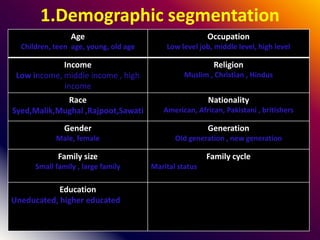
Age
Children, teen age, young, old age
Occupation
Low level job, middle level, high level
Income
Low income, middle income , high
income
Religion
Muslim , Christian , Hindus
Race
Syed,Malik,Mughal ,Rajpoot,Sawati
Nationality
American, African, Pakistani , britishers
Gender
Male, female
Generation
Old generation , new generation
Family size
Small family , large family
Family cycle
Marital status
Education
Uneducated, higher educated
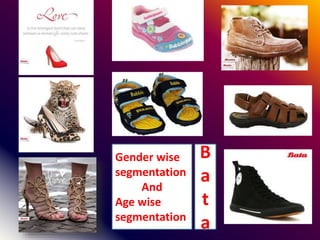
Gender wise
segmentation
And
Age wise
segmentation
B
a
t
a
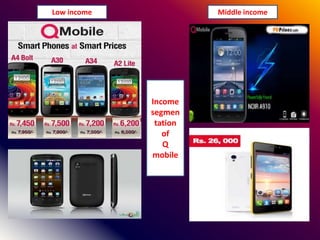
Income
segmen
tation
of
Q
mobile
Low income Middle income
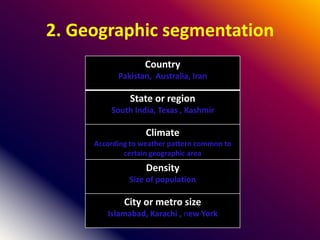
2. Geographic segmentation
Country
Pakistan, Australia, Iran
State or region
South India, Texas , Kashmir
Climate
According to weather pattern common to
certain geographic area
Density
Size of population
City or metro size
Islamabad, Karachi , new York
Geographic Segmentation on basis of
climate
(Beauty creams for cold climate)
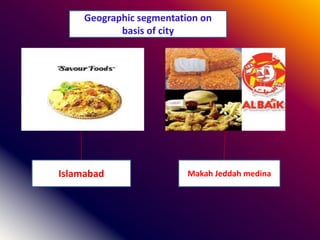
Islamabad Makah Jeddah medina
Geographic segmentation on
basis of city
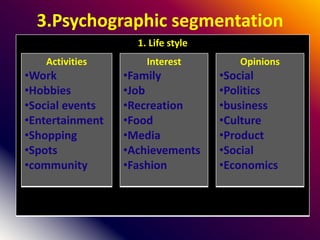
3.Psychographic segmentation
1. Life style
Activities
•Work
•Hobbies
•Social events
•Entertainment
•Shopping
•Spots
•community
Interest
•Family
•Job
•Recreation
•Food
•Media
•Achievements
•Fashion
Opinions
•Social
•Politics
•business
•Culture
•Product
•Social
•Economics
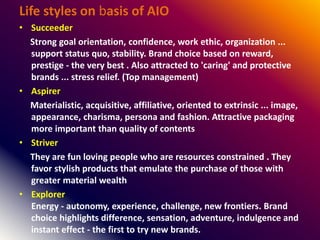
Life styles on basis of AIO
• Succeeder
Strong goal orientation, confidence, work ethic, organization ...
support status quo, stability. Brand choice based on reward,
prestige - the very best . Also attracted to 'caring' and protective
brands ... stress relief. (Top management)
• Aspirer
Materialistic, acquisitive, affiliative, oriented to extrinsic ... image,
appearance, charisma, persona and fashion. Attractive packaging
more important than quality of contents
• Striver
They are fun loving people who are resources constrained . They
favor stylish products that emulate the purchase of those with
greater material wealth
• Explorer
Energy - autonomy, experience, challenge, new frontiers. Brand
choice highlights difference, sensation, adventure, indulgence and
instant effect - the first to try new brands.
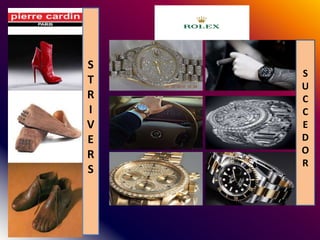
S
T
R
I
V
E
R
S
S
U
C
C
E
D
O
R
2. Social class
• Different consumers fall in different social classes. This
depends mainly on their buying power. The buying power is
affected by the background of the customer, his income as
well as his spending habits. The customer will always buy to
maintain his social class. Thus premium brands like gucci,
longiness or others always target the Sec A segments because
they know that these would be the classes capable of buying
their products. These brands have to keep in mind both –
Lifestyle as well as social class.
Gucci
brand
for
high
social
class
3. Personality
• Personality in psychographic segmentation is dependent on
both – lifestyle as well as social class. A person will have a rich
personality only if he has high buying power as well as the
taste in clothes to maintain such a lifestyle. Thus the term
“Brand personality” came into effect. The reason for that is
that different brands target different personalities. A simple
example would be if i ask you what comes in mind if i talk
about a “Harley davidson biker” more commonly known as
Hogs. They would be people unshaven, tall, manly who like to
live a rough lifestyle. That’s the personality built for harley
over time. Thus brands target their customers even based on
their personality.
4. Behavioral segmentation
• Occasions
Groups individuals according to the occasions when they
purchase, use or think of buying a product.
• Benefits
Groups individuals according to the benefits they seek from
the product.
• Loyalty status
• Groups individuals according to their level of loyalty to the
product. 'Hard core loyals' always purchase the product /
brand in question. Whilst 'Soft core loyals' will sometimes
purchase another brand, and 'Switchers' will not specifically
seek out a particular brand, but rather purchase the brand
available to them at time of need, or that which was on sale.
User status
Every product has its nonusers, ex-users, potential users, first
time user ad regular users. A company has not to rely only on
regular users, it has to attract the other type as well.
• Usage
Customers can be segmented on the basis of usage status-
heavy users, light users, and on users of a product category.
The profiling of heavy users allows this group to receive most
marketing attention (particularly promotion efforts) on
assumption that brand loyalty among these people ill pay
heavy divides.
• Buyer readiness
Groups individuals according to their readiness to purchase
the product. This segmentation model is particularly useful in
formulating and monitoring the marketing communication
strategies employed to move consumers towards purchase of
a product or brand.
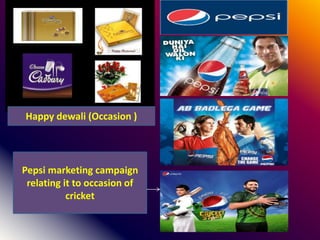
Happy dewali (Occasion )
Pepsi marketing campaign
relating it to occasion of
cricket
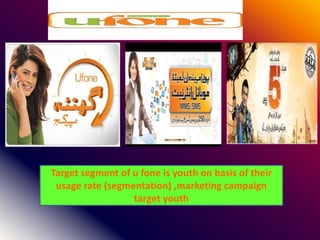
Target segment of u fone is youth on basis of their
usage rate (segmentation) ,marketing campaign
target youth
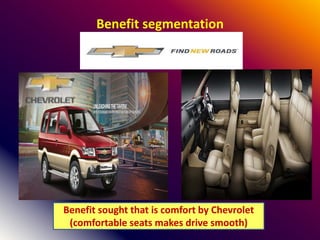
Benefit segmentation
Benefit sought that is comfort by Chevrolet
(comfortable seats makes drive smooth)
Need Based segmentation process
• Needs-based segmentation
• Segment identification
• Segment attractiveness
• Segment profitability
• Segment positioning
• Segment “acid test”
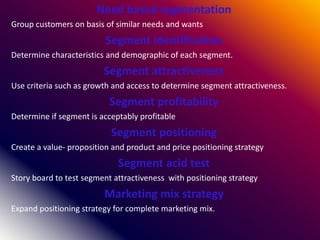
Need based segmentation
Group customers on basis of similar needs and wants
Segment identification
Determine characteristics and demographic of each segment.
Segment attractiveness
Use criteria such as growth and access to determine segment attractiveness.
Segment profitability
Determine if segment is acceptably profitable
Segment positioning
Create a value- proposition and product and price positioning strategy
Segment acid test
Story board to test segment attractiveness with positioning strategy
Marketing mix strategy
Expand positioning strategy for complete marketing mix.
Benefits of segmentation
• With the help of knowledge about different segments, the marketer
can better allocate the total marketing budget. Differences in
customer response to different marketing tools serve as the basis for
deciding on the allocation of market funds to different customer
groups.
• Facilitate proper choice of target market
• Management can identify new profitable segments which deserve
special attention.
• It is possible to deal with competition more effectively by using
resources more effectively.
• Appropriate service packages can be developed for each market
segment.
• Improve communication with customer .
• Allow marketing campaigns to be more cost and time efficient.
Limitations of segmentation
• Segmentation increases costs. When a firm attempts to
serve several market segments, there is a proliferation of
products. Cost of production rises due to shorter production
runs and product variations.
• Promotion and distribution expenditures increase when
separate programme are used for different market
segments.
• When characteristics of a market segment change,
investment made already might become useless.
• Along with segmentation, you also need to check out the
competition offered in the same segment from other
products. Getting into a segment already saturated will
mean higher costs and lesser profit margins
• Read
more: http://www.businessdictionary.com/definition/mass-
marketing.html#ixzz3JgC14ZaY
• Cambridge dictionary online
• www.investopedia.com
• http://www.slideshare.net/allanray/chapter-8-make-your-
mark-know-your-customer
• http://www.slideshare.net/aabhas19871/market-
segmentation-ppt
• Marketing management Philip Kotler
Marketing management

Marketing management

  • 1.
  • 2.
    Overview • Market segmentation •Pattern of preference segments • Criteria for good market segment • Basis for segmentation • Need based segmentation process • Benefits and limits of segmentation
  • 3.
    Mass marketing andMicro marketing • Mass marketing An attempt to appeal to an entire market with one basic marketing strategy utilizing mass distribution and mass media. Also called undifferentiated marketing. Read more: http://www.businessdictionary.com/definition/mass-marketing.html#ixzz3JgC14ZaY • Micro marketing The activity of marketing products or service directly to particular groups of people based on information that has been collected about them Read more at Cambridge dictionary online
  • 4.
    Level of micromarketing 1. Segment marketing Group of customers who share similar wants. E.G : a car company decide to target young middle-income buyers 2. Niche marketing Concentrating all marketing efforts on a small but specific and well defined segment of the population i.e. segment is divided into sub segment E.G: car company decide to target young middle- income buyers who have small family . 3. Local marketing Targets the community around a physical store or restaurant i.e. target local customers. It also referred to neighborhood marketing. E.G hotels target market is near customers or city 4. Individual marketing Customized marketing or one- to-one marketing refers to target particular customer with their customized needs and wants. E.G. hair stylist to customer, cobbler to customer.
  • 6.
    Market segmentation “ Marketsegmentation is sub-dividing a market into distinct and homogeneous subgroups of customers, where any group can conceivably be selected as a target market to be met with distinct marketing mix.” Philip kottler. “A marketing term referring to the aggregating of prospective buyers into groups (segments) that have common needs and will respond similarly to a marketing action.” Investopedia definition
  • 7.
    Three patterns ofpreference segments • 1. Homogeneous Preferences: shows a market where all the consumers have roughly the same preferences. The market shows no natural segments. We would predict that existing brands would be similar and cluster around the middle of the scale in both sweetness & saltiness. • 2. Diffused Preferences: At the other extreme, consumer preferences maybe scattered throughout the space, indicating that customers vary greatly in their preferences. The first brand to enter the market is likely to position in the center to appeal to the most people • 3. Clustered Preferences: The market might reveal distinct preference clusters, called natural market segments. The first firm in this market has three options. It might position in the center, hoping to appeal to all groups. It might position in the largest market segment (concentrated marketing).It might develop several brands, each positioned in a different segment. If the first firm developed only one brand, competitors would enter and introduce brands in the other segments. •
  • 8.
    5 Criteria ofmarket segmentation 1. Measureable 2. Substantial 3. Accessible 4.Differentiable 5. Actionable
  • 9.
    2.Substnatial Segment should belarge enough in term of sale and profitable to serve there would be no point in wasting marketing budget on a market segment that is insufficiently large. 1. Measurable Size ,purchasing power and other characteristics should be measurable with approximate accuracy so that strategists can then decide whether, how, and to what extent they should focus their efforts on marketing to this segment.
  • 10.
    3. Accessible • Themarket segment should be reachable effectively, particularly in terms of distribution and communication. Different segments might respond better to outdoor advertising, social media campaigns, television infomercials, or any number of other approaches. 4.Differentiable An ideal market segment should be internally homogeneous (i.e. all customers within the segment have similar preferences and characteristics), but externally heterogeneous. Differences between market segments should be clearly defined, so that the campaigns, products and marketing tools applied to them can be implemented without overlap.
  • 11.
    5 .Actionable The firmneeds to be able to implement a distinctive marketing mix for each market segment. The market segment must have practical value in term of resources and their utilization .
  • 12.
    Basis for Segmentation 1.Demographic segmentation 2. Geographic segmentation 3. Psychographic segmentation 4. Behavioral segmentation
  • 13.
    1.Demographic segmentation Age Children, teenage, young, old age Occupation Low level job, middle level, high level Income Low income, middle income , high income Religion Muslim , Christian , Hindus Race Syed,Malik,Mughal ,Rajpoot,Sawati Nationality American, African, Pakistani , britishers Gender Male, female Generation Old generation , new generation Family size Small family , large family Family cycle Marital status Education Uneducated, higher educated
  • 14.
  • 15.
  • 16.
    2. Geographic segmentation Country Pakistan,Australia, Iran State or region South India, Texas , Kashmir Climate According to weather pattern common to certain geographic area Density Size of population City or metro size Islamabad, Karachi , new York
  • 17.
    Geographic Segmentation onbasis of climate (Beauty creams for cold climate)
  • 18.
    Islamabad Makah Jeddahmedina Geographic segmentation on basis of city
  • 19.
    3.Psychographic segmentation 1. Lifestyle Activities •Work •Hobbies •Social events •Entertainment •Shopping •Spots •community Interest •Family •Job •Recreation •Food •Media •Achievements •Fashion Opinions •Social •Politics •business •Culture •Product •Social •Economics
  • 20.
    Life styles onbasis of AIO • Succeeder Strong goal orientation, confidence, work ethic, organization ... support status quo, stability. Brand choice based on reward, prestige - the very best . Also attracted to 'caring' and protective brands ... stress relief. (Top management) • Aspirer Materialistic, acquisitive, affiliative, oriented to extrinsic ... image, appearance, charisma, persona and fashion. Attractive packaging more important than quality of contents • Striver They are fun loving people who are resources constrained . They favor stylish products that emulate the purchase of those with greater material wealth • Explorer Energy - autonomy, experience, challenge, new frontiers. Brand choice highlights difference, sensation, adventure, indulgence and instant effect - the first to try new brands.
  • 21.
  • 22.
    2. Social class •Different consumers fall in different social classes. This depends mainly on their buying power. The buying power is affected by the background of the customer, his income as well as his spending habits. The customer will always buy to maintain his social class. Thus premium brands like gucci, longiness or others always target the Sec A segments because they know that these would be the classes capable of buying their products. These brands have to keep in mind both – Lifestyle as well as social class.
  • 23.
  • 24.
    3. Personality • Personalityin psychographic segmentation is dependent on both – lifestyle as well as social class. A person will have a rich personality only if he has high buying power as well as the taste in clothes to maintain such a lifestyle. Thus the term “Brand personality” came into effect. The reason for that is that different brands target different personalities. A simple example would be if i ask you what comes in mind if i talk about a “Harley davidson biker” more commonly known as Hogs. They would be people unshaven, tall, manly who like to live a rough lifestyle. That’s the personality built for harley over time. Thus brands target their customers even based on their personality.
  • 25.
    4. Behavioral segmentation •Occasions Groups individuals according to the occasions when they purchase, use or think of buying a product. • Benefits Groups individuals according to the benefits they seek from the product. • Loyalty status • Groups individuals according to their level of loyalty to the product. 'Hard core loyals' always purchase the product / brand in question. Whilst 'Soft core loyals' will sometimes purchase another brand, and 'Switchers' will not specifically seek out a particular brand, but rather purchase the brand available to them at time of need, or that which was on sale.
  • 26.
    User status Every producthas its nonusers, ex-users, potential users, first time user ad regular users. A company has not to rely only on regular users, it has to attract the other type as well. • Usage Customers can be segmented on the basis of usage status- heavy users, light users, and on users of a product category. The profiling of heavy users allows this group to receive most marketing attention (particularly promotion efforts) on assumption that brand loyalty among these people ill pay heavy divides. • Buyer readiness Groups individuals according to their readiness to purchase the product. This segmentation model is particularly useful in formulating and monitoring the marketing communication strategies employed to move consumers towards purchase of a product or brand.
  • 27.
    Happy dewali (Occasion) Pepsi marketing campaign relating it to occasion of cricket
  • 28.
    Target segment ofu fone is youth on basis of their usage rate (segmentation) ,marketing campaign target youth
  • 29.
    Benefit segmentation Benefit soughtthat is comfort by Chevrolet (comfortable seats makes drive smooth)
  • 30.
    Need Based segmentationprocess • Needs-based segmentation • Segment identification • Segment attractiveness • Segment profitability • Segment positioning • Segment “acid test”
  • 31.
    Need based segmentation Groupcustomers on basis of similar needs and wants Segment identification Determine characteristics and demographic of each segment. Segment attractiveness Use criteria such as growth and access to determine segment attractiveness. Segment profitability Determine if segment is acceptably profitable Segment positioning Create a value- proposition and product and price positioning strategy Segment acid test Story board to test segment attractiveness with positioning strategy Marketing mix strategy Expand positioning strategy for complete marketing mix.
  • 32.
    Benefits of segmentation •With the help of knowledge about different segments, the marketer can better allocate the total marketing budget. Differences in customer response to different marketing tools serve as the basis for deciding on the allocation of market funds to different customer groups. • Facilitate proper choice of target market • Management can identify new profitable segments which deserve special attention. • It is possible to deal with competition more effectively by using resources more effectively. • Appropriate service packages can be developed for each market segment. • Improve communication with customer . • Allow marketing campaigns to be more cost and time efficient.
  • 33.
    Limitations of segmentation •Segmentation increases costs. When a firm attempts to serve several market segments, there is a proliferation of products. Cost of production rises due to shorter production runs and product variations. • Promotion and distribution expenditures increase when separate programme are used for different market segments. • When characteristics of a market segment change, investment made already might become useless. • Along with segmentation, you also need to check out the competition offered in the same segment from other products. Getting into a segment already saturated will mean higher costs and lesser profit margins
  • 34.
    • Read more: http://www.businessdictionary.com/definition/mass- marketing.html#ixzz3JgC14ZaY •Cambridge dictionary online • www.investopedia.com • http://www.slideshare.net/allanray/chapter-8-make-your- mark-know-your-customer • http://www.slideshare.net/aabhas19871/market- segmentation-ppt • Marketing management Philip Kotler