 Dr. Shahzad Ahmad Khan
 Assistant Professor
 Email: shahzad.ahmad@riphah.edu.pk
Riphah School of Leadership
Faculty of Management Sciences
Riphah International University
Islamabad
CHAPTER :4
Conducting
Marketing Research
Chapter Questions
What constitutes good marketing research?
What are the best metrics for measuring marketing
productivity?
How can marketers assess their return on investment
of marketing expenditures?
What is Marketing Research?
Marketing research is the systematic design,
collection, analysis, and reporting of data and
findings relevant to a specific marketing situation
facing the company.
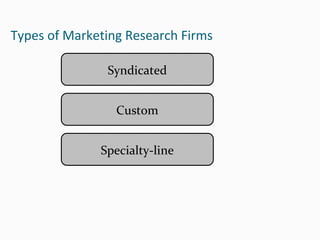
Types of Marketing Research Firms
Syndicated
Custom
Specialty-line
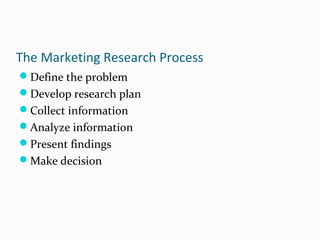
The Marketing Research Process
Define the problem
Develop research plan
Collect information
Analyze information
Present findings
Make decision
Step 1: Define the Problem

Define the problem
Specify decision alternatives
State research objectives
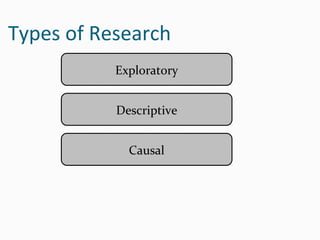
Types of Research
Exploratory
Descriptive
Causal
Step 2: Develop the Research Plan
Data sources
Research approach
Research instruments
Sampling plan
Contact methods
Data sources
Research Approaches
Observational and ethnographic
Focus group
Survey
Behavioral
Experimental
Research Instruments
Questionnaires
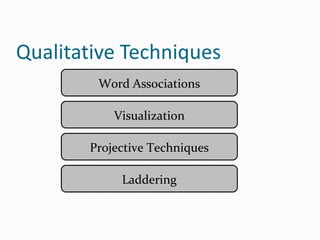
Qualitative Measures
Technological Devices
Word Associations
Visualization
Projective Techniques
Laddering
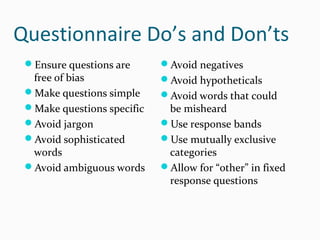
Questionnaire Do’s and Don’ts
Ensure questions are
free of bias
Make questions simple
Make questions specific
Avoid jargon
Avoid sophisticated
words
Avoid ambiguous words
Avoid negatives
Avoid hypotheticals
Avoid words that could
be misheard
Use response bands
Use mutually exclusive
categories
Allow for “other” in fixed
response questions
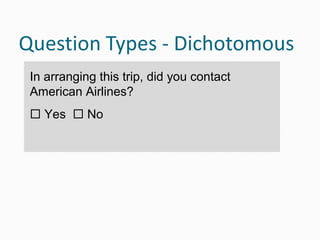
In arranging this trip, did you contact
American Airlines?
 Yes  No
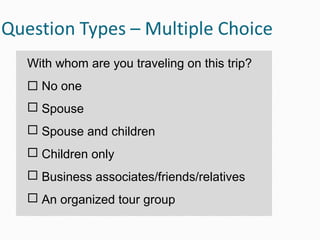
With whom are you traveling on this trip?
 No one
 Spouse
 Spouse and children
 Children only
 Business associates/friends/relatives
 An organized tour group
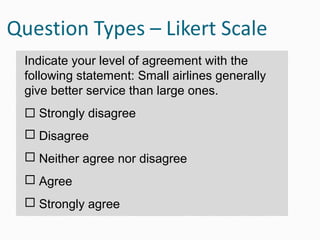
Indicate your level of agreement with the
following statement: Small airlines generally
give better service than large ones.
 Strongly disagree
 Disagree
 Neither agree nor disagree
 Agree
 Strongly agree
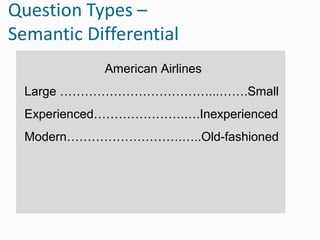
American Airlines
Large ………………………………...…….Small
Experienced………………….….Inexperienced
Modern……………………….…..Old-fashioned
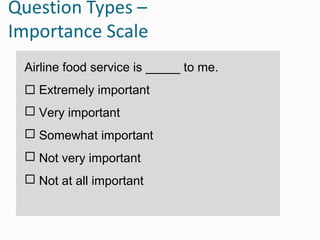
Airline food service is _____ to me.
 Extremely important
 Very important
 Somewhat important
 Not very important
 Not at all important
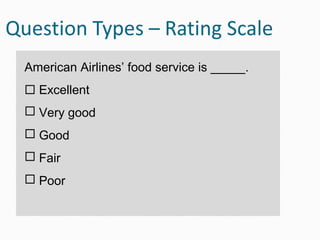
American Airlines’ food service is _____.
 Excellent
 Very good
 Good
 Fair
 Poor
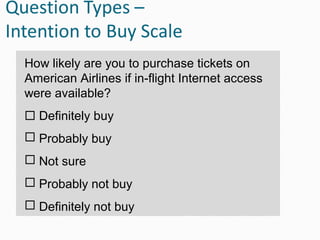
How likely are you to purchase tickets on
American Airlines if in-flight Internet access
were available?
 Definitely buy
 Probably buy
 Not sure
 Probably not buy
 Definitely not buy
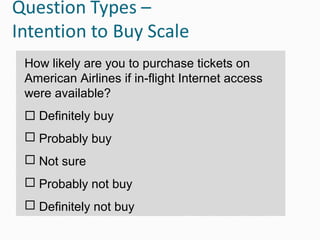
How likely are you to purchase tickets on
American Airlines if in-flight Internet access
were available?
 Definitely buy
 Probably buy
 Not sure
 Probably not buy
 Definitely not buy
What is your opinion of American Airlines?
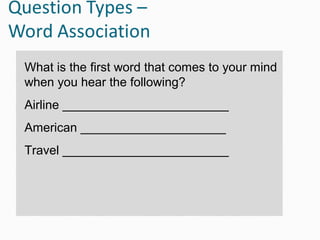
What is the first word that comes to your mind
when you hear the following?
Airline ________________________
American _____________________
Travel ________________________
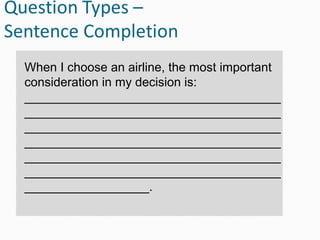
When I choose an airline, the most important
consideration in my decision is:
_____________________________________
_____________________________________
_____________________________________
_____________________________________
_____________________________________
_____________________________________
__________________.
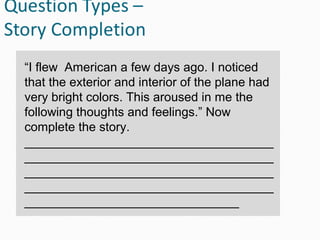
“I flew American a few days ago. I noticed
that the exterior and interior of the plane had
very bright colors. This aroused in me the
following thoughts and feelings.” Now
complete the story.
____________________________________
____________________________________
____________________________________
____________________________________
_______________________________
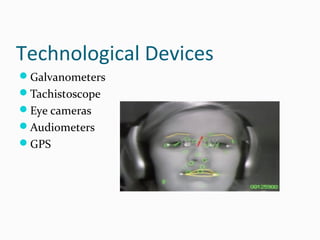
Technological Devices
Galvanometers
Tachistoscope
Eye cameras
Audiometers
GPS
Sampling Plan
Sampling unit: Who is to be surveyed?
Sample size: How many people should be surveyed?
Sampling procedure: How should the respondents be
chosen?
Contact Methods
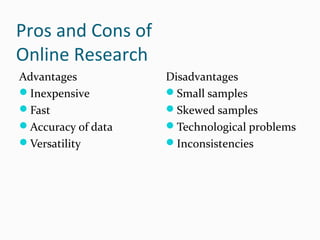
Pros and Cons of
Online Research
Advantages
Inexpensive
Fast
Accuracy of data
Versatility
Disadvantages
Small samples
Skewed samples
Technological problems
Inconsistencies
What is a
Marketing Decision Support
System (MDSS)?
A marketing decision support system is a
coordinated collection of data, systems, tools, and
techniques with supporting hardware and
software by which an organization gathers and
interprets relevant information from business and
environment and turns it into a basis for
marketing action.
Barriers Limiting the Use of
Marketing Research
A narrow conception of the research
Uneven caliber of researchers
Poor framing of the problem
Late and occasionally erroneous findings
Personality and presentational differences
What are Marketing Metrics?
Marketing metrics are the set of measures that helps
marketers quantify, compare, and interpret marketing
performance.
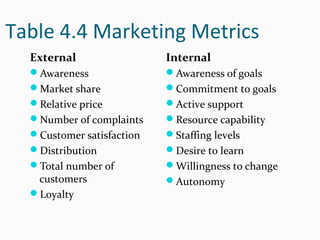
Table 4.4 Marketing Metrics
External
Awareness
Market share
Relative price
Number of complaints
Customer satisfaction
Distribution
Total number of
customers
Loyalty
Internal
Awareness of goals
Commitment to goals
Active support
Resource capability
Staffing levels
Desire to learn
Willingness to change
Autonomy
What is Marketing-Mix Modeling?
Marketing-mix models analyze data from a
variety of sources, such as retailer scanner data,
company shipment data, pricing, media, and
promotion spending data, to understand more
precisely the effects of specific marketing
activities.
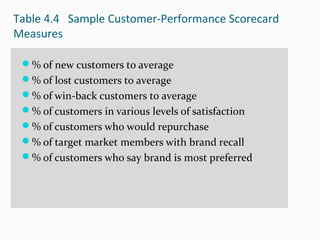
Table 4.4 Sample Customer-Performance Scorecard
Measures
% of new customers to average
% of lost customers to average
% of win-back customers to average
% of customers in various levels of satisfaction
% of customers who would repurchase
% of target market members with brand recall
% of customers who say brand is most preferred
For Review
What constitutes good marketing research?
What are the best metrics for measuring marketing
productivity?
How can marketers assess their return on investment
of marketing expenditures?
Thanks

Chapter four

  • 1.
     Dr. ShahzadAhmad Khan  Assistant Professor  Email: shahzad.ahmad@riphah.edu.pk Riphah School of Leadership Faculty of Management Sciences Riphah International University Islamabad CHAPTER :4 Conducting Marketing Research
  • 2.
    Chapter Questions What constitutesgood marketing research? What are the best metrics for measuring marketing productivity? How can marketers assess their return on investment of marketing expenditures?
  • 3.
    What is MarketingResearch? Marketing research is the systematic design, collection, analysis, and reporting of data and findings relevant to a specific marketing situation facing the company.
  • 4.
    Types of MarketingResearch Firms Syndicated Custom Specialty-line
  • 5.
    The Marketing ResearchProcess Define the problem Develop research plan Collect information Analyze information Present findings Make decision
  • 6.
    Step 1: Definethe Problem Define the problem Specify decision alternatives State research objectives
  • 7.
  • 8.
    Step 2: Developthe Research Plan Data sources Research approach Research instruments Sampling plan Contact methods
  • 9.
  • 10.
    Research Approaches Observational andethnographic Focus group Survey Behavioral Experimental
  • 12.
  • 13.
  • 14.
    Questionnaire Do’s andDon’ts Ensure questions are free of bias Make questions simple Make questions specific Avoid jargon Avoid sophisticated words Avoid ambiguous words Avoid negatives Avoid hypotheticals Avoid words that could be misheard Use response bands Use mutually exclusive categories Allow for “other” in fixed response questions
  • 15.
    In arranging thistrip, did you contact American Airlines?  Yes  No
  • 16.
    With whom areyou traveling on this trip?  No one  Spouse  Spouse and children  Children only  Business associates/friends/relatives  An organized tour group
  • 17.
    Indicate your levelof agreement with the following statement: Small airlines generally give better service than large ones.  Strongly disagree  Disagree  Neither agree nor disagree  Agree  Strongly agree
  • 18.
  • 19.
    Airline food serviceis _____ to me.  Extremely important  Very important  Somewhat important  Not very important  Not at all important
  • 20.
    American Airlines’ foodservice is _____.  Excellent  Very good  Good  Fair  Poor
  • 21.
    How likely areyou to purchase tickets on American Airlines if in-flight Internet access were available?  Definitely buy  Probably buy  Not sure  Probably not buy  Definitely not buy
  • 22.
    How likely areyou to purchase tickets on American Airlines if in-flight Internet access were available?  Definitely buy  Probably buy  Not sure  Probably not buy  Definitely not buy
  • 23.
    What is youropinion of American Airlines?
  • 24.
    What is thefirst word that comes to your mind when you hear the following? Airline ________________________ American _____________________ Travel ________________________
  • 25.
    When I choosean airline, the most important consideration in my decision is: _____________________________________ _____________________________________ _____________________________________ _____________________________________ _____________________________________ _____________________________________ __________________.
  • 26.
    “I flew Americana few days ago. I noticed that the exterior and interior of the plane had very bright colors. This aroused in me the following thoughts and feelings.” Now complete the story. ____________________________________ ____________________________________ ____________________________________ ____________________________________ _______________________________
  • 27.
  • 28.
    Sampling Plan Sampling unit:Who is to be surveyed? Sample size: How many people should be surveyed? Sampling procedure: How should the respondents be chosen?
  • 29.
  • 30.
    Pros and Consof Online Research Advantages Inexpensive Fast Accuracy of data Versatility Disadvantages Small samples Skewed samples Technological problems Inconsistencies
  • 31.
    What is a MarketingDecision Support System (MDSS)? A marketing decision support system is a coordinated collection of data, systems, tools, and techniques with supporting hardware and software by which an organization gathers and interprets relevant information from business and environment and turns it into a basis for marketing action.
  • 32.
    Barriers Limiting theUse of Marketing Research A narrow conception of the research Uneven caliber of researchers Poor framing of the problem Late and occasionally erroneous findings Personality and presentational differences
  • 33.
    What are MarketingMetrics? Marketing metrics are the set of measures that helps marketers quantify, compare, and interpret marketing performance.
  • 34.
    Table 4.4 MarketingMetrics External Awareness Market share Relative price Number of complaints Customer satisfaction Distribution Total number of customers Loyalty Internal Awareness of goals Commitment to goals Active support Resource capability Staffing levels Desire to learn Willingness to change Autonomy
  • 35.
    What is Marketing-MixModeling? Marketing-mix models analyze data from a variety of sources, such as retailer scanner data, company shipment data, pricing, media, and promotion spending data, to understand more precisely the effects of specific marketing activities.
  • 37.
    Table 4.4 SampleCustomer-Performance Scorecard Measures % of new customers to average % of lost customers to average % of win-back customers to average % of customers in various levels of satisfaction % of customers who would repurchase % of target market members with brand recall % of customers who say brand is most preferred
  • 38.
    For Review What constitutesgood marketing research? What are the best metrics for measuring marketing productivity? How can marketers assess their return on investment of marketing expenditures?
  • 39.

Editor's Notes

  • #3 Good marketers need insights to help them interpret past performance as well as plan future activities. To make the best possible tactical decisions in the short run and strategic decisions in the long run, they need timely, accurate, and actionable information about consumers, competition, and their brands. Discovering a consumer insight and understanding its marketing implications can often lead to a successful product launch or spur the growth of a brand. In this chapter, we review the steps in the marketing research process. We also consider how marketers can develop effective metrics for measuring marketing productivity.
  • #4 Gaining marketing insights is crucial for marketing success. If marketers lack consumer insights, they often get in trouble.
  • #5 Most companies use a combination of marketing research resources to study their industries, competitors, audiences, and channel strategies. Companies normally budget marketing research at 1 percent to 2 percent of company sales and spend a large percentage of that on the services of outside firms. Marketing research firms fall into three categories: 1. Syndicated-service research firms—These firms gather consumer and trade information, which they sell for a fee. Examples include the Nielsen Company, Kantar Group,Westat, and IRI. 2. Custom marketing research firms—These firms are hired to carry out specific projects. They design the study and report the findings. 3. Specialty-line marketing research firms—These firms provide specialized research services. The best example is the field-service firm, which sells field interviewing services to other firms.
  • #6 Effective marketing research follows the six steps shown in Figure 4.1. These steps will be discussed individually in the slides that follow.
  • #7 Marketing managers must be careful not to define the problem too broadly or too narrowly for the marketing researcher. A marketing manager who says, “Find out everything you can about firstclass air travelers’ needs,” will collect a lot of unnecessary information.
  • #8 Not all research projects can be this specific. Some research is exploratory—its goal is to shed light on the real nature of the problem and to suggest possible solutions or new ideas. Some research is descriptive—it seeks to quantify demand, such as how many first-class passengers would purchase in-flight Internet service at $25. Some research is causal—its purpose is to test a cause-and- effect relationship.
  • #9 The second stage of marketing research is where we develop the most efficient plan for gathering the needed information and what that will cost. To design a research plan, we need to make decisions about the data sources, research approaches, research instruments, sampling plan, and contact methods.
  • #10 The researcher can gather secondary data, primary data, or both. Secondary data are data that were collected for another purpose and already exist somewhere. Primary data are data freshly gathered for a specific purpose or for a specific research project. Researchers usually start their investigation by examining some of the rich variety of low-cost and readily available secondary data, to see whether they can partly or wholly solve the problem without collecting costly primary data. When the needed data don’t exist or are dated, inaccurate, incomplete, or unreliable, the researcher will need to collect primary data. Most marketing research projects do include some primary-data collection.
  • #11 Researchers can gather fresh data by observing the relevant actors and settings as they shop or consume products. Sometimes they equip consumers with pagers and instruct them to write down what they’re doing whenever prompted, or they hold informal interview sessions at a café or bar. Photographs can also provide a wealth of detailed information. Ethnographic research is a particular observational research approach that uses concepts and tools from anthropology and other social science disciplines to provide deep cultural understanding of how people live and work. The goal is to immerse the researcher into consumers’ lives to uncover unarticulated desires that might not surface in any other form of research. Companies undertake surveys to assess people’s knowledge, beliefs, preferences, and satisfaction and to measure these magnitudes in the general population. Customers leave traces of their purchasing behavior in store scanning data, catalog purchases, and customer databases. Marketers can learn much by analyzing these data. Actual purchases reflect consumers’ preferences and often are more reliable than statements they offer to market researchers. The most scientifically valid research is experimental research, designed to capture cause-and-effect relationships by eliminating competing explanations of the observed findings. If the experiment is well designed and executed, research and marketing managers can have confidence in the conclusions. Experiments call for selecting matched groups of subjects, subjecting them to different treatments, controlling extraneous variables, and checking whether observed response differences are statistically significant.
  • #12 A focus group is a gathering of 6 to 10 people carefully selected by researchers based on certain demographic, psychographic, or other considerations and brought together to discuss various topics of interest at length. Participants are normally paid a small sum for attending. A professional research moderator provides questions and probes based on the marketing managers’ discussion guide or agenda. In focus groups, moderators try to discern consumers’ real motivations and why they say and do certain things. They typically record the sessions, and marketing managers often remain behind two-way mirrors in the next room. To allow for more in-depth discussion with participants, focus groups are trending smaller in size. Focus-group research is a useful exploratory step, but researchers must avoid generalizing from focus-group participants to the whole market, because the sample size is too small and the sample is not drawn randomly.
  • #13 A questionnaire consists of a set of questions presented to respondents. Because of its flexibility, it is by far the most common instrument used to collect primary data. Researchers need to carefully develop, test, and debug questionnaires before administering them on a large scale. The form, wording, and sequence of the questions can all influence the responses. Closed-end questions specify all the possible answers and provide answers that are easier to interpret and tabulate. Open-end questions allow respondents to answer in their own words and often reveal more about how people think. Qualitative research techniques are relatively unstructured measurement approaches that permit a range of possible responses. Their variety is limited only by the creativity of the marketing researcher. There has been much interest in recent years in various technological devices.
  • #14 Word associations involve asking subjects what words come to mind when they hear the brand’s name. Projective techniques involve giving people an incomplete stimulus and ask them to complete it, or give them an ambiguous stimulus and ask them to make sense of it. Visualization requires people to create a collage from magazine photos or drawings to depict their perceptions. Laddering is a series of increasingly more specific “why” questions can reveal consumer motivation and consumers’ deeper, more abstract goals.
  • #15 The Marketing Memo provides questionnaire Do’s and Don’ts. Table 4.1 provides examples of several types of questions. Some of these are illustrated on the coming slides.
  • #16 The next few slides illustrate some of the types of questions which can be used in descriptive research.
  • #28 Galvanometers can measure the interest or emotions aroused by exposure to a specific ad or picture. The tachistoscope flashes an ad to a subject with an exposure interval that may range from less than one hundredth of a second to several seconds. After each exposure, the respondent describes everything he or she recalls. Eye cameras study respondents’ eye movements to see where their eyes land first, how long they linger on a given item, and so on. Technology has now advanced to such a degree that marketers can use devices such as skin sensors, brain wave scanners, and full body scanners to get consumer responses. Some researchers study eye movements and brain activity of Web surfers to see which ads grab their attention. Technology has replaced the diaries that participants in media surveys used to keep. Audiometers attached to television sets in participating homes now record when the set is on and to which channel it is tuned. Electronic devices can record the number of radio programs a person is exposed to during the day, or, using Global Positioning System (GPS) technology, how many billboards a person may walk or drive by during a day.
  • #29 After deciding on the research approach and instruments, the marketing researcher must design a sampling plan. This calls for three decisions: 1. Sampling unit: Whom should we survey? 2. Sample size: How many people should we survey? Large samples give more reliable results, but it’s not necessary to sample the entire target population to achieve reliable results. Samples of less than 1 percent of a population can often provide good reliability, with a credible sampling procedure. 3. Sampling procedure: How should we choose the respondents? Probability sampling allows marketers to calculate confidence limits for sampling error and makes the sample more representative.
  • #30 Researchers can collect data using mail, telephone, personal, and online interviews. The mail questionnaire is one way to reach people who would not give personal interviews or whose responses might be biased or distorted by the interviewers. Mail questionnaires require simple and clearly worded questions. Telephone interviewing is a good method for gathering information quickly; the interviewer is also able to clarify questions if respondents do not understand them. Interviews must be brief and not too personal. Personal interviewing is the most versatile method. The interviewer can ask more questions and record additional observations about the respondent, such as dress and body language. At the same time, however, personal interviewing is the most expensive method, is subject to interviewer bias, and requires more administrative planning and supervision. An approach of increasing importance, the Internet offers many ways to do research. A company can embed a questionnaire on its Web site and offer an incentive to answer it, or it can place a banner on a frequently visited site such as Yahoo!, inviting people to answer some questions and possibly win a prize.
  • #32 Some organizations use marketing decision support systems to help their marketing managers make better decisions. A marketing decision support system (MDSS) is a coordinated collection of data, systems, tools, and techniques, with supporting software and hardware, by which an organization gathers and interprets relevant information from business and environment and turns it into a basis for marketing action.
  • #33 There are barriers to marketing research. These need to be kept in mind when buying or conducting research to ensure a quality report.
  • #34 Two complementary approaches to measuring marketing productivity are: (1) marketing metrics to assess marketing effects and (2) marketing-mix modeling to estimate causal relationships and measure how marketing activity affects outcomes. Marketing dashboards are a structured way to distribute the perceptions gleaned from these two approaches within the organization.
  • #35 Marketers employ a wide variety of measures to assess marketing effects. Marketing metrics is the set of measures that helps them quantify, compare, and interpret their marketing performance.
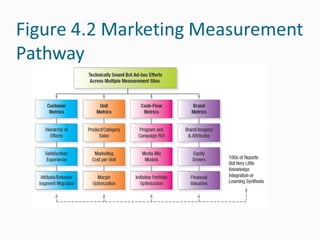
  • #37 There are four common measurement “pathways” marketers are pursuing today as shown in Figure 4.2. The customer metrics pathway looks at how prospects become customers, from awareness to preference to trial to repeat purchase, or some less linear model. This area also examines how the customer experience contributes to the perception of value and competitive advantage. The unit metrics pathway reflects what marketers know about sales of product/service units—how much is sold by product line and/or by geography; the marketing cost per unit sold as an efficiency yardstick; and where and how margin is optimized in terms of characteristics of the product line or distribution channel. equity The cash-flow metrics pathway focuses on how well marketing expenditures are achieving short-term returns. Program and campaign ROI models measure the immediate impact or net present value of profits expected from a given investment. The brand metrics pathway tracks the development of the longer term impact of marketing through brand equity measures that assess both the perceptual health of the brand from customer and prospective customer perspectives as well as the overall financial health of the brand.
  • #38 Table 4.4 provides an example of some scorecard measures.
  • #39 This chapter has provided answers to these questions.