Fundamentals of Human Resource Management, 10/e, DeCenzo/Robbins Chapter 7, slide 1
Chapter 7
Selecting Employees
Fundamentals of Human Resource Management, 10/e, DeCenzo/Robbins Chapter 7, slide 2
The Selection Process
initial screening
completed application
employment test
comprehensive interviewconditional
job offer
medical/physical examination
(conditional job offer made)
permanent
job offer reject applicant
background examination
if required
Passed
Passed
Able to perform essential
elements of the job
Passed
Passed
Passed
Problems encountered
Failed to impress interviewer and/or
meet job expectations
Failed test
Failed to complete application or
failed job specifications
Failed to meet minimum qualifications
Unfit to do essential
elements of job
The selection
process typically
consists of eight
steps.
Fundamentals of Human Resource Management, 10/e, DeCenzo/Robbins Chapter 7, slide 3
initial screening
interview
The Selection Process
 weeding out of applicants who don’t meet general job
requirements
 screening interviews help candidates decide if
position is suitable
Job description information is shared
along with a salary range.
Fundamentals of Human Resource Management, 10/e, DeCenzo/Robbins Chapter 7, slide 4
The Selection Process
completing
the application
Gives a job-performance-related synopsis of what
applicants have been doing, their skills and
accomplishments.
Legal considerations
1. omit items that are not job-related; e.g., sex, religion
2. includes statement giving employer the right to
dismiss an employee for falsifying information
3. asks for permission to check work references
4. typically includes “employment-at-will” statement
Fundamentals of Human Resource Management, 10/e, DeCenzo/Robbins Chapter 7, slide 5
The Selection Process
Weighted application forms
 individual pieces of information are validated against
performance and turnover measures and given
appropriate weights
 data must be collected for each job to determine how
well a particular item (e.g., years of schooling, tenure
on last job) predicts success on target job
completing
the application
Fundamentals of Human Resource Management, 10/e, DeCenzo/Robbins Chapter 7, slide 6
The Selection Process
 information collected on application forms can be highly
predictive of successful job performance
 forms must be validated and continuously reviewed and
updated
 data should be verified through background investigations
completing
the application
Fundamentals of Human Resource Management, 10/e, DeCenzo/Robbins Chapter 7, slide 7
The Selection Process
 performance simulation tests require applicants to engage in job
behaviors necessary for doing the job successfully
 work sampling uses job analysis to develop a miniature replica of
the job so the applicant can demonstrate his/her skills
 assessment centers give tests and exercises, (individual and
group), to assess managerial potential or other complex skills
Selection practices must be adapted to cultures
and regulations of the host country.
pre-employment testing
Fundamentals of Human Resource Management, 10/e, DeCenzo/Robbins Chapter 7, slide 8
The Selection Process
assesses motivation, values, ability to work
under pressure, attitude, ability to fit in
can be traditional, panel, or situational
especially useful for high-turnover jobs and less
routine ones
comprehensive
interviews
Video: Justin Menkes, Interviewing for Executive Intelligence
The interview is only as effective as those conducting it.
Fundamentals of Human Resource Management, 10/e, DeCenzo/Robbins Chapter 7, slide 9
The Selection Process
 impression management, (applicant’s desire to project the
“right” image), may help to give positive interview results
 behavioral interviews are much more effective at predicting
job performance than traditional interviews
 realistic job previews (brochures, videos, plant tours, work
sampling) help reduce turnover rates
comprehensive
interviews
Fundamentals of Human Resource Management, 10/e, DeCenzo/Robbins Chapter 7, slide 10
The Selection Process
 HR manager makes an offer of employment, contingent
on successful completion of background check,
physical/medical exam, drug test, etc.
 may use only job-related information to make a hiring
decision
conditional
job offer
Fundamentals of Human Resource Management, 10/e, DeCenzo/Robbins Chapter 7, slide 11
The Selection Process
Verifies information from the application form.
background
investigation
Online searches can yield too much information on applicants.
See http://www.privacyrights.org/fs/fs16-bck.htm for an analysis of online
background checks as they pertain to employer/employee rights.
references
former employers
education
legal status to work in U.S.
criminal records
Fundamentals of Human Resource Management, 10/e, DeCenzo/Robbins Chapter 7, slide 12
The Selection Process
 qualified privilege: employers may discuss
employees with prospective employers without
fear of revenge as long as the discussion is about
job-related, documented facts
 one-third of all applicants exaggerate their
backgrounds or experiences
 a good predictor of future behavior is an
individual’s past behavior
Companies can be held liable for failure to properly hire.
background
investigation
Fundamentals of Human Resource Management, 10/e, DeCenzo/Robbins Chapter 7, slide 13
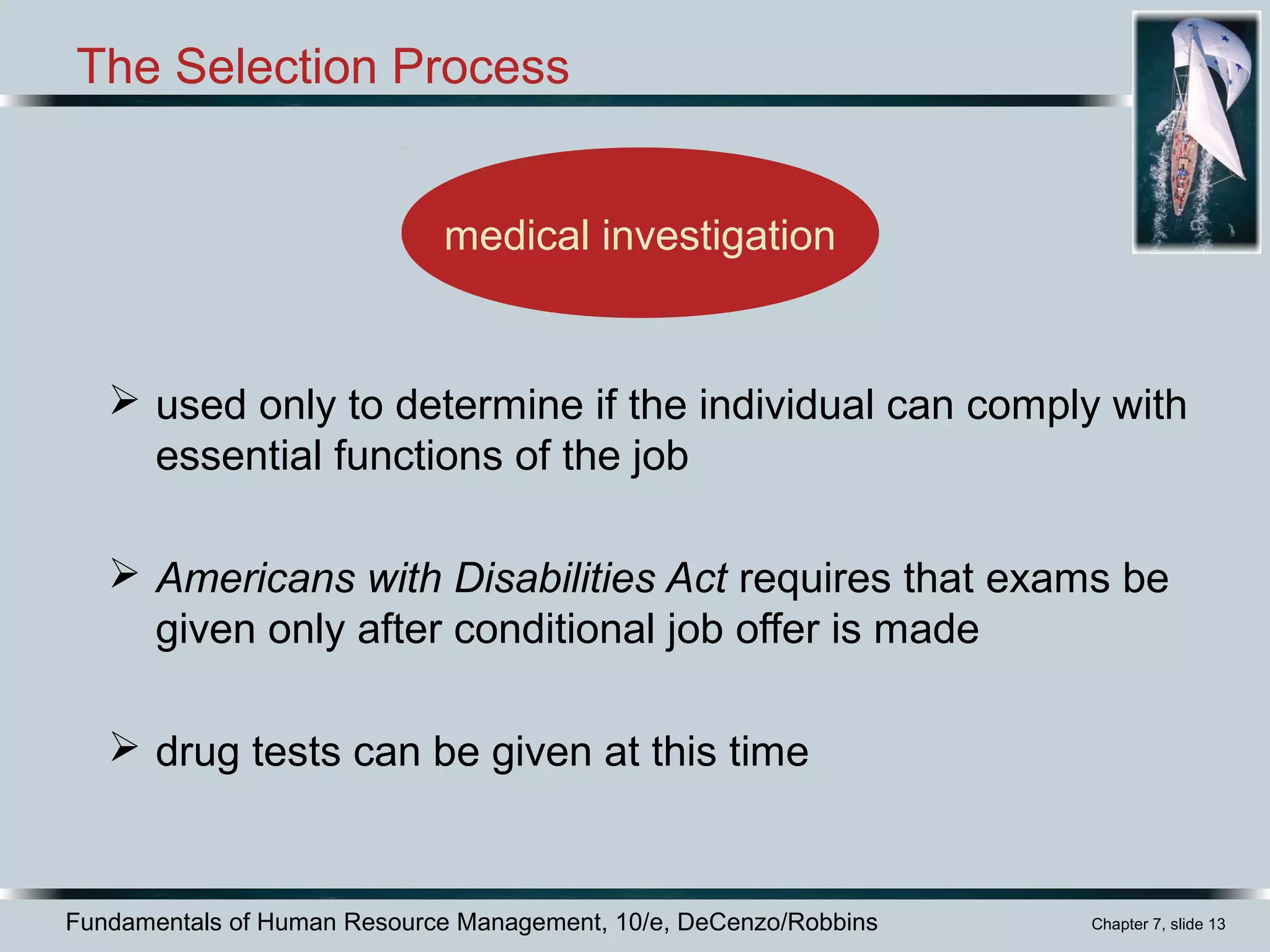
The Selection Process
 used only to determine if the individual can comply with
essential functions of the job
 Americans with Disabilities Act requires that exams be
given only after conditional job offer is made
 drug tests can be given at this time
medical investigation
Fundamentals of Human Resource Management, 10/e, DeCenzo/Robbins Chapter 7, slide 14
The Selection Process
 actual hiring decision generally made by the
department manager, not HR manager
 candidates not hired deserve the courtesy of prompt
notification
job offer
Resources for Job Seekers: Evaluating Companies
Dun & Bradstreet’s Million Dollar Directory
Standard and Poor’s Register of Corporations
Mergent’s Industrial Review (formerly Moody’s Industrial Manual)
Thomas Register of American Manufacturers
Ward’s Business Directory
From: http://www.bls.gov/oco/oco20046.htm
Fundamentals of Human Resource Management, 10/e, DeCenzo/Robbins Chapter 7, slide 15
The Selection Process
Comprehensive selection puts applicants through
all the steps in the selection process before
making a decision.
 assesses both strengths and weaknesses, and is
considered more realistic
 must measure factors related to the job only
The Comprehensive Approach
Fundamentals of Human Resource Management, 10/e, DeCenzo/Robbins Chapter 7, slide 16
The Selection Process
Now It’s Up to the Candidate
 most people want jobs compatible with their
personality
 applicants who are not hired this time will still form an
impression about the company
 management should assure the selection process
leaves them with a favorable impression of the
company
Fundamentals of Human Resource Management, 10/e, DeCenzo/Robbins Chapter 7, slide 17
Key Elements for Successful Predictors
What test elements help predict which applicants
will be successful on the job?
reliability
validity
cut scores
Fundamentals of Human Resource Management, 10/e, DeCenzo/Robbins Chapter 7, slide 18
Key Elements for Successful Predictors
The ability of the selection tool to measure an attribute
consistently.
 HR managers need reliable tests to make sure the
applicant will perform satisfactorily
reliability
There are companies that specialize in employment testing. For
example, watch the demo at www.eSkill.com
Fundamentals of Human Resource Management, 10/e, DeCenzo/Robbins Chapter 7, slide 19
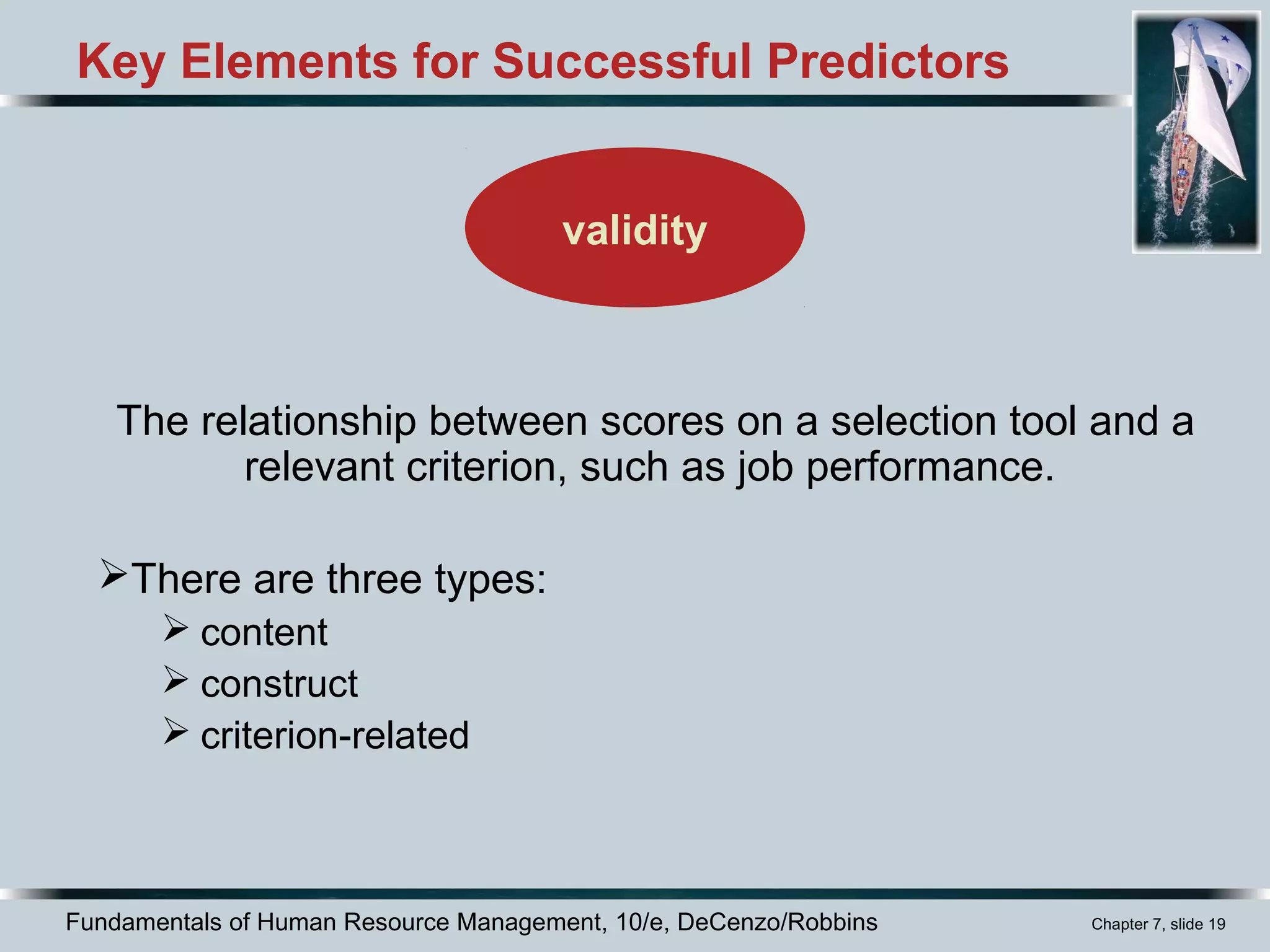
Key Elements for Successful Predictors
The relationship between scores on a selection tool and a
relevant criterion, such as job performance.
There are three types:
 content
 construct
 criterion-related
validity
Fundamentals of Human Resource Management, 10/e, DeCenzo/Robbins Chapter 7, slide 20
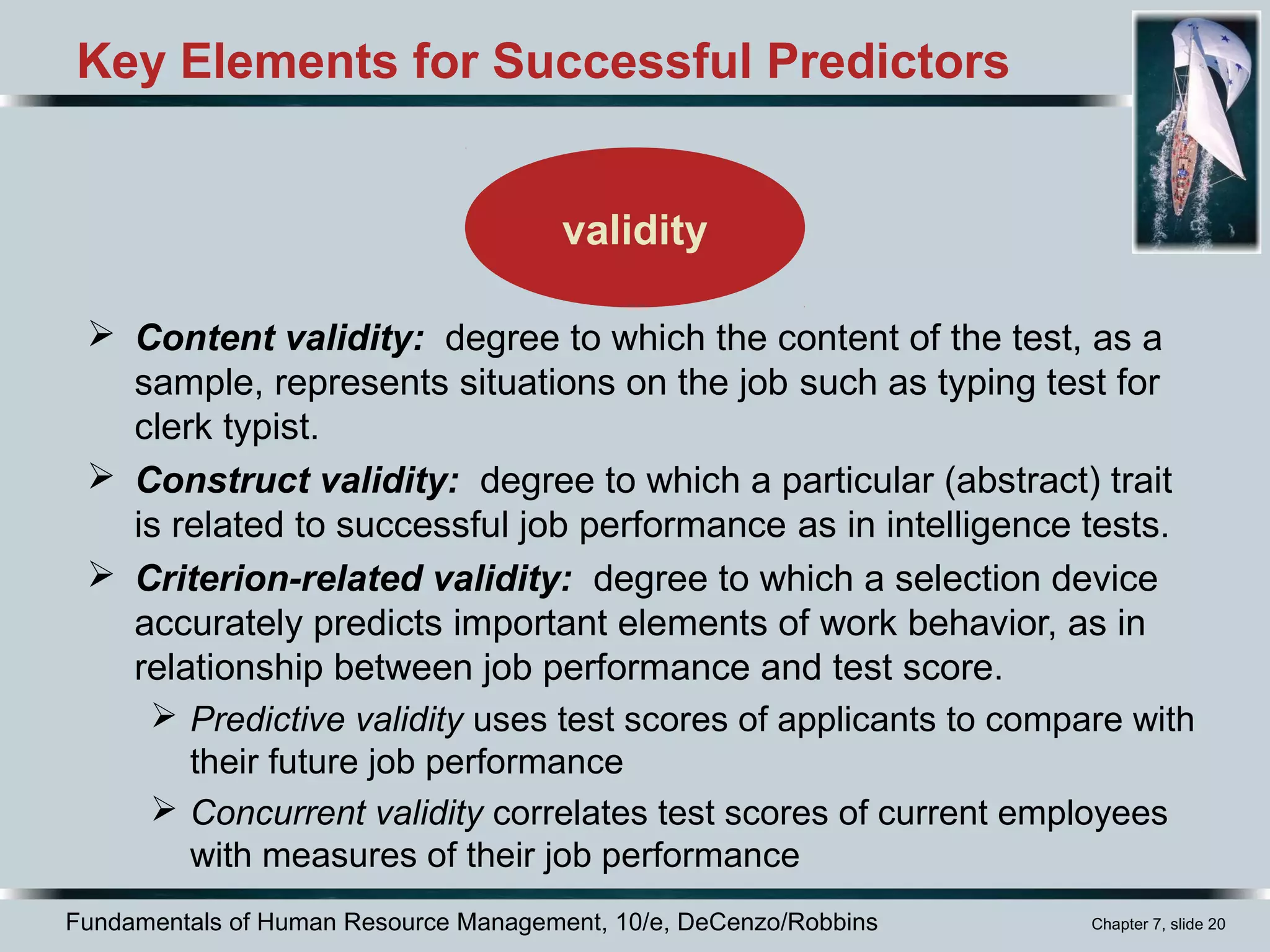
Key Elements for Successful Predictors
 Content validity: degree to which the content of the test, as a
sample, represents situations on the job such as typing test for
clerk typist.
 Construct validity: degree to which a particular (abstract) trait
is related to successful job performance as in intelligence tests.
 Criterion-related validity: degree to which a selection device
accurately predicts important elements of work behavior, as in
relationship between job performance and test score.
 Predictive validity uses test scores of applicants to compare with
their future job performance
 Concurrent validity correlates test scores of current employees
with measures of their job performance
validity
Fundamentals of Human Resource Management, 10/e, DeCenzo/Robbins Chapter 7, slide 21
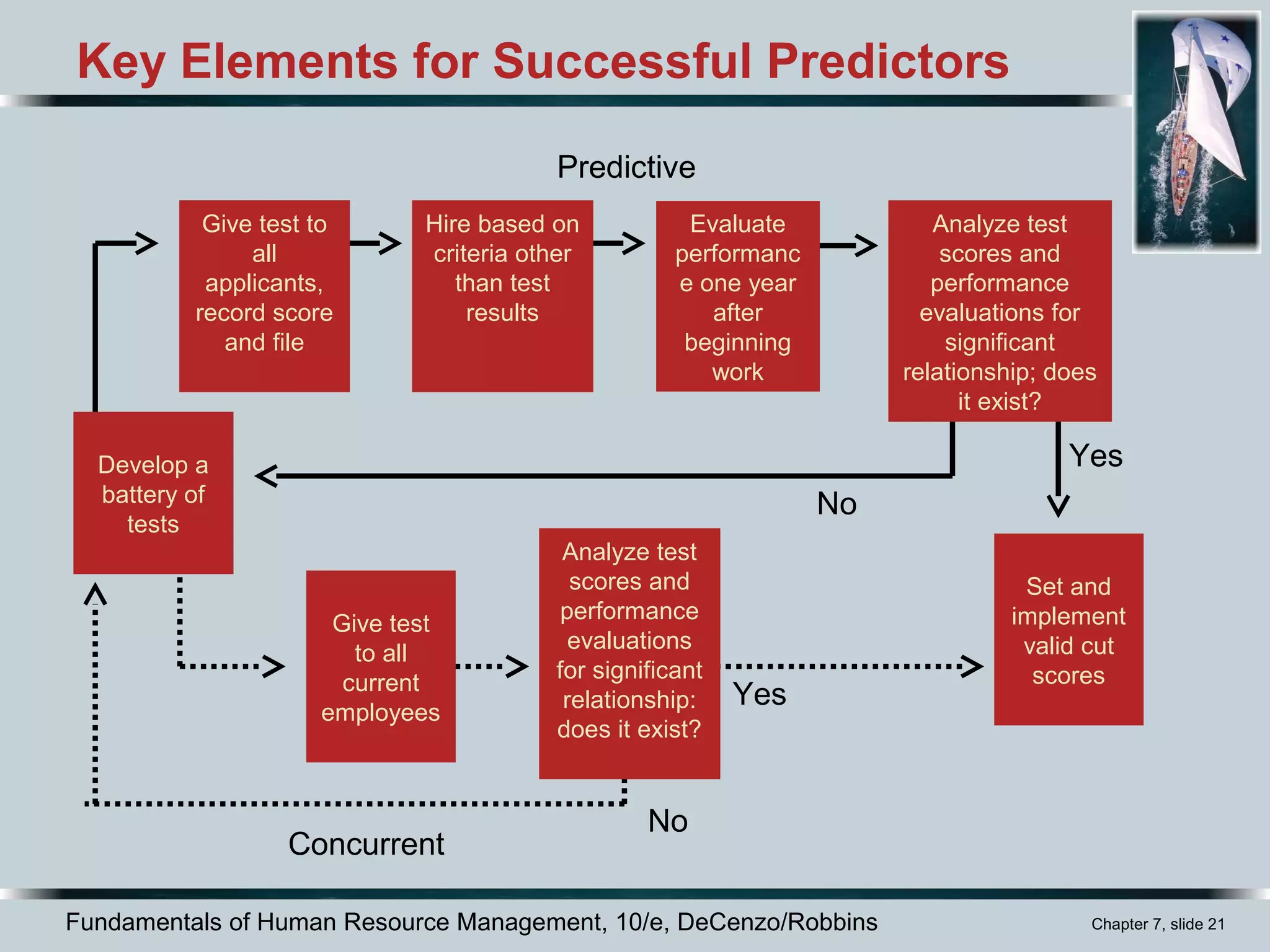
Key Elements for Successful Predictors
Give test to
all
applicants,
record score
and file
Hire based on
criteria other
than test
results
Evaluate
performanc
e one year
after
beginning
work
Set and
implement
valid cut
scores
Give test
to all
current
employees
Predictive
Concurrent
Develop a
battery of
tests
Analyze test
scores and
performance
evaluations for
significant
relationship; does
it exist?
Analyze test
scores and
performance
evaluations
for significant
relationship:
does it exist?
Yes
No
Yes
No
Fundamentals of Human Resource Management, 10/e, DeCenzo/Robbins Chapter 7, slide 22
Key Elements for Successful Predictors
The cut score separates successful
from unsuccessful performers.
 cut scores on a selection device can be determined by
validity studies
 applicants scoring below the cut score are predicted to be
unsuccessful on the job and are rejected
cut scores
Fundamentals of Human Resource Management, 10/e, DeCenzo/Robbins Chapter 7, slide 23
Excelling at the Interview
For the “don’t do’s” see
http://hotjobs.yahoo.com/career-articles-10_ways_to_be_liked_in_your_job_i
Suggestions for making your interviews as an
applicant successful:
1. do some homework on the company
2. get a good night’s rest the night before
3. dress appropriately
4. arrive for the interview a few minutes early
5. use a firm handshake
6. maintain good eye contact
7. take the opportunity to have practice interviews
8. thank the interviewer in person, and send a thank-you note

Chapter 7 HRM

  • 1.
    Fundamentals of HumanResource Management, 10/e, DeCenzo/Robbins Chapter 7, slide 1 Chapter 7 Selecting Employees
  • 2.
    Fundamentals of HumanResource Management, 10/e, DeCenzo/Robbins Chapter 7, slide 2 The Selection Process initial screening completed application employment test comprehensive interviewconditional job offer medical/physical examination (conditional job offer made) permanent job offer reject applicant background examination if required Passed Passed Able to perform essential elements of the job Passed Passed Passed Problems encountered Failed to impress interviewer and/or meet job expectations Failed test Failed to complete application or failed job specifications Failed to meet minimum qualifications Unfit to do essential elements of job The selection process typically consists of eight steps.
  • 3.
    Fundamentals of HumanResource Management, 10/e, DeCenzo/Robbins Chapter 7, slide 3 initial screening interview The Selection Process  weeding out of applicants who don’t meet general job requirements  screening interviews help candidates decide if position is suitable Job description information is shared along with a salary range.
  • 4.
    Fundamentals of HumanResource Management, 10/e, DeCenzo/Robbins Chapter 7, slide 4 The Selection Process completing the application Gives a job-performance-related synopsis of what applicants have been doing, their skills and accomplishments. Legal considerations 1. omit items that are not job-related; e.g., sex, religion 2. includes statement giving employer the right to dismiss an employee for falsifying information 3. asks for permission to check work references 4. typically includes “employment-at-will” statement
  • 5.
    Fundamentals of HumanResource Management, 10/e, DeCenzo/Robbins Chapter 7, slide 5 The Selection Process Weighted application forms  individual pieces of information are validated against performance and turnover measures and given appropriate weights  data must be collected for each job to determine how well a particular item (e.g., years of schooling, tenure on last job) predicts success on target job completing the application
  • 6.
    Fundamentals of HumanResource Management, 10/e, DeCenzo/Robbins Chapter 7, slide 6 The Selection Process  information collected on application forms can be highly predictive of successful job performance  forms must be validated and continuously reviewed and updated  data should be verified through background investigations completing the application
  • 7.
    Fundamentals of HumanResource Management, 10/e, DeCenzo/Robbins Chapter 7, slide 7 The Selection Process  performance simulation tests require applicants to engage in job behaviors necessary for doing the job successfully  work sampling uses job analysis to develop a miniature replica of the job so the applicant can demonstrate his/her skills  assessment centers give tests and exercises, (individual and group), to assess managerial potential or other complex skills Selection practices must be adapted to cultures and regulations of the host country. pre-employment testing
  • 8.
    Fundamentals of HumanResource Management, 10/e, DeCenzo/Robbins Chapter 7, slide 8 The Selection Process assesses motivation, values, ability to work under pressure, attitude, ability to fit in can be traditional, panel, or situational especially useful for high-turnover jobs and less routine ones comprehensive interviews Video: Justin Menkes, Interviewing for Executive Intelligence The interview is only as effective as those conducting it.
  • 9.
    Fundamentals of HumanResource Management, 10/e, DeCenzo/Robbins Chapter 7, slide 9 The Selection Process  impression management, (applicant’s desire to project the “right” image), may help to give positive interview results  behavioral interviews are much more effective at predicting job performance than traditional interviews  realistic job previews (brochures, videos, plant tours, work sampling) help reduce turnover rates comprehensive interviews
  • 10.
    Fundamentals of HumanResource Management, 10/e, DeCenzo/Robbins Chapter 7, slide 10 The Selection Process  HR manager makes an offer of employment, contingent on successful completion of background check, physical/medical exam, drug test, etc.  may use only job-related information to make a hiring decision conditional job offer
  • 11.
    Fundamentals of HumanResource Management, 10/e, DeCenzo/Robbins Chapter 7, slide 11 The Selection Process Verifies information from the application form. background investigation Online searches can yield too much information on applicants. See http://www.privacyrights.org/fs/fs16-bck.htm for an analysis of online background checks as they pertain to employer/employee rights. references former employers education legal status to work in U.S. criminal records
  • 12.
    Fundamentals of HumanResource Management, 10/e, DeCenzo/Robbins Chapter 7, slide 12 The Selection Process  qualified privilege: employers may discuss employees with prospective employers without fear of revenge as long as the discussion is about job-related, documented facts  one-third of all applicants exaggerate their backgrounds or experiences  a good predictor of future behavior is an individual’s past behavior Companies can be held liable for failure to properly hire. background investigation
  • 13.
    Fundamentals of HumanResource Management, 10/e, DeCenzo/Robbins Chapter 7, slide 13 The Selection Process  used only to determine if the individual can comply with essential functions of the job  Americans with Disabilities Act requires that exams be given only after conditional job offer is made  drug tests can be given at this time medical investigation
  • 14.
    Fundamentals of HumanResource Management, 10/e, DeCenzo/Robbins Chapter 7, slide 14 The Selection Process  actual hiring decision generally made by the department manager, not HR manager  candidates not hired deserve the courtesy of prompt notification job offer Resources for Job Seekers: Evaluating Companies Dun & Bradstreet’s Million Dollar Directory Standard and Poor’s Register of Corporations Mergent’s Industrial Review (formerly Moody’s Industrial Manual) Thomas Register of American Manufacturers Ward’s Business Directory From: http://www.bls.gov/oco/oco20046.htm
  • 15.
    Fundamentals of HumanResource Management, 10/e, DeCenzo/Robbins Chapter 7, slide 15 The Selection Process Comprehensive selection puts applicants through all the steps in the selection process before making a decision.  assesses both strengths and weaknesses, and is considered more realistic  must measure factors related to the job only The Comprehensive Approach
  • 16.
    Fundamentals of HumanResource Management, 10/e, DeCenzo/Robbins Chapter 7, slide 16 The Selection Process Now It’s Up to the Candidate  most people want jobs compatible with their personality  applicants who are not hired this time will still form an impression about the company  management should assure the selection process leaves them with a favorable impression of the company
  • 17.
    Fundamentals of HumanResource Management, 10/e, DeCenzo/Robbins Chapter 7, slide 17 Key Elements for Successful Predictors What test elements help predict which applicants will be successful on the job? reliability validity cut scores
  • 18.
    Fundamentals of HumanResource Management, 10/e, DeCenzo/Robbins Chapter 7, slide 18 Key Elements for Successful Predictors The ability of the selection tool to measure an attribute consistently.  HR managers need reliable tests to make sure the applicant will perform satisfactorily reliability There are companies that specialize in employment testing. For example, watch the demo at www.eSkill.com
  • 19.
    Fundamentals of HumanResource Management, 10/e, DeCenzo/Robbins Chapter 7, slide 19 Key Elements for Successful Predictors The relationship between scores on a selection tool and a relevant criterion, such as job performance. There are three types:  content  construct  criterion-related validity
  • 20.
    Fundamentals of HumanResource Management, 10/e, DeCenzo/Robbins Chapter 7, slide 20 Key Elements for Successful Predictors  Content validity: degree to which the content of the test, as a sample, represents situations on the job such as typing test for clerk typist.  Construct validity: degree to which a particular (abstract) trait is related to successful job performance as in intelligence tests.  Criterion-related validity: degree to which a selection device accurately predicts important elements of work behavior, as in relationship between job performance and test score.  Predictive validity uses test scores of applicants to compare with their future job performance  Concurrent validity correlates test scores of current employees with measures of their job performance validity
  • 21.
    Fundamentals of HumanResource Management, 10/e, DeCenzo/Robbins Chapter 7, slide 21 Key Elements for Successful Predictors Give test to all applicants, record score and file Hire based on criteria other than test results Evaluate performanc e one year after beginning work Set and implement valid cut scores Give test to all current employees Predictive Concurrent Develop a battery of tests Analyze test scores and performance evaluations for significant relationship; does it exist? Analyze test scores and performance evaluations for significant relationship: does it exist? Yes No Yes No
  • 22.
    Fundamentals of HumanResource Management, 10/e, DeCenzo/Robbins Chapter 7, slide 22 Key Elements for Successful Predictors The cut score separates successful from unsuccessful performers.  cut scores on a selection device can be determined by validity studies  applicants scoring below the cut score are predicted to be unsuccessful on the job and are rejected cut scores
  • 23.
    Fundamentals of HumanResource Management, 10/e, DeCenzo/Robbins Chapter 7, slide 23 Excelling at the Interview For the “don’t do’s” see http://hotjobs.yahoo.com/career-articles-10_ways_to_be_liked_in_your_job_i Suggestions for making your interviews as an applicant successful: 1. do some homework on the company 2. get a good night’s rest the night before 3. dress appropriately 4. arrive for the interview a few minutes early 5. use a firm handshake 6. maintain good eye contact 7. take the opportunity to have practice interviews 8. thank the interviewer in person, and send a thank-you note