Emerging Trends in
Consumer Behavior
Online Customer Behavior
• With the evolution of online communication through internet,
customers now see online advertisements of various brands. It is
fast catching up with the buying behavior of consumers and is a
major source of publicity for niche segments and also for
established brands.
• Examples − Online catalogues, Websites, or Search engines.
• When customers have sufficient information, they will need to
compare with the choices of products or services.
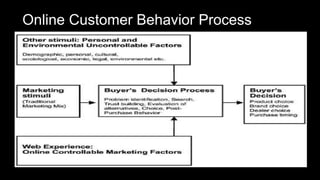
Online Customer Behavior Process
• According to the previous figure, in the search stage, Customer
might look for the product reviews or other customer comments.
They will find out which brand or company offers them the best fit
to their expectation.
• During this stage, well-organized web site structure and
attractive design are important things to persuade consumers to
be interested in buying product or service.
• Stage 1
The most useful characteristic of internet is that it supports the pre-
purchase stage as it helps customers compare different options.
• Stage 2
During the purchasing stage, product assortment, sale services and
information quality seem to be the most important point to help
consumers decide what product they should select, or what seller they
should buy from.
• Stage 3
Post-purchase behavior will become more important after their online
purchase. Consumers sometimes have a difficulty or concern about the
product, or they might want to change or return the product that they
have bought. Thus, return and exchange services become more
important at this stage
Factors of Online Customer Behavior
• The External Factors are the ones beyond the control of the
customers. They can divide into five sectors namely demographic,
socio-economic, technology and public policy; culture; sub- culture;
reference groups; and marketing.
• Internal Factors are the personal traits or behaviors which include
attitudes, learning, perception, motivation, self-image.
• The Functional Motives is related to the consumer needs and
include things like time, convenience of shopping online, price, the
environment of shopping place, selection of products etc.
• The Non-Functional Motives related to the culture or social values
like the brand of the store or product.
Filtering Elements
• Customers use these three factors to filter their buying choices
and decide on the final selection of stores they are willing to
purchase from. They use the knowledge to filter their purchase
options by three factors −
Security
Privacy
Trust and Trustworthiness
Use of Information technology
and AI in consumer profiling
and engagement
Customer
Engagement
• “Customer engagement is
the ongoing interactions
between company and
customer, offered by the
company, chosen by the
customer.” -Hubspot
• Today’s customer engagement exercises – customer
profiling, target marketing, lead scoring, technology
interventions – help reach out to potential customers in a
way they don’t feel their privacy is being violated.
• Customers also have the freedom to respond and to
choose how they want to interact with a business.
Customer profiling
• It is a way to create a portrait of your customers to help
you make design decisions concerning your service.
Your customers are broken down into groups
of customers sharing similar goals and characteristics
and each group is given a representative with a photo, a
name, and a description.
Capitalizing on Artificial
Intelligence and Automation to
Drive on Enhanced Customer
Experiences
• In recent times, Artificial Intelligence has emerged as a powerful
tool for brands and marketers. By leveraging advanced business
intelligence, AI-driven automated tools can turn data from
multiple, disparate sources into valuable insights.
• More interestingly, the more data is fed into the system, the more
accurate these insights become – and the higher is the business
value driven.
Capitalizing on Artificial Intelligence
and Automation to Drive on Enhanced
Customer Experiences
• By integrating an AI-based solution with the organization’s customer
relationship and data management interfaces, marketers can ensure more
accurate end-user assessments and deploy the right strategic interventions.
Such integrations can also offer the following benefits:
• Predicting churn
• Personalizing content
• Social analytics to understand customers
• Offer customers real-time recommendations
• Enabling smart customer interactions
Conclusion
• Today, adopting AI-driven solutions across various departments
like sales, marketing, and customer relationship management is
crucial for brands to ensure effective, proactive engagement with
their consumers.
• AI-driven technologies using multiple data sources enable
marketers to map each stage of the customer journey and
initiate meaningful engagement opportunities with them.
• It allows businesses to identify existing gaps in the customer
experience, extract relevant insights, and take the necessary
efforts to retain customers, keep them engaged, and increase
their delight with each interaction with the brand.
Concept of Materialistic vs
Spiritualistic consumption.
Materialism
• Consumer research typically looks at materialism in two ways: one as
a collection of personality traits; and the other as an enduring belief or
value.
• Materialism as a personality trait
• Russell W. Belk conceptualizes materialism to include three original
personality traits.
• Nongenerosity – an unwillingness to give or share possession with others.
• Envy – desire for other people's possessions.
• Possessiveness – concern about loss of possessions and a desire for the
greater control of ownership.
• Materialism as a value
• Acquisition centrality is when acquiring material possession functions as a
central life goal with the belief that possessions are the key to happiness and
that success can be judged by a person's material wealth and the quality and
price of material goods she or he can buy.[
Emerging trends in consumer behavior

Emerging trends in consumer behavior

  • 1.
  • 2.
    Online Customer Behavior •With the evolution of online communication through internet, customers now see online advertisements of various brands. It is fast catching up with the buying behavior of consumers and is a major source of publicity for niche segments and also for established brands. • Examples − Online catalogues, Websites, or Search engines. • When customers have sufficient information, they will need to compare with the choices of products or services.
  • 3.
  • 4.
    Online Customer BehaviorProcess • According to the previous figure, in the search stage, Customer might look for the product reviews or other customer comments. They will find out which brand or company offers them the best fit to their expectation. • During this stage, well-organized web site structure and attractive design are important things to persuade consumers to be interested in buying product or service.
  • 5.
    • Stage 1 Themost useful characteristic of internet is that it supports the pre- purchase stage as it helps customers compare different options. • Stage 2 During the purchasing stage, product assortment, sale services and information quality seem to be the most important point to help consumers decide what product they should select, or what seller they should buy from. • Stage 3 Post-purchase behavior will become more important after their online purchase. Consumers sometimes have a difficulty or concern about the product, or they might want to change or return the product that they have bought. Thus, return and exchange services become more important at this stage
  • 6.
    Factors of OnlineCustomer Behavior • The External Factors are the ones beyond the control of the customers. They can divide into five sectors namely demographic, socio-economic, technology and public policy; culture; sub- culture; reference groups; and marketing. • Internal Factors are the personal traits or behaviors which include attitudes, learning, perception, motivation, self-image. • The Functional Motives is related to the consumer needs and include things like time, convenience of shopping online, price, the environment of shopping place, selection of products etc. • The Non-Functional Motives related to the culture or social values like the brand of the store or product.
  • 7.
    Filtering Elements • Customersuse these three factors to filter their buying choices and decide on the final selection of stores they are willing to purchase from. They use the knowledge to filter their purchase options by three factors − Security Privacy Trust and Trustworthiness
  • 8.
    Use of Informationtechnology and AI in consumer profiling and engagement
  • 9.
    Customer Engagement • “Customer engagementis the ongoing interactions between company and customer, offered by the company, chosen by the customer.” -Hubspot
  • 10.
    • Today’s customerengagement exercises – customer profiling, target marketing, lead scoring, technology interventions – help reach out to potential customers in a way they don’t feel their privacy is being violated. • Customers also have the freedom to respond and to choose how they want to interact with a business.
  • 11.
    Customer profiling • Itis a way to create a portrait of your customers to help you make design decisions concerning your service. Your customers are broken down into groups of customers sharing similar goals and characteristics and each group is given a representative with a photo, a name, and a description.
  • 13.
    Capitalizing on Artificial Intelligenceand Automation to Drive on Enhanced Customer Experiences • In recent times, Artificial Intelligence has emerged as a powerful tool for brands and marketers. By leveraging advanced business intelligence, AI-driven automated tools can turn data from multiple, disparate sources into valuable insights. • More interestingly, the more data is fed into the system, the more accurate these insights become – and the higher is the business value driven.
  • 14.
    Capitalizing on ArtificialIntelligence and Automation to Drive on Enhanced Customer Experiences • By integrating an AI-based solution with the organization’s customer relationship and data management interfaces, marketers can ensure more accurate end-user assessments and deploy the right strategic interventions. Such integrations can also offer the following benefits: • Predicting churn • Personalizing content • Social analytics to understand customers • Offer customers real-time recommendations • Enabling smart customer interactions
  • 15.
    Conclusion • Today, adoptingAI-driven solutions across various departments like sales, marketing, and customer relationship management is crucial for brands to ensure effective, proactive engagement with their consumers. • AI-driven technologies using multiple data sources enable marketers to map each stage of the customer journey and initiate meaningful engagement opportunities with them. • It allows businesses to identify existing gaps in the customer experience, extract relevant insights, and take the necessary efforts to retain customers, keep them engaged, and increase their delight with each interaction with the brand.
  • 16.
    Concept of Materialisticvs Spiritualistic consumption.
  • 18.
    Materialism • Consumer researchtypically looks at materialism in two ways: one as a collection of personality traits; and the other as an enduring belief or value. • Materialism as a personality trait • Russell W. Belk conceptualizes materialism to include three original personality traits. • Nongenerosity – an unwillingness to give or share possession with others. • Envy – desire for other people's possessions. • Possessiveness – concern about loss of possessions and a desire for the greater control of ownership. • Materialism as a value • Acquisition centrality is when acquiring material possession functions as a central life goal with the belief that possessions are the key to happiness and that success can be judged by a person's material wealth and the quality and price of material goods she or he can buy.[