Chapter 8 Production & Cost in  the Short Run
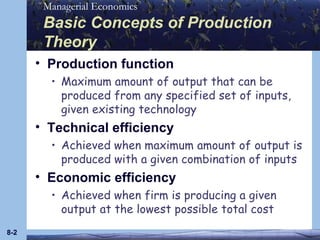
Basic Concepts of Production Theory Production function Maximum amount of output that can be produced from any specified set of inputs, given existing technology Technical efficiency Achieved when maximum amount of output is produced with a given combination of inputs Economic efficiency Achieved when firm is producing a given output at the lowest possible total cost 8-
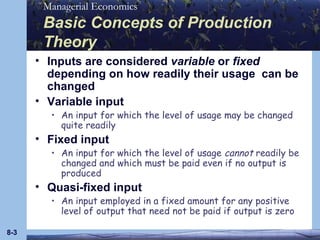
Basic Concepts of Production Theory Inputs are considered  variable  or  fixed  depending on how readily their usage  can be changed Variable input An input for which the level of usage may be changed quite readily Fixed input An input for which the level of usage  cannot  readily be changed and which must be paid even if no output is produced Quasi-fixed input An input employed in a fixed amount for any positive level of output that need not be paid if output is zero 8-
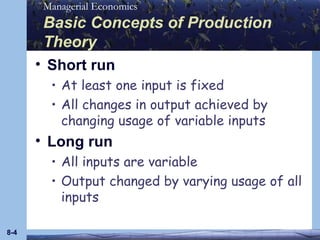
Basic Concepts of Production Theory Short run At least one input is fixed All changes in output achieved by changing usage of variable inputs Long run All inputs are variable Output changed by varying usage of all inputs 8-
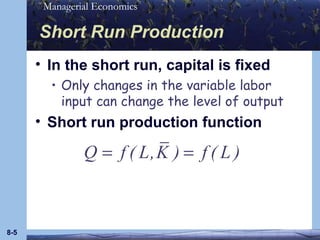
Short Run Production In the short run, capital is fixed Only changes in the variable labor input can change the level of output Short run production function 8-
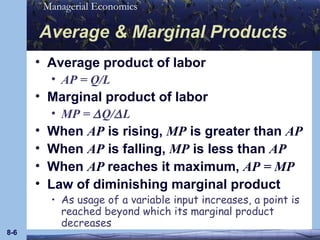
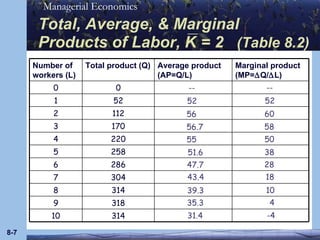
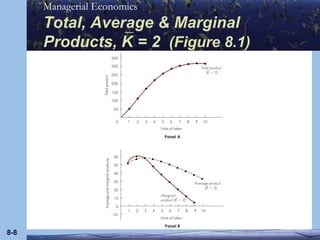
Average & Marginal Products Average product of labor AP = Q/L Marginal product of labor MP =   Q/  L When  AP  is rising,  MP  is greater than  AP When  AP  is falling,  MP  is less than  AP When  AP  reaches it maximum,  AP = MP Law of diminishing marginal product As usage of a variable input increases, a point is reached beyond which its marginal product decreases 8-
Total, Average, & Marginal Products of Labor, K = 2  (Table 8.2) 8- -- 55 51.6 52 56 56.7 47.7 43.4 39.3 35.3 31.4 -- 50 38 52 60 58 28 18 10 4 -4 Number of workers (L) Total product (Q) Average product (AP=Q/L) Marginal product (MP=  Q/  L) 0 0 1 52 2 112 3 170 4 220 5 258 6 286 7 304 8 314 9 318 10 314
Total, Average & Marginal Products, K = 2  (Figure 8.1) 8-
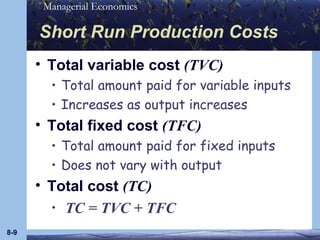
Short Run Production Costs Total variable cost  (TVC) Total amount paid for variable inputs Increases as output increases Total fixed cost  (TFC) Total amount paid for fixed inputs Does not vary with output Total cost  (TC) TC = TVC + TFC 8-
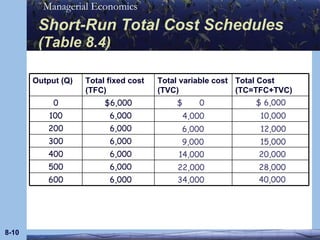
Short-Run Total Cost Schedules  (Table 8.4) 8- $  0 14,000 22,000 4,000 6,000 9,000 34,000 $ 6,000 20,000 28,000 10,000 12,000 15,000 40,000 Output (Q) Total fixed cost (TFC) Total variable cost (TVC) Total Cost (TC=TFC+TVC) 0 $6,000 100 6,000 200 6,000 300 6,000 400 6,000 500 6,000 600 6,000
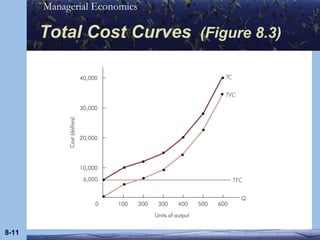
Total Cost Curves   (Figure 8.3) 8-
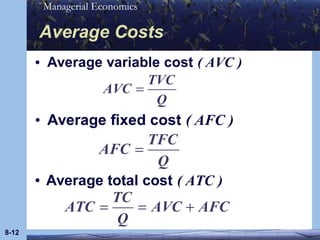
Average Costs 8- • • •
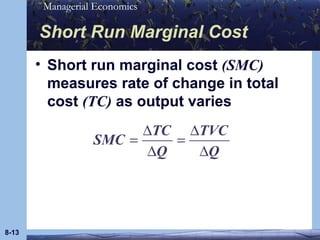
Short Run Marginal Cost Short run marginal cost  (SMC)  measures rate of change in total cost  (TC)  as output varies 8-
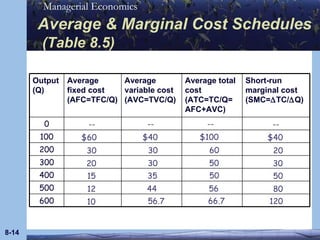
Average & Marginal Cost Schedules  (Table 8.5) 8- -- 15 12 $60 30 20 10 -- 35 44 $40 30 30 56.7 -- 50 56 $100 60 50 66.7 -- 50 80 $40 20 30 120 Output (Q) Average fixed cost (AFC=TFC/Q) Average variable cost (AVC=TVC/Q) Average total cost (ATC=TC/Q= AFC+AVC) Short-run marginal cost (SMC=  TC/  Q) 0 100 200 300 400 500 600
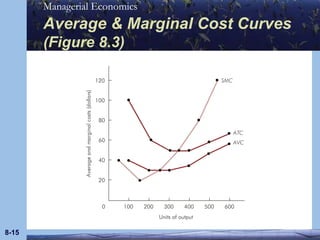
Average & Marginal Cost Curves  (Figure 8.3) 8-
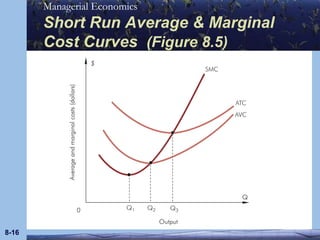
Short Run Average & Marginal Cost Curves  (Figure 8.5) 8-
Short Run Cost Curve Relations AFC  decreases continuously as output increases Equal to vertical distance between  ATC  &  AVC AVC  is  U -shaped Equals  SMC  at  AVC’s  minimum ATC  is  U -shaped Equals  SMC  at  ATC’s  minimum 8-
Short Run Cost Curve Relations SMC  is  U -shaped Intersects  AVC  &  ATC  at their minimum points Lies below  AVC  &  ATC  when  AVC  &  ATC  are falling Lies above  AVC  &  ATC  when  AVC  &  ATC  are rising 8-
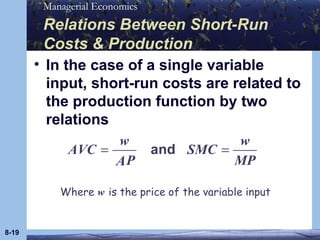
In the case of a single variable input, short-run costs are related to the production function by two relations Relations Between Short-Run Costs & Production 8- A

Chapter 8 su1

  • 1.
    Chapter 8 Production& Cost in the Short Run
  • 2.
    Basic Concepts ofProduction Theory Production function Maximum amount of output that can be produced from any specified set of inputs, given existing technology Technical efficiency Achieved when maximum amount of output is produced with a given combination of inputs Economic efficiency Achieved when firm is producing a given output at the lowest possible total cost 8-
  • 3.
    Basic Concepts ofProduction Theory Inputs are considered variable or fixed depending on how readily their usage can be changed Variable input An input for which the level of usage may be changed quite readily Fixed input An input for which the level of usage cannot readily be changed and which must be paid even if no output is produced Quasi-fixed input An input employed in a fixed amount for any positive level of output that need not be paid if output is zero 8-
  • 4.
    Basic Concepts ofProduction Theory Short run At least one input is fixed All changes in output achieved by changing usage of variable inputs Long run All inputs are variable Output changed by varying usage of all inputs 8-
  • 5.
    Short Run ProductionIn the short run, capital is fixed Only changes in the variable labor input can change the level of output Short run production function 8-
  • 6.
    Average & MarginalProducts Average product of labor AP = Q/L Marginal product of labor MP =  Q/  L When AP is rising, MP is greater than AP When AP is falling, MP is less than AP When AP reaches it maximum, AP = MP Law of diminishing marginal product As usage of a variable input increases, a point is reached beyond which its marginal product decreases 8-
  • 7.
    Total, Average, &Marginal Products of Labor, K = 2 (Table 8.2) 8- -- 55 51.6 52 56 56.7 47.7 43.4 39.3 35.3 31.4 -- 50 38 52 60 58 28 18 10 4 -4 Number of workers (L) Total product (Q) Average product (AP=Q/L) Marginal product (MP=  Q/  L) 0 0 1 52 2 112 3 170 4 220 5 258 6 286 7 304 8 314 9 318 10 314
  • 8.
    Total, Average &Marginal Products, K = 2 (Figure 8.1) 8-
  • 9.
    Short Run ProductionCosts Total variable cost (TVC) Total amount paid for variable inputs Increases as output increases Total fixed cost (TFC) Total amount paid for fixed inputs Does not vary with output Total cost (TC) TC = TVC + TFC 8-
  • 10.
    Short-Run Total CostSchedules (Table 8.4) 8- $ 0 14,000 22,000 4,000 6,000 9,000 34,000 $ 6,000 20,000 28,000 10,000 12,000 15,000 40,000 Output (Q) Total fixed cost (TFC) Total variable cost (TVC) Total Cost (TC=TFC+TVC) 0 $6,000 100 6,000 200 6,000 300 6,000 400 6,000 500 6,000 600 6,000
  • 11.
    Total Cost Curves (Figure 8.3) 8-
  • 12.
    Average Costs 8-• • •
  • 13.
    Short Run MarginalCost Short run marginal cost (SMC) measures rate of change in total cost (TC) as output varies 8-
  • 14.
    Average & MarginalCost Schedules (Table 8.5) 8- -- 15 12 $60 30 20 10 -- 35 44 $40 30 30 56.7 -- 50 56 $100 60 50 66.7 -- 50 80 $40 20 30 120 Output (Q) Average fixed cost (AFC=TFC/Q) Average variable cost (AVC=TVC/Q) Average total cost (ATC=TC/Q= AFC+AVC) Short-run marginal cost (SMC=  TC/  Q) 0 100 200 300 400 500 600
  • 15.
    Average & MarginalCost Curves (Figure 8.3) 8-
  • 16.
    Short Run Average& Marginal Cost Curves (Figure 8.5) 8-
  • 17.
    Short Run CostCurve Relations AFC decreases continuously as output increases Equal to vertical distance between ATC & AVC AVC is U -shaped Equals SMC at AVC’s minimum ATC is U -shaped Equals SMC at ATC’s minimum 8-
  • 18.
    Short Run CostCurve Relations SMC is U -shaped Intersects AVC & ATC at their minimum points Lies below AVC & ATC when AVC & ATC are falling Lies above AVC & ATC when AVC & ATC are rising 8-
  • 19.
    In the caseof a single variable input, short-run costs are related to the production function by two relations Relations Between Short-Run Costs & Production 8- A