1
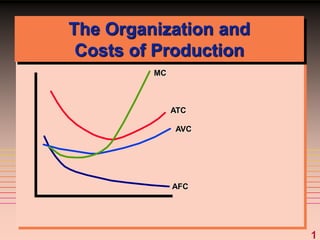
The Organization and
Costs of Production
AFC
AVC
ATC
MC
2
In this chapter you will learn
 The various organizational forms a firm
can take
 The nature of economic costs
 About a firm’s short-run production
relationships
 About a firm’s short-run production
costs
 The link between a firm’s size and
costs in the long run
3
Topics to be covered
 The Business Sector
 Economic Costs
 Short-Run Production Relationships
 Short-Run Production Costs
 Long-Run Production Costs
4
Terminology....
1- PLANT
one location
The Business Sector
5
Terminology....
1- PLANT
2- FIRM
one business
organization
with
one or more
plants
The Business Sector
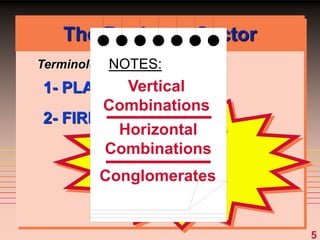
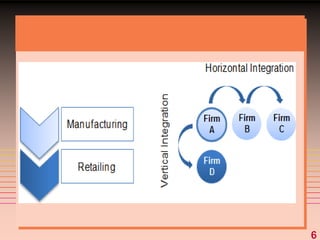
NOTES:
Vertical
Combinations
Horizontal
Combinations
Conglomerates
6
7
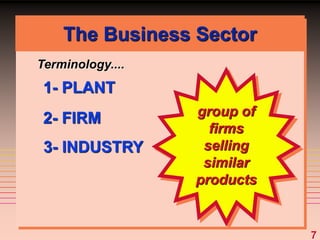
Terminology....
1- PLANT
2- FIRM group of
firms
selling
similar
products
3- INDUSTRY
The Business Sector
8
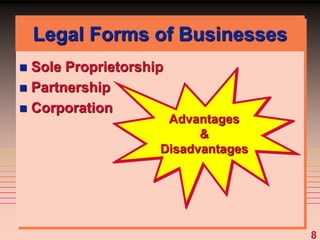
Legal Forms of Businesses
 Sole Proprietorship
 Partnership
 Corporation
Advantages
&
Disadvantages
9
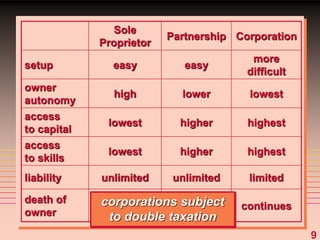
Sole
Proprietor
Partnership Corporation
setup easy easy
more
difficult
owner
autonomy
high lower lowest
access
to capital
lowest higher highest
access
to skills
lowest higher highest
liability unlimited unlimited limited
death of
owner
dissolves dissolves continues
corporations subject
to double taxation
10
Legal Forms of Businesses
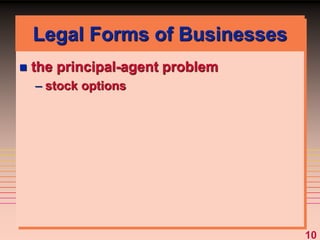
 the principal-agent problem
– stock options
11
Topics
 The Business Sector
 Economic Costs
 Short-Run Production Relationships
 Short-Run Production Costs
 Long-Run Production Costs
12
Economic Costs...
...are Opportunity Costs
13
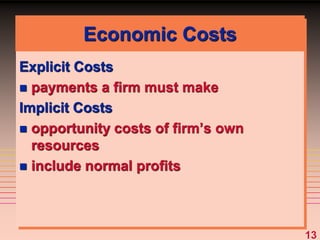
Explicit Costs
 payments a firm must make
Implicit Costs
 opportunity costs of firm’s own
resources
 include normal profits
Economic Costs
14
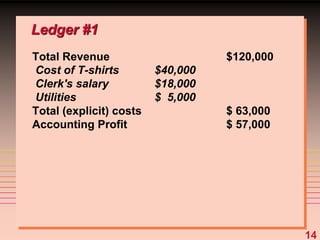
Ledger #1
Total Revenue $120,000
Cost of T-shirts $40,000
Clerk's salary $18,000
Utilities $ 5,000
Total (explicit) costs $ 63,000
Accounting Profit $ 57,000
15
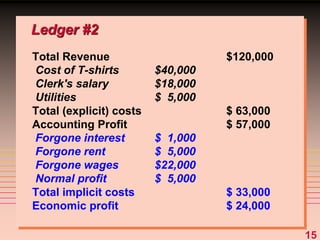
Ledger #2
Total Revenue $120,000
Cost of T-shirts $40,000
Clerk's salary $18,000
Utilities $ 5,000
Total (explicit) costs $ 63,000
Accounting Profit $ 57,000
Forgone interest $ 1,000
Forgone rent $ 5,000
Forgone wages $22,000
Normal profit $ 5,000
Total implicit costs $ 33,000
Economic profit $ 24,000
16
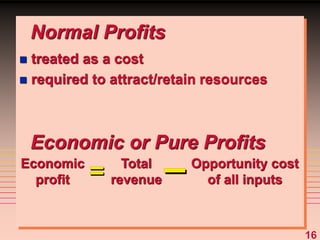
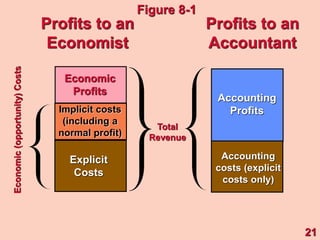
Economic
profit
Total
revenue
Opportunity cost
of all inputs
Normal Profits
Economic or Pure Profits
 treated as a cost
 required to attract/retain resources
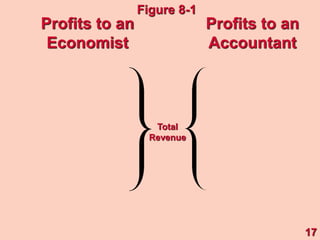
Total
Revenue
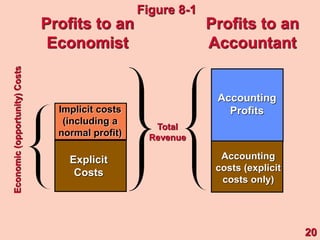
Profits to an
Economist
Profits to an
Accountant
17
Figure 8-1
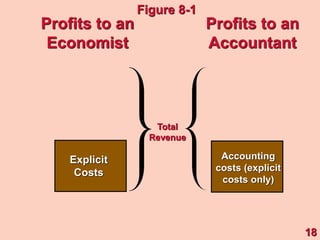
Explicit
Costs
Accounting
costs (explicit
costs only)
Total
Revenue
Profits to an
Economist
Profits to an
Accountant
18
Figure 8-1
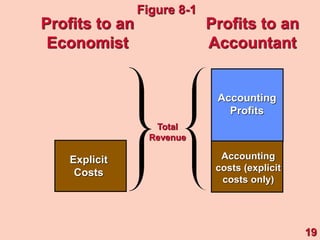
Explicit
Costs
Accounting
costs (explicit
costs only)
Accounting
Profits
Total
Revenue
Profits to an
Economist
Profits to an
Accountant
19
Figure 8-1
Implicit costs
(including a
normal profit)
Explicit
Costs
Accounting
costs (explicit
costs only)
Accounting
Profits
Economic
(opportunity)
Costs
Total
Revenue
Profits to an
Economist
Profits to an
Accountant
20
Figure 8-1
Economic
Profits
Implicit costs
(including a
normal profit)
Explicit
Costs
Accounting
costs (explicit
costs only)
Accounting
Profits
Economic
(opportunity)
Costs
Total
Revenue
Profits to an
Economist
Profits to an
Accountant
21
Figure 8-1
22
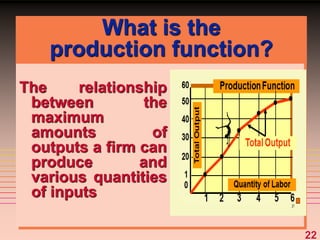
What is the
production function?
The relationship
between the
maximum
amounts of
outputs a firm can
produce and
various quantities
of inputs
23
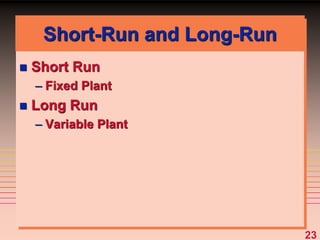
Short-Run and Long-Run
 Short Run
– Fixed Plant
 Long Run
– Variable Plant
24
Topics
 The Business Sector
 Economic Costs
 Short-Run Production Relationships
 Short-Run Production Costs
 Long-Run Production Costs
25
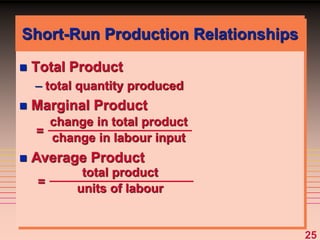
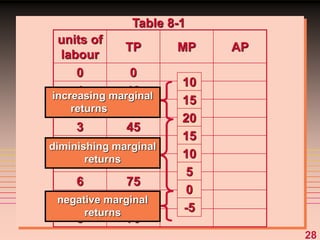
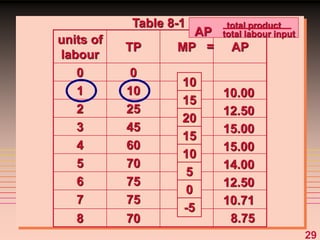
Short-Run Production Relationships
 Total Product
– total quantity produced
 Marginal Product
 Average Product
change in total product
change in labour input
=
total product
units of labour
=
26
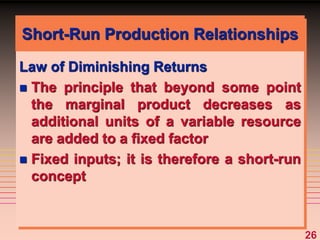
Short-Run Production Relationships
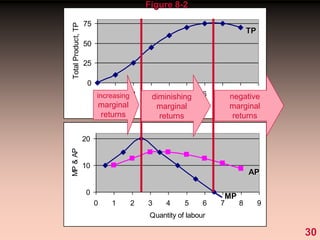
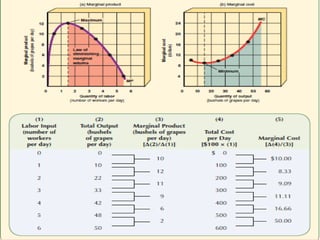
Law of Diminishing Returns
 The principle that beyond some point
the marginal product decreases as
additional units of a variable resource
are added to a fixed factor
 Fixed inputs; it is therefore a short-run
concept
27
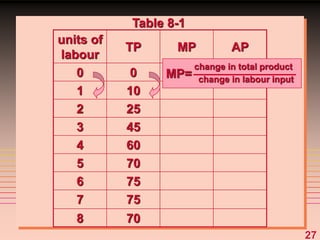
units of
labour
TP MP AP
0 0
1 10
2 25
3 45
4 60
5 70
6 75
7 75
8 70
change in total product
change in labour input
MP=
Table 8-1
28
units of
labour
TP MP AP
0 0
1 10
2 25
3 45
4 60
5 70
6 75
7 75
8 70
10
15
20
15
10
5
0
-5
increasing marginal
returns
diminishing marginal
returns
negative marginal
returns
Table 8-1
29
units of
labour
TP MP AP
0 0
1 10
2 25
3 45
4 60
5 70
6 75
7 75
8 70
10
15
20
15
10
5
0
-5
10.00
12.50
15.00
15.00
14.00
12.50
10.71
8.75
total product
total labour input
AP
=
Table 8-1
0
25
50
75
0 1 2 3 4 5 6 7 8 9
Quantity of labour
Total
Product,
TP
0
10
20
0 1 2 3 4 5 6 7 8 9
Quantity of labour
MP
&
AP
AP
MP
TP
increasing
marginal
returns
diminishing
marginal
returns
negative
marginal
returns
30
Figure 8-2
31
Marginal & Average Values
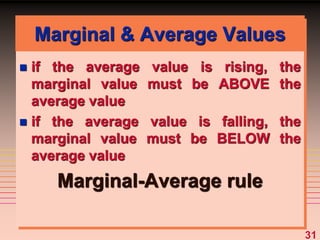
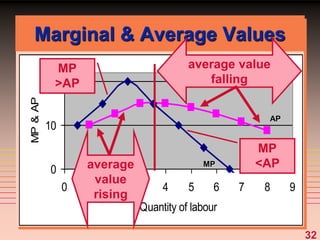
 if the average value is rising, the
marginal value must be ABOVE the
average value
 if the average value is falling, the
marginal value must be BELOW the
average value
Marginal-Average rule
32
Marginal & Average Values
0
10
20
0 1 2 3 4 5 6 7 8 9
Quantity of labour
MP
&
AP
AP
MP
MP
>AP
MP
<AP
average
value
rising
average value
falling
33
Topics
 The Business Sector
 Economic Costs
 Short-Run Production Relationships
 Short-Run Production Costs
 Long-Run Production Costs
34
Fixed Cost
• does not vary with output
Short-Run Production Costs
35
Fixed Cost
Total fixed cost
Short-Run Production Costs
36
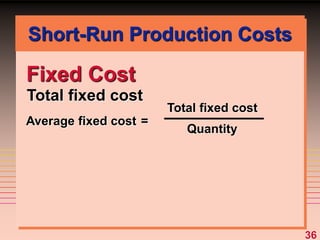
Fixed Cost
Total fixed cost
Average fixed cost =
Total fixed cost
Quantity
Short-Run Production Costs
37
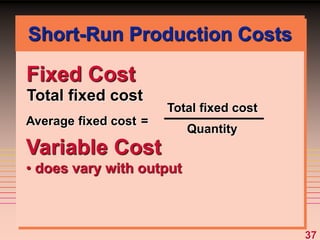
Fixed Cost
Total fixed cost
Variable Cost
• does vary with output
Average fixed cost =
Total fixed cost
Quantity
Short-Run Production Costs
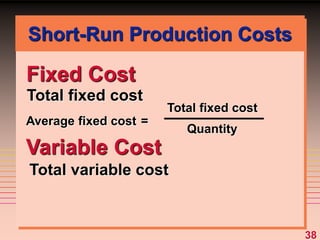
38
Fixed Cost
Total fixed cost
Variable Cost
Total variable cost
Average fixed cost =
Total fixed cost
Quantity
Short-Run Production Costs
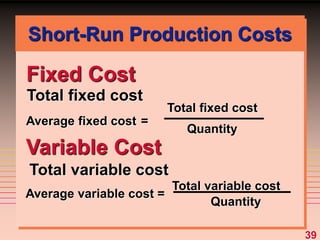
39
Fixed Cost
Total fixed cost
Variable Cost
Average variable cost =
Total variable cost
Quantity
Average fixed cost =
Total fixed cost
Quantity
Total variable cost
Short-Run Production Costs
40
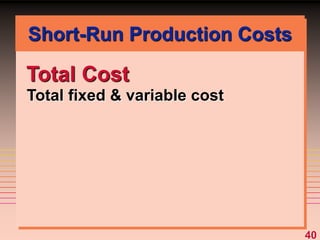
Total Cost
Total fixed & variable cost
Short-Run Production Costs
41
Total Cost
Total fixed & variable cost
Average total cost =
Total cost
Quantity
Short-Run Production Costs
42
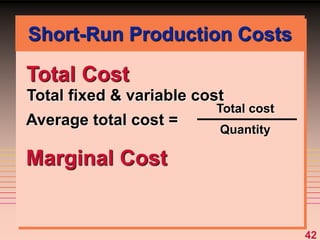
Total Cost
Total fixed & variable cost
Marginal Cost
Average total cost =
Total cost
Quantity
Short-Run Production Costs
43
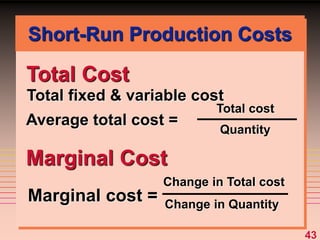
Total Cost
Total fixed & variable cost
Marginal Cost
Marginal cost =
Change in Total cost
Change in Quantity
Average total cost =
Total cost
Quantity
Short-Run Production Costs
44
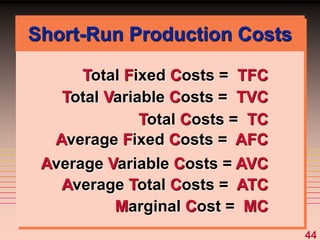
Marginal Cost = MC
Total Fixed Costs = TFC
Total Variable Costs = TVC
Average Variable Costs = AVC
Total Costs = TC
Average Total Costs = ATC
Average Fixed Costs = AFC
Short-Run Production Costs
Q TFC TVC TC AFC AVC ATC MC
0 100
1
2
3
4
5
6
7
8
9
10
45
Table 8-2
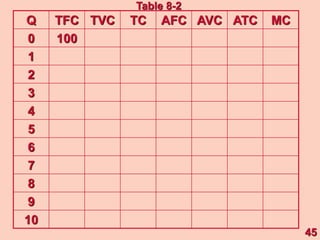
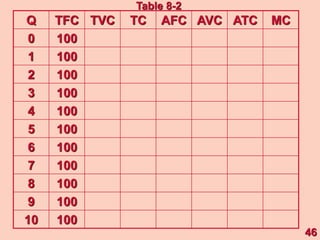
Q TFC TVC TC AFC AVC ATC MC
0 100
1 100
2 100
3 100
4 100
5 100
6 100
7 100
8 100
9 100
10 100
46
Table 8-2
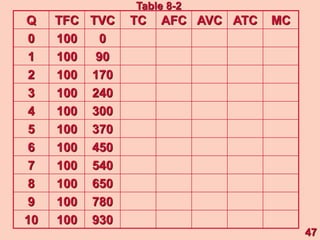
Q TFC TVC TC AFC AVC ATC MC
0 100 0
1 100 90
2 100 170
3 100 240
4 100 300
5 100 370
6 100 450
7 100 540
8 100 650
9 100 780
10 100 930
47
Table 8-2
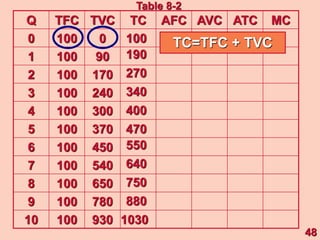
Q TFC TVC TC AFC AVC ATC MC
0 100 0
1 100 90
2 100 170
3 100 240
4 100 300
5 100 370
6 100 450
7 100 540
8 100 650
9 100 780
10 100 930
100
190
270
340
400
470
550
640
750
880
1030
TC=TFC + TVC
48
Table 8-2
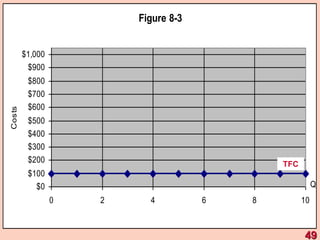
Figure 8-3
$0
$100
$200
$300
$400
$500
$600
$700
$800
$900
$1,000
0 2 4 6 8 10
Q
Costs
TFC
49
Figure 8-3
$0
$100
$200
$300
$400
$500
$600
$700
$800
$900
$1,000
0 2 4 6 8 10
Q
Costs
TFC
TVC
50
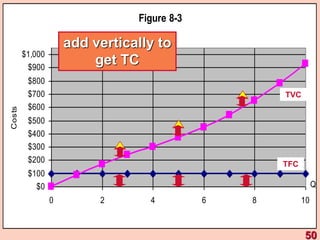
add vertically to
get TC
Figure 8-3
$0
$100
$200
$300
$400
$500
$600
$700
$800
$900
$1,000
0 2 4 6 8 10
Q
Costs
TFC
TVC
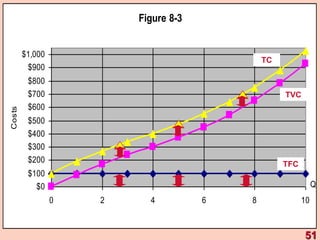
TC
51
Q TFC TVC TC AFC AVC ATC MC
0 100 0
1 100 90
2 100 170
3 100 240
4 100 300
5 100 370
6 100 450
7 100 540
8 100 650
9 100 780
10 100 930
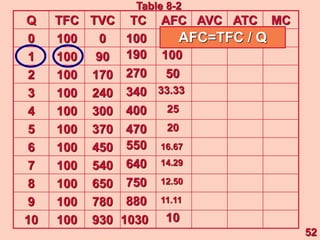
100
190
270
340
400
470
550
640
750
880
1030
100
50
33.33
25
20
16.67
14.29
12.50
11.11
10
AFC=TFC / Q
52
Table 8-2
Q TFC TVC TC AFC AVC ATC MC
0 100 0
1 100 90
2 100 170
3 100 240
4 100 300
5 100 370
6 100 450
7 100 540
8 100 650
9 100 780
10 100 930
100
190
270
340
400
470
550
640
750
880
1030
100
50
33.33
25
20
16.67
14.29
12.50
11.11
10
90
85
80
75
74
75
77.14
81.25
86.67
93
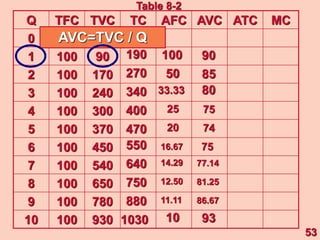
AVC=TVC / Q
53
Table 8-2
Q TFC TVC TC AFC AVC ATC MC
0 100 0
1 100 90
2 100 170
3 100 240
4 100 300
5 100 370
6 100 450
7 100 540
8 100 650
9 100 780
10 100 930
100
190
270
340
400
470
550
640
750
880
1030
100
50
33.33
25
20
16.67
14.29
12.50
11.11
10
90
85
80
75
74
75
77.14
81.25
86.67
93
190
135
113.33
100
94
91.67
91.43
93.75
97.78
103
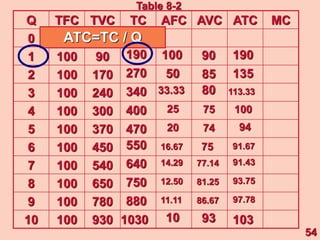
ATC=TC / Q
54
Table 8-2
Q TFC TVC TC AFC AVC ATC MC
0 100 0
1 100 90
2 100 170
3 100 240
4 100 300
5 100 370
6 100 450
7 100 540
8 100 650
9 100 780
10 100 930
100
190
270
340
400
470
550
640
750
880
1030
100
50
33.33
25
20
16.67
14.29
12.50
11.11
10
90
85
80
75
74
75
77.14
81.25
86.67
93
190
135
113.33
100
94
91.67
91.43
93.75
97.78
103
90
80
70
60
70
80
90
110
130
150
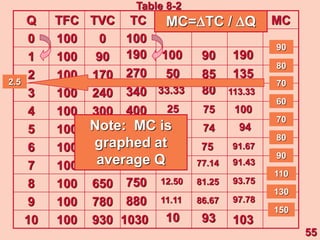
MC=TC / Q
55
MC=TC / Q
Note: MC is
graphed at
average Q
2.5
Table 8-2
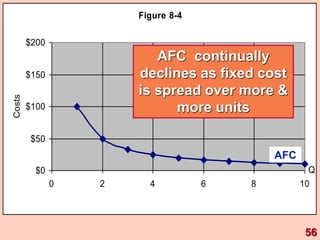
Figure 8-4
$0
$50
$100
$150
$200
0 2 4 6 8 10
Q
Costs
AFC
AFC continually
declines as fixed cost
is spread over more &
more units
56
Figure 8-4
$0
$50
$100
$150
$200
0 2 4 6 8 10
Q
Costs
AFC
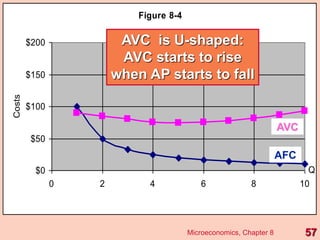
AVC
AVC is U-shaped:
AVC starts to rise
when AP starts to fall
57
Microeconomics, Chapter 8
Figure 8-4
$0
$50
$100
$150
$200
0 2 4 6 8 10
Q
Costs
AFC
AVC
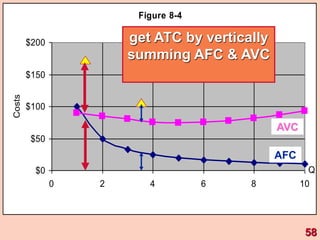
get ATC by vertically
summing AFC & AVC
58
Figure 8-4
$0
$50
$100
$150
$200
0 2 4 6 8 10
Q
Costs
AFC
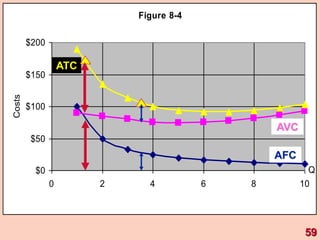
ATC
AVC
59
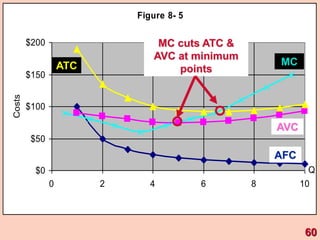
Figure 8- 5
$0
$50
$100
$150
$200
0 2 4 6 8 10
Q
Costs
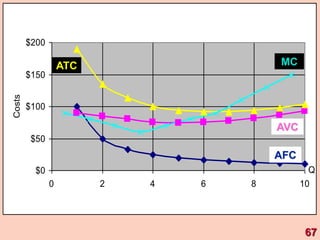
AFC
ATC MC
AVC
MC cuts ATC &
AVC at minimum
points
60
61
61
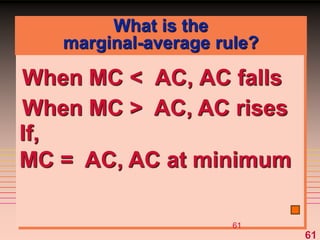
What is the
marginal-average rule?
When MC < AC, AC falls
When MC > AC, AC rises
If,
MC = AC, AC at minimum
Quantity of labour
Costs
(dollars)
Average
Product
and
Marginal
Product
Quantity of labour
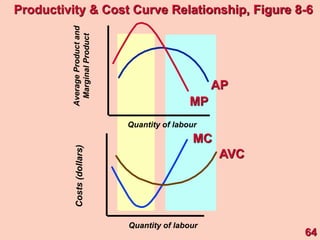
Productivity & Cost Curve Relationship, Figure 8-6
62
Quantity of labour
Costs
(dollars)
Average
Product
and
Marginal
Product
Quantity of
labour
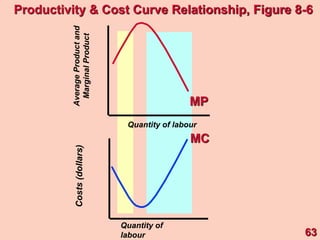
MP
MC
63
Productivity & Cost Curve Relationship, Figure 8-6
Quantity of labour
Costs
(dollars)
Average
Product
and
Marginal
Product
Quantity of labour
MP
AP
MC
AVC
64
Productivity & Cost Curve Relationship, Figure 8-6
65
66
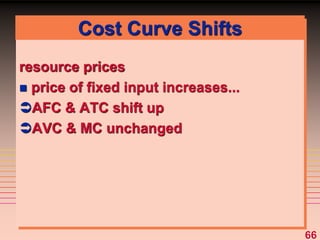
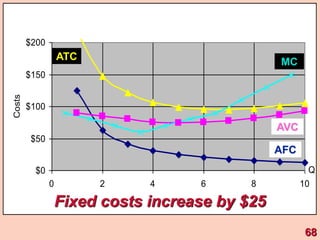
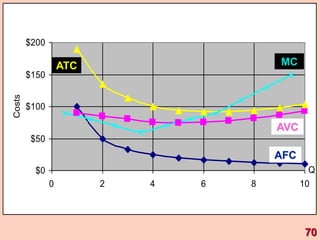
Cost Curve Shifts
resource prices
 price of fixed input increases...
AFC & ATC shift up
AVC & MC unchanged
$0
$50
$100
$150
$200
0 2 4 6 8 10
Q
Costs
AFC
ATC MC
AVC
67
$0
$50
$100
$150
$200
0 2 4 6 8 10
Q
Costs
AFC
ATC MC
AVC
Fixed costs increase by $25
68
69
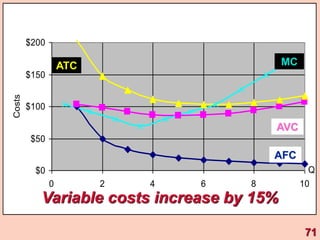
Cost Curve Shifts
resource prices
 price of variable input increases...
AVC, ATC & MC shift up
AFC unchanged
$0
$50
$100
$150
$200
0 2 4 6 8 10
Q
Costs
AFC
ATC MC
AVC
70
$0
$50
$100
$150
$200
0 2 4 6 8 10
Q
Costs
AFC
ATC MC
AVC
Variable costs increase by 15%
71
72
Cost Curve Shifts
technology
 improved technology
lower costs
cost curves shift down
 curve shifts depend on whether
technology affects FC, VC or both
73
Topics
 The Business Sector
 Economic Costs
 Short-Run Production Relationships
 Short-Run Production Costs
 Long-Run Production Costs
74
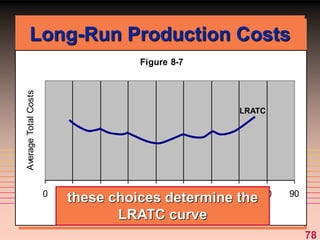
Long-Run Production Costs
 What will costs look like when the firm
can choose the best plant size for any
given situation?
75
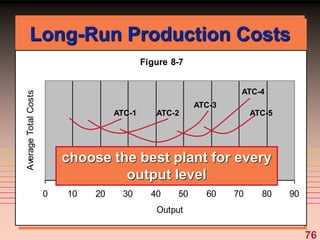
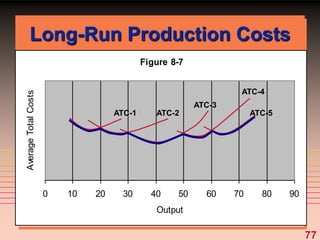
Long-Run Production Costs
 For every plant capacity size, there is a
short-run ATC curve
 All such plant capacities can be
plotted....
76
Long-Run Production Costs
Figure 8-7
0 10 20 30 40 50 60 70 80 90
Output
Average
Total
Costs
ATC-1 ATC-2
ATC-3
ATC-4
ATC-5
choose the best plant for every
output level
77
Long-Run Production Costs
Figure 8-7
0 10 20 30 40 50 60 70 80 90
Output
Average
Total
Costs
ATC-1 ATC-2
ATC-3
ATC-4
ATC-5
78
Long-Run Production Costs
Figure 8-7
0 10 20 30 40 50 60 70 80 90
Output
Average
Total
Costs
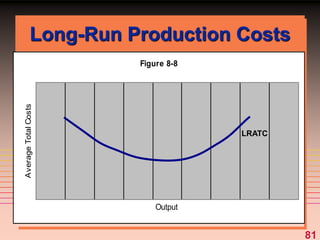
these choices determine the
LRATC curve
LRATC
79
Long-Run Production Costs
Figure 8-8
Output
Average
Total
Costs
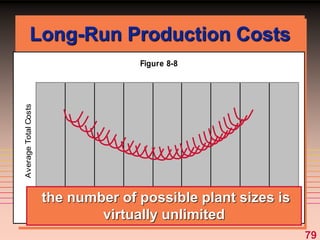
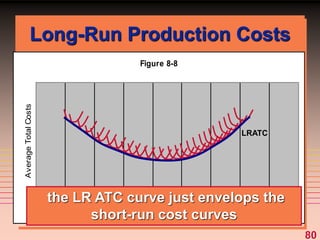
the number of possible plant sizes is
virtually unlimited
80
Figure 8-8
Output
Average
Total
Costs
Long-Run Production Costs
the LR ATC curve just envelops the
short-run cost curves
LRATC
81
Figure 8-8
Output
Average
Total
Costs
Long-Run Production Costs
LRATC
82
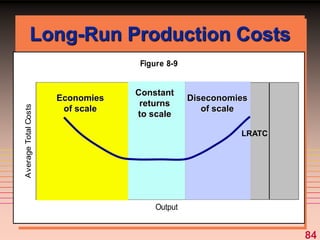
Figure 8-9
Output
Average
Total
Costs
Long-Run Production Costs
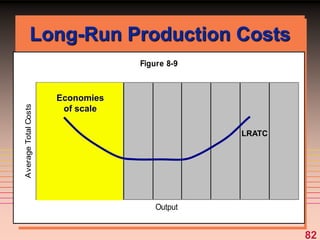
LRATC
Economies
of scale
83
Figure 8-9
Output
Average
Total
Costs
Long-Run Production Costs
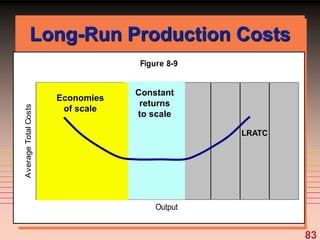
LRATC
Constant
returns
to scale
Economies
of scale
84
Figure 8-9
Output
Average
Total
Costs
Long-Run Production Costs
Economies
of scale
Constant
returns
to scale
Diseconomies
of scale
LRATC
85
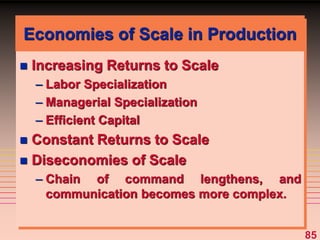
Economies of Scale in Production
 Increasing Returns to Scale
– Labor Specialization
– Managerial Specialization
– Efficient Capital
 Constant Returns to Scale
 Diseconomies of Scale
– Chain of command lengthens, and
communication becomes more complex.
86
Topics Covered
 The Business Sector
 Economic Costs
 Short-Run Production Relationships
 Short-Run Production Costs
 Long-Run Production Costs
87
NEXT:
Pure Competition

Production Cost 7.pdf