The Theory of the Firm and the cost of
production
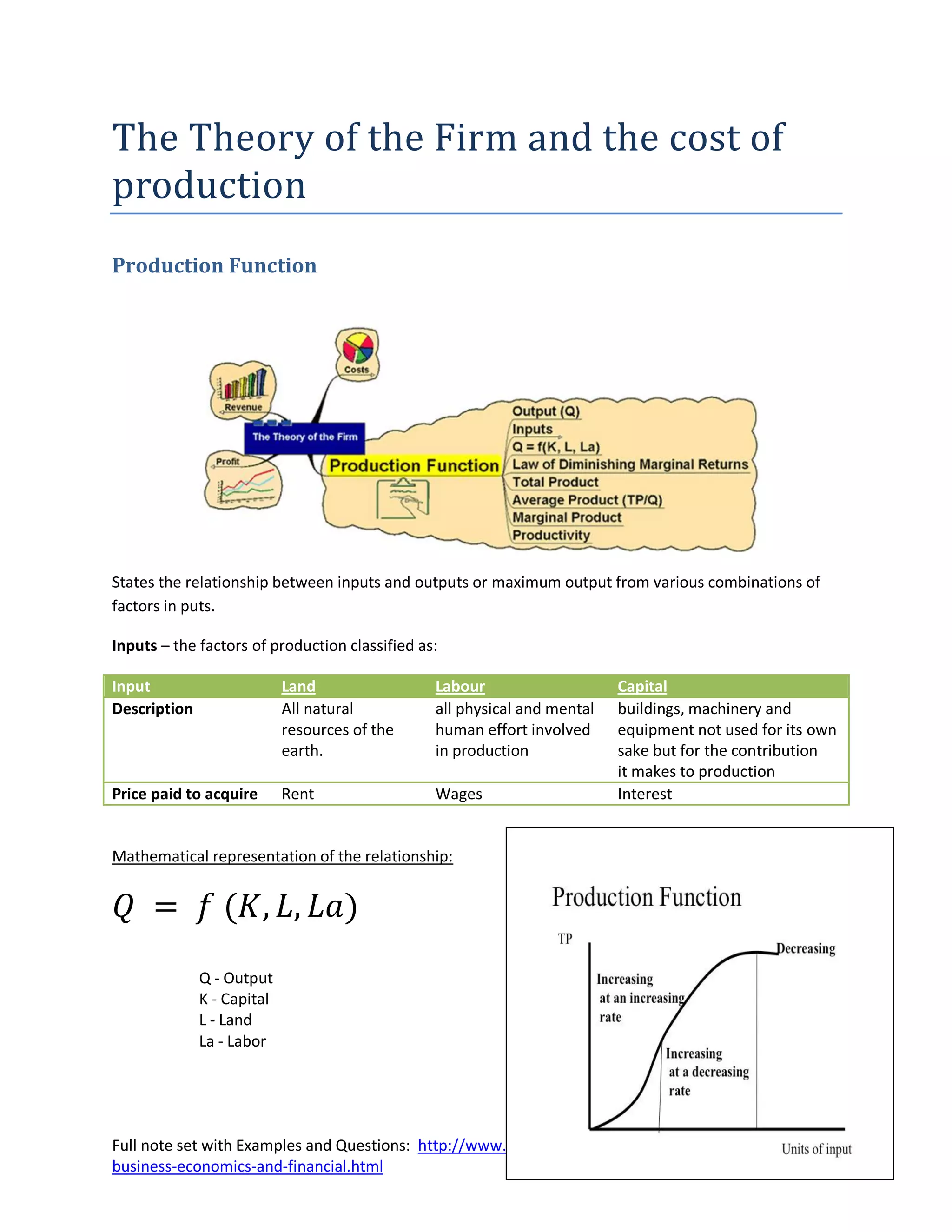
Production Function


States the relationship between inputs and outputs or maximum output from various combinations of
factors in puts.

Inputs – the factors of production classified as:

Input                       Land                Labour                    Capital
Description                 All natural         all physical and mental   buildings, machinery and
                            resources of the    human effort involved     equipment not used for its own
                            earth.              in production             sake but for the contribution
                                                                          it makes to production
Price paid to acquire       Rent                Wages                     Interest


Mathematical representation of the relationship:


 𝑄 = 𝑓 (𝐾, 𝐿, 𝐿𝑎)
              Q - Output
              K - Capital
              L - Land
              La - Labor


Full note set with Examples and Questions: http://www.executioncycle.lkblog.com/2012/06/my-
business-economics-and-financial.html
Analysis of Production Function (Short Run and Long run):

Short Run

       In the short run at least one factor fixed in supply but all other factors capable of being changed
       Reflects ways in which firms respond to changes in output (demand)
       Can increase or decrease output using more or less of some factors but some likely to be easier
        to change than others.

Long Run

       The long run is defined as the period taken to vary all factors of production
       By doing this, the firm is able to increase its total capacity – not just short-term capacity and
        Associated with a change in the scale of production
       The period varies according to the firm and the industry
       In electricity supply, the time taken to build new capacity could be many years; for a market
        stallholder, the ‘long run’ could be as little as a few weeks

Marginal Product

The marginal product of any input in the production process is the increase in output that arises from an
additional unit of that input
                                                            𝑐𝑕𝑎𝑛𝑔𝑒 𝑖𝑛 𝑡𝑜𝑡𝑎𝑙 𝑜𝑢𝑡𝑝𝑢𝑡
                     𝑀𝑎𝑟𝑔𝑖𝑛𝑎𝑙 𝑝𝑕𝑦𝑠𝑖𝑐𝑎𝑙 𝑃𝑟𝑜𝑑𝑢𝑐𝑡 𝑀𝑃𝑃 =
                                                          𝑐𝑕𝑎𝑛𝑔𝑒 𝑖𝑛 𝑖𝑛𝑝𝑢𝑡 𝑞𝑢𝑎𝑛𝑡𝑖𝑡𝑦

Diminishing Marginal Product

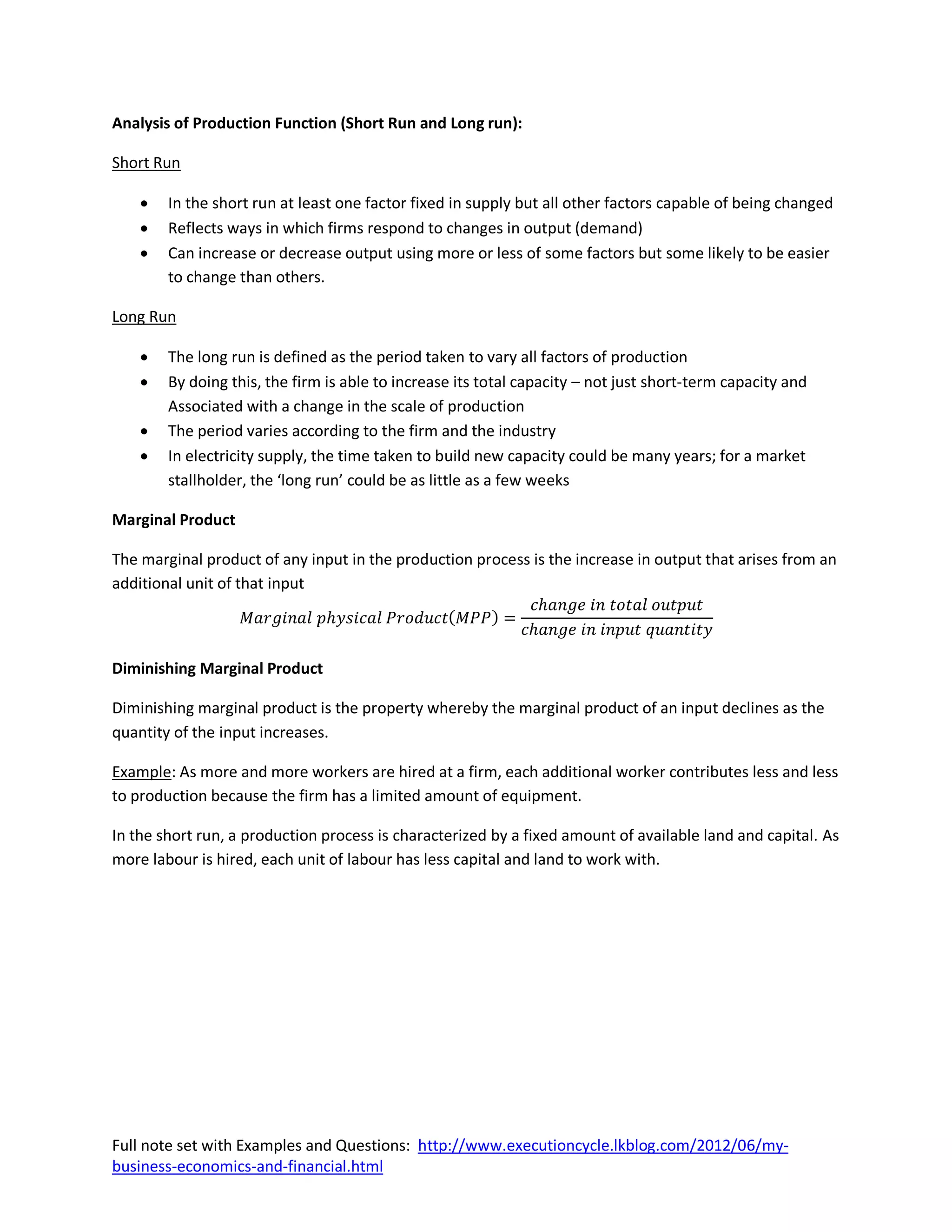
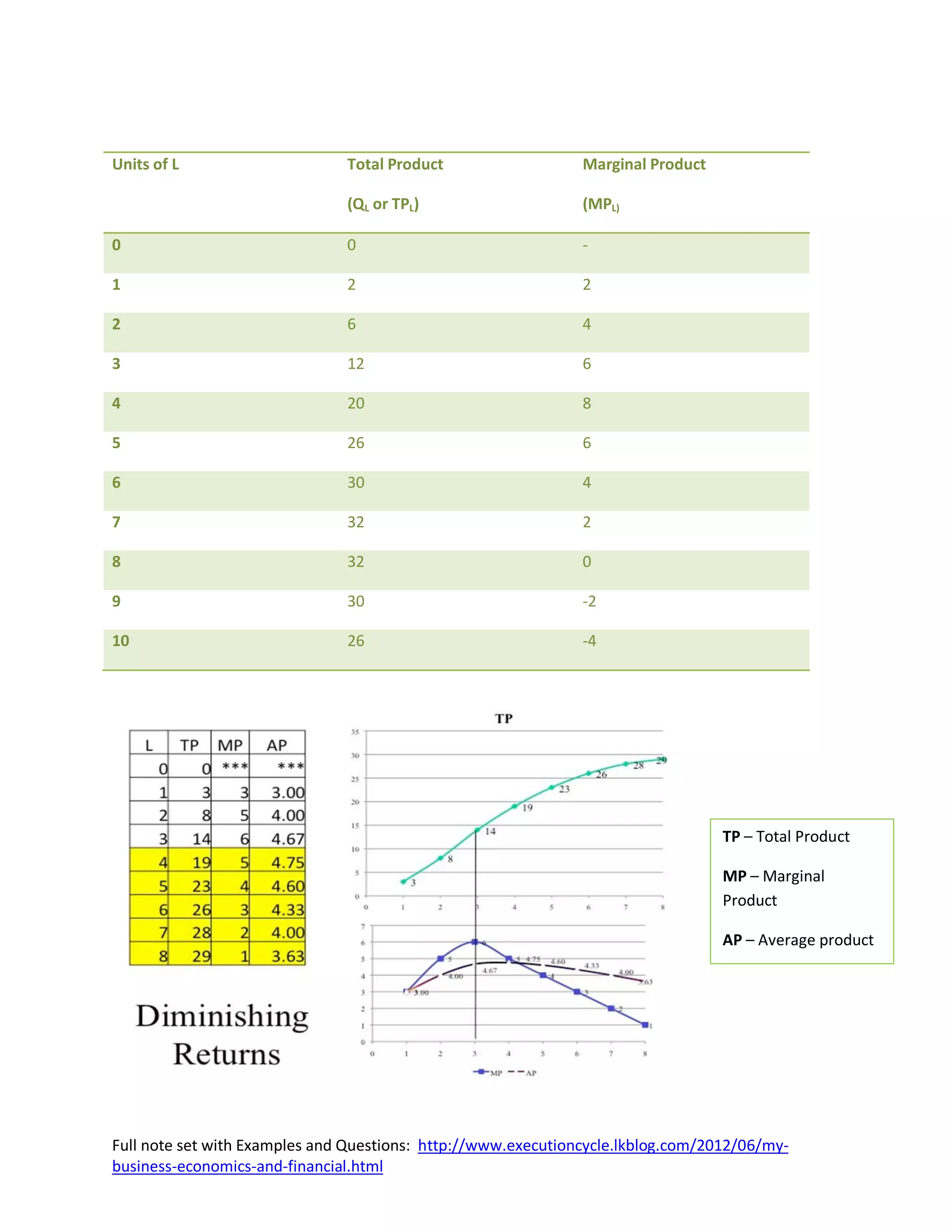
Diminishing marginal product is the property whereby the marginal product of an input declines as the
quantity of the input increases.

Example: As more and more workers are hired at a firm, each additional worker contributes less and less
to production because the firm has a limited amount of equipment.

In the short run, a production process is characterized by a fixed amount of available land and capital. As
more labour is hired, each unit of labour has less capital and land to work with.


Full note set with Examples and Questions: http://www.executioncycle.lkblog.com/2012/06/my-
business-economics-and-financial.html
Units of L                     Total Product                   Marginal Product

                               (QL or TPL)                     (MPL)

0                              0                               -

1                              2                               2

2                              6                               4

3                              12                              6

4                              20                              8

5                              26                              6

6                              30                              4

7                              32                              2

8                              32                              0

9                              30                              -2

10                             26                              -4


                                                                                  TP – Total Product

                                                                                  MP – Marginal
                                                                                  Product

                                                                                  AP – Average product


Full note set with Examples and Questions: http://www.executioncycle.lkblog.com/2012/06/my-
business-economics-and-financial.html
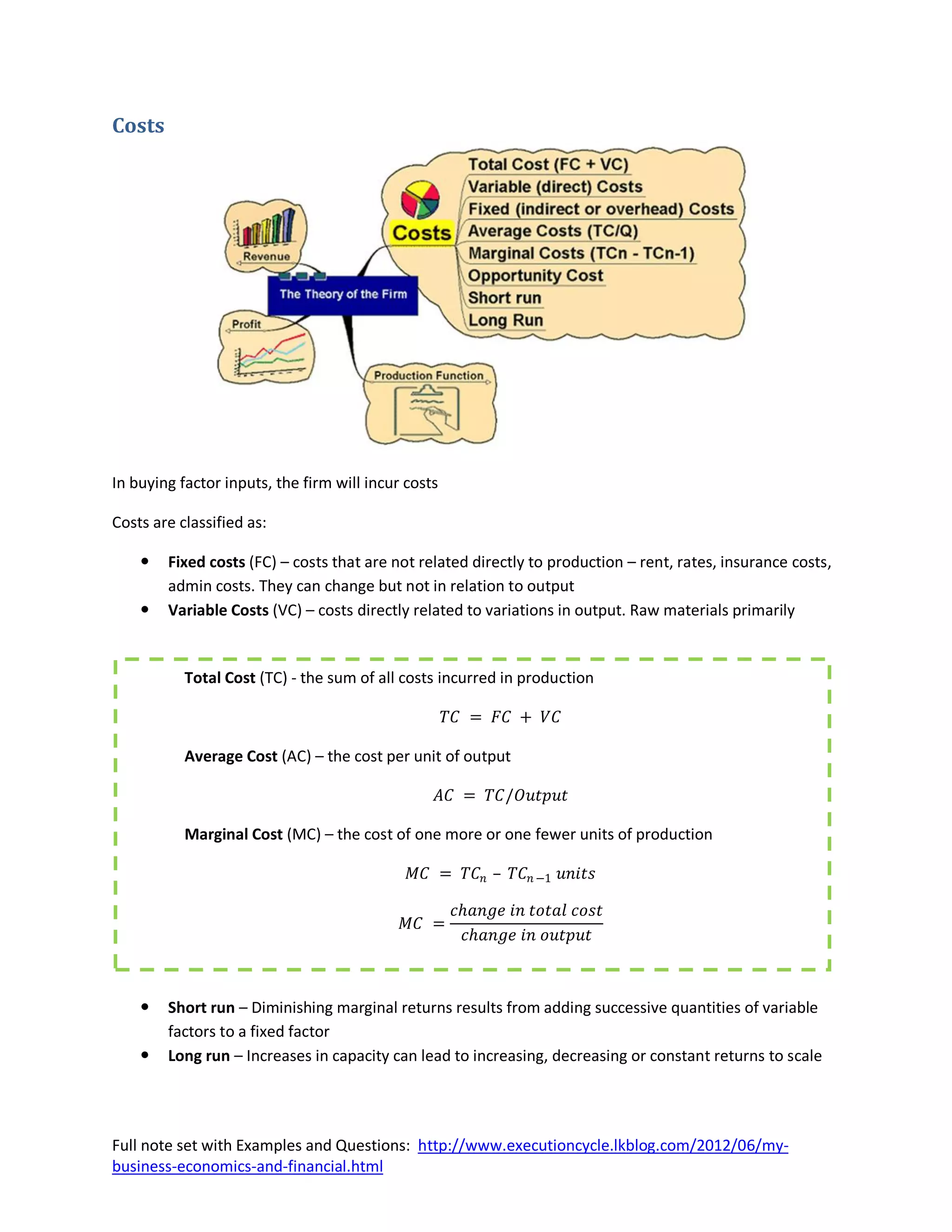
Costs


In buying factor inputs, the firm will incur costs

Costs are classified as:

       Fixed costs (FC) – costs that are not related directly to production – rent, rates, insurance costs,
        admin costs. They can change but not in relation to output
       Variable Costs (VC) – costs directly related to variations in output. Raw materials primarily


           Total Cost (TC) - the sum of all costs incurred in production

                                                     𝑇𝐶 = 𝐹𝐶 + 𝑉𝐶

           Average Cost (AC) – the cost per unit of output

                                                     𝐴𝐶 = 𝑇𝐶/𝑂𝑢𝑡𝑝𝑢𝑡

           Marginal Cost (MC) – the cost of one more or one fewer units of production

                                              𝑀𝐶 = 𝑇𝐶 𝑛 – 𝑇𝐶 𝑛 −1 𝑢𝑛𝑖𝑡𝑠

                                                      𝑐𝑕𝑎𝑛𝑔𝑒 𝑖𝑛 𝑡𝑜𝑡𝑎𝑙 𝑐𝑜𝑠𝑡
                                            𝑀𝐶 =
                                                       𝑐𝑕𝑎𝑛𝑔𝑒 𝑖𝑛 𝑜𝑢𝑡𝑝𝑢𝑡


       Short run – Diminishing marginal returns results from adding successive quantities of variable
        factors to a fixed factor
       Long run – Increases in capacity can lead to increasing, decreasing or constant returns to scale


Full note set with Examples and Questions: http://www.executioncycle.lkblog.com/2012/06/my-
business-economics-and-financial.html
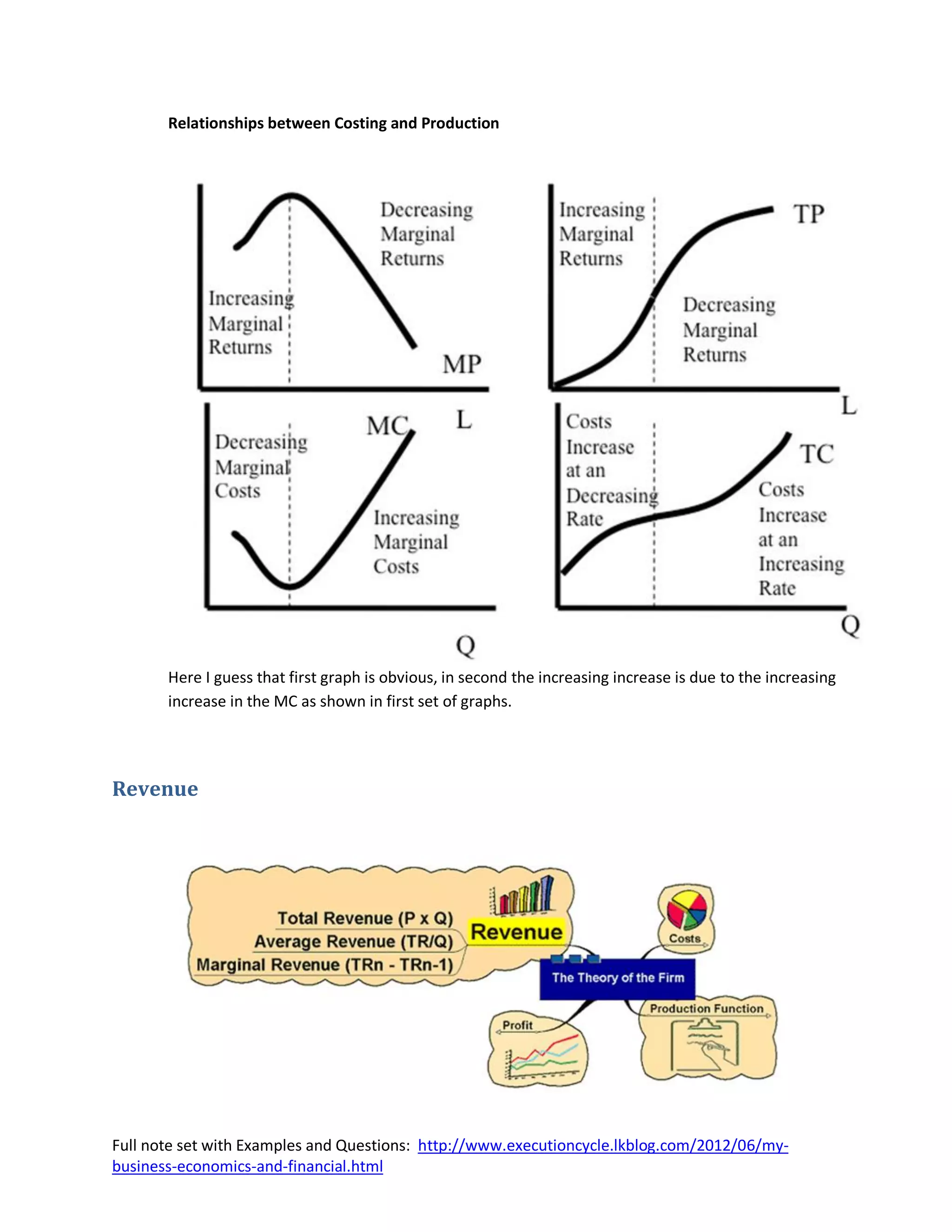
Relationships between Costing and Production


       Here I guess that first graph is obvious, in second the increasing increase is due to the increasing
       increase in the MC as shown in first set of graphs.


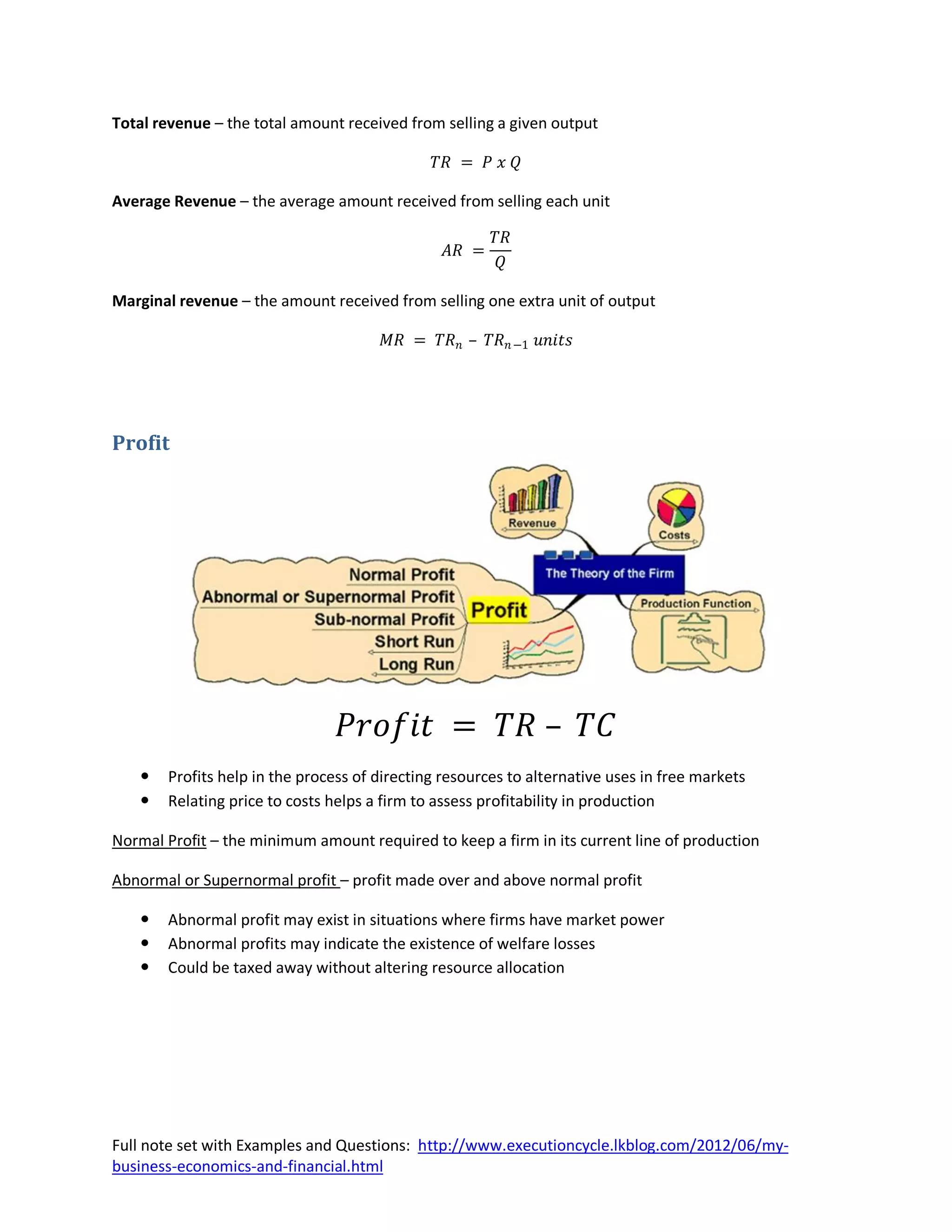
Revenue


Full note set with Examples and Questions: http://www.executioncycle.lkblog.com/2012/06/my-
business-economics-and-financial.html
Total revenue – the total amount received from selling a given output

                                              𝑇𝑅 = 𝑃 𝑥 𝑄

Average Revenue – the average amount received from selling each unit

                                                       𝑇𝑅
                                                𝐴𝑅 =
                                                        𝑄

Marginal revenue – the amount received from selling one extra unit of output

                                       𝑀𝑅 = 𝑇𝑅 𝑛 – 𝑇𝑅 𝑛 −1 𝑢𝑛𝑖𝑡𝑠


Profit


                                 𝑃𝑟𝑜𝑓𝑖𝑡 = 𝑇𝑅 – 𝑇𝐶
      Profits help in the process of directing resources to alternative uses in free markets
      Relating price to costs helps a firm to assess profitability in production

Normal Profit – the minimum amount required to keep a firm in its current line of production

Abnormal or Supernormal profit – profit made over and above normal profit

      Abnormal profit may exist in situations where firms have market power
      Abnormal profits may indicate the existence of welfare losses
      Could be taxed away without altering resource allocation


Full note set with Examples and Questions: http://www.executioncycle.lkblog.com/2012/06/my-
business-economics-and-financial.html
Sub-normal Profit –

              profit below normal profit Firms may not exit the market even if sub-normal profits
               made if they are able to cover variable costs
              Cost of exit may be high
              Sub-normal profit may be temporary (or perceived as such!)

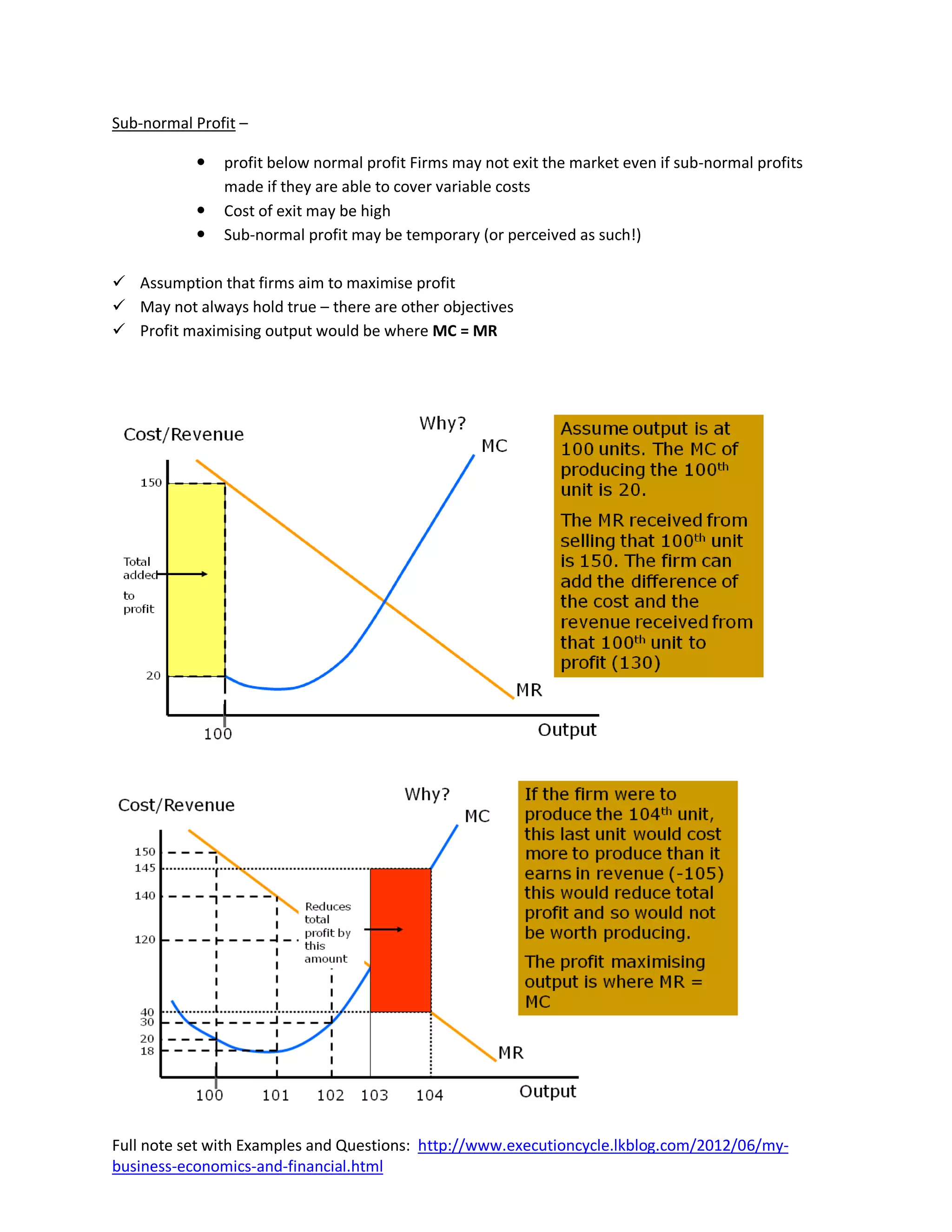
 Assumption that firms aim to maximise profit
 May not always hold true – there are other objectives
 Profit maximising output would be where MC = MR


Full note set with Examples and Questions: http://www.executioncycle.lkblog.com/2012/06/my-
business-economics-and-financial.html
The Cost of Production


     Profit = Total revenue - Total cost
     Total Cost includes all of the opportunity costs of production

Explicit Costs and Implicit Costs

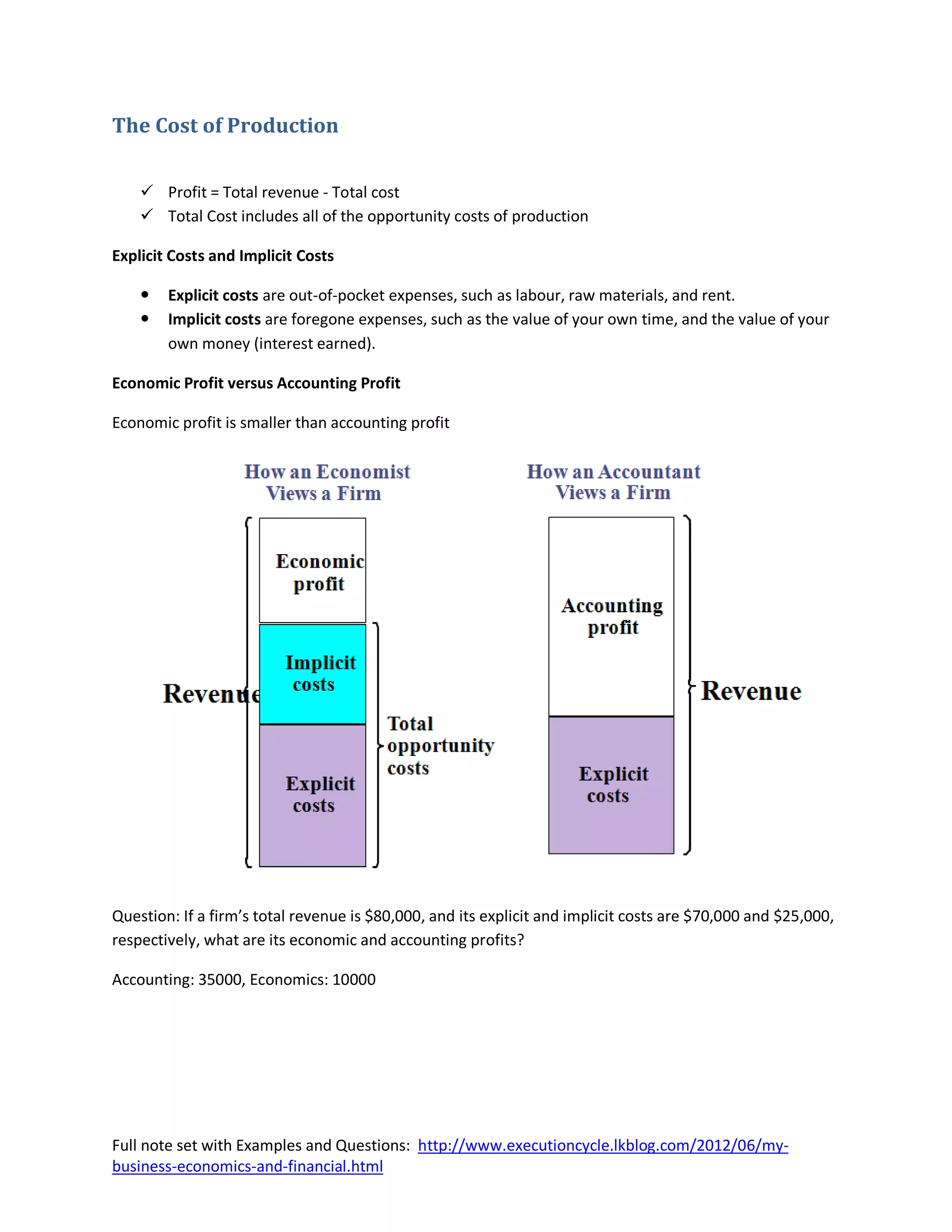
       Explicit costs are out-of-pocket expenses, such as labour, raw materials, and rent.
       Implicit costs are foregone expenses, such as the value of your own time, and the value of your
        own money (interest earned).

Economic Profit versus Accounting Profit

Economic profit is smaller than accounting profit


Question: If a firm’s total revenue is $80,000, and its explicit and implicit costs are $70,000 and $25,000,
respectively, what are its economic and accounting profits?

Accounting: 35000, Economics: 10000


Full note set with Examples and Questions: http://www.executioncycle.lkblog.com/2012/06/my-
business-economics-and-financial.html
Total and Per Unit Costs

       Total Variable Cost (TVC)
       Total Fixed Cost (TFC)
       Total Cost (TC)
       Average Variable Cost (AVC)
       Average Fixed Cost (AFC)
       Average Total Cost (ATC)
       Marginal Cost (MC)

Fixed and Variable Costs

Fixed costs are those costs that do not vary with the quantity of output produced. Variable costs are
those costs that do change as the firm alters the quantity of output produced.

Average Costs

Average costs can be determined by dividing the firm’s costs by the quantity of output produced. The
average cost is the cost of each typical unit of product.

Marginal Cost

Marginal cost (MC) measures the amount total cost rises when the firm increases production by one
unit.

Question: Fill in the missing values

Three Important Properties of Cost Curves

    1. Marginal cost eventually rises with the quantity of output. [Law of Diminishing Marginal
       Returns]
    2. The average-total-cost curve is U-shaped.
    3. The marginal-cost curve crosses the average-total-cost curve at the minimum of average total
       cost.


Full note set with Examples and Questions: http://www.executioncycle.lkblog.com/2012/06/my-
business-economics-and-financial.html
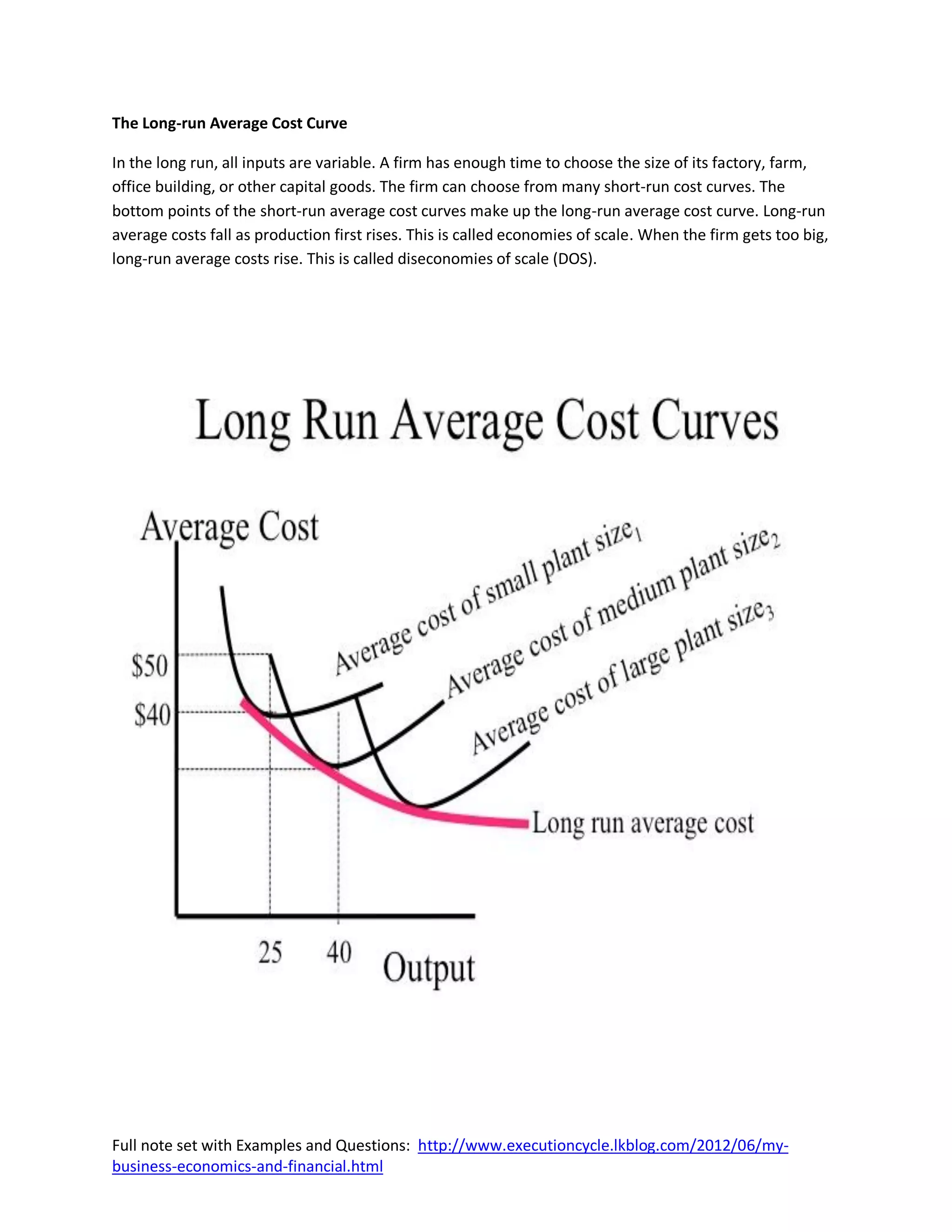
The Long-run Average Cost Curve

In the long run, all inputs are variable. A firm has enough time to choose the size of its factory, farm,
office building, or other capital goods. The firm can choose from many short-run cost curves. The
bottom points of the short-run average cost curves make up the long-run average cost curve. Long-run
average costs fall as production first rises. This is called economies of scale. When the firm gets too big,
long-run average costs rise. This is called diseconomies of scale (DOS).


Full note set with Examples and Questions: http://www.executioncycle.lkblog.com/2012/06/my-
business-economics-and-financial.html
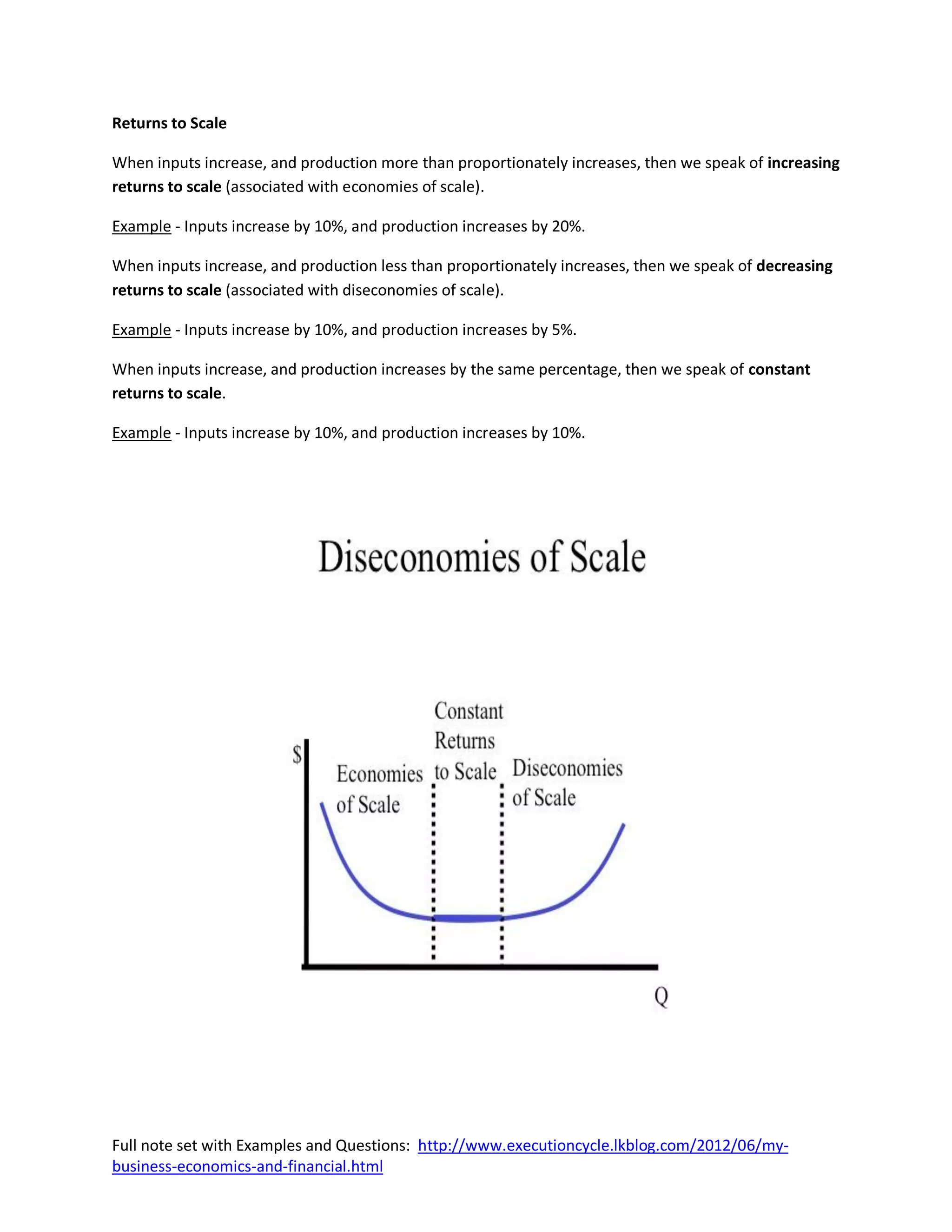
Returns to Scale

When inputs increase, and production more than proportionately increases, then we speak of increasing
returns to scale (associated with economies of scale).

Example - Inputs increase by 10%, and production increases by 20%.

When inputs increase, and production less than proportionately increases, then we speak of decreasing
returns to scale (associated with diseconomies of scale).

Example - Inputs increase by 10%, and production increases by 5%.

When inputs increase, and production increases by the same percentage, then we speak of constant
returns to scale.

Example - Inputs increase by 10%, and production increases by 10%.


Full note set with Examples and Questions: http://www.executioncycle.lkblog.com/2012/06/my-
business-economics-and-financial.html

4 the theory of the firm and the cost of production

  • 1.
    The Theory ofthe Firm and the cost of production Production Function States the relationship between inputs and outputs or maximum output from various combinations of factors in puts. Inputs – the factors of production classified as: Input Land Labour Capital Description All natural all physical and mental buildings, machinery and resources of the human effort involved equipment not used for its own earth. in production sake but for the contribution it makes to production Price paid to acquire Rent Wages Interest Mathematical representation of the relationship: 𝑄 = 𝑓 (𝐾, 𝐿, 𝐿𝑎) Q - Output K - Capital L - Land La - Labor Full note set with Examples and Questions: http://www.executioncycle.lkblog.com/2012/06/my- business-economics-and-financial.html
  • 2.
    Analysis of ProductionFunction (Short Run and Long run): Short Run  In the short run at least one factor fixed in supply but all other factors capable of being changed  Reflects ways in which firms respond to changes in output (demand)  Can increase or decrease output using more or less of some factors but some likely to be easier to change than others. Long Run  The long run is defined as the period taken to vary all factors of production  By doing this, the firm is able to increase its total capacity – not just short-term capacity and Associated with a change in the scale of production  The period varies according to the firm and the industry  In electricity supply, the time taken to build new capacity could be many years; for a market stallholder, the ‘long run’ could be as little as a few weeks Marginal Product The marginal product of any input in the production process is the increase in output that arises from an additional unit of that input 𝑐𝑕𝑎𝑛𝑔𝑒 𝑖𝑛 𝑡𝑜𝑡𝑎𝑙 𝑜𝑢𝑡𝑝𝑢𝑡 𝑀𝑎𝑟𝑔𝑖𝑛𝑎𝑙 𝑝𝑕𝑦𝑠𝑖𝑐𝑎𝑙 𝑃𝑟𝑜𝑑𝑢𝑐𝑡 𝑀𝑃𝑃 = 𝑐𝑕𝑎𝑛𝑔𝑒 𝑖𝑛 𝑖𝑛𝑝𝑢𝑡 𝑞𝑢𝑎𝑛𝑡𝑖𝑡𝑦 Diminishing Marginal Product Diminishing marginal product is the property whereby the marginal product of an input declines as the quantity of the input increases. Example: As more and more workers are hired at a firm, each additional worker contributes less and less to production because the firm has a limited amount of equipment. In the short run, a production process is characterized by a fixed amount of available land and capital. As more labour is hired, each unit of labour has less capital and land to work with. Full note set with Examples and Questions: http://www.executioncycle.lkblog.com/2012/06/my- business-economics-and-financial.html
  • 3.
    Units of L Total Product Marginal Product (QL or TPL) (MPL) 0 0 - 1 2 2 2 6 4 3 12 6 4 20 8 5 26 6 6 30 4 7 32 2 8 32 0 9 30 -2 10 26 -4 TP – Total Product MP – Marginal Product AP – Average product Full note set with Examples and Questions: http://www.executioncycle.lkblog.com/2012/06/my- business-economics-and-financial.html
  • 4.
    Costs In buying factorinputs, the firm will incur costs Costs are classified as:  Fixed costs (FC) – costs that are not related directly to production – rent, rates, insurance costs, admin costs. They can change but not in relation to output  Variable Costs (VC) – costs directly related to variations in output. Raw materials primarily Total Cost (TC) - the sum of all costs incurred in production 𝑇𝐶 = 𝐹𝐶 + 𝑉𝐶 Average Cost (AC) – the cost per unit of output 𝐴𝐶 = 𝑇𝐶/𝑂𝑢𝑡𝑝𝑢𝑡 Marginal Cost (MC) – the cost of one more or one fewer units of production 𝑀𝐶 = 𝑇𝐶 𝑛 – 𝑇𝐶 𝑛 −1 𝑢𝑛𝑖𝑡𝑠 𝑐𝑕𝑎𝑛𝑔𝑒 𝑖𝑛 𝑡𝑜𝑡𝑎𝑙 𝑐𝑜𝑠𝑡 𝑀𝐶 = 𝑐𝑕𝑎𝑛𝑔𝑒 𝑖𝑛 𝑜𝑢𝑡𝑝𝑢𝑡  Short run – Diminishing marginal returns results from adding successive quantities of variable factors to a fixed factor  Long run – Increases in capacity can lead to increasing, decreasing or constant returns to scale Full note set with Examples and Questions: http://www.executioncycle.lkblog.com/2012/06/my- business-economics-and-financial.html
  • 5.
    Relationships between Costingand Production Here I guess that first graph is obvious, in second the increasing increase is due to the increasing increase in the MC as shown in first set of graphs. Revenue Full note set with Examples and Questions: http://www.executioncycle.lkblog.com/2012/06/my- business-economics-and-financial.html
  • 6.
    Total revenue –the total amount received from selling a given output 𝑇𝑅 = 𝑃 𝑥 𝑄 Average Revenue – the average amount received from selling each unit 𝑇𝑅 𝐴𝑅 = 𝑄 Marginal revenue – the amount received from selling one extra unit of output 𝑀𝑅 = 𝑇𝑅 𝑛 – 𝑇𝑅 𝑛 −1 𝑢𝑛𝑖𝑡𝑠 Profit 𝑃𝑟𝑜𝑓𝑖𝑡 = 𝑇𝑅 – 𝑇𝐶  Profits help in the process of directing resources to alternative uses in free markets  Relating price to costs helps a firm to assess profitability in production Normal Profit – the minimum amount required to keep a firm in its current line of production Abnormal or Supernormal profit – profit made over and above normal profit  Abnormal profit may exist in situations where firms have market power  Abnormal profits may indicate the existence of welfare losses  Could be taxed away without altering resource allocation Full note set with Examples and Questions: http://www.executioncycle.lkblog.com/2012/06/my- business-economics-and-financial.html
  • 7.
    Sub-normal Profit –  profit below normal profit Firms may not exit the market even if sub-normal profits made if they are able to cover variable costs  Cost of exit may be high  Sub-normal profit may be temporary (or perceived as such!)  Assumption that firms aim to maximise profit  May not always hold true – there are other objectives  Profit maximising output would be where MC = MR Full note set with Examples and Questions: http://www.executioncycle.lkblog.com/2012/06/my- business-economics-and-financial.html
  • 8.
    The Cost ofProduction  Profit = Total revenue - Total cost  Total Cost includes all of the opportunity costs of production Explicit Costs and Implicit Costs  Explicit costs are out-of-pocket expenses, such as labour, raw materials, and rent.  Implicit costs are foregone expenses, such as the value of your own time, and the value of your own money (interest earned). Economic Profit versus Accounting Profit Economic profit is smaller than accounting profit Question: If a firm’s total revenue is $80,000, and its explicit and implicit costs are $70,000 and $25,000, respectively, what are its economic and accounting profits? Accounting: 35000, Economics: 10000 Full note set with Examples and Questions: http://www.executioncycle.lkblog.com/2012/06/my- business-economics-and-financial.html
  • 9.
    Total and PerUnit Costs  Total Variable Cost (TVC)  Total Fixed Cost (TFC)  Total Cost (TC)  Average Variable Cost (AVC)  Average Fixed Cost (AFC)  Average Total Cost (ATC)  Marginal Cost (MC) Fixed and Variable Costs Fixed costs are those costs that do not vary with the quantity of output produced. Variable costs are those costs that do change as the firm alters the quantity of output produced. Average Costs Average costs can be determined by dividing the firm’s costs by the quantity of output produced. The average cost is the cost of each typical unit of product. Marginal Cost Marginal cost (MC) measures the amount total cost rises when the firm increases production by one unit. Question: Fill in the missing values Three Important Properties of Cost Curves 1. Marginal cost eventually rises with the quantity of output. [Law of Diminishing Marginal Returns] 2. The average-total-cost curve is U-shaped. 3. The marginal-cost curve crosses the average-total-cost curve at the minimum of average total cost. Full note set with Examples and Questions: http://www.executioncycle.lkblog.com/2012/06/my- business-economics-and-financial.html
  • 10.
    The Long-run AverageCost Curve In the long run, all inputs are variable. A firm has enough time to choose the size of its factory, farm, office building, or other capital goods. The firm can choose from many short-run cost curves. The bottom points of the short-run average cost curves make up the long-run average cost curve. Long-run average costs fall as production first rises. This is called economies of scale. When the firm gets too big, long-run average costs rise. This is called diseconomies of scale (DOS). Full note set with Examples and Questions: http://www.executioncycle.lkblog.com/2012/06/my- business-economics-and-financial.html
  • 11.
    Returns to Scale Wheninputs increase, and production more than proportionately increases, then we speak of increasing returns to scale (associated with economies of scale). Example - Inputs increase by 10%, and production increases by 20%. When inputs increase, and production less than proportionately increases, then we speak of decreasing returns to scale (associated with diseconomies of scale). Example - Inputs increase by 10%, and production increases by 5%. When inputs increase, and production increases by the same percentage, then we speak of constant returns to scale. Example - Inputs increase by 10%, and production increases by 10%. Full note set with Examples and Questions: http://www.executioncycle.lkblog.com/2012/06/my- business-economics-and-financial.html