ELECTROMAGNETIC RADIATION
• subatomicparticles (electron, photon, etc)
have both PARTICLE and WAVE properties
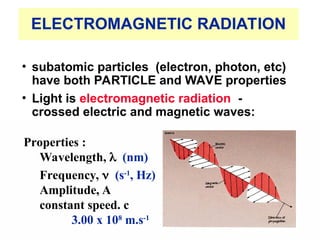
• Light is electromagnetic radiation -
crossed electric and magnetic waves:
Properties :
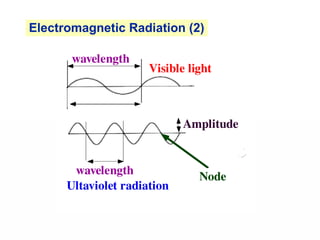
Wavelength, (nm)
Frequency, (s-1
, Hz)
Amplitude, A
constant speed. c
3.00 x 10⁸
m.s-1
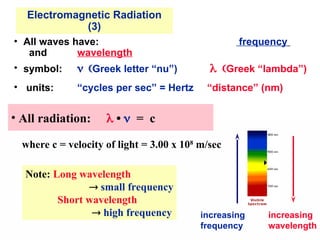
• All waveshave: frequency
and wavelength
• symbol: Greek letter “nu”) Greek “lambda”)
• units: “cycles per sec” = Hertz “distance” (nm)
• All radiation: • = c
where c = velocity of light = 3.00 x 10⁸
m/sec
Electromagnetic Radiation
(3)
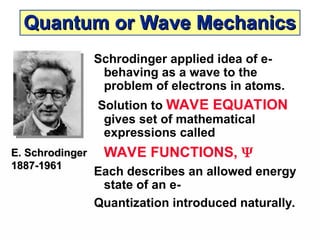
Note: Long wavelength
small frequency
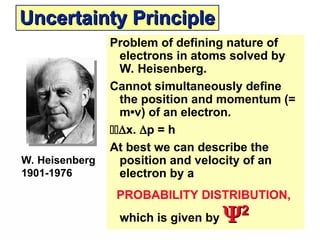
Short wavelength
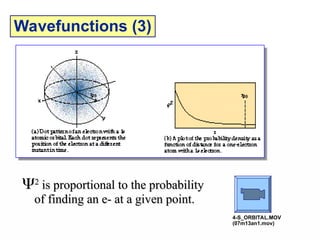
high frequency increasing
wavelength
increasing
frequency
5.
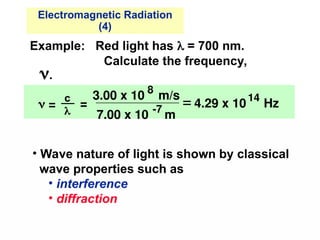
Example: Red lighthas = 700 nm.
Calculate the frequency,
.
=
3.00 x 10
8
m/s
7.00 x 10 -7
m
4.29 x 10
14
Hz
=
c
• Wave nature of light is shown by classical
wave properties such as
• interference
• diffraction
Electromagnetic Radiation
(4)
6.
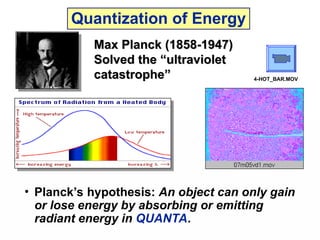
Quantization of Energy
•Planck’s hypothesis: An object can only gain
or lose energy by absorbing or emitting
radiant energy in QUANTA.
Max Planck (1858-1947)
Max Planck (1858-1947)
Solved the “ultraviolet
Solved the “ultraviolet
catastrophe”
catastrophe” 4-HOT_BAR.MOV
7.
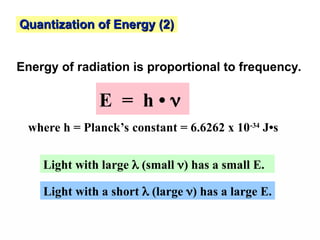
E = h•
Quantization of Energy (2)
Quantization of Energy (2)
Energy of radiation is proportional to frequency.
where h = Planck’s constant = 6.6262 x 10⁻³⁴
J•s
Light with large (small ) has a small E.
Light with a short (large ) has a large E.
8.
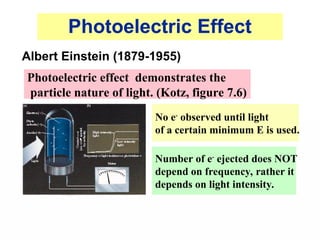
Photoelectric effect demonstratesthe
particle nature of light. (Kotz, figure 7.6)
Number of e-
ejected does NOT
depend on frequency, rather it
depends on light intensity.
No e-
observed until light
of a certain minimum E is used.
Photoelectric Effect
Albert Einstein (1879-1955)
9.
Photoelectric Effect
Photoelectric Effect
(2)
(2)
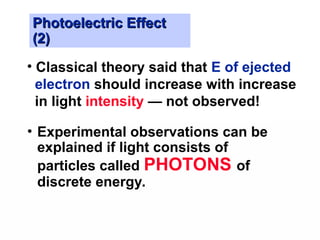
•Experimental observations can be
explained if light consists of
particles called PHOTONS of
discrete energy.
• Classical theory said that E of ejected
electron should increase with increase
in light intensity — not observed!
10.
E = h•
E= h•
= (6.63 x 10
= (6.63 x 10⁻³⁴
-34
J•s)(4.29 x 10
J•s)(4.29 x 10¹⁴
14
sec
sec-1
-1
)
)
= 2.85 x 10
= 2.85 x 10⁻¹⁹
-19
J per photon
J per photon
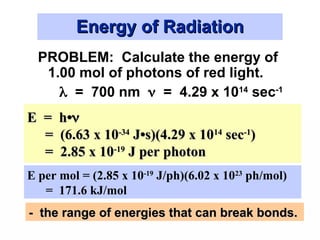
Energy of Radiation
Energy of Radiation
PROBLEM: Calculate the energy of
1.00 mol of photons of red light.
= 700 nm = 4.29 x 10¹⁴
sec-1
- the range of energies that can break bonds.
- the range of energies that can break bonds.
E per mol = (2.85 x 10⁻¹⁹
J/ph)(6.02 x 1023
ph/mol)
= 171.6 kJ/mol
11.
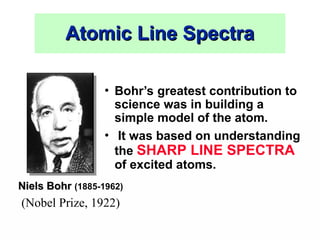
Atomic Line Spectra
AtomicLine Spectra
• Bohr’s greatest contribution to
science was in building a
simple model of the atom.
• It was based on understanding
the SHARP LINE SPECTRA
of excited atoms.
Niels Bohr
Niels Bohr (1885-1962)
(Nobel Prize, 1922)
12.
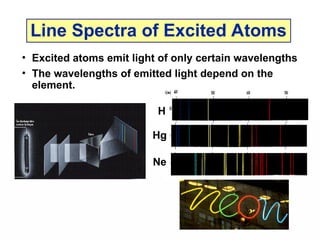
Line Spectra ofExcited Atoms
• Excited atoms emit light of only certain wavelengths
• The wavelengths of emitted light depend on the
element.
H
Hg
Ne
13.
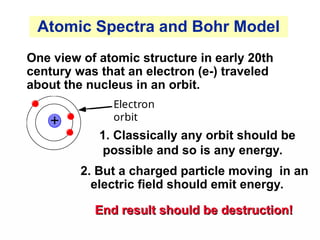
Atomic Spectra andBohr Model
2. But a charged particle moving in an
electric field should emit energy.
+
Electron
orbit
One view of atomic structure in early 20th
century was that an electron (e-) traveled
about the nucleus in an orbit.
1. Classically any orbit should be
possible and so is any energy.
End result should be destruction!
End result should be destruction!
14.
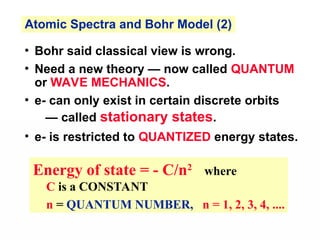
Energy of state= - C/n2
where
C is a CONSTANT
n = QUANTUM NUMBER, n = 1, 2, 3, 4, ....
• Bohr said classical view is wrong.
• Need a new theory — now called QUANTUM
or WAVE MECHANICS.
• e- can only exist in certain discrete orbits
— called stationary states.
• e- is restricted to QUANTIZED energy states.
Atomic Spectra and Bohr Model (2)
15.
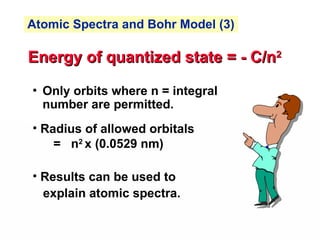
• Only orbitswhere n = integral
number are permitted.
Energy of quantized state = - C/n
Energy of quantized state = - C/n2
2
• Radius of allowed orbitals
= n2
x (0.0529 nm)
• Results can be used to
explain atomic spectra.
Atomic Spectra and Bohr Model (3)
16.
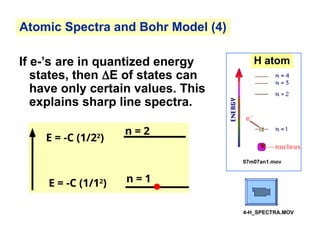
If e-’s arein quantized energy
states, then E of states can
have only certain values. This
explains sharp line spectra.
n = 1
n = 2
E = -C (1/22
)
E = -C (1/12
)
Atomic Spectra and Bohr Model (4)
H atom
07m07an1.mov
4-H_SPECTRA.MOV
17.
Calculate E fore- in H “falling” from
n = 2 to n = 1 (higher to lower energy) .
n=1
n=2
Energy
so, E of emitted light = (3/4)R = 2.47 x 10¹⁵
Hz
and = c/ = 121.6 nm (in ULTRAVIOLET
ULTRAVIOLET region)
E = Efinal - Einitial = -C[(1/12
) - (1/2)2
] = -(3/4)C
C has been found from experiment. It is now called R,
the Rydberg constant. R = 1312 kJ/mol or 3.29 x 10¹⁵
Hz
This is exactly in agreement with experiment!
• (-ve sign for E indicates emission (+ve for absorption)
• since energy (wavelength, frequency) of light can only be +ve
it is best to consider such calculations as E = Eupper - Elower
Atomic Spectra and Bohr Model
(5)
18.
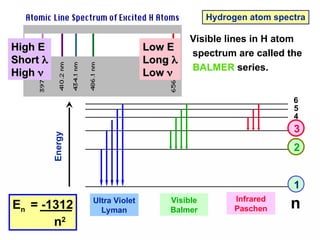
Hydrogen atom spectra
Visiblelines in H atom
spectrum are called the
BALMER series.
High E
High E
Short
Short
High
High
Low E
Low E
Long
Long
Low
Low
Energy
Ultra Violet
Lyman
Infrared
Paschen
Visible
Balmer
En = -1312
n2
6
5
3
2
1
4
n
19.
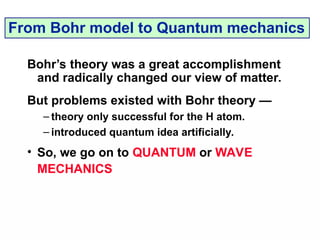
Bohr’s theory wasa great accomplishment
and radically changed our view of matter.
But problems existed with Bohr theory —
– theory only successful for the H atom.
– introduced quantum idea artificially.
• So, we go on to QUANTUM or WAVE
MECHANICS
From Bohr model to Quantum mechanics
20.
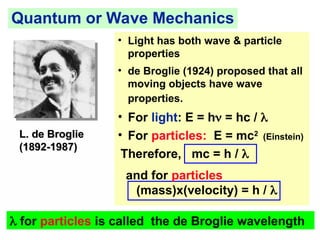
Quantum or WaveMechanics
• Light has both wave & particle
properties
• de Broglie (1924) proposed that all
moving objects have wave
properties.
• For light: E = h = hc /
• For particles: E = mc2
(Einstein)
L. de Broglie
L. de Broglie
(1892-1987)
(1892-1987)
for particles is called the de Broglie wavelength
Therefore, mc = h /
and for particles
(mass)x(velocity) = h /
21.
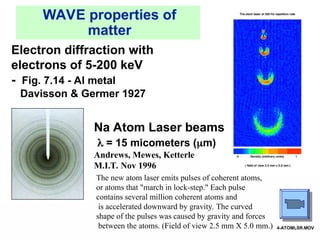
WAVE properties of
matter
Electrondiffraction with
electrons of 5-200 keV
- Fig. 7.14 - Al metal
Davisson & Germer 1927
Na Atom Laser beams
= 15 micometers (m)
Andrews, Mewes, Ketterle
M.I.T. Nov 1996
The new atom laser emits pulses of coherent atoms,
or atoms that "march in lock-step." Each pulse
contains several million coherent atoms and
is accelerated downward by gravity. The curved
shape of the pulses was caused by gravity and forces
between the atoms. (Field of view 2.5 mm X 5.0 mm.) 4-ATOMLSR.MOV
22.
Schrodinger applied ideaof e-
behaving as a wave to the
problem of electrons in atoms.
Solution to WAVE EQUATION
gives set of mathematical
expressions called
WAVE FUNCTIONS,
Each describes an allowed energy
state of an e-
Quantization introduced naturally.
E. Schrodinger
E. Schrodinger
1887-1961
1887-1961
Quantum or Wave Mechanics
Quantum or Wave Mechanics
23.
WAVE FUNCTIONS,
WAVE FUNCTIONS,
•
is a function of distance and two
is a function of distance and two
angles.
angles.
•
• For 1 electron,
For 1 electron,
corresponds to an
corresponds to an
ORBITAL
ORBITAL — the region of space
— the region of space
within which an electron is found.
within which an electron is found.
•
•
does NOT describe the exact
does NOT describe the exact
location of the electron.
location of the electron.
•
•
2
2
is proportional to the probability of
is proportional to the probability of
finding an e- at a given point.
finding an e- at a given point.
24.
Uncertainty Principle
Uncertainty Principle
Problemof defining nature of
electrons in atoms solved by
W. Heisenberg.
Cannot simultaneously define
the position and momentum (=
m•v) of an electron.
x. p = h
At best we can describe the
position and velocity of an
electron by a
PROBABILITY DISTRIBUTION,
which is given by
2
2
W. Heisenberg
1901-1976
25.
Wavefunctions (3)
2
2
is proportionalto the probability
is proportional to the probability
of finding an e- at a given point.
of finding an e- at a given point.
4-S_ORBITAL.MOV
(07m13an1.mov)
26.
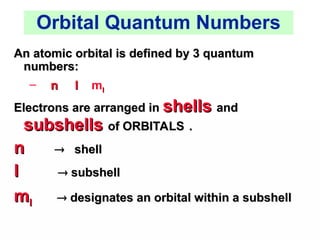
Orbital Quantum Numbers
Anatomic orbital is defined by 3 quantum
An atomic orbital is defined by 3 quantum
numbers:
numbers:
– n
n l
l ml
l
Electrons are arranged in
Electrons are arranged in shells
shells and
and
subshells
subshells of ORBITALS
of ORBITALS .
.
n
n
shell
shell
l
l
subshell
subshell
m
ml
l
designates an orbital within a subshell
designates an orbital within a subshell
27.
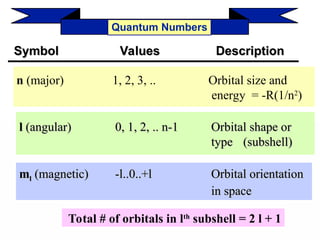
Quantum Numbers
m
ml
l (magnetic)
(magnetic)-l..0..+l
-l..0..+l Orbital orientation
Orbital orientation
in space
in space
l
l (angular)
(angular) 0, 1, 2, .. n-1
0, 1, 2, .. n-1 Orbital shape or
Orbital shape or
type
type (subshell)
(subshell)
n (major) 1, 2, 3, .. Orbital size and
energy = -R(1/n2
)
Total # of orbitals in lth
subshell = 2 l + 1
Symbol
Symbol Values
Values Description
Description
28.
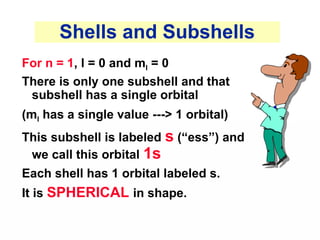
Shells and Subshells
Forn = 1, l = 0 and ml = 0
There is only one subshell and that
subshell has a single orbital
(ml has a single value ---> 1 orbital)
This subshell is labeled s (“ess”) and
we call this orbital 1s
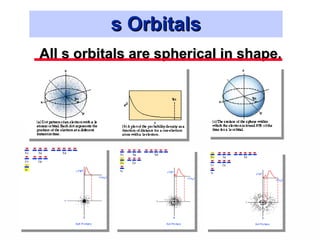
Each shell has 1 orbital labeled s.
It is SPHERICAL in shape.
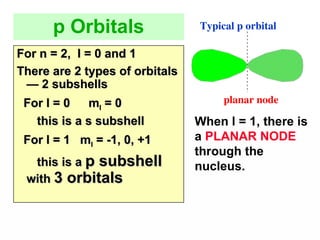
p Orbitals
For n= 2, l = 0 and 1
For n = 2, l = 0 and 1
There are 2 types of orbitals
There are 2 types of orbitals
— 2 subshells
— 2 subshells
For l = 0
For l = 0 m
ml
l = 0
= 0
this is a s subshell
this is a s subshell
For l = 1 m
For l = 1 ml
l = -1, 0, +1
= -1, 0, +1
this is a
this is a p subshell
p subshell
with
with 3 orbitals
3 orbitals
planar node
Typical p orbital
When l = 1, there is
a PLANAR NODE
through the
nucleus.
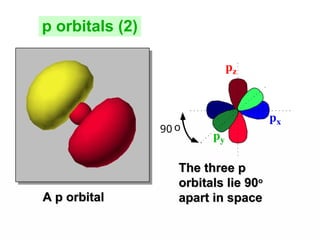
31.
A p orbital
Ap orbital
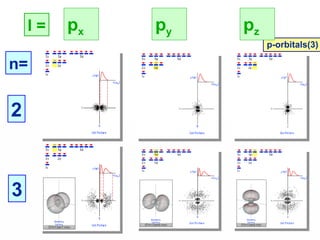
pz
py
px
90 o
The three p
The three p
orbitals lie 90
orbitals lie 90o
o
apart in space
apart in space
p orbitals (2)
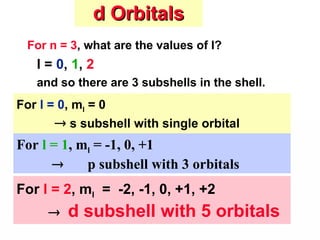
For l =2, ml = -2, -1, 0, +1, +2
d subshell with 5 orbitals
For l = 1, ml = -1, 0, +1
p subshell with 3 orbitals
For l = 0, ml = 0
s subshell with single orbital
For n = 3, what are the values of l?
l = 0, 1, 2
and so there are 3 subshells in the shell.
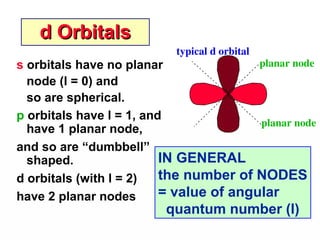
d Orbitals
d Orbitals
34.
d Orbitals
d Orbitals
sorbitals have no planar
node (l = 0) and
so are spherical.
p orbitals have l = 1, and
have 1 planar node,
and so are “dumbbell”
shaped.
d orbitals (with l = 2)
have 2 planar nodes
typical d orbital
planar node
planar node
IN GENERAL
the number of NODES
= value of angular
quantum number (l)
35.
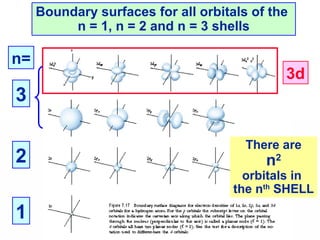
Boundary surfaces forall orbitals of the
n = 1, n = 2 and n = 3 shells
2
1
3d
n=
3
There are
n2
orbitals in
the nth
SHELL

![Calculate E for e- in H “falling” from
n = 2 to n = 1 (higher to lower energy) .
n=1
n=2
Energy
so, E of emitted light = (3/4)R = 2.47 x 10¹⁵
Hz
and = c/ = 121.6 nm (in ULTRAVIOLET
ULTRAVIOLET region)
E = Efinal - Einitial = -C[(1/12
) - (1/2)2
] = -(3/4)C
C has been found from experiment. It is now called R,
the Rydberg constant. R = 1312 kJ/mol or 3.29 x 10¹⁵
Hz
This is exactly in agreement with experiment!
• (-ve sign for E indicates emission (+ve for absorption)
• since energy (wavelength, frequency) of light can only be +ve
it is best to consider such calculations as E = Eupper - Elower
Atomic Spectra and Bohr Model
(5)](https://image.slidesharecdn.com/lec04-250923061129-cb9e34bd/85/lec04-ppt-ALL-ABOUT-CHEMISTRY-SCIENCE-IMPORTANT-TOPIC-17-320.jpg)