Chapter 9
Linear Momentum and Collisions
Linear Momentum
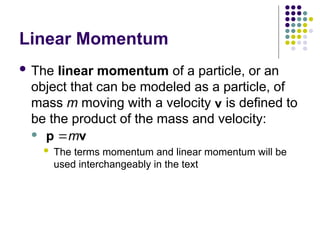
 The linear momentum of a particle, or an
object that can be modeled as a particle, of
mass m moving with a velocity is defined to
be the product of the mass and velocity:

 The terms momentum and linear momentum will be
used interchangeably in the text
v

m

p v
 
Linear Momentum, cont
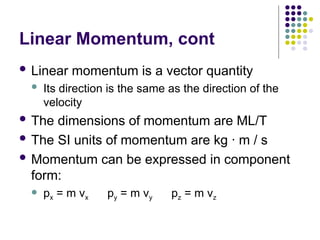
 Linear momentum is a vector quantity
 Its direction is the same as the direction of the
velocity
 The dimensions of momentum are ML/T
 The SI units of momentum are kg · m / s
 Momentum can be expressed in component
form:
 px = m vx py = m vy pz = m vz
Newton and Momentum
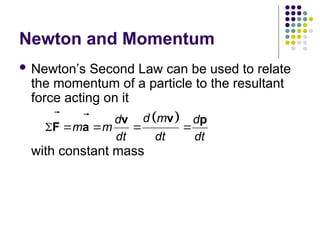
 Newton’s Second Law can be used to relate
the momentum of a particle to the resultant
force acting on it
with constant mass
 
d m
d d
m m
dt dt dt
    
v
v p
F a
 

 
Newton’s Second Law
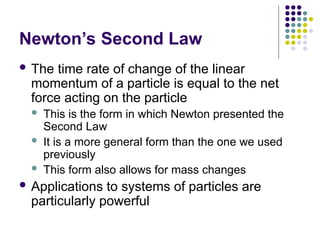
 The time rate of change of the linear
momentum of a particle is equal to the net
force acting on the particle
 This is the form in which Newton presented the
Second Law
 It is a more general form than the one we used
previously
 This form also allows for mass changes
 Applications to systems of particles are
particularly powerful
Conservation of Linear
Momentum
 Whenever two or more particles in an
isolated system interact, the total momentum
of the system remains constant
 The momentum of the system is conserved, not
necessarily the momentum of an individual
particle
 This also tells us that the total momentum of an
isolated system equals its initial momentum
Conservation of Momentum, 2
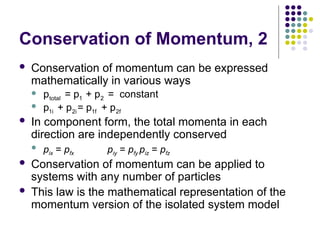
 Conservation of momentum can be expressed
mathematically in various ways


 In component form, the total momenta in each
direction are independently conserved
 pix = pfx piy = pfy piz = pfz
 Conservation of momentum can be applied to
systems with any number of particles
 This law is the mathematical representation of the
momentum version of the isolated system model
total 1 2
p = p + p = constant
  
1i 2i 1f 2f
p + p = p + p
   
Conservation of Momentum,
Archer Example
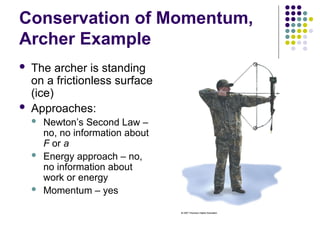
 The archer is standing
on a frictionless surface
(ice)
 Approaches:
 Newton’s Second Law –
no, no information about
F or a
 Energy approach – no,
no information about
work or energy
 Momentum – yes
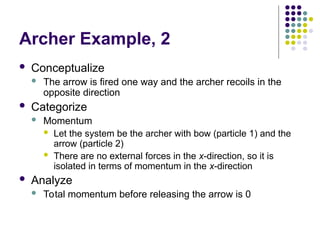
Archer Example, 2
 Conceptualize
 The arrow is fired one way and the archer recoils in the
opposite direction
 Categorize
 Momentum
 Let the system be the archer with bow (particle 1) and the
arrow (particle 2)
 There are no external forces in the x-direction, so it is
isolated in terms of momentum in the x-direction
 Analyze
 Total momentum before releasing the arrow is 0
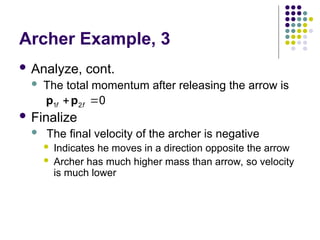
Archer Example, 3
 Analyze, cont.
 The total momentum after releasing the arrow is
 Finalize
 The final velocity of the archer is negative
 Indicates he moves in a direction opposite the arrow
 Archer has much higher mass than arrow, so velocity
is much lower
1 2 0
f f
 
p p
 
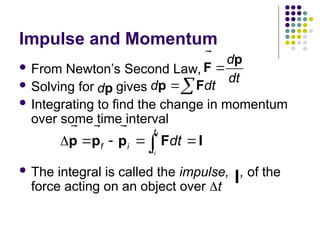
Impulse and Momentum
 From Newton’s Second Law,
 Solving for gives
 Integrating to find the change in momentum
over some time interval
 The integral is called the impulse, , of the
force acting on an object over t
f
i
t
f i t
dt
    

p p p F I
 
  
d
dt

p
F


dp

d dt

p F


I

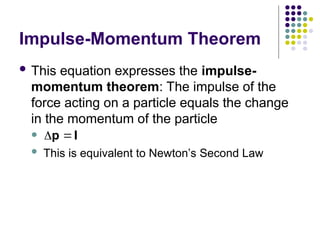
Impulse-Momentum Theorem
 This equation expresses the impulse-
momentum theorem: The impulse of the
force acting on a particle equals the change
in the momentum of the particle

 This is equivalent to Newton’s Second Law
 
p I


More About Impulse
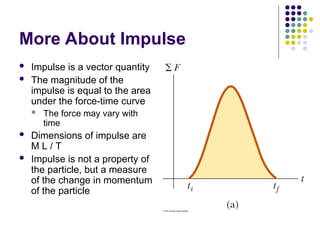
 Impulse is a vector quantity
 The magnitude of the
impulse is equal to the area
under the force-time curve
 The force may vary with
time
 Dimensions of impulse are
M L / T
 Impulse is not a property of
the particle, but a measure
of the change in momentum
of the particle
Impulse, Final
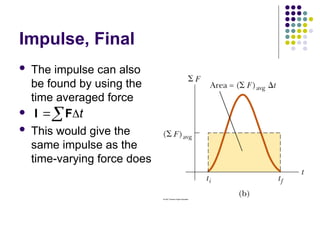
 The impulse can also
be found by using the
time averaged force

 This would give the
same impulse as the
time-varying force does
t
 

I F
 
Impulse Approximation
 In many cases, one force acting on a particle acts
for a short time, but is much greater than any other
force present
 When using the Impulse Approximation, we will
assume this is true
 Especially useful in analyzing collisions
 The force will be called the impulsive force
 The particle is assumed to move very little during
the collision
 represent the momenta immediately before
and after the collision
i f
and
p p
 
Impulse-Momentum: Crash
Test Example
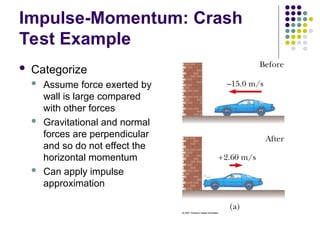
 Categorize
 Assume force exerted by
wall is large compared
with other forces
 Gravitational and normal
forces are perpendicular
and so do not effect the
horizontal momentum
 Can apply impulse
approximation
Crash Test Example, 2
 Analyze
 The momenta before and after the collision between the
car and the wall can be determined
 Find
 Initial momentum
 Final momentum
 Impulse
 Average force
 Finalize
 Check signs on velocities to be sure they are reasonable
Collisions – Characteristics
 We use the term collision to represent an event
during which two particles come close to each other
and interact by means of forces
 May involve physical contact, but must be generalized to
include cases with interaction without physical contact
 The time interval during which the velocity changes
from its initial to final values is assumed to be short
 The interaction forces are assumed to be much
greater than any external forces present
 This means the impulse approximation can be used
Collisions – Example 1
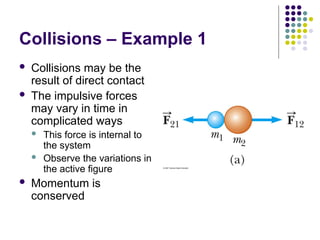
 Collisions may be the
result of direct contact
 The impulsive forces
may vary in time in
complicated ways
 This force is internal to
the system
 Observe the variations in
the active figure
 Momentum is
conserved
Collisions – Example 2
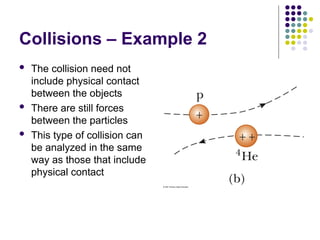
 The collision need not
include physical contact
between the objects
 There are still forces
between the particles
 This type of collision can
be analyzed in the same
way as those that include
physical contact
Types of Collisions
 In an elastic collision, momentum and kinetic
energy are conserved
 Perfectly elastic collisions occur on a microscopic level
 In macroscopic collisions, only approximately elastic
collisions actually occur
 Generally some energy is lost to deformation, sound, etc.
 In an inelastic collision, kinetic energy is not
conserved, although momentum is still conserved
 If the objects stick together after the collision, it is a
perfectly inelastic collision
Collisions, cont
 In an inelastic collision, some kinetic energy
is lost, but the objects do not stick together
 Elastic and perfectly inelastic collisions are
limiting cases, most actual collisions fall in
between these two types
 Momentum is conserved in all collisions
Perfectly Inelastic Collisions
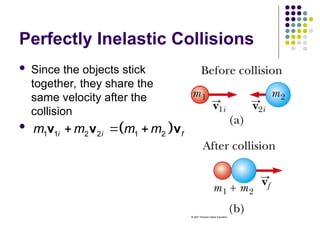
 Since the objects stick
together, they share the
same velocity after the
collision

 
1 1 2 2 1 2
i i f
m m m m
  
v v v
  
Elastic Collisions
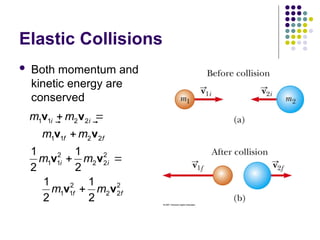
 Both momentum and
kinetic energy are
conserved
1 1 2 2
1 1 2 2
2 2
1 1 2 2
2 2
1 1 2 2
1 1
2 2
1 1
2 2
i i
f f
i i
f f
m m
m m
m m
m m
 

 

v v
v v
v v
v v
 
 
Elastic Collisions, cont
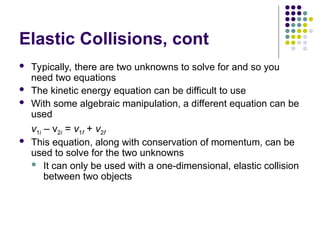
 Typically, there are two unknowns to solve for and so you
need two equations
 The kinetic energy equation can be difficult to use
 With some algebraic manipulation, a different equation can be
used
v1i – v2i = v1f + v2f
 This equation, along with conservation of momentum, can be
used to solve for the two unknowns
 It can only be used with a one-dimensional, elastic collision
between two objects
Elastic Collisions, final
 Example of some special cases
 m1 = m2 – the particles exchange velocities
 When a very heavy particle collides head-on with a very
light one initially at rest, the heavy particle continues in
motion unaltered and the light particle rebounds with a
speed of about twice the initial speed of the heavy particle
 When a very light particle collides head-on with a very
heavy particle initially at rest, the light particle has its
velocity reversed and the heavy particle remains
approximately at rest
Problem-Solving Strategy:
One-Dimensional Collisions
 Conceptualize
 Image the collision occurring in your mind
 Draw simple diagrams of the particles before and
after the collision
 Include appropriate velocity vectors
 Categorize
 Is the system of particles isolated?
 Is the collision elastic, inelastic or perfectly
inelastic?
Problem-Solving Strategy:
One-Dimensional Collisions
 Analyze
 Set up the mathematical representation of the
problem
 Solve for the unknown(s)
 Finalize
 Check to see if the answers are consistent with
the mental and pictorial representations
 Check to be sure your results are realistic
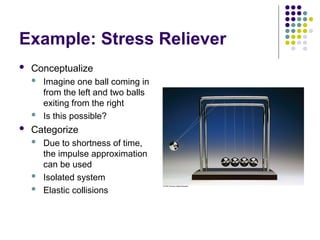
Example: Stress Reliever
 Conceptualize
 Imagine one ball coming in
from the left and two balls
exiting from the right
 Is this possible?
 Categorize
 Due to shortness of time,
the impulse approximation
can be used
 Isolated system
 Elastic collisions
Example: Stress Reliever, cont
 Analyze
 Check to see if momentum is conserved
 It is
 Check to see if kinetic energy is conserved
 It is not
 Therefore, the collision couldn’t be elastic
 Finalize
 Having two balls exit was not possible if only one
ball is released
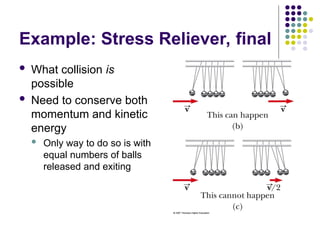
Example: Stress Reliever, final
 What collision is
possible
 Need to conserve both
momentum and kinetic
energy
 Only way to do so is with
equal numbers of balls
released and exiting
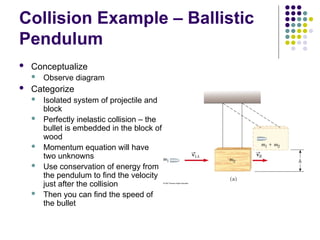
Collision Example – Ballistic
Pendulum
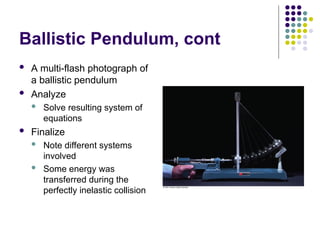
 Conceptualize
 Observe diagram
 Categorize
 Isolated system of projectile and
block
 Perfectly inelastic collision – the
bullet is embedded in the block of
wood
 Momentum equation will have
two unknowns
 Use conservation of energy from
the pendulum to find the velocity
just after the collision
 Then you can find the speed of
the bullet
Ballistic Pendulum, cont
 A multi-flash photograph of
a ballistic pendulum
 Analyze
 Solve resulting system of
equations
 Finalize
 Note different systems
involved
 Some energy was
transferred during the
perfectly inelastic collision
Two-Dimensional Collisions
 The momentum is conserved in all directions
 Use subscripts for
 Identifying the object
 Indicating initial or final values
 The velocity components
 If the collision is elastic, use conservation of kinetic
energy as a second equation
 Remember, the simpler equation can only be used for one-
dimensional situations
Two-Dimensional Collision,
example
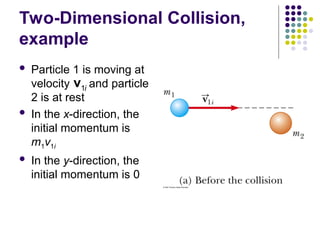
 Particle 1 is moving at
velocity and particle
2 is at rest
 In the x-direction, the
initial momentum is
m1v1i
 In the y-direction, the
initial momentum is 0
1i
v

Two-Dimensional Collision,
example cont
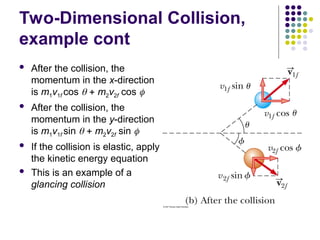
 After the collision, the
momentum in the x-direction
is m1v1f cos  m2v2f cos 
 After the collision, the
momentum in the y-direction
is m1v1f sin  m2v2f sin 
 If the collision is elastic, apply
the kinetic energy equation
 This is an example of a
glancing collision
Problem-Solving Strategies –
Two-Dimensional Collisions
 Conceptualize
 Imagine the collision
 Predict approximate directions the particles will
move after the collision
 Set up a coordinate system and define your
velocities with respect to that system
 It is usually convenient to have the x-axis coincide
with one of the initial velocities
 In your sketch of the coordinate system, draw and
label all velocity vectors and include all the given
information
Problem-Solving Strategies –
Two-Dimensional Collisions, 2
 Categorize
 Is the system isolated?
 If so, categorize the collision as elastic, inelastic or
perfectly inelastic
 Analyze
 Write expressions for the x- and y-components of the
momentum of each object before and after the collision
 Remember to include the appropriate signs for the
components of the velocity vectors
 Write expressions for the total momentum of the system in
the x-direction before and after the collision and equate the
two. Repeat for the total momentum in the y-direction.
Problem-Solving Strategies –
Two-Dimensional Collisions, 3
 Analyze, cont
 If the collision is inelastic, kinetic energy of the system is
not conserved, and additional information is probably
needed
 If the collision is perfectly inelastic, the final velocities of the
two objects are equal. Solve the momentum equations for
the unknowns.
 If the collision is elastic, the kinetic energy of the system is
conserved
 Equate the total kinetic energy before the collision to the
total kinetic energy after the collision to obtain more
information on the relationship between the velocities
Problem-Solving Strategies –
Two-Dimensional Collisions, 4
 Finalize
 Check to see if your answers are consistent with
the mental and pictorial representations
 Check to be sure your results are realistic
Two-Dimensional Collision
Example
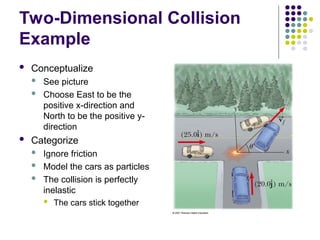
 Conceptualize
 See picture
 Choose East to be the
positive x-direction and
North to be the positive y-
direction
 Categorize
 Ignore friction
 Model the cars as particles
 The collision is perfectly
inelastic
 The cars stick together
Two-Dimensional Collision
Example, cont
 Analyze
 Before the collision, the car has the total momentum in the
x-direction and the van has the total momentum in the y-
direction
 After the collision, both have x- and y-components
 Write expressions for initial and final momenta in both
directions
 Evaluate any expressions with no unknowns
 Solve for unknowns
 Finalize
 Check to be sure the results are reasonable
The Center of Mass
 There is a special point in a system or object,
called the center of mass, that moves as if
all of the mass of the system is concentrated
at that point
 The system will move as if an external force
were applied to a single particle of mass M
located at the center of mass
 M is the total mass of the system
Center of Mass, Coordinates
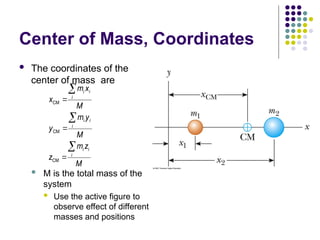
 The coordinates of the
center of mass are
 M is the total mass of the
system
 Use the active figure to
observe effect of different
masses and positions
CM
CM
CM
i i
i
i i
i
i i
i
m x
x
M
m y
y
M
m z
z
M






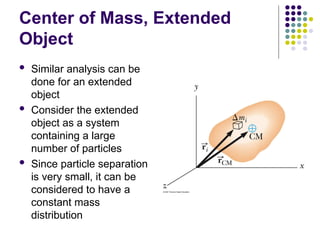
Center of Mass, Extended
Object
 Similar analysis can be
done for an extended
object
 Consider the extended
object as a system
containing a large
number of particles
 Since particle separation
is very small, it can be
considered to have a
constant mass
distribution
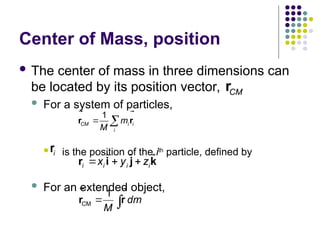
Center of Mass, position
 The center of mass in three dimensions can
be located by its position vector,
 For a system of particles,
 is the position of the ith
particle, defined by
 For an extended object,
CM
1
dm
M
 
r r
 
ˆ ˆ ˆ
i i i i
x y z
  
r i j k
CM
r

1
CM i i
i
m
M
 
r r
 
i
r

Center of Mass, Symmetric
Object
 The center of mass of any symmetric object
lies on an axis of symmetry and on any plane
of symmetry
 If the object has uniform density
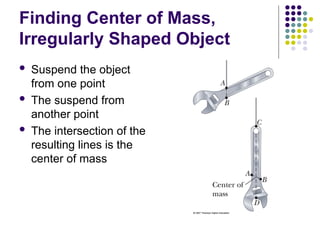
Finding Center of Mass,
Irregularly Shaped Object
 Suspend the object
from one point
 The suspend from
another point
 The intersection of the
resulting lines is the
center of mass
Center of Gravity
 Each small mass element of an extended
object is acted upon by the gravitational force
 The net effect of all these forces is equivalent
to the effect of a single force acting
through a point called the center of gravity
 If is constant over the mass distribution, the
center of gravity coincides with the center of mass
Mg

g

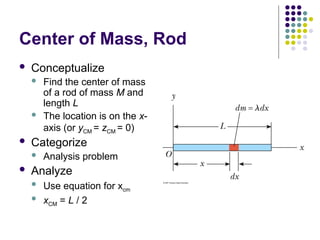
Center of Mass, Rod
 Conceptualize
 Find the center of mass
of a rod of mass M and
length L
 The location is on the x-
axis (or yCM = zCM = 0)
 Categorize
 Analysis problem
 Analyze
 Use equation for xcm
 xCM = L / 2
Motion of a System of Particles
 Assume the total mass, M, of the system
remains constant
 We can describe the motion of the system in
terms of the velocity and acceleration of the
center of mass of the system
 We can also describe the momentum of the
system and Newton’s Second Law for the
system
Velocity and Momentum of a
System of Particles
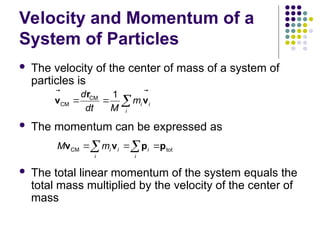
 The velocity of the center of mass of a system of
particles is
 The momentum can be expressed as
 The total linear momentum of the system equals the
total mass multiplied by the velocity of the center of
mass
CM
CM
1
i i
i
d
m
dt M
  
r
v v

 
CM tot
i i i
i i
M m
  
 
v v p p
 
 
Acceleration of the Center of
Mass
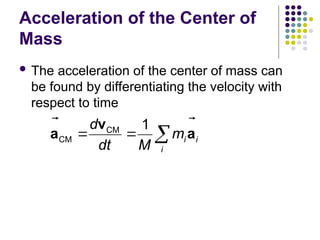
 The acceleration of the center of mass can
be found by differentiating the velocity with
respect to time
CM
CM
1
i i
i
d
m
dt M
  
v
a a

 
Forces In a System of Particles
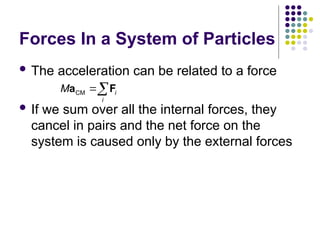
 The acceleration can be related to a force
 If we sum over all the internal forces, they
cancel in pairs and the net force on the
system is caused only by the external forces
CM i
i
M 
a F


Newton’s Second Law for a
System of Particles
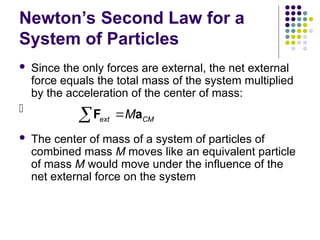
 Since the only forces are external, the net external
force equals the total mass of the system multiplied
by the acceleration of the center of mass:

 The center of mass of a system of particles of
combined mass M moves like an equivalent particle
of mass M would move under the influence of the
net external force on the system
ext CM
M

F a
 
Impulse and Momentum of a
System of Particles
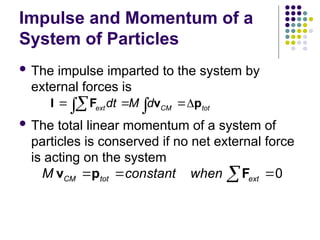
 The impulse imparted to the system by
external forces is
 The total linear momentum of a system of
particles is conserved if no net external force
is acting on the system
ext CM tot
dt M d
  

 
I F v p
  

0
CM tot ext
M constant when
  

v p F



Motion of the Center of Mass,
Example
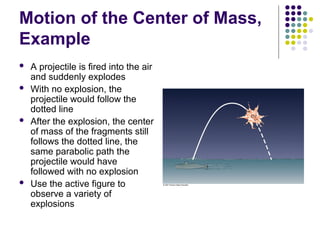
 A projectile is fired into the air
and suddenly explodes
 With no explosion, the
projectile would follow the
dotted line
 After the explosion, the center
of mass of the fragments still
follows the dotted line, the
same parabolic path the
projectile would have
followed with no explosion
 Use the active figure to
observe a variety of
explosions
Deformable Systems
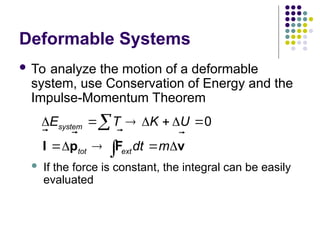
 To analyze the motion of a deformable
system, use Conservation of Energy and the
Impulse-Momentum Theorem
 If the force is constant, the integral can be easily
evaluated
0
system
tot ext
E T K U
dt m
      
   


I p F v
 
 
Deformable System (Spring)
Example
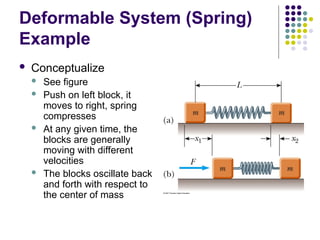
 Conceptualize
 See figure
 Push on left block, it
moves to right, spring
compresses
 At any given time, the
blocks are generally
moving with different
velocities
 The blocks oscillate back
and forth with respect to
the center of mass
Spring Example, cont
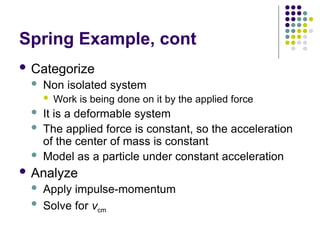
 Categorize
 Non isolated system
 Work is being done on it by the applied force
 It is a deformable system
 The applied force is constant, so the acceleration
of the center of mass is constant
 Model as a particle under constant acceleration
 Analyze
 Apply impulse-momentum
 Solve for vcm
Spring Example, final
 Analyze, cont.
 Find energies
 Finalize
 Answers do not depend on spring length, spring
constant, or time interval
Rocket Propulsion
 The operation of a rocket depends upon the
law of conservation of linear momentum as
applied to a system of particles, where the
system is the rocket plus its ejected fuel
Rocket Propulsion, 2
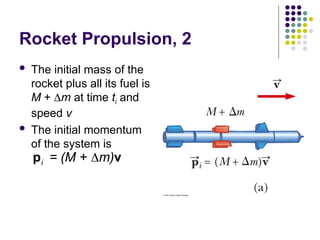
 The initial mass of the
rocket plus all its fuel is
M + m at time ti and
speed v
 The initial momentum
of the system is
i = (M + m)

p v
 
Rocket Propulsion, 3
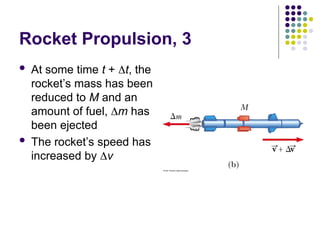
 At some time t + t, the
rocket’s mass has been
reduced to M and an
amount of fuel, m has
been ejected
 The rocket’s speed has
increased by v
Rocket Propulsion, 4
 Because the gases are given some momentum
when they are ejected out of the engine, the rocket
receives a compensating momentum in the opposite
direction
 Therefore, the rocket is accelerated as a result of
the “push” from the exhaust gases
 In free space, the center of mass of the system
(rocket plus expelled gases) moves uniformly,
independent of the propulsion process
Rocket Propulsion, 5
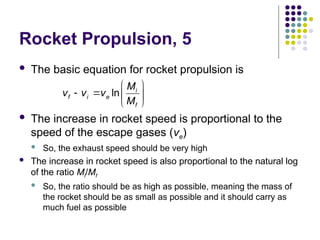
 The basic equation for rocket propulsion is
 The increase in rocket speed is proportional to the
speed of the escape gases (ve)
 So, the exhaust speed should be very high
 The increase in rocket speed is also proportional to the natural log
of the ratio Mi/Mf
 So, the ratio should be as high as possible, meaning the mass of
the rocket should be as small as possible and it should carry as
much fuel as possible
ln i
f i e
f
M
v v v
M
 
   
 
Thrust
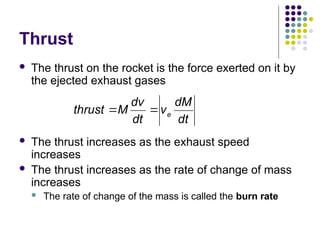
 The thrust on the rocket is the force exerted on it by
the ejected exhaust gases
 The thrust increases as the exhaust speed
increases
 The thrust increases as the rate of change of mass
increases
 The rate of change of the mass is called the burn rate
e
dv dM
thrust M v
dt dt
 

Glenn B. Stracher Physics Chapter9.ppt

  • 1.
  • 2.
    Linear Momentum  Thelinear momentum of a particle, or an object that can be modeled as a particle, of mass m moving with a velocity is defined to be the product of the mass and velocity:   The terms momentum and linear momentum will be used interchangeably in the text v  m  p v  
  • 3.
    Linear Momentum, cont Linear momentum is a vector quantity  Its direction is the same as the direction of the velocity  The dimensions of momentum are ML/T  The SI units of momentum are kg · m / s  Momentum can be expressed in component form:  px = m vx py = m vy pz = m vz
  • 4.
    Newton and Momentum Newton’s Second Law can be used to relate the momentum of a particle to the resultant force acting on it with constant mass   d m d d m m dt dt dt      v v p F a     
  • 5.
    Newton’s Second Law The time rate of change of the linear momentum of a particle is equal to the net force acting on the particle  This is the form in which Newton presented the Second Law  It is a more general form than the one we used previously  This form also allows for mass changes  Applications to systems of particles are particularly powerful
  • 6.
    Conservation of Linear Momentum Whenever two or more particles in an isolated system interact, the total momentum of the system remains constant  The momentum of the system is conserved, not necessarily the momentum of an individual particle  This also tells us that the total momentum of an isolated system equals its initial momentum
  • 7.
    Conservation of Momentum,2  Conservation of momentum can be expressed mathematically in various ways    In component form, the total momenta in each direction are independently conserved  pix = pfx piy = pfy piz = pfz  Conservation of momentum can be applied to systems with any number of particles  This law is the mathematical representation of the momentum version of the isolated system model total 1 2 p = p + p = constant    1i 2i 1f 2f p + p = p + p    
  • 8.
    Conservation of Momentum, ArcherExample  The archer is standing on a frictionless surface (ice)  Approaches:  Newton’s Second Law – no, no information about F or a  Energy approach – no, no information about work or energy  Momentum – yes
  • 9.
    Archer Example, 2 Conceptualize  The arrow is fired one way and the archer recoils in the opposite direction  Categorize  Momentum  Let the system be the archer with bow (particle 1) and the arrow (particle 2)  There are no external forces in the x-direction, so it is isolated in terms of momentum in the x-direction  Analyze  Total momentum before releasing the arrow is 0
  • 10.
    Archer Example, 3 Analyze, cont.  The total momentum after releasing the arrow is  Finalize  The final velocity of the archer is negative  Indicates he moves in a direction opposite the arrow  Archer has much higher mass than arrow, so velocity is much lower 1 2 0 f f   p p  
  • 11.
    Impulse and Momentum From Newton’s Second Law,  Solving for gives  Integrating to find the change in momentum over some time interval  The integral is called the impulse, , of the force acting on an object over t f i t f i t dt       p p p F I      d dt  p F   dp  d dt  p F   I 
  • 12.
    Impulse-Momentum Theorem  Thisequation expresses the impulse- momentum theorem: The impulse of the force acting on a particle equals the change in the momentum of the particle   This is equivalent to Newton’s Second Law   p I  
  • 13.
    More About Impulse Impulse is a vector quantity  The magnitude of the impulse is equal to the area under the force-time curve  The force may vary with time  Dimensions of impulse are M L / T  Impulse is not a property of the particle, but a measure of the change in momentum of the particle
  • 14.
    Impulse, Final  Theimpulse can also be found by using the time averaged force   This would give the same impulse as the time-varying force does t    I F  
  • 15.
    Impulse Approximation  Inmany cases, one force acting on a particle acts for a short time, but is much greater than any other force present  When using the Impulse Approximation, we will assume this is true  Especially useful in analyzing collisions  The force will be called the impulsive force  The particle is assumed to move very little during the collision  represent the momenta immediately before and after the collision i f and p p  
  • 16.
    Impulse-Momentum: Crash Test Example Categorize  Assume force exerted by wall is large compared with other forces  Gravitational and normal forces are perpendicular and so do not effect the horizontal momentum  Can apply impulse approximation
  • 17.
    Crash Test Example,2  Analyze  The momenta before and after the collision between the car and the wall can be determined  Find  Initial momentum  Final momentum  Impulse  Average force  Finalize  Check signs on velocities to be sure they are reasonable
  • 18.
    Collisions – Characteristics We use the term collision to represent an event during which two particles come close to each other and interact by means of forces  May involve physical contact, but must be generalized to include cases with interaction without physical contact  The time interval during which the velocity changes from its initial to final values is assumed to be short  The interaction forces are assumed to be much greater than any external forces present  This means the impulse approximation can be used
  • 19.
    Collisions – Example1  Collisions may be the result of direct contact  The impulsive forces may vary in time in complicated ways  This force is internal to the system  Observe the variations in the active figure  Momentum is conserved
  • 20.
    Collisions – Example2  The collision need not include physical contact between the objects  There are still forces between the particles  This type of collision can be analyzed in the same way as those that include physical contact
  • 21.
    Types of Collisions In an elastic collision, momentum and kinetic energy are conserved  Perfectly elastic collisions occur on a microscopic level  In macroscopic collisions, only approximately elastic collisions actually occur  Generally some energy is lost to deformation, sound, etc.  In an inelastic collision, kinetic energy is not conserved, although momentum is still conserved  If the objects stick together after the collision, it is a perfectly inelastic collision
  • 22.
    Collisions, cont  Inan inelastic collision, some kinetic energy is lost, but the objects do not stick together  Elastic and perfectly inelastic collisions are limiting cases, most actual collisions fall in between these two types  Momentum is conserved in all collisions
  • 23.
    Perfectly Inelastic Collisions Since the objects stick together, they share the same velocity after the collision    1 1 2 2 1 2 i i f m m m m    v v v   
  • 24.
    Elastic Collisions  Bothmomentum and kinetic energy are conserved 1 1 2 2 1 1 2 2 2 2 1 1 2 2 2 2 1 1 2 2 1 1 2 2 1 1 2 2 i i f f i i f f m m m m m m m m       v v v v v v v v    
  • 25.
    Elastic Collisions, cont Typically, there are two unknowns to solve for and so you need two equations  The kinetic energy equation can be difficult to use  With some algebraic manipulation, a different equation can be used v1i – v2i = v1f + v2f  This equation, along with conservation of momentum, can be used to solve for the two unknowns  It can only be used with a one-dimensional, elastic collision between two objects
  • 26.
    Elastic Collisions, final Example of some special cases  m1 = m2 – the particles exchange velocities  When a very heavy particle collides head-on with a very light one initially at rest, the heavy particle continues in motion unaltered and the light particle rebounds with a speed of about twice the initial speed of the heavy particle  When a very light particle collides head-on with a very heavy particle initially at rest, the light particle has its velocity reversed and the heavy particle remains approximately at rest
  • 27.
    Problem-Solving Strategy: One-Dimensional Collisions Conceptualize  Image the collision occurring in your mind  Draw simple diagrams of the particles before and after the collision  Include appropriate velocity vectors  Categorize  Is the system of particles isolated?  Is the collision elastic, inelastic or perfectly inelastic?
  • 28.
    Problem-Solving Strategy: One-Dimensional Collisions Analyze  Set up the mathematical representation of the problem  Solve for the unknown(s)  Finalize  Check to see if the answers are consistent with the mental and pictorial representations  Check to be sure your results are realistic
  • 29.
    Example: Stress Reliever Conceptualize  Imagine one ball coming in from the left and two balls exiting from the right  Is this possible?  Categorize  Due to shortness of time, the impulse approximation can be used  Isolated system  Elastic collisions
  • 30.
    Example: Stress Reliever,cont  Analyze  Check to see if momentum is conserved  It is  Check to see if kinetic energy is conserved  It is not  Therefore, the collision couldn’t be elastic  Finalize  Having two balls exit was not possible if only one ball is released
  • 31.
    Example: Stress Reliever,final  What collision is possible  Need to conserve both momentum and kinetic energy  Only way to do so is with equal numbers of balls released and exiting
  • 32.
    Collision Example –Ballistic Pendulum  Conceptualize  Observe diagram  Categorize  Isolated system of projectile and block  Perfectly inelastic collision – the bullet is embedded in the block of wood  Momentum equation will have two unknowns  Use conservation of energy from the pendulum to find the velocity just after the collision  Then you can find the speed of the bullet
  • 33.
    Ballistic Pendulum, cont A multi-flash photograph of a ballistic pendulum  Analyze  Solve resulting system of equations  Finalize  Note different systems involved  Some energy was transferred during the perfectly inelastic collision
  • 34.
    Two-Dimensional Collisions  Themomentum is conserved in all directions  Use subscripts for  Identifying the object  Indicating initial or final values  The velocity components  If the collision is elastic, use conservation of kinetic energy as a second equation  Remember, the simpler equation can only be used for one- dimensional situations
  • 35.
    Two-Dimensional Collision, example  Particle1 is moving at velocity and particle 2 is at rest  In the x-direction, the initial momentum is m1v1i  In the y-direction, the initial momentum is 0 1i v 
  • 36.
    Two-Dimensional Collision, example cont After the collision, the momentum in the x-direction is m1v1f cos  m2v2f cos   After the collision, the momentum in the y-direction is m1v1f sin  m2v2f sin   If the collision is elastic, apply the kinetic energy equation  This is an example of a glancing collision
  • 37.
    Problem-Solving Strategies – Two-DimensionalCollisions  Conceptualize  Imagine the collision  Predict approximate directions the particles will move after the collision  Set up a coordinate system and define your velocities with respect to that system  It is usually convenient to have the x-axis coincide with one of the initial velocities  In your sketch of the coordinate system, draw and label all velocity vectors and include all the given information
  • 38.
    Problem-Solving Strategies – Two-DimensionalCollisions, 2  Categorize  Is the system isolated?  If so, categorize the collision as elastic, inelastic or perfectly inelastic  Analyze  Write expressions for the x- and y-components of the momentum of each object before and after the collision  Remember to include the appropriate signs for the components of the velocity vectors  Write expressions for the total momentum of the system in the x-direction before and after the collision and equate the two. Repeat for the total momentum in the y-direction.
  • 39.
    Problem-Solving Strategies – Two-DimensionalCollisions, 3  Analyze, cont  If the collision is inelastic, kinetic energy of the system is not conserved, and additional information is probably needed  If the collision is perfectly inelastic, the final velocities of the two objects are equal. Solve the momentum equations for the unknowns.  If the collision is elastic, the kinetic energy of the system is conserved  Equate the total kinetic energy before the collision to the total kinetic energy after the collision to obtain more information on the relationship between the velocities
  • 40.
    Problem-Solving Strategies – Two-DimensionalCollisions, 4  Finalize  Check to see if your answers are consistent with the mental and pictorial representations  Check to be sure your results are realistic
  • 41.
    Two-Dimensional Collision Example  Conceptualize See picture  Choose East to be the positive x-direction and North to be the positive y- direction  Categorize  Ignore friction  Model the cars as particles  The collision is perfectly inelastic  The cars stick together
  • 42.
    Two-Dimensional Collision Example, cont Analyze  Before the collision, the car has the total momentum in the x-direction and the van has the total momentum in the y- direction  After the collision, both have x- and y-components  Write expressions for initial and final momenta in both directions  Evaluate any expressions with no unknowns  Solve for unknowns  Finalize  Check to be sure the results are reasonable
  • 43.
    The Center ofMass  There is a special point in a system or object, called the center of mass, that moves as if all of the mass of the system is concentrated at that point  The system will move as if an external force were applied to a single particle of mass M located at the center of mass  M is the total mass of the system
  • 44.
    Center of Mass,Coordinates  The coordinates of the center of mass are  M is the total mass of the system  Use the active figure to observe effect of different masses and positions CM CM CM i i i i i i i i i m x x M m y y M m z z M      
  • 45.
    Center of Mass,Extended Object  Similar analysis can be done for an extended object  Consider the extended object as a system containing a large number of particles  Since particle separation is very small, it can be considered to have a constant mass distribution
  • 46.
    Center of Mass,position  The center of mass in three dimensions can be located by its position vector,  For a system of particles,  is the position of the ith particle, defined by  For an extended object, CM 1 dm M   r r   ˆ ˆ ˆ i i i i x y z    r i j k CM r  1 CM i i i m M   r r   i r 
  • 47.
    Center of Mass,Symmetric Object  The center of mass of any symmetric object lies on an axis of symmetry and on any plane of symmetry  If the object has uniform density
  • 48.
    Finding Center ofMass, Irregularly Shaped Object  Suspend the object from one point  The suspend from another point  The intersection of the resulting lines is the center of mass
  • 49.
    Center of Gravity Each small mass element of an extended object is acted upon by the gravitational force  The net effect of all these forces is equivalent to the effect of a single force acting through a point called the center of gravity  If is constant over the mass distribution, the center of gravity coincides with the center of mass Mg  g 
  • 50.
    Center of Mass,Rod  Conceptualize  Find the center of mass of a rod of mass M and length L  The location is on the x- axis (or yCM = zCM = 0)  Categorize  Analysis problem  Analyze  Use equation for xcm  xCM = L / 2
  • 51.
    Motion of aSystem of Particles  Assume the total mass, M, of the system remains constant  We can describe the motion of the system in terms of the velocity and acceleration of the center of mass of the system  We can also describe the momentum of the system and Newton’s Second Law for the system
  • 52.
    Velocity and Momentumof a System of Particles  The velocity of the center of mass of a system of particles is  The momentum can be expressed as  The total linear momentum of the system equals the total mass multiplied by the velocity of the center of mass CM CM 1 i i i d m dt M    r v v    CM tot i i i i i M m      v v p p    
  • 53.
    Acceleration of theCenter of Mass  The acceleration of the center of mass can be found by differentiating the velocity with respect to time CM CM 1 i i i d m dt M    v a a   
  • 54.
    Forces In aSystem of Particles  The acceleration can be related to a force  If we sum over all the internal forces, they cancel in pairs and the net force on the system is caused only by the external forces CM i i M  a F  
  • 55.
    Newton’s Second Lawfor a System of Particles  Since the only forces are external, the net external force equals the total mass of the system multiplied by the acceleration of the center of mass:   The center of mass of a system of particles of combined mass M moves like an equivalent particle of mass M would move under the influence of the net external force on the system ext CM M  F a  
  • 56.
    Impulse and Momentumof a System of Particles  The impulse imparted to the system by external forces is  The total linear momentum of a system of particles is conserved if no net external force is acting on the system ext CM tot dt M d       I F v p     0 CM tot ext M constant when     v p F   
  • 57.
    Motion of theCenter of Mass, Example  A projectile is fired into the air and suddenly explodes  With no explosion, the projectile would follow the dotted line  After the explosion, the center of mass of the fragments still follows the dotted line, the same parabolic path the projectile would have followed with no explosion  Use the active figure to observe a variety of explosions
  • 58.
    Deformable Systems  Toanalyze the motion of a deformable system, use Conservation of Energy and the Impulse-Momentum Theorem  If the force is constant, the integral can be easily evaluated 0 system tot ext E T K U dt m              I p F v    
  • 59.
    Deformable System (Spring) Example Conceptualize  See figure  Push on left block, it moves to right, spring compresses  At any given time, the blocks are generally moving with different velocities  The blocks oscillate back and forth with respect to the center of mass
  • 60.
    Spring Example, cont Categorize  Non isolated system  Work is being done on it by the applied force  It is a deformable system  The applied force is constant, so the acceleration of the center of mass is constant  Model as a particle under constant acceleration  Analyze  Apply impulse-momentum  Solve for vcm
  • 61.
    Spring Example, final Analyze, cont.  Find energies  Finalize  Answers do not depend on spring length, spring constant, or time interval
  • 62.
    Rocket Propulsion  Theoperation of a rocket depends upon the law of conservation of linear momentum as applied to a system of particles, where the system is the rocket plus its ejected fuel
  • 63.
    Rocket Propulsion, 2 The initial mass of the rocket plus all its fuel is M + m at time ti and speed v  The initial momentum of the system is i = (M + m)  p v  
  • 64.
    Rocket Propulsion, 3 At some time t + t, the rocket’s mass has been reduced to M and an amount of fuel, m has been ejected  The rocket’s speed has increased by v
  • 65.
    Rocket Propulsion, 4 Because the gases are given some momentum when they are ejected out of the engine, the rocket receives a compensating momentum in the opposite direction  Therefore, the rocket is accelerated as a result of the “push” from the exhaust gases  In free space, the center of mass of the system (rocket plus expelled gases) moves uniformly, independent of the propulsion process
  • 66.
    Rocket Propulsion, 5 The basic equation for rocket propulsion is  The increase in rocket speed is proportional to the speed of the escape gases (ve)  So, the exhaust speed should be very high  The increase in rocket speed is also proportional to the natural log of the ratio Mi/Mf  So, the ratio should be as high as possible, meaning the mass of the rocket should be as small as possible and it should carry as much fuel as possible ln i f i e f M v v v M        
  • 67.
    Thrust  The thruston the rocket is the force exerted on it by the ejected exhaust gases  The thrust increases as the exhaust speed increases  The thrust increases as the rate of change of mass increases  The rate of change of the mass is called the burn rate e dv dM thrust M v dt dt  