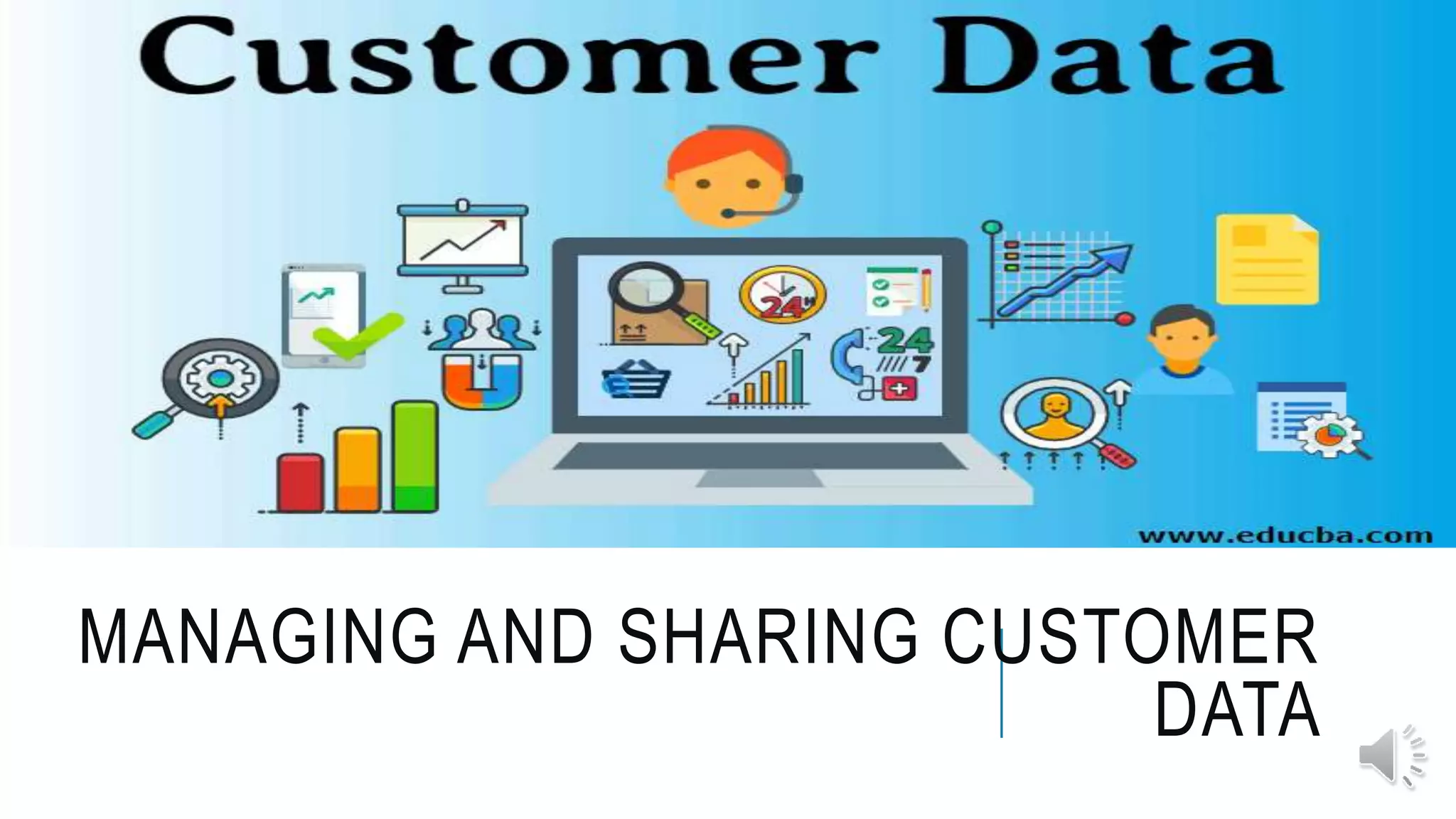
MANAGING AND SHARING CUSTOMER
DATA
Customer data is the behavioral,
demographic and personal information
about customers collected by
businesses and marketing companies
to understand, communicate and
engage with customers.
What Is Customer Data?
Customer data is defined as the
information your customers provide
while interacting with your business via
your website, mobile applications,
surveys, social media, marketing
campaigns, and other online and
offline avenues.
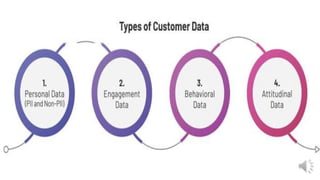
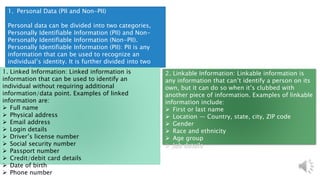
1. Personal Data (PII and Non-PII)
Personal data can be divided into two categories,
Personally Identifiable Information (PII) and Non-
Personally Identifiable Information (Non-PII).
Personally Identifiable Information (PII): PII is any
information that can be used to recognize an
individual’s identity. It is further divided into two
categories
1. Linked Information: Linked information is
information that can be used to identify an
individual without requiring additional
information/data point. Examples of linked
information are:
 Full name
 Physical address
 Email address
 Login details
 Driver’s license number
 Social security number
 Passport number
 Credit/debit card details
 Date of birth
 Phone number
2. Linkable Information: Linkable information is
any information that can’t identify a person on its
own, but it can do so when it’s clubbed with
another piece of information. Examples of linkable
information include:
 First or last name
 Location — Country, state, city, ZIP code
 Gender
 Race and ethnicity
 Age group
 Job details
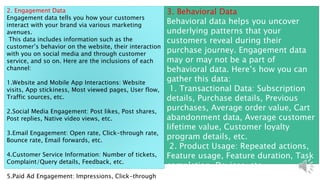
2. Engagement Data
Engagement data tells you how your customers
interact with your brand via various marketing
avenues.
This data includes information such as the
customer’s behavior on the website, their interaction
with you on social media and through customer
service, and so on. Here are the inclusions of each
channel:
1.Website and Mobile App Interactions: Website
visits, App stickiness, Most viewed pages, User flow,
Traffic sources, etc.
2.Social Media Engagement: Post likes, Post shares,
Post replies, Native video views, etc.
3.Email Engagement: Open rate, Click-through rate,
Bounce rate, Email forwards, etc.
4.Customer Service Information: Number of tickets,
Complaint/Query details, Feedback, etc.
5.Paid Ad Engagement: Impressions, Click-through
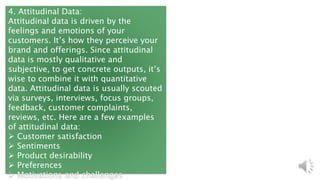
3. Behavioral Data
Behavioral data helps you uncover
underlying patterns that your
customers reveal during their
purchase journey. Engagement data
may or may not be a part of
behavioral data. Here’s how you can
gather this data:
1. Transactional Data: Subscription
details, Purchase details, Previous
purchases, Average order value, Cart
abandonment data, Average customer
lifetime value, Customer loyalty
program details, etc.
2. Product Usage: Repeated actions,
Feature usage, Feature duration, Task
completion, Devices, etc.
3. Qualitative Data: User attention,
4. Attitudinal Data:
Attitudinal data is driven by the
feelings and emotions of your
customers. It’s how they perceive your
brand and offerings. Since attitudinal
data is mostly qualitative and
subjective, to get concrete outputs, it’s
wise to combine it with quantitative
data. Attitudinal data is usually scouted
via surveys, interviews, focus groups,
feedback, customer complaints,
reviews, etc. Here are a few examples
of attitudinal data:
 Customer satisfaction
 Sentiments
 Product desirability
 Preferences
 Motivations and challenges
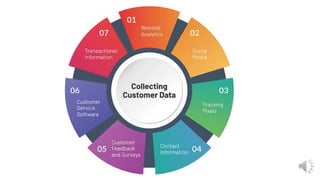
1. Website Analytics
Your website is often the primary channel that your
customers interact with. You can collect customer
data such as their demographic and geographic
characteristics along with engagement and
behavioral data.
Tools such as Google Analytics, Mixpanel, Piwik PRO,
and Matomo help you understand their interests,
referral sources, conversion details, along with their
real-time behavior on your website.
2. Social Media
You can know a lot about your customers based on
how they interact with you on social media. Apart
from using basic engagement metrics (such as
likes, comments, and shares), you can get to know
a lot about your customers through the native
analytics/insights section of each social media
platform.
3. Tracking Pixels
A tracking pixel is a piece of HTML or JavaScript
code inserted into a website or an email that records
every visitor landing onto your website or opening
the email. Tracking pixels can record IP addresses,
operating systems, browsers, etc. which in turn
helps advertisers run sophisticated remarketing
campaigns
4. Contact Information
Contact information is perhaps the most important
information from the perspective of communicating
with your customers. It is unlikely that your
customers will share all the information from the
get-go. It’s wise to collect their details considering
the stage of the buyer’s journey. For instance, longer
forms will be ineffective early in the stage. Make
sure to provide appropriate rewards/incentives when
your customers provide their data.
5. Customer Feedback and Surveys
Customer feedback and surveys are effective to
gather interests, tastes, and preferences of your
customers. By asking the right questions, surveys
can help you collect qualitative, attitudinal data. You
can receive feedback on your offerings, services,
sales and marketing activities through surveys.
6. Customer Service Software
A customer service software helps you understand
the instances when your customers seek help,
problems existing in your product, the complexity
of those problems, the medium your customers
choose to connect with you, how long it takes to
resolve a query and how it can be optimized.
7. Transactional Information
Depending on your business model, there are
different ways to collect transactional customer data.
For a SaaS business, it is often entirely through
online means, and it typically consists of the
standard data such as the subscription details of the
customer.
MANAGING CUSTOMER DATA
Take security seriously.
Gather information
ethically.
Decide what you really
need.
Invest in customer database
software.
Back up your data.
Clean up your customer
data.
Train your team.
Think about access.
Effective customer data management
 Boost in sales through better knowledge of
customer needs
 Higher efficiency of business processes by
eliminating duplication and junk data
collection
 Compliance and data security through
standardisation and centralisation of data.
Major benefits:
o Generate customer insights
o Customer Segmentation
o Build innovation
o Building effective communications &
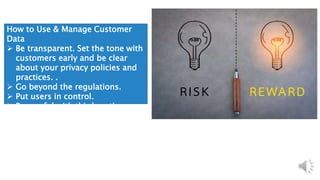
How to Use & Manage Customer
Data
 Be transparent. Set the tone with
customers early and be clear
about your privacy policies and
practices. .
 Go beyond the regulations.
 Put users in control.
 Be careful with third parties.
 Use security best practices.

Managing and sharing customer data

  • 1.
    MANAGING AND SHARINGCUSTOMER DATA
  • 2.
    Customer data isthe behavioral, demographic and personal information about customers collected by businesses and marketing companies to understand, communicate and engage with customers. What Is Customer Data? Customer data is defined as the information your customers provide while interacting with your business via your website, mobile applications, surveys, social media, marketing campaigns, and other online and offline avenues.
  • 4.
    1. Personal Data(PII and Non-PII) Personal data can be divided into two categories, Personally Identifiable Information (PII) and Non- Personally Identifiable Information (Non-PII). Personally Identifiable Information (PII): PII is any information that can be used to recognize an individual’s identity. It is further divided into two categories 1. Linked Information: Linked information is information that can be used to identify an individual without requiring additional information/data point. Examples of linked information are:  Full name  Physical address  Email address  Login details  Driver’s license number  Social security number  Passport number  Credit/debit card details  Date of birth  Phone number 2. Linkable Information: Linkable information is any information that can’t identify a person on its own, but it can do so when it’s clubbed with another piece of information. Examples of linkable information include:  First or last name  Location — Country, state, city, ZIP code  Gender  Race and ethnicity  Age group  Job details
  • 5.
    2. Engagement Data Engagementdata tells you how your customers interact with your brand via various marketing avenues. This data includes information such as the customer’s behavior on the website, their interaction with you on social media and through customer service, and so on. Here are the inclusions of each channel: 1.Website and Mobile App Interactions: Website visits, App stickiness, Most viewed pages, User flow, Traffic sources, etc. 2.Social Media Engagement: Post likes, Post shares, Post replies, Native video views, etc. 3.Email Engagement: Open rate, Click-through rate, Bounce rate, Email forwards, etc. 4.Customer Service Information: Number of tickets, Complaint/Query details, Feedback, etc. 5.Paid Ad Engagement: Impressions, Click-through 3. Behavioral Data Behavioral data helps you uncover underlying patterns that your customers reveal during their purchase journey. Engagement data may or may not be a part of behavioral data. Here’s how you can gather this data: 1. Transactional Data: Subscription details, Purchase details, Previous purchases, Average order value, Cart abandonment data, Average customer lifetime value, Customer loyalty program details, etc. 2. Product Usage: Repeated actions, Feature usage, Feature duration, Task completion, Devices, etc. 3. Qualitative Data: User attention,
  • 6.
    4. Attitudinal Data: Attitudinaldata is driven by the feelings and emotions of your customers. It’s how they perceive your brand and offerings. Since attitudinal data is mostly qualitative and subjective, to get concrete outputs, it’s wise to combine it with quantitative data. Attitudinal data is usually scouted via surveys, interviews, focus groups, feedback, customer complaints, reviews, etc. Here are a few examples of attitudinal data:  Customer satisfaction  Sentiments  Product desirability  Preferences  Motivations and challenges
  • 8.
    1. Website Analytics Yourwebsite is often the primary channel that your customers interact with. You can collect customer data such as their demographic and geographic characteristics along with engagement and behavioral data. Tools such as Google Analytics, Mixpanel, Piwik PRO, and Matomo help you understand their interests, referral sources, conversion details, along with their real-time behavior on your website. 2. Social Media You can know a lot about your customers based on how they interact with you on social media. Apart from using basic engagement metrics (such as likes, comments, and shares), you can get to know a lot about your customers through the native analytics/insights section of each social media platform. 3. Tracking Pixels A tracking pixel is a piece of HTML or JavaScript code inserted into a website or an email that records every visitor landing onto your website or opening the email. Tracking pixels can record IP addresses, operating systems, browsers, etc. which in turn helps advertisers run sophisticated remarketing campaigns 4. Contact Information Contact information is perhaps the most important information from the perspective of communicating with your customers. It is unlikely that your customers will share all the information from the get-go. It’s wise to collect their details considering the stage of the buyer’s journey. For instance, longer forms will be ineffective early in the stage. Make sure to provide appropriate rewards/incentives when your customers provide their data. 5. Customer Feedback and Surveys Customer feedback and surveys are effective to gather interests, tastes, and preferences of your customers. By asking the right questions, surveys can help you collect qualitative, attitudinal data. You can receive feedback on your offerings, services, sales and marketing activities through surveys. 6. Customer Service Software A customer service software helps you understand the instances when your customers seek help, problems existing in your product, the complexity of those problems, the medium your customers choose to connect with you, how long it takes to resolve a query and how it can be optimized.
  • 9.
    7. Transactional Information Dependingon your business model, there are different ways to collect transactional customer data. For a SaaS business, it is often entirely through online means, and it typically consists of the standard data such as the subscription details of the customer. MANAGING CUSTOMER DATA Take security seriously. Gather information ethically. Decide what you really need. Invest in customer database software. Back up your data. Clean up your customer data. Train your team. Think about access. Effective customer data management  Boost in sales through better knowledge of customer needs  Higher efficiency of business processes by eliminating duplication and junk data collection  Compliance and data security through standardisation and centralisation of data. Major benefits: o Generate customer insights o Customer Segmentation o Build innovation o Building effective communications &
  • 10.
    How to Use& Manage Customer Data  Be transparent. Set the tone with customers early and be clear about your privacy policies and practices. .  Go beyond the regulations.  Put users in control.  Be careful with third parties.  Use security best practices.