E-Customer Relationship Management
Supply Chain Manageement
Enterprise Resource Planning
Dr.S.Chandramouli
Assistant professor
Department of Commerce
SRM IST, Ramapuram Campus
CRM
CRM is not about technology, It’s about a company’s culture
and how that culture focuses on their customers.
Of the people, by the people, and for the people
“CRM is a customer-focused business strategy designed to
optimize revenue, profitability, and customer loyalty”
• CRM
“comprehensive strategy and process of acquiring, retaining, and
partnering with selective customers to create superior value for
the company and the selective customers to create superior value
for the company and the customer”
• E-CRM:- E-Business + CRM
“It also uses net environment i.e., intranet, extranet and internet.
Electronic CRM concerns all forms of managing relationships with
customers making use of information technology(IT)”
3
Objectives of E-CRM
1. To provide the entire organization with a complete, 360-degree (a full circle) view of the
customer,
2. To increase revenue and profitability by attracting new customers,
3. To grow the customer business,
4. To increase the customer satisfaction and loyalty,
5. To enable more efficient business processes and utilizing lower cost technologies.
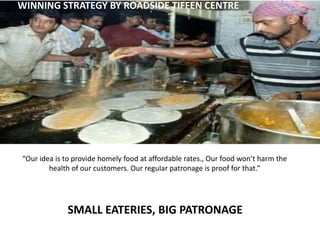
“Our idea is to provide homely food at affordable rates., Our food won’t harm the
health of our customers. Our regular patronage is proof for that.”
WINNING STRATEGY BY ROADSIDE TIFFEN CENTRE
SMALL EATERIES, BIG PATRONAGE
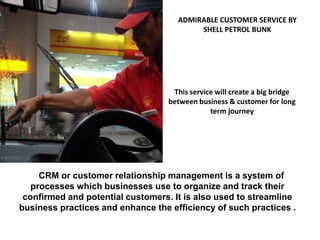
CRM or customer relationship management is a system of
processes which businesses use to organize and track their
confirmed and potential customers. It is also used to streamline
business practices and enhance the efficiency of such practices .
ADMIRABLE CUSTOMER SERVICE BY
SHELL PETROL BUNK
This service will create a big bridge
between business & customer for long
term journey
APPROACHES OF CRM
• Data Driven Approach
• Process Driven Approach
To give our enterprise a 360° (a full circle) view of each customer for
consistent and unified contact with that customer whenever anyone
anywhere in the enterprise deals with that customer. This knowledge
increases the opportunities for sales and the effectiveness of customer service.
enable our customers to have a consistent view of our enterprise, regardless of the way
the customer often contacts us
360 – degree view of customers
Differences between CRM and eCRM
12
Customer contacts
CRM – Contact with customer made through the retail store, phone, and fax.
eCRM – All of the traditional methods are used in addition to Internet, email, wireless, and PDA
technologies.
System interface
CRM – Implements the use of ERP systems, emphasis is on the back-end.
eCRM – Geared more toward front end, which interacts with the back-end through use of ERP
systems, data warehouses, and data marts.
System overhead (client computers)
CRM – The client must download various applications to view the web-enabled applications. They
would have to be rewritten for different platform.
eCRM – Does not have these requirements because the client uses the browser.
Customization and personalization of information
CRM – Views differ based on the audience, and personalized views are not available. Individual
personalization requires program changes.
eCRM – Personalized individual views based on purchase history and preferences. Individual has
ability to customize view.
13
System focus
CRM – System (created for internal use) designed based on job function and products.
Web applications designed for a single department or business unit.
eCRM – System (created for external use) designed based on customer needs. Web
application designed for enterprise-wide use.
System maintenance and modification
CRM – More time involved in implementation and maintenance is more expensive
because the system exists at different locations and on various servers.
eCRM – Reduction in time and cost. Implementation and maintenance can take place at
one location and on one server.
Enterprise Resource Planning (ERP)
“It is the technological backbone of E-Business, an enterprise-wide transaction
framework with links into sales order processing, Inventory management and
control , production and distribution planning and finance”
ERP software can aid in the control of many business activities like sales,
delivery, billing, production, inventory management, and HRM system modules.
Need of ERP
1. Business integration
2. Flexibility
3. Better analysis and planning capabilities
4. Use of latest technology
1960
1990
1980
1970
2000 - 2010
NOW...
EVOLUTION OF ERP
ERP
Modules
Hr
Management
Module
Production
Planning
Module
Plant
Maintenance
Module
Sales And
Distribution
Modules
Financial
Module
Manufacturing
Module
Quality
Management
Module
Materials
Management
Module
Business
environment
Business
environment
Merits and Demerits of ERP
MERITS
1. Reduction of lead-time
2. On-time shipment
3. Reduction in cycle time
4. Improved resource utilization
5. Better customer satisfaction
6. Improved supplier performance
7. Increased flexibility
8. Reduced quality cost
9. Improved information accuracy and decision making capability
10.Decision making
DEMERITS
1. Expense and time in implementation
2. Difficulty implementing change
3. Difficulty integrating with other systems
4. Risks in using one vendor
5. Risk of implementation failure
"design, planning, execution, control, and
monitoring of supply chain activities with the
objective of creating net value, building a
competitive infrastructure, leveraging worldwide
logistics, synchronizing supply with demand and
measuring performance globally.“
Supply Chain Management
21
Right product / materials
Right quantity levels
Right destination / location
Right time / need
Right price
Right delivery
SIX RIGHT ASPECTS OF SCM
Crm,scm & erp
Crm,scm & erp

Crm,scm & erp

  • 1.
    E-Customer Relationship Management SupplyChain Manageement Enterprise Resource Planning Dr.S.Chandramouli Assistant professor Department of Commerce SRM IST, Ramapuram Campus
  • 2.
    CRM CRM is notabout technology, It’s about a company’s culture and how that culture focuses on their customers. Of the people, by the people, and for the people “CRM is a customer-focused business strategy designed to optimize revenue, profitability, and customer loyalty”
  • 3.
    • CRM “comprehensive strategyand process of acquiring, retaining, and partnering with selective customers to create superior value for the company and the selective customers to create superior value for the company and the customer” • E-CRM:- E-Business + CRM “It also uses net environment i.e., intranet, extranet and internet. Electronic CRM concerns all forms of managing relationships with customers making use of information technology(IT)” 3
  • 4.
    Objectives of E-CRM 1.To provide the entire organization with a complete, 360-degree (a full circle) view of the customer, 2. To increase revenue and profitability by attracting new customers, 3. To grow the customer business, 4. To increase the customer satisfaction and loyalty, 5. To enable more efficient business processes and utilizing lower cost technologies.
  • 5.
    “Our idea isto provide homely food at affordable rates., Our food won’t harm the health of our customers. Our regular patronage is proof for that.” WINNING STRATEGY BY ROADSIDE TIFFEN CENTRE SMALL EATERIES, BIG PATRONAGE
  • 6.
    CRM or customerrelationship management is a system of processes which businesses use to organize and track their confirmed and potential customers. It is also used to streamline business practices and enhance the efficiency of such practices . ADMIRABLE CUSTOMER SERVICE BY SHELL PETROL BUNK This service will create a big bridge between business & customer for long term journey
  • 8.
    APPROACHES OF CRM •Data Driven Approach • Process Driven Approach
  • 11.
    To give ourenterprise a 360° (a full circle) view of each customer for consistent and unified contact with that customer whenever anyone anywhere in the enterprise deals with that customer. This knowledge increases the opportunities for sales and the effectiveness of customer service. enable our customers to have a consistent view of our enterprise, regardless of the way the customer often contacts us 360 – degree view of customers
  • 12.
    Differences between CRMand eCRM 12 Customer contacts CRM – Contact with customer made through the retail store, phone, and fax. eCRM – All of the traditional methods are used in addition to Internet, email, wireless, and PDA technologies. System interface CRM – Implements the use of ERP systems, emphasis is on the back-end. eCRM – Geared more toward front end, which interacts with the back-end through use of ERP systems, data warehouses, and data marts. System overhead (client computers) CRM – The client must download various applications to view the web-enabled applications. They would have to be rewritten for different platform. eCRM – Does not have these requirements because the client uses the browser. Customization and personalization of information CRM – Views differ based on the audience, and personalized views are not available. Individual personalization requires program changes. eCRM – Personalized individual views based on purchase history and preferences. Individual has ability to customize view.
  • 13.
    13 System focus CRM –System (created for internal use) designed based on job function and products. Web applications designed for a single department or business unit. eCRM – System (created for external use) designed based on customer needs. Web application designed for enterprise-wide use. System maintenance and modification CRM – More time involved in implementation and maintenance is more expensive because the system exists at different locations and on various servers. eCRM – Reduction in time and cost. Implementation and maintenance can take place at one location and on one server.
  • 14.
    Enterprise Resource Planning(ERP) “It is the technological backbone of E-Business, an enterprise-wide transaction framework with links into sales order processing, Inventory management and control , production and distribution planning and finance” ERP software can aid in the control of many business activities like sales, delivery, billing, production, inventory management, and HRM system modules. Need of ERP 1. Business integration 2. Flexibility 3. Better analysis and planning capabilities 4. Use of latest technology
  • 15.
  • 16.
  • 17.
    Merits and Demeritsof ERP MERITS 1. Reduction of lead-time 2. On-time shipment 3. Reduction in cycle time 4. Improved resource utilization 5. Better customer satisfaction 6. Improved supplier performance 7. Increased flexibility 8. Reduced quality cost 9. Improved information accuracy and decision making capability 10.Decision making DEMERITS 1. Expense and time in implementation 2. Difficulty implementing change 3. Difficulty integrating with other systems 4. Risks in using one vendor 5. Risk of implementation failure
  • 19.
    "design, planning, execution,control, and monitoring of supply chain activities with the objective of creating net value, building a competitive infrastructure, leveraging worldwide logistics, synchronizing supply with demand and measuring performance globally.“ Supply Chain Management
  • 21.
    21 Right product /materials Right quantity levels Right destination / location Right time / need Right price Right delivery SIX RIGHT ASPECTS OF SCM