Customer Relationship
Management
 CRM is a strategy by which companies optimise
profitability through enhanced customer satisfaction.
 CRM is about automating and enhancing the customer-
centric business processes of Sales, Marketing, and
Service.
 CRM also focuses on added customer loyalty that
directly affects the organization’s bottom line.
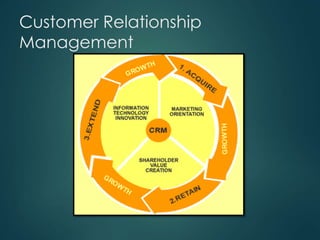
Customer Relationship
Management
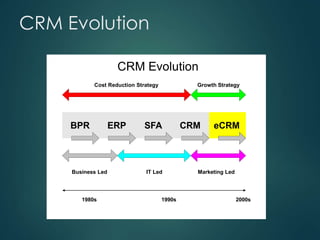
CRM Evolution
CRM Evolution
BPR ERP SFA CRM eCRM
Cost Reduction Strategy Growth Strategy
IT LedBusiness Led Marketing Led
1980s 1990s 2000s
ECRM is the customer focussed management of the
whole eBusiness relationship with each customer, in
order to measure, create and increase income and
reduce costs for each customer & segment and thus to
generate greater positive lifetime value.
Electronic CRM (eCRM)
ECRM is the customer focussed management of the
whole eBusiness relationship with each customer, in
order to measure, create and increase income and
reduce costs for each customer & segment and thus to
generate greater positive lifetime value.
Electronic CRM (eCRM)
e-CRM expands the traditional CRM
techniques by integrating new electronic
channels, such as Web, wireless, and voice
technologies and combines it with e-business
applications into the overall enterprise CRM
strategy.
Traditional CRM + Internet = e-CRM
Why eCRM?
 Due to the introduction of new technology
 Due to globalization
 Changing customer attitudes and expectations
 To gain competitive advantage
 To measure, create and increase income for the
business
 To reduce costs
e-CRM System Architecture
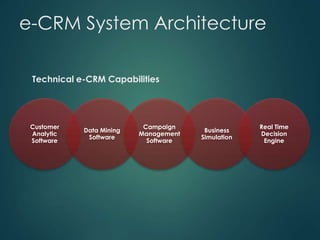
Technical e-CRM Capabilities
Customer
Analytic
Software
Data Mining
Software
Campaign
Management
Software
Business
Simulation
Real Time
Decision
Engine
e-CRM System Architecture
Technical e-CRM Capabilities
 Customer analytic software predicts, measures, and interprets
customer behaviors, allowing companies to understand the
effectiveness of e-CRM efforts.
 Data mining software builds predictive models to identify
customers most likely to perform a particular behavior.
 Campaign management software leverages the data
warehouse to plan and execute multiple, highly targeted
campaigns overtime, using triggers that respond timed events
and customer behaviour.
 Business simulation used in conjunction with campaign
management software optimises offer; messaging and channel
delivery prior to the execution of campaigns, and compares
planned costs and ROI projections with actual results.
 A real time decision engine coordinates and synchronises
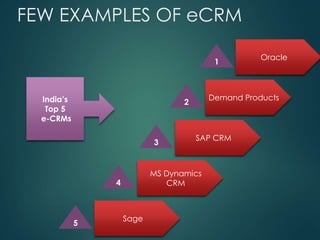
FEW EXAMPLES OF eCRM
Oracle
Demand Products
Sage
MS Dynamics
CRM
SAP CRM
India’s
Top 5
e-CRMs
2
1
5
3
4
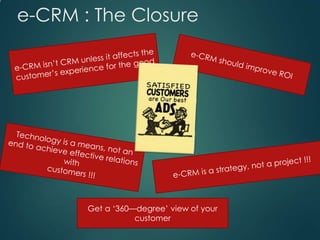
e-CRM : The Closure
Get a ‘360—degree’ view of your
customer

Ecrm anki tn-agin

  • 2.
    Customer Relationship Management  CRMis a strategy by which companies optimise profitability through enhanced customer satisfaction.  CRM is about automating and enhancing the customer- centric business processes of Sales, Marketing, and Service.  CRM also focuses on added customer loyalty that directly affects the organization’s bottom line.
  • 3.
  • 4.
    CRM Evolution CRM Evolution BPRERP SFA CRM eCRM Cost Reduction Strategy Growth Strategy IT LedBusiness Led Marketing Led 1980s 1990s 2000s
  • 5.
    ECRM is thecustomer focussed management of the whole eBusiness relationship with each customer, in order to measure, create and increase income and reduce costs for each customer & segment and thus to generate greater positive lifetime value. Electronic CRM (eCRM) ECRM is the customer focussed management of the whole eBusiness relationship with each customer, in order to measure, create and increase income and reduce costs for each customer & segment and thus to generate greater positive lifetime value.
  • 6.
    Electronic CRM (eCRM) e-CRMexpands the traditional CRM techniques by integrating new electronic channels, such as Web, wireless, and voice technologies and combines it with e-business applications into the overall enterprise CRM strategy. Traditional CRM + Internet = e-CRM
  • 7.
    Why eCRM?  Dueto the introduction of new technology  Due to globalization  Changing customer attitudes and expectations  To gain competitive advantage  To measure, create and increase income for the business  To reduce costs
  • 8.
    e-CRM System Architecture Technicale-CRM Capabilities Customer Analytic Software Data Mining Software Campaign Management Software Business Simulation Real Time Decision Engine
  • 9.
    e-CRM System Architecture Technicale-CRM Capabilities  Customer analytic software predicts, measures, and interprets customer behaviors, allowing companies to understand the effectiveness of e-CRM efforts.  Data mining software builds predictive models to identify customers most likely to perform a particular behavior.  Campaign management software leverages the data warehouse to plan and execute multiple, highly targeted campaigns overtime, using triggers that respond timed events and customer behaviour.  Business simulation used in conjunction with campaign management software optimises offer; messaging and channel delivery prior to the execution of campaigns, and compares planned costs and ROI projections with actual results.  A real time decision engine coordinates and synchronises
  • 10.
    FEW EXAMPLES OFeCRM Oracle Demand Products Sage MS Dynamics CRM SAP CRM India’s Top 5 e-CRMs 2 1 5 3 4
  • 11.
    e-CRM : TheClosure Get a ‘360—degree’ view of your customer

Editor's Notes

  • #6 It is the expected profit that you will realize from sales to a particular customer in the future. Although it builds on past customer history, LTV is all about the future.