Rossita Radzak : SASER

ACID - BASES
           The pH value of 1.0 mol dm-3 hydrochloric acid is 1
           The pH value of 1.0 mol dm-3 methanoic acid is 4

Explain why these two solutions have different pH values.
    identify strong acid , weak acid
    definition strong acid
    definition weak acid
    relationship between pH value and concentration of hydrogen ions

Sample answer:
   1. Hydrochloric acid is a strong acid while methanoic acid is a weak acid.
   2. Hydrochloric acid completely ionizes in water to form high concentration of hydrogen
      ions.
      HCl + H2O  H3O+ + Cl- // HCl  H+ + Cl- , H3O+ , hydroxonium ion
   3. methanoic acid ionizes partially in water to form low concentration hydrogen ions
      CH3COOH  CH3COO- + H+
   4. the higher the concentration of hydrogen ions the lower the pH value.

Aim :To determine the end point during the neutralization of potassium hydroxide
and hydrochloric acid

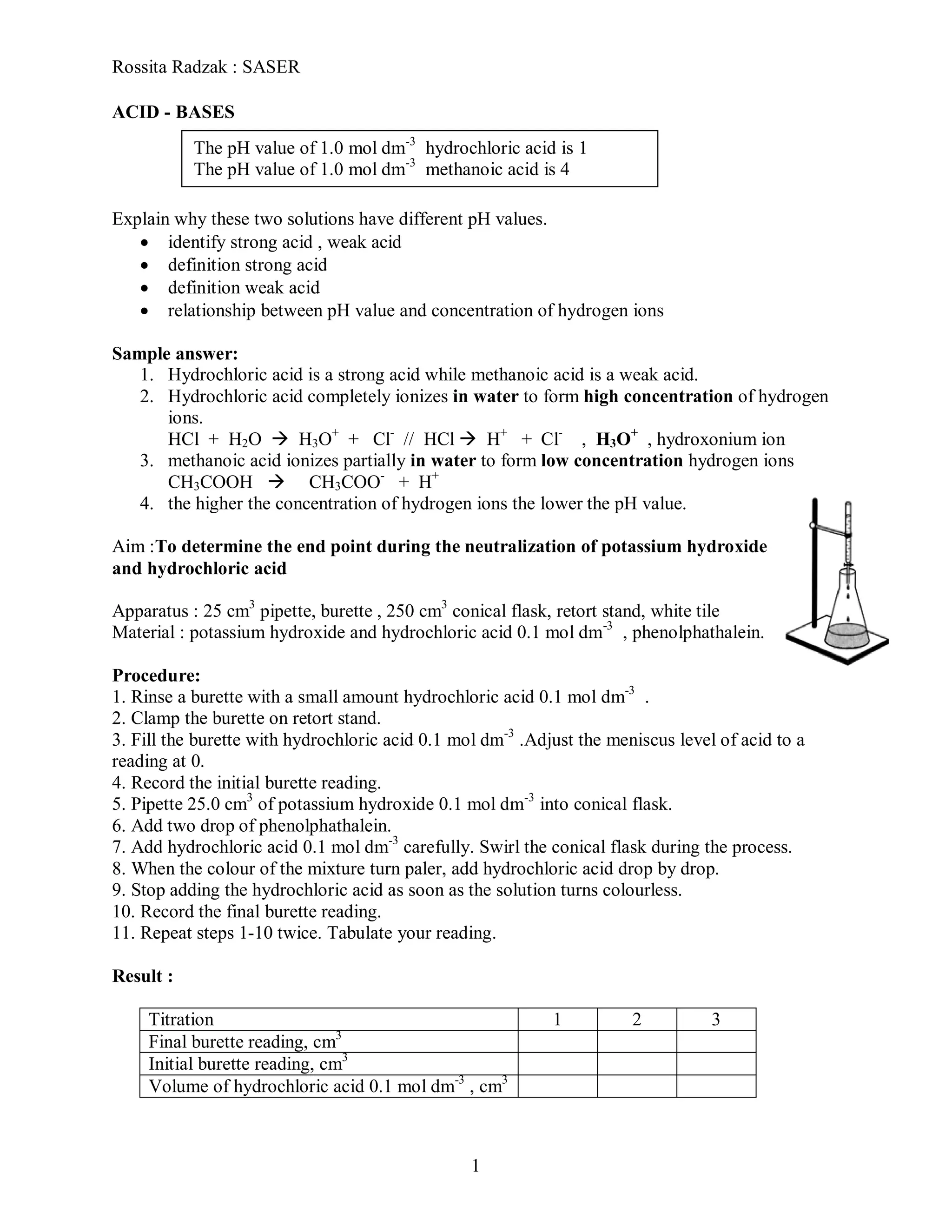
Apparatus : 25 cm3 pipette, burette , 250 cm3 conical flask, retort stand, white tile
Material : potassium hydroxide and hydrochloric acid 0.1 mol dm-3 , phenolphathalein.

Procedure:
1. Rinse a burette with a small amount hydrochloric acid 0.1 mol dm-3 .
2. Clamp the burette on retort stand.
3. Fill the burette with hydrochloric acid 0.1 mol dm-3 .Adjust the meniscus level of acid to a
reading at 0.
4. Record the initial burette reading.
5. Pipette 25.0 cm3 of potassium hydroxide 0.1 mol dm-3 into conical flask.
6. Add two drop of phenolphathalein.
7. Add hydrochloric acid 0.1 mol dm-3 carefully. Swirl the conical flask during the process.
8. When the colour of the mixture turn paler, add hydrochloric acid drop by drop.
9. Stop adding the hydrochloric acid as soon as the solution turns colourless.
10. Record the final burette reading.
11. Repeat steps 1-10 twice. Tabulate your reading.

Result :

     Titration                                              1          2          3
     Final burette reading, cm3
     Initial burette reading, cm3
     Volume of hydrochloric acid 0.1 mol dm-3 , cm3


                                                 1
Rossita Radzak : SASER

Preparation Standard solution ( 0.1 mol dm-3 NaOH, 100 cm3)

   1.   calculate the mass of solute ( mole = 0.1 x 100/1000 , 0.01 = mass/ 40)
   2.   weigh 0.4g of NaOH in weighing bottle using digital balance / electronic balance
   3.   pour into a beaker, rinse the bottle with distilled water.
   4.   dissolve NaOH with a little ( 10 – 20 cm3 )distilled water.
   5.   transfer the mixture into volumetric flask 100 cm3 rinse the beaker with distilled water.
   6.   pour the washings into volumetric flask 100 cm3
   7.   add distilled water, shake well
   8.   add distilled water drop by drop to finally bring the volume of solution to the 100 cm3
        mark / calibration mark.

Preparation of a standard solution by dilution method
             M1V1 = M2V2
             M1 – initial molarity
             V1 - initial volume
             M2 – final molarity
             V2 – final volume

NOTE : CONCENTRATION – 1. MOLARITY - mol dm-3
                       2. g dm-3


                                                 2

Chapter 7 acid base

  • 1.
    Rossita Radzak :SASER ACID - BASES The pH value of 1.0 mol dm-3 hydrochloric acid is 1 The pH value of 1.0 mol dm-3 methanoic acid is 4 Explain why these two solutions have different pH values.  identify strong acid , weak acid  definition strong acid  definition weak acid  relationship between pH value and concentration of hydrogen ions Sample answer: 1. Hydrochloric acid is a strong acid while methanoic acid is a weak acid. 2. Hydrochloric acid completely ionizes in water to form high concentration of hydrogen ions. HCl + H2O  H3O+ + Cl- // HCl  H+ + Cl- , H3O+ , hydroxonium ion 3. methanoic acid ionizes partially in water to form low concentration hydrogen ions CH3COOH  CH3COO- + H+ 4. the higher the concentration of hydrogen ions the lower the pH value. Aim :To determine the end point during the neutralization of potassium hydroxide and hydrochloric acid Apparatus : 25 cm3 pipette, burette , 250 cm3 conical flask, retort stand, white tile Material : potassium hydroxide and hydrochloric acid 0.1 mol dm-3 , phenolphathalein. Procedure: 1. Rinse a burette with a small amount hydrochloric acid 0.1 mol dm-3 . 2. Clamp the burette on retort stand. 3. Fill the burette with hydrochloric acid 0.1 mol dm-3 .Adjust the meniscus level of acid to a reading at 0. 4. Record the initial burette reading. 5. Pipette 25.0 cm3 of potassium hydroxide 0.1 mol dm-3 into conical flask. 6. Add two drop of phenolphathalein. 7. Add hydrochloric acid 0.1 mol dm-3 carefully. Swirl the conical flask during the process. 8. When the colour of the mixture turn paler, add hydrochloric acid drop by drop. 9. Stop adding the hydrochloric acid as soon as the solution turns colourless. 10. Record the final burette reading. 11. Repeat steps 1-10 twice. Tabulate your reading. Result : Titration 1 2 3 Final burette reading, cm3 Initial burette reading, cm3 Volume of hydrochloric acid 0.1 mol dm-3 , cm3 1
  • 2.
    Rossita Radzak :SASER Preparation Standard solution ( 0.1 mol dm-3 NaOH, 100 cm3) 1. calculate the mass of solute ( mole = 0.1 x 100/1000 , 0.01 = mass/ 40) 2. weigh 0.4g of NaOH in weighing bottle using digital balance / electronic balance 3. pour into a beaker, rinse the bottle with distilled water. 4. dissolve NaOH with a little ( 10 – 20 cm3 )distilled water. 5. transfer the mixture into volumetric flask 100 cm3 rinse the beaker with distilled water. 6. pour the washings into volumetric flask 100 cm3 7. add distilled water, shake well 8. add distilled water drop by drop to finally bring the volume of solution to the 100 cm3 mark / calibration mark. Preparation of a standard solution by dilution method M1V1 = M2V2 M1 – initial molarity V1 - initial volume M2 – final molarity V2 – final volume NOTE : CONCENTRATION – 1. MOLARITY - mol dm-3 2. g dm-3 2