Weighing and preparation of solution of different strength and their dilutions.pptx
1.
Weighing and preparationof solution of
different strength and their dilutions
Submitted by – Dr. Akshit Tyagi
V-15076/23
PG Scholar
Department of Vet. Pathology
A.N.D.U.A.T., Kumarganj, Ayodhya
Solutions
● Solution uniformhomogenous mixture of two or
more substances i.e, solute and solvent.
Solution=solute+solvent
● Solute- A Solute is a substance that can be dissolved
into a solvent.
● Solvent- A solvent is a substance in which a substance
dissolve.
5.
continue….
● Standard solutionvery precise solution,usually 3-4 significant
figures,used in quantitative analysis or an analytic procedure.
● Saturated solution a solution that contain the maximum amount of
a particular solute that will dissolved at the temperature.
● Supersaturated solution a solute that contains more solute than
equilibrium condition allow;it is unstable and the solute may
precipitate upon slight agitation or addition of single crystal.
6.
Preparing Solutions
Solutions ofknown concentration can be prepared in a number of
different ways depending on the nature of the analyte and/or the
concentration required:
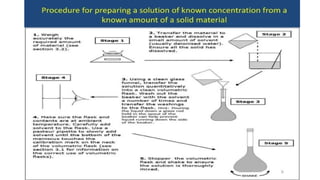
● Weighing out of solid material of known purity,dissolving it in a
suitable solvent and diluting to the required volume.
● Weighing out a liquid of normal purity,dissolving it in a suitable
solvent and diluting to the required volume.
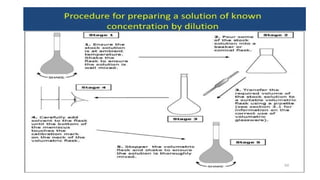
● Diluting a solution previously prepared in the laboratory.
● Diluting a solution from a chemical supplier.
7.
Weight measurements
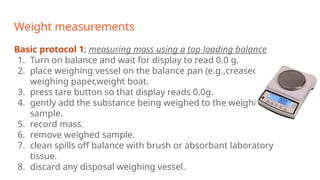
Basic protocol1; measuring mass using a top loading balance
1. Turn on balance and wait for display to read 0.0 g.
2. place weighing vessel on the balance pan (e.g.,creased
weighing paper,weight boat.
3. press tare button so that display reads 0.0g.
4. gently add the substance being weighed to the weighing
sample.
5. record mass.
6. remove weighed sample.
7. clean spills off balance with brush or absorbant laboratory
tissue.
8. discard any disposal weighing vessel.
8.
contd…
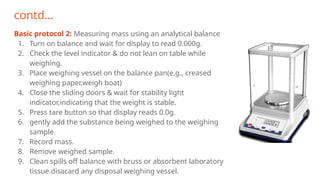
Basic protocol 2:Measuring mass using an analytical balance
1. Turn on balance and wait for display to read 0.000g.
2. Check the level indicator & do not lean on table while
weighing.
3. Place weighing vessel on the balance pan(e.g., creased
weighing paper,weigh boat)
4. Close the sliding doors & wait for stability light
indicator,indicating that the weight is stable.
5. Press tare button so that display reads 0.0g.
6. gently add the substance being weighed to the weighing
sample.
7. Record mass.
8. Remove weighed sample.
9. Clean spills off balance with bruss or absorbent laboratory
tissue.disacard any disposal weighing vessel.
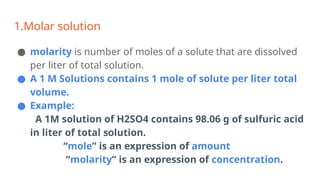
1.Molar solution
● molarityis number of moles of a solute that are dissolved
per liter of total solution.
● A 1 M Solutions contains 1 mole of solute per liter total
volume.
● Example:
A 1M solution of H2SO4 contains 98.06 g of sulfuric acid
in liter of total solution.
“mole” is an expression of amount
“molarity” is an expression of concentration.
15.
contd…
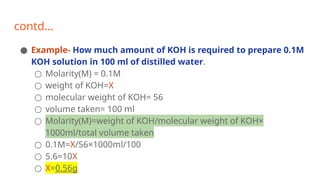
● Example- Howmuch amount of KOH is required to prepare 0.1M
KOH solution in 100 ml of distilled water.
○ Molarity(M) = 0.1M
○ weight of KOH=X
○ molecular weight of KOH= 56
○ volume taken= 100 ml
○ Molarity(M)=weight of KOH/molecular weight of KOH×
1000ml/total volume taken
○ 0.1M=X/56×1000ml/100
○ 5.6=10X
○ X=0.56g
16.
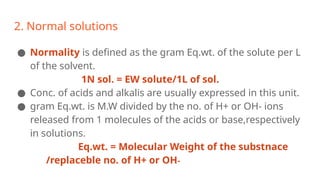
2. Normal solutions
●Normality is defined as the gram Eq.wt. of the solute per L
of the solvent.
1N sol. = EW solute/1L of sol.
● Conc. of acids and alkalis are usually expressed in this unit.
● gram Eq.wt. is M.W divided by the no. of H+ or OH- ions
released from 1 molecules of the acids or base,respectively
in solutions.
Eq.wt. = Molecular Weight of the substnace
/replaceble no. of H+ or OH-
17.
cont….
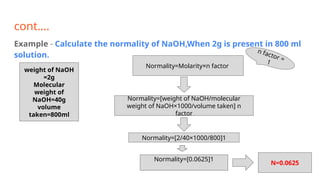
Example - Calculatethe normality of NaOH,When 2g is present in 800 ml
solution.
weight of NaOH
=2g
Molecular
weight of
NaOH=40g
volume
taken=800ml
Normality=Molarity×n factor
Normality=[weight of NaOH/molecular
weight of NaOH×1000/volume taken] n
factor
n factor =
1
Normality=[2/40×1000/800]1
Normality=[0.0625]1
N=0.0625
18.
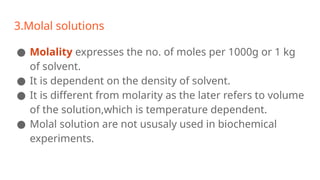
3.Molal solutions
● Molalityexpresses the no. of moles per 1000g or 1 kg
of solvent.
● It is dependent on the density of solvent.
● It is different from molarity as the later refers to volume
of the solution,which is temperature dependent.
● Molal solution are not ususaly used in biochemical
experiments.
19.
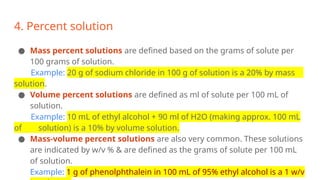
4. Percent solution
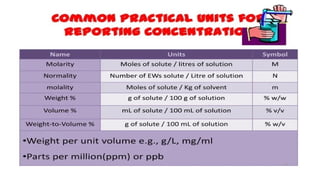
●Mass percent solutions are defined based on the grams of solute per
100 grams of solution.
Example: 20 g of sodium chloride in 100 g of solution is a 20% by mass
solution.
● Volume percent solutions are defined as ml of solute per 100 mL of
solution.
Example: 10 mL of ethyl alcohol + 90 ml of H2O (making approx. 100 mL
of solution) is a 10% by volume solution.
● Mass-volume percent solutions are also very common. These solutions
are indicated by w/v % & are defined as the grams of solute per 100 mL
of solution.
Example: 1 g of phenolphthalein in 100 mL of 95% ethyl alcohol is a 1 w/v
20.
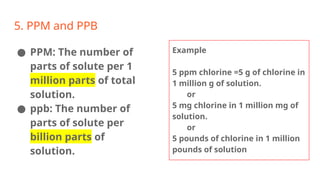
5. PPM andPPB
● PPM: The number of
parts of solute per 1
million parts of total
solution.
● ppb: The number of
parts of solute per
billion parts of
solution.
Example
5 ppm chlorine =5 g of chlorine in
1 million g of solution.
or
5 mg chlorine in 1 million mg of
solution.
or
5 pounds of chlorine in 1 million
pounds of solution
21.
To Assure thequality of a solution
● Know the solutions & diferent conc. to represent
them.
● Documentation,labeling & recording what was
done.
● Treceability.
● Taintenance and calibration of instruments.
● Stability and expiry date record.
● Proper storage.
 Most read

 Most read
 Most read