Rossita Radzak SASER


CARBON COMPOUND

1. Hydrocarbon – chemical compound containing carbon and hydrogen atom only.
2. Alkene – chemical compound containing carbon and hydrogen atom and at least
            one carbon-carbon double bond.
3. Isomers are molecules with the same molecular formula, but with different structural
formula.


                                                  C6H12O6

                                     Fermention
                                                                   KMnO4/ H+,           CH3COOH
                                               C2H5OH              K2Cr2O7/ H+
                               Br2                                                      Carboxyl
               C2H4Br2                         Hydroxyl
                                                                                        -COOH
                                                 -OH
                               H2                                   Oxidation
                 C2H6
                                                     C2H4
                           KMnO4/ H+,        Double bond between
              C2H4(OH)2    K2Cr2O7/ H+       C atoms, C=C                        Esterification
                                                                                 H2SO4
                                         A
                               H2O       d
               C2H5OH                                              CH3COO C2H5
                                         d
                                         i                         Ethyl ethanoate
                               HX
               C2H5Br                    t
                                         i            CnH 2n+ 2 , n = 1,2 alkane
                                         o            CnH2n        , n = 2, 3 alkene
            - CH2- CH2-                  n            CnH 2n+ 1 OH, n = 1, 2 alcohol
                                                      CnH 2n+1 COOH , n=0,1.. carboxylic acid


1. C2H4 + [O] + H2O  C2H4(OH)2
2. C2H5OH + CH3COOH  CH3COO C2H5 + H2O
3. C2H4 + H2O  C2H5OH
4. C6H12O6  2C2H5OH + 2CO2


                                              1
Rossita Radzak SASER


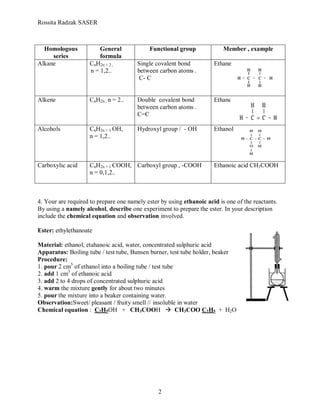
  Homologous            General             Functional group              Member , example
     series             formula
Alkane              CnH2n + 2 ,        Single covalent bond           Ethane
                    n = 1,2..          between carbon atoms .
                                        C- C


Alkene              CnH2n , n = 2..    Double covalent bond           Ethane
                                       between carbon atoms .
                                       C=C

Alcohols            CnH2n + 1 OH,      Hydroxyl group / - OH          Ethanol
                    n = 1,2..


Carboxylic acid     CnH2n + 1 COOH, Carboxyl group , -COOH            Ethanoic acid CH3COOH
                    n = 0,1,2..


4. Your are required to prepare one namely ester by using ethanoic acid is one of the reactants.
By using a namely alcohol, describe one experiment to prepare the ester. In your description
include the chemical equation and observation involved.

Ester: ethylethanoate

Material: ethanol, etahanoic acid, water, concentrated sulphuric acid
Apparatus: Boiling tube / test tube, Bunsen burner, test tube holder, beaker
Procedure:
1. pour 2 cm3 of ethanol into a boiling tube / test tube
2. add 1 cm3 of ethanoic acid
3. add 2 to 4 drops of concentrated sulphuric acid
4. warm the mixture gently for about two minutes
5. pour the mixture into a beaker containing water.
Observation:Sweet/ pleasant / fruity smell // insoluble in water
Chemical equation : C2H5OH + CH3COOH  CH3COO C2H5 + H2O


                                                2
Rossita Radzak SASER


4. Dehydration of alcohol
Diagram of set up of apparatus
1. Complete and functional
2. Labels of set up of apparatus correct

Procedure:
   1. Place some glass wool in a boiling tube
   2. Use a dropper to add propan-1-ol to wet the glass wool.
   3. Clamp the boiling tube horizontally and placed unglazed porcelain chips in the mid
   section of the boiling tube.
   Unglazed porcelain


                                                    Test tube
 Glass wool
 soaked in
                  Heat
 propanol
                                                      water


   4. Heat the unglazed porcelain chips strongly.
   5. Then heat the glass wool gently to vaporize the propanol.
   6. [Description of the chemical test to the gas collected in the test tube.]
      Add 1 cm3 of bromine water and shake well.
      Or,
      Add 1 cm3 of acidified potassium manganate(VII) solution and shake well.
   7. [Observation]:
       Reddish brown colour of bromine decolourised Or,
       Purple colour of potassium manganate(VII) solution decolourised
   8. Chemical equation: C3H7OH  C3H6 + H2O


                                               3
Rossita Radzak SASER


   1. Compare and differentiate between namely alkene and alkane

           Alkane ( hexane ) C6H14                         Alkene ( hexene ) C6H12
1                              Hydrocarbon ( contain C and H atom)
2                                 Low melting and boiling point
3                          Insoluble in water, soluble in organic solvent
4                                   Cannot conduct electricity
5                                     Density less than water
6                          Completely combustion produce CO2 + H2O
7 Saturated , single covalent bond, C-C       Unsaturated , contain at least one double bond
                                              C=C
8 Unreactive – undergo substitution with      Reactive – undergo addition reaction
   halogen in the presence of sunlight / UV ( hydrogenation, halogenations, oxidation,
   ray                                        polymerization, with halide, steam(hydration)
9 General formula , CnH2n+2 , n = 1,2 …       , CnH2n , n= 2 …
10 Identify test
   1. Combustion, burn less soot flame (% 1. More soot flame ( % of carbon per molecule is
   of carbon per molecule is lower)           higher).
   Chemical tests
   2. add bromine water , brown colour        2. decolorized brown colour
   remains
   3. add acidified KMnO4 , purple colour 3. purple colour is decolourized
   remains


5. Table shows results of latex coagulation

                       Procedure                                    Observation
     Propanoic acid is added to latex                  Latex coagulates immediately
     Latex is left under natural conditions            Latex coagulates slowly
                                          -
                  Protein        -                    Rubber particles
                  membranes     -             -
                                     -                Rubber molecules

Explain why there is a difference in these observations
       Answer:
       1. acid ionizes in water to produce high concentration of / a lot of hydrogen ions
       2. hydrogen ions , H+ neutralize the negative charges on the protein membranes
       3. the rubber particles collide and the protein membranes break
       4. rubber molecules are released and combine with one another and entangle.
       5. the existence of bacteria in natural conditions
       6. the growth of bacteria produce / lactic acid /weak acid / low concentration of H+ ions.
       7. due to the slow bacterial action, the coagulation of latex take a longer time to occur.
       [ monomer of natural rubber : 2 – methylbuta-1,3- diene , C5H8 / isoprene ]


                                                  4
Rossita Radzak SASER


Explain how to prevent coagulation of latex
        1. add ammonia solution
        2. ammonia solution contains / ionized to produce hydroxide ions , OH-
        3. hydroxide ions , OH- neutralized the hydrogen ions , H+ / acid produced by the
bacteria
        4. the rubber particles remain negatively charged and coagulation is prevented.


6. [Paper 3]
Aim : To compare the elasticity of vulcanised and unvulcanised rubber

Problem statement: Does vulcanised rubber more elastic than unvulcanised rubber

Hypothesis: Vulcanised rubber is more elastic than unvulcanised rubber

Manipulated variable : vulcanised rubber and unvulcanised rubber
Responding variable : length of rubber strip / elasticity
Fixed variable : mass of weight , size of rubber
Material and apparatus : retort stand, bulldog clip, meter ruler, weight, vulcanised and
unvulcanised rubber
Procedure:
   2. hang both rubber strips to the retort stand with bulldog clip.
   3. measure the initial length of both rubber strips and record.
   4. hang 50 g weight to the end of each rubber using bulldog clip.
   5. remove the weight and measure the length of both rubber strips and record.//
   6. record all the data obtained.


Result / Data


     Type of rubber      Initial length , cm       Length after removal of
                                                   weight , cm
     vulcanised
     unvulcanised


                                               5
Rossita Radzak SASER


[Paper 2]

Conclusion:
   1. Vulcanised rubber is more elastic than unvulcanised rubber due to the presence of cross-
      linkage of sulfur atoms between the rubber molecules. Vulcanised rubber could return
      to its original length after removal of the weight.

Note: 1. Rubber can be vulcanized by dipping natural rubber sheets into disulphur dichloride
solution
       in methylbenzene or heated with sulphur.
        2. Vulcanised rubber is more heat resistance due to the presence of cross-linkage of
        sulfur atoms increases the size of rubber molecules. Force of attraction between
        molecules will increase.


                                              6

Chapter 11 carbon compound

  • 1.
    Rossita Radzak SASER CARBONCOMPOUND 1. Hydrocarbon – chemical compound containing carbon and hydrogen atom only. 2. Alkene – chemical compound containing carbon and hydrogen atom and at least one carbon-carbon double bond. 3. Isomers are molecules with the same molecular formula, but with different structural formula. C6H12O6 Fermention KMnO4/ H+, CH3COOH C2H5OH K2Cr2O7/ H+ Br2 Carboxyl C2H4Br2 Hydroxyl -COOH -OH H2 Oxidation C2H6 C2H4 KMnO4/ H+, Double bond between C2H4(OH)2 K2Cr2O7/ H+ C atoms, C=C Esterification H2SO4 A H2O d C2H5OH CH3COO C2H5 d i Ethyl ethanoate HX C2H5Br t i CnH 2n+ 2 , n = 1,2 alkane o CnH2n , n = 2, 3 alkene - CH2- CH2- n CnH 2n+ 1 OH, n = 1, 2 alcohol CnH 2n+1 COOH , n=0,1.. carboxylic acid 1. C2H4 + [O] + H2O  C2H4(OH)2 2. C2H5OH + CH3COOH  CH3COO C2H5 + H2O 3. C2H4 + H2O  C2H5OH 4. C6H12O6  2C2H5OH + 2CO2 1
  • 2.
    Rossita Radzak SASER Homologous General Functional group Member , example series formula Alkane CnH2n + 2 , Single covalent bond Ethane n = 1,2.. between carbon atoms . C- C Alkene CnH2n , n = 2.. Double covalent bond Ethane between carbon atoms . C=C Alcohols CnH2n + 1 OH, Hydroxyl group / - OH Ethanol n = 1,2.. Carboxylic acid CnH2n + 1 COOH, Carboxyl group , -COOH Ethanoic acid CH3COOH n = 0,1,2.. 4. Your are required to prepare one namely ester by using ethanoic acid is one of the reactants. By using a namely alcohol, describe one experiment to prepare the ester. In your description include the chemical equation and observation involved. Ester: ethylethanoate Material: ethanol, etahanoic acid, water, concentrated sulphuric acid Apparatus: Boiling tube / test tube, Bunsen burner, test tube holder, beaker Procedure: 1. pour 2 cm3 of ethanol into a boiling tube / test tube 2. add 1 cm3 of ethanoic acid 3. add 2 to 4 drops of concentrated sulphuric acid 4. warm the mixture gently for about two minutes 5. pour the mixture into a beaker containing water. Observation:Sweet/ pleasant / fruity smell // insoluble in water Chemical equation : C2H5OH + CH3COOH  CH3COO C2H5 + H2O 2
  • 3.
    Rossita Radzak SASER 4.Dehydration of alcohol Diagram of set up of apparatus 1. Complete and functional 2. Labels of set up of apparatus correct Procedure: 1. Place some glass wool in a boiling tube 2. Use a dropper to add propan-1-ol to wet the glass wool. 3. Clamp the boiling tube horizontally and placed unglazed porcelain chips in the mid section of the boiling tube. Unglazed porcelain Test tube Glass wool soaked in Heat propanol water 4. Heat the unglazed porcelain chips strongly. 5. Then heat the glass wool gently to vaporize the propanol. 6. [Description of the chemical test to the gas collected in the test tube.] Add 1 cm3 of bromine water and shake well. Or, Add 1 cm3 of acidified potassium manganate(VII) solution and shake well. 7. [Observation]: Reddish brown colour of bromine decolourised Or, Purple colour of potassium manganate(VII) solution decolourised 8. Chemical equation: C3H7OH  C3H6 + H2O 3
  • 4.
    Rossita Radzak SASER 1. Compare and differentiate between namely alkene and alkane Alkane ( hexane ) C6H14 Alkene ( hexene ) C6H12 1 Hydrocarbon ( contain C and H atom) 2 Low melting and boiling point 3 Insoluble in water, soluble in organic solvent 4 Cannot conduct electricity 5 Density less than water 6 Completely combustion produce CO2 + H2O 7 Saturated , single covalent bond, C-C Unsaturated , contain at least one double bond C=C 8 Unreactive – undergo substitution with Reactive – undergo addition reaction halogen in the presence of sunlight / UV ( hydrogenation, halogenations, oxidation, ray polymerization, with halide, steam(hydration) 9 General formula , CnH2n+2 , n = 1,2 … , CnH2n , n= 2 … 10 Identify test 1. Combustion, burn less soot flame (% 1. More soot flame ( % of carbon per molecule is of carbon per molecule is lower) higher). Chemical tests 2. add bromine water , brown colour 2. decolorized brown colour remains 3. add acidified KMnO4 , purple colour 3. purple colour is decolourized remains 5. Table shows results of latex coagulation Procedure Observation Propanoic acid is added to latex Latex coagulates immediately Latex is left under natural conditions Latex coagulates slowly - Protein - Rubber particles membranes - - - Rubber molecules Explain why there is a difference in these observations Answer: 1. acid ionizes in water to produce high concentration of / a lot of hydrogen ions 2. hydrogen ions , H+ neutralize the negative charges on the protein membranes 3. the rubber particles collide and the protein membranes break 4. rubber molecules are released and combine with one another and entangle. 5. the existence of bacteria in natural conditions 6. the growth of bacteria produce / lactic acid /weak acid / low concentration of H+ ions. 7. due to the slow bacterial action, the coagulation of latex take a longer time to occur. [ monomer of natural rubber : 2 – methylbuta-1,3- diene , C5H8 / isoprene ] 4
  • 5.
    Rossita Radzak SASER Explainhow to prevent coagulation of latex 1. add ammonia solution 2. ammonia solution contains / ionized to produce hydroxide ions , OH- 3. hydroxide ions , OH- neutralized the hydrogen ions , H+ / acid produced by the bacteria 4. the rubber particles remain negatively charged and coagulation is prevented. 6. [Paper 3] Aim : To compare the elasticity of vulcanised and unvulcanised rubber Problem statement: Does vulcanised rubber more elastic than unvulcanised rubber Hypothesis: Vulcanised rubber is more elastic than unvulcanised rubber Manipulated variable : vulcanised rubber and unvulcanised rubber Responding variable : length of rubber strip / elasticity Fixed variable : mass of weight , size of rubber Material and apparatus : retort stand, bulldog clip, meter ruler, weight, vulcanised and unvulcanised rubber Procedure: 2. hang both rubber strips to the retort stand with bulldog clip. 3. measure the initial length of both rubber strips and record. 4. hang 50 g weight to the end of each rubber using bulldog clip. 5. remove the weight and measure the length of both rubber strips and record.// 6. record all the data obtained. Result / Data Type of rubber Initial length , cm Length after removal of weight , cm vulcanised unvulcanised 5
  • 6.
    Rossita Radzak SASER [Paper2] Conclusion: 1. Vulcanised rubber is more elastic than unvulcanised rubber due to the presence of cross- linkage of sulfur atoms between the rubber molecules. Vulcanised rubber could return to its original length after removal of the weight. Note: 1. Rubber can be vulcanized by dipping natural rubber sheets into disulphur dichloride solution in methylbenzene or heated with sulphur. 2. Vulcanised rubber is more heat resistance due to the presence of cross-linkage of sulfur atoms increases the size of rubber molecules. Force of attraction between molecules will increase. 6