C5d                                  Titrations               (Foundation + Higher)

This type of reaction is called a “___________________ reaction”.

        acid         +      alkali                              salt       +      water


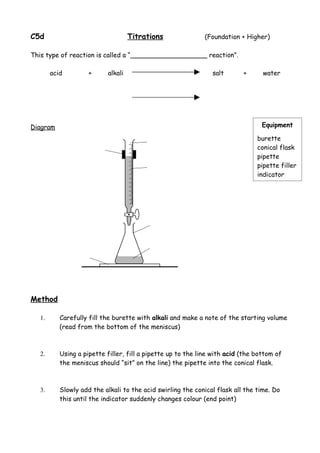
Diagram                                                                           Equipment

                                                                                burette
                                                                                conical flask
                                                                                pipette
                                                                                pipette filler
                                                                                indicator


Method

   1.      Carefully fill the burette with alkali and make a note of the starting volume
           (read from the bottom of the meniscus)


   2.      Using a pipette filler, fill a pipette up to the line with acid (the bottom of
           the meniscus should “sit” on the line) the pipette into the conical flask.


   3.      Slowly add the alkali to the acid swirling the conical flask all the time. Do
           this until the indicator suddenly changes colour (end point)
Results

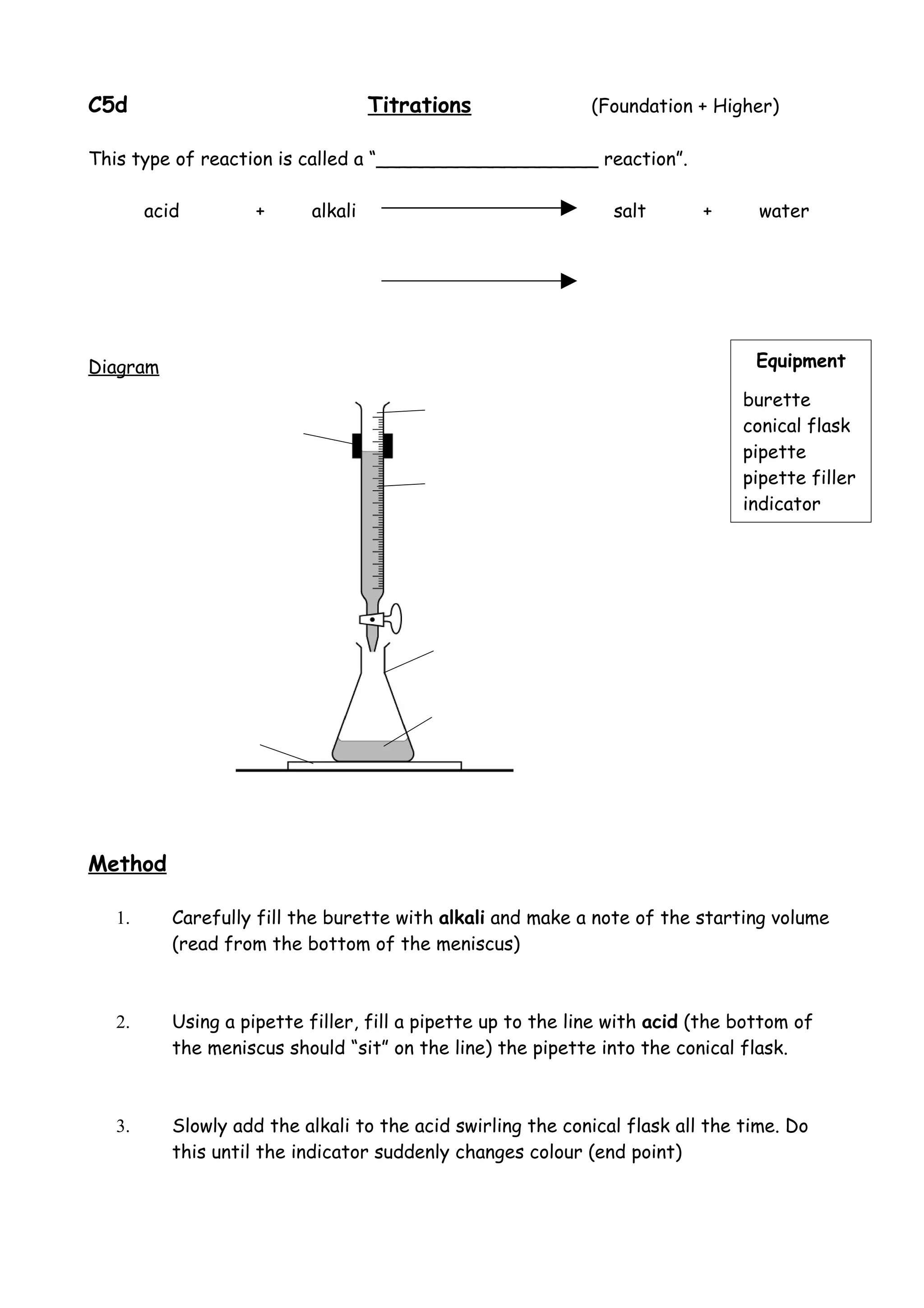
Titration     volume before     volume after    titre (volume of alkali added)   Average Titre
                   cm3              cm3                      cm3                     cm3
       1           0.0              24.9
       2           24.9             49.7
       3           0.2              25.1


  1.       Work out the titres (volume of alkali used to neutralise the acid each time).

  2. Work out the average titre used and explain why we use an average


  3. Why do we need three titre readings that are within ± 0.02cm3?


  HIGHER LEVEL
  4. Using the average titre, calculate how many moles of alkali were added to the acid.
  Concentration of the alkali is 1.0 mol/dm3.


  5. One mole of acid reacts with one mole of alkali so how many moles of acid must
  have been in the conical flask.


  6. Now calculate the concentration of the original 25cm3 of acid


  7. What mass of sodium hydroxide (NaOH) was dissolved in your average titre


                                                     moles = concentration × volume in dm3
                                                     concentration = moles ÷ volume in dm3
                                                     volume in dm3 = moles ÷ concentration
                                                     moles = mass ÷ molecular mass
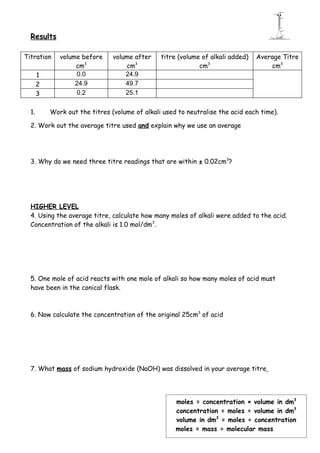
Titration curves - if you measure the pH continually as you titrate you get a curve:


 HIGHER - You must be able to sketch a pH titration curve for the titration of an acid or an alkali


1.    On your graph label the end-point of the reaction i.e when the solution
      neutralises.

2.    Describe the shape of your graph in terms of the volume of the alkali added
      and the pH


3.    As more alkali is added the pH of the solution____________________

4.    From your graph, what is the pH at:

          a) 10cm3 acid added

          b) 20cm3 acid added

          c) 40cm3 acid added
5.     What volume of alkali was added to make the solution neutral?
                                               Indicators

      Mixed Indicators        e.g. universal indicator

      We use Universal indicator to estimate the pH of a solution. It is made from a
      mixture of different indicators so it produces a continuous colour change as the pH
      changes.

      1. If we had used universal indicator, what colour would it turn for:

                    a) pH 1

             b) pH 5

             c) pH 7

             d) pH 9

             e) pH 14


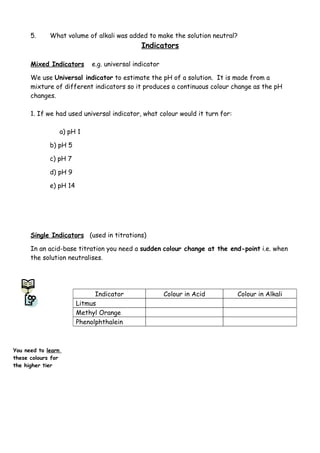
      Single Indicators (used in titrations)

      In an acid-base titration you need a sudden colour change at the end-point i.e. when
      the solution neutralises.


                               Indicator                 Colour in Acid       Colour in Alkali
                         Litmus
                         Methyl Orange
                         Phenolphthalein


You need to learn
these colours for
the higher tier
2. Explain why we need to use single indicators in titrations and not a mixed
   indicator like universal indicator.

C5d Titrations Higher

  • 1.
    C5d Titrations (Foundation + Higher) This type of reaction is called a “___________________ reaction”. acid + alkali salt + water Diagram Equipment burette conical flask pipette pipette filler indicator Method 1. Carefully fill the burette with alkali and make a note of the starting volume (read from the bottom of the meniscus) 2. Using a pipette filler, fill a pipette up to the line with acid (the bottom of the meniscus should “sit” on the line) the pipette into the conical flask. 3. Slowly add the alkali to the acid swirling the conical flask all the time. Do this until the indicator suddenly changes colour (end point)
  • 2.
    Results Titration volume before volume after titre (volume of alkali added) Average Titre cm3 cm3 cm3 cm3 1 0.0 24.9 2 24.9 49.7 3 0.2 25.1 1. Work out the titres (volume of alkali used to neutralise the acid each time). 2. Work out the average titre used and explain why we use an average 3. Why do we need three titre readings that are within ± 0.02cm3? HIGHER LEVEL 4. Using the average titre, calculate how many moles of alkali were added to the acid. Concentration of the alkali is 1.0 mol/dm3. 5. One mole of acid reacts with one mole of alkali so how many moles of acid must have been in the conical flask. 6. Now calculate the concentration of the original 25cm3 of acid 7. What mass of sodium hydroxide (NaOH) was dissolved in your average titre moles = concentration × volume in dm3 concentration = moles ÷ volume in dm3 volume in dm3 = moles ÷ concentration moles = mass ÷ molecular mass
  • 3.
    Titration curves -if you measure the pH continually as you titrate you get a curve: HIGHER - You must be able to sketch a pH titration curve for the titration of an acid or an alkali 1. On your graph label the end-point of the reaction i.e when the solution neutralises. 2. Describe the shape of your graph in terms of the volume of the alkali added and the pH 3. As more alkali is added the pH of the solution____________________ 4. From your graph, what is the pH at: a) 10cm3 acid added b) 20cm3 acid added c) 40cm3 acid added
  • 4.
    5. What volume of alkali was added to make the solution neutral? Indicators Mixed Indicators e.g. universal indicator We use Universal indicator to estimate the pH of a solution. It is made from a mixture of different indicators so it produces a continuous colour change as the pH changes. 1. If we had used universal indicator, what colour would it turn for: a) pH 1 b) pH 5 c) pH 7 d) pH 9 e) pH 14 Single Indicators (used in titrations) In an acid-base titration you need a sudden colour change at the end-point i.e. when the solution neutralises. Indicator Colour in Acid Colour in Alkali Litmus Methyl Orange Phenolphthalein You need to learn these colours for the higher tier
  • 5.
    2. Explain whywe need to use single indicators in titrations and not a mixed indicator like universal indicator.