From Bloom & Fawcett, Textbook of Histology 
Professor : 
Dr. Sabangan, Maria Rhea F 
Prepared by : 
Khafi Makoo , Noorallah
Composition of Blood 
Blood is responsible for….. 
 Transporting gases 
(oxygen & carbon dioxide) 
 Transporting waste 
products 
 Transporting nutrients 
 Helping remove toxins 
from the body
Composition of Blood 
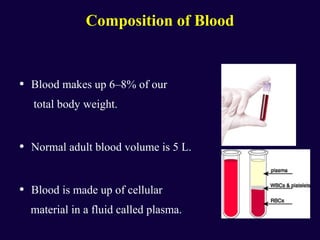
• Blood makes up 6–8% of our 
total body weight. 
• Normal adult blood volume is 5 L. 
• Blood is made up of cellular 
material in a fluid called plasma.
Composition of Blood 
• Contains cellular and liquid components 
• A specialized connective tissue 
• Blood cells – formed elements 
• Plasma – fluid portion and fibrinogen 
• Blood volume 
• Males: 5 – 6 liters 
• Females: 4 – 5 liters 
• The pH of blood is about 7.35-7.45
Composition of Blood 
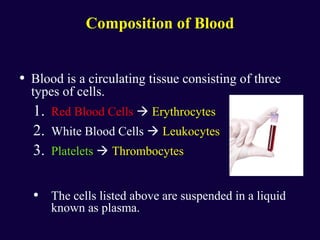
• Blood is a circulating tissue consisting of three 
types of cells. 
1. Red Blood Cells  Erythrocytes 
2. White Blood Cells  Leukocytes 
3. Platelets  Thrombocytes 
• The cells listed above are suspended in a liquid 
known as plasma.
What makes up our Blood? 
• RED BLOOD CELLS (Erythrocytes) – The most abundant 
cells in our blood; they are produced in the bone marrow and 
contain a protein called hemoglobin that carries oxygen to our 
cells. 
• WHITE BLOOD CELLS (Leukocytes) – They are part of 
the immune system and destroy infectious agents called 
pathogens. 
• PLASMA – This is the yellowish liquid portion of blood that 
contains electrolytes, nutrients and vitamins, hormones, 
clotting factors, and proteins such as antibodies to fight 
infection. 
• PLATELETS (Thrombocytes) – The clotting factors that are 
carried in the plasma; they clot together in a process called 
coagulation to seal a wound and prevent a loss of blood.
Composition of Blood 
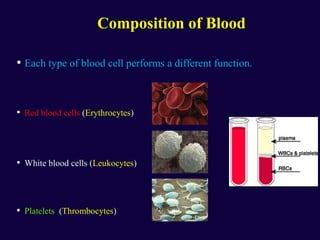
• Each type of blood cell performs a different function. 
• Red blood cells (Erythrocytes) 
• White blood cells (Leukocytes) 
• Platelets (Thrombocytes)
Why is blood red ? 
• Blood is red because 
it contains 
hemoglobin and iron 
rich pigment.
What does hemoglobin do ? 
• Hemoglobin 
picks up the 
oxygen 
molecules and 
drops off CO2
• Red Blood Cells 
Red Blood Cells 
Stain pink-tan 
 Center of cell is lighter 
“central area of pallor” 
Life span of about 120 days 
Hemoglobin (iron protein)is 
found in the RBC 
Hemoglobin carries oxygen from the 
lungs to the rest of the body and carbon 
dioxide binds to the RBC and is taken to 
the lungs to be exhaled.
Erythrocytes 
• Shaped like round 
plates indented in the 
center. 
• Have no nucleus
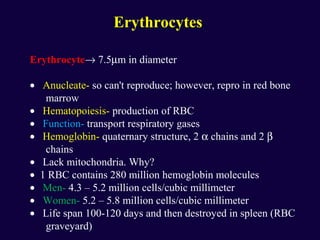
Erythrocyte® 7.5mm in diameter 
· Anucleate- so can't reproduce; however, repro in red bone 
marrow 
· Hematopoiesis- production of RBC 
· Function- transport respiratory gases 
· Hemoglobin- quaternary structure, 2 a chains and 2 b 
chains 
· Lack mitochondria. Why? 
· 1 RBC contains 280 million hemoglobin molecules 
· Men- 4.3 – 5.2 million cells/cubic millimeter 
· Women- 5.2 – 5.8 million cells/cubic millimeter 
· Life span 100-120 days and then destroyed in spleen (RBC 
graveyard) 
Erythrocytes
What’s wrong with this picture?
Sickle Cell Anemia 
• Genetic disease 
• Red blood cells 
become sickle shape 
• Cant carry as much 
oxygen
RRBBCC DDiisseeaasseess 
Anemia- when blood has low O2 carrying 
capacity; insufficient RBC or iron deficiency. 
Factors that can cause anemia- exercise, B12 
deficiency
RRBBCC DDiisseeaasseess 
Sickle-cell anemia- 
•HbS results from a change in just one of the 287 amino acids in 
the b chain in the globin molecule. 
•Found in 1 out of 400 African Americans. 
•Homozygous for sickle-cell is deadly, but in malaria infested 
countries, the heterozygous condition is beneficial.
RRBBCC DDiisseeaasseess 
Polycythemia- excess of erythrocytes, ­ viscosity 
of blood; 
8-11 million cells/mm3 
Usually caused by cancer; however, naturally occurs 
at high elevations 
Blood doping- in athletes®remove blood 2 days 
before event and then replace it- banned by 
Olympics.
Blood Cell Production
White Blood Cells 
• Fight infections 
• Large in size 
• Have a nucleus 
• Phagocyte
White Blood Cells 
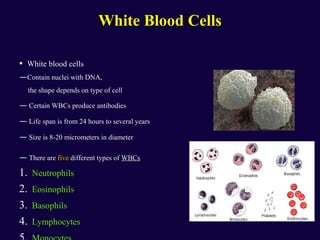
• White blood cells 
—Contain nuclei with DNA, 
the shape depends on type of cell 
— Certain WBCs produce antibodies 
— Life span is from 24 hours to several years 
— Size is 8-20 micrometers in diameter 
— There are five different types of WBCs 
1. Neutrophils 
2. Eosinophils 
3. Basophils 
4. Lymphocytes 
5. Monocytes
Types of Leukocytes 
The Number of Leukocytes in the circulation ranges 
from 5,000-9,000 cells/mm 3 (per cubic millimeter) 
Granulocytes 
Neutrophils- 55-60 % 
Eosinophils- 1-3 % 
Basophils- <1 % or 0-0.7 % 
Nongranulocytes 
Monocytes- 4-8 % 
Lymphocytes- 25-33 %
White Blood Cells 
Type Of White Blood 
Cells 
% By Volume Of WBC Description Function 
Neutrophils 55 – 60 % Nucleus has many 
interconnected lobes; blue 
granules 
Phagocytize and destory 
bacteria; most numerous 
WBC 
Eosinophils 1 – 3 % Nucleus has bilobed nuclei; 
red or yellow granules 
containing digestive 
enzymes 
Play a role in ending allergic 
reactions 
Basophils < 1 % Bilobed nuclei hidden by 
large purple granules full of 
chemical mediators of 
inflammation 
Function in inflammation 
medication; similar in 
function to mast cells 
Lymphocytes (B Cells 
and T Cells) 
25 – 33 % Dense, purple staining, 
round nucleus; little 
cytoplasm 
the most important cells of 
the immune system; 
effective in fighting infectious 
organisms; act against a 
specific foreign molecule 
(antigen) 
Monocytes 4 – 8 % Largest leukocyte; kidney 
shaped nucleus 
Transform into 
macrophages; phagocytic 
cells
Granulocytes 
Neutrophil Eosinophil Basophil 
Nongranulocytes 
Lymphocyte Monocyte
Neutrophils 
10 to 15 u diameter. 
These cells 
constitute 60% of 
leukocytes and 
usually have 2 to 5 
nuclear lobes 
connected by fine 
filaments of 
chromatin. 
Neutrophils are the 
most numerous of 
all leukocytes
Eosinophils 
10 to 15 um diameter. 
Eosinophils 
constitute 1.0 to 
3.0% of leukocytes. 
These cells usually 
contain a bilobate 
(two lobes) nucleus 
and a cytoplasm full 
of brightly stained 
eosinophilic 
(orange-red) 
specific granules.
Basophils 
10 to 15 u diameter. 
Basophils constitute 
approximately 0 to 
0.7% of leukocytes 
and are therefore 
more difficult to 
find in a routine 
blood smear. The 
nucleus consists of 
2 to 3 lobes but is 
usually not as 
lobulated as 
neutrophils.
Lymphocytes 
9 to 14 um diameter. 
Lymphocytes 
constitute 25 - 33% 
of agranulocytes and 
may be small, 
medium or large in 
size. The nucleus is 
rounded or oval, and 
usually the same size 
as an erythrocyte. 
The chromatin is 
densely packed with 
no apparent nucleoli.
Monocytes 
12 to 20 um diameter. 
Monocytes comprise 
3 - 7% of agranulocytes. 
This large cell has a 
lightly stained nucleus 
that often appears 
horseshoe or kidney 
shaped. The chromatin 
appears lacy and 
nucleoli are usually not 
apparent.
Photomicrographs 
From 
Bloom & Fawcett, 
Textbook of 
Histology
Leukopenia 
• Abnormally low WBC count—drug induced 
Leukemias 
• Cancerous conditions involving WBCs 
• Named according to the abnormal WBC clone 
involved 
Mononucleosis 
• highly contagious viral disease caused by 
Epstein-Barr virus; excessive # of agranulocytes; 
fatigue, sore throat, recover in a few weeks
Platelets 
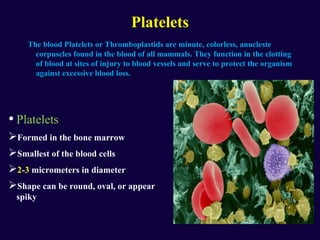
The blood Platelets or Thromboplastids are minute, colorless, anucleste 
corpuscles found in the blood of all mammals. They function in the clotting 
of blood at sites of injury to blood vessels and serve to protect the organism 
against excessive blood loss. 
• Platelets 
Formed in the bone marrow 
Smallest of the blood cells 
2-3 micrometers in diameter 
Shape can be round, oval, or appear 
spiky
• Platelets 
Platelets 
Life span of around 8-12 days 
Involved in the clotting process 
Seal wounds and prevent blood loss 
Help repair damaged vessels 
150,000 – 350,000 per cubic millimeter of 
blood 
Platelets stain bluish with reddish or purple 
granules
Stem cell Developmental pathway 
Hemocyto-blast 
Megakaryoblast 
Promegakaryocyte 
Megakaryocyte Platelets
Hemostasis: 
1. Vessel injury 
2. Vascular spasm 
3. Platelet plug formation 
4. Coagulation
Blood Clot 
RBC 
Platelet 
Fibrin thread
Microscopic 
Views 
Bird Blood 
Cat Blood 
Dog Blood 
Fish Blood 
Frog Blood 
Horse Blood 
Human Blood Snake Blood
What are blood types? 
There are 3 alleles or genes for blood 
type: A, B, & O. Since we have 2 genes, 
there are 6 possible combinations. 
http://learn.genetics.utah.edu/units/basics/blood/types.cfm 
Blood Types 
AA or AO = Type A 
BB or BO = Type B 
OO = Type O 
AB = Type AB
46.1% 
38.8% 
11.1% 
3.9% 
How common is your blood type?

Blood

  • 1.
    From Bloom &Fawcett, Textbook of Histology Professor : Dr. Sabangan, Maria Rhea F Prepared by : Khafi Makoo , Noorallah
  • 2.
    Composition of Blood Blood is responsible for…..  Transporting gases (oxygen & carbon dioxide)  Transporting waste products  Transporting nutrients  Helping remove toxins from the body
  • 3.
    Composition of Blood • Blood makes up 6–8% of our total body weight. • Normal adult blood volume is 5 L. • Blood is made up of cellular material in a fluid called plasma.
  • 4.
    Composition of Blood • Contains cellular and liquid components • A specialized connective tissue • Blood cells – formed elements • Plasma – fluid portion and fibrinogen • Blood volume • Males: 5 – 6 liters • Females: 4 – 5 liters • The pH of blood is about 7.35-7.45
  • 5.
    Composition of Blood • Blood is a circulating tissue consisting of three types of cells. 1. Red Blood Cells  Erythrocytes 2. White Blood Cells  Leukocytes 3. Platelets  Thrombocytes • The cells listed above are suspended in a liquid known as plasma.
  • 6.
    What makes upour Blood? • RED BLOOD CELLS (Erythrocytes) – The most abundant cells in our blood; they are produced in the bone marrow and contain a protein called hemoglobin that carries oxygen to our cells. • WHITE BLOOD CELLS (Leukocytes) – They are part of the immune system and destroy infectious agents called pathogens. • PLASMA – This is the yellowish liquid portion of blood that contains electrolytes, nutrients and vitamins, hormones, clotting factors, and proteins such as antibodies to fight infection. • PLATELETS (Thrombocytes) – The clotting factors that are carried in the plasma; they clot together in a process called coagulation to seal a wound and prevent a loss of blood.
  • 7.
    Composition of Blood • Each type of blood cell performs a different function. • Red blood cells (Erythrocytes) • White blood cells (Leukocytes) • Platelets (Thrombocytes)
  • 8.
    Why is bloodred ? • Blood is red because it contains hemoglobin and iron rich pigment.
  • 9.
    What does hemoglobindo ? • Hemoglobin picks up the oxygen molecules and drops off CO2
  • 10.
    • Red BloodCells Red Blood Cells Stain pink-tan  Center of cell is lighter “central area of pallor” Life span of about 120 days Hemoglobin (iron protein)is found in the RBC Hemoglobin carries oxygen from the lungs to the rest of the body and carbon dioxide binds to the RBC and is taken to the lungs to be exhaled.
  • 11.
    Erythrocytes • Shapedlike round plates indented in the center. • Have no nucleus
  • 12.
    Erythrocyte® 7.5mm indiameter · Anucleate- so can't reproduce; however, repro in red bone marrow · Hematopoiesis- production of RBC · Function- transport respiratory gases · Hemoglobin- quaternary structure, 2 a chains and 2 b chains · Lack mitochondria. Why? · 1 RBC contains 280 million hemoglobin molecules · Men- 4.3 – 5.2 million cells/cubic millimeter · Women- 5.2 – 5.8 million cells/cubic millimeter · Life span 100-120 days and then destroyed in spleen (RBC graveyard) Erythrocytes
  • 13.
    What’s wrong withthis picture?
  • 14.
    Sickle Cell Anemia • Genetic disease • Red blood cells become sickle shape • Cant carry as much oxygen
  • 15.
    RRBBCC DDiisseeaasseess Anemia-when blood has low O2 carrying capacity; insufficient RBC or iron deficiency. Factors that can cause anemia- exercise, B12 deficiency
  • 16.
    RRBBCC DDiisseeaasseess Sickle-cellanemia- •HbS results from a change in just one of the 287 amino acids in the b chain in the globin molecule. •Found in 1 out of 400 African Americans. •Homozygous for sickle-cell is deadly, but in malaria infested countries, the heterozygous condition is beneficial.
  • 17.
    RRBBCC DDiisseeaasseess Polycythemia-excess of erythrocytes, ­ viscosity of blood; 8-11 million cells/mm3 Usually caused by cancer; however, naturally occurs at high elevations Blood doping- in athletes®remove blood 2 days before event and then replace it- banned by Olympics.
  • 18.
  • 19.
    White Blood Cells • Fight infections • Large in size • Have a nucleus • Phagocyte
  • 20.
    White Blood Cells • White blood cells —Contain nuclei with DNA, the shape depends on type of cell — Certain WBCs produce antibodies — Life span is from 24 hours to several years — Size is 8-20 micrometers in diameter — There are five different types of WBCs 1. Neutrophils 2. Eosinophils 3. Basophils 4. Lymphocytes 5. Monocytes
  • 21.
    Types of Leukocytes The Number of Leukocytes in the circulation ranges from 5,000-9,000 cells/mm 3 (per cubic millimeter) Granulocytes Neutrophils- 55-60 % Eosinophils- 1-3 % Basophils- <1 % or 0-0.7 % Nongranulocytes Monocytes- 4-8 % Lymphocytes- 25-33 %
  • 22.
    White Blood Cells Type Of White Blood Cells % By Volume Of WBC Description Function Neutrophils 55 – 60 % Nucleus has many interconnected lobes; blue granules Phagocytize and destory bacteria; most numerous WBC Eosinophils 1 – 3 % Nucleus has bilobed nuclei; red or yellow granules containing digestive enzymes Play a role in ending allergic reactions Basophils < 1 % Bilobed nuclei hidden by large purple granules full of chemical mediators of inflammation Function in inflammation medication; similar in function to mast cells Lymphocytes (B Cells and T Cells) 25 – 33 % Dense, purple staining, round nucleus; little cytoplasm the most important cells of the immune system; effective in fighting infectious organisms; act against a specific foreign molecule (antigen) Monocytes 4 – 8 % Largest leukocyte; kidney shaped nucleus Transform into macrophages; phagocytic cells
  • 23.
    Granulocytes Neutrophil EosinophilBasophil Nongranulocytes Lymphocyte Monocyte
  • 24.
    Neutrophils 10 to15 u diameter. These cells constitute 60% of leukocytes and usually have 2 to 5 nuclear lobes connected by fine filaments of chromatin. Neutrophils are the most numerous of all leukocytes
  • 25.
    Eosinophils 10 to15 um diameter. Eosinophils constitute 1.0 to 3.0% of leukocytes. These cells usually contain a bilobate (two lobes) nucleus and a cytoplasm full of brightly stained eosinophilic (orange-red) specific granules.
  • 26.
    Basophils 10 to15 u diameter. Basophils constitute approximately 0 to 0.7% of leukocytes and are therefore more difficult to find in a routine blood smear. The nucleus consists of 2 to 3 lobes but is usually not as lobulated as neutrophils.
  • 27.
    Lymphocytes 9 to14 um diameter. Lymphocytes constitute 25 - 33% of agranulocytes and may be small, medium or large in size. The nucleus is rounded or oval, and usually the same size as an erythrocyte. The chromatin is densely packed with no apparent nucleoli.
  • 28.
    Monocytes 12 to20 um diameter. Monocytes comprise 3 - 7% of agranulocytes. This large cell has a lightly stained nucleus that often appears horseshoe or kidney shaped. The chromatin appears lacy and nucleoli are usually not apparent.
  • 29.
    Photomicrographs From Bloom& Fawcett, Textbook of Histology
  • 30.
    Leukopenia • Abnormallylow WBC count—drug induced Leukemias • Cancerous conditions involving WBCs • Named according to the abnormal WBC clone involved Mononucleosis • highly contagious viral disease caused by Epstein-Barr virus; excessive # of agranulocytes; fatigue, sore throat, recover in a few weeks
  • 31.
    Platelets The bloodPlatelets or Thromboplastids are minute, colorless, anucleste corpuscles found in the blood of all mammals. They function in the clotting of blood at sites of injury to blood vessels and serve to protect the organism against excessive blood loss. • Platelets Formed in the bone marrow Smallest of the blood cells 2-3 micrometers in diameter Shape can be round, oval, or appear spiky
  • 32.
    • Platelets Platelets Life span of around 8-12 days Involved in the clotting process Seal wounds and prevent blood loss Help repair damaged vessels 150,000 – 350,000 per cubic millimeter of blood Platelets stain bluish with reddish or purple granules
  • 33.
    Stem cell Developmentalpathway Hemocyto-blast Megakaryoblast Promegakaryocyte Megakaryocyte Platelets
  • 34.
    Hemostasis: 1. Vesselinjury 2. Vascular spasm 3. Platelet plug formation 4. Coagulation
  • 35.
    Blood Clot RBC Platelet Fibrin thread
  • 36.
    Microscopic Views BirdBlood Cat Blood Dog Blood Fish Blood Frog Blood Horse Blood Human Blood Snake Blood
  • 37.
    What are bloodtypes? There are 3 alleles or genes for blood type: A, B, & O. Since we have 2 genes, there are 6 possible combinations. http://learn.genetics.utah.edu/units/basics/blood/types.cfm Blood Types AA or AO = Type A BB or BO = Type B OO = Type O AB = Type AB
  • 38.
    46.1% 38.8% 11.1% 3.9% How common is your blood type?