ENZYME
FPPT.com
Slide Title
INTRODUCTION
Enzymes
3
INTRODUCTION
4
• Enzymes are biocatalysts – the catalysts of life.
• A catalyst is defined as a substance that
increases the velocity or rate of a chemical
reaction without itself undergoing any change
in the overall process.
• Enzymes may be defined as biocatalysts
synthesized by living cells.
5
PROPERTIES
6
PROPERTIES
• They are protein in nature
• colloidal
• thermolabile in character
• specific in their action.
PROPERTIES
7
8
PROPERTIES
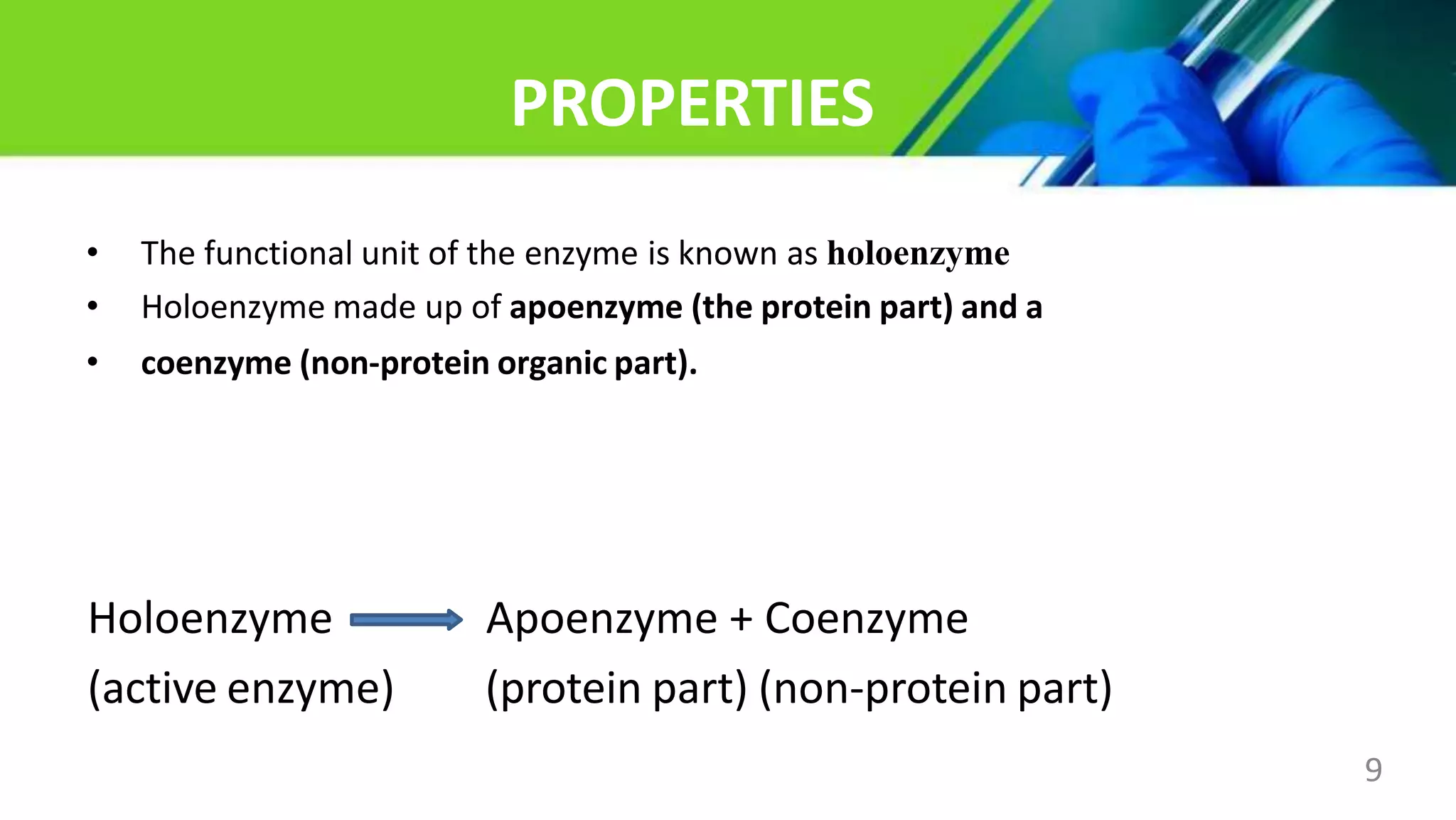
• The functional unit of the enzyme is known as holoenzyme
• Holoenzyme made up of apoenzyme (the protein part) and a
• coenzyme (non-protein organic part).
Holoenzyme
(active enzyme)
Apoenzyme + Coenzyme
(protein part) (non-protein part)
9
STRUCTURE OF ENZYMES
 The active site of an enzyme is the region that binds
substrates, co-factors and prosthetic groups and contains
residue that helps to hold the substrate.
 Active sites generally occupy less than 5% of the total surface
area of enzyme.
 Active site has a specific shape due to tertiary structure of
protein.
 A change in the shape of protein affects the shape of active
site and function of the enzyme.
ACTIVE SITE
It chooses the substrate
and binds it to active site.
It performs the catalytic
action of enzyme.
o Active site can be further divided into:
Active Site
Binding Site Catalytic Site
SUBSTRATE
 The reactant in biochemical reaction is termed as substrate.
 When a substrate binds to an enzyme it forms an enzyme-
substrate complex.
Enzyme
Joins
Substrate
CLASS
• Enzymes are sometimes considered under two broad
categories :
(a) Intracellular enzymes –
• They are functional within cells where they are
synthesized.
(b) Extracellular enzymes –
• These enzymes are active outside the cell; all the digestive
enzymes belong to this group.
NOMENCLATURE OF ENZYMES
o An enzyme is named according to the name of the substrate it
catalyses.
o Some enzymes were named before a systematic way of
naming enzyme was formed.
Example: pepsin, trypsin and rennin
o By adding suffix -ase at the end of the name of the
substrate, enzymes are named.
o Enzyme for catalyzing the hydrolysis is termed as hydrolase.
Example :
maltose + water glucose + glucose
maltase
EXAMPLE
S
substrate enzymes products
lactose lactase glucose + galactose
maltose maltase Glucose
cellulose cellulase Glucose
lipid lipase Glycerol + fatty acid
starch amylase Maltose
protein protease Peptides +
polypeptide
CLASSIFICATION
• The International Union of Biochemistry (IUB) appointed
an Enzyme Commission in 1961.
• Since 1964, the IUB system of enzyme
classification has been in force.
• Enzymes are divided into six major classes (in that
order).
• Each class on its own represents the general type of reaction
brought about by the enzymes of that class
1. Oxidoreductases : Enzymes involved in
oxidation-reduction reactions.
2. Transferases : Enzymes that catalyse the transfer of functional groups.
3. Hydrolases : Enzymes that bring about hydrolysis of various compounds.
4. Lyases : Enzymes specialised in the addition or
removal of water, ammonia, CO2 etc.
5. Isomerases : Enzymes involved in all the
isomerization reactions.
6. Ligases : Enzymes catalysing the synthetic reactions (Greek : ligate—to bind)
where two molecules are joined together and ATP is used.
[The word OTHLIL (first letter in each class) may be memorised
to remember the six classes of enzymes in the correct order].
• Each class in turn is subdivided into many sub- classes which are further
divided.
• A four digit Enzyme Commission (E.C.) number is
assigned to each enzyme representing the class
(first digit), sub-class (second digit), sub-sub class (third digit) and the individual
enzyme (fourth digit).
• Each enzyme is given a specific name indicating the substrate, coenzyme (if
any) and the type of the reaction catalysed by the enzyme.
• The contact between the enzyme and substrate is
the most essential pre-requisite for enzyme activity.
Factors affecting Enzyme
1. Concentration of enzyme
• As the concentration of the enzyme is increased, the
velocity of the reaction proportionately increases
Factors affecting Enzyme
2. Concentration of substrate
• Increase in the substrate concentration gradually
increases the velocity of enzyme reaction within the
limited range of substrate levels.
• A rectangular hyperbola is obtained when velocity is
plotted against the substrate concentration .
Factors affecting Enzyme
3. Effect of temperature
• Velocity of an enzyme reaction increases with increase
temperature up to a maximum and then declines.
• A bell-shaped curve is usually observed .
• Temperature coefficient or Q10 is defined as increase in
enzyme velocity when the temperature is increased by 10°C.
Factors affecting Enzyme
4. Effect of pH
•Increase in the hydrogen ion concentration (pH) considerably
influences the enzyme activity and a bell-shaped curve is
normally obtained
• Each enzyme has an optimum pH at
which the velocity is maximum. Below and
above this pH, the enzyme activity is much lower and at
extreme pH, the enzyme becomes totally inactive.
Factors affecting Enzyme
5. Effect of product concentration
• The accumulation of reaction products generally
decreases the enzyme velocity.
• For certain enzymes, the products combine with the
active site of enzyme and form a loose complex and,
thus, inhibit the enzyme activity.
Factors affecting Enzyme
6. Effect of activators
• Some of the enzymes require certain inorganic metallic cations like Mg2+, Mn2+, Zn2+, Ca2+,
Co2+, Cu2+, Na+, K+ etc. for theiroptimum activity.
• Rarely, anions are also needed For enzyme activity e.g. chloride ion
• (Cl–) for amylase.
• Two categories of enzymes requiring metals for their activity are distinguished
1. Metal-activated enzymes : The metal is not tightly held by the enzyme and can be
exchanged easily with other ions e.g. ATPase (Mg2+ and Ca2+) Enolase (Mg2+)
2.Metalloenzymes : These enzymes hold the metals rather tightly which are not readily
exchanged. e.g. alcohol dehydrogenase, carbonic anhydrase, alkaline
phosphatase, carboxypeptidase and aldolase contain zinc.
Factors affecting Enzyme
7. Effect of time
• Under ideal and optimal conditions (like pH, temperature etc.), the time
required for an enzyme reaction is less.
• Variations in the time of the reaction are generally related to the
alterations in pH and temperature.
Factors affecting Enzyme
8. Effect of light and radiation
• Exposure of enzymes to ultraviolet, beta, gamma and X-
rays inactivates certain enzymes due to the formation
of peroxides. e.g. UV rays inhibit salivary amylase
activity.
Factors affecting Enzyme
• Enzyme kinetics is the study of the chemical
reactions that are catalysed by enzymes.
• In enzyme kinetics, the reaction rate is measured and
the effects of varying the conditions of the reaction is
investigated.
• Studying an enzymes kinetics in this way can reveal
the catalytic mechanism of this enzyme
• Km value is a constant and a characteristic feature of a given enzyme.
• A low Km value indicates a strong affinity between enzyme and
substrate, whereas a high Km value reflects a weak affinity between
them.
• For majority of enzymes, the Km values are in the range of 10–5 to 10–2
moles.
• It may however, be noted that Km is not dependent on the
concentration of enzyme.
Lineweaver-Burk doublereciprocal plot:
• For the determination of Km value, the substrate saturation curve
(Fig.) is not very accurate
• since Vmax is approached
asymptotically.
• By taking the reciprocals
of the equation (1), a
straight line graphic representation is
obtained.
Lineweaver-Burk doublereciprocal plot:
REGULATION OF ENZYME
Enzyme regulation definition: “Process, by which cells can
turn on, turn off, or modulate the activities of various
metabolic pathways by regulating the activity of enzyme”
WHAT DO
YOU
UNDESTAND
BY
REGULATION
OF ENZYME
• Enzyme regulation is the control of the rate of a reaction
catalyzed by an enzyme by some effector (e.g., inhibitors or
activators) or by alteration of some condition (ph or ionic
strength)
• There are many kinds of molecules that block or
promote enzyme function, and that affect enzyme
function by different routes.
COMPETITIVE VS NON COMPETITIVE
Competitive
Examples –
Enzyme- lactate dehydrogenase
Substrate- lactate
Inhibitor- Oxamate
The enzyme of Krebs cycle succinate
dehydrogenase catalyzes a reaction to
convert succinate into fumarate. Malonate
acts as a competitive inhibitor because it
has a similar structure to succinate, the
inhibitor binds to the active site of
succinate dehydrogenase and inhibits the
reaction.
Noncompetitive
Cyanide action on cytochrome oxidase is an
example of non-competitive inhibition because
cyanide acts as the inhibitor which attaches to
cytochrome oxidase at a place other than the
active site and brings a conformational change
which in turn prevents the transport of electrons
from cytochrome c to oxygen.
Isoenzymes
• Isoenzymes or isozymes are multiple forms of same enzyme that catalyze the
same chemical reaction
• Different chemical and physical properties: LIKE Electrophoretic mobility
• Kinetic properties
• Amino acid sequence
• Amino acid composition
• Multiple forms of the same enzyme will also help in the regulation of enzyme
activity, Many of the isoenzymes are tissue-specific. Although isoenzymes of a
given enzyme catalyse the same reaction, they differ in Km, Vmax or both.
e.g.isoenzymes of LDH and CPK.
Clinically Important Isoenzymes

CHAPTER 6.pptx

  • 1.
  • 2.
  • 3.
  • 4.
    INTRODUCTION 4 • Enzymes arebiocatalysts – the catalysts of life. • A catalyst is defined as a substance that increases the velocity or rate of a chemical reaction without itself undergoing any change in the overall process. • Enzymes may be defined as biocatalysts synthesized by living cells.
  • 5.
  • 6.
    6 PROPERTIES • They areprotein in nature • colloidal • thermolabile in character • specific in their action.
  • 7.
  • 8.
  • 9.
    PROPERTIES • The functionalunit of the enzyme is known as holoenzyme • Holoenzyme made up of apoenzyme (the protein part) and a • coenzyme (non-protein organic part). Holoenzyme (active enzyme) Apoenzyme + Coenzyme (protein part) (non-protein part) 9
  • 10.
    STRUCTURE OF ENZYMES The active site of an enzyme is the region that binds substrates, co-factors and prosthetic groups and contains residue that helps to hold the substrate.  Active sites generally occupy less than 5% of the total surface area of enzyme.  Active site has a specific shape due to tertiary structure of protein.  A change in the shape of protein affects the shape of active site and function of the enzyme.
  • 11.
    ACTIVE SITE It choosesthe substrate and binds it to active site. It performs the catalytic action of enzyme. o Active site can be further divided into: Active Site Binding Site Catalytic Site
  • 12.
    SUBSTRATE  The reactantin biochemical reaction is termed as substrate.  When a substrate binds to an enzyme it forms an enzyme- substrate complex. Enzyme Joins Substrate
  • 13.
    CLASS • Enzymes aresometimes considered under two broad categories : (a) Intracellular enzymes – • They are functional within cells where they are synthesized. (b) Extracellular enzymes – • These enzymes are active outside the cell; all the digestive enzymes belong to this group.
  • 14.
    NOMENCLATURE OF ENZYMES oAn enzyme is named according to the name of the substrate it catalyses. o Some enzymes were named before a systematic way of naming enzyme was formed. Example: pepsin, trypsin and rennin o By adding suffix -ase at the end of the name of the substrate, enzymes are named. o Enzyme for catalyzing the hydrolysis is termed as hydrolase. Example : maltose + water glucose + glucose maltase
  • 15.
    EXAMPLE S substrate enzymes products lactoselactase glucose + galactose maltose maltase Glucose cellulose cellulase Glucose lipid lipase Glycerol + fatty acid starch amylase Maltose protein protease Peptides + polypeptide
  • 16.
    CLASSIFICATION • The InternationalUnion of Biochemistry (IUB) appointed an Enzyme Commission in 1961. • Since 1964, the IUB system of enzyme classification has been in force. • Enzymes are divided into six major classes (in that order). • Each class on its own represents the general type of reaction brought about by the enzymes of that class
  • 18.
    1. Oxidoreductases :Enzymes involved in oxidation-reduction reactions. 2. Transferases : Enzymes that catalyse the transfer of functional groups. 3. Hydrolases : Enzymes that bring about hydrolysis of various compounds. 4. Lyases : Enzymes specialised in the addition or removal of water, ammonia, CO2 etc. 5. Isomerases : Enzymes involved in all the isomerization reactions. 6. Ligases : Enzymes catalysing the synthetic reactions (Greek : ligate—to bind) where two molecules are joined together and ATP is used.
  • 19.
    [The word OTHLIL(first letter in each class) may be memorised to remember the six classes of enzymes in the correct order]. • Each class in turn is subdivided into many sub- classes which are further divided. • A four digit Enzyme Commission (E.C.) number is assigned to each enzyme representing the class (first digit), sub-class (second digit), sub-sub class (third digit) and the individual enzyme (fourth digit). • Each enzyme is given a specific name indicating the substrate, coenzyme (if any) and the type of the reaction catalysed by the enzyme.
  • 20.
    • The contactbetween the enzyme and substrate is the most essential pre-requisite for enzyme activity. Factors affecting Enzyme
  • 22.
  • 23.
    1. Concentration ofenzyme • As the concentration of the enzyme is increased, the velocity of the reaction proportionately increases Factors affecting Enzyme
  • 24.
    2. Concentration ofsubstrate • Increase in the substrate concentration gradually increases the velocity of enzyme reaction within the limited range of substrate levels. • A rectangular hyperbola is obtained when velocity is plotted against the substrate concentration . Factors affecting Enzyme
  • 25.
    3. Effect oftemperature • Velocity of an enzyme reaction increases with increase temperature up to a maximum and then declines. • A bell-shaped curve is usually observed . • Temperature coefficient or Q10 is defined as increase in enzyme velocity when the temperature is increased by 10°C. Factors affecting Enzyme
  • 26.
    4. Effect ofpH •Increase in the hydrogen ion concentration (pH) considerably influences the enzyme activity and a bell-shaped curve is normally obtained • Each enzyme has an optimum pH at which the velocity is maximum. Below and above this pH, the enzyme activity is much lower and at extreme pH, the enzyme becomes totally inactive. Factors affecting Enzyme
  • 27.
    5. Effect ofproduct concentration • The accumulation of reaction products generally decreases the enzyme velocity. • For certain enzymes, the products combine with the active site of enzyme and form a loose complex and, thus, inhibit the enzyme activity. Factors affecting Enzyme
  • 28.
    6. Effect ofactivators • Some of the enzymes require certain inorganic metallic cations like Mg2+, Mn2+, Zn2+, Ca2+, Co2+, Cu2+, Na+, K+ etc. for theiroptimum activity. • Rarely, anions are also needed For enzyme activity e.g. chloride ion • (Cl–) for amylase. • Two categories of enzymes requiring metals for their activity are distinguished 1. Metal-activated enzymes : The metal is not tightly held by the enzyme and can be exchanged easily with other ions e.g. ATPase (Mg2+ and Ca2+) Enolase (Mg2+) 2.Metalloenzymes : These enzymes hold the metals rather tightly which are not readily exchanged. e.g. alcohol dehydrogenase, carbonic anhydrase, alkaline phosphatase, carboxypeptidase and aldolase contain zinc. Factors affecting Enzyme
  • 29.
    7. Effect oftime • Under ideal and optimal conditions (like pH, temperature etc.), the time required for an enzyme reaction is less. • Variations in the time of the reaction are generally related to the alterations in pH and temperature. Factors affecting Enzyme
  • 30.
    8. Effect oflight and radiation • Exposure of enzymes to ultraviolet, beta, gamma and X- rays inactivates certain enzymes due to the formation of peroxides. e.g. UV rays inhibit salivary amylase activity. Factors affecting Enzyme
  • 32.
    • Enzyme kineticsis the study of the chemical reactions that are catalysed by enzymes. • In enzyme kinetics, the reaction rate is measured and the effects of varying the conditions of the reaction is investigated. • Studying an enzymes kinetics in this way can reveal the catalytic mechanism of this enzyme
  • 36.
    • Km valueis a constant and a characteristic feature of a given enzyme. • A low Km value indicates a strong affinity between enzyme and substrate, whereas a high Km value reflects a weak affinity between them. • For majority of enzymes, the Km values are in the range of 10–5 to 10–2 moles. • It may however, be noted that Km is not dependent on the concentration of enzyme.
  • 37.
    Lineweaver-Burk doublereciprocal plot: •For the determination of Km value, the substrate saturation curve (Fig.) is not very accurate • since Vmax is approached asymptotically. • By taking the reciprocals of the equation (1), a straight line graphic representation is obtained.
  • 38.
  • 39.
    REGULATION OF ENZYME Enzymeregulation definition: “Process, by which cells can turn on, turn off, or modulate the activities of various metabolic pathways by regulating the activity of enzyme”
  • 40.
  • 41.
    • Enzyme regulationis the control of the rate of a reaction catalyzed by an enzyme by some effector (e.g., inhibitors or activators) or by alteration of some condition (ph or ionic strength)
  • 42.
    • There aremany kinds of molecules that block or promote enzyme function, and that affect enzyme function by different routes.
  • 43.
    COMPETITIVE VS NONCOMPETITIVE
  • 44.
    COMPETITIVE VS NONCOMPETITIVE Competitive Examples – Enzyme- lactate dehydrogenase Substrate- lactate Inhibitor- Oxamate The enzyme of Krebs cycle succinate dehydrogenase catalyzes a reaction to convert succinate into fumarate. Malonate acts as a competitive inhibitor because it has a similar structure to succinate, the inhibitor binds to the active site of succinate dehydrogenase and inhibits the reaction. Noncompetitive Cyanide action on cytochrome oxidase is an example of non-competitive inhibition because cyanide acts as the inhibitor which attaches to cytochrome oxidase at a place other than the active site and brings a conformational change which in turn prevents the transport of electrons from cytochrome c to oxygen.
  • 45.
    Isoenzymes • Isoenzymes orisozymes are multiple forms of same enzyme that catalyze the same chemical reaction • Different chemical and physical properties: LIKE Electrophoretic mobility • Kinetic properties • Amino acid sequence • Amino acid composition • Multiple forms of the same enzyme will also help in the regulation of enzyme activity, Many of the isoenzymes are tissue-specific. Although isoenzymes of a given enzyme catalyse the same reaction, they differ in Km, Vmax or both. e.g.isoenzymes of LDH and CPK.
  • 46.