Chapter 02 
The Dynamic Environment 
of HRM 
Sehrish Imdad Dogar 
BBA(H) University of Sindh 
MBA SZABIST 
email i.d: dogarsehrish@gmail.com 
FB page: https://www.facebook.com/Sehrish 
Fundamentals of Human Resource Management, 10/e, DeCenzo/Robbins
introduction 
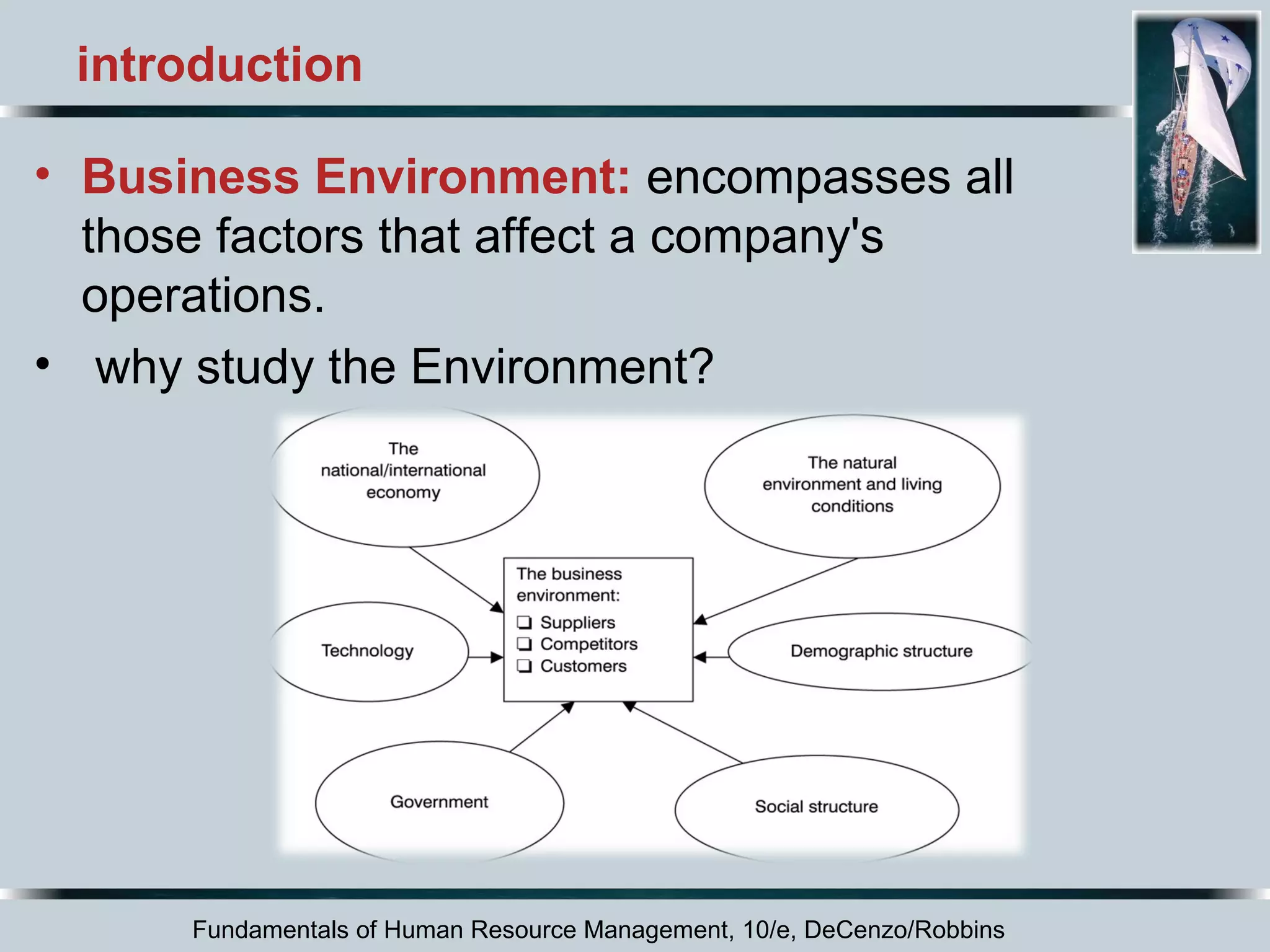
• Business Environment: encompasses all 
those factors that affect a company's 
operations. 
• why study the Environment? 
Fundamentals of Human Resource Management, 10/e, DeCenzo/Robbins
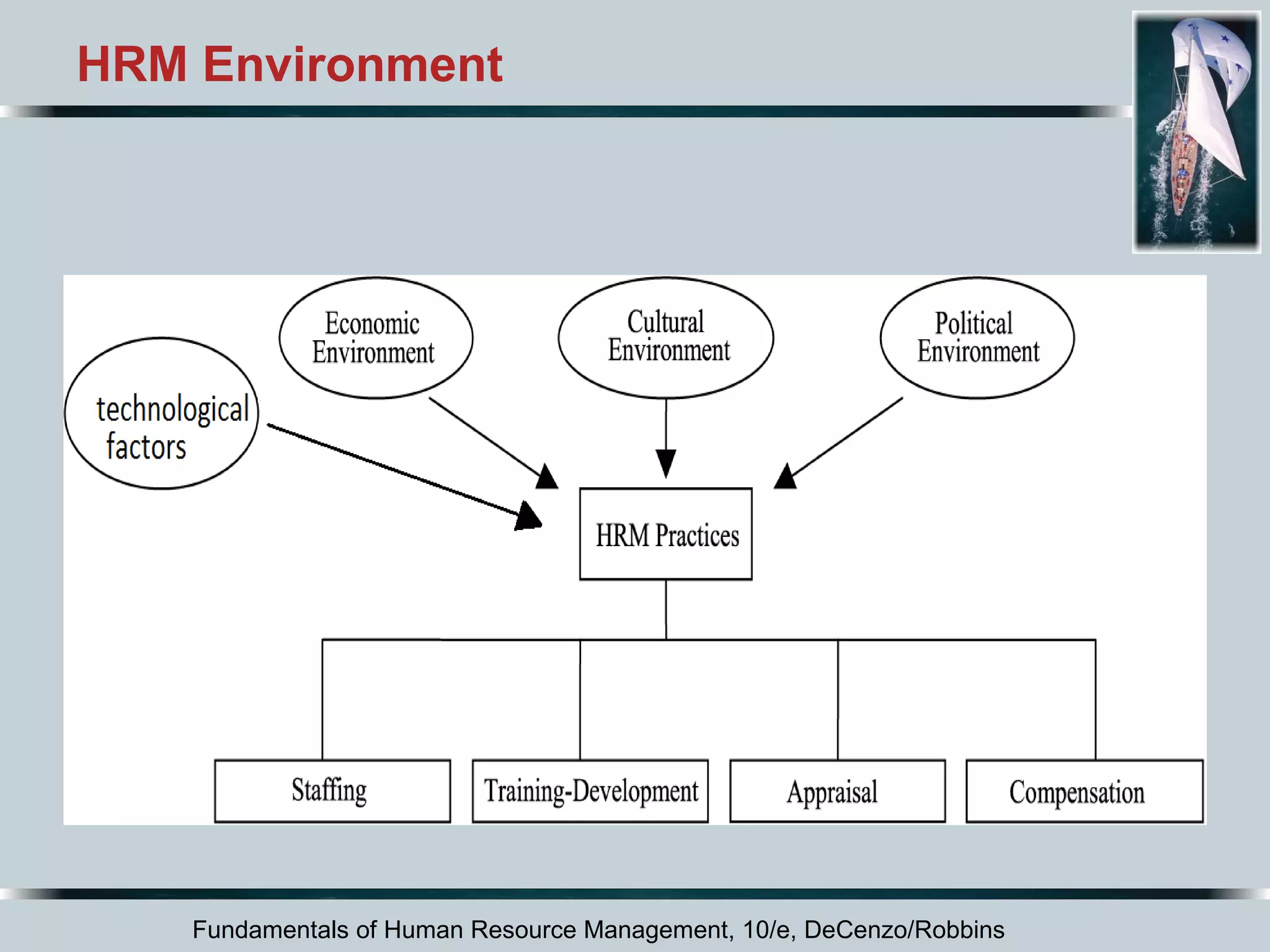
HRM Environment 
Fundamentals of Human Resource Management, 10/e, DeCenzo/Robbins
Introduction 
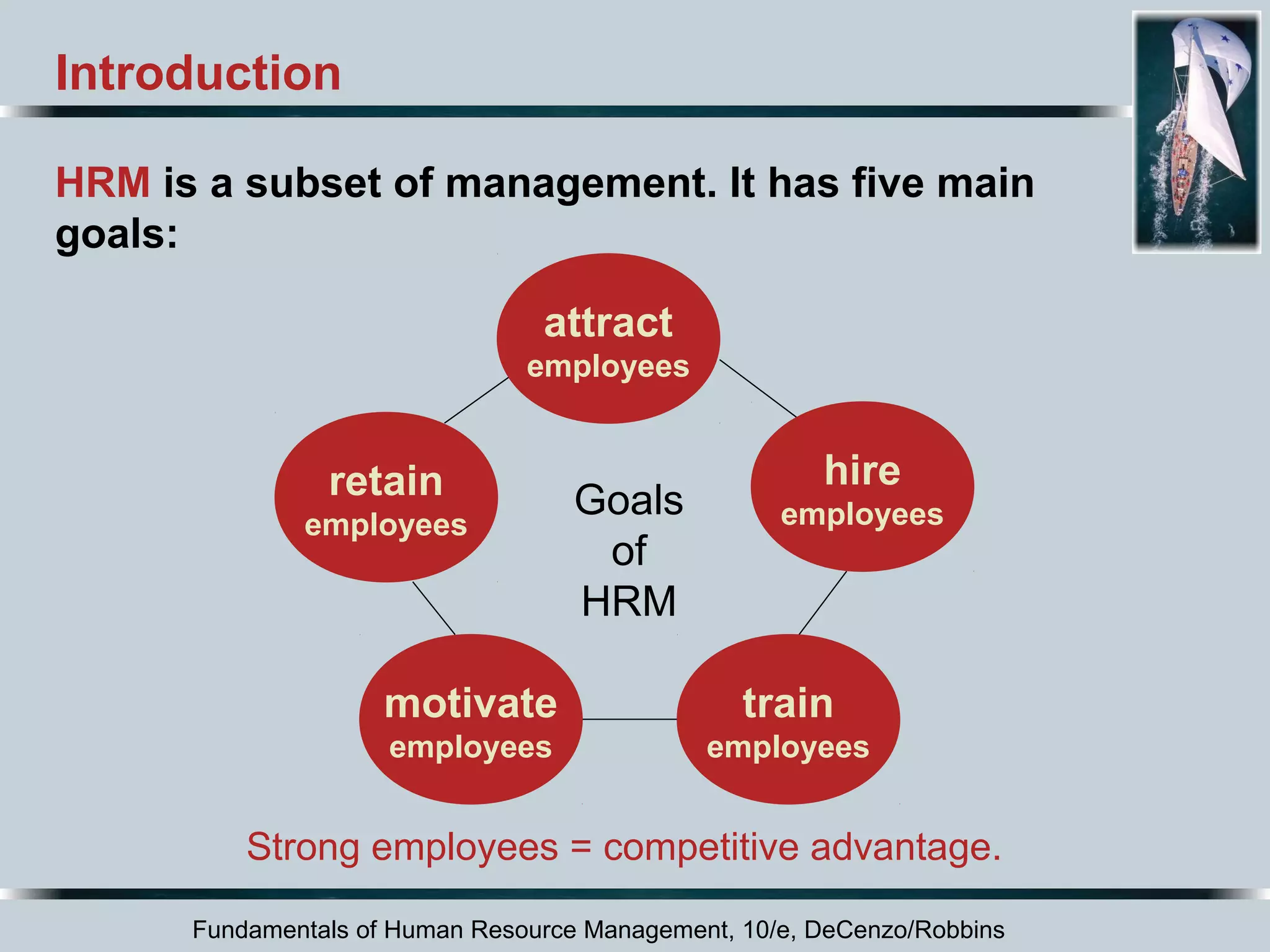
HRM is a subset of management. It has five main 
goals: 
attract 
employees 
Goals 
of 
HRM 
hire 
employees 
retain 
employees 
motivate 
employees 
train 
employees 
Strong employees = competitive advantage. 
Fundamentals of Human Resource Management, 10/e, DeCenzo/Robbins
Objective 1 
How cultural 
environment affects 
HRM practices? 
Fundamentals of Human Resource Management, 10/e, DeCenzo/Robbins
Understanding Cultural Environments 
Culture: the specific learned norms of a society 
that reflect attitudes, values, and beliefs that 
exist in a nation. 
Attitude: thinking/feeling 
Values: what do u hold important 
Beliefs: accepts as true 
Countries have different 
 values 
 morals 
 customs 
 political, economic, and legal systems 
Fundamentals of Human Resource Management, 10/e, DeCenzo/Robbins
Understanding Cultural Environments 
• Ascribed status v/s acquired status 
• Performance orientation (competence 
v/s seniority) 
• Family based orientation (TATA, 
Ambani) 
• Materialism and leisure 
• Assertiveness 
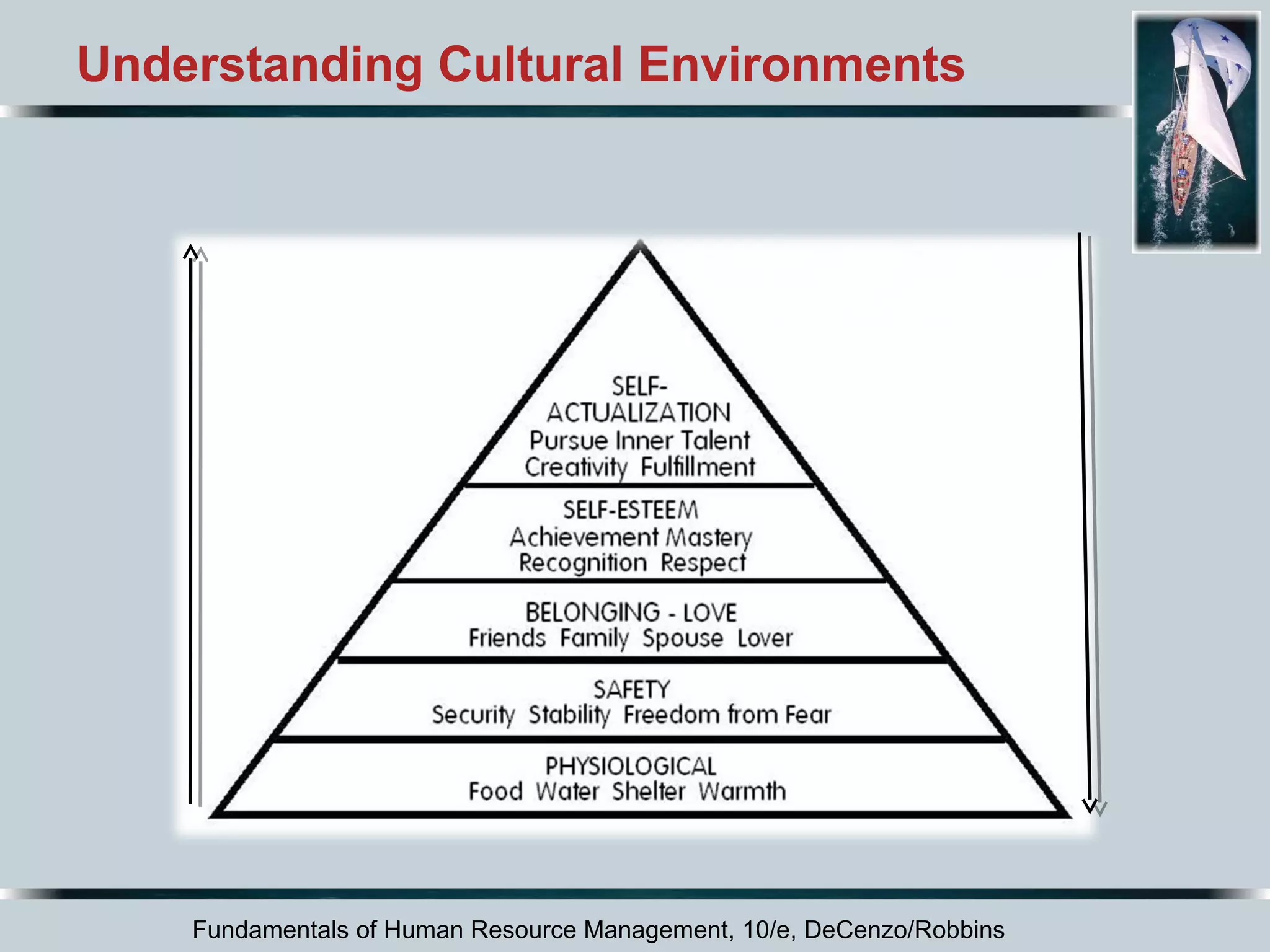
• Hierarchy of needs 
Fundamentals of Human Resource Management, 10/e, DeCenzo/Robbins
Understanding Cultural Environments 
Fundamentals of Human Resource Management, 10/e, DeCenzo/Robbins
Understanding Cultural Environments 
• Power distance (autocratic v/s 
consultative) 
• Individualism v/s collectivism 
• Uncertainty avoidance 
• Fatalism 
Fundamentals of Human Resource Management, 10/e, DeCenzo/Robbins
Objective 2 
How technological 
environment affects HRM 
practices 
Fundamentals of Human Resource Management, 10/e, DeCenzo/Robbins
The Changing World of Technology 
HRM information systems help to 
 facilitate HR plans 
 make decisions faster 
 clearly define jobs 
 evaluate performance 
 provide desirable, cost-effective benefits 
Fundamentals of Human Resource Management, 10/e, DeCenzo/Robbins
The Changing World of Technology 
 Recruiting 
Employee selection 
Training and development 
Ethics and employee rights 
Motivating knowledge workers 
Communications 
Decentralized work sites 
Skill levels 
A legal concern 
Fundamentals of Human Resource Management, 10/e, DeCenzo/Robbins
Objective 3 
What is workforce 
diversity. Identify changes 
in workforce composition 
and how firms respond to 
these changes. 
Fundamentals of Human Resource Management, 10/e, DeCenzo/Robbins
Workforce Diversity 
HRM has moved from the melting pot 
assumption to celebrating workforce diversity. 
1. in 1960s legislation in favor of minority and 
women opened up opportunities. 
2. birthrates declined and the era of“graying of 
the workforce” started 
3. Multiculturalism 
(immigration+ globalization) 
Fundamentals of Human Resource Management, 10/e, DeCenzo/Robbins
How has the companies responded to 
Workforce Diversity 
1. Workforce Diversity Programs 
2. Cultural audits 
3. Healthy work/life balance. 
They can work any time, from almost anywhere 
 Global organizations– the world never sleeps 
 Communication technology 
 Organizations are asking to put in more hours 
 Dual career couples 
They want “a life” as well as a job! 
Fundamentals of Human Resource Management, 10/e, DeCenzo/Robbins
OBJECTIVE 4 
HRM implications of labor 
shortage 
Fundamentals of Human Resource Management, 10/e, DeCenzo/Robbins
The Labor Supply– why the shortage? 
HR managers monitor the labor supply. 
• Cyclical labor trends are difficult to predict.– 
Economic changes were sudden where as 
Demographic changes are predictable over time. 
• Labor shortage = f (birthrates, labor participation rates) 
• by 2014 2.4 million jobs will go unfiled. 
• September 11, 2001 has slowed down the immigrants. 
Fundamentals of Human Resource Management, 10/e, DeCenzo/Robbins
Why do organizations lay off employees 
during shortages? 
In good times you hire employees; 
in bad times, you fire them 
• Downsizing: an activity in an organization aimed at creating 
greater efficiency by eliminating certain jobs 
• Today flatter structures and redesigning jobs is the norm. 
• Rightsizing: linking employee needs to organizational strategy. 
• Outsourcing: sending work “outside” the organization to be 
done by individuals not employed full time with the organization. 
Fundamentals of Human Resource Management, 10/e, DeCenzo/Robbins
How do organizations balance labor supply? 
 part-time workers– fewer than 40 hours a week 
temporary workers– acts as fill ins. fixed cost 
 contract workers/ subcontractors/ consultants – 
typically highly skilled. Charges a fee. Fixed cost. 
Economies of scale. 
why contingent workforce? Quickly react to changes. 
Fundamentals of Human Resource Management, 10/e, DeCenzo/Robbins
Issues contingent workers create for HRM 
• Introduce them policies and practices 
• Make sure they are not treated as second-class 
workers 
• They maybe less loyal, less committed and less 
motivated. 
• Set scheduling options as per their needs. 
• Decide whether benefits will be offered to the 
contingent workforce or not 
• Deal with potential conflicts between core and 
contingent workers. 
• See to it that core employees are not lured with 
the flexibility. 
Fundamentals of Human Resource Management, 10/e, DeCenzo/Robbins
Objective 5 
Continuous 
improvement programs 
and the role of HRM 
Fundamentals of Human Resource Management, 10/e, DeCenzo/Robbins
Continuous Improvement Programs 
• Continuous improvement: organizational 
commitment to constantly improving quality of 
products and services. 
• W.Edward Deming. In 1950 he advised that an 
organization which uses statistical control to reduce 
variability should result in uniform and predictable 
quantity of output . 
• CIP is called kaizen in Japanese. 
Fundamentals of Human Resource Management, 10/e, DeCenzo/Robbins
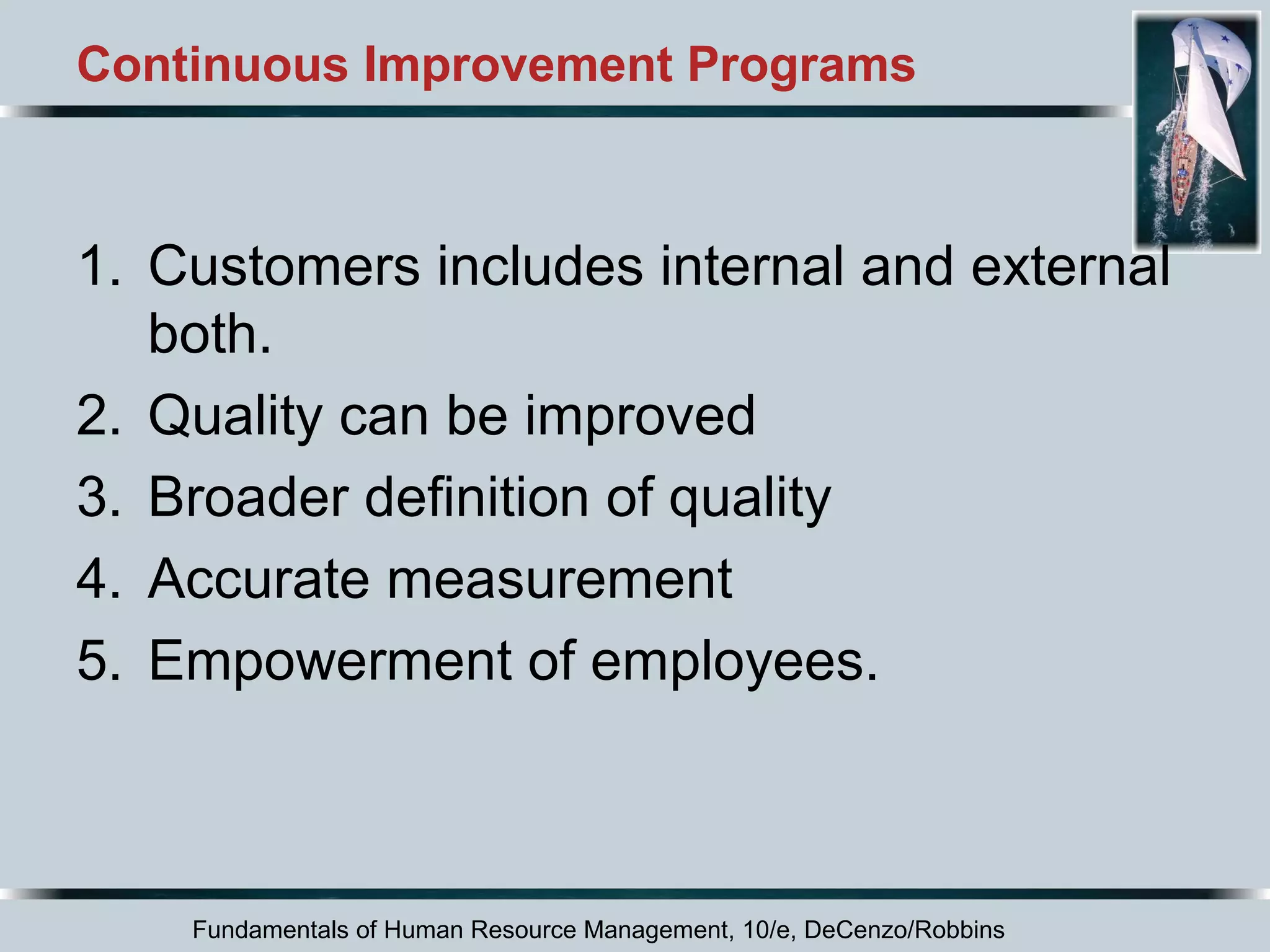
Continuous Improvement Programs 
1. Customers includes internal and external 
both. 
2. Quality can be improved 
3. Broader definition of quality 
4. Accurate measurement 
5. Empowerment of employees. 
Fundamentals of Human Resource Management, 10/e, DeCenzo/Robbins
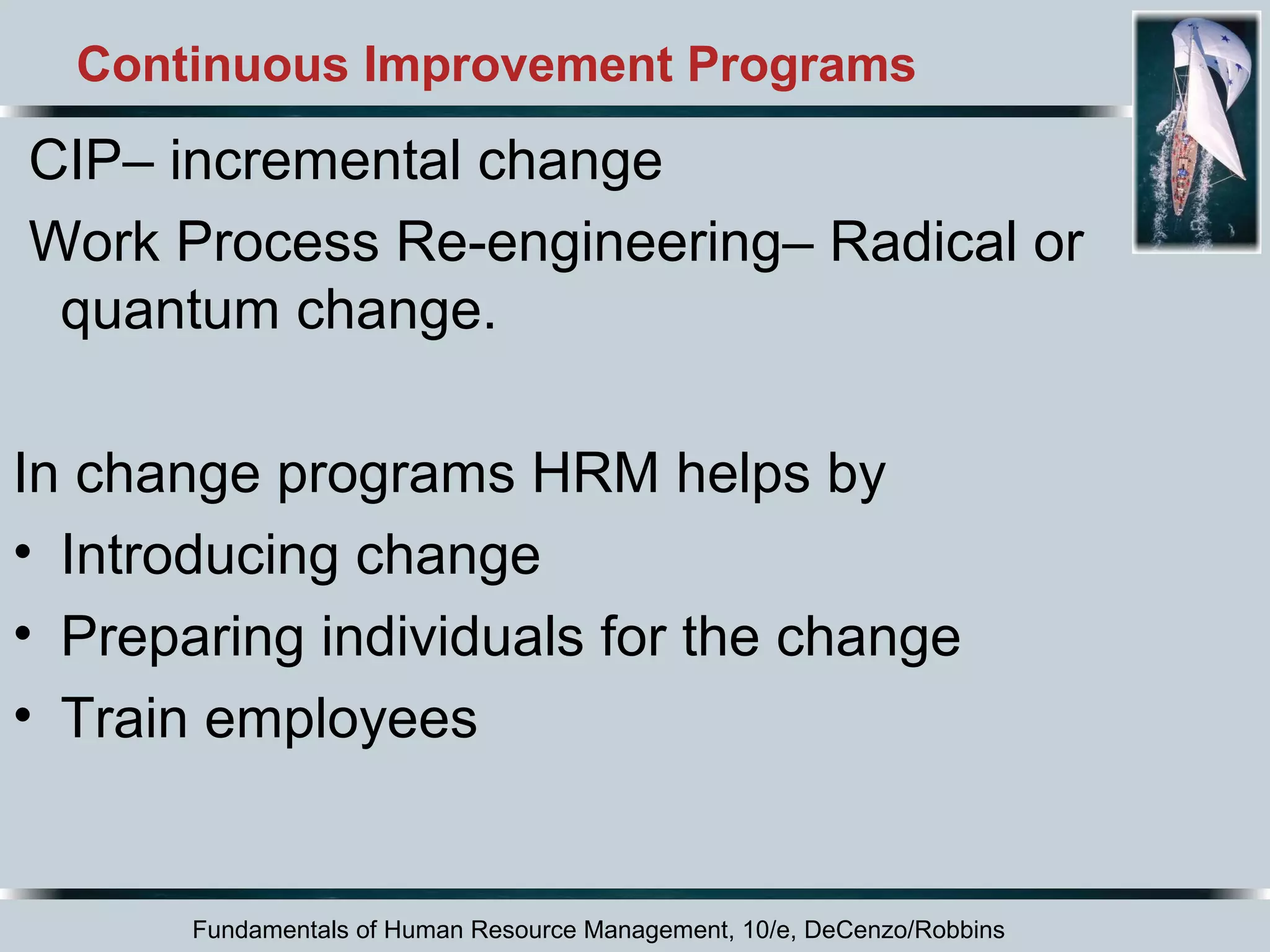
Continuous Improvement Programs 
CIP– incremental change 
Work Process Re-engineering– Radical or 
quantum change. 
In change programs HRM helps by 
• Introducing change 
• Preparing individuals for the change 
• Train employees 
Fundamentals of Human Resource Management, 10/e, DeCenzo/Robbins
Objective 6 
The recent concept of 
Employee involvement and the 
role of HRM in achieving that 
Fundamentals of Human Resource Management, 10/e, DeCenzo/Robbins
Employee Involvement 
It’s all about employee empowerment through 
involvement, which increases worker productivity 
and loyalty. 
Employee Involvement Concepts 
delegation • participative management 
work teams • goal setting • employer training 
Fundamentals of Human Resource Management, 10/e, DeCenzo/Robbins
The role of HRM in Employee involvement 
• Autocratic authority is far gone. Delegation is 
required. 
• It gives greater access to customer demands 
• Teams help building and capitalizing on the 
various skills and background of the 
employees 
Fundamentals of Human Resource Management, 10/e, DeCenzo/Robbins
The role of HRM in Employee involvement 
• It requires Leadership Skills. 
• Train the employees 
• Not only job design is changed by it may 
need to change the interpersonal skills 
Fundamentals of Human Resource Management, 10/e, DeCenzo/Robbins
Objective 7 
Other HRM challenges 
Fundamentals of Human Resource Management, 10/e, DeCenzo/Robbins
Recession 
• Recession: a continuous state of joblessness 
and inflation. 
• Layoffs– the morale suffers. Fear and 
resentment. 
• On a brighter side it is possible to attract and 
hire better qualified people for jobs. 
Fundamentals of Human Resource Management, 10/e, DeCenzo/Robbins
Off shoring 
• Off shoring: the process of moving jobs out of 
one country into another country. 
Why off shoring? 
• Find necessary skills 
• Lower labor costs 
• Reduced costs of distribution 
• To produce better paying jobs in the home 
country 
Fundamentals of Human Resource Management, 10/e, DeCenzo/Robbins
mergers 
Mergers: joining ownership of two 
organizations 
Acquisition: the transfer of ownership and 
control of one organization to another. 
• Loss of jobs 
• Differences in culture 
• Better way to enter a new market 
Fundamentals of Human Resource Management, 10/e, DeCenzo/Robbins

dynamic enviroment of HRM

  • 1.
    Chapter 02 TheDynamic Environment of HRM Sehrish Imdad Dogar BBA(H) University of Sindh MBA SZABIST email i.d: dogarsehrish@gmail.com FB page: https://www.facebook.com/Sehrish Fundamentals of Human Resource Management, 10/e, DeCenzo/Robbins
  • 2.
    introduction • BusinessEnvironment: encompasses all those factors that affect a company's operations. • why study the Environment? Fundamentals of Human Resource Management, 10/e, DeCenzo/Robbins
  • 3.
    HRM Environment Fundamentalsof Human Resource Management, 10/e, DeCenzo/Robbins
  • 4.
    Introduction HRM isa subset of management. It has five main goals: attract employees Goals of HRM hire employees retain employees motivate employees train employees Strong employees = competitive advantage. Fundamentals of Human Resource Management, 10/e, DeCenzo/Robbins
  • 5.
    Objective 1 Howcultural environment affects HRM practices? Fundamentals of Human Resource Management, 10/e, DeCenzo/Robbins
  • 6.
    Understanding Cultural Environments Culture: the specific learned norms of a society that reflect attitudes, values, and beliefs that exist in a nation. Attitude: thinking/feeling Values: what do u hold important Beliefs: accepts as true Countries have different  values  morals  customs  political, economic, and legal systems Fundamentals of Human Resource Management, 10/e, DeCenzo/Robbins
  • 7.
    Understanding Cultural Environments • Ascribed status v/s acquired status • Performance orientation (competence v/s seniority) • Family based orientation (TATA, Ambani) • Materialism and leisure • Assertiveness • Hierarchy of needs Fundamentals of Human Resource Management, 10/e, DeCenzo/Robbins
  • 8.
    Understanding Cultural Environments Fundamentals of Human Resource Management, 10/e, DeCenzo/Robbins
  • 9.
    Understanding Cultural Environments • Power distance (autocratic v/s consultative) • Individualism v/s collectivism • Uncertainty avoidance • Fatalism Fundamentals of Human Resource Management, 10/e, DeCenzo/Robbins
  • 10.
    Objective 2 Howtechnological environment affects HRM practices Fundamentals of Human Resource Management, 10/e, DeCenzo/Robbins
  • 11.
    The Changing Worldof Technology HRM information systems help to  facilitate HR plans  make decisions faster  clearly define jobs  evaluate performance  provide desirable, cost-effective benefits Fundamentals of Human Resource Management, 10/e, DeCenzo/Robbins
  • 12.
    The Changing Worldof Technology  Recruiting Employee selection Training and development Ethics and employee rights Motivating knowledge workers Communications Decentralized work sites Skill levels A legal concern Fundamentals of Human Resource Management, 10/e, DeCenzo/Robbins
  • 13.
    Objective 3 Whatis workforce diversity. Identify changes in workforce composition and how firms respond to these changes. Fundamentals of Human Resource Management, 10/e, DeCenzo/Robbins
  • 14.
    Workforce Diversity HRMhas moved from the melting pot assumption to celebrating workforce diversity. 1. in 1960s legislation in favor of minority and women opened up opportunities. 2. birthrates declined and the era of“graying of the workforce” started 3. Multiculturalism (immigration+ globalization) Fundamentals of Human Resource Management, 10/e, DeCenzo/Robbins
  • 15.
    How has thecompanies responded to Workforce Diversity 1. Workforce Diversity Programs 2. Cultural audits 3. Healthy work/life balance. They can work any time, from almost anywhere  Global organizations– the world never sleeps  Communication technology  Organizations are asking to put in more hours  Dual career couples They want “a life” as well as a job! Fundamentals of Human Resource Management, 10/e, DeCenzo/Robbins
  • 16.
    OBJECTIVE 4 HRMimplications of labor shortage Fundamentals of Human Resource Management, 10/e, DeCenzo/Robbins
  • 17.
    The Labor Supply–why the shortage? HR managers monitor the labor supply. • Cyclical labor trends are difficult to predict.– Economic changes were sudden where as Demographic changes are predictable over time. • Labor shortage = f (birthrates, labor participation rates) • by 2014 2.4 million jobs will go unfiled. • September 11, 2001 has slowed down the immigrants. Fundamentals of Human Resource Management, 10/e, DeCenzo/Robbins
  • 18.
    Why do organizationslay off employees during shortages? In good times you hire employees; in bad times, you fire them • Downsizing: an activity in an organization aimed at creating greater efficiency by eliminating certain jobs • Today flatter structures and redesigning jobs is the norm. • Rightsizing: linking employee needs to organizational strategy. • Outsourcing: sending work “outside” the organization to be done by individuals not employed full time with the organization. Fundamentals of Human Resource Management, 10/e, DeCenzo/Robbins
  • 19.
    How do organizationsbalance labor supply?  part-time workers– fewer than 40 hours a week temporary workers– acts as fill ins. fixed cost  contract workers/ subcontractors/ consultants – typically highly skilled. Charges a fee. Fixed cost. Economies of scale. why contingent workforce? Quickly react to changes. Fundamentals of Human Resource Management, 10/e, DeCenzo/Robbins
  • 20.
    Issues contingent workerscreate for HRM • Introduce them policies and practices • Make sure they are not treated as second-class workers • They maybe less loyal, less committed and less motivated. • Set scheduling options as per their needs. • Decide whether benefits will be offered to the contingent workforce or not • Deal with potential conflicts between core and contingent workers. • See to it that core employees are not lured with the flexibility. Fundamentals of Human Resource Management, 10/e, DeCenzo/Robbins
  • 21.
    Objective 5 Continuous improvement programs and the role of HRM Fundamentals of Human Resource Management, 10/e, DeCenzo/Robbins
  • 22.
    Continuous Improvement Programs • Continuous improvement: organizational commitment to constantly improving quality of products and services. • W.Edward Deming. In 1950 he advised that an organization which uses statistical control to reduce variability should result in uniform and predictable quantity of output . • CIP is called kaizen in Japanese. Fundamentals of Human Resource Management, 10/e, DeCenzo/Robbins
  • 23.
    Continuous Improvement Programs 1. Customers includes internal and external both. 2. Quality can be improved 3. Broader definition of quality 4. Accurate measurement 5. Empowerment of employees. Fundamentals of Human Resource Management, 10/e, DeCenzo/Robbins
  • 24.
    Continuous Improvement Programs CIP– incremental change Work Process Re-engineering– Radical or quantum change. In change programs HRM helps by • Introducing change • Preparing individuals for the change • Train employees Fundamentals of Human Resource Management, 10/e, DeCenzo/Robbins
  • 25.
    Objective 6 Therecent concept of Employee involvement and the role of HRM in achieving that Fundamentals of Human Resource Management, 10/e, DeCenzo/Robbins
  • 26.
    Employee Involvement It’sall about employee empowerment through involvement, which increases worker productivity and loyalty. Employee Involvement Concepts delegation • participative management work teams • goal setting • employer training Fundamentals of Human Resource Management, 10/e, DeCenzo/Robbins
  • 27.
    The role ofHRM in Employee involvement • Autocratic authority is far gone. Delegation is required. • It gives greater access to customer demands • Teams help building and capitalizing on the various skills and background of the employees Fundamentals of Human Resource Management, 10/e, DeCenzo/Robbins
  • 28.
    The role ofHRM in Employee involvement • It requires Leadership Skills. • Train the employees • Not only job design is changed by it may need to change the interpersonal skills Fundamentals of Human Resource Management, 10/e, DeCenzo/Robbins
  • 29.
    Objective 7 OtherHRM challenges Fundamentals of Human Resource Management, 10/e, DeCenzo/Robbins
  • 30.
    Recession • Recession:a continuous state of joblessness and inflation. • Layoffs– the morale suffers. Fear and resentment. • On a brighter side it is possible to attract and hire better qualified people for jobs. Fundamentals of Human Resource Management, 10/e, DeCenzo/Robbins
  • 31.
    Off shoring •Off shoring: the process of moving jobs out of one country into another country. Why off shoring? • Find necessary skills • Lower labor costs • Reduced costs of distribution • To produce better paying jobs in the home country Fundamentals of Human Resource Management, 10/e, DeCenzo/Robbins
  • 32.
    mergers Mergers: joiningownership of two organizations Acquisition: the transfer of ownership and control of one organization to another. • Loss of jobs • Differences in culture • Better way to enter a new market Fundamentals of Human Resource Management, 10/e, DeCenzo/Robbins