1
2
GROUP NAME
Motivators
GROUP MEMBERS:
ď‚§ Zunera Latif
ď‚§ Waqas Muntazir Zia
ď‚§ Maria Nusrat
ď‚§ Noshaba khalil
ď‚§ Mohsin Mukhtar
ď‚§ Sobia Arshad
ď‚§ Kiran Mustafa
3
DEDICATION
We dedicate our presentation to our beloved Parents who
blessed us with priceless love and care throughout our lives
and make us able to deal such a big task. We are also
dedicating this presentation to our honorable Sir. HUSSAIN,
who boast our moral and build confidence in us to complete
this presentation .We consider ourselves successful because
the blessings of Almighty Allah our Sir and Parents support.
4
Human Resource
Management
5
TABLE OF CONTENTS
ď‚§ Introduction to HRM
ď‚§ Definition of HRM
ď‚§ Introduction to Recruitment
ď‚§ Meaning of Recruitment
ď‚§ Definition of Recruitment
ď‚§ Goal of recruitment
ď‚§ Objective of recruitment
ď‚§ Factors of recruitment
ď‚§ Constraints of recruitment
ď‚§ Purpose and importance of recruitment
ď‚§ Sources of recruitment
6
TABLE OF CONTENTS
ď‚§ Effective recruitment
ď‚§ Principles of recruitment
ď‚§ Strategic of recruiting
ď‚§ Types of recruitment
ď‚§ Advertising
ď‚§ Recruitment process
ď‚§ A global perspective
ď‚§ Meeting the organization
7
Introduction to HRM
 HRM is a management of the organization’s employees.
ď‚§ This includes employment and arbitration in accord with the
law and with a company directives.
ď‚§ HRM is a most critical function of manager.
ď‚§ The main function is the focus on recruitment of
management and providing direction for the people who work
in a organization.
8
Definition to HRM
ď‚§ It is the organizational function that deal with issues related
to people such as compensation ,hiring, performance
management, organization development, safety, wellness,
benefit, employee motivation ,communication and training.
9
Recruitment
INTRODUCTION:-
ď‚§ Recruitment is an important function of health manpower
management ,which determines whether the required will be
available at the work spot, when a job is actually to be
undertaken.
ď‚§ Recruiting brings together those with jobs to fill and those
seeking jobs.
10
Meaning
ď‚§ In a simple term ,recruitment is understood as the process of
searching for and obtaining applicants for job, from among
whom the right people can be selected.
11
Definition of Recruiting
ď‚§ Recruiting is the process of searching the candidates for
employment and stimulating them to employee for jobs in the
organization . B Flippo
ď‚§ It is a process in which the right person for the right post is
procured .IGNOU Module
ď‚§ The process for gathering a pool of qualified candidates for a
particular job.
ď‚§ The process of discovering potential candidates.
12
Recruiting Goal
ď‚§ To provide information that will attract a significant pool of
qualified candidates and discourage unqualified ones from
apply.
1 Communicate the position in
effective manner
2 Save time and money
3
Encourage unqualified candidates
to self-select themselves out
Attract the qualified candidates
13
Next Presenter
14
Objective of Recruiting
ď‚§ To attract people with multi- dimensional skills and
experiences that suit the present and future organizational
strategies .
ď‚§ To induct outsiders with new perspective to lead the
company.
ď‚§ To infuse fresh blood at all levels of organization.

ď‚§ To develop an organizational culture that attracts competent
people to the company .
15
Objective of Recruiting
 To search or head hunt people whose skills fit the company’s
values.
ď‚§ To devise methodologies for assessing physiological traits.
ď‚§ To search for talent globally and not just within the company.
ď‚§ To design entry pay that competes on quality but not on
quantum.
ď‚§ To anticipate and find people for positions that does not exist
yet.
16
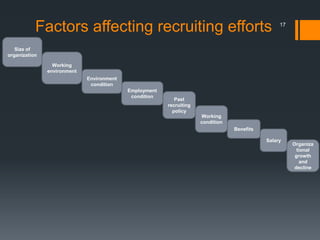
Factors affecting recruiting efforts
Size of
organization
Employment
condition
Working
environment
Past
recruiting
policy
Environment
condition
Working
condition
Benefits
Salary
Organiza
tional
growth
and
decline
17
Constraints on recruiting effort
ď‚§ Ideal recruitment effort might bring satisfactory number of
qualified applicant.
ď‚§ Pool of applicant may not include best candidate.
ď‚§ Best candidate may not work want to work for the
organization.
ď‚§ There are five basic constraints.
18
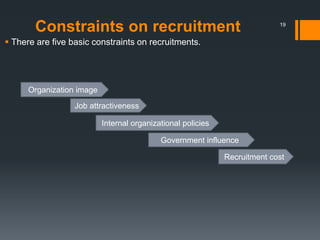
Constraints on recruitment
ď‚§ There are five basic constraints on recruitments.
Organization image
Job attractiveness
Internal organizational policies
Government influence
Recruitment cost
19
Organization image
ď‚§ Perspective candidate may not be interested in pursing job .
ď‚§ Image of organization is potential constraint .
ď‚§ E.g. Disney word
ď‚§ McDonald
ď‚§ Microsoft
20
Job attractiveness
ď‚§ For unattractive job like manual labor position recruiting pool
of applicant will be difficult.
21
Internal organizational policies
ď‚§ Promotion from within.
ď‚§ Reduce the number of application.
22
Government influence
ď‚§ Employer no longer seek out preferred individual based on
non job related factor e.g.
1. Physical appearance
2. Male and female
3. Religious background(air line job)
23
Recruitment cost
ď‚§ Recruitment effort are expensive .
ď‚§ 10500$ per position.
ď‚§ Budget constrain put time limit.
ď‚§ Interview technique.
ď‚§ Conference call.
ď‚§ Video conference.
24
Purpose and importance
ď‚§ Determine the present and future requirements of the
organization in conjunction with the personnel(staff) planning
and job analysis activities.
ď‚§ Increase the pool of job candidates with minimum cost
ď‚§ Help increase the success rate of the selection process
reducing the number of obviously under qualified and over
qualified job applicants.
ď‚§ Help reduce the probability that the job applicants, once
recruited and selected will leave the organization only after
short period of time.
25
Purpose and importance
ď‚§ Start identifying and preparing potential job applicants who
will be appropriate candidates .
ď‚§ Increase organizational and individual effectiveness in the
short and long term.
ď‚§ Evaluate the effectiveness of various recruiting techniques
and sources for all types of job applicants.
26
Next Presenter
27
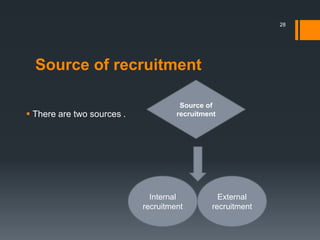
Source of recruitment
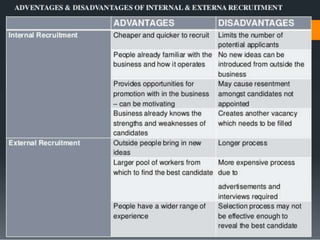
ď‚§ There are two sources .
Source of
recruitment
Internal
recruitment
External
recruitment
28
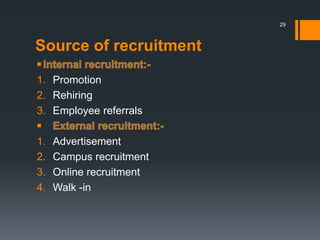
Source of recruitment
1. Promotion
2. Rehiring
3. Employee referrals
1. Advertisement
2. Campus recruitment
3. Online recruitment
4. Walk -in
29
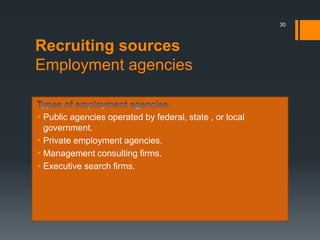
Recruiting sources
Employment agencies
ď‚§ Public agencies operated by federal, state , or local
government.
ď‚§ Private employment agencies.
ď‚§ Management consulting firms.
ď‚§ Executive search firms.
30
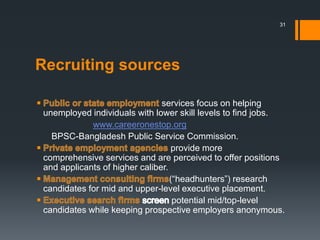
Recruiting sources
services focus on helping
unemployed individuals with lower skill levels to find jobs.
www.careeronestop.org
BPSC-Bangladesh Public Service Commission.
provide more
comprehensive services and are perceived to offer positions
and applicants of higher caliber.
(“headhunters”) research
candidates for mid and upper-level executive placement.
potential mid/top-level
candidates while keeping prospective employers anonymous.
31
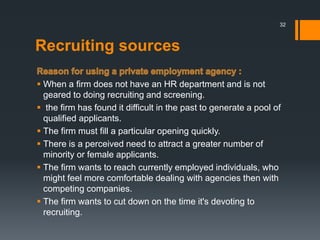
Recruiting sources
ď‚§ When a firm does not have an HR department and is not
geared to doing recruiting and screening.
ď‚§ the firm has found it difficult in the past to generate a pool of
qualified applicants.
ď‚§ The firm must fill a particular opening quickly.
ď‚§ There is a perceived need to attract a greater number of
minority or female applicants.
ď‚§ The firm wants to reach currently employed individuals, who
might feel more comfortable dealing with agencies then with
competing companies.
ď‚§ The firm wants to cut down on the time it's devoting to
recruiting.
32
Recruiting sources
Schools, Colleges and universities
ď‚§ Educational institution at all levels offer opportunities for
recruiting recent graduates.
ď‚§ Most educational institution operate placement services
where prospective employers can review credentials and
interview graduates.
ď‚§ May provide entry-level or experienced workers through their
placement services.
ď‚§ May also help companies establish cooperative education
assignments and internships.
33
Recruiting sources
Job fairs:-
ď‚§ Attended by company recruiters seeking resumes and
information from qualified candidates.
ď‚§ Virtual online jobs fairs could bring employers and job
seekers together online by logging into a specific web sites at
a certain time.
ď‚§ http://www.inxpo.com/products/virtual-career-fairs/index.htm
ď‚§ http://work.secondlife.com/worksolutions/meetings
34
Recruiting sources
Professional organizations:-
ď‚§ Many professional organizations, include labor unions
operate placement services for the benefit of their members.
ď‚§ the professional organizations include such varied
occupations as industrial engineering, psychology,
accounting, legal and academics.
ď‚§ These organizations publish rosters of job vacancies and
distribute these lists to members.
1. Run placement services at meetings.
2. Control the supply of prospective applicants.
3. Labor unions are also in this category.
35
Recruiting sources
unsolicited applicants(walk-ins):
ď‚§ Unsolicited applicants, whether they reach the employer by
letter, telephone or in person, constitute a source of
prospective applicants.
ď‚§ May provide a stockpile of prospective applicants if there are
no current openings.
ď‚§ Direct applicants who seek employment with or without
encouragement from other sources .
ď‚§ courteous treatment of any applicant is a good business
practice.
36
Recruiting sources
ď‚§ Most companies use the internet to recruit employees.
ď‚§ Job seekers use online resumes and create Web pages
about their qualifications.
1. Monster
2. Yahoo! Hot jobs
3. Inxpo
4. careerbuilder.com
5. second life.
6. Man power.
ď‚§ In Bangladesh, www.bdbojs.com etc is used for getting
potential candidates.
Online
sources
37
Recruiting sources
1. Cost –effective way to publicize jobs openings
2. More applicants attracted over a longer period
3. Immediate applicant responses
4. Online prescreening of applicants
5. Links to other job search sites
6. Automation of applicant tracking and evaluation
38
Next Presenter
39
Recruiting Sources
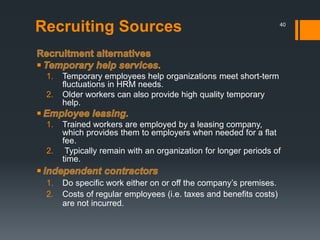
1. Temporary employees help organizations meet short-term
fluctuations in HRM needs.
2. Older workers can also provide high quality temporary
help.
1. Trained workers are employed by a leasing company,
which provides them to employers when needed for a flat
fee.
2. Typically remain with an organization for longer periods of
time.
1. Do specific work either on or off the company’s premises.
2. Costs of regular employees (i.e. taxes and benefits costs)
are not incurred.
40
41
Effective Recruiting
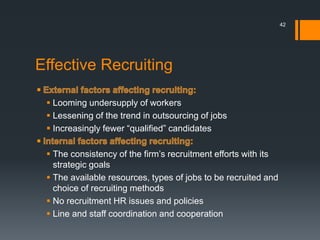
ď‚§ Looming undersupply of workers
ď‚§ Lessening of the trend in outsourcing of jobs
 Increasingly fewer “qualified” candidates
 The consistency of the firm’s recruitment efforts with its
strategic goals
ď‚§ The available resources, types of jobs to be recruited and
choice of recruiting methods
ď‚§ No recruitment HR issues and policies
ď‚§ Line and staff coordination and cooperation
42
Effective Recruiting
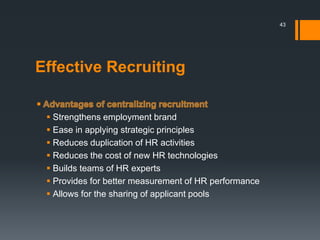
ď‚§ Strengthens employment brand
ď‚§ Ease in applying strategic principles
ď‚§ Reduces duplication of HR activities
ď‚§ Reduces the cost of new HR technologies
ď‚§ Builds teams of HR experts
ď‚§ Provides for better measurement of HR performance
ď‚§ Allows for the sharing of applicant pools
43
Next Presenter
44
Principles of recruitment
ď‚§ Recruitment should be done from a central place E.g.
Administrative officer / Nursing service administration.
ď‚§ Termination and creation of any post should be done by
responsible officers ,e.g. regarding nursing staff the
Nursing superintendent along with her officers
has to take the decision and not the Medical
Superintendent.
ď‚§ Only the vacant positions should be filled and neither less nor
more should be employed.
ď‚§ Job description / work analysis should be made before
recruitment.
45
Principles of recruitment
ď‚§ Procedure for recruitment should be developed by an
experienced person.
ď‚§ Recruitment should be done on the basis of definite
qualifications and set standards.
ď‚§ Chances of promotion should be clearly stated .
ď‚§ Policy should be clear and changeable according to the
need.
ď‚§ Recruitment of workers should be done from internal and
external sources.
46
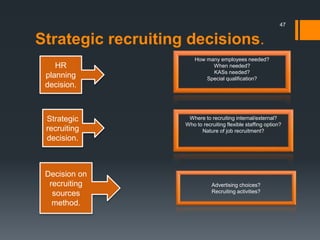
Strategic recruiting decisions.
Where to recruiting internal/external?
Who to recruiting flexible staffing option?
Nature of job recruitment?
Advertising choices?
Recruiting activities?
HR
planning
decision.
Strategic
recruiting
decision.
Decision on
recruiting
sources
method.
How many employees needed?
When needed?
KASs needed?
Special qualification?
47
Types of recruitment
ď‚§ There are three types of recruitment:-
1. Planned:- arise from changes in organization and
recruitment policy.
2. Anticipated:-by studying trends in the internal and
external organization.
3. Unexpected:-arise due to accidents, transfer
resignation, illness and death.
48
Advertising
ď‚§ For this to be successful the firm must address two issues:
ď‚§ The advertising media
ď‚§ The advert construction
49
Advertising media
ď‚§ The selection to the media depends on the positions which
the firm is recruiting for
 Local newspapers – for blue collar jobs and jobs whose labor
is in plenty supply
ď‚§ Specialized jobs will be adverted in trade and professional
journals like the economists , etc
ď‚§ Jobs with an international focus will be advertised in
international dailies or magazines
50
Constructing an Ad – principles
 Attention – must attract attention to the Ad or readers may
just miss it or ignore it
 Interest – you can create interest by the nature of the job
itself, or with lines such as “will thrive on challenging work”,
or use other aspects such as location
 Desire – by spotlighting the job interest factors with words
such as travel or challenge
ď‚§ Action - Make sure the ad prompts action with statements
such as “call today”
51
Next Presenter
52
Recruitment Process
53
Job analysis
ď‚§Job should be design as per the requirements that
are received from the various departments of the
company.
54
Prepare a Job Description
ď‚§Design of job is to be prepared as what sex, age,
qualifications , skill, work experience is desirable
for that particular job
55
Candidate identification
ď‚§Maximum potential area is selected to attract more
candidate to get maximum C.V.
56
Advertised Recruitment
ď‚§Main as well as the basic source to get more CV,
is advertisement in local as well as national level
news papers (as per requirements), as in case of
MR or ASM employment notice can be pasted in
union offices etc.
57
Database Selection
To choose the right candidate company’s previous
database can be consider. References from the
company staff are also welcome, job rotation and
job promotions can also be analyzed .
58
Internet search
ď‚§To attract the young candidates , the latest
technology internet is very helpful as
monsterindia,noukri.com.public and social forums
can also try for example orkut,yahoo etc.collages
sites ate very helpful.
59
Managing the response
ď‚§After getting the resumes ,all should be arranged
as priority and relevant.
60
Short listing candidates
ď‚§Shortlist candidates qualifications and experience
wise .
61
Next Presenter
62
Recruiting: A Global Perspective
ď‚§ For some positions, the whole world is a relevant labor
market.
ď‚§ Home-country nationals are recruited when an organization
is searching for someone with extensive company
experience to launch a very technical product in a country
where it has never sold before.
63
Recruiting: A Global Perspective
ď‚§ Host-country nationals (HCNs) are targeted as recruits
when companies want each foreign subsidiary to have its
own distinct national identity.
ď‚§ In some countries, laws control how many expatriates a
corporation can send.
 HCN’s minimize potential problems with language, family
adjustment and hostile political environments.
64
Recruiting: A Global Perspective
ď‚§ Recruiting regardless of nationality may
develop an executive cadre with a truly global
perspective.
65
Meeting the Organization
ď‚§ View getting a job as your job at the moment.
ď‚§ Preparing Your Resume
1. Use quality paper and easy to read type.
2. Proofread carefully.
3. Include volunteer experience.
4. Use typical job description phraseology.
5. Use a cover letter to highlight your greatest strengths.
 Don’t forget about networking as an excellent way of gaining
access to an organization.
66
67
Summary
ď‚§ Introduction to HRM
ď‚§ Definition of HRM
ď‚§ Introduction to Recruitment
ď‚§ Meaning of Recruitment
ď‚§ Definition of Recruitment
ď‚§ Goal of recruitment
ď‚§ Objective of recruitment
ď‚§ Factors of recruitment
ď‚§ Constraints of recruitment
ď‚§ Purpose and importance of recruitment
ď‚§ Sources of recruitment
68
ď‚§ Effective recruitment
ď‚§ Principles of recruitment
ď‚§ Strategic of recruiting
ď‚§ Types of recruitment
ď‚§ Advertising
ď‚§ Recruitment process
ď‚§ A global perspective
ď‚§ Meeting the organization
69
Summary
70
71

Hrm recruitment

  • 1.
  • 2.
  • 3.
    GROUP NAME Motivators GROUP MEMBERS: ď‚§Zunera Latif ď‚§ Waqas Muntazir Zia ď‚§ Maria Nusrat ď‚§ Noshaba khalil ď‚§ Mohsin Mukhtar ď‚§ Sobia Arshad ď‚§ Kiran Mustafa 3
  • 4.
    DEDICATION We dedicate ourpresentation to our beloved Parents who blessed us with priceless love and care throughout our lives and make us able to deal such a big task. We are also dedicating this presentation to our honorable Sir. HUSSAIN, who boast our moral and build confidence in us to complete this presentation .We consider ourselves successful because the blessings of Almighty Allah our Sir and Parents support. 4
  • 5.
  • 6.
    TABLE OF CONTENTS ď‚§Introduction to HRM ď‚§ Definition of HRM ď‚§ Introduction to Recruitment ď‚§ Meaning of Recruitment ď‚§ Definition of Recruitment ď‚§ Goal of recruitment ď‚§ Objective of recruitment ď‚§ Factors of recruitment ď‚§ Constraints of recruitment ď‚§ Purpose and importance of recruitment ď‚§ Sources of recruitment 6
  • 7.
    TABLE OF CONTENTS ď‚§Effective recruitment ď‚§ Principles of recruitment ď‚§ Strategic of recruiting ď‚§ Types of recruitment ď‚§ Advertising ď‚§ Recruitment process ď‚§ A global perspective ď‚§ Meeting the organization 7
  • 8.
    Introduction to HRM HRM is a management of the organization’s employees.  This includes employment and arbitration in accord with the law and with a company directives.  HRM is a most critical function of manager.  The main function is the focus on recruitment of management and providing direction for the people who work in a organization. 8
  • 9.
    Definition to HRM ď‚§It is the organizational function that deal with issues related to people such as compensation ,hiring, performance management, organization development, safety, wellness, benefit, employee motivation ,communication and training. 9
  • 10.
    Recruitment INTRODUCTION:- ď‚§ Recruitment isan important function of health manpower management ,which determines whether the required will be available at the work spot, when a job is actually to be undertaken. ď‚§ Recruiting brings together those with jobs to fill and those seeking jobs. 10
  • 11.
    Meaning ď‚§ In asimple term ,recruitment is understood as the process of searching for and obtaining applicants for job, from among whom the right people can be selected. 11
  • 12.
    Definition of Recruiting ď‚§Recruiting is the process of searching the candidates for employment and stimulating them to employee for jobs in the organization . B Flippo ď‚§ It is a process in which the right person for the right post is procured .IGNOU Module ď‚§ The process for gathering a pool of qualified candidates for a particular job. ď‚§ The process of discovering potential candidates. 12
  • 13.
    Recruiting Goal ď‚§ Toprovide information that will attract a significant pool of qualified candidates and discourage unqualified ones from apply. 1 Communicate the position in effective manner 2 Save time and money 3 Encourage unqualified candidates to self-select themselves out Attract the qualified candidates 13
  • 14.
  • 15.
    Objective of Recruiting ď‚§To attract people with multi- dimensional skills and experiences that suit the present and future organizational strategies . ď‚§ To induct outsiders with new perspective to lead the company. ď‚§ To infuse fresh blood at all levels of organization. ď‚§ To develop an organizational culture that attracts competent people to the company . 15
  • 16.
    Objective of Recruiting To search or head hunt people whose skills fit the company’s values.  To devise methodologies for assessing physiological traits.  To search for talent globally and not just within the company.  To design entry pay that competes on quality but not on quantum.  To anticipate and find people for positions that does not exist yet. 16
  • 17.
    Factors affecting recruitingefforts Size of organization Employment condition Working environment Past recruiting policy Environment condition Working condition Benefits Salary Organiza tional growth and decline 17
  • 18.
    Constraints on recruitingeffort ď‚§ Ideal recruitment effort might bring satisfactory number of qualified applicant. ď‚§ Pool of applicant may not include best candidate. ď‚§ Best candidate may not work want to work for the organization. ď‚§ There are five basic constraints. 18
  • 19.
    Constraints on recruitment ď‚§There are five basic constraints on recruitments. Organization image Job attractiveness Internal organizational policies Government influence Recruitment cost 19
  • 20.
    Organization image ď‚§ Perspectivecandidate may not be interested in pursing job . ď‚§ Image of organization is potential constraint . ď‚§ E.g. Disney word ď‚§ McDonald ď‚§ Microsoft 20
  • 21.
    Job attractiveness ď‚§ Forunattractive job like manual labor position recruiting pool of applicant will be difficult. 21
  • 22.
    Internal organizational policies ď‚§Promotion from within. ď‚§ Reduce the number of application. 22
  • 23.
    Government influence ď‚§ Employerno longer seek out preferred individual based on non job related factor e.g. 1. Physical appearance 2. Male and female 3. Religious background(air line job) 23
  • 24.
    Recruitment cost ď‚§ Recruitmenteffort are expensive . ď‚§ 10500$ per position. ď‚§ Budget constrain put time limit. ď‚§ Interview technique. ď‚§ Conference call. ď‚§ Video conference. 24
  • 25.
    Purpose and importance ď‚§Determine the present and future requirements of the organization in conjunction with the personnel(staff) planning and job analysis activities. ď‚§ Increase the pool of job candidates with minimum cost ď‚§ Help increase the success rate of the selection process reducing the number of obviously under qualified and over qualified job applicants. ď‚§ Help reduce the probability that the job applicants, once recruited and selected will leave the organization only after short period of time. 25
  • 26.
    Purpose and importance ď‚§Start identifying and preparing potential job applicants who will be appropriate candidates . ď‚§ Increase organizational and individual effectiveness in the short and long term. ď‚§ Evaluate the effectiveness of various recruiting techniques and sources for all types of job applicants. 26
  • 27.
  • 28.
    Source of recruitment ď‚§There are two sources . Source of recruitment Internal recruitment External recruitment 28
  • 29.
    Source of recruitment 1.Promotion 2. Rehiring 3. Employee referrals 1. Advertisement 2. Campus recruitment 3. Online recruitment 4. Walk -in 29
  • 30.
    Recruiting sources Employment agencies ď‚§Public agencies operated by federal, state , or local government. ď‚§ Private employment agencies. ď‚§ Management consulting firms. ď‚§ Executive search firms. 30
  • 31.
    Recruiting sources services focuson helping unemployed individuals with lower skill levels to find jobs. www.careeronestop.org BPSC-Bangladesh Public Service Commission. provide more comprehensive services and are perceived to offer positions and applicants of higher caliber. (“headhunters”) research candidates for mid and upper-level executive placement. potential mid/top-level candidates while keeping prospective employers anonymous. 31
  • 32.
    Recruiting sources ď‚§ Whena firm does not have an HR department and is not geared to doing recruiting and screening. ď‚§ the firm has found it difficult in the past to generate a pool of qualified applicants. ď‚§ The firm must fill a particular opening quickly. ď‚§ There is a perceived need to attract a greater number of minority or female applicants. ď‚§ The firm wants to reach currently employed individuals, who might feel more comfortable dealing with agencies then with competing companies. ď‚§ The firm wants to cut down on the time it's devoting to recruiting. 32
  • 33.
    Recruiting sources Schools, Collegesand universities ď‚§ Educational institution at all levels offer opportunities for recruiting recent graduates. ď‚§ Most educational institution operate placement services where prospective employers can review credentials and interview graduates. ď‚§ May provide entry-level or experienced workers through their placement services. ď‚§ May also help companies establish cooperative education assignments and internships. 33
  • 34.
    Recruiting sources Job fairs:- ď‚§Attended by company recruiters seeking resumes and information from qualified candidates. ď‚§ Virtual online jobs fairs could bring employers and job seekers together online by logging into a specific web sites at a certain time. ď‚§ http://www.inxpo.com/products/virtual-career-fairs/index.htm ď‚§ http://work.secondlife.com/worksolutions/meetings 34
  • 35.
    Recruiting sources Professional organizations:- ď‚§Many professional organizations, include labor unions operate placement services for the benefit of their members. ď‚§ the professional organizations include such varied occupations as industrial engineering, psychology, accounting, legal and academics. ď‚§ These organizations publish rosters of job vacancies and distribute these lists to members. 1. Run placement services at meetings. 2. Control the supply of prospective applicants. 3. Labor unions are also in this category. 35
  • 36.
    Recruiting sources unsolicited applicants(walk-ins): ď‚§Unsolicited applicants, whether they reach the employer by letter, telephone or in person, constitute a source of prospective applicants. ď‚§ May provide a stockpile of prospective applicants if there are no current openings. ď‚§ Direct applicants who seek employment with or without encouragement from other sources . ď‚§ courteous treatment of any applicant is a good business practice. 36
  • 37.
    Recruiting sources ď‚§ Mostcompanies use the internet to recruit employees. ď‚§ Job seekers use online resumes and create Web pages about their qualifications. 1. Monster 2. Yahoo! Hot jobs 3. Inxpo 4. careerbuilder.com 5. second life. 6. Man power. ď‚§ In Bangladesh, www.bdbojs.com etc is used for getting potential candidates. Online sources 37
  • 38.
    Recruiting sources 1. Cost–effective way to publicize jobs openings 2. More applicants attracted over a longer period 3. Immediate applicant responses 4. Online prescreening of applicants 5. Links to other job search sites 6. Automation of applicant tracking and evaluation 38
  • 39.
  • 40.
    Recruiting Sources 1. Temporaryemployees help organizations meet short-term fluctuations in HRM needs. 2. Older workers can also provide high quality temporary help. 1. Trained workers are employed by a leasing company, which provides them to employers when needed for a flat fee. 2. Typically remain with an organization for longer periods of time. 1. Do specific work either on or off the company’s premises. 2. Costs of regular employees (i.e. taxes and benefits costs) are not incurred. 40
  • 41.
  • 42.
    Effective Recruiting  Loomingundersupply of workers  Lessening of the trend in outsourcing of jobs  Increasingly fewer “qualified” candidates  The consistency of the firm’s recruitment efforts with its strategic goals  The available resources, types of jobs to be recruited and choice of recruiting methods  No recruitment HR issues and policies  Line and staff coordination and cooperation 42
  • 43.
    Effective Recruiting ď‚§ Strengthensemployment brand ď‚§ Ease in applying strategic principles ď‚§ Reduces duplication of HR activities ď‚§ Reduces the cost of new HR technologies ď‚§ Builds teams of HR experts ď‚§ Provides for better measurement of HR performance ď‚§ Allows for the sharing of applicant pools 43
  • 44.
  • 45.
    Principles of recruitment ď‚§Recruitment should be done from a central place E.g. Administrative officer / Nursing service administration. ď‚§ Termination and creation of any post should be done by responsible officers ,e.g. regarding nursing staff the Nursing superintendent along with her officers has to take the decision and not the Medical Superintendent. ď‚§ Only the vacant positions should be filled and neither less nor more should be employed. ď‚§ Job description / work analysis should be made before recruitment. 45
  • 46.
    Principles of recruitment ď‚§Procedure for recruitment should be developed by an experienced person. ď‚§ Recruitment should be done on the basis of definite qualifications and set standards. ď‚§ Chances of promotion should be clearly stated . ď‚§ Policy should be clear and changeable according to the need. ď‚§ Recruitment of workers should be done from internal and external sources. 46
  • 47.
    Strategic recruiting decisions. Whereto recruiting internal/external? Who to recruiting flexible staffing option? Nature of job recruitment? Advertising choices? Recruiting activities? HR planning decision. Strategic recruiting decision. Decision on recruiting sources method. How many employees needed? When needed? KASs needed? Special qualification? 47
  • 48.
    Types of recruitment ď‚§There are three types of recruitment:- 1. Planned:- arise from changes in organization and recruitment policy. 2. Anticipated:-by studying trends in the internal and external organization. 3. Unexpected:-arise due to accidents, transfer resignation, illness and death. 48
  • 49.
    Advertising ď‚§ For thisto be successful the firm must address two issues: ď‚§ The advertising media ď‚§ The advert construction 49
  • 50.
    Advertising media  Theselection to the media depends on the positions which the firm is recruiting for  Local newspapers – for blue collar jobs and jobs whose labor is in plenty supply  Specialized jobs will be adverted in trade and professional journals like the economists , etc  Jobs with an international focus will be advertised in international dailies or magazines 50
  • 51.
    Constructing an Ad– principles  Attention – must attract attention to the Ad or readers may just miss it or ignore it  Interest – you can create interest by the nature of the job itself, or with lines such as “will thrive on challenging work”, or use other aspects such as location  Desire – by spotlighting the job interest factors with words such as travel or challenge  Action - Make sure the ad prompts action with statements such as “call today” 51
  • 52.
  • 53.
  • 54.
    Job analysis ď‚§Job shouldbe design as per the requirements that are received from the various departments of the company. 54
  • 55.
    Prepare a JobDescription ď‚§Design of job is to be prepared as what sex, age, qualifications , skill, work experience is desirable for that particular job 55
  • 56.
    Candidate identification ď‚§Maximum potentialarea is selected to attract more candidate to get maximum C.V. 56
  • 57.
    Advertised Recruitment ď‚§Main aswell as the basic source to get more CV, is advertisement in local as well as national level news papers (as per requirements), as in case of MR or ASM employment notice can be pasted in union offices etc. 57
  • 58.
    Database Selection To choosethe right candidate company’s previous database can be consider. References from the company staff are also welcome, job rotation and job promotions can also be analyzed . 58
  • 59.
    Internet search ď‚§To attractthe young candidates , the latest technology internet is very helpful as monsterindia,noukri.com.public and social forums can also try for example orkut,yahoo etc.collages sites ate very helpful. 59
  • 60.
    Managing the response ď‚§Aftergetting the resumes ,all should be arranged as priority and relevant. 60
  • 61.
    Short listing candidates ď‚§Shortlistcandidates qualifications and experience wise . 61
  • 62.
  • 63.
    Recruiting: A GlobalPerspective ď‚§ For some positions, the whole world is a relevant labor market. ď‚§ Home-country nationals are recruited when an organization is searching for someone with extensive company experience to launch a very technical product in a country where it has never sold before. 63
  • 64.
    Recruiting: A GlobalPerspective  Host-country nationals (HCNs) are targeted as recruits when companies want each foreign subsidiary to have its own distinct national identity.  In some countries, laws control how many expatriates a corporation can send.  HCN’s minimize potential problems with language, family adjustment and hostile political environments. 64
  • 65.
    Recruiting: A GlobalPerspective ď‚§ Recruiting regardless of nationality may develop an executive cadre with a truly global perspective. 65
  • 66.
    Meeting the Organization View getting a job as your job at the moment.  Preparing Your Resume 1. Use quality paper and easy to read type. 2. Proofread carefully. 3. Include volunteer experience. 4. Use typical job description phraseology. 5. Use a cover letter to highlight your greatest strengths.  Don’t forget about networking as an excellent way of gaining access to an organization. 66
  • 67.
  • 68.
    Summary ď‚§ Introduction toHRM ď‚§ Definition of HRM ď‚§ Introduction to Recruitment ď‚§ Meaning of Recruitment ď‚§ Definition of Recruitment ď‚§ Goal of recruitment ď‚§ Objective of recruitment ď‚§ Factors of recruitment ď‚§ Constraints of recruitment ď‚§ Purpose and importance of recruitment ď‚§ Sources of recruitment 68
  • 69.
    ď‚§ Effective recruitment ď‚§Principles of recruitment ď‚§ Strategic of recruiting ď‚§ Types of recruitment ď‚§ Advertising ď‚§ Recruitment process ď‚§ A global perspective ď‚§ Meeting the organization 69 Summary
  • 70.
  • 71.