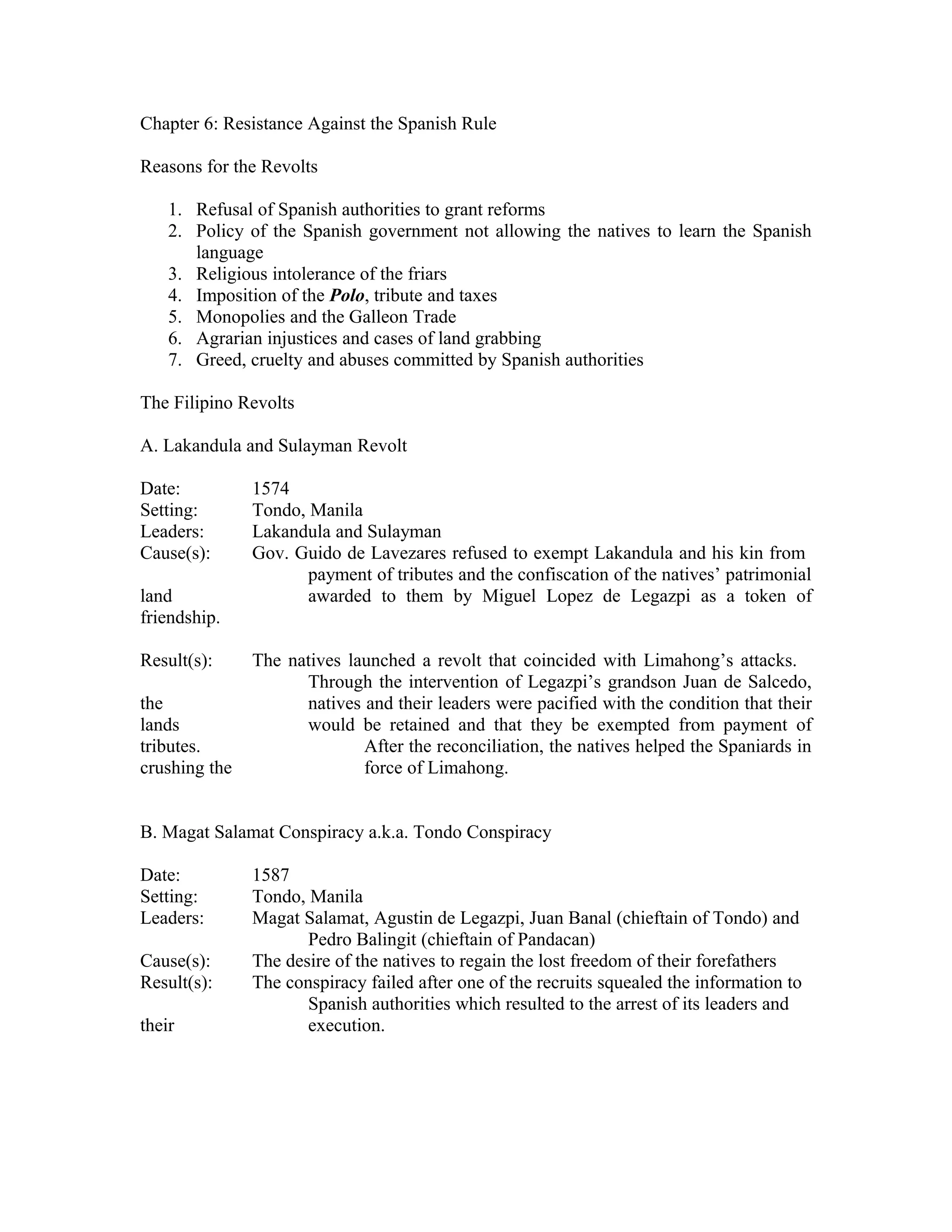
Chapter 6: Resistance Against the Spanish Rule

Reasons for the Revolts

    1. Refusal of Spanish authorities to grant reforms
    2. Policy of the Spanish government not allowing the natives to learn the Spanish
       language
    3. Religious intolerance of the friars
    4. Imposition of the Polo, tribute and taxes
    5. Monopolies and the Galleon Trade
    6. Agrarian injustices and cases of land grabbing
    7. Greed, cruelty and abuses committed by Spanish authorities

The Filipino Revolts

A. Lakandula and Sulayman Revolt

Date:          1574
Setting:       Tondo, Manila
Leaders:       Lakandula and Sulayman
Cause(s):      Gov. Guido de Lavezares refused to exempt Lakandula and his kin from
                      payment of tributes and the confiscation of the natives’ patrimonial
land                  awarded to them by Miguel Lopez de Legazpi as a token of
friendship.

Result(s):     The natives launched a revolt that coincided with Limahong’s attacks.
                     Through the intervention of Legazpi’s grandson Juan de Salcedo,
the                  natives and their leaders were pacified with the condition that their
lands                would be retained and that they be exempted from payment of
tributes.                    After the reconciliation, the natives helped the Spaniards in
crushing the                 force of Limahong.


B. Magat Salamat Conspiracy a.k.a. Tondo Conspiracy

Date:          1587
Setting:       Tondo, Manila
Leaders:       Magat Salamat, Agustin de Legazpi, Juan Banal (chieftain of Tondo) and
                      Pedro Balingit (chieftain of Pandacan)
Cause(s):      The desire of the natives to regain the lost freedom of their forefathers
Result(s):     The conspiracy failed after one of the recruits squealed the information to
                      Spanish authorities which resulted to the arrest of its leaders and
their                 execution.
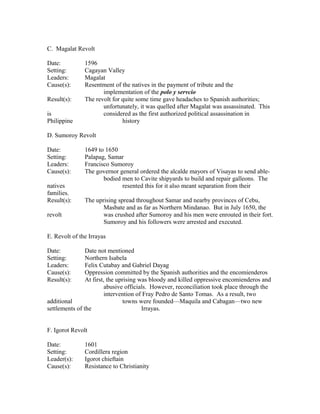
C. Magalat Revolt

Date:          1596
Setting:       Cagayan Valley
Leaders:       Magalat
Cause(s):      Resentment of the natives in the payment of tribute and the
                      implementation of the polo y servcio
Result(s):     The revolt for quite some time gave headaches to Spanish authorities;
                      unfortunately, it was quelled after Magalat was assassinated. This
is                    considered as the first authorized political assassination in
Philippine                    history

D. Sumoroy Revolt

Date:          1649 to 1650
Setting:       Palapag, Samar
Leaders:       Francisco Sumoroy
Cause(s):      The governor general ordered the alcalde mayors of Visayas to send able-
                      bodied men to Cavite shipyards to build and repair galleons. The
natives                      resented this for it also meant separation from their
families.
Result(s):     The uprising spread throughout Samar and nearby provinces of Cebu,
                      Masbate and as far as Northern Mindanao. But in July 1650, the
revolt                was crushed after Sumoroy and his men were enrouted in their fort.
                      Sumoroy and his followers were arrested and executed.

E. Revolt of the Irrayas

Date:           Date not mentioned
Setting:        Northern Isabela
Leaders:        Felix Cutabay and Gabriel Dayag
Cause(s):       Oppression committed by the Spanish authorities and the encomienderos
Result(s):      At first, the uprising was bloody and killed oppressive encomienderos and
                         abusive officials. However, reconciliation took place through the
                         intervention of Fray Pedro de Santo Tomas. As a result, two
additional                       towns were founded—Maquila and Cabagan—two new
settlements of the                      Irrayas.


F. Igorot Revolt

Date:          1601
Setting:       Cordillera region
Leader(s):     Igorot chieftain
Cause(s):      Resistance to Christianity
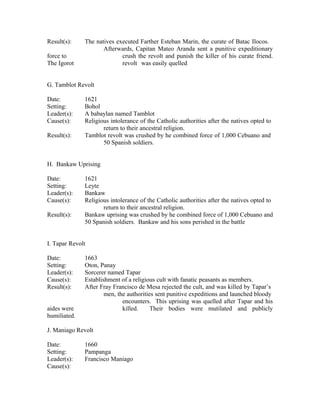
Result(s):    The natives executed Farther Esteban Marin, the curate of Batac Ilocos.
                     Afterwards, Capitan Mateo Aranda sent a punitive expeditionary
force to                    crush the revolt and punish the killer of his curate friend.
The Igorot                  revolt was easily quelled


G. Tamblot Revolt

Date:         1621
Setting:      Bohol
Leader(s):    A babaylan named Tamblot
Cause(s):     Religious intolerance of the Catholic authorities after the natives opted to
                     return to their ancestral religion.
Result(s):    Tamblot revolt was crushed by he combined force of 1,000 Cebuano and
                     50 Spanish soldiers.


H. Bankaw Uprising

Date:         1621
Setting:      Leyte
Leader(s):    Bankaw
Cause(s):     Religious intolerance of the Catholic authorities after the natives opted to
                     return to their ancestral religion.
Result(s):    Bankaw uprising was crushed by he combined force of 1,000 Cebuano and
              50 Spanish soldiers. Bankaw and his sons perished in the battle


I. Tapar Revolt

Date:         1663
Setting:      Oton, Panay
Leader(s):    Sorcerer named Tapar
Cause(s):     Establishment of a religious cult with fanatic peasants as members.
Result(s):    After Fray Francisco de Mesa rejected the cult, and was killed by Tapar’s
                      men, the authorities sent punitive expeditions and launched bloody
                             encounters. This uprising was quelled after Tapar and his
aides were                   killed.     Their bodies were mutilated and publicly
humiliated.

J. Maniago Revolt

Date:         1660
Setting:      Pampanga
Leader(s):    Francisco Maniago
Cause(s):
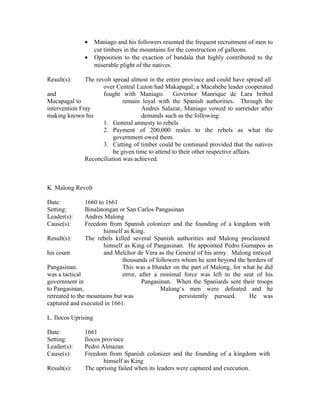
•      Maniago and his followers resented the frequent recruitment of men to
                     cut timbers in the mountains for the construction of galleons.
              •      Opposition to the exaction of bandala that highly contributed to the
                     miserable plight of the natives.

Result(s):     The revolt spread almost in the entire province and could have spread all
                      over Central Luzon had Makapagal; a Macabebe leader cooperated
and                   fought with Maniago. Governor Manrique de Lara bribed
Macapagal to                  remain loyal with the Spanish authorities. Through the
intervention Fray                    Andres Salazar, Maniago vowed to surrender after
making known his                     demands such as the following:
                      1. General amnesty to rebels
                      2. Payment of 200,000 reales to the rebels as what the
                          government owed them.
                      3. Cutting of timber could be continued provided that the natives
                          be given time to attend to their other respective affairs.
               Reconciliation was achieved.


K. Malong Revolt

Date:           1660 to 1661
Setting:        Binalatongan or San Carlos Pangasinan
Leader(s):      Andres Malong
Cause(s):       Freedom from Spanish colonizer and the founding of a kingdom with
                       himself as King.
Result(s):      The rebels killed several Spanish authorities and Malong proclaimed
                       himself as King of Pangasinan. He appointed Pedro Gumapos as
his count              and Melchor de Vera as the General of his army. Malong enticed
                              thousands of followers whom he sent beyond the borders of
Pangasinan.                   This was a blunder on the part of Malong, for what he did
was a tactical                error, after a minimal force was left to the seat of his
government in                         Pangasinan. When the Spaniards sent their troops
to Pangasinan,                               Malong’s men were defeated and he
retreated to the mountains but was                  persistently pursued.     He was
captured and executed in 1661.

L. Ilocos Uprising

Date:         1661
Setting:      Ilocos province
Leader(s):    Pedro Almazan
Cause(s):     Freedom from Spanish colonizer and the founding of a kingdom with
                      himself as King
Result(s):    The uprising failed when its leaders were captured and execution.
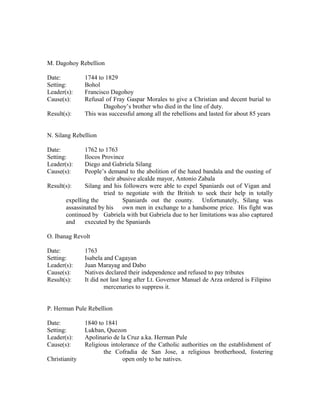
M. Dagohoy Rebellion

Date:          1744 to 1829
Setting:       Bohol
Leader(s):     Francisco Dagohoy
Cause(s):      Refusal of Fray Gaspar Morales to give a Christian and decent burial to
                      Dagohoy’s brother who died in the line of duty.
Result(s):     This was successful among all the rebellions and lasted for about 85 years


N. Silang Rebellion

Date:          1762 to 1763
Setting:       Ilocos Province
Leader(s):     Diego and Gabriela Silang
Cause(s):      People’s demand to the abolition of the hated bandala and the ousting of
                       their abusive alcalde mayor, Antonio Zabala
Result(s):     Silang and his followers were able to expel Spaniards out of Vigan and
                       tried to negotiate with the British to seek their help in totally
       expelling the           Spaniards out the county. Unfortunately, Silang was
       assassinated by his own men in exchange to a handsome price. His fight was
       continued by Gabriela with but Gabriela due to her limitations was also captured
       and     executed by the Spaniards

O. Ibanag Revolt

Date:          1763
Setting:       Isabela and Cagayan
Leader(s):     Juan Marayag and Dabo
Cause(s):      Natives declared their independence and refused to pay tributes
Result(s):     It did not last long after Lt. Governor Manuel de Arza ordered is Filipino
                       mercenaries to suppress it.


P. Herman Pule Rebellion

Date:          1840 to 1841
Setting:       Lukban, Quezon
Leader(s):     Apolinario de la Cruz a.ka. Herman Pule
Cause(s):      Religious intolerance of the Catholic authorities on the establishment of
                      the Cofradia de San Jose, a religious brotherhood, fostering
Christianity                  open only to he natives.
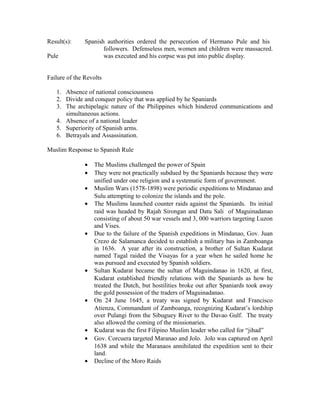
Result(s):     Spanish authorities ordered the persecution of Hermano Pule and his
                      followers. Defenseless men, women and children were massacred.
Pule                  was executed and his corpse was put into public display.


Failure of the Revolts

   1. Absence of national consciousness
   2. Divide and conquer policy that was applied by he Spaniards
   3. The archipelagic nature of the Philippines which hindered communications and
      simultaneous actions.
   4. Absence of a national leader
   5. Superiority of Spanish arms.
   6. Betrayals and Assassination.

Muslim Response to Spanish Rule

               •   The Muslims challenged the power of Spain
               •   They were not practically subdued by the Spaniards because they were
                   unified under one religion and a systematic form of government.
               •   Muslim Wars (1578-1898) were periodic expeditions to Mindanao and
                   Sulu attempting to colonize the islands and the pole.
               •   The Muslims launched counter raids against the Spaniards. Its initial
                   raid was headed by Rajah Sirongan and Datu Sali of Maguinadanao
                   consisting of about 50 war vessels and 3, 000 warriors targeting Luzon
                   and Vises.
               •   Due to the failure of the Spanish expeditions in Mindanao, Gov. Juan
                   Crezo de Salamanca decided to establish a military bas in Zamboanga
                   in 1636. A year after its construction, a brother of Sultan Kudarat
                   named Tagal raided the Visayas for a year when he sailed home he
                   was pursued and executed by Spanish soldiers.
               •   Sultan Kudarat became the sultan of Maguindanao in 1620, at first,
                   Kudarat established friendly relations with the Spaniards as how he
                   treated the Dutch, but hostilities broke out after Spaniards took away
                   the gold possession of the traders of Maguinadanao.
               •   On 24 June 1645, a treaty was signed by Kudarat and Francisco
                   Atienza, Commandant of Zamboanga, recognizing Kudarat’s lordship
                   over Pulangi from the Sibuguey River to the Davao Gulf. The treaty
                   also allowed the coming of the missionaries.
               •   Kudarat was the first Filipino Muslim leader who called for “jihad”
               •   Gov. Corcuera targeted Maranao and Jolo. Jolo was captured on April
                   1638 and while the Maranaos annihilated the expedition sent to their
                   land.
               •   Decline of the Moro Raids
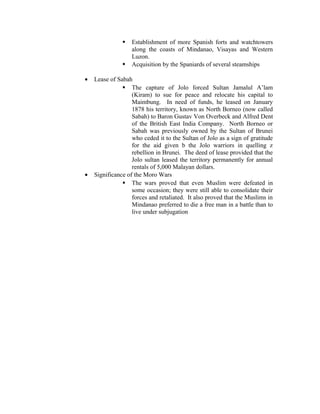
   Establishment of more Spanish forts and watchtowers
                   along the coasts of Mindanao, Visayas and Western
                   Luzon.
                  Acquisition by the Spaniards of several steamships

•   Lease of Sabah
                The capture of Jolo forced Sultan Jamalul A’lam
                   (Kiram) to sue for peace and relocate his capital to
                   Maimbung. In need of funds, he leased on January
                   1878 his territory, known as North Borneo (now called
                   Sabah) to Baron Gustav Von Overbeck and Alfred Dent
                   of the British East India Company. North Borneo or
                   Sabah was previously owned by the Sultan of Brunei
                   who ceded it to the Sultan of Jolo as a sign of gratitude
                   for the aid given b the Jolo warriors in quelling z
                   rebellion in Brunei. The deed of lease provided that the
                   Jolo sultan leased the territory permanently for annual
                   rentals of 5,000 Malayan dollars.
•   Significance of the Moro Wars
                The wars proved that even Muslim were defeated in
                   some occasion; they were still able to consolidate their
                   forces and retaliated. It also proved that the Muslims in
                   Mindanao preferred to die a free man in a battle than to
                   live under subjugation

Chapter 6

  • 1.
    Chapter 6: ResistanceAgainst the Spanish Rule Reasons for the Revolts 1. Refusal of Spanish authorities to grant reforms 2. Policy of the Spanish government not allowing the natives to learn the Spanish language 3. Religious intolerance of the friars 4. Imposition of the Polo, tribute and taxes 5. Monopolies and the Galleon Trade 6. Agrarian injustices and cases of land grabbing 7. Greed, cruelty and abuses committed by Spanish authorities The Filipino Revolts A. Lakandula and Sulayman Revolt Date: 1574 Setting: Tondo, Manila Leaders: Lakandula and Sulayman Cause(s): Gov. Guido de Lavezares refused to exempt Lakandula and his kin from payment of tributes and the confiscation of the natives’ patrimonial land awarded to them by Miguel Lopez de Legazpi as a token of friendship. Result(s): The natives launched a revolt that coincided with Limahong’s attacks. Through the intervention of Legazpi’s grandson Juan de Salcedo, the natives and their leaders were pacified with the condition that their lands would be retained and that they be exempted from payment of tributes. After the reconciliation, the natives helped the Spaniards in crushing the force of Limahong. B. Magat Salamat Conspiracy a.k.a. Tondo Conspiracy Date: 1587 Setting: Tondo, Manila Leaders: Magat Salamat, Agustin de Legazpi, Juan Banal (chieftain of Tondo) and Pedro Balingit (chieftain of Pandacan) Cause(s): The desire of the natives to regain the lost freedom of their forefathers Result(s): The conspiracy failed after one of the recruits squealed the information to Spanish authorities which resulted to the arrest of its leaders and their execution.
  • 2.
    C. Magalat Revolt Date: 1596 Setting: Cagayan Valley Leaders: Magalat Cause(s): Resentment of the natives in the payment of tribute and the implementation of the polo y servcio Result(s): The revolt for quite some time gave headaches to Spanish authorities; unfortunately, it was quelled after Magalat was assassinated. This is considered as the first authorized political assassination in Philippine history D. Sumoroy Revolt Date: 1649 to 1650 Setting: Palapag, Samar Leaders: Francisco Sumoroy Cause(s): The governor general ordered the alcalde mayors of Visayas to send able- bodied men to Cavite shipyards to build and repair galleons. The natives resented this for it also meant separation from their families. Result(s): The uprising spread throughout Samar and nearby provinces of Cebu, Masbate and as far as Northern Mindanao. But in July 1650, the revolt was crushed after Sumoroy and his men were enrouted in their fort. Sumoroy and his followers were arrested and executed. E. Revolt of the Irrayas Date: Date not mentioned Setting: Northern Isabela Leaders: Felix Cutabay and Gabriel Dayag Cause(s): Oppression committed by the Spanish authorities and the encomienderos Result(s): At first, the uprising was bloody and killed oppressive encomienderos and abusive officials. However, reconciliation took place through the intervention of Fray Pedro de Santo Tomas. As a result, two additional towns were founded—Maquila and Cabagan—two new settlements of the Irrayas. F. Igorot Revolt Date: 1601 Setting: Cordillera region Leader(s): Igorot chieftain Cause(s): Resistance to Christianity
  • 3.
    Result(s): The natives executed Farther Esteban Marin, the curate of Batac Ilocos. Afterwards, Capitan Mateo Aranda sent a punitive expeditionary force to crush the revolt and punish the killer of his curate friend. The Igorot revolt was easily quelled G. Tamblot Revolt Date: 1621 Setting: Bohol Leader(s): A babaylan named Tamblot Cause(s): Religious intolerance of the Catholic authorities after the natives opted to return to their ancestral religion. Result(s): Tamblot revolt was crushed by he combined force of 1,000 Cebuano and 50 Spanish soldiers. H. Bankaw Uprising Date: 1621 Setting: Leyte Leader(s): Bankaw Cause(s): Religious intolerance of the Catholic authorities after the natives opted to return to their ancestral religion. Result(s): Bankaw uprising was crushed by he combined force of 1,000 Cebuano and 50 Spanish soldiers. Bankaw and his sons perished in the battle I. Tapar Revolt Date: 1663 Setting: Oton, Panay Leader(s): Sorcerer named Tapar Cause(s): Establishment of a religious cult with fanatic peasants as members. Result(s): After Fray Francisco de Mesa rejected the cult, and was killed by Tapar’s men, the authorities sent punitive expeditions and launched bloody encounters. This uprising was quelled after Tapar and his aides were killed. Their bodies were mutilated and publicly humiliated. J. Maniago Revolt Date: 1660 Setting: Pampanga Leader(s): Francisco Maniago Cause(s):
  • 4.
    Maniago and his followers resented the frequent recruitment of men to cut timbers in the mountains for the construction of galleons. • Opposition to the exaction of bandala that highly contributed to the miserable plight of the natives. Result(s): The revolt spread almost in the entire province and could have spread all over Central Luzon had Makapagal; a Macabebe leader cooperated and fought with Maniago. Governor Manrique de Lara bribed Macapagal to remain loyal with the Spanish authorities. Through the intervention Fray Andres Salazar, Maniago vowed to surrender after making known his demands such as the following: 1. General amnesty to rebels 2. Payment of 200,000 reales to the rebels as what the government owed them. 3. Cutting of timber could be continued provided that the natives be given time to attend to their other respective affairs. Reconciliation was achieved. K. Malong Revolt Date: 1660 to 1661 Setting: Binalatongan or San Carlos Pangasinan Leader(s): Andres Malong Cause(s): Freedom from Spanish colonizer and the founding of a kingdom with himself as King. Result(s): The rebels killed several Spanish authorities and Malong proclaimed himself as King of Pangasinan. He appointed Pedro Gumapos as his count and Melchor de Vera as the General of his army. Malong enticed thousands of followers whom he sent beyond the borders of Pangasinan. This was a blunder on the part of Malong, for what he did was a tactical error, after a minimal force was left to the seat of his government in Pangasinan. When the Spaniards sent their troops to Pangasinan, Malong’s men were defeated and he retreated to the mountains but was persistently pursued. He was captured and executed in 1661. L. Ilocos Uprising Date: 1661 Setting: Ilocos province Leader(s): Pedro Almazan Cause(s): Freedom from Spanish colonizer and the founding of a kingdom with himself as King Result(s): The uprising failed when its leaders were captured and execution.
  • 5.
    M. Dagohoy Rebellion Date: 1744 to 1829 Setting: Bohol Leader(s): Francisco Dagohoy Cause(s): Refusal of Fray Gaspar Morales to give a Christian and decent burial to Dagohoy’s brother who died in the line of duty. Result(s): This was successful among all the rebellions and lasted for about 85 years N. Silang Rebellion Date: 1762 to 1763 Setting: Ilocos Province Leader(s): Diego and Gabriela Silang Cause(s): People’s demand to the abolition of the hated bandala and the ousting of their abusive alcalde mayor, Antonio Zabala Result(s): Silang and his followers were able to expel Spaniards out of Vigan and tried to negotiate with the British to seek their help in totally expelling the Spaniards out the county. Unfortunately, Silang was assassinated by his own men in exchange to a handsome price. His fight was continued by Gabriela with but Gabriela due to her limitations was also captured and executed by the Spaniards O. Ibanag Revolt Date: 1763 Setting: Isabela and Cagayan Leader(s): Juan Marayag and Dabo Cause(s): Natives declared their independence and refused to pay tributes Result(s): It did not last long after Lt. Governor Manuel de Arza ordered is Filipino mercenaries to suppress it. P. Herman Pule Rebellion Date: 1840 to 1841 Setting: Lukban, Quezon Leader(s): Apolinario de la Cruz a.ka. Herman Pule Cause(s): Religious intolerance of the Catholic authorities on the establishment of the Cofradia de San Jose, a religious brotherhood, fostering Christianity open only to he natives.
  • 6.
    Result(s): Spanish authorities ordered the persecution of Hermano Pule and his followers. Defenseless men, women and children were massacred. Pule was executed and his corpse was put into public display. Failure of the Revolts 1. Absence of national consciousness 2. Divide and conquer policy that was applied by he Spaniards 3. The archipelagic nature of the Philippines which hindered communications and simultaneous actions. 4. Absence of a national leader 5. Superiority of Spanish arms. 6. Betrayals and Assassination. Muslim Response to Spanish Rule • The Muslims challenged the power of Spain • They were not practically subdued by the Spaniards because they were unified under one religion and a systematic form of government. • Muslim Wars (1578-1898) were periodic expeditions to Mindanao and Sulu attempting to colonize the islands and the pole. • The Muslims launched counter raids against the Spaniards. Its initial raid was headed by Rajah Sirongan and Datu Sali of Maguinadanao consisting of about 50 war vessels and 3, 000 warriors targeting Luzon and Vises. • Due to the failure of the Spanish expeditions in Mindanao, Gov. Juan Crezo de Salamanca decided to establish a military bas in Zamboanga in 1636. A year after its construction, a brother of Sultan Kudarat named Tagal raided the Visayas for a year when he sailed home he was pursued and executed by Spanish soldiers. • Sultan Kudarat became the sultan of Maguindanao in 1620, at first, Kudarat established friendly relations with the Spaniards as how he treated the Dutch, but hostilities broke out after Spaniards took away the gold possession of the traders of Maguinadanao. • On 24 June 1645, a treaty was signed by Kudarat and Francisco Atienza, Commandant of Zamboanga, recognizing Kudarat’s lordship over Pulangi from the Sibuguey River to the Davao Gulf. The treaty also allowed the coming of the missionaries. • Kudarat was the first Filipino Muslim leader who called for “jihad” • Gov. Corcuera targeted Maranao and Jolo. Jolo was captured on April 1638 and while the Maranaos annihilated the expedition sent to their land. • Decline of the Moro Raids
  • 7.
    Establishment of more Spanish forts and watchtowers along the coasts of Mindanao, Visayas and Western Luzon.  Acquisition by the Spaniards of several steamships • Lease of Sabah  The capture of Jolo forced Sultan Jamalul A’lam (Kiram) to sue for peace and relocate his capital to Maimbung. In need of funds, he leased on January 1878 his territory, known as North Borneo (now called Sabah) to Baron Gustav Von Overbeck and Alfred Dent of the British East India Company. North Borneo or Sabah was previously owned by the Sultan of Brunei who ceded it to the Sultan of Jolo as a sign of gratitude for the aid given b the Jolo warriors in quelling z rebellion in Brunei. The deed of lease provided that the Jolo sultan leased the territory permanently for annual rentals of 5,000 Malayan dollars. • Significance of the Moro Wars  The wars proved that even Muslim were defeated in some occasion; they were still able to consolidate their forces and retaliated. It also proved that the Muslims in Mindanao preferred to die a free man in a battle than to live under subjugation