Downloaded 184 times
![1
Grado 7 Mga Saksi sa Kasaysayang Pilipino
Markahan 2 Pagsibol ng kamalayang Pilipino
Modyul 1 Pag-aalsa Laban sa Pang-aabuso
Gawain 1. Pag-aalsa ni Tamblot, 1621-1622
2. Pag-aalsa ni Maniago, 1660
3. Mga pag-aalsang agraryo sa mga Tagalog na probinsya,
1745
Oras Lima (5)
MODYUL SA PAGKATUTO
Pangkalahatang Ideya
Tinalakay sa nakaraang modyul ang mga instrumentong kolonyal ng mga
Kastila sa Pilipinas. Ito ay ang Kristiyanisasyon, reducción, tributo at polo. Ang
mga ito ay naging dahilan ng pag-aalsa ng mga Pilipino, lalo na ang tributo at
polo. Mayroon ding mga Pilipinong nag-alsa dahil ayaw nilang iwanan ang mga
sinaunang paniniwala na matagal nang nakaugat sa sariling kultura. Ang
pagkamkam ng mga prayleng Espanyol sa mga lupain ng mga Pilipino ay isa pang
dahilan ng mga pag-aalsa, lalo na sa mga Tagalog na lalawigan sa Luzon.
Tatalakayin sa modyul na ito ang mga pag-aalsa nina Tamblot sa Bohol
(1621-1622), Maniago sa Pampanga (1660), at ang mga agraryong pag-aalsa sa
mga probinsya ng Luzon (1745). Ang magkakahiwalay na mga pag-aalsang ito ay
isinalaysay ng mga pari at matataas na opisyal na Kastila sa kanilang mga sinulat.
Ang mga primaryang sanggunian ay nagbibigay liwanag tungkol sa hinaing ng
mga Pilipino sa ilalim ng Espanya at mahihinuha mula sa mga dokumentong ito
ang epekto at kahalagahan ng mga pag-aalsa sa kasaysayan ng Pilipinas.
Gawain 1. Pag-aalsa ni Tamblot, 1621-1622
1. Isang tugon laban sa mga patakarang kolonyal na ipinairal ng mga
Kastila ang pag-aalsa. Gaano kadalas o karami ang pag-aalsa laban sa Espanya
bago ang rebolusyon ng 1896? Basahin ang puna ni Francisco Leandro de Viana,
isang piskal (abogado) sa Audiencia ng Maynila, sa kanyang “Memorial of 1765.”
… it ought to be borne in mind that, from the first years of this
conquest [1521] until the one in which we now are [1765], nearly all
the provinces have at various times rebelled and risen in arms; and
not one of … [us] doubts that for this kind of offense the Indians
ought to be punished by an increase of their tributes, that this may
serve them as a warning and example; for they [thus] lost the right to
be treated with the mildness which their first voluntary submission
deserved.
Francisco Leandro de Viana, “Memorial of 1765,” sa Blair at
Robertson 48: 248.
2. Anong impormasyon ang makukuha at mahihinuha mo mula sa sipi?](https://image.slidesharecdn.com/2-1amodyulfinalok-120812102901-phpapp02/85/2-1a-modyul-final-ok-1-320.jpg)
![1
Grado 7 Mga Saksi sa Kasaysayang Pilipino
Markahan 2 Pagsibol ng kamalayang Pilipino
Modyul 1 Pag-aalsa Laban sa Pang-aabuso
Gawain 1. Pag-aalsa ni Tamblot, 1621-1622
2. Pag-aalsa ni Maniago, 1660
3. Mga pag-aalsang agraryo sa mga Tagalog na probinsya,
1745
Oras Lima (5)
MODYUL SA PAGKATUTO
Pangkalahatang Ideya
Tinalakay sa nakaraang modyul ang mga instrumentong kolonyal ng mga
Kastila sa Pilipinas. Ito ay ang Kristiyanisasyon, reducción, tributo at polo. Ang
mga ito ay naging dahilan ng pag-aalsa ng mga Pilipino, lalo na ang tributo at
polo. Mayroon ding mga Pilipinong nag-alsa dahil ayaw nilang iwanan ang mga
sinaunang paniniwala na matagal nang nakaugat sa sariling kultura. Ang
pagkamkam ng mga prayleng Espanyol sa mga lupain ng mga Pilipino ay isa pang
dahilan ng mga pag-aalsa, lalo na sa mga Tagalog na lalawigan sa Luzon.
Tatalakayin sa modyul na ito ang mga pag-aalsa nina Tamblot sa Bohol
(1621-1622), Maniago sa Pampanga (1660), at ang mga agraryong pag-aalsa sa
mga probinsya ng Luzon (1745). Ang magkakahiwalay na mga pag-aalsang ito ay
isinalaysay ng mga pari at matataas na opisyal na Kastila sa kanilang mga sinulat.
Ang mga primaryang sanggunian ay nagbibigay liwanag tungkol sa hinaing ng
mga Pilipino sa ilalim ng Espanya at mahihinuha mula sa mga dokumentong ito
ang epekto at kahalagahan ng mga pag-aalsa sa kasaysayan ng Pilipinas.
Gawain 1. Pag-aalsa ni Tamblot, 1621-1622
1. Isang tugon laban sa mga patakarang kolonyal na ipinairal ng mga
Kastila ang pag-aalsa. Gaano kadalas o karami ang pag-aalsa laban sa Espanya
bago ang rebolusyon ng 1896? Basahin ang puna ni Francisco Leandro de Viana,
isang piskal (abogado) sa Audiencia ng Maynila, sa kanyang “Memorial of 1765.”
… it ought to be borne in mind that, from the first years of this
conquest [1521] until the one in which we now are [1765], nearly all
the provinces have at various times rebelled and risen in arms; and
not one of … [us] doubts that for this kind of offense the Indians
ought to be punished by an increase of their tributes, that this may
serve them as a warning and example; for they [thus] lost the right to
be treated with the mildness which their first voluntary submission
deserved.
Francisco Leandro de Viana, “Memorial of 1765,” sa Blair at
Robertson 48: 248.
2. Anong impormasyon ang makukuha at mahihinuha mo mula sa sipi?](https://image.slidesharecdn.com/2-1amodyulfinalok-120812102901-phpapp02/75/2-1a-modyul-final-ok-1-2048.jpg)
![3
isang paring Agostino, sa kanyang aklat na Conquista de las Islas
Filipinas (Conquest of the Philippine Islands), 1890
The majority of the ministers in the island of Bohol had gone to
Zebu, to celebrate the feasts of the beatification of St. Xavier; in their
absence …. [t]he diwata,* or demon, appeared to some Indians in
[Konteksto]
the woods … and commanded them to quit the gospel … and the
Spanish vassalage, and take refuge in the hills; and to build him a
chapel, where he would aid them and give them whatever they
needed to pass their lives in happiness and abundance, without the
encumbrance of paying tribute to the Spaniards or dues to the
churches.
Two or three Indians … became priests of this diwata [one of the
priests was called Tamblot], in order to persuade the people to
[Aktor]
apostasy and rebellion.… four villages revolted; only Loboc (which is
the chief village) and Baclayon remained firm in the faith, and in
loyalty to the king.
… to take away the fear which they naturally fear toward the
Spaniards, these [native] priests told them that, if they would attack
the Spaniards,
• the diwata would cause the mountains to rise against their foe;
• the muskets of the latter would not go off, or else the bullets
[Sanhi]
would rebound on those who fired them;
• if any Indian should die, the demon would resuscitate him;
• that the leaves of the trees would be converted into saranga (a
large fish);
• when they cut bejucos [cane or palm], these would distil wine
instead of water;
• from the banana leaves they would make fine linen; and,
• in short, that all would be pleasure, enjoyment, and delight.
Information of this reached Zebu, and immediately Don Juan
de Alcarazo, alcalde-mayor of Zebu, went to quiet the island; he
invited them to make peace, for which the rebels did not care. Their
boldness increasing, they burned the four villages and their
churches; they flung on the ground the rosaries and crosses, and
pierced an image of the blessed Virgin eighteen times…. Thereupon
the chief ordered troops from Zebu, fifty Spaniards and a thousand
friendly Indians…; and on New Year’s day, 1622, he began a march
to the mountains, where the insurgents were…. more than 1,500
[Pagkilos]
rebel Indians attacked our vanguard…; but when our muskets were
fired so many fell dead that the rebels began to retreat to a bamboo
thicket. When we followed them a heavy rain fell, which encouraged
the rebels, for they said that our muskets were then useless. But
Heaven favored our cause…. The rebels fled into the mountains;
and our men arrived at a village of more than a thousand houses, in
the midst of which was the temple of their diwata. Our troops found
there much food, various jewels of silver and gold, and many bells of
the sort those people use—all of which was given to our Indians.…
Captain Alcarazo… commanded that some of the rebels be hanged,
and published a pardon to the rest; and he returned to Zebu, where
the victory was celebrated.](https://image.slidesharecdn.com/2-1amodyulfinalok-120812102901-phpapp02/85/2-1a-modyul-final-ok-3-320.jpg)
![4
This success had very important results, for it checked the revolt of
other islands and other villages—who were expecting the favourable
result which the demon had promised them, so that they could
shake off the mild yoke of Christ, and with it their vassalage to the
Spaniards. Many of them, now undeceived, accepted the pardon;
but others, who were stubborn, fortified themselves at the summit of
a rugged and lofty hill, difficult of access, and closed the road [to it]
with brambles and thorns…. Six months later the same Don Juan
[Epekto]
Alcarazo returned, to dislodge those rebels with forty Spaniards and
many Indians. After suffering great hardships in making the paths
accessible, nearly all his men were hurt, by the time they reached
the fort, by the many stones which the enemy hurled down from the
summit; but our soldiers courageously climbed the ascent, firing
their muskets, and killed many of the rebels, putting the rest to flight.
Thus was dispersed that sedition, which was one of the most
dangerous that had occurred in the islands—not only because the
Boholanos were the most warlike and valiant of the Indians, but on
account of the conspiracy spreading to many other tribes.
Pedro Murillo Velarde, Historia de la Provincia de Philipinas de la
Compañia de Jesus, 1749, at Casimiro Diaz, Conquista de las Islas
Filipinas, 1890, sa “Insurrections by Filipinos in the Seventeenth
Century,” Blair at Robertson 38: 87-91.
Glosari
Apostasy – pagtakwil sa paniniwala
Ascent – pag-akyat
Babaylan – paring babae o lalaki sa relihiyon ng mga sinaunang Pilipino
Beatification – pagdeklara sa Katolisismo ng paggiging santo o santa
Bramble – mababa, mayabong at matinik na halaman
Check the revolt – pigilin ang pag-aalsa
Conspiracy – sabwatan
Delight – kasiyahan
Dislodge – tanggalin
Disperse – itaboy
Diwata – anito o ispiritu ng sinaunang panahon
Dues – bayad
Encumbrance – pasanin, abala
Foe – kalaban
Fortify – palakasin
Hurl – ibato
Insurgent – rebelde
Lofty – mataas
Musket – uri ng baril
Pardon – patawarin
Pierce – tusukin
Quit the gospel – iwanan ang pananampalataya
Rebound – bumalik
Refuge – kanlungan
Resuscitate – buhayin
Rugged – mabato, magaspang](https://image.slidesharecdn.com/2-1amodyulfinalok-120812102901-phpapp02/85/2-1a-modyul-final-ok-4-320.jpg)


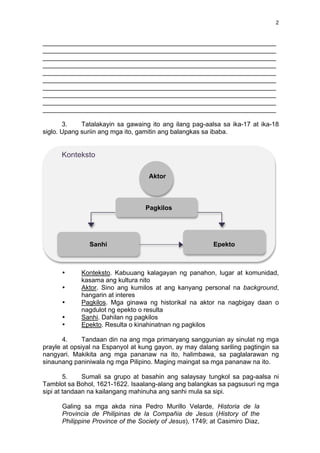
1. A rebellion led by Tamblot and other native priests broke out in Bohol in 1621 after the Spanish ministers left for another island. They were encouraged by a diwata or demon to reject Christianity and Spanish rule. 2. Over 4,000 rebels attacked the Spanish forces but were eventually defeated. The victory discouraged further revolts in other islands and villages. However, some rebels continued resisting from a fortified hill until being defeated six months later.


