STRUGGLE FOR RIGHTS AND
FREEDOM
Maniago Revolt
Francisco
Maniago
(October
1660)
• Chief from
Mexico,
Pampanga
Cause of
rebellion
• Frequent
recruitment
of men to
cut timber
in the
mountains
• Bandala
Events that took place
• The workers mutinied and set their
campsite on fire
• Closed the mouths of the river to
prevent the transport of food to Manila
• Maniago asked help from the chiefs of
Pangasinan, Ilocos and Cagayan
• Governor Manrique de Lara called for
Juan Macapagal, chief or Arayat (others
from Macabebe joined Macapagal); the
governor promised him reward if he
would side with the Spaniards
• The Spaniards concluded an agreement
with Maniago and they never revolted
against the Spaniards
Andres Malong’s Revolt (1660-61)
Causes
• Spanish oppression
• The desire to replace
the Spaniards as
personal rulers of the
people
Events that took place
• December 15, 1660 – the natives of
Lingayen, Pangasinan rose arms against
the Spaniards and killed the alcade
mayor
• Malong proclaimed himself king and
invited other chiefs of the provinces
(Ilocos, Zambales, Pampanga and
Cagayan) to join him in revolt against
Spain but Maniago did not join him
• Malong sent most of his men to
Pampanga, Ilocos and Cagayan to extend
his sovereignty; with only few men with
him in Pangasinan, they were easily
captured by the government troops and
were executed in Binalatogan.
Gumapos Revolt (1661)
Cause
• Continue Andres
Malong’s revolt
Events that took place (Ilocos)
• Pedro Gumapos and his Zambal army
killed many Spaniards
• The people did not join Gumapos;
during the invasion, the Ilocanos hid
their valuables in the Bishop’s house
• The bishop assembled the Zambals
and threatened them with
excommunication but the Zambal
continued to plunder the church and
his house
• Spanish forces came and subdued
Gumapos and his army. He was taken
as prisoner and was hanged in Vigan.
REVOLT OF ALMAZAN (1660’s, Ilocos)
Cause: Personal
ambition
•Pedro Almazan was a rich chief of San
Nicholas.
•He crowned himself King of Ilocos; he
wore the crown of the Queen of Angels.
•He was successful at first but was later
defeated by the Spaniards.
TAPAR’S REVOLT (1663 in Otan, Panay)
Cause: found a new
religion under
native supervision
•Tapar established his own religion
similar to Christianity in Panay.
•Father Francisco de Mesa opposed the
religious movement and ordered
government troops along with native
volunteer soldiers to kill Tapar and his
men.
•Their corpses were impaled on stakes
Dagohoy’s Revolt (1744-1829, Bohol)
Cause: refusal
of the church
to give his
brother a
Christian
burial
•It was the
longest revolt
in Philippine
history; it
lasted for 85
years.
•Dagohoy’s brother who was a policeman in Inabangan, was killed in a
duel with a rebel.
•Dagohoy argued that it was the responsibility of the Jesuit priest
because his brother died in carrying out the missionary order.
•It was refused by the priest unless the proper limosanas, or church
offerings were given
•Dagohoy incited the natives of Bohol to revolt; he took around 3, 000
men and women to Talibon and Inabangan and set up a self-
sustanining community far from the Spanish authorities
•His community grew because more people fled to the mountains to
avoid being recruited by the government to join expeditions in
Northern Mindanao; When the Spaniards killed an innocent porter
and Dagohoy’s future father-in-law, more people joined Dagohoy’s
group (which amounted close to 20, 000)
•Twenty Spanish governors from Gaspar de la Torre (1739-45) to Juan
Antonio Martinez (1822-25) tried to stop the rebellion but failed.
•Governor Mariano Ricafort attacked Bohol in 1829; the rebels were
pardoned but the Spaniards did not find Dagohoy (he died two years
before)
•The pardoned rebels were allowed to live in new villeges which
included the towns of Butuan, Bililihan, Cabulao, Catigoina, and Vilar
SILANG’S REVOLT (1962-63 in Vigan, Ilocos Sur)
Causes:
•his
imprisonment
•Abusive
government
officials
•Heavy
taxation
•Silang was incarcerated when he appealed to Don Antonio Zabala, the
provincial governor of Ilocos, to consider the demands of the natives
regarding the anomalous collection of tributes
•Silang led the revolt of the Ilocanos; proclaimed the independence of his
people and made Vigan the capital of Free Ilocos.
•He ordered the arrest of principales who did not support him; imposed a
100 peso fine (later reduced to 80 pesos) on each priest; took church
properties
•Bishop Bernardo Ustariz of Vigan opposed Silang and his followers but
Silang imprisoned Ustariz’ followers
•Governor Simon de Anda gave Silang an ultimatum; Silang sought
protection the British and accepted their offer of friendship to fight against
the Spanish.
•Silang was assassinated by Manuel Vicos who shot him in the back. Pedro
Becbec, Silang’s trusted aide also conspired to kill the latter.
•Gabriela Silang continued her husband’s fight. She has won many battles
and that won her the title “Joan of Arc of the Ilocos.”
•Don Miguel de Arza followed Gabriela to Abra. With the aid of Apayao’s and
Kalingas, they captured her and her followers.
•They were executed in Vigan, Ilocos Sur
Palaris Revolt (1762-65, Pangasinan)
Causes
• tribute,
• Spain’s loss
of prestige
due to the
British
occupation
of Manila
Juan de la Cruz Palaris from Binalatongan,
Pangasinan led the revolt
• The local inhabitants demanded the abolition of
the tribute and the removal of the alcalde mayor,
Joaquin Gamboa for the irregularities in tax
collection
• Palaris urged the people to fight because the
Spaniards were weak due to its defeat at the hand
of the British in Manila
• Don Mariano de Arza with 3, 000 loyal Ilocano
soldiers suppressed the revolt in March 1764.
• Palaris was publicly hanged.
Basi Revolt (1807, Ilocos Norte)
cause
• Wine
monopoly
of 1786
• The Ilocanos
were
prohibited
to drink
homemade
basi (wine
fermented
from
sugarcane)
• They were
compelled
to buy wine
from
government
stores
• The ilocanos rose in arms in
defense of basi
• The rebellion spread to
neighboring towns of Badoc and
Sto. Domingo.
• September 28, 1807-the alcalde
mayor together with a strong
force attacked the rebels in San
Ildefonso and the revolt was
quelled.
Revolt in defense of the Spanish
Constitution (1815, Ilocos)
Cause
• Abolition of the Liberal
Spanish Constitution
• The Spanish
Constitution of 1812
granted human rights to
both Spaniards and
Filipinos
• It was promulgated by
the Spanish Cortes
(Parliament) and
approved and signed by
184 delegates of Spain
and her colonies
including Ventura de los
Reyes, a Filipino.
• On May 4, 1814, King
Ferdinand VII abolished
this constitution.
• The masses suspected
that the principales
were behind the
abolition because they
have presumed aiding
the Spanish authorities
to perpetuate in power
• March 3, 1815 – Simon
Tomas led more than 1,
500 men in Sarrat,
Ilocos Norte in defense
of the Spanish
Constitution of 1812
• They plundered the
houses of rich Spaniards
and pro-Spaniard
natives
• The Spanish
government sent forces
to suppress the
rebellion. On March 6,
the rebellion ended; the
surviving leaders were
severely punished.
Revolt of the Bayot Brothers (1822, Manila)
Cause
• Feeling of
distrust between
the Peninsulares
and the Creoles
• Peninsulares –
Spaniards who
were born in
Spain (Iberian
Peninsula)
• Insulares/creoles
– a person
whose parents
were both
Spanish but was
born in the
Philippines
• The insulares and the
creoles resented the
extra privileges given
to the peninsulares,
thus resulting the
feeling of distrust of
the former to the
latter.
• Manuel, Jose, and
Joaquin Bayot-sons of
prominent creole in
Manila, conspired
with other Creole
officers to overthrow
the government
dominated by
peninsulares; the plot
was to be carried out
at dawn of April 17,
1822
• The plot was
discovered a few days
before the plan.
• Governor Mariano de
Folgueras alerted the
Queen’s Regiment
and surrounded the
barracks of the rebels.
• The Bayot brothers
were imprisoned after
trial.
Religious Revolt of Hermano Pule (1840-41, Tayabas)
Cause
• Religious
freedom
• Apolinario
de la Cruz
(aka
Hermano
Pule)
wanted to
pursue
priestly
order but
was
refused
because he
was an
indio
• He returned to Lucban,
Tayabas (now Quezon) and
founded his own religion,
Confradia de San Jose, a
nationalist fellowship which
fostered the practice of
Christian virtues
• He sought recognition from
the church but Gov.-Gen.
Marcelino Oraa and
Archbishop Jose Segui banned
his cofraternity.
• He continued his religious
movement which attracted
many followers from Tayabas,
Laguna and Batangas
• The Spanish launched an
assault and captured
Hermano Pule in Alitao.
• Many Filipino soldiers in the
Spanish Army’s Tayabas
Regiment at Malate had
relatives killed in the
massacre.
• Sergeant Ireneo Samaniego
led mutiny on January 20,
1843; they captured Fort
Santiago in Intramuros.
• January 21, 1843 – several
Filipinos loyal to Spain opened
the gates of Fort Santiago;
Samaniego and 81 of his men
were captured and were shot
at Bagumbayan at sundown of
January 21, 1843.
THE MUSLIM WARS (1578-1898)
• The word “Moro” in Spanish means Muslim.
• The war between the Muslim Filipinos and the
Spaniards (aided by Christian Filipinos) lasted
for more than 300 years
Reasons for Muslim wars
• The Spanish invasion of Mindano and Sulu
• Preservation of Islam
• The love of adventure arising from the spoils
of war
• In 1597, the Spanish colonizers tried to seize
Jolo and force the sultanate into submission
• Gov. Francisco de Sande sent forces to Jolo
and ordered the pacification of the place and
payment of tribute to the colonial government
• Sultan Pangiran Budiman (Muhamad ul-Halim)
resisted but was defeated.
• The Muslims avenged by plundering the
coastal towns under Spanish dominion
• Sirungan and Salikala prepared a stronger
force after their previous victory in the
Visayas; but they were defeated in Arevalo,
Iloilo after they were repulsed by Don Juan
Garcia de Sierra along with Spanish and
Visayan troops.
• On June 23, 1635, Father Melchor de Vera
along with 1, 000 Visayans began the building
of the stone fort in the province. The fort was
named Fort Pilar (in honor of Nuestra Señora
del Pilar, the patroness of Zamboanga), which
helped the government forces in their
campaign against the belligerent natives.
Sultan Kudarat
• Sultan Muhamad Dipatuan Kudarat was the
greatest warrior of Mindanao, who defended
Lamitan against the Spaniards in 1637.
• On March 13, 1637, Gov. Corcuerra assaulted
and captured Lamitan after a bloody
encounter, but Kudarat escaped.
• On May 24, Gov. Corcuerra returned to Manila
and was given a conqueror’s welcome
• Sultan Kudarat later mounted raids on Spanish
settlements in Luzon and the Visayas and
inspired fellow Muslims never to submit to the
Spanish colonizers
• The Muslims assaulted the Spanish outposts
in Mindanao and Sulu
• In 1645, the Tausugs liberated Jolo from
Spanish colonizers
Sultan Alimud Din I
• He was deposed by his brother Bantilan in
1749 because of his friendship with the
Spaniards.
• On January 2, 1750, he and his family arrived
in Manila; he was baptized as Don Fernando
Alimud Din I on April 28 and became the first
Christian sultan of Jolo; his children were
baptized as Christians and were given
education in Manila
• In 1751, Gov.-Gen. Jose Francisco Obando
ordered Alimud Din I to regain his throne in
Jolo but was intercepted by the Spanish
commander in Zamboanga and was shipped
back and imprisoned at Fort Santiago for
alleged treason.
• Gov.-Gen. Pedro Manuel de Arandia released
Alimud Din I and granted him royal privileges.
• In 1762, the British troops rescued him and
restored him his throne in Jolo.
• The Spanish forces were not able to control
the Moro raids on Christian pueblos in the
Visayas and Luzon.
• In 1769, the Moros landed at Malate and
plundered the place.
• 500 Christians were captured and sold
annually as slaves in Betavia, Sandakan, and
other slave markets in the East Indies.
• In 1848, Gov.-Gen. Narciso Claveria attacked
the Samals at Banguingui; they brought 350
Samal prisoners to Manila
• On December 11, 1850, Gov.-Gen. Antonio de
Urbiztondo commanded a force of 100 troops
of artillery and 500 infantry to subjugate the
Muslims of Sulu.
• In January 1851, he sailed to Jolo and after the
native’s attack, his force burned down 1, 000
houses and around 100 bancas before
returning to Zamboanga
• In February 1851, Urbiztondo attacked Jolo;
the natives of Sulu lost over 100 men and
were forced into the interior.
• In 1861, the sultan of Maguindanao
recognized Spanish sovereignty.
• Datu Ugto in upper Pulangi continued to resist
• In 1874, Gov.-Gen. Jose Malcampo prepared a
mighty armada for the invasion of Jolo.
• On March 1, 1876, Sultan Jamalul A’lam
worked for peace with the Spaniards.
• Sultan Jamalul A’lam leased Sabah (North
Borneo) to Mr. Alfred Dent and Baron
Gustavus Von Overbeck for an annual rental of
5, 000 Malayan dollars (which was increased
to 5, 300 dollars in 1903-1963).
• In 1886, Gov.-Gen. Emilio Terrero destroyed
some forts in Cotabato, but he failed to crush
Datu Utto’s fighters. After suffering heavy
losses, Terrero returned to Manila.
• In 1891, Gov.-Gen. Valeriano Weyler known as
the “Butcher” invaded Lanao. He was able to
win the First Battle of Marawi on August 21,
1891.
• Datu Amai Pakpak escaped and recruited
more warriors to fight the Spaniards.
• Weyler failed to conquer Lanao so he
assaulted Cotabato but he was overpowered
by Datu Ali Jimbagan.
• In 1895, Gov.-Gen. Ramon Blanco attacked
Marawi on March 10, 1895; Datu Amai Pakpak
died in action; Blanco won his battle but failed
to conquer Lanao
• The Muslim warriors declared jihad (holy war)
against Blanco and his men to avenge the fall
of Marawi and the death of Datu Amai
Pakpak; Blanco was forced to return to
Manila.
• The war between the Spaniards and the
Muslims ended in 1898, after the signing of
the Peace Treaty of Paris on December 10,
1898, which ended the Spanish domination in
the Philippines.
Why the revolts failed
• Lack of discipline, unity, and able leader;
divide et impers (divide and rule)
• Revolted without concrete plan
• The revolts were regional; therefore, it didn’t
come out of national consciousness.
• Most Filipinos were loyal to the Spaniards
than to their fellow Filipinos
Historical Value
• Without the cooperation of the Filipinos,
Spain could not have ruled our country for
more than three centuries
• The Filipinos served Spain for three reasons
1. Lack of unity among Filipinos
2. The Catholic religion
3. Rewards and honors given to Filipinos who
cooperated with Spain
Historical values
• The Filipinos rendered the following services
to Spain:
1. Providing food for the Spaniards
2. Working in various industries that helped
Spain
3. Fighting in the armed forces of Spain against
other Filipinos and foreigners
• What can you say about the information
learned in the lecture/discussion?
• How will these pieces of information help you
face the challenges that you will encounter
when it comes to loyalty to your country?
The Rise of Filipino Nationalism
• When the people of a nation become
united and work together for common
aims, this is called “nationalism.”
• Nationalism also means devotion to one’s
country, or fighting for its independence.
• In the 19th century, Philippine nationalism
was born.
• The people began to think of themselves
as one nation with common origin,
customs and tradition, history and destiny,
and aspirations.
• They wanted to be separated or be
independent of Spain
FACTORS THAT GAVE RISE
TO FILIPINO NATIONALISM
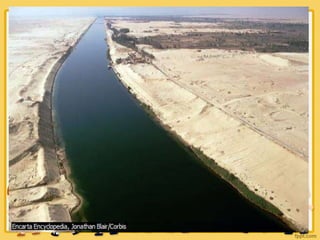
• Opening of the Suez Canal – It made the
Philippines closer to world trade,
communications and travel. More travelers
and information came to the Philippines.
Spread of liberalism
• Liberal ideas from Europe filtered in;
thoughts of famous political philosophers
were made known through books and
periodicals brought into the country by
men from foreign ports.
• The improvement in transportation and
communication facilities brought Filipinos
closer, and made them realize their
common predicament
• The principalia were able to send their
children to schools and even to schools in
Spain where their children were exposed
to liberal ideas.
Rise of the new middle class
• In 1830, Spain open the ports of Manila to
the world followed by opening of other
ports in other areas of the Philippines
• Chinese and Spanish mestizos who
owned lands that were used to plant and
harvest products for export and those who
engaged in import and export businesses
became the middle class (bourgeoisie).
• They stood in between the principalia and
the masses.
• The Spaniards considered them as
“bestias cargada de oro.”
• The ideas of masonry (freethinking,
anticlerical, and humanitarian) also made
the new middle class aware of the
repressive policy of the Spanish
authorities in the colony, thus making
themselves more outspoken about these
things.
Sentiment against the principales
• There was a mounting dissatisfaction
against the prinicipales, accommodated as
intermediaries of the Spanish government
from the inception of its colonial rule.
• The masses had been skeptical about the
local aristocracy due to their proportion of
influence in the society.
Racial prejudice
• The Spaniards regarded the Filipinos as
“indios” (belonging to inferior race)
• The preconceived notion of the Spanish
colonizers that the natives could not rise
beyond their “limited intelligence”
instigated the enlightened Filipinos to
struggle for equality.
Cultural changes
• The educational reforms of 1863 improved
the standards of education in the primary
level; qualified Filipinos were able to
pursue higher education
• The ilustrados (the enlightened ones)
became the new breed of Filipinos
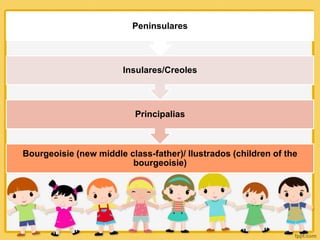
Bourgeoisie (new middle class-father)/ Ilustrados (children of the
bourgeoisie)
Principalias
Insulares/Creoles
Peninsulares
• The ilustrados got the chance to manifest
their political will when Carlos de la Torre
became governor general in 1869.
• He invoked reforms in the government like
the revocation of press censorship and the
abolition of flogging as a form of
punishment
• He lived simply within his means; he
inspired the Filipino middle class to sustain
their campaign for reforms.
Secularization controversy
• The Council of Trent (1545-63) affirmed
that secular priest be appointed to
administer the parishes in the colony.
• In 1567, Pope Pius V issued the Exponi
Nobis, which allowed the regular clergy to
serve as parish priest without diocesan
authorization and be exempted from
bishop’s authority.
• The regular orders resisted diocesan
visitation because this would place them
under two superiors, the head of their
religious order and the bishop. This
caused the expulsion of priests who
refused the visitation of parishes by
representatives of the bishop.
• The parishes vacated by the Jesuits were
given to the native seculars (those who
don’t belong to any religious order.)
• Archbishop Basilio Santa Justa accepted
the resignation of regular priests and
appointed native secular priests to the
parishes.
• On November 9, 1774, a royal decree
ordering the secularization of parishes
became the basis for the appointment of
native secular clergy.
• This was suspended in 1776 due to
opposition of the friars and the
unpreparedness of the native priests.
• The return of the Jesuits in 1859 and the
desecularization policy affected the native
seculars; it transformed into Filipinization
issue since the secular priests were mostly
Filipinos.
• In 1870, Archbishop Gregorio Meliton
Martinez wrote to the Spanish Regent
advocating secularization and mentioned
that discrimination against Filipino priests
would encourage anti-Spanish sentiments.
• Other proponents of the secularization
movement included Fathers Pedro Pelaez,
Jose Burgos, Mariano Gomez, Jacinto
Zamora, etc.
Cavite Mutiny of 1872
• Gov.-Gen. Rafael de Izquierdo replaced
Gov. de la Torre in 1871, and he
discarded the liberal measures.
• He abolished the privileges of arsenal
workers and engineer corps regarding
exemption from tribute and force labor.
• January 20, 1872, about 200 Filipino soldiers
and dock workers of Cavite, under the
leadership of Sergeant La Madrid, mutinied
and killed their Spanish officers.
• It was suppressed and La Madrid and 41
others were executed in Bagumbayan.
• Fathers Jose Burgos, Mariano Gomez, Jacinto
Zamora were accused of treason to Spain and
tried in an unfair trial. They were sentenced to
death by garrote on February 17, 1872 in
Bagumbayan.
• Some were thrown into jail while others were
exiled to Marianas Islands on March 14, 1872.
• Between 1872 and 1892, national
consciousness was growing among
Filipinos who had settled in Europe.
• The execution of GOM-BUR-ZA hastened
the growth of Filipino nationalism
• The concept of nationhood coincided with
the development of the concept of
Filipinos.
Españoles insulares
Mestizos de sangley and the native
elite who Hispanized themselves
The propagandists tried to infuse the
term Filipino with national meaning,
which later included the entire people
in the archipelago
Filipinos
• What makes you a “Filipino”?
Defend your answer.
THE
PROPAGANDA
MOVEMENT
• The emergence of Filipino ilustrados gave
birth to a unified nationalist movement
known as the Propaganda movement.
• The propagandists were young Filipinos in
their 20’s or 30’s who came from the best,
the brightest, and the richest families in
the Philippines (although not all of them
were really rich).
• The aim of the Propaganda Movement
was peaceful assimilation, referring to the
transition of the Philippines from being a
colony to a province of Spain
• Its adherents did not seek independence
from Spain but reforms
• These reforms include:
1.Equality of Filipinos and Spaniards before
the laws
2.Restoration of the Philippine
representation in the Spanish Cortes
3.Secularization of Philippine parishes and
the expulsion of friars
4.Human rights for Filipinos and freedom to
meet and petition to redress their
grievances
Marcelo H. del Pilar
• Lawyer and journalist from Bulacan
• He joined dupluhan and dalitan or literary
jousts during fiestas
• He satarized corrupt officials and friars
during pintakasi (cockfighting day)
• He wrote anti-friar pamphlets in simple yet
forceful Tagalog
• In 1882, he helped establish the Diariong
Tagalog, the first bilingual newspaper; he
edited the Tagalog section.
• He released Dasalan at Tocsohan
(Prayers and Mockeries), a manual of
anticlerical commentary in the format of
novena
• He parodied the Lord’s Prayer, Hail Mary,
the Apostles Creed, the Ten
Commandments, the Act of Contrition, and
the cathechism.
• His house was burned mysteriously.
• He left the Philippines in October 1888 to
escape the prosecution of the friars
Graciano Lopez Jaena
• He was from Iloilo
• An orator
• Fray Botod “Friar Potbelly” (1874). It is
about a fictitious cleric named Fray Botod
who arrived looking like a hungry mosquito
and soon became stout because of the
stocks taken from the people.
Jose Rizal
• From Calamba, Laguna
• 1882 – he studied medicine at Universidad
Central de Madrid.
• Noli Me Tangere (1887) was Rizal’s socio-
historical novel; it reflected the defects of
the Spanish rule in the Philippines
Other Propagandists
• Pedro A. Paterno, a lawyer, poet,historian
• Antonio Luna, pharmacist and essayist
• Pedro Serrano Laktaw, teacher-tutor of
Prince Alfonso de Bourbon, lexicographer
• Isabelo de los Reyes, folklorist, historian
and newspaperman
• Juan Luna, painted the Spoliarium
• Felix Resurreccion Hidalgo, painted
Virgenes Christianas al Populacho
• Mariano Ponce, physician-journalist
• Jose Ma. Panganiban, linguist and
essayist
• Jose Alejandrino, engineer and writer
• Fernando Canon, engineer, poet, musician
• Dominador Gomez, physician, orator
• Spanish friends of the Propagandists:
Juan Atayde, a Spaniard born in
Manila founded Circulo Hispano-
Filipino
Prof. Miguel Morayta, Rizal’s professor
in Madrid, tried to form Asociacion
Hispano-Filipino
La Solidaridad (organization)
• A purely Filipino organization established
in Barcelona on December 31, 1888
• Galiciano Apacible was the President and
Graciano Lopez Jaena was the Vice-
President
La Solidaridad (newspaper)
• Graciano Lopez Jaena founded this
fortnightly newspaper in Barcelona on
February 15, 1889. M.H. del Pilar helped
prepare the issues
• It was printed in Barcelona from
February 15 to October 31, 1889, then
in Madrid from November 15, 1889 to
November 15, 1895.
Contributors to La Solidaridad
• MH del Pilar (Plaridel)
• Dr. Jose Rizal (Dimas Alang, Laong Laan)
• Mariano Ponce (Naning, Kalipulako, or
Tigbalang)
• Antonio Luna (Taga-Ilog)
• Professor Ferdinand Blumentritt and
Dr. Morayta also contributed their
articles to the newspapers
Freemasonry
• Many Filipino propagandists turned
masons because they needed the help of
masons in Spain and in other countries in
their fight for reforms.
• This organization called Freemasonry,
consisted of fraternal lodges, which
later evolved into social societies
subsequently opened to non-masons
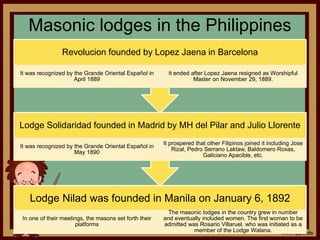
Lodge Nilad was founded in Manila on January 6, 1892
In one of their meetings, the masons set forth their
platforms
The masonic lodges in the country grew in number
and eventually included women. The first woman to be
admitted was Rosario Villaruel, who was initiated as a
member of the Lodge Walana.
Lodge Solidaridad founded in Madrid by MH del Pilar and Julio Llorente
It was recognized by the Grande Oriental Español in
May 1890
It prospered that other Filipinos joined it including Jose
Rizal, Pedro Serrano Laktaw, Baldomero Roxas,
Galiciano Apacible, etc.
Revolucion founded by Lopez Jaena in Barcelona
It was recognized by the Grande Oriental Español in
April 1889
It ended after Lopez Jaena resigned as Worshipful
Master on November 29, 1889.
Masonic lodges in the Philippines
La Liga Filipina
• Rizal wrote the constitution of La Liga
Filipina while living in Hong Kong with the
help of Jose Ma. Basa.
• July 3, 1892, Rizal founded La Liga
Filipina in Ilaya St.,Tondo, Manila
• La Liga Filipina was a political
association of patriotic Filipinos to
crusade for reforms.
• It was to be a sort of mutual aid and self-
help society, dispensing scholarship funds
and legal aids, loaning capital and setting
up cooperatives
• Its motto was Unus Instar Omnium (one
like all)
Objectives of La Liga
• Unification of the whole archipelago into
one compact, vigorous, and homogenous
body
• Protection in case of want and necessity
• Defense against violence and injustice
• Encouragement of instruction,
agriculture, and commerce
• The study and implementation of
reforms.
• The goals of La Liga were to be carried out by
the Supreme Council, the Provincial Council,
and the Popular Council.
• Each member had to pay 10 centavos as
monthly dues
• They had to choose a symbolic name: Pedro
Serrano Laktaw (Panday Pira), Domingo
Franco (Felipe Leal), Jose A. Ramos
Socorro), Moises Salvador (Araw),
Faustino Villaruel (Ilaw), Numeriano
Adriano (Ipil), Apolinario Mabini (Katabay),
and Andres Bonifacio (May Pag-asa)
• The members became quite active which
alarmed the Spanish authorities.
• July 6, 1892, Rizal was secretly arrested
and imprisoned at Fort Santiago. The next
day, he was deported to Dapitan,
Zamboanga del Norte as a punishment
for his alleged subversive
materials (his translation of the
French Declaration of the Rights
of Men)
THE KATIPUNAN
• Los Compromisarios or Cuerpo de
Compromisarios led by Domingo
Franco pledged to continue
supporting the Propaganda
movement in Spain.
• “That is enough!” thought Bonifacio after
the shocking news of Rizal’s exile to
Dapitan.
• Bonifacio and the others believed that the
welfare of the people could not be
achieved by requests for reforms but by an
armed revolution
• Their goal was transformed from
assimilation to separation and then
independence
The aims of the Katipunan
• To unite the Filipinos into one solid
nation
• To fight for Philippine independence
from Spain. The Katipunan prepared
the country for an armed revolution to
regain the country’s lost freedom.
Founding of the Katipunan
• July 7, 1892, Bonifacio and his friends met
secretly at Deodato Arellano’s house at # 72
Azcarraga Stree (now C.M. Recto) near
Elcano Street in Tondo, Manila.
• They formed a secret revolutionary society,
modeled in part on Masonic Order.
• This was called Kataastaasan Kagalang-
galangang Katipunan ng mga Anak ng
Bayan (Highest and Most Respectable
Society of the Sons of the People), otherwise
known as the “Katipunan” or KKK for short.
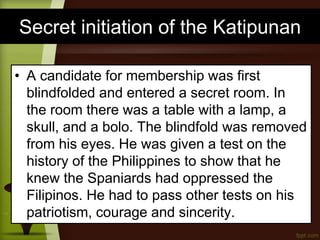
Secret initiation of the Katipunan
• A candidate for membership was first
blindfolded and entered a secret room. In
the room there was a table with a lamp, a
skull, and a bolo. The blindfold was removed
from his eyes. He was given a test on the
history of the Philippines to show that he
knew the Spaniards had oppressed the
Filipinos. He had to pass other tests on his
patriotism, courage and sincerity.
The oath of Katipunan
• “In the name of God and my country, I
promise to defend with valor and
integrity the aims of the Katipunan, to
keep its secrets, to obey its orders, to
help the members in times of danger
and need, to recognize the authority of
its leaders, and not to be a traitor to its
rules.”
• The members signed their papers with
their own blood.
• They also agreed to pay an entrance
fee of one real fuerte (twenty-five
centavos) and a monthly due of medio
real (about twelve centavos)
• The members were recruited by
triangle method in which an original
member would recruit two members
who did not know each other but only
knew the original member who took
them.
• The triangle method was abolished in
December 1892 after it was found out
to be too cumbersome.
• The new converts were made to
swear to guard the secrets of the
society.
• The Katipunan spread quickly and
attracted many members, especially
among the poor oppressed masses.
By the time it was found out in 1896, it
had about 20, 000 members.
• Some of the famous Katipuneros were
Bonifacio, Arellano, Emilio Jacinto
(“Brains of the Katipunan”), Dr. Pio
Valenzuela, Jose A. Dizon, Valentin
Diaz, Ladislao Diwa, and Teodoro
Plata.
• The Katipunan was a government
itself with a constitution promulgated
in 1892, and another constitution
replacing the first one in 1894.
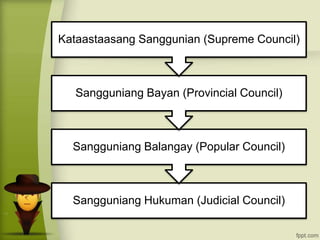
• The central government of the
Katipunan was vested in a
Kataastaasang Sanggunian (Supreme
Council)
Sangguniang Hukuman (Judicial Council)
Sangguniang Balangay (Popular Council)
Sangguniang Bayan (Provincial Council)
Kataastaasang Sanggunian (Supreme Council)
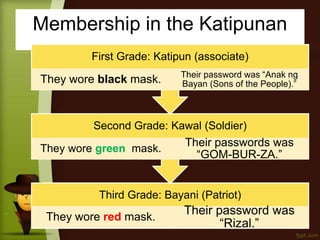
Membership in the Katipunan
Third Grade: Bayani (Patriot)
They wore red mask.
Their password was
“Rizal.”
Second Grade: Kawal (Soldier)
They wore green mask.
Their passwords was
“GOM-BUR-ZA.”
First Grade: Katipun (associate)
They wore black mask. Their password was “Anak ng
Bayan (Sons of the People).”
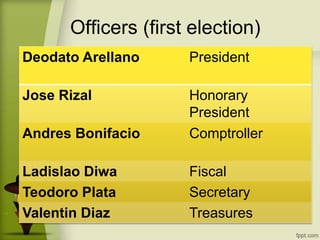
Deodato Arellano President
Jose Rizal Honorary
President
Andres Bonifacio Comptroller
Ladislao Diwa Fiscal
Teodoro Plata Secretary
Valentin Diaz Treasures
Officers (first election)
• Women also joined the Katipunan.
To be admitted in the women’s
section, one had to be a wife,
daughter, or sister of a Katipunero to
ensure the secrecy of the movement.
• When a secret meeting was being
held, the female Katipuneros
pretended it was a party by singing
songs and dancing.
• They guarded the secret papers and
documents of the society.
• They also helped the society by
recruiting more members.
• They made the Katipunan flag and
celebrated the Katipunan’s
anniversary.
• Among the famous Katipuneras were
Gregoria de Jesus (wife of Bonifacio),
who was called the “Lakambini of the
Katipunan,” Marina Dizon, Benita
Rodriguez (the wife of Restituto
Javier), Marta Saldaña, Semeona de
Remigio, and Macaria Pangilinan,
Josefa and Trinidad Rizal (sisters of
Jose Rizal)
• Josefa Rizal was elected President of
the woman’s chapter called La
Semilla.
• Bonifacio deposed both Arellano and
Basa for presidency in the Katipunan
because of their inaction.
• The title of president was changed to
“Supremo.”
• Bonifacio was Supremo of the
Katipunan from 1895 until his death in
1897.
• Benita Rodriguez and Gregoria de
Jesus made a flag, which consisted of
a red rectangular piece of cloth with
three white K’s arranged horizontally
at the center. This was the first official
flag of the society; however, some
members had their flag with three K’s
arranged in the form of a triangle.
Others had one K at the center of the
red flag. Some generals of the
revolution, likewise, adopted their own
designs.
• Emilio Jacinto prepared the primer of
the Katipunan; he called it the Kartilla
(from the Spanish ‘cartilla’)
• According to UP President Rafael
Palma, it was Apolinario Mabini wrote
the statutes of the Katipunan’s Kartilla
and Emilio Jacinto translated it into
Tagalog for the benefit of the
unschooled members of the
Katipunan.
Kartilla of the Katipunan
• The Kartilla consisted of 13 teachings,
which members of the society were
expected to observe. The next slides
contain the primer of the Kartilla of the
Katipunan.
I. Life which is not consecrated to a
lofty and sacred cause is like a tree
without a shadow, if not a poisonous
weed.
II. A good deed that springs from desire
for personal profit and not from a
desire to do good is not kindness.
III. True greatness consists of being
charitable, in loving one’s fellowmen
and in adjusting every movement,
deed and word to true Reason.
IV. All men are equal, be the color of
their skin black or white. One may be
superior to another in knowledge,
wealth, and beauty but cannot be
superior in being.
V. He who is noble prefers honor to
personal gains; he who is mean
prefers personal profit to honor.
VI. To a man with a sense of shame, his
word in inviolable.
VII.Don’t fritter away time; lost riches
may be recovered, but time lost will
never come again.
VIII.Defend the oppressed and fight the
oppressor.
IX. An intelligent man is he who is
cautious in speech and knows how to
keep the secrets that must be
guarded.
X. In the thorny path of life, man is the
guide of his wife and children; if he
who guides moves toward evil, they
who are guided are likewise to move
toward evil.
XI. Think not of woman as a thing
merely to while away with time, but
as a helper and partner in the
hardships of life. Respect her in her
weakness, and remember the mother
who brought you into this world and
cared for you in your childhood.
XII.What you do not want done in your
wife, daughter and sister, don not do
to the wife, daughter and sister of
another.
XIII.The nobility of a man does not
consist in being a king, nor in the
highness of the nose and the
whiteness of the skin, nor in being a
priest representing God, nor in the
exalted position on this earth, but
pure and truly noble is he who,
(cont’d)
• though born in the woods, is possessed of an
upright character; who is true to his word;
who has dignity and honor; who does not
oppress and does not help those who
oppress; who knows how to look after and
love the land of his birth. When these
doctrines spread and the Sun of beloved
liberty shines with brilliant effulgence on
these unhappy isles and sheds its soft rays
upon the united people and brothers in
everlasting happiness, the lives, labors, and
sufferings of those who are gone shall be
more than recompensed.
Decalogue (Ten
Commandments of Katipunan)
• Bonifacio wrote a decalogue or 10
commandments titled Katungkulang
Gagawin ng mga Anak ng Bayan
(Duties to be Observed by the Sons of
the Country) to lay down the
guidelines for good citizenship.
• He also wrote a patriotic poem Pag-
ibig sa Tinubuang Bayan (Love for
Country)
• The Katipunan also established printing
press to propagate its teachings.
• Francisco del Castillo and Candido
Iban donated money that was used to
buy an old hand press.
• The types used in printing were
purchased from Isabelo de los Reyes
while others were stolen from the press
of the Diario de Manila by Filipino
employees who were members of the
Katipunan.
• Emilio Jacinto was called “The Brains
of the Katipunan” because he was its
greatest writer.
• Among his patriotic poems was A La
Patria (To Country), written shortly
before his death in Laguna in 1897.
• Under Emilio Jacinto’s supervision,
Faustino Duque and Ulpiano
Fernandez printed the Kalayaan, the
organ of the Katipunan
• Kalayaan had its first and only issue in
January 1896, which carried a false
masthead stating that it was printed in
Yokohama with MH del Pilar as editor
in order to deceive the Spanish
authorities and evade arrest.
• “Ang Dapat Mabatid ng mga Tagalog”
(What the Filipinos Should Know) was
written by Andres Bonifacio
• The essay answered the following
questions:
What were the conditions in the
Philippines before the Spanish
conquest?
What is the condition of the country
today?
What will the Philippines be tomorrow?
• Macario Sakay and Pio del Pilar
distributed copies of the Kalayaan which
reached members and possible recruits.
• On April 10, 1895, Bonifacio and other
Katipuneros entered the Pamitinan Cave in
San Mateo, Rizal where they held a secret
session leading to the initiation rites of new
recruits.
• Others who were present included Jacinto,
Aurelio Tolentino, Restituto Javier,
Guillermo Masangkay, and Faustino
Mañalac wrote their signatures on the wall.
• Then Aurelio Tolentino wrote on the cave
wall in Spanish, “Viva La Independencia
Filipina!”
• The Katipunan Council leaders set August
29, 1896 as the date of revolt. It was
agreed at 7:00 o’clock on August 29th, the
revolt would begin at Manila. Then they
would enter Intramuros, killing as many
Spanish officials and friars on the way
• On June 15, 1896, Dr. Pio Valenzuela
sailed to Dapitan to get Rizal’s support for
the armed revolution.
• Rizal did not agree to the Katipunan’s plans
of armed uprising since the people were
not ready for it.
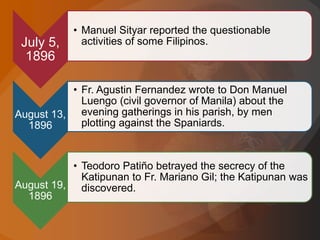
July 5,
1896
• Manuel Sityar reported the questionable
activities of some Filipinos.
August 13,
1896
• Fr. Agustin Fernandez wrote to Don Manuel
Luengo (civil governor of Manila) about the
evening gatherings in his parish, by men
plotting against the Spaniards.
August 19,
1896
• Teodoro Patiño betrayed the secrecy of the
Katipunan to Fr. Mariano Gil; the Katipunan was
discovered.
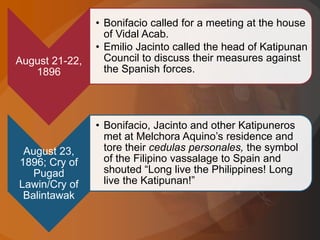
August 21-22,
1896
• Bonifacio called for a meeting at the house
of Vidal Acab.
• Emilio Jacinto called the head of Katipunan
Council to discuss their measures against
the Spanish forces.
August 23,
1896; Cry of
Pugad
Lawin/Cry of
Balintawak
• Bonifacio, Jacinto and other Katipuneros
met at Melchora Aquino’s residence and
tore their cedulas personales, the symbol
of the Filipino vassalage to Spain and
shouted “Long live the Philippines! Long
live the Katipunan!”
August 29, 1896
• Melchora Aquino was arrested for giving aid
to the Katipuneros
August 30, 1896
• Gov.-Gen. Ramon Blanco issued a decree
declaring a state of war in Manila and seven
provinces of Luzon-Cavite, Laguna,
Batangas, Bulacan, Pampanga, Nueva
Ecija, and Tarlac and put them under
martial law a few hours after the Battle of
Pinaglabanan.
• At Hagdang Bato, Mandaluyong, Bonifacio
gave his last manifesto Katipunang
Mararahas ng mga Anak ng Bayan
regarding the revolution that would take
place.
August 30,
1896
• The first battle of the revolution took place
at the town of San Juan del Monte at dawn.
This is known as the Battle of
Pinaglabanan.
• Bonifacio and his men were outnumbered;
due to heavy casualties, they were forced
to retreat to Balara.
September
4, 1896
• Four members of the Katipunan were executed
at Bagumbayan
September
12, 1896
• Thirteen were put to death at Plaza de Armas,
near the Fort of San Felipe in Cavite and are
now remembered as “Los Trece Martires” (The
Thirteen Martyrs of Cavite)
• They were Maximo Inocencio, Luis Aguado,
Victoriano Luciano, Hugo Perez, Jose Lallana,
Antonio San Agustin, Agapito Conchu, Feliciano
Cabuco, Maximo Gregorio, Eugenio Cabezas,
Severino Lapidario, Alfonso de Ocampo, and
Francisco Osorio.
September 16,
1896
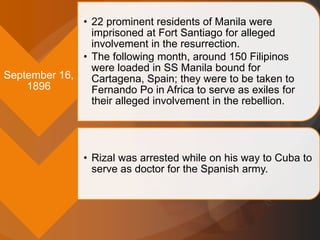
• 22 prominent residents of Manila were
imprisoned at Fort Santiago for alleged
involvement in the resurrection.
• The following month, around 150 Filipinos
were loaded in SS Manila bound for
Cartagena, Spain; they were to be taken to
Fernando Po in Africa to serve as exiles for
their alleged involvement in the rebellion.
• Rizal was arrested while on his way to Cuba to
serve as doctor for the Spanish army.
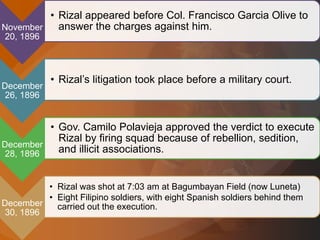
November
20, 1896
• Rizal appeared before Col. Francisco Garcia Olive to
answer the charges against him.
December
26, 1896
• Rizal’s litigation took place before a military court.
December
28, 1896
• Gov. Camilo Polavieja approved the verdict to execute
Rizal by firing squad because of rebellion, sedition,
and illicit associations.
December
30, 1896
• Rizal was shot at 7:03 am at Bagumbayan Field (now Luneta)
• Eight Filipino soldiers, with eight Spanish soldiers behind them
carried out the execution.
August 31,
1896
• The Katipuneros in Cavite assaulted the tribunal
(municipal building) of San Francisco de Malabon
• At Cavite el Viejo (now Kawit), the Magdalo troops led
by Candido Tria Tirona attacked the enemy garrison.
• The Magdiwang forces pounded on the Spaniards in
Noveleta
September
5, 1896
• Emilio Aguinaldo and his troops assailed the Spanish
troops stationed at Imus.
• Because of Aguinaldo’s victory over the Spaniards in
that battle, the Caviteños recognized him as a man of
distinguished valor and called him Heneral Miong.
November
9-11, 1896
• The Spanish regular army were defeated at the twin battles of
Binakayan and Dalahican.
• Candido Tria Tirona, the secretary of war in the Magdalo
Council died in the Battle of Binakayan
•The Katipunan members of
Balangay Dimasalang met at Bigaa
(now Pandi and Balagtas) in
Bulacan to reinforce their
operations against the Spaniards
and to conduct and election of
officials under the newly founded
Kakarong Republic.
•Gen. Eusebio Roque (aka
January
1, 1897
• Gen. Olaguer Feliu and his men rushed to the
fortifications of Kakarong and launched a
massive attack.
• The revolutionaries were overwhelmed by the
superior armaments of the enemy.
• Maestro Sebio escaped.
January
11, 1897
• Maestro Sebio was captured at Bunga Mayor,
Bustos.
January
16, 1897
• He was executed at 5 pm.
February
15, 1897
• Governor Polavieja lauched an all-out offensive in
Cavite.
February
17, 1897
• A Spanish sniper killed Gen. Evangelista in the
Battle of Zapote.
February
19, 1897
• General Lachambre of the Spanish forces captured
Silang.
• General Aguinaldo, with Generals Vito Belarmino
and Artemio Ricarte, mounted a counteroffensive,
but failed to get Silang back.
February
25, 1897
• Gen. Antonio Zabala (Spanish) attacked Salitran
which was defended by Gen. Flaviano Yengko.
• Yengko was mortally wounded and died on March 3,
1897 at Imus Military Hospital.
• Yengko was the youngest general of the Philippine
revolution, being younger than Gen. Gregorio del
Pilar by one year, two months and seven days.
• General Zabala was killed by Yengko’s troops.
RIVALRY IN THE KATIPUNAN
Two Katipunan Councils in Cavite
• Magdalo Council headed by Baldomero
Aguinaldo (Emilio Aguinaldo’s cousin)
• Magdiwang Council headed by Mariano
Alvarez (uncle of Gregoria de Jesus, Bonifacio’s
wife) as president
• Magdiwang Council
 Its capital is in Noveleta
then it was transferred
to Francisco de
Malabon (now Gen.
Trias).
 Towns under its
jurisdiction: Rosario,
Tanza, Naic, Ternate,
Maragondon,
Magallanes, Bailen,
Alfonso, Indang, San
Roque
• Magdalo Council
 Its capital was in Imus.
 Towns under its
jurisdiction: Kawit,
Dasmariñas, Silang,
Amadeo, Mendez-
Nuñez, Bacoor, and
Carmen.
• The Magdiwangs supported
Bonifacio as leader because he
started the revolution while the
Magdalos supported Aguinaldo as
leader because he won his battles
while Bonifacio lost all his battles.
December 1,
1896
• Bonifacio arrived in Cavite with his wife, his brothers,
General Lucino and his 20 soldiers.
December
31, 1898
• The Magdalo Council hosted a general assembly for both
factions.
• Among the issues discussed were the establishment of a
revolutionary government under the new elected
officials and uniting Magdiwang and Magdalo under a
single command.
• The Magdalo believed that the Katipunan had ceased to
be a secret society and therefore should be replaced by
a new one while Magdiwang insisted that there was no
need to create a new one since the Katipunan was
actually a government with a constitution and bylaws
recognized by everyone.
• Gen. Edilberto Evangelista tried to reconcile
the two groups by drafting a constitution
establishing the Philippine Republic.
• Nothing was accomplished due to heated
arguments among those who were present.
• Severino de las Alas suggested that the
convention should resolve the issue of
whether there should be a new government
to replace the Katipunan. This resulted in
another heated discussion.
• Majority wanted a new revolutionary
government.
• Bonifacio presided over the election of new
officials; he reminded that whoever gets
elected in any position should be respected.
• The Second Convention happened on March
22, 1897 at Tejeros, San Francisco de
Malabon, Cavite.
• Majority of those who attended were the
Magdiwangs.
• Gen. Aguinaldo and other Magdalo officials
were absent because they were defending the
Magdalo towns at that time.
• The session was presided by Jacinto
Lumberas.
President Emilio Aguinaldo
Vice-President Mariano Trias
Captain General Artemio Ricarte
Director of War Emiliano Riego de Dios
Director of the
Interior
Andres Bonifacio
• Daniel Tirona, a Magdalo, protested
Bonifacio’s election saying that this position
should be occupied by a lawyer and suggested
that Jose del Rosario for the post.
• Bonifacio was insulted and nearly shot Tirona.
• He walked out of the Tejeros meeting and
refused to accept the election.
• He insisted that he was still the leader of the
revolution.
• Aguinaldo was sworn into office inside the
Catholic Church of Santa Cruz de Malabon
(Tanza) together with other newly elected
officials.
• March 23, 1897 – Bonifacio drafted a
document called Acta de Tejeros signed by
Bonifacio and 44 other plotters
• Acta de Tejeros rejected the revolutionary
government of Aguinaldo because:
1. The Tejeros Assembly lacks legality;
2. There was a Magdalo conspiracy to oust
Bonifacio from leadership;
3. The election of officials was fraudulent;
4. Actual pressure has been brought
upon the presidency
• April 19, 1897; Naic, Cavite – Bonifacio and his
conspirators drew up and signed Naic Military
Pact.
• 41 men which included Bonifacio, Ricarte, Pio
del Pilar, and Severino de las Alas signed the
document.
• An army corps under the command of Gen.
Pio del Pilar was created.
• Lazaro Makapagal escaped and informed
President Aguinaldo about the plan.
• Aguinaldo immediately went to confront
Bonifacio but the latter left leaving Gen. Pio
del Pilar and Gen. Mariano Noriel who
subsequently joined Aguinaldo’s troop.
• Bonifacio, his wife Gregoria, his brothers
Ciriaco and Procopio, and his loyal followers
fled to Limbon, Indang.
• Aguinaldo ordered their arrest but Bonifacio
resisted.
• Ciriaco Bonifacio and two soldiers died while
Andres Bonifacio was wounded.
Bonifacio and his companions were brought to
Naic where he was court martialed.
May 5, 1897
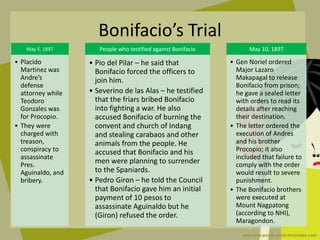
• Placido
Martinez was
Andre’s
defense
attorney while
Teodoro
Gonzales was
for Procopio.
• They were
charged with
treason,
conspiracy to
assassinate
Pres.
Aguinaldo, and
bribery.
People who testified against Bonifacio
• Pio del Pilar – he said that
Bonifacio forced the officers to
join him.
• Severino de las Alas – he testified
that the friars bribed Bonifacio
into fighting a war. He also
accused Bonifacio of burning the
convent and church of Indang
and stealing carabaos and other
animals from the people. He
accused that Bonifacio and his
men were planning to surrender
to the Spaniards.
• Pedro Giron – he told the Council
that Bonifacio gave him an initial
payment of 10 pesos to
assassinate Aguinaldo but he
(Giron) refused the order.
May 10, 1897
• Gen Noriel ordered
Major Lazaro
Makapagal to release
Bonifacio from prison;
he gave a sealed letter
with orders to read its
details after reaching
their destination.
• The letter ordered the
execution of Andres
and his brother
Procopio; it also
included that failure to
comply with the order
would result to severe
punishment.
• The Bonifacio brothers
were executed at
Mount Nagpatong
(according to NHI),
Maragondon.
Bonifacio’s Trial
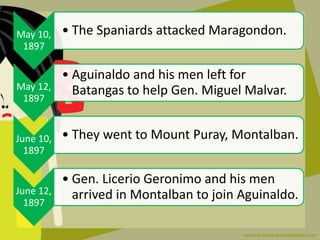
May 10,
1897
• The Spaniards attacked Maragondon.
May 12,
1897
• Aguinaldo and his men left for
Batangas to help Gen. Miguel Malvar.
June 10,
1897
• They went to Mount Puray, Montalban.
June 12,
1897
• Gen. Licerio Geronimo and his men
arrived in Montalban to join Aguinaldo.
• April 23, 1897 – Fernando Primo de Rivera
replaced Gen. Camilo Polavieja.
• Gov. Gen. Rivera issued a decree granting
pardon to rebels until May 17 but most
Filipinos ignored the decree so the governor
general launched an attack forcing Aguinaldo
and his forces to seek refuge in Batangas.
• June 14, 1897 – Col. Djiols attacked
Aguinaldo’s camp at Mt. Puray; they won over
the Spaniards.
• Then President Aguinaldo organized the
Department of Central Luzon under the
jurisdiction of the revolutionary government.
• It was headed by Fr. Pedro Dandan as
President; Dr. Anastacio Francisco, VP; Paciano
Rizal, Secretary of the Treasury; Cipriano
Pacheco, Secretary of War; Teodoro Gonzales,
Secretary of the Interior; Feliciano Jocson,
Secretary of Welfare.
Biak-na-Bato
Republic
• June 27, 1897 – Aguinaldo arrived at Biak-
na-Bato, San Miguel Mayumo where he
met the troops of Gen. Mariano Llanera of
Nueva Ecija in assaulting the Spaniards in
Central Luzon.
• November 1, 1897 – the revolutionary
leaders adapted the constitution entitled
Provisional Constitution of the Philippine
Republic.
• The aim of the Constitution was to
separate the Philippines from Spanish
monarchy and the formation of an
independent State.
• Isabelo Artacho and Felix Ferrer wrote the
provisional constitution which was based
on the Cuban Constitution known as
Jimaguayu Constitution.
Biak-na-Bato Republic
Emilio Aguinaldo President
Mariano Trias Vice- President
Isabelo Artacho Secretary Interior
Antonio Montealegre Secretary of Foreign
Affairs
Baldomero Aguinaldo Secretary of the Treasury
Emiliano Reigo de Dios Secretary of War
• The struggle between the Spanish
government at the Biak-na-Bato Republic
had reached a deadlock.
• Gov.Gen. Priomo de Rivera offered peace
negotiation to Aguinaldo which he readily
accpeted.
• The Pact of Biak-na-Bato resulted to the
voluntary exile of Aguinaldo and his men
to Hongkong.
• The Pact consisted of three documents:
The first two documents which were called
The Program were signed on December
14. This document says that de Rivera
would pay 800, 000 to those who revolted
and that Aguinaldo and his men would
retire to Hong Kong.
The second document was called Act of
Agreement which reiterated the granting of
amnesty to those who would surrender.
The third document discussed the
question of indemnity, wherein Spain
would pay a total of 1, 700, 000 pesos, of
which 800, 000 was to be paid to those
who would lay down their arms while the
remaining 900, 000 would be distributed
among the civilian for the damages.
• December 25, 1897 – Aguinaldo with
Pedro Paterno and others in boarded the
Uranius while Gen. Artemio Ricarte stayed
behind to supervise the surrender of arms
by the revolutionaries.
• January 8, 1898 – the Spanish
government announced the end of
hostilities; part of the promised money was
given to the rebels in Hong Kong.
• Both parties were insincere in its promise
as neither were committed to the terms of
the agreement.
• Aguinaldo went into exile but he did not
end the fight to win the independence from
Spain. Biak-na-Bato Pact was signed by
Aguinaldo in order to give the revolutionist
rest and regain their lost strength and then
return to combat with renewed vigor.
UPRISINGS WHILE AGUINALDO
WAS IN EXILE
Northern Luzon
• March 7, 1898 – Zambales, the
revolutionaries besieged a cable
station at Bolinao and seized the
telegraph connected to Manila.
• March 25, 1898 – Candon, Ilocos
Sur, Federico Isabelo Abaya and his
men were able to get the town
from the Spaniards.
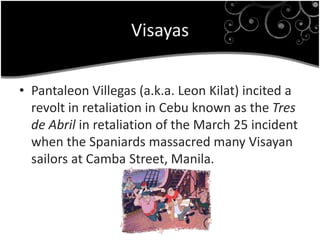
Visayas
• Pantaleon Villegas (a.k.a. Leon Kilat) incited a
revolt in retaliation in Cebu known as the Tres
de Abril in retaliation of the March 25 incident
when the Spaniards massacred many Visayan
sailors at Camba Street, Manila.
Central Luzon
• General Francisco Makabulos of Tarlac
established a provincial revolutionary
government with a constitution written by
him.
• The Makabulos Constitution adopted on April
17, 1898, set up this provisional government
in Central Luzon to continue in force until a
general government for the Republic was
established.
• General Isidro Torres established in camp in
Malolos to continue the revolutionary spirit.
• Felciano Jocson incited the patriots in Manila
to continue the fight against the Spaniards.
• Revolts were also experienced in Bohol,
Cebu, Panay, and other islands in the
country.
The Philippine revolution of 1896
teaches us the following values:
• The Filipinos lost many battles and lives because
the revolution was not really planned well. They
were only forced to fight because of the discovery
of the Katipunan.
• Nothing can stop the people who are determined
to fight for their freedom. Many Filipinos were
punished for their part in the revolution. But
these martyrs and heroes only made the other
Filipinos more willing to fight and even die for
their cause.
The Philippine revolution of 1896
teaches us the following values:
• The rivalry between Aguinaldo caused the
Filipinos to lose many battles and even to fight
among themselves. This lack of unity
prevented the victory against the Spaniards.
FILIPINO-AMERICAN
COLLABORATION
• Germany sent warships led by Admiral
Von Diedrichs to protect the interests of
her nationals in the Philippines.
• The fleet cut in front of American ships
which angered Dewey so he sent an
ultimatum for Diedrich.
• Captain Edward Chichester of the
English fleet came to support Dewey.
• Diedrich ended his hostile activities.
• General Aguinaldo arrived in Cavite on
May 19, 1898 on board McCulloch.
• He reassumed command of the rebel
forces – his first command was to urge the
people to rise in arms and join the
Americans in a common struggle against
the Spaniards.
• May 24, 1898 – Aguinaldo established a
dictatorial government upon the advice of
Ambrosio Rianzares Bautista.
• It was established to revoke the authority of
Biak-na-Bato Republic and unite the
revolutionary forces.
• The dictatorial government was necessary
but it was only temporary until a republic
could be established.
• May 28, 1898 – a Consultative Assembly
was instituted by Gov.-Gen. Basilio Augustin.
• Aguinaldo repulsed the Spanish marines at
Alapan in Imus, Cavite where thePhilippine
flag was first unfurled in the Battle of Alapan.
• The capture of Manila was the principal
objective of Aguinaldo so he and his men
surrounded the city.
• The Spaniards were trapped within the city
walls. Aguinaldo’s ,men had cut off the
supply of foodstuffs and potable water in the
city.
• Aguinaldo offered Gov.Gen Augustin terms
for an honorable surrender but the governor
refused.
• Dewey demanded the surrender of Manila on
August 7 and the Spanish governor
conceded.
Compiled by
GLENDA R. PEREY
For
HISN01G – Philippine History
ABC 102
7:00-8:30 AM/MTh
J418
Source
• Halili, Maria Christine N. (2010). Philippine
History. Second Edition. Manila: Rex Book
Store.
• Zaide, Gregorio F. and Sonia M. Zaide.
(2004). Philippine History and
Government. Quezon City: All Nations
Publishing Co., Inc.

philippine history.pptx

  • 1.
  • 2.
    Maniago Revolt Francisco Maniago (October 1660) • Chieffrom Mexico, Pampanga Cause of rebellion • Frequent recruitment of men to cut timber in the mountains • Bandala Events that took place • The workers mutinied and set their campsite on fire • Closed the mouths of the river to prevent the transport of food to Manila • Maniago asked help from the chiefs of Pangasinan, Ilocos and Cagayan • Governor Manrique de Lara called for Juan Macapagal, chief or Arayat (others from Macabebe joined Macapagal); the governor promised him reward if he would side with the Spaniards • The Spaniards concluded an agreement with Maniago and they never revolted against the Spaniards
  • 3.
    Andres Malong’s Revolt(1660-61) Causes • Spanish oppression • The desire to replace the Spaniards as personal rulers of the people Events that took place • December 15, 1660 – the natives of Lingayen, Pangasinan rose arms against the Spaniards and killed the alcade mayor • Malong proclaimed himself king and invited other chiefs of the provinces (Ilocos, Zambales, Pampanga and Cagayan) to join him in revolt against Spain but Maniago did not join him • Malong sent most of his men to Pampanga, Ilocos and Cagayan to extend his sovereignty; with only few men with him in Pangasinan, they were easily captured by the government troops and were executed in Binalatogan.
  • 4.
    Gumapos Revolt (1661) Cause •Continue Andres Malong’s revolt Events that took place (Ilocos) • Pedro Gumapos and his Zambal army killed many Spaniards • The people did not join Gumapos; during the invasion, the Ilocanos hid their valuables in the Bishop’s house • The bishop assembled the Zambals and threatened them with excommunication but the Zambal continued to plunder the church and his house • Spanish forces came and subdued Gumapos and his army. He was taken as prisoner and was hanged in Vigan.
  • 5.
    REVOLT OF ALMAZAN(1660’s, Ilocos) Cause: Personal ambition •Pedro Almazan was a rich chief of San Nicholas. •He crowned himself King of Ilocos; he wore the crown of the Queen of Angels. •He was successful at first but was later defeated by the Spaniards. TAPAR’S REVOLT (1663 in Otan, Panay) Cause: found a new religion under native supervision •Tapar established his own religion similar to Christianity in Panay. •Father Francisco de Mesa opposed the religious movement and ordered government troops along with native volunteer soldiers to kill Tapar and his men. •Their corpses were impaled on stakes
  • 6.
    Dagohoy’s Revolt (1744-1829,Bohol) Cause: refusal of the church to give his brother a Christian burial •It was the longest revolt in Philippine history; it lasted for 85 years. •Dagohoy’s brother who was a policeman in Inabangan, was killed in a duel with a rebel. •Dagohoy argued that it was the responsibility of the Jesuit priest because his brother died in carrying out the missionary order. •It was refused by the priest unless the proper limosanas, or church offerings were given •Dagohoy incited the natives of Bohol to revolt; he took around 3, 000 men and women to Talibon and Inabangan and set up a self- sustanining community far from the Spanish authorities •His community grew because more people fled to the mountains to avoid being recruited by the government to join expeditions in Northern Mindanao; When the Spaniards killed an innocent porter and Dagohoy’s future father-in-law, more people joined Dagohoy’s group (which amounted close to 20, 000) •Twenty Spanish governors from Gaspar de la Torre (1739-45) to Juan Antonio Martinez (1822-25) tried to stop the rebellion but failed. •Governor Mariano Ricafort attacked Bohol in 1829; the rebels were pardoned but the Spaniards did not find Dagohoy (he died two years before) •The pardoned rebels were allowed to live in new villeges which included the towns of Butuan, Bililihan, Cabulao, Catigoina, and Vilar
  • 7.
    SILANG’S REVOLT (1962-63in Vigan, Ilocos Sur) Causes: •his imprisonment •Abusive government officials •Heavy taxation •Silang was incarcerated when he appealed to Don Antonio Zabala, the provincial governor of Ilocos, to consider the demands of the natives regarding the anomalous collection of tributes •Silang led the revolt of the Ilocanos; proclaimed the independence of his people and made Vigan the capital of Free Ilocos. •He ordered the arrest of principales who did not support him; imposed a 100 peso fine (later reduced to 80 pesos) on each priest; took church properties •Bishop Bernardo Ustariz of Vigan opposed Silang and his followers but Silang imprisoned Ustariz’ followers •Governor Simon de Anda gave Silang an ultimatum; Silang sought protection the British and accepted their offer of friendship to fight against the Spanish. •Silang was assassinated by Manuel Vicos who shot him in the back. Pedro Becbec, Silang’s trusted aide also conspired to kill the latter. •Gabriela Silang continued her husband’s fight. She has won many battles and that won her the title “Joan of Arc of the Ilocos.” •Don Miguel de Arza followed Gabriela to Abra. With the aid of Apayao’s and Kalingas, they captured her and her followers. •They were executed in Vigan, Ilocos Sur
  • 8.
    Palaris Revolt (1762-65,Pangasinan) Causes • tribute, • Spain’s loss of prestige due to the British occupation of Manila Juan de la Cruz Palaris from Binalatongan, Pangasinan led the revolt • The local inhabitants demanded the abolition of the tribute and the removal of the alcalde mayor, Joaquin Gamboa for the irregularities in tax collection • Palaris urged the people to fight because the Spaniards were weak due to its defeat at the hand of the British in Manila • Don Mariano de Arza with 3, 000 loyal Ilocano soldiers suppressed the revolt in March 1764. • Palaris was publicly hanged.
  • 9.
    Basi Revolt (1807,Ilocos Norte) cause • Wine monopoly of 1786 • The Ilocanos were prohibited to drink homemade basi (wine fermented from sugarcane) • They were compelled to buy wine from government stores • The ilocanos rose in arms in defense of basi • The rebellion spread to neighboring towns of Badoc and Sto. Domingo. • September 28, 1807-the alcalde mayor together with a strong force attacked the rebels in San Ildefonso and the revolt was quelled.
  • 10.
    Revolt in defenseof the Spanish Constitution (1815, Ilocos) Cause • Abolition of the Liberal Spanish Constitution • The Spanish Constitution of 1812 granted human rights to both Spaniards and Filipinos • It was promulgated by the Spanish Cortes (Parliament) and approved and signed by 184 delegates of Spain and her colonies including Ventura de los Reyes, a Filipino. • On May 4, 1814, King Ferdinand VII abolished this constitution. • The masses suspected that the principales were behind the abolition because they have presumed aiding the Spanish authorities to perpetuate in power • March 3, 1815 – Simon Tomas led more than 1, 500 men in Sarrat, Ilocos Norte in defense of the Spanish Constitution of 1812 • They plundered the houses of rich Spaniards and pro-Spaniard natives • The Spanish government sent forces to suppress the rebellion. On March 6, the rebellion ended; the surviving leaders were severely punished.
  • 11.
    Revolt of theBayot Brothers (1822, Manila) Cause • Feeling of distrust between the Peninsulares and the Creoles • Peninsulares – Spaniards who were born in Spain (Iberian Peninsula) • Insulares/creoles – a person whose parents were both Spanish but was born in the Philippines • The insulares and the creoles resented the extra privileges given to the peninsulares, thus resulting the feeling of distrust of the former to the latter. • Manuel, Jose, and Joaquin Bayot-sons of prominent creole in Manila, conspired with other Creole officers to overthrow the government dominated by peninsulares; the plot was to be carried out at dawn of April 17, 1822 • The plot was discovered a few days before the plan. • Governor Mariano de Folgueras alerted the Queen’s Regiment and surrounded the barracks of the rebels. • The Bayot brothers were imprisoned after trial.
  • 12.
    Religious Revolt ofHermano Pule (1840-41, Tayabas) Cause • Religious freedom • Apolinario de la Cruz (aka Hermano Pule) wanted to pursue priestly order but was refused because he was an indio • He returned to Lucban, Tayabas (now Quezon) and founded his own religion, Confradia de San Jose, a nationalist fellowship which fostered the practice of Christian virtues • He sought recognition from the church but Gov.-Gen. Marcelino Oraa and Archbishop Jose Segui banned his cofraternity. • He continued his religious movement which attracted many followers from Tayabas, Laguna and Batangas • The Spanish launched an assault and captured Hermano Pule in Alitao. • Many Filipino soldiers in the Spanish Army’s Tayabas Regiment at Malate had relatives killed in the massacre. • Sergeant Ireneo Samaniego led mutiny on January 20, 1843; they captured Fort Santiago in Intramuros. • January 21, 1843 – several Filipinos loyal to Spain opened the gates of Fort Santiago; Samaniego and 81 of his men were captured and were shot at Bagumbayan at sundown of January 21, 1843.
  • 13.
    THE MUSLIM WARS(1578-1898)
  • 14.
    • The word“Moro” in Spanish means Muslim. • The war between the Muslim Filipinos and the Spaniards (aided by Christian Filipinos) lasted for more than 300 years
  • 15.
    Reasons for Muslimwars • The Spanish invasion of Mindano and Sulu • Preservation of Islam • The love of adventure arising from the spoils of war
  • 16.
    • In 1597,the Spanish colonizers tried to seize Jolo and force the sultanate into submission • Gov. Francisco de Sande sent forces to Jolo and ordered the pacification of the place and payment of tribute to the colonial government • Sultan Pangiran Budiman (Muhamad ul-Halim) resisted but was defeated.
  • 17.
    • The Muslimsavenged by plundering the coastal towns under Spanish dominion • Sirungan and Salikala prepared a stronger force after their previous victory in the Visayas; but they were defeated in Arevalo, Iloilo after they were repulsed by Don Juan Garcia de Sierra along with Spanish and Visayan troops.
  • 18.
    • On June23, 1635, Father Melchor de Vera along with 1, 000 Visayans began the building of the stone fort in the province. The fort was named Fort Pilar (in honor of Nuestra Señora del Pilar, the patroness of Zamboanga), which helped the government forces in their campaign against the belligerent natives.
  • 19.
    Sultan Kudarat • SultanMuhamad Dipatuan Kudarat was the greatest warrior of Mindanao, who defended Lamitan against the Spaniards in 1637. • On March 13, 1637, Gov. Corcuerra assaulted and captured Lamitan after a bloody encounter, but Kudarat escaped. • On May 24, Gov. Corcuerra returned to Manila and was given a conqueror’s welcome
  • 20.
    • Sultan Kudaratlater mounted raids on Spanish settlements in Luzon and the Visayas and inspired fellow Muslims never to submit to the Spanish colonizers • The Muslims assaulted the Spanish outposts in Mindanao and Sulu • In 1645, the Tausugs liberated Jolo from Spanish colonizers
  • 21.
    Sultan Alimud DinI • He was deposed by his brother Bantilan in 1749 because of his friendship with the Spaniards. • On January 2, 1750, he and his family arrived in Manila; he was baptized as Don Fernando Alimud Din I on April 28 and became the first Christian sultan of Jolo; his children were baptized as Christians and were given education in Manila
  • 22.
    • In 1751,Gov.-Gen. Jose Francisco Obando ordered Alimud Din I to regain his throne in Jolo but was intercepted by the Spanish commander in Zamboanga and was shipped back and imprisoned at Fort Santiago for alleged treason. • Gov.-Gen. Pedro Manuel de Arandia released Alimud Din I and granted him royal privileges. • In 1762, the British troops rescued him and restored him his throne in Jolo.
  • 23.
    • The Spanishforces were not able to control the Moro raids on Christian pueblos in the Visayas and Luzon. • In 1769, the Moros landed at Malate and plundered the place. • 500 Christians were captured and sold annually as slaves in Betavia, Sandakan, and other slave markets in the East Indies.
  • 24.
    • In 1848,Gov.-Gen. Narciso Claveria attacked the Samals at Banguingui; they brought 350 Samal prisoners to Manila • On December 11, 1850, Gov.-Gen. Antonio de Urbiztondo commanded a force of 100 troops of artillery and 500 infantry to subjugate the Muslims of Sulu. • In January 1851, he sailed to Jolo and after the native’s attack, his force burned down 1, 000 houses and around 100 bancas before returning to Zamboanga
  • 25.
    • In February1851, Urbiztondo attacked Jolo; the natives of Sulu lost over 100 men and were forced into the interior. • In 1861, the sultan of Maguindanao recognized Spanish sovereignty. • Datu Ugto in upper Pulangi continued to resist • In 1874, Gov.-Gen. Jose Malcampo prepared a mighty armada for the invasion of Jolo. • On March 1, 1876, Sultan Jamalul A’lam worked for peace with the Spaniards.
  • 26.
    • Sultan JamalulA’lam leased Sabah (North Borneo) to Mr. Alfred Dent and Baron Gustavus Von Overbeck for an annual rental of 5, 000 Malayan dollars (which was increased to 5, 300 dollars in 1903-1963). • In 1886, Gov.-Gen. Emilio Terrero destroyed some forts in Cotabato, but he failed to crush Datu Utto’s fighters. After suffering heavy losses, Terrero returned to Manila.
  • 27.
    • In 1891,Gov.-Gen. Valeriano Weyler known as the “Butcher” invaded Lanao. He was able to win the First Battle of Marawi on August 21, 1891. • Datu Amai Pakpak escaped and recruited more warriors to fight the Spaniards. • Weyler failed to conquer Lanao so he assaulted Cotabato but he was overpowered by Datu Ali Jimbagan.
  • 28.
    • In 1895,Gov.-Gen. Ramon Blanco attacked Marawi on March 10, 1895; Datu Amai Pakpak died in action; Blanco won his battle but failed to conquer Lanao • The Muslim warriors declared jihad (holy war) against Blanco and his men to avenge the fall of Marawi and the death of Datu Amai Pakpak; Blanco was forced to return to Manila.
  • 29.
    • The warbetween the Spaniards and the Muslims ended in 1898, after the signing of the Peace Treaty of Paris on December 10, 1898, which ended the Spanish domination in the Philippines.
  • 30.
    Why the revoltsfailed • Lack of discipline, unity, and able leader; divide et impers (divide and rule) • Revolted without concrete plan • The revolts were regional; therefore, it didn’t come out of national consciousness. • Most Filipinos were loyal to the Spaniards than to their fellow Filipinos
  • 31.
    Historical Value • Withoutthe cooperation of the Filipinos, Spain could not have ruled our country for more than three centuries • The Filipinos served Spain for three reasons 1. Lack of unity among Filipinos 2. The Catholic religion 3. Rewards and honors given to Filipinos who cooperated with Spain
  • 32.
    Historical values • TheFilipinos rendered the following services to Spain: 1. Providing food for the Spaniards 2. Working in various industries that helped Spain 3. Fighting in the armed forces of Spain against other Filipinos and foreigners
  • 33.
    • What canyou say about the information learned in the lecture/discussion? • How will these pieces of information help you face the challenges that you will encounter when it comes to loyalty to your country?
  • 34.
    The Rise ofFilipino Nationalism
  • 35.
    • When thepeople of a nation become united and work together for common aims, this is called “nationalism.” • Nationalism also means devotion to one’s country, or fighting for its independence.
  • 36.
    • In the19th century, Philippine nationalism was born. • The people began to think of themselves as one nation with common origin, customs and tradition, history and destiny, and aspirations. • They wanted to be separated or be independent of Spain
  • 37.
    FACTORS THAT GAVERISE TO FILIPINO NATIONALISM
  • 38.
    • Opening ofthe Suez Canal – It made the Philippines closer to world trade, communications and travel. More travelers and information came to the Philippines.
  • 40.
    Spread of liberalism •Liberal ideas from Europe filtered in; thoughts of famous political philosophers were made known through books and periodicals brought into the country by men from foreign ports.
  • 41.
    • The improvementin transportation and communication facilities brought Filipinos closer, and made them realize their common predicament • The principalia were able to send their children to schools and even to schools in Spain where their children were exposed to liberal ideas.
  • 42.
    Rise of thenew middle class • In 1830, Spain open the ports of Manila to the world followed by opening of other ports in other areas of the Philippines • Chinese and Spanish mestizos who owned lands that were used to plant and harvest products for export and those who engaged in import and export businesses became the middle class (bourgeoisie). • They stood in between the principalia and the masses.
  • 43.
    • The Spaniardsconsidered them as “bestias cargada de oro.” • The ideas of masonry (freethinking, anticlerical, and humanitarian) also made the new middle class aware of the repressive policy of the Spanish authorities in the colony, thus making themselves more outspoken about these things.
  • 44.
    Sentiment against theprincipales • There was a mounting dissatisfaction against the prinicipales, accommodated as intermediaries of the Spanish government from the inception of its colonial rule. • The masses had been skeptical about the local aristocracy due to their proportion of influence in the society.
  • 45.
    Racial prejudice • TheSpaniards regarded the Filipinos as “indios” (belonging to inferior race) • The preconceived notion of the Spanish colonizers that the natives could not rise beyond their “limited intelligence” instigated the enlightened Filipinos to struggle for equality.
  • 46.
    Cultural changes • Theeducational reforms of 1863 improved the standards of education in the primary level; qualified Filipinos were able to pursue higher education • The ilustrados (the enlightened ones) became the new breed of Filipinos
  • 47.
    Bourgeoisie (new middleclass-father)/ Ilustrados (children of the bourgeoisie) Principalias Insulares/Creoles Peninsulares
  • 48.
    • The ilustradosgot the chance to manifest their political will when Carlos de la Torre became governor general in 1869. • He invoked reforms in the government like the revocation of press censorship and the abolition of flogging as a form of punishment • He lived simply within his means; he inspired the Filipino middle class to sustain their campaign for reforms.
  • 49.
    Secularization controversy • TheCouncil of Trent (1545-63) affirmed that secular priest be appointed to administer the parishes in the colony. • In 1567, Pope Pius V issued the Exponi Nobis, which allowed the regular clergy to serve as parish priest without diocesan authorization and be exempted from bishop’s authority.
  • 50.
    • The regularorders resisted diocesan visitation because this would place them under two superiors, the head of their religious order and the bishop. This caused the expulsion of priests who refused the visitation of parishes by representatives of the bishop. • The parishes vacated by the Jesuits were given to the native seculars (those who don’t belong to any religious order.)
  • 51.
    • Archbishop BasilioSanta Justa accepted the resignation of regular priests and appointed native secular priests to the parishes. • On November 9, 1774, a royal decree ordering the secularization of parishes became the basis for the appointment of native secular clergy. • This was suspended in 1776 due to opposition of the friars and the unpreparedness of the native priests.
  • 52.
    • The returnof the Jesuits in 1859 and the desecularization policy affected the native seculars; it transformed into Filipinization issue since the secular priests were mostly Filipinos. • In 1870, Archbishop Gregorio Meliton Martinez wrote to the Spanish Regent advocating secularization and mentioned that discrimination against Filipino priests would encourage anti-Spanish sentiments.
  • 53.
    • Other proponentsof the secularization movement included Fathers Pedro Pelaez, Jose Burgos, Mariano Gomez, Jacinto Zamora, etc.
  • 54.
    Cavite Mutiny of1872 • Gov.-Gen. Rafael de Izquierdo replaced Gov. de la Torre in 1871, and he discarded the liberal measures. • He abolished the privileges of arsenal workers and engineer corps regarding exemption from tribute and force labor.
  • 55.
    • January 20,1872, about 200 Filipino soldiers and dock workers of Cavite, under the leadership of Sergeant La Madrid, mutinied and killed their Spanish officers. • It was suppressed and La Madrid and 41 others were executed in Bagumbayan. • Fathers Jose Burgos, Mariano Gomez, Jacinto Zamora were accused of treason to Spain and tried in an unfair trial. They were sentenced to death by garrote on February 17, 1872 in Bagumbayan. • Some were thrown into jail while others were exiled to Marianas Islands on March 14, 1872.
  • 56.
    • Between 1872and 1892, national consciousness was growing among Filipinos who had settled in Europe. • The execution of GOM-BUR-ZA hastened the growth of Filipino nationalism • The concept of nationhood coincided with the development of the concept of Filipinos.
  • 57.
    Españoles insulares Mestizos desangley and the native elite who Hispanized themselves The propagandists tried to infuse the term Filipino with national meaning, which later included the entire people in the archipelago Filipinos
  • 58.
    • What makesyou a “Filipino”? Defend your answer.
  • 59.
  • 60.
    • The emergenceof Filipino ilustrados gave birth to a unified nationalist movement known as the Propaganda movement. • The propagandists were young Filipinos in their 20’s or 30’s who came from the best, the brightest, and the richest families in the Philippines (although not all of them were really rich). • The aim of the Propaganda Movement was peaceful assimilation, referring to the transition of the Philippines from being a colony to a province of Spain
  • 61.
    • Its adherentsdid not seek independence from Spain but reforms • These reforms include: 1.Equality of Filipinos and Spaniards before the laws 2.Restoration of the Philippine representation in the Spanish Cortes 3.Secularization of Philippine parishes and the expulsion of friars 4.Human rights for Filipinos and freedom to meet and petition to redress their grievances
  • 62.
    Marcelo H. delPilar • Lawyer and journalist from Bulacan • He joined dupluhan and dalitan or literary jousts during fiestas • He satarized corrupt officials and friars during pintakasi (cockfighting day) • He wrote anti-friar pamphlets in simple yet forceful Tagalog
  • 63.
    • In 1882,he helped establish the Diariong Tagalog, the first bilingual newspaper; he edited the Tagalog section. • He released Dasalan at Tocsohan (Prayers and Mockeries), a manual of anticlerical commentary in the format of novena • He parodied the Lord’s Prayer, Hail Mary, the Apostles Creed, the Ten Commandments, the Act of Contrition, and the cathechism.
  • 64.
    • His housewas burned mysteriously. • He left the Philippines in October 1888 to escape the prosecution of the friars
  • 65.
    Graciano Lopez Jaena •He was from Iloilo • An orator • Fray Botod “Friar Potbelly” (1874). It is about a fictitious cleric named Fray Botod who arrived looking like a hungry mosquito and soon became stout because of the stocks taken from the people.
  • 66.
    Jose Rizal • FromCalamba, Laguna • 1882 – he studied medicine at Universidad Central de Madrid. • Noli Me Tangere (1887) was Rizal’s socio- historical novel; it reflected the defects of the Spanish rule in the Philippines
  • 67.
    Other Propagandists • PedroA. Paterno, a lawyer, poet,historian • Antonio Luna, pharmacist and essayist • Pedro Serrano Laktaw, teacher-tutor of Prince Alfonso de Bourbon, lexicographer • Isabelo de los Reyes, folklorist, historian and newspaperman • Juan Luna, painted the Spoliarium
  • 68.
    • Felix ResurreccionHidalgo, painted Virgenes Christianas al Populacho • Mariano Ponce, physician-journalist • Jose Ma. Panganiban, linguist and essayist • Jose Alejandrino, engineer and writer • Fernando Canon, engineer, poet, musician • Dominador Gomez, physician, orator
  • 69.
    • Spanish friendsof the Propagandists: Juan Atayde, a Spaniard born in Manila founded Circulo Hispano- Filipino Prof. Miguel Morayta, Rizal’s professor in Madrid, tried to form Asociacion Hispano-Filipino
  • 70.
    La Solidaridad (organization) •A purely Filipino organization established in Barcelona on December 31, 1888 • Galiciano Apacible was the President and Graciano Lopez Jaena was the Vice- President
  • 71.
    La Solidaridad (newspaper) •Graciano Lopez Jaena founded this fortnightly newspaper in Barcelona on February 15, 1889. M.H. del Pilar helped prepare the issues • It was printed in Barcelona from February 15 to October 31, 1889, then in Madrid from November 15, 1889 to November 15, 1895.
  • 72.
    Contributors to LaSolidaridad • MH del Pilar (Plaridel) • Dr. Jose Rizal (Dimas Alang, Laong Laan) • Mariano Ponce (Naning, Kalipulako, or Tigbalang) • Antonio Luna (Taga-Ilog) • Professor Ferdinand Blumentritt and Dr. Morayta also contributed their articles to the newspapers
  • 73.
    Freemasonry • Many Filipinopropagandists turned masons because they needed the help of masons in Spain and in other countries in their fight for reforms. • This organization called Freemasonry, consisted of fraternal lodges, which later evolved into social societies subsequently opened to non-masons
  • 74.
    Lodge Nilad wasfounded in Manila on January 6, 1892 In one of their meetings, the masons set forth their platforms The masonic lodges in the country grew in number and eventually included women. The first woman to be admitted was Rosario Villaruel, who was initiated as a member of the Lodge Walana. Lodge Solidaridad founded in Madrid by MH del Pilar and Julio Llorente It was recognized by the Grande Oriental Español in May 1890 It prospered that other Filipinos joined it including Jose Rizal, Pedro Serrano Laktaw, Baldomero Roxas, Galiciano Apacible, etc. Revolucion founded by Lopez Jaena in Barcelona It was recognized by the Grande Oriental Español in April 1889 It ended after Lopez Jaena resigned as Worshipful Master on November 29, 1889. Masonic lodges in the Philippines
  • 75.
    La Liga Filipina •Rizal wrote the constitution of La Liga Filipina while living in Hong Kong with the help of Jose Ma. Basa. • July 3, 1892, Rizal founded La Liga Filipina in Ilaya St.,Tondo, Manila • La Liga Filipina was a political association of patriotic Filipinos to crusade for reforms.
  • 76.
    • It wasto be a sort of mutual aid and self- help society, dispensing scholarship funds and legal aids, loaning capital and setting up cooperatives • Its motto was Unus Instar Omnium (one like all)
  • 77.
    Objectives of LaLiga • Unification of the whole archipelago into one compact, vigorous, and homogenous body • Protection in case of want and necessity • Defense against violence and injustice • Encouragement of instruction, agriculture, and commerce • The study and implementation of reforms.
  • 78.
    • The goalsof La Liga were to be carried out by the Supreme Council, the Provincial Council, and the Popular Council. • Each member had to pay 10 centavos as monthly dues • They had to choose a symbolic name: Pedro Serrano Laktaw (Panday Pira), Domingo Franco (Felipe Leal), Jose A. Ramos Socorro), Moises Salvador (Araw), Faustino Villaruel (Ilaw), Numeriano Adriano (Ipil), Apolinario Mabini (Katabay), and Andres Bonifacio (May Pag-asa)
  • 79.
    • The membersbecame quite active which alarmed the Spanish authorities. • July 6, 1892, Rizal was secretly arrested and imprisoned at Fort Santiago. The next day, he was deported to Dapitan, Zamboanga del Norte as a punishment for his alleged subversive materials (his translation of the French Declaration of the Rights of Men)
  • 80.
  • 81.
    • Los Compromisariosor Cuerpo de Compromisarios led by Domingo Franco pledged to continue supporting the Propaganda movement in Spain.
  • 82.
    • “That isenough!” thought Bonifacio after the shocking news of Rizal’s exile to Dapitan. • Bonifacio and the others believed that the welfare of the people could not be achieved by requests for reforms but by an armed revolution • Their goal was transformed from assimilation to separation and then independence
  • 83.
    The aims ofthe Katipunan • To unite the Filipinos into one solid nation • To fight for Philippine independence from Spain. The Katipunan prepared the country for an armed revolution to regain the country’s lost freedom.
  • 84.
    Founding of theKatipunan • July 7, 1892, Bonifacio and his friends met secretly at Deodato Arellano’s house at # 72 Azcarraga Stree (now C.M. Recto) near Elcano Street in Tondo, Manila. • They formed a secret revolutionary society, modeled in part on Masonic Order. • This was called Kataastaasan Kagalang- galangang Katipunan ng mga Anak ng Bayan (Highest and Most Respectable Society of the Sons of the People), otherwise known as the “Katipunan” or KKK for short.
  • 85.
    Secret initiation ofthe Katipunan • A candidate for membership was first blindfolded and entered a secret room. In the room there was a table with a lamp, a skull, and a bolo. The blindfold was removed from his eyes. He was given a test on the history of the Philippines to show that he knew the Spaniards had oppressed the Filipinos. He had to pass other tests on his patriotism, courage and sincerity.
  • 86.
    The oath ofKatipunan • “In the name of God and my country, I promise to defend with valor and integrity the aims of the Katipunan, to keep its secrets, to obey its orders, to help the members in times of danger and need, to recognize the authority of its leaders, and not to be a traitor to its rules.”
  • 87.
    • The memberssigned their papers with their own blood. • They also agreed to pay an entrance fee of one real fuerte (twenty-five centavos) and a monthly due of medio real (about twelve centavos)
  • 88.
    • The memberswere recruited by triangle method in which an original member would recruit two members who did not know each other but only knew the original member who took them.
  • 89.
    • The trianglemethod was abolished in December 1892 after it was found out to be too cumbersome. • The new converts were made to swear to guard the secrets of the society.
  • 90.
    • The Katipunanspread quickly and attracted many members, especially among the poor oppressed masses. By the time it was found out in 1896, it had about 20, 000 members. • Some of the famous Katipuneros were Bonifacio, Arellano, Emilio Jacinto (“Brains of the Katipunan”), Dr. Pio Valenzuela, Jose A. Dizon, Valentin Diaz, Ladislao Diwa, and Teodoro Plata.
  • 91.
    • The Katipunanwas a government itself with a constitution promulgated in 1892, and another constitution replacing the first one in 1894. • The central government of the Katipunan was vested in a Kataastaasang Sanggunian (Supreme Council)
  • 92.
    Sangguniang Hukuman (JudicialCouncil) Sangguniang Balangay (Popular Council) Sangguniang Bayan (Provincial Council) Kataastaasang Sanggunian (Supreme Council)
  • 93.
    Membership in theKatipunan Third Grade: Bayani (Patriot) They wore red mask. Their password was “Rizal.” Second Grade: Kawal (Soldier) They wore green mask. Their passwords was “GOM-BUR-ZA.” First Grade: Katipun (associate) They wore black mask. Their password was “Anak ng Bayan (Sons of the People).”
  • 94.
    Deodato Arellano President JoseRizal Honorary President Andres Bonifacio Comptroller Ladislao Diwa Fiscal Teodoro Plata Secretary Valentin Diaz Treasures Officers (first election)
  • 95.
    • Women alsojoined the Katipunan. To be admitted in the women’s section, one had to be a wife, daughter, or sister of a Katipunero to ensure the secrecy of the movement. • When a secret meeting was being held, the female Katipuneros pretended it was a party by singing songs and dancing.
  • 96.
    • They guardedthe secret papers and documents of the society. • They also helped the society by recruiting more members. • They made the Katipunan flag and celebrated the Katipunan’s anniversary.
  • 97.
    • Among thefamous Katipuneras were Gregoria de Jesus (wife of Bonifacio), who was called the “Lakambini of the Katipunan,” Marina Dizon, Benita Rodriguez (the wife of Restituto Javier), Marta Saldaña, Semeona de Remigio, and Macaria Pangilinan, Josefa and Trinidad Rizal (sisters of Jose Rizal) • Josefa Rizal was elected President of the woman’s chapter called La Semilla.
  • 98.
    • Bonifacio deposedboth Arellano and Basa for presidency in the Katipunan because of their inaction. • The title of president was changed to “Supremo.” • Bonifacio was Supremo of the Katipunan from 1895 until his death in 1897.
  • 99.
    • Benita Rodriguezand Gregoria de Jesus made a flag, which consisted of a red rectangular piece of cloth with three white K’s arranged horizontally at the center. This was the first official flag of the society; however, some members had their flag with three K’s arranged in the form of a triangle. Others had one K at the center of the red flag. Some generals of the revolution, likewise, adopted their own designs.
  • 100.
    • Emilio Jacintoprepared the primer of the Katipunan; he called it the Kartilla (from the Spanish ‘cartilla’) • According to UP President Rafael Palma, it was Apolinario Mabini wrote the statutes of the Katipunan’s Kartilla and Emilio Jacinto translated it into Tagalog for the benefit of the unschooled members of the Katipunan.
  • 101.
    Kartilla of theKatipunan • The Kartilla consisted of 13 teachings, which members of the society were expected to observe. The next slides contain the primer of the Kartilla of the Katipunan.
  • 102.
    I. Life whichis not consecrated to a lofty and sacred cause is like a tree without a shadow, if not a poisonous weed. II. A good deed that springs from desire for personal profit and not from a desire to do good is not kindness. III. True greatness consists of being charitable, in loving one’s fellowmen and in adjusting every movement, deed and word to true Reason.
  • 103.
    IV. All menare equal, be the color of their skin black or white. One may be superior to another in knowledge, wealth, and beauty but cannot be superior in being. V. He who is noble prefers honor to personal gains; he who is mean prefers personal profit to honor. VI. To a man with a sense of shame, his word in inviolable.
  • 104.
    VII.Don’t fritter awaytime; lost riches may be recovered, but time lost will never come again. VIII.Defend the oppressed and fight the oppressor. IX. An intelligent man is he who is cautious in speech and knows how to keep the secrets that must be guarded.
  • 105.
    X. In thethorny path of life, man is the guide of his wife and children; if he who guides moves toward evil, they who are guided are likewise to move toward evil. XI. Think not of woman as a thing merely to while away with time, but as a helper and partner in the hardships of life. Respect her in her weakness, and remember the mother who brought you into this world and cared for you in your childhood.
  • 106.
    XII.What you donot want done in your wife, daughter and sister, don not do to the wife, daughter and sister of another. XIII.The nobility of a man does not consist in being a king, nor in the highness of the nose and the whiteness of the skin, nor in being a priest representing God, nor in the exalted position on this earth, but pure and truly noble is he who, (cont’d)
  • 107.
    • though bornin the woods, is possessed of an upright character; who is true to his word; who has dignity and honor; who does not oppress and does not help those who oppress; who knows how to look after and love the land of his birth. When these doctrines spread and the Sun of beloved liberty shines with brilliant effulgence on these unhappy isles and sheds its soft rays upon the united people and brothers in everlasting happiness, the lives, labors, and sufferings of those who are gone shall be more than recompensed.
  • 108.
    Decalogue (Ten Commandments ofKatipunan) • Bonifacio wrote a decalogue or 10 commandments titled Katungkulang Gagawin ng mga Anak ng Bayan (Duties to be Observed by the Sons of the Country) to lay down the guidelines for good citizenship. • He also wrote a patriotic poem Pag- ibig sa Tinubuang Bayan (Love for Country)
  • 109.
    • The Katipunanalso established printing press to propagate its teachings. • Francisco del Castillo and Candido Iban donated money that was used to buy an old hand press. • The types used in printing were purchased from Isabelo de los Reyes while others were stolen from the press of the Diario de Manila by Filipino employees who were members of the Katipunan.
  • 110.
    • Emilio Jacintowas called “The Brains of the Katipunan” because he was its greatest writer. • Among his patriotic poems was A La Patria (To Country), written shortly before his death in Laguna in 1897. • Under Emilio Jacinto’s supervision, Faustino Duque and Ulpiano Fernandez printed the Kalayaan, the organ of the Katipunan
  • 111.
    • Kalayaan hadits first and only issue in January 1896, which carried a false masthead stating that it was printed in Yokohama with MH del Pilar as editor in order to deceive the Spanish authorities and evade arrest. • “Ang Dapat Mabatid ng mga Tagalog” (What the Filipinos Should Know) was written by Andres Bonifacio
  • 112.
    • The essayanswered the following questions: What were the conditions in the Philippines before the Spanish conquest? What is the condition of the country today? What will the Philippines be tomorrow? • Macario Sakay and Pio del Pilar distributed copies of the Kalayaan which reached members and possible recruits.
  • 113.
    • On April10, 1895, Bonifacio and other Katipuneros entered the Pamitinan Cave in San Mateo, Rizal where they held a secret session leading to the initiation rites of new recruits. • Others who were present included Jacinto, Aurelio Tolentino, Restituto Javier, Guillermo Masangkay, and Faustino Mañalac wrote their signatures on the wall. • Then Aurelio Tolentino wrote on the cave wall in Spanish, “Viva La Independencia Filipina!”
  • 114.
    • The KatipunanCouncil leaders set August 29, 1896 as the date of revolt. It was agreed at 7:00 o’clock on August 29th, the revolt would begin at Manila. Then they would enter Intramuros, killing as many Spanish officials and friars on the way • On June 15, 1896, Dr. Pio Valenzuela sailed to Dapitan to get Rizal’s support for the armed revolution. • Rizal did not agree to the Katipunan’s plans of armed uprising since the people were not ready for it.
  • 116.
    July 5, 1896 • ManuelSityar reported the questionable activities of some Filipinos. August 13, 1896 • Fr. Agustin Fernandez wrote to Don Manuel Luengo (civil governor of Manila) about the evening gatherings in his parish, by men plotting against the Spaniards. August 19, 1896 • Teodoro Patiño betrayed the secrecy of the Katipunan to Fr. Mariano Gil; the Katipunan was discovered.
  • 117.
    August 21-22, 1896 • Bonifaciocalled for a meeting at the house of Vidal Acab. • Emilio Jacinto called the head of Katipunan Council to discuss their measures against the Spanish forces. August 23, 1896; Cry of Pugad Lawin/Cry of Balintawak • Bonifacio, Jacinto and other Katipuneros met at Melchora Aquino’s residence and tore their cedulas personales, the symbol of the Filipino vassalage to Spain and shouted “Long live the Philippines! Long live the Katipunan!”
  • 118.
    August 29, 1896 •Melchora Aquino was arrested for giving aid to the Katipuneros August 30, 1896 • Gov.-Gen. Ramon Blanco issued a decree declaring a state of war in Manila and seven provinces of Luzon-Cavite, Laguna, Batangas, Bulacan, Pampanga, Nueva Ecija, and Tarlac and put them under martial law a few hours after the Battle of Pinaglabanan.
  • 119.
    • At HagdangBato, Mandaluyong, Bonifacio gave his last manifesto Katipunang Mararahas ng mga Anak ng Bayan regarding the revolution that would take place. August 30, 1896 • The first battle of the revolution took place at the town of San Juan del Monte at dawn. This is known as the Battle of Pinaglabanan. • Bonifacio and his men were outnumbered; due to heavy casualties, they were forced to retreat to Balara.
  • 121.
    September 4, 1896 • Fourmembers of the Katipunan were executed at Bagumbayan September 12, 1896 • Thirteen were put to death at Plaza de Armas, near the Fort of San Felipe in Cavite and are now remembered as “Los Trece Martires” (The Thirteen Martyrs of Cavite) • They were Maximo Inocencio, Luis Aguado, Victoriano Luciano, Hugo Perez, Jose Lallana, Antonio San Agustin, Agapito Conchu, Feliciano Cabuco, Maximo Gregorio, Eugenio Cabezas, Severino Lapidario, Alfonso de Ocampo, and Francisco Osorio.
  • 123.
    September 16, 1896 • 22prominent residents of Manila were imprisoned at Fort Santiago for alleged involvement in the resurrection. • The following month, around 150 Filipinos were loaded in SS Manila bound for Cartagena, Spain; they were to be taken to Fernando Po in Africa to serve as exiles for their alleged involvement in the rebellion. • Rizal was arrested while on his way to Cuba to serve as doctor for the Spanish army.
  • 124.
    November 20, 1896 • Rizalappeared before Col. Francisco Garcia Olive to answer the charges against him. December 26, 1896 • Rizal’s litigation took place before a military court. December 28, 1896 • Gov. Camilo Polavieja approved the verdict to execute Rizal by firing squad because of rebellion, sedition, and illicit associations. December 30, 1896 • Rizal was shot at 7:03 am at Bagumbayan Field (now Luneta) • Eight Filipino soldiers, with eight Spanish soldiers behind them carried out the execution.
  • 126.
    August 31, 1896 • TheKatipuneros in Cavite assaulted the tribunal (municipal building) of San Francisco de Malabon • At Cavite el Viejo (now Kawit), the Magdalo troops led by Candido Tria Tirona attacked the enemy garrison. • The Magdiwang forces pounded on the Spaniards in Noveleta September 5, 1896 • Emilio Aguinaldo and his troops assailed the Spanish troops stationed at Imus. • Because of Aguinaldo’s victory over the Spaniards in that battle, the Caviteños recognized him as a man of distinguished valor and called him Heneral Miong. November 9-11, 1896 • The Spanish regular army were defeated at the twin battles of Binakayan and Dalahican. • Candido Tria Tirona, the secretary of war in the Magdalo Council died in the Battle of Binakayan
  • 129.
    •The Katipunan membersof Balangay Dimasalang met at Bigaa (now Pandi and Balagtas) in Bulacan to reinforce their operations against the Spaniards and to conduct and election of officials under the newly founded Kakarong Republic. •Gen. Eusebio Roque (aka
  • 131.
    January 1, 1897 • Gen.Olaguer Feliu and his men rushed to the fortifications of Kakarong and launched a massive attack. • The revolutionaries were overwhelmed by the superior armaments of the enemy. • Maestro Sebio escaped. January 11, 1897 • Maestro Sebio was captured at Bunga Mayor, Bustos. January 16, 1897 • He was executed at 5 pm.
  • 132.
    February 15, 1897 • GovernorPolavieja lauched an all-out offensive in Cavite. February 17, 1897 • A Spanish sniper killed Gen. Evangelista in the Battle of Zapote. February 19, 1897 • General Lachambre of the Spanish forces captured Silang. • General Aguinaldo, with Generals Vito Belarmino and Artemio Ricarte, mounted a counteroffensive, but failed to get Silang back.
  • 133.
    February 25, 1897 • Gen.Antonio Zabala (Spanish) attacked Salitran which was defended by Gen. Flaviano Yengko. • Yengko was mortally wounded and died on March 3, 1897 at Imus Military Hospital. • Yengko was the youngest general of the Philippine revolution, being younger than Gen. Gregorio del Pilar by one year, two months and seven days. • General Zabala was killed by Yengko’s troops.
  • 135.
    RIVALRY IN THEKATIPUNAN
  • 136.
    Two Katipunan Councilsin Cavite • Magdalo Council headed by Baldomero Aguinaldo (Emilio Aguinaldo’s cousin) • Magdiwang Council headed by Mariano Alvarez (uncle of Gregoria de Jesus, Bonifacio’s wife) as president
  • 137.
    • Magdiwang Council Its capital is in Noveleta then it was transferred to Francisco de Malabon (now Gen. Trias).  Towns under its jurisdiction: Rosario, Tanza, Naic, Ternate, Maragondon, Magallanes, Bailen, Alfonso, Indang, San Roque • Magdalo Council  Its capital was in Imus.  Towns under its jurisdiction: Kawit, Dasmariñas, Silang, Amadeo, Mendez- Nuñez, Bacoor, and Carmen.
  • 138.
    • The Magdiwangssupported Bonifacio as leader because he started the revolution while the Magdalos supported Aguinaldo as leader because he won his battles while Bonifacio lost all his battles.
  • 139.
    December 1, 1896 • Bonifacioarrived in Cavite with his wife, his brothers, General Lucino and his 20 soldiers. December 31, 1898 • The Magdalo Council hosted a general assembly for both factions. • Among the issues discussed were the establishment of a revolutionary government under the new elected officials and uniting Magdiwang and Magdalo under a single command. • The Magdalo believed that the Katipunan had ceased to be a secret society and therefore should be replaced by a new one while Magdiwang insisted that there was no need to create a new one since the Katipunan was actually a government with a constitution and bylaws recognized by everyone.
  • 140.
    • Gen. EdilbertoEvangelista tried to reconcile the two groups by drafting a constitution establishing the Philippine Republic. • Nothing was accomplished due to heated arguments among those who were present.
  • 141.
    • Severino delas Alas suggested that the convention should resolve the issue of whether there should be a new government to replace the Katipunan. This resulted in another heated discussion. • Majority wanted a new revolutionary government. • Bonifacio presided over the election of new officials; he reminded that whoever gets elected in any position should be respected.
  • 142.
    • The SecondConvention happened on March 22, 1897 at Tejeros, San Francisco de Malabon, Cavite. • Majority of those who attended were the Magdiwangs. • Gen. Aguinaldo and other Magdalo officials were absent because they were defending the Magdalo towns at that time. • The session was presided by Jacinto Lumberas.
  • 143.
    President Emilio Aguinaldo Vice-PresidentMariano Trias Captain General Artemio Ricarte Director of War Emiliano Riego de Dios Director of the Interior Andres Bonifacio
  • 144.
    • Daniel Tirona,a Magdalo, protested Bonifacio’s election saying that this position should be occupied by a lawyer and suggested that Jose del Rosario for the post. • Bonifacio was insulted and nearly shot Tirona. • He walked out of the Tejeros meeting and refused to accept the election. • He insisted that he was still the leader of the revolution.
  • 145.
    • Aguinaldo wassworn into office inside the Catholic Church of Santa Cruz de Malabon (Tanza) together with other newly elected officials. • March 23, 1897 – Bonifacio drafted a document called Acta de Tejeros signed by Bonifacio and 44 other plotters
  • 146.
    • Acta deTejeros rejected the revolutionary government of Aguinaldo because: 1. The Tejeros Assembly lacks legality; 2. There was a Magdalo conspiracy to oust Bonifacio from leadership; 3. The election of officials was fraudulent; 4. Actual pressure has been brought upon the presidency
  • 147.
    • April 19,1897; Naic, Cavite – Bonifacio and his conspirators drew up and signed Naic Military Pact. • 41 men which included Bonifacio, Ricarte, Pio del Pilar, and Severino de las Alas signed the document. • An army corps under the command of Gen. Pio del Pilar was created.
  • 148.
    • Lazaro Makapagalescaped and informed President Aguinaldo about the plan. • Aguinaldo immediately went to confront Bonifacio but the latter left leaving Gen. Pio del Pilar and Gen. Mariano Noriel who subsequently joined Aguinaldo’s troop.
  • 149.
    • Bonifacio, hiswife Gregoria, his brothers Ciriaco and Procopio, and his loyal followers fled to Limbon, Indang. • Aguinaldo ordered their arrest but Bonifacio resisted. • Ciriaco Bonifacio and two soldiers died while Andres Bonifacio was wounded. Bonifacio and his companions were brought to Naic where he was court martialed.
  • 150.
    May 5, 1897 •Placido Martinez was Andre’s defense attorney while Teodoro Gonzales was for Procopio. • They were charged with treason, conspiracy to assassinate Pres. Aguinaldo, and bribery. People who testified against Bonifacio • Pio del Pilar – he said that Bonifacio forced the officers to join him. • Severino de las Alas – he testified that the friars bribed Bonifacio into fighting a war. He also accused Bonifacio of burning the convent and church of Indang and stealing carabaos and other animals from the people. He accused that Bonifacio and his men were planning to surrender to the Spaniards. • Pedro Giron – he told the Council that Bonifacio gave him an initial payment of 10 pesos to assassinate Aguinaldo but he (Giron) refused the order. May 10, 1897 • Gen Noriel ordered Major Lazaro Makapagal to release Bonifacio from prison; he gave a sealed letter with orders to read its details after reaching their destination. • The letter ordered the execution of Andres and his brother Procopio; it also included that failure to comply with the order would result to severe punishment. • The Bonifacio brothers were executed at Mount Nagpatong (according to NHI), Maragondon. Bonifacio’s Trial
  • 151.
    May 10, 1897 • TheSpaniards attacked Maragondon. May 12, 1897 • Aguinaldo and his men left for Batangas to help Gen. Miguel Malvar. June 10, 1897 • They went to Mount Puray, Montalban. June 12, 1897 • Gen. Licerio Geronimo and his men arrived in Montalban to join Aguinaldo.
  • 152.
    • April 23,1897 – Fernando Primo de Rivera replaced Gen. Camilo Polavieja. • Gov. Gen. Rivera issued a decree granting pardon to rebels until May 17 but most Filipinos ignored the decree so the governor general launched an attack forcing Aguinaldo and his forces to seek refuge in Batangas.
  • 153.
    • June 14,1897 – Col. Djiols attacked Aguinaldo’s camp at Mt. Puray; they won over the Spaniards. • Then President Aguinaldo organized the Department of Central Luzon under the jurisdiction of the revolutionary government. • It was headed by Fr. Pedro Dandan as President; Dr. Anastacio Francisco, VP; Paciano Rizal, Secretary of the Treasury; Cipriano Pacheco, Secretary of War; Teodoro Gonzales, Secretary of the Interior; Feliciano Jocson, Secretary of Welfare.
  • 154.
  • 155.
    • June 27,1897 – Aguinaldo arrived at Biak- na-Bato, San Miguel Mayumo where he met the troops of Gen. Mariano Llanera of Nueva Ecija in assaulting the Spaniards in Central Luzon. • November 1, 1897 – the revolutionary leaders adapted the constitution entitled Provisional Constitution of the Philippine Republic.
  • 156.
    • The aimof the Constitution was to separate the Philippines from Spanish monarchy and the formation of an independent State. • Isabelo Artacho and Felix Ferrer wrote the provisional constitution which was based on the Cuban Constitution known as Jimaguayu Constitution.
  • 157.
    Biak-na-Bato Republic Emilio AguinaldoPresident Mariano Trias Vice- President Isabelo Artacho Secretary Interior Antonio Montealegre Secretary of Foreign Affairs Baldomero Aguinaldo Secretary of the Treasury Emiliano Reigo de Dios Secretary of War
  • 158.
    • The strugglebetween the Spanish government at the Biak-na-Bato Republic had reached a deadlock. • Gov.Gen. Priomo de Rivera offered peace negotiation to Aguinaldo which he readily accpeted. • The Pact of Biak-na-Bato resulted to the voluntary exile of Aguinaldo and his men to Hongkong.
  • 159.
    • The Pactconsisted of three documents: The first two documents which were called The Program were signed on December 14. This document says that de Rivera would pay 800, 000 to those who revolted and that Aguinaldo and his men would retire to Hong Kong.
  • 160.
    The second documentwas called Act of Agreement which reiterated the granting of amnesty to those who would surrender. The third document discussed the question of indemnity, wherein Spain would pay a total of 1, 700, 000 pesos, of which 800, 000 was to be paid to those who would lay down their arms while the remaining 900, 000 would be distributed among the civilian for the damages.
  • 161.
    • December 25,1897 – Aguinaldo with Pedro Paterno and others in boarded the Uranius while Gen. Artemio Ricarte stayed behind to supervise the surrender of arms by the revolutionaries. • January 8, 1898 – the Spanish government announced the end of hostilities; part of the promised money was given to the rebels in Hong Kong.
  • 162.
    • Both partieswere insincere in its promise as neither were committed to the terms of the agreement. • Aguinaldo went into exile but he did not end the fight to win the independence from Spain. Biak-na-Bato Pact was signed by Aguinaldo in order to give the revolutionist rest and regain their lost strength and then return to combat with renewed vigor.
  • 163.
  • 164.
    Northern Luzon • March7, 1898 – Zambales, the revolutionaries besieged a cable station at Bolinao and seized the telegraph connected to Manila. • March 25, 1898 – Candon, Ilocos Sur, Federico Isabelo Abaya and his men were able to get the town from the Spaniards.
  • 165.
    Visayas • Pantaleon Villegas(a.k.a. Leon Kilat) incited a revolt in retaliation in Cebu known as the Tres de Abril in retaliation of the March 25 incident when the Spaniards massacred many Visayan sailors at Camba Street, Manila.
  • 166.
    Central Luzon • GeneralFrancisco Makabulos of Tarlac established a provincial revolutionary government with a constitution written by him. • The Makabulos Constitution adopted on April 17, 1898, set up this provisional government in Central Luzon to continue in force until a general government for the Republic was established.
  • 167.
    • General IsidroTorres established in camp in Malolos to continue the revolutionary spirit. • Felciano Jocson incited the patriots in Manila to continue the fight against the Spaniards. • Revolts were also experienced in Bohol, Cebu, Panay, and other islands in the country.
  • 168.
    The Philippine revolutionof 1896 teaches us the following values: • The Filipinos lost many battles and lives because the revolution was not really planned well. They were only forced to fight because of the discovery of the Katipunan. • Nothing can stop the people who are determined to fight for their freedom. Many Filipinos were punished for their part in the revolution. But these martyrs and heroes only made the other Filipinos more willing to fight and even die for their cause.
  • 169.
    The Philippine revolutionof 1896 teaches us the following values: • The rivalry between Aguinaldo caused the Filipinos to lose many battles and even to fight among themselves. This lack of unity prevented the victory against the Spaniards.
  • 170.
  • 171.
    • Germany sentwarships led by Admiral Von Diedrichs to protect the interests of her nationals in the Philippines. • The fleet cut in front of American ships which angered Dewey so he sent an ultimatum for Diedrich. • Captain Edward Chichester of the English fleet came to support Dewey. • Diedrich ended his hostile activities.
  • 172.
    • General Aguinaldoarrived in Cavite on May 19, 1898 on board McCulloch. • He reassumed command of the rebel forces – his first command was to urge the people to rise in arms and join the Americans in a common struggle against the Spaniards.
  • 173.
    • May 24,1898 – Aguinaldo established a dictatorial government upon the advice of Ambrosio Rianzares Bautista. • It was established to revoke the authority of Biak-na-Bato Republic and unite the revolutionary forces. • The dictatorial government was necessary but it was only temporary until a republic could be established.
  • 174.
    • May 28,1898 – a Consultative Assembly was instituted by Gov.-Gen. Basilio Augustin. • Aguinaldo repulsed the Spanish marines at Alapan in Imus, Cavite where thePhilippine flag was first unfurled in the Battle of Alapan. • The capture of Manila was the principal objective of Aguinaldo so he and his men surrounded the city.
  • 175.
    • The Spaniardswere trapped within the city walls. Aguinaldo’s ,men had cut off the supply of foodstuffs and potable water in the city. • Aguinaldo offered Gov.Gen Augustin terms for an honorable surrender but the governor refused. • Dewey demanded the surrender of Manila on August 7 and the Spanish governor conceded.
  • 176.
    Compiled by GLENDA R.PEREY For HISN01G – Philippine History ABC 102 7:00-8:30 AM/MTh J418
  • 177.
    Source • Halili, MariaChristine N. (2010). Philippine History. Second Edition. Manila: Rex Book Store. • Zaide, Gregorio F. and Sonia M. Zaide. (2004). Philippine History and Government. Quezon City: All Nations Publishing Co., Inc.